The ongoing calls for the release of Nnamdi Kanu, leader of the Indigenous People of Biafra (IPOB), have sparked widespread debate across Nigeria. While some Igbo elders and leaders have framed his release as a condition for peace in the Southeast, this perspective risks oversimplifying the complex dynamics of the region.
While we share the sentiment that his release is a matter of urgency, we respectfully disagree with the notion that peace in the Southeast should be contingent upon his freedom. Ndi Igbo are peace builders by nature, known for their resilience, dialogue driven approaches, and commitment to unity. Peace in the Southeast is not, and should not be, a bargaining chip. It is a fundamental right and responsibility that transcends any single individual. Instead, the release of Nnamdi Kanu should be viewed as a step toward justice, reconciliation, and the restoration of trust between the Federal Government and the people of the Southeast. His prolonged detention has become a symbol of perceived marginalization and systemic inequities, fuelling tensions and mistrust. Releasing him would signify a commitment to addressing these grievances through dialogue and mutual respect.
Moreover, his release would align with Nigeria’s constitutional principles and international human rights obligations. The rule of law demands that every citizen, regardless of their political stance, is treated fairly and afforded due process. Prolonged detention without resolution undermines these principles and erodes public confidence in the justice system.
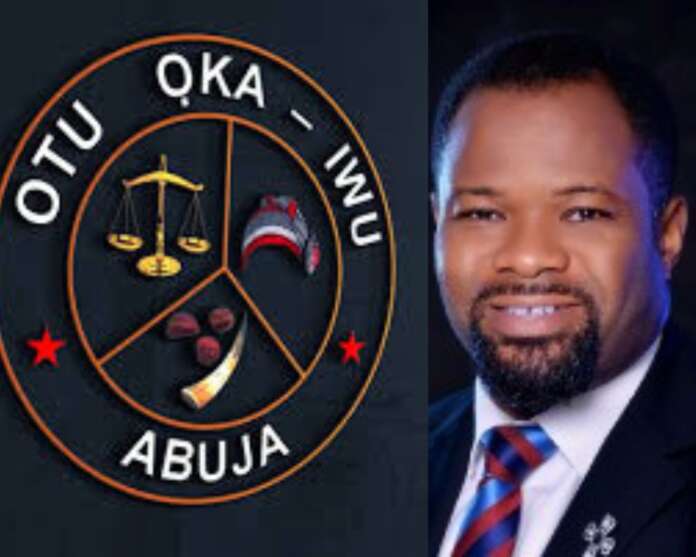
Otu Oka-Iwu Abuja maintains that the release of Nnamdi Kanu would serve as a gesture of goodwill, signalling the Federal Government’s willingness to engage in meaningful dialogue with Igbo leaders and stakeholders. Nigeria’s strength lies in its diversity, and addressing the concerns of marginalized groups, including Ndi Igbo, is essential for fostering national unity. Releasing Nnamdi Kanu would demonstrate a commitment to inclusivity and equity, reinforcing the idea that every Nigerian has a stake in the nation’s future. Reconciliation is a cornerstone of sustainable peace. By releasing Nnamdi Kanu, the Federal Government would create an opportunity for healing and bridge-building, allowing all parties to move forward in a spirit of cooperation and mutual understanding.
While peace in the Southeast is not dependent on any one individual, the release of Nnamdi Kanu could help de-escalate tensions and create an environment conducive to constructive dialogue and development. The release of Nnamdi Kanu would reaffirm Nigeria’s commitment to the rule of law and due process. It would send a strong message that the government is willing to uphold justice and fairness, even in politically sensitive cases. This would enhance Nigeria’s reputation both domestically and internationally as a nation that respects human rights and democratic principles. The release of Nnamdi Kanu would set a precedent for resolving conflicts through dialogue rather than force. It would demonstrate that the government is willing to listen to the concerns of its citizens and address them through peaceful and inclusive means.
We, therefore, once again, urge the Federal Government to release Nnamdi Kanu not as a condition for peace but as a demonstration of its commitment to justice, equity, and reconciliation. At the same time, we call on Igbo leaders, elders, and stakeholders to continue championing peace and unity in the Southeast. Ndi Igbo have always been a people of peace, progress, and resilience, this is not just about one man; it is about the collective aspirations of a people and the promise of a united, prosperous Nigeria.
Sir. Chidiebere Nwabueze Udekwe, KSC PRESIDENT Otu Oka-iwu Abuja
Pope Francis has been eulogised as “a pope among the people, with an open heart towards everyone” during a funeral mass that brought 400,000 mourners to Rome, from pilgrims and refugees to powerful world leaders and royalty.
Francis, 88, died on Monday after a stroke and subsequent heart failure, setting into motion a series of centuries-old rituals and a huge, meticulously planned logistical and security operation not seen in Italy since the funeral of John Paul II in April 2005.
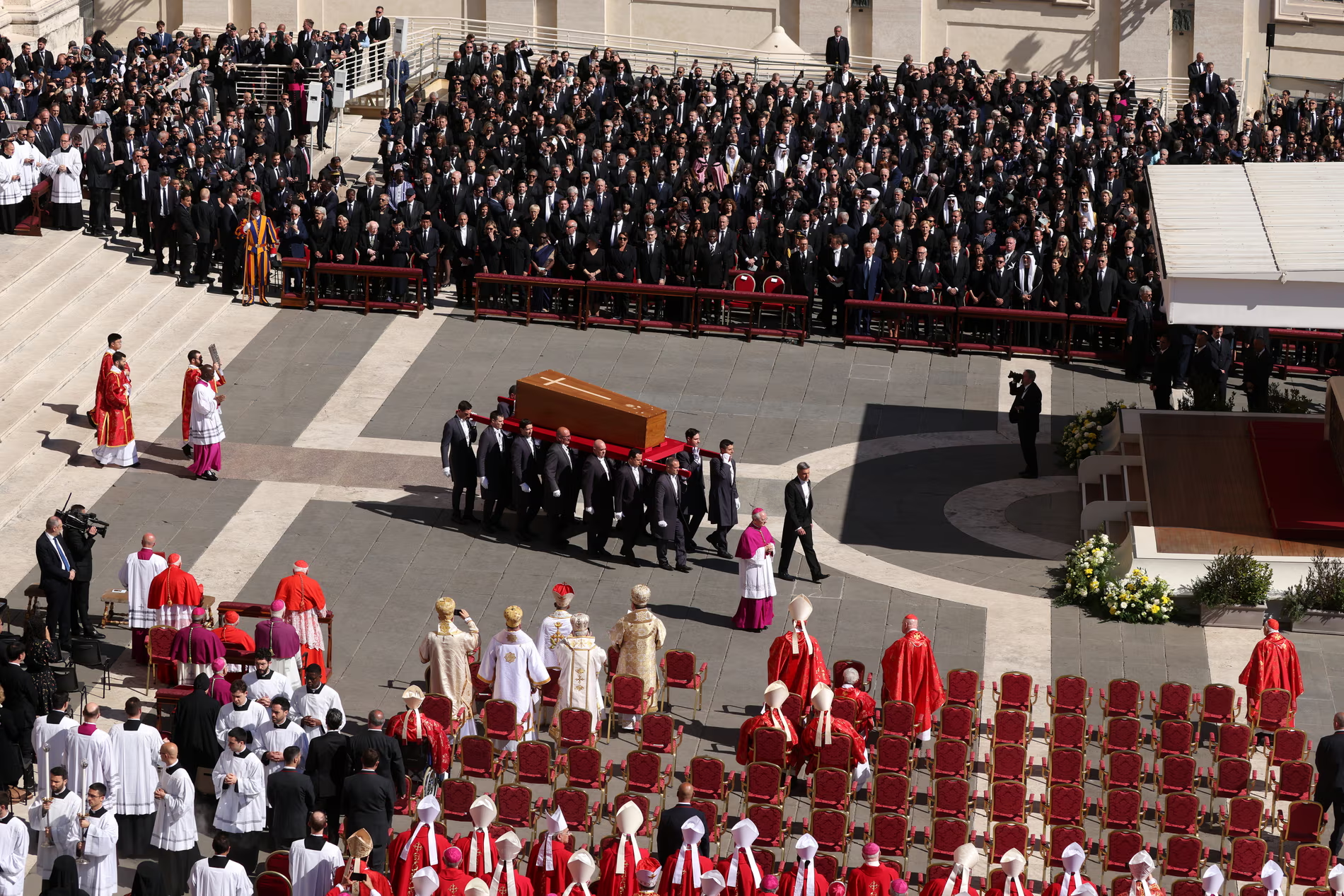
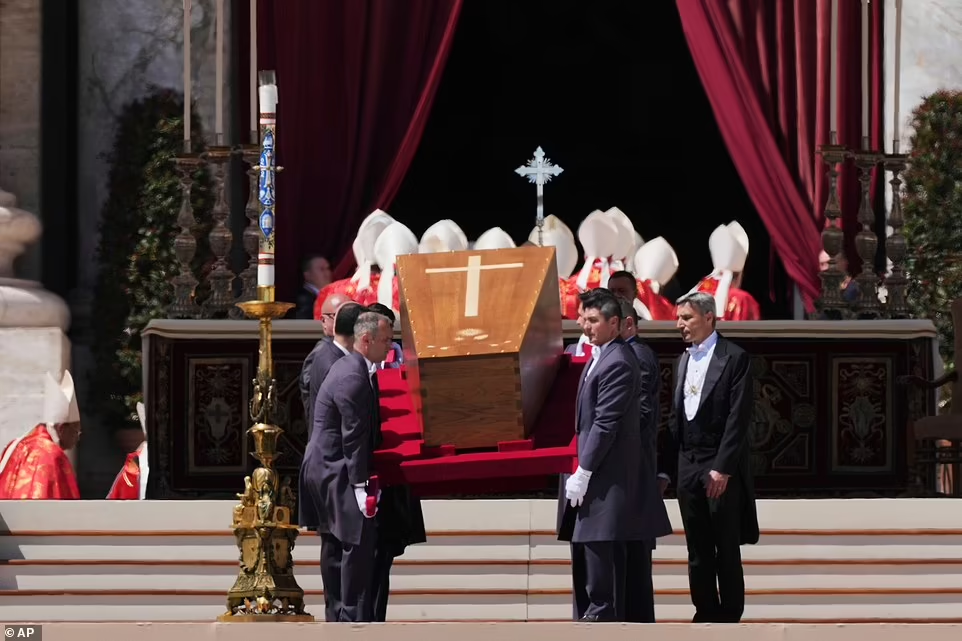
The crowd erupted into applause as the late pontiff’s wooden coffin was carried from the altar of the 16th-century St Peter’s Basilica, where it had lain in state for three days, by 14 white-gloved pallbearers and into the square for the open-air ceremony.
Applause also rang out when the Italian cardinal Giovanni Battista Re, who presided over the funeral mass, spoke of Francis’s care for immigrants, his constant pleas for peace, the need for negotiations to end wars and the importance of the climate.
Under a blue sky, crowds stretched along Via della Conciliazione, the road connecting the Italian capital with the Vatican.
Among the pilgrims were Rosa Cirielli and her friend Pina Sanarico, who left their homes in Taranto, in southern Italy, at 5am, and managed to secure themselves a decent position in front of a huge TV screen. “When Pope Francis was alive, he gave us hope. Now we have this huge hole,” said Cirielli. “He left us during a very ugly period for the world. He was the only one who loudly called for peace.”
“The outpouring of affection that we have witnessed in recent days following his passing from this Earth into eternity tells us how much the profound pontificate of Pope Francis touched minds and hearts,” Battista Re said at the start of his eulogy.
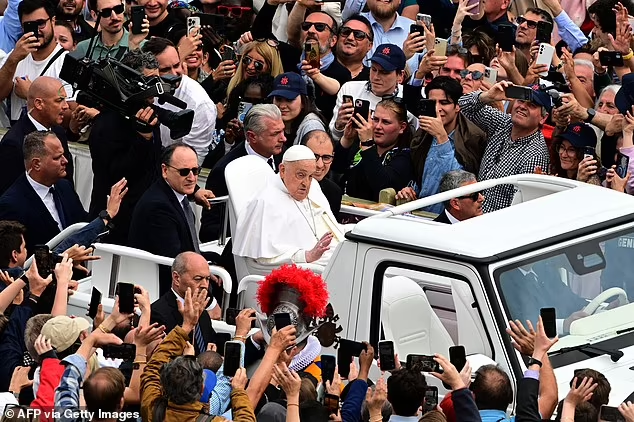
He recalled that the last image many people would have had of Francis was of him delivering what would become his final blessing on Easter Sunday, and saluting from the popemobile in the same piazza where his funeral was celebrated.
Di Battista described Francis’s charisma of “welcome and listening”, adding that the guiding thread of his mission was “the conviction that the church is home for all”.
There was more applause and cries of “Papa Francesco!” among the crowds lining the streets as the late pontiff made his final journey, aboard a specially adapted popemobile, from the Vatican towards his burial tomb at Santa Maria Maggiore Basilica in Rome’s Esquilino neighbourhood.
Flanked by police on motorbikes, the vehicle, which had been used on one of Francis’s trips overseas, crossed a bridge over Rome’s Tiber River, before slowly making its way along Via Vittorio Emmanele, passing Piazza Venezia, the Roman Forum, and the Colosseum before arriving at Santa Maria Maggiore, a basilica loved by Francis.
Francis was given a final sendoff by a group of people, including prisoners, refugees, transgender people and the homeless, who awaited his arrival on the steps of the fourth-century basilica.
Cardinals then performed the rite of burial, a private event attended by some of Francis’ relatives. His coffin was blessed by Cardinal Kevin Farrell, who is leading the church between papacies, before it was interred.
Francis is the first pontiff in more than a century not to be buried with great fanfare in the grottoes beneath St Peter’s Basilica. Instead, his coffin was entombed in a small niche that until now has been used to store candlestick holders.
As requested in his final testament, the tomb will not be decorated and will be inscribed only with his papal name in Latin: Franciscus. The public will be able to visit the tomb from Sunday.
As the funeral wraps up, speculation about who will succeed Francis will go into overdrive.
Francis, born in Argentina, was the first non-European pope for almost 13 centuries. During his 12-year papacy, the liberal late pontiff faced some fierce challenges from rightwing cardinals. Nine days of mourning will begin from Saturday, with a conclave – the secret election process to choose a new pope – therefore not expected to begin before 5 May.
There is no clear frontrunner, although Luis Antonio Tagle, a reformer from the Philippines, and Pietro Parolin, from Italy, are early favourites.
Virginio and his wife, Anna Maria, travelled to Rome from Naples for the funeral. They’re here to reflect on Francis but are also contemplating who will follow him.
“We hope the new pope continues along the same line as Francis,” said Anna Maria.
For a second time at the funeral of Pope Francis, a spontaneous applause broke out from the crowd. This time it was for Volodymyr Zelenskyy, the President of Ukraine.
A crowd outside St Peter’s, which the Vatican later said numbered 200,000, applauded as large screens showed Zelensky take his seat.
The first applause had erupted when the late pontiff’s wooden coffin was carried from the altar of the 16th-century St Peter’s Basilica, where it had lain in state for three days, by 14 white-gloved pallbearers and into the square for the open-air ceremony.
Following the response of Benue State government, after rights lawyer and law teacher, Prof. Chidi Odinkalu, came hard on them with a blistering post on X (formerly Twitter) criticising Governor Hyacinth Alia, over his handling of the ongoing violence in the state, Odinkalu has again replied that the government’s reaction “wld have been beneath laughable if we were not dealing with a life-and-death crisis. All I have done is advise Mr. Governor of Benue State to go back to the Seminary, where they will teach him that there are no #HausaFromMali.”
Odinkalu in an earlier post on X wrote:
“@ChidiOdinkalu: #OnThisDay of #PopeFuneral, Benue State Gov, Hyacinth Alia, a Catholic Priest, has no time to mourn the Pope. Instead, he’s sent out Tersoo Kula, his #Spox, to issue a cringe-worthy statement protesting that I said he, Mr. Catholic Governor, needs re-education. Here’s why….”
The comment immediately drew swif disapproval from the Benue State Government, which described Odinkalu’s reaction as “disturbingly insensitive” to the plight of victims suffering from terrorist attacks across the state.
Sir Tersoo Kula, MNIPR, Chief Press Secretary to Governor Alia, in an official statement, said it was unfortunate that Odinkalu chose to mock rather than empathize with the thousands of families displaced by incessant attacks by armed herders.
“It would be more rational if the focus remains on the plight of the people suffering these unprovoked terrorist attacks, rather than sneering at the Governor and his approaches,” Kula said.
Benue State, known as the “Food Basket of the Nation,” has endured repeated violent incursions that have left many dead and thousands homeless. According to Kula, Governor Alia has consistently named criminal elements among Fulani herders as the perpetrators of the violence, while stressing the importance of avoiding ethnic generalizations.
“Governor Alia, as a well-educated priest, understands that generalizing an entire ethnic group only deepens divisions and distracts from real solutions,” the statement noted.
Kula criticized Odinkalu’s remarks as a form of “performative critique” that ignores the dire humanitarian situation in the state.
“What truly matters now is solidarity, empathy, and working towards effective solutions for the displaced victims, not cynical commentary that detracts from the crisis,” Kula concluded.
The government’s response came after Odinkalu’s previous criticism of Governor Alia’s remarks about the recent violence in the state. On April 24, Odinkalu took to his official X handle, questioning the governor’s claim that the recent massacre in Benue was carried out by Hausa speakers from Mali. Odinkalu argued that the governor, given his background, should return to the seminary or seek re-education, as his assertions about the attackers were misguided.
Odinkalu pointed out that Malians speak languages such as Bambara, Songhai, and Malinke, and that the governor’s description of the attackers as “Hausa speakers with a French accent” was inconsistent, as Hausa speakers with such an accent would likely be from Niger, not Mali.
“Benue massacres are the handiwork of Hausa speakers from Mali? Malians speak Bambara, Songhai, Malinke. Hausa speakers with French accent should be from Niger, not Mali,” Odinkalu emphasized.
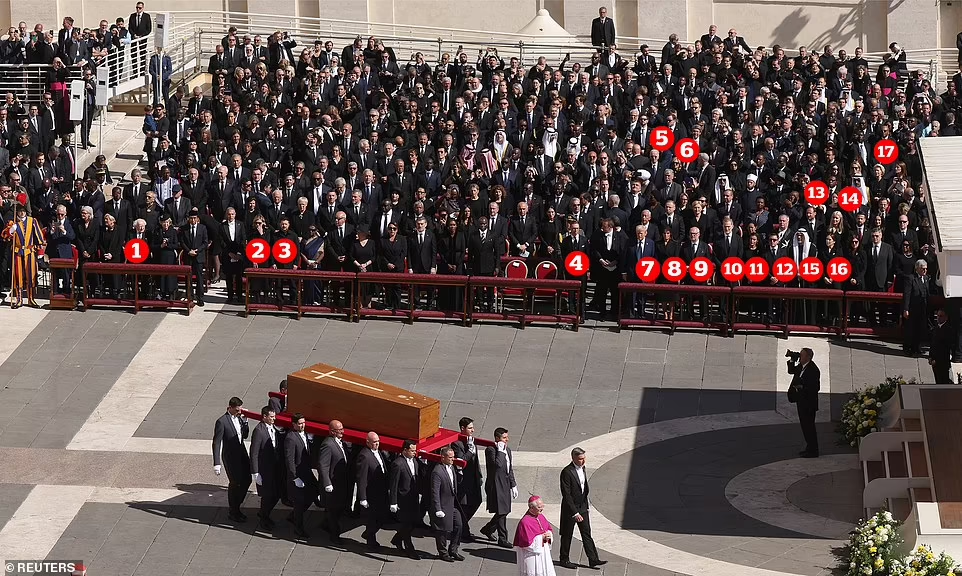
1. Michael D Higgins, President of Ireland; 2. Olena Zelenska, First Lady of Ukraine; 3. Volodymyr Zelensky, President of Ukraine; 4. Alexander Stubb, President of Finland; 5. Joe Biden, former US President; 6. Jill Biden, former First Lady ; 7. Donald J Trump, US President; 8. Melania Trump, US First Lady; 9. Alar Karis, President of Estonia ; 10. King Felipe VI of Spain; 11. Queen Letizia of Spain; 12. Daniel Noboa, President of Ecuador; 13. Haakon, Crown Prince of Norway; 14. Mette-Marit, Crown Princess of Norway; 15. Mohammed bin Zayed Al Nahyan, President of the UAE; 16. Queen Mary of Denmark ; 17. Ursula von der Leyen, President of the European Commission
The death of Pope Francis saw the world’s leaders and great dignitaries surrender themselves to a higher power – that of the Vatican’s funeral planners.
Leaders including Volodymyr Zelensky, Donald Trump, Sir Keir Starmer and Emmanuel Macron are scattered across a seating arrangement described as a ‘master plan’ in stage-managing ‘big egos’.
And while there had been speculation that Trump would be in the third row – which he would have likely seen as a snub – the leader of the free world found himself front and centre for the service.
Alongside Trump and First Lady Melania, other front-row dignitaries include President of Ireland Michael D Higgins, Ukraine‘s Volodymyr Zelensky – who made a last-minute trip to be there – and Argentina’s Javier Milei, given the top spot.
Pope Francis’ coffin – a humble wooden casket lined with zinc – is taken back inside St Peter’s Basilica following his requiem Mass
Milei found himself closest to the Pope’s humble wooden casket because Francis is of Argentine birth, born Jorge Mario Bergoglio in December 1936.
Next came Italy, as the Pope is also the bishop of Rome. Italian president Sergio Mattarella and his daughter Laura occupied the seats next to the Argentine leader. Immediately behind him sat Georgia Meloni, the Prime Minister of Italy.
Standing shoulder to shoulder with the Italian president Mr Mattarella, meanwhile, were the leaders of countries such as Albania and Angola.
However, Zelensky appears to have been given special treatment to ensure he was given a front row seat – as his place should have been further back.
Prince William, on the other hand, found himself standing shoulder-to-shoulder with Olaf Scholz, the chancellor of Germany two rows behind Javier Milei and his sister Karina Milei, Argentina’s General Secretary of the Presidency.
The requiem mass lasted almost two hours, and saw prayers read in several languages to the audience of thousands from around the world
William attended on behalf of his father of King Charles III, the United Kingdom’s head of state.
As for Sir Keir, he had to settle for a number of rows back alongside wife Victoria as a head of a government rather than the head of a state – as did the likes of Ursula von der Leyen, president of the European Commission.
The idea that the UK and other countries have been snubbed, or sent further down the pecking order, however, doesn’t quite ring true – as Vatican planners have tried to wield diplomacy in determining the pecking order.
The Vatican seating plan for dignitaries – who are sitting directly across from senior clergy – prioritises reigning monarchs and heads of state over heads of Government: presidents, kings and queens come before prime ministers.
But even then, there is an order beyond priority. Despite designating Latin and Italian as its official languages, the Vatican has arranged its seating plan in French alphabetical order.
This was chosen as, thanks to France’s historical power across the continent, it is still considered the language of European diplomacy.
So the United States becomes les États-Unis; Germany becomes Allemagne, pushing it towards the front of the queue; and the United Kingdom is shoved further back under Royaume-Uni.
This explains why Trump found himself front and centre among around 50 heads of state, and why heads of governments – like Sir Keir – found themselves further back in what may in other circumstances be considered the ‘cheap seats’.
Next to Milei, Joan-Enric Vives i Sicilia, a Catholic prelate and co-Prince of the tiny landlocked nation of Andorra, is standing shoulder to shoulder with Bajram Begaj, the president of Albania, and João Lourenço, president of Angola.
What it does not explain, however, is why President Zelensky found himself in the front row despite Ukraine remaining the same in French.
He and his wife were sandwiched somewhere between France and Ireland in what appeared to be a flouting of the rules.
Asked for comment by The Telegraph, the Vatican did not deny that this was the case.
Spokesperson Matteo Bruni said: ‘I believe they filled a vacant place.’
The late Pope’s position on Ukraine has been criticised prior to his death, as he had suggested the country take the ‘courage of the white flag’ and sue for peace with Russia, a standpoint rejected by Ukrainians. Francis had also stopped short of condemning Vladimir Putin as the aggressor in the conflict.
There was no special treatment for Britain, however. Sir Keir, Lady Victoria and Foreign Secretary David Lammy have found themselves squashed in between dignitaries from Qatar and Serbia.
Cardinal Vincent Nichols, the leader of Catholics in England and Wales, said the funeral organisers are well-used to dealing with the sensitivities of such big events.
In an interview with the PA news agency in Rome prior to the funeral, he said the funeral will be ‘without a doubt another masterpiece of stage management when you consider those state leaders who have high opinions of their importance’.
He added: ‘In the past, I’ve seen it here over and over again that the combination of Rome and the Holy See, they actually are geniuses at dealing with these big events.
‘I think they’ve been doing it since the emperors ruled Rome – that they know how to deal with big egos.
‘And I think every leader of a nation that comes here on Saturday will go home reasonably content.’
Cardinal Nichols will take part in his first conclave to elect a new pope in the coming weeks. Today is the first of nine days of mourning, which must pass before any talk of a new pontiff can begin.
Other VIPs who wished to attend were found space, such as ex-US President – and lifelong Catholic – Joe Biden, who arrived with wife Jill. They were sat around five rows behind Donald Trump and his wife Melania.
Vatican spokesman Matteo Bruni said on Friday that no distinction was made between Catholic and non-Catholic royalty for the seating order.
The gathering of world leaders has already prompted rumblings of further diplomacy beyond that conducted by Vatican seat planners this week.
Further talks are thought to be in the works after the pair’s hot-headed White House spat in February – as the pair try to hammer out a deal to bring an end to Russia’s three-year invasion of Ukraine.
The pair were also seen chatting with Emmanuel Macron and Keir Starmer.
Hundreds of thousands of people packed out St Peter’s Square and the streets of Rome for Francis’ open-air service, which saw a requiem mass held in Vatican City before the late pontiff’s coffin was driven across the Italian capital to its final resting place.
He lay in state in St Peter’s Basilica for three days, with some 250,000 mourners passing him day and night, before his coffin was formally sealed in private on Friday, with his face covered by a simple white shroud.
Francis was ‘a pope among the people, with an open heart’, who strove for a more compassionate, open-minded Catholic Church, Cardinal Giovanni Battista Re said in his funeral homily.
There was applause as he hailed the pope’s ‘conviction that the Church is a home for all, a home with its doors always open’.
It was ultimately prisoners and migrants who ushered the pope into the St. Mary Major Basilica where he is set to be buried, reflecting his priorities as head of the Catholic Church.
It is the first time in more than 100 years that a Pope has not been buried at the Vatican – but it was not the Pope’s only break with convention.
His casket was a simple wooden casket, lined with zinc and emblazoned with a cross, a far cry from the traditional combination of three coffins made of cypress wood, lead and oak.
His tomb will be similarly humble: an alcove in the church that was previously used to store candlesticks. It will be labelled with just his papal name in Latin: Franciscus.
In his final hours, he had joined crowds for an Easter Sunday blessing at St Peter’s Square. The pontiff had only recently been discharged from hospital, after five weeks of treatment for an infection that led to double pneumonia.
Ahead of the funeral, thousands of people made their way along Via della Conciliazione – the grand thoroughfare that leads to the Vatican – singing hymns, praying and swapping stories.
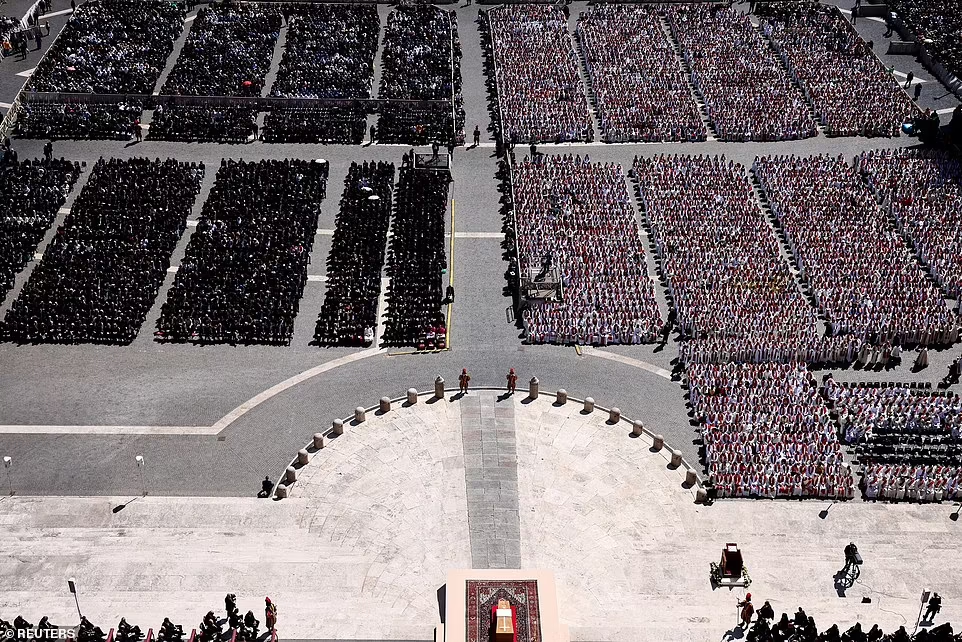
Some camped out in the streets in sleeping bags and foil blankets to ensure they secured their spot in St Peter’s Square. Vatican officials sealed the entrances when capacity was hit – and later said around 250,000 people were present in and around the square.
‘I’m touched by how many people are here. It’s beautiful to see all these nationalities together,’ said Jeremie Metais, 29, from Grenoble, France, ahead of the ceremony.
‘It’s a bit like the centre of the world today.’
‘We want to say goodbye because he (was a) living saint, very humble and simple,’ said Mary James, a Franciscan nun, who had stayed up overnight to guarantee a good place.
‘You can feel a lot of energy, yes, a little bit of despair because we are tired, but ultimately we want to come and say ‘thank you’, thanks to Pope Francis for all he did for his church,’ said Eduardo Valencia, visiting from Mexico.
The massive crowd was largely silent, watching proceedings on several large screens around the square.
Applause then rang out at the start of the ceremony as 14 white-gloved pallbearers carried the coffin, inlaid with a large cross, out of St. Peter’s Basilica and into the square.
The pope’s casket was placed on a carpet in front of the altar, with the book of gospels laid on top, as the Vatican choirs sang.
Choirs sang Latin hymns and prayers were recited in various languages, including Italian, Spanish, Chinese, Portuguese and Arabic, reflecting the global reach of the 1.4-billion-member Roman Catholic Church.
The crowd broke into applause when Italian Cardinal Giovanni Battista Re spoke of Francis’ care for immigrants, his constant pleas for peace, the need for negotiations to end wars and the importance of the climate.
‘Rich in human warmth and deeply sensitive to today’s challenges, Pope Francis truly shared the anxieties, sufferings and hopes of this time,’ Re said.
‘Pope Francis incessantly raised his voice imploring peace and calling for reason and honest negotiation to find possible solutions.
‘War, he said, results in the death of people and the destruction of homes, hospitals and schools. War always leaves the world worse than it was before: it is always a painful and tragic defeat for everyone.
”Build bridges, not walls’ was an exhortation he repeated many times.’
Speaking to the Pope’s ability to connect with people, Cardinal Battista Re added: ‘He had great spontaneity and an informal way of addressing everyone, even those far from the Church.
‘Rich in human warmth and deeply sensitive to today’s challenges, Pope Francis truly shared the anxieties, sufferings and hopes of this time.
‘He gave of himself by comforting and encouraging us with a message capable of reaching people’s hearts in a direct and immediate way.’
He recalled how the Pope, in what would become his final public act, insisted on blessing the crowds on Easter Sunday despite his ailing healh.
‘The final image we have of him, which will remain etched in our memory, is that of last Sunday, Easter Sunday, when Pope Francis, despite his serious health problems, wanted to give us his blessing from the balcony of St Peter’s Basilica,’ the Cardinal said.
Crowds at the funeral applauded as the pontiff’s coffin both emerged from and then was brought back into the basilica after the open-air mass.
Some of those who travelled from the UK and Ireland told of the importance of being present in-person to celebrate Francis’s life and reign as pope.
Phil Callaghan, from Manchester, said he booked flights as soon as the Pope died, describing the crowds gathered in the city as ‘astounding’ and that ‘it’s shown just how much Pope Francis meant to people’.
Speaking to the PA news agency in Rome, friend and fellow Mancunian Kate Wilkinson said it had been ‘an incredible opportunity to witness history’, describing it as ‘the most amazing moment of my life’.
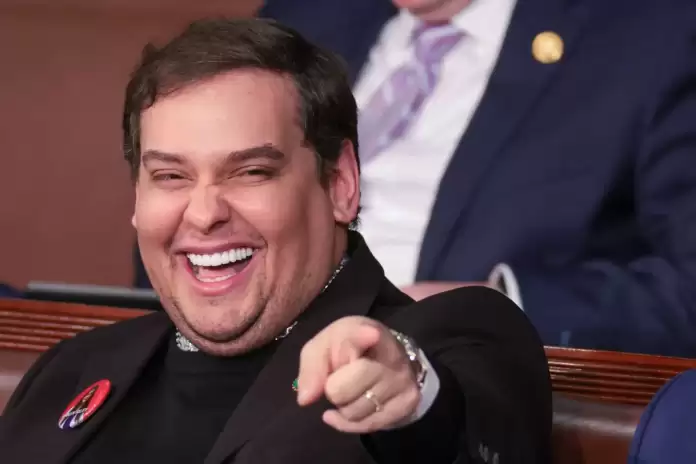
George Santos became a punch line to an unfortunate joke before his career on Capitol Hill even began. In December 2022, just weeks before he was sworn in as a member of Congress, the New York Republican was exposed as a prolific liar, having created a detailed personal narrative that bore no resemblance to reality.
But it wasn’t long before Santos’ troubles grew considerably worse: The GOP politician wasn’t just a fabulist, he was also a criminal. Five months into his congressional career, the Justice Department charged the then-congressman with seven counts of wire fraud, three counts of money laundering, one count of theft of public funds, and two counts of making materially false statements to the House of Representatives. Soon after, prosecutors filed additional charges against Santos, accusing him of, among other things, identity theft and charging a supporter’s credit card and then transferring the money to his personal bank account.
He was ultimately expelled from Congress — a rarity in American history — and though Santos initially pleaded not guilty and professed his innocence, the case against him ultimately proved overwhelming. Last summer, as part of a plea deal with prosecutors, the former congressman pleaded guilty to two counts — wire fraud and aggravated identity theft — and agreed to pay restitution.
A federal judge in New York sentenced former Rep. George Santos to over seven years in prison Friday. Prosecutors had urged U.S. District Judge Joanna Seybert to throw the book at Santos, the disgraced former Republican congressman, to “reflect the seriousness of Santos’s unparalleled crimes.”
The sentence was entirely in line with expectations. Indeed, the night before he was sentenced, Santos told The New York Times, “Right now, my expectation is I’m going to prison for 87 months. I’m totally resigned.”
The developments would appear to bring this sad saga to an end, though there’s still some question about a possible presidential pardon. Earlier this month, for example, Santos responded to a question about whether he planned to ask Donald Trump for a pardon, and the disgraced former lawmaker said, “You bet your sweet a– I would.”
Indeed, the night before sentencing, Santos appeared on a conservative media outlet called OANN, where former Republican Rep. Matt Gaetz asked about the prospect of a presidential rescue.
“I haven’t petitioned the president for a pardon,” Santos said. “A lot of people keep asking me this, but obviously, if the president were to extend one, I’d be humbly grateful, because he’d be taking a major weight off my back.”
He added, “But again, I hope — hope’s the last to die — like, I can hope for many things, and I do hope that hopefully he takes a look at me, too.”
Trump hasn’t made any public comments of late about Santos’ scandals, though as we were reminded again this week, the incumbent president has repeatedly come to the aid of former Republican congressmen convicted of corruption.
Each morning Pope Francis awoke before dawn in his modest accommodation at Casa Santa Marta, the Vatican guesthouse. As day broke, Pope Francis prayed and meditated before delivering a homily at morning Mass.
By midday the pope had undertaken any number of duties, preferring to manage his schedule personally. Phone calls to colleagues and friends, meetings, and other appointments preceded lunch, after which he took a siesta.
His afternoons were often spent visiting prisons and juvenile detention centers, consulting with ambassadors to the papacy, or making appointments. Once a week he received a soccer update from a member of the Swiss Guard, a necessity since the pope stopped watching television in 1990. Though Pope Francis may have given up television, he was an active lover of the arts. He enjoyed opera, classical music, and baroque artwork, and he identified Federico Fellini’s La Strada as his favorite film.
A few times a month, the pope led Papal Mass and hosted regular audiences in St. Peter’s Square or the Basilica (and sometimes both on busy days), which allowed tens of thousands of people to be in the pope’s presence. Often these individuals were from all over the world and wept and cheered when they caught a glimpse of the head of the Roman Catholic Church.
His evening meal was again taken among his fellow residents at the Casa Santa Marta. True to form, he never dined alone. Once back in his austere domicile, Pope Francis ended his day as it began—quietly. Each night, the pontiff read before drifting off to sleep.
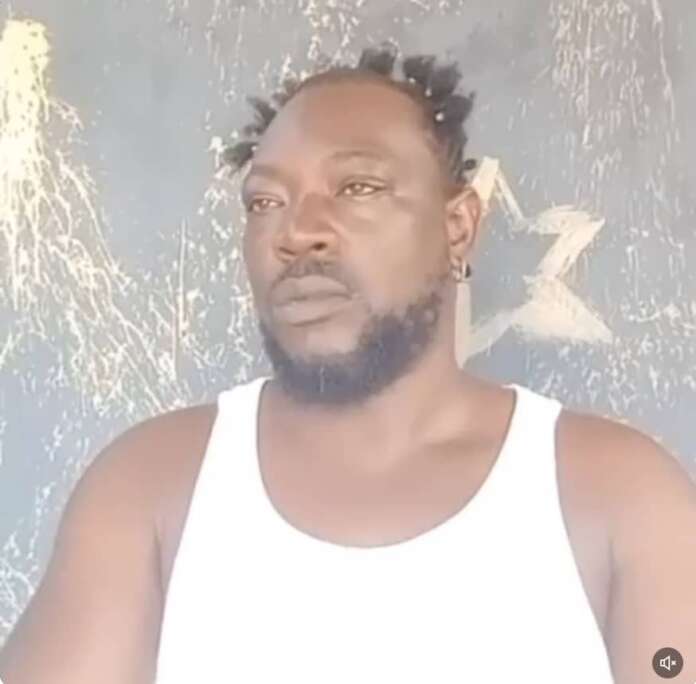
A popular TikToker known as ‘Disturbing’, who was involved in the ‘JUSTICE FOR MOHBAD’ movement, lived up to his name by practically dying disturbingly during a live stream.
A video making the rounds on social media shows the moment he suffered what looks like a seizure before passing away in front of the camera.
Investigative journalist Temilola Sobola shared the viral footage on Instagram.
“A popular TikToker known as Disturbing, who was also into JUSTICE FOR MOHBAD passed away some hours ago while he was on a live video,” he captioned the post.
Reacting to the incident, some social media users alleged that Disturbing had been seen vocally cursing individuals linked to the late singer Mohbad’s case, including Mohbad’s mother, widow, his brother Adura, and Liam, during his live broadcast.
The cause of his death cannot be ascertained at the time of filing this report, however, some people suggested that it may be a result of substance abuse or a heart attack.
The deceased is survived by his mother, a pregnant wife and children.
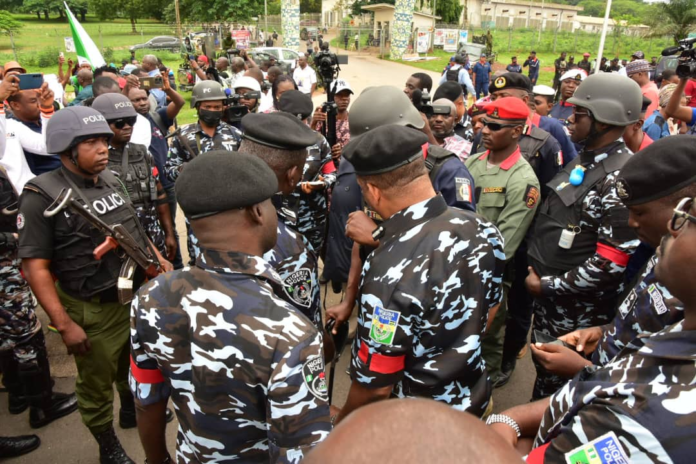
Personnel of the Nigerian Police Force from Courses 27, 28, and 29 have been promoted ahead of their seniors in Course 26, prompting anger and frustration among the affected officers.
According to Sahara Reporters, a police wireless message dated April 23, 2025, from the Force Secretary in Abuja and circulated to state police commissioners and other relevant offices, confirmed the latest promotions, notably of the 2022 Specialist cadre.
However, officers from the 2021 General Duty batch (Course 26) said they were unjustly sidelined.
“Instead of promoting General Duty 2021, they skipped us and promoted Specialist 2022, who are far junior to us,” one of the aggrieved officers told SaharaReporters.
Sources within the force expressed dismay that Course 26 officers, who should logically be next in line for promotion to Chief Superintendent of Police (CSP), were overlooked.
“They’re promoting 2022 specialists ahead of us — SP General Duty 2021 — which is unacceptable,” another officer said.
The wireless message with reference number CB:4001/FS/FHQ/ABJ/VOL.12/88, reads, “Order and directives x grateful as a matter of urgency direct all SPS specialist promoted on or before 12/05/2022 X DSPS Specialist promoted on or before 12/05/2022 serving yours X to forward mine duly completed aper forms X for the periods of 2022 X 2023 X 2024 X officers are to clearly indicate their AP numbers on top of the APER forms X which should be received mine on or before Monday 28/04/2025 unfailingly X Treat as very urgent please.”
Our site uses cookies. By clicking “Accept All Cookies”, you direct Law and Society Magazine to store cookies on your device and disclose information in accordance with our Cookie Statement: cookie policyACCEPTREJECT
Privacy & Cookies Policy
Privacy Overview
This website uses cookies to improve your experience while you navigate through the website. Out of these cookies, the cookies that are categorized as necessary are stored on your browser as they are essential for the working of basic functionalities of the website. We also use third-party cookies that help us analyze and understand how you use this website. These cookies will be stored in your browser only with your consent. You also have the option to opt-out of these cookies. But opting out of some of these cookies may have an effect on your browsing experience.
Necessary cookies are absolutely essential for the website to function properly. This category only includes cookies that ensures basic functionalities and security features of the website. These cookies do not store any personal information.
Any cookies that may not be particularly necessary for the website to function and is used specifically to collect user personal data via analytics, ads, other embedded contents are termed as non-necessary cookies. It is mandatory to procure user consent prior to running these cookies on your website.