Home Blog Page 368

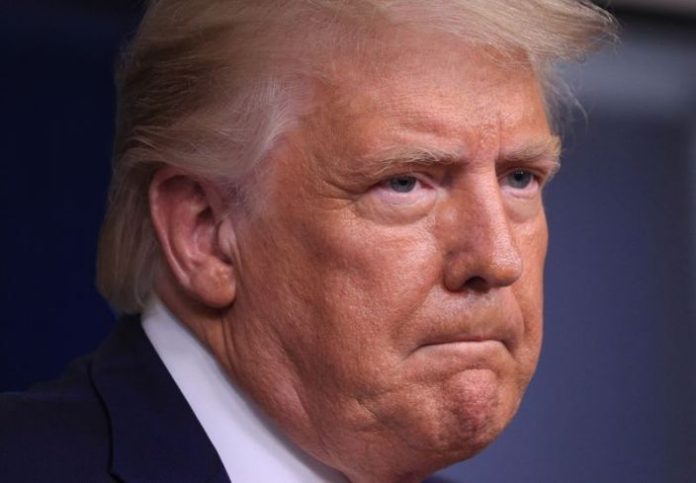
Did you know that Trump refused to give Biden Air Force One ride to Pope’s funeral?

Not even the death of Pope Francis could bring President Donald Trump to make nice and ride with former President Joe Biden.

Sitting President George W. Bush rode with former presidents George H.W. Bush and Bill Clinton on Air Force One to the funeral Mass of Pope John Paul II’s in 2005. Yet when Trump was told that Biden would also be attending the Saturday ceremony, he didn’t give his political rival much thought.

“Oh he is? I didn’t know,” Trump told reporters aboard Air Force One on Friday, The Daily Mail reported. Trump said that a meeting with Biden during the trip to Italy was “not high on my list.”

“It’s really not,” he added.

The MAGA president doubled down on that sentiment during the ceremony as he sat with First Lady Melania Trump and ignored Biden and former First Lady Jill Biden—despite them clearly being within his line of sight, The Daily Mail reported.

Yet even after his sweeping second election win, Trump has kept Biden front and center as a scapegoat. The New York Times reported that Trump mentioned Biden more than 300 times in the first 50 days of his presidency, regularly blaming him for manufactured chaos at the border and attacking him as “the worst president in American history.”

However, Trump did make time to sit down with political frenemy Ukraine President Volodymyr Zelenskyy, reported NYT.

“They are very close to a deal,” Trump wrote on Truth Social on Friday as he landed in Rome. “The two sides should now meet, at very high levels, to ‘finish it off.’”

Yahoo

Meta faces Ghana lawsuits over impact of extreme content on moderators

Meta is facing a second set of lawsuits in Africa over the psychological distress experienced by content moderators employed to take down disturbing social media content, including depictions of murders, extreme violence and child sexual abuse.

According to The Guardian UK, lawyers are gearing up for court action against a company contracted by Meta, which owns Facebook and Instagram, after meeting moderators at a facility in Ghana that is understood to employ about 150 people.

Moderators working for Majorel in Accra claim they have suffered from depression, anxiety, insomnia and substance abuse as a direct consequence of the work they do checking extreme content.

The allegedly gruelling conditions endured by workers in Ghana are revealed in a joint investigation by the Guardian and the Bureau of Investigative Journalism.

It comes after more than 140 Facebook content moderators in Kenya were diagnosed with severe post-traumatic stress disorder caused by exposure to graphic social media content.

The workers in Kenya were employed by Samasource, an outsourcing company that carries out content moderation for Meta using workers from across Africa. Majorel, the company at the centre of the allegations in Ghana, is owned by the French multinational Teleperformance.

One man, who cannot be named for legal reasons, said he attempted suicide owing to the nature of his work. His claims his contract was subsequently terminated and he has returned to his home country.

Facebook and other large social media companies employ armies of content moderators, often based in the poorest parts of the world, to remove posts that breach their community standards and to train AI systems to do the same.

Moderators are required to review distressing and often brutal pictures and videos to establish whether they should be removed from Meta’s platforms. According to workers in Ghana, they have seen videos of a person being skinned alive and a woman being beheaded.

The moderators claim mental health care offered by the firm was unhelpful, was not delivered by medical doctors, and that personal disclosures made by staff about the effects of their work were circulated among managers.

Teleperformance disputed this, saying it employed licensed mental health professionals who are registered with the local regulatory body and hold a master’s degree in psychology, counselling, or another mental health field.

The legal case is being prepared by a UK-based nonprofit, Foxglove. It would be the second case brought by content moderators in Africa, after Samasource workers in Kenya sued in 2023.

Foxglove said it was “urgently investigating these shocking abuses of workers” with a view to using “every tool at our disposal, including potential legal action” to improve working conditions.

It is working with a Ghanaian firm, Agency Seven Seven, on preparing two possible lawsuits. One would allege psychological harms and could involve a group of moderators, and the other unfair dismissal, involving the moderator from east Africa whose contract was terminated after he attempted suicide.

Foxglove’s co-executive director Martha Dark said: “These are the worst conditions I have seen in six years of working with social media content moderators around the world.

“In Ghana, Meta is displaying nothing short of a complete disregard for the humanity of its key safety workers upon whom all its profits rely: content moderators. They are treated as objects who can be used up, burned out and replaced with no care whatsoever for the permanent damage to their mental and physical wellbeing.”

Dark said basic wages for content moderators in Accra were below living costs, incentivising them to work overtime, for which pay is understood to be even lower than normal rates. Moderators faced deductions from their pay for failing to meet performance targets, she added.

Contracts seen by the Guardian show that the base wage starts at about 1,300 Ghanaian cedis a month – just over £64. This is supplemented by a system of performance-related bonuses, the upper range of which amounts to about 4,900 cedis (£243) a month, significantly less than the estimated cost of living in Accra.

A Teleperformance spokesperson said content moderators enjoyed “strong pay and benefits, including monthly pay that is roughly 10 times the country’s minimum wage for domestic moderators, and 16 times the minimum wage for those who have relocated from other countries, when including project allowance, transportation allowance, language premium and more – all of which are automatically paid to the moderator and are not performance-based”.


Foxglove’s researcher Michaela Chen said she had seen photos of moderators’ living quarters, in which they were “crammed five to a flat, two to a room”. She said there appeared to be a culture of secrecy, including surveillance from managers, who follow workers into the toilets during breaks.

This extends to moderators’ work for Meta. She said: “Workers spend all day working on Meta’s platforms, moderating to Meta’s standards and using Meta’s systems, but at the same time, moderators are told constantly: ‘You do not work for Meta,’ and are forbidden from telling anyone they do.”

Teleperformance said moderators were “offered housing in … one of the most upscale and well-known residential and commercial neighbourhoods in Accra”.

The spokesperson described the housing as “safe, with strong security” and having air conditioning, recreation facilities, including gyms and pools.

Carla Olympio, a partner at Agency Seven Seven, said she believed a personal injury case could succeed in Ghana’s courts and would set a precedent establishing that worker protections extend to psychological harms as well as physical injury.

“[There is] currently a gap in our laws because they haven’t necessarily caught up with the new developments that cover technology and virtual work,” she said.

Rosa Curling, a co-executive director at Foxglove, said it was seeking for the court to “order immediate changes to the content moderators’ workplace”, including proper safeguards and psychiatric care.

A spokesperson for Teleperformance said: “At TP in Ghana, we take our content moderation work seriously. From the very beginning during the interview process, within the employee contract and through employee training and resiliency testing, we are fully transparent with our prospective moderators regarding the content they might see during their work to help keep the internet safe for our communities. We have robust people management systems and workplace practices, including a robust wellbeing programme staffed by fully licensed psychologists to support our content moderators throughout their content moderation journey.”

Meta said the companies it worked with were “contractually obliged to pay their employees who review content on Facebook and Instagram above the industry standard in the markets they operate”.

The tech company said it took “the support of content reviewers seriously”, including detailing expectations around counselling, training and other support in contracts with the companies it outsourced.

It said all content moderators signed client confidentiality agreements because they were dealing with user information which needed to be protected and for their own safety, but moderators may discuss their jobs with doctors and counsellors, and some aspects with family members.

The Guardian UK

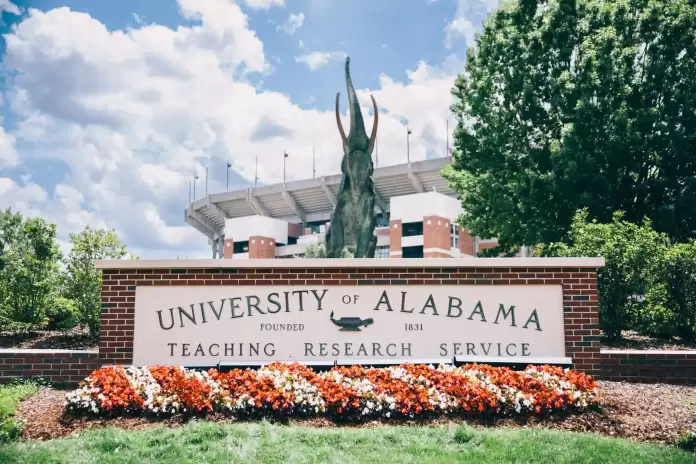
University of Alabama faces civil rights complaint for offering ‘discriminatory’ black-only scholarships — ‘UA is violating Title VI’

The University of Alabama (UA) was at the receiving end of a Friday civil rights complaint with the U.S. Department of Education’s Office for Civil Rights (OCR) for allegedly offering a race-based scholarship program.

The lawsuit stems from UA’s “Norton-Textra Endowed Scholarship for Minority Students in English,” which is awarded to “full-time African-American students pursuing degrees in English in the College of Arts and Sciences.”

According to the Equal Protection Project (EPP), this scholarship violates Title VI of the Civil Rights Act of 1964 and the Equal Protection Clause of the Fourteenth Amendment of the U.S. Constitution.

“Regardless of UA’s reasons for offering, promoting, and administering such a discriminatory scholarship, UA is violating Title VI by doing so,” the complaint reads. “It does not matter if the recipient of federal funding discriminates in order to advance a benign ‘intention’ or ‘motivation.'” 

It continues, “Because the discrimination outlined above is presumptively illegal, and since UA cannot show any compelling government justification for it, the fact that it conditions eligibility for a scholarship on race, color, and national origin violates federal civil rights statutes and constitutional equal protection guarantees.”

According to its website, EPP is “devoted to the fair treatment of all persons without regard to race or ethnicity. Our guiding principle is that there is no ‘good’ form of racism. The remedy for racism never is more racism.”

In March, the OCR initially stated it was investigating UA for “alleged impermissible race-based scholarships and race-based segregation.” However, it later changed its release, stating that it was, in fact, the University of Alabama at Birmingham (UAB). Now, according to EPP, the OCR is investigating the complaint against UA.

1819news

In Defense of Nigerian Bar Association retention of Rivers State’s N300-Million NBA-AGC 2025 donation

By Sylvester Udemezue

  1. A group known as the Public Interest Lawyers League (PILL) recently called on the Nigerian Bar Association (NBA) to refund “the controversial N300 million donation” it received from the Rivers State Government under Governor Siminalayi Fubara. Speaking at a press conference in Abuja on 24 April 2025, Dr. Abdul Mahmud, President of PILL, argued that a refund was necessary to restore public trust and safeguard the moral authority of the Bar. According to Dr. Mahmud, the non-disclosure of the donation, only revealed through a statement by the Sole Administrator of Rivers State, raised serious concerns about transparency and ethical conduct within the NBA. He insisted that this issue “is not just about money; it is about principle, accountability, and the integrity of an institution that has long positioned itself as a guardian of the rule of law.” In addition to calling for a refund, PILL demanded the resignation of Mr. Afam Osigwe, SAN (NBA President), and Mr. Emeka Obegolu, SAN (Chairman of the NBA-AGC Planning Committee), claiming such actions were necessary to rebuild public confidence in the Association.
  2. With due respect, these calls are legally unsound, intellectually unreflective, and grossly misconceived.
  3. First, under settled principles of law, a gift is a voluntary transfer of property or money from a donor to a donee without expectation of something in return. Once delivered and accepted, ownership passes immediately and irrevocably to the donee. Nigerian law, like common law, recognizes that a completed gift cannot be revoked except where fraud, duress, mistake, or illegality is proven. No such vitiating factors exist in the case of the N300 million donation. The Rivers State Government made a voluntary, unconditional donation to the NBA for the purpose of supporting the planning of the 2025 Annual General Conference (AGC). No enforceable conditions were attached; no strings were left hanging.
  4. Second, the statement accompanying the donation, that the funds were intended to support the AGC, demonstrates an immediate and purposive intent. This triggers the doctrine of equitable estoppel, which prevents a donor from reneging on a voluntary commitment that has been relied upon to the receiving party’s detriment. Having accepted the donation and commenced conference planning activities based on it, the NBA is insulated against any belated claims or demands for a refund. Courts, guided by the maxim that equity does not aid a volunteer, will not intervene to undo a completed gift merely because the donor has had a change of heart.
  5. Third, the NBA is under no legal obligation to announce publicly every donation it receives during conference preparations. The NBA-AGC Planning Committee, empowered by the NBA’s National Executive Council (NEC), is authorized to raise and deploy funds for conference activities. After the conference, the Committee submits a comprehensive report detailing all receipts, expenditures, and sponsorships to the NEC. This long-standing practice safeguards transparency and accountability, and there is no evidence of deviation in the present circumstances.
  6. Public policy strongly favors certainty and finality in voluntary transfers. Permitting donors to reclaim unconditional gifts after the fact would create legal uncertainty, undermine trust in charitable and professional transactions, and destabilize institutional integrity. The law is designed to protect not only the expectations of the donee but also the sanctity of properly concluded transactions.
  7. Furthermore, the principle of freedom of contract and donation upholds the autonomy of individuals and entities to make voluntary transfers of their property. To compel a return of the N300 million donation in the absence of fraud, coercion, or mistake would violate Rivers State’s own exercise of free will and autonomy at the time the donation was made.
  8. The absence of any evidence of fraud, duress, undue influence, or mistake further cements the NBA’s right to retain the donation. The NBA obtained the funds properly, for a legitimate purpose, and acted responsibly in its application. There is no legal or moral basis for demanding a refund.
  9. Whether the relocation of the AGC was justified is a separate matter entirely, one I propose to address at a later date. However, with respect to the N300 million donation, there is no ambiguity: the NBA is under neither legal nor moral obligation to refund what was lawfully and unconditionally given.
  10. The REALITY, therefore, is that those calling for a refund are either motivated by political considerations or are misinformed about the law. Their demands are grossly misconceived and deserve to be firmly rejected by the NBA and ignored by all right-thinking members of society.

Respectfully,
§¢µð𝓮̂𝓶𝓮̂𝔃µ𝓮̂
Sylvester Udemezue (udems)
Lawyer, Law Teacher, and Proctor, The Reality Ministry of Truth, Law and Justice (TRM) (A Nonaligned, Nonprofit Public Interest Law Advocacy Group)
08109024556.
[email protected]
(26 April 2025)

I’d Rather Have Jesus than Silver or Gold-Femi Falana, SAN as an Example of a True Activist who Prioritises Consistency and Adherence to Principles Over Profits and Personal Friendships With Tinubu: The wounds of honour are self-inflicted

By Dr. Tonye Clinton Jaja

Some weeks ago a debate broke out on a certain WhatsApp platform of lawyers as to whether certain lawyers who were formerly human rights activists such as Festus Keyamo, SAN and Dr. Monday Ubani SAN had not lost their activism (and compromised) as soon as they accepted appointments with the government of the day.

One lawyer who has maintained his consistency as a human rights activism is Femi Falana, SAN.

His consistency is remarkable because it comes at great personal costs and sacrifices.

However, Femi Falana SAN has by the choice to stand in support of the public interest provided an outstanding example and role model for my good self and other younger lawyers.

In the year 1999, Femi Falana SAN was the lawyer for the then Governor Bola Ahmed Tinubu (BAT) of Lagos State.

That decision to represent BAT caused Femi Falana SAN to lose the friendship of the late Gani Fawehinmi SAN.

When BAT was announced as President of the Federal Republic of Nigeria in the year 2023, Femi Falana SAN would have viewed it as an opportunity to “cash out” from the regime of President Bola Ahmed Tinubu (PBAT).

Instead Femi Falana SAN choose to take sides with the public interests by criticising the policies and actions of the government of PBAT that are not in the best interests of the public such as the Proclamation of a State of Emergency in Rivers State.

In a nutshell, when I look at the career trajectory of Femi Falana SAN, I have learned two very important lessons which can be summarised as follows:

  1. It is a personal conscious choice to choose a life of public interest advocacy as a lawyer, and this choice comes with personal sacrifices; and
  2. Wisdom must be applied to find and explore and exploit extra sources of income other than any income from the government that holds sway.

Any lawyer who makes a decision to speak out in the public choice must be conscious that it comes at great personal costs to both your reputation and finances.

This is because those who hold public offices also hold the instruments of coercion which they can illegally and unethically deplore to penalise anyone who utters any words of criticism against such public office holders (it doesn’t matter whether the criticism is constructive or delivered in the most polite of languages)!!!

So this is a choice that must be made before hand.

As the introductory part of the title of this write-up which is culled from a song by Jim Reeves says:

“I’d rather have Jesus than silver or gold
I’d rather be His than have riches untold
I’d rather have Jesus than houses or land
I’d rather be led by His nail-pierced hand
Than to be the king of a vast domain
And be held in sin’s dread sway
I’d rather have Jesus than anything
This world affords today”.

So having made the decision to cling to truth and public interest advocacy, such a lawyer must be prepared for the second and more important aspect which is the ability to endure the deprivations, personal insults, reputational damages, defamation lawsuits and economic hardships that can result.

In the course of my own public interest advocacy, I have grown a thick-skin to them and I now fondly refer to such as “love letters” that come in the form of letters of suspension, or even outright removal from any positions that one may hold.

This aspect can be summarised by the expression: “The Wounds of Honour Are Self-Inflicted”.

“The saying “the wounds of honor are self-inflicted” suggests that the negative consequences or suffering associated with a person’s sense of honor are often a result of their own choices and actions, rather than external forces. It implies that individuals who prioritize their honor may inadvertently harm themselves or others in pursuit of it.

Elaboration :
Internal Responsibility:
The phrase emphasizes the individual’s agency in shaping their experience with honor. It highlights that one’s actions, attitudes, and decisions are the primary drivers of the outcomes, both positive and negative, associated with their sense of honor.

Self-Imposed Constraints :
Individuals who are overly focused on maintaining their reputation or upholding their perceived standards of honor may inadvertently limit themselves, create unnecessary conflicts, or make choices that ultimately harm them or those around them.

The “Wounds”:
The “wounds” can be understood as various forms of suffering, whether physical, emotional, or reputational. These wounds are not necessarily caused by external forces, but rather by the choices and actions taken in the name of honor.

These words were uttered in the movie the ‘Last Knights’ starring Morgan Freeman.

It is a tale of valour and honour set against a backdrop of an empire boasting of ministers, noblemen and warriors of various ethnicity.

Freeman does not disappoint despite his brief role nor does the person who penned the dialogue.

Freeman’s powerful articulation on matters of corruption and oppression before the emperor is enthralling and could serve as a lesson for those in positions of power:

Morgan Freeman’s speech is reproduced below as follows:

“For far too long, I failed to recognise my own hypocrisy. I ignored my own cowardice, conveniently hiding behind a position of political compromise.

And for what? To retain the meagre wealth and rank that men desire.

“So I come before you a condemned man for having finally stood up to injustice. My shame and regret is failing to do so before it arrived in my own court.

“We supply the armies, we build the roads and we employ the nation. Still we remain silent while our coffers are emptied and our freedoms eroded.

“There will be times where we are powerless to injustice, but there must never be a time when we fail to protest.

“Remember, the wounds of honour are self-inflicted.” (This quote is perhaps the most poignant of all)”

The views expressed by contributors are strictly personal and not of Law & Society Magazine.

When I Remember Ife (Nigeria) Water Run Away My Eyes: Lessons from the financial (and other related) costs of sexual harassment/indiscretions upon governance-case studies of the Trojan War, President Bill Clinton, Natasha-gate and Federal University, Oye-Ekiti

By Dr. Tonye Clinton Jaja

“When I remember Ife, water run away my eyes” is “A song we used to sing in Obafemi Awolowo University during candle light processions to honour fellow students who had passed away.”

It is a also a song that is popular as a rallying cry amongst Nigerian students who are activists and who are seeking the attention of the Nigerian government officials on different issues that are negatively affecting them.

One of the issues that is causing “water (tears) to run away our eyes” in Nigeria of today is the issue of raising sexual harassment.

It needs to be addressed by a legislation by the National Assembly or at least by each institution implementing a sexual harrasment policy.

When the Senator Natasha Akpoti-Uduaghan allegation of sexual harrasment against the Senate President became breaking news, I was promised by a Senate who is also a Senior Advocate of NIGERIA-SAN that it is high time that the Senate of the Federal Republic of Nigeria would implement a sexual harrasment policy.

According to the said Senator, the Sexual Harassment policy would be not only to protect females who are the victims of sexual harrasment but also males who are victims of false accusations of sexual harrasment by mischievous females.

Imagine the huge financial (and other related) costs that the allegations of sexual harrasment has cost both Nigerian tax payers and others since February 2025 when it first broke. For example, the Senate Committee on Ethics, Privileges and Public Petitions has held at least three meetings to address the issue of sexual allegations raised by Senator Natasha Akpoti-Uduaghan. Assuming that the sitting allowance of each of the 39 Senators who are members of the said Committee is put at a conservative cost of ₦100,000 per sitting, so each of the three meetings cost a minimum of ₦3,900,000. So the three meetings would cost a grand total of ₦11,700,000. This is not to add the costs of refreshments and payments to the support staff who provide secretarial services to the said Committee. The costs of professional legal fees to the lawyer to the President of the Senate President, Dr. Monday Ubani, SAN, just to mention a few.

On the side of Senator Natasha Akpoti-Uduaghan, there were transportation fares and costs arising from attendance by her lawyers (Dr. Mrs. Abiola Afolabi-Akiyode) and the eyewitnesses and constituent who is the petitioner. Assuming the costs of airflght ticket from Lagos to Abuja is ₦300,000, per meeting there is also associated costs of hotel accommodation which cannot be less than ₦500,000 per meeting, so approximately ₦5,000,000.

Sexual harrasment or indiscretion is not a child’s play, it is a serious matter that has destroyed lives and even whole kingdoms.

According to the respected Historian Herodotus, the Kingdom of Troy was completely destroyed by 50,000 soldiers of Greece, the so-called ‘Father of History’, placed the Trojan War almost 800 years before his own time. Eratosthenes, a mathematician, was more specific, dating the war at 1184/3 BC.”

It was one act of sexual indiscretion that ignited the Trojan War.

Paris the Prince of Troy, had stolen the wife of Menelaus, a brother to the King of Greece (Agemennom).

Of all the beautiful maidens, that he could conquer, Prince Paris of Troy decided that it was only a married woman he could have to himself.

His sexual indiscretion caused a war that lasted ten years and eventually resulted in the complete destruction of the Kingdom of Troy which was burnt to the ground by the soldiers of Greece.

The question is was such one act of sexual indiscretion worth the costs in terms of disruption to governance for ten years and eventual destruction of Troy?

In our modern times, former President Bill Clinton of the United States of America (USA) provides evidence of the negative financial (and other costs) costs and disruption to governance that occurs when people holding public offices decide to indulge in sexual indiscretion. “Clinton ended televised remarks on January 26, 1998, with the later infamous statement: “I did not have sexual relations with that woman, Ms. Lewinsky.” Further investigation led to charges of perjury and to the impeachment of Clinton in 1998 by the U.S. House of Representatives”. What saved him from removal from office was that the Senate of the USA did not also pass a vote of impeachment against him.

One of the cost of former President Bill Clinton’s sexual indiscretion was that the Republican party’s candidate, George W. Bush won and became the President of the USA.

On a final note, the most recent example of the financial costs of sexual harrasment upon public funds is the Federal University, Oye-Ekiti, Ekiti State, Nigeria.

Between 8th April and 14th April 2025, the Governing Council of the said University headed by Senator Victor Ndoma-Egba, SAN held two meetings. Let us assume that the sitting allowance for each member of the 10 man Governing Council is ₦200,000 that means that each meeting costs ₦2,000,000. In addition, the costs of airflght tickets for the Chairman and other members of the Governing Council.

So a total of not less than ₦50,000,000 would have been paid because of the sexual indiscretion of the said former Vice-Chancellor, who decided that of all the unmarried staff and students of the said University, the only person he wanted to sleep with was a married woman.

As a sort of soft landing for the said Vice-Chancellor, below is the report of the incidence as follows:

“The Vice-Chancellor of the Federal University Oye-Ekiti (FUOYE), Abayomi Fasina, a professor whom the university council cleared of sexual harassment allegations last week, has proceeded on a six month leave.

The university spokesperson, Foluso Ogunmodede, told PREMIUM TIMES on Monday that the university council approved Mr Fasina’s request to proceed on a six-month “accumulated annual and research leave.”

Mr Ogunmodede said the leave which begins Monday, 14 April is 126 working days of Mr Fasina’s total entitlements of 228 days.”

The views expressed by contributors are strictly personal and not of Law & Society Magazine.

How Access Bank’s Stephen Ejezie secretly filmed 400 Videos of nude colleagues in office

Stephen Ifeanyichukwu Ejezie, a former quality assurance specialist at Access Bank’s contact centre in Oniru, Lagos State, secretly recorded hundreds of video clips of his colleagues in the restrooms. He was caught in the female restroom around 1:30 am Wednesday, an insider told FIJ.

Sources told FIJ that the bank ordered his arrest afterwards and his house was raided. However, he has been released.

Although the bank seems to have sacked him, some of the affected staff members believe their chances of getting justice are slim.

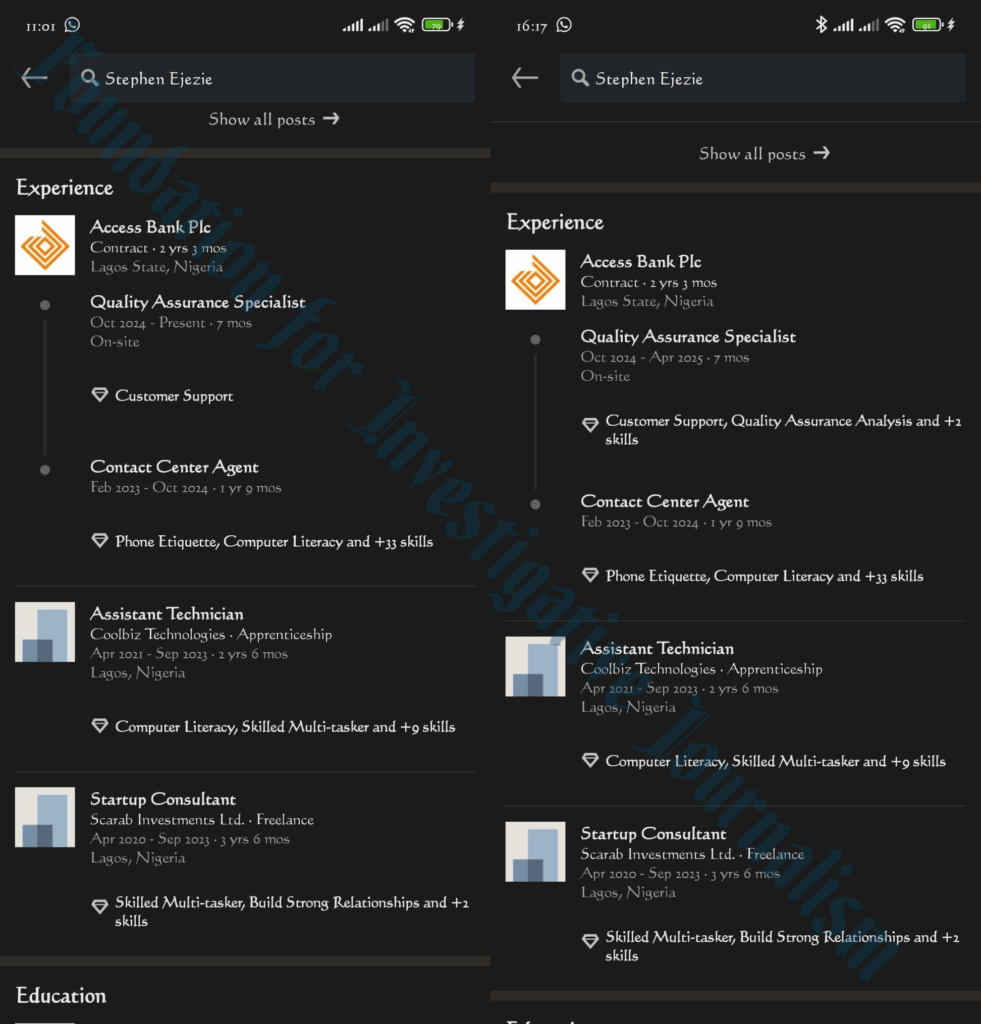
When FIJ first checked his LinkedIn profile on Friday morning, our reporter found that the status of his employment as a Quality Assurance Specialist showed “present”. However, when we checked five hours later, he had updated it to show that he no longer worked there.

Stephan Ejezie’s LinkedIn profile in the morning Vs hours later

The profile shows that Ejezie started working with Access Bank in February 2023 as a contact centre agent. He was promoted to the role of Quality Assurance Specialist in October.

With his apparent release from police custody, the contact centre staff have reasons to believe the bank might not take legal actions against Ejezie ‘to protect its brand’.

“Perhaps it is because we are contract staff,” said one of them.

FIJ understands that the workers at the contact centre, the customer service hub of Access Bank, work in shifts. So, some have to sleep at the office, clean up and take their bath there, among other things.

“Ejezie snuck into the ladies restroom. I believe he wanted to hide his camera as usual, so he noticed ladies coming and hid in one of the toilets beside the bathroom,” a source explained.

“Mind you, the men’s restroom is not too close for him to have mistakenly entered the one for women.

“He was found when a lady taking her bath noticed a phone recording her from the toilet cubicle, which is directly by the side of the bathroom. She noticed someone closed the water closet seat, and was making a video. She just saw the camera by chance.”

After the lady raised the alarm and more people asked whoever was there to open the door, he eventually did.

“That was when people saw it was Stephen. He said he didn’t know how he got to the ladies’ toilet but couldn’t explain the part of him making videos.”

Sources revealed that he was arrested later that day when more video clips of male and female colleagues taking baths or naked in the restroom were found on his devices.

They said the police raided his house the following day, Thursday, and more than 400 different videos were found on his laptop.

He sells them online.

Some claimed he sold them to white people and Indians: “He has an Onlyfans account he created to sell people’s nudes and videos taken unawares. They also found some he’s been selling on Telegram.”

While describing the kind of person Ejezie seemed to be, one of them said they would never have suspected him of any wrongdoing, not in a million years.

“He was so cool and would always ask after people. That aside, he was an exceptional agent. No one would ever have thought this would come from him,” a former colleague said.

Many of the contact centre agents are worried and panicking. And they feel the bank prefers protecting its reputation over theirs.

“What happens to us if the videos he has already sold circulate online?” one of them asked.

Even a Friday morning meeting convened by management failed to ease the growing fears and concerns among workers.

“We were banned from staying over at work. Some people whose shifts end at 7:30 pm used to stay behind occasionally, but now it’s officially prohibited. They also warned that if an incident like this happens again, the person involved could spend years in jail,” a witness told FIJ.

Workers say this response has only deepened suspicions that management is attempting to sweep the scandal under the rug.

“No one really has the nerve to challenge anything,” one said.

“We are just contact staff and not really rated. Any little thing, and you get tossed in the trash.

“Some people in the videos don’t even know they are there. A lot of people are depressed just with the fear that they may be there. I feel like people have absolutely the right to know so it doesn’t haunt them in future or when they have political careers. Because at that point, nothing can be done about it. He has over 400 videos, which is a lot.

“Many are traumatised already, and there is no support offered by the organisation.”

FIJ emailed the bank on Friday, but no relevant response had been received at press time.

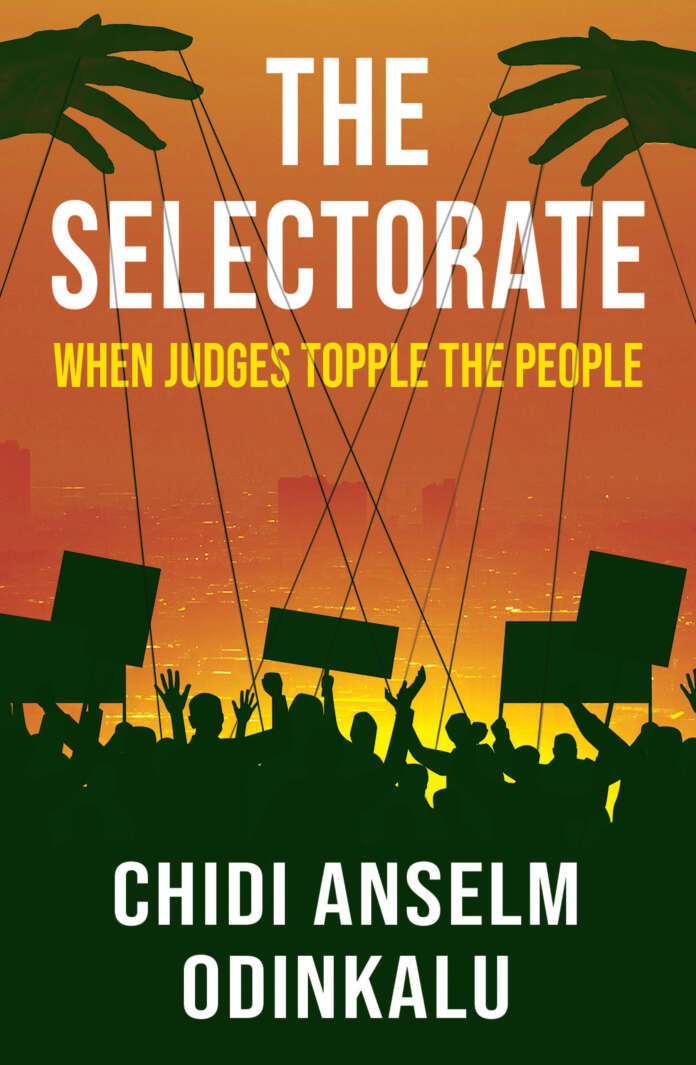
Watch Out! “The Selectorate” …for anyone who believes democracy should be governed by the people, not by courtroom decrees — Odinkalu

Legal scholars often present the rule of law as a neutral force guiding governance, but Chidi Odinkalu peels back the layers of this doctrine to reveal its political undercurrents. Judges are not divine figures beyond reproach; they are human beings shaped by their social and political contexts.

The-Selectorate-Cover-and-back

The Selectorate critiques the uncritical deference to judicial authority and calls for a more accountable judiciary that serves the public interest rather than elite networks. This book is essential reading for anyone who believes democracy should be governed by the people, not by courtroom decrees.

It is available on preorder at https://lnkd.in/d6qYcyiD

Tragedy as several JAMB candidates perish in Oyo-Ogbomoso road crash on their way to write UTME

A tragic accident on the Oyo-Ogbomoso road in Oyo State has claimed the lives of several students who were on their way to sit for the Joint Admissions and Matriculation Board (JAMB) examination.

In a video clip seen by SaharaReporters, the incident occurred on the morning of Saturday. It involved a commercial vehicle conveying the students to a JAMB centre in Ogbomoso.

Eyewitnesses at the scene said the crash happened when the vehicle had a brake failure.

“Fatal accident claimed the life of the students that were going to write JAMB in OGBOMOSO on OYO road, Oyo State,” the video was captioned.

The Police Public Relations Officer, Oyo

“One-Party Participatory Democracy”

By Chidi Anselm Odinkalu

On 13 December 1972, Zambia’s founding president, Kenneth Kaunda, signed into law the Constitution (Amendment) Acts, numbers 3,4 and 5 ending the country’s First Republic and ushering in a new constitution for the country, which promised a “One-Party Participatory Democracy” under “one and only one party…., namely, the United National Independence Party (UNIP).” All of this was to be realized under an official ideology of “Humanism.” The previous day, Zambia’s Court of Appeal had thrown out the case brought by veteran nationalist, Harry Nkumbula, in his appeal from the decision of the High Court dismissing his case against the establishment of a one-party state.

The developments leading to Zambia’s chastening detour into one-party authoritarianism under President Kaunda should offer an object lesson to President Bola Ahmed Tinubu and all the people cheering him on in his transparent machinations to turn Nigeria into a single-party experiment denuded of opposition parties.

Zambia’s march to one-party rule began following the general election in December 1968. At that election, the ruling UNIP of President Kaunda had won an overwhelming majority. The African National Congress (ANC) of Harry Nkumbula came a distant second with a handful of members of parliament confined to Nkumbula’s stronghold in the southern province.

The constitution adopted at Zambia’s independence in 1964 established a multi-party system of government. In 1940, Godwin Lewanika emerged as the president of the Northern Rhodesia Congress, the first organized political party in the country that would later come to be known as Zambia. 11 years later, the party became known as Northern Rhodesia African National Congress under the leadership of Harry Nkumbula, a teacher. Kenneth Kaunda emerged two years later as the secretary-general of the party.

As their advocacy against white rule intensified, Nkumbula became more emollient while Kaunda became radicalized. Following a split in the party, Kaunda emerged in 1958 as the factional leader of the Zambia African National Congress (ZANC). In March 1959, the party was banned  and Kaunda herded into jail. UNIP was formed from the ashes of the banned (ZANC) while Kaunda was in detention. Upon his release, Kaunda was installed leader of UNIP. In April 1961, Nkumbula was imprisoned for causing death by dangerous driving. By the time he emerged from jail in January 1962, Kaunda had eclipsed him politically.

Kaunda’s UNIP led the country to independence in 1964, with Harry Nkumbula as leader of the opposition. Following the December 1968 elections, however, speaker of the National Assembly, Robinson Nabulyato, declined to recognize Nkumbula’s ANC as the leader of the opposition claiming that the party could neither form a quorum nor execute the business of parliament or government. In doing this, Speaker Nabulyato channeled his party leader, President Kaunda who, mistaking himself for the country, had declared on the eve of Christmas in 1968: I cannot see how I can continue to pay a police officer or civil servant who works for Nkumbula…. How dare they bite the hand that feeds them? They must learn that it pays to belong to UNIP.”

As President Kaunda centralized power in and around himself, party management became more embittered into a contest between Zambia’s ethnic rivalries. In February 1972, with his most prominent political opponents detained, President Kaunda appointed a Commission to work out the modalities for a new constitution on the basis of single-party rule.

The job of the Commission was not to inquire whether the country desired to be run on the basis of one-party rule. Kaunda had already decided that it would. The only issue was how to bring that about. Comprising 21 members, Kaunda tapped Mainza Chona, his loyal Vice-President, to chair the Commission. Harry Nkumbula, leader of the ANC, declined his nomination as a member of the Commission. Reflecting the skeptical mood of the country, a basic education teacher advised the Commission at one of its public hearings that “the National Assembly should be turned into flats, since there was a housing shortage in Lusaka (the capital city) and no need for parliament in a one-party state.”

In October 1972, the Mainza Chona Commission reported to President Kaunda. Shortly before receiving the report, Kaunda dismissed opponents of single party rule as “idiots and lost sheep”; told the public service that they existed “to serve the party in power”; and informed “the churches and the judiciary that their continued independence rested on being effective ‘mirror reflections’ of the nation”, which he subsumed in the ruling party.

Things moved swiftly thereafter. One month after receiving the report, in November 1972, Kaunda issued his white paper on the recommendations of the Mainza Chona Commission. On 8 December 1972, Zambia’s National Assembly did something that observers of Godswill Akpabio’s 10th National Assembly will by now have grown used to: the parliament suspended their rules and standing orders and, in one swift afternoon session, passed three separate bills to amend the constitution, rushing each through first, second and third readings without debate or discussion.

Four days later, the Court of Appeal perfunctorily dispensed with Harry Nkumbula’s legal challenge. The following day, Kaunda signed the bills into law heralding the arrival of Zambia’s second Republic as a single-party state.

The new Constitution itself was not published until May 1973. The following month, on 27 June 1973, Harry Nkumbula entered into the so-called Choma Declaration, dissolving his ANC and announcing that he and the remaining members of Parliament from his party had joined Kaunda’s UNIP. His capitulation was complete as was Kaunda’s transformation into the autocrat that he dearly desired to be. Delta’s State’s Sheriff Oborevwori in Nigeria will be relieved to know that he is not without storied predecessors in the pantheon of political harlotry.

Zambia was not the only country in which the judiciary acted as midwife to dismantling democratic pluralism and replacing it with a one-party autocracy. At its 1965-66 session, Sierra Leone’s parliament adopted a resolution asking the government to “give serious consideration to the introduction of a One Party System of government.” To implement this resolution, in April 1966, the government constituted a committee with the Orwellian mission to “collate and assess all views on the One Party System both in and out of Parliament and to make recommendations on the type of One Party System suitable for Sierra Leone.”

Three months later, the government issued its White Paper on the recommendations of the Committee. On 3 January 1967, the Supreme Court of Sierra Leone buried the legal challenge to the process of converting the country into single-party rule under a rash of legal technicalities. Unknown to them, Sierra Leone’s descent into eventual conflict in the next generation had begun.

It is impossible to behold the orchestrated emptying of opposition political parties currently on-going in Nigeria without recalling these examples from sister African countries which presaged deeper descent into constitutional instability. The return of President Tinubu to the country after his extended Lenten retreat to the land of the Marian Apparition (in Lourdes) has coincided with a rush of politicians seeking to outdo one another in emptying the country of viable political parties.

Ironically, President Tinubu himself represents the example of a politician who resisted this tendency. After President Obasanjo’s Peoples’ Democratic Party (PDP) stole nearly all of the South-West from his Alliance for Democracy (AD) in 2003, Tinubu, then the only surviving opposition governor in the region, refused to give in. It took him two decades of back-breaking rebuilding to work his way to the top of the political grease-pole in the country. As he embarks on his own transparent journey to a “one-party participatory democracy”, President Tinubu may wish to be reminded that of the major misfortunes in life, few are as ruinous as the tragedy of fulfilled desires.

A lawyer and a teacher, Odinkalu can be reached at [email protected]

The views expressed by contributors are strictly personal and not of Law & Society Magazine.

TIPS