Home Blog Page 365

Senator Natasha replies Agbakoba, says only court can assess my case against Akpabio

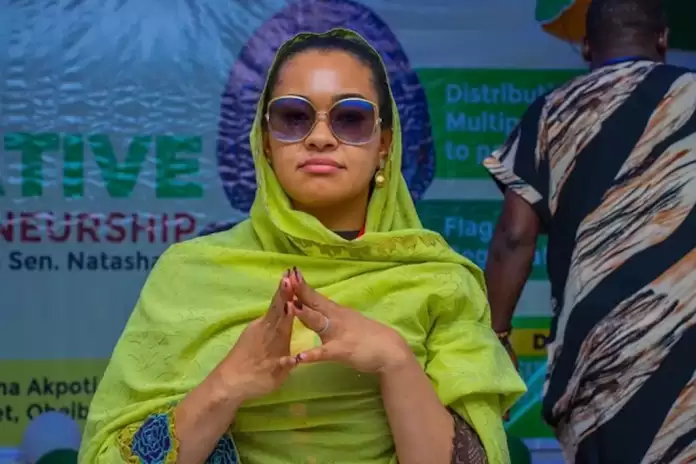
The Senator representing Kogi Central at the National Assembly, Senator Natasha Akpoti-Uduaghan, has responded to recent public comments made by the notable advocate, Dr. Olisa Agbakoba (SAN), regarding her sexual harassment allegation against Senate President Godswill Akpabio.

Agbakoba, a former President of the Nigerian Bar Association (NBA), had in a letter dated April 14, 2025, demanded that Senator Natasha retract her allegations and provide evidence that Akpabio sexually harassed her on December 8, 2023.

In her response dated April 30, Natasha stated that she had not received any letter from Agbakoba through post, courier, or personal delivery, and therefore rejected any suggestion of deliberate silence.

“I place it on formal record that no such letters have ever been served upon me. The imputation of recalcitrance is therefore inoperative,” she said.

She cited the legal doctrine of lis pendens—which discourages public commentary on matters already before the courts—as the reason for her initial silence, noting that two suits are currently pending. One, filed by Akpabio’s wife at the FCT High Court, seeks ₦250 billion in damages, while the other, filed by Natasha at the Federal High Court, Abuja, challenges her suspension from the Senate.

“While Suit No. FHC/ABJ/CS/384/2025 is unrelated to the sexual harassment allegations, Suit No. CV/816/2025 is directly related to those allegations and was instituted by your client’s spouse,” she noted.

She described Agbakoba’s actions as improper and contradictory, accusing him of attempting to influence public opinion while previously invoking the sub judice rule to halt a Senate probe into the matter.

“A litigant may not approbate in the courts and reprobate in the press,” she said.

Natasha further accused Akpabio of presiding over his own case when she was suspended from the Senate for six months, thereby violating the principle of natural justice.

“Nemo judex in causa sua: no one ought to be judge in his own cause,” she said.

She also dismissed claims that her past cordial interactions with Akpabio contradicted her complaint, stating that “civility should not be mistaken for consent or comfort.”

“To do so trivialises a serious concern of sexual harassment, especially in a workplace where there is a dominant power dynamic,” she added.

Natasha asserted that Agbakoba had no constitutional authority to demand evidence outside judicial proceedings.

“A private legal practitioner, however distinguished, is not vested with adjudicatory authority under the Constitution or any statute of the Federal Republic,” she wrote.

She concluded by standing firmly by her February 28, 2025, complaint and her court filings, urging Agbakoba to properly advise his client on the implications of presiding over matters in which he is personally implicated.

“This letter is issued solely to correct the public record and to prevent a constructive admission being inferred from silence,” she stated.

She requested that all future correspondence be directed through her legal representatives.

Another Open Letter to Dr Olisa Agbakoba, SAN and Soibi Ovia: The epidemic of defections-professional ethical defection of lawyers from public interest advocacy to bourgeois interests (case studies of lawyering for Ken saro Wiwa, Akpabio and the Sole Administrator of Rivers State)

By Dr. Tonye Clinton Jaja.

Dear Dr. Olisa Agbakoba SAN and Soibi Ovia,

By way of re-introduction, my name is Dr. Tonye Clinton Jaja, I am a lawyer called to the Bar in the year 2004.

It is necessary to provide a background and context to this letter.

Let me preface this letter by saying that a hurricane of defections is blowing across Nigeria at this very moment.

This hurricane which started with the recent defection of the Governor of Delta State to the All Progressives Congress (APC) is not restricted to the political arena.

It appears that the hurricane of defections is now blowing across the legal profession in Nigeria.

Previously, there was a calmour amongst Nigerian lawyers to be identified as human rights activists and public interest advocates and lawyers.

During the years of military rule and immediately thereafter, Dr. Olisa Agbakoba SAN, Ayo Obe, Femi Falana SAN, Festus Keyamo, SAN and Abdul Mahmud (to mention a few and in no particular order) prioritised the interests of the public above any other considerations!!!

However, nowadays, it appears that little or no attention or priority is given to protection of public interest advocacy by lawyers.

It appears that gradually, lawyers are undertaking a professional ethical defection from representing the public interests to lawyering for the interests of the rich and powerful holders of public office (whose private interests are often at the detriment of the public interests of the majority of Nigerian citizens).

For example, years ago, Femi Falana, SAN stood as a lawyer for Dr. Olisa Agbakoba SAN to challenge the seizure of the international passport of Dr. Olisa Agbakoba, SAN by officials of the State Security Services (SSS).

That lawsuit was to reaffirm the constitutionally guaranteed freedom of movement of Dr. Olisa Agbakoba SAN.

Lawyers back then were more concerned about utilising public interest litigation to establish and protect members of the public and getting the courts to expand our jurisprudence of constitutional law.

Ironically, back then, the motivation for majority of lawyers engaging in public interest advocacy and litigation was not money or pecuniary. Infact they had access to limited funds, much more less than the funds that are now available.

Ironically, back in those days, these same public interest lawyers undertook such public interest litigation and advocacy against the government of the day and other “corporate” bullies who had far more money (to hire the most lawyers) than they themselves had back then and now.

For example, thirty years ago, from February 1995, Dr. Olisa Agbakoba SAN was lawyer to the late Ken Saro Wiwa, during his trial. That trial was epic because Dr. Olisa Agbakoba SAN was up against both the military regime of the late Sani Abacha and it’s “partner-in-crime”, Shell Oil Company, who regarded the late Ken Saro Wiwa as an impediment to their oil exploration and exploitation activities within ogoniland in Rivers State!!

I write to you, Soibi Ovia, to respectfully reject (on grounds of professional ethics) your recent appointment as the Senior Special Adviser on Legal Matters to the Sole Administrator of Rivers State.

Consider the example of a fellow lawyer and former Magistrate, George Ejike, who resigned his appointment from the services of the Rivers State Judicial Service Commission on the grounds that it is both morally, ethically and legally absurd for a lawyer and magistrate to be taking orders and directives from a retired military official in the person of the Sole Administrator of Rivers State!!!

Highly respected, Dr. Olisa Agbakoba SAN, I also respectfully request you to reconsider your representations on behalf of His Excellency, Senate President, Godswill Obot Akpabio-GOA.

As I said in my previous letter, the Senate President is entitled to your legal representation and he also enjoys presumption of innocence.

However, the purpose of this letter is to draw your attention to the professional ethical implications as you undertake your defence of the Senate President.

For example, as a matter of fact, the balance of power and odds are stacked in favour of the Senate President who is the third most powerful citizen of Nigeria.

On the other hand, Senator Natasha Akpoti-Uduaghan is the underdog in this legal battle.

Already, as evidence of the UNFAIR ADVANTAGE that is enjoyed by the Senate President, I urge you to watch the proceedings at the plenary on 6th March 2025, when Senator Natasha was suspended.

During the voice votes, the Senate President struck the gavel in his own favour even when majority of Senators by their voice votes were saying that they voted in favour of Senator Natasha.

Senators Seriake Dickson and Aminu Tambuwal, who are both lawyers and member of the opposition party (Peoples Democratic Party-PDP) are the only.members of the 10th Senate who are brave enough to make public statements to challenge the use of voice votes by the Senate President.

There is a climate of unwholesome fear of repercussions and reprisals against any Senator who speaks up to offer any criticism against the Senate President (regardless of whether the said criticism is constructive or not).

Suspension and threat of suspension is the instrument wielded by the Senate President.

As evidence of the immense power that the Senate President wields in this regard, within his regime since June 2023, he has already orchestrated the suspension of Senator Abdul Ningi, and Senator Natasha Akpoti-Uduaghan.

Senator Ali Ndume escaped suspension by the whiskers, he was given a verbal warning!!!

If you are in doubt about the unfair advantage and balance of power in favour of the Senate President, kindly find time to ask the Senators that represent your state of origin or ask Senator Enyinna Abaribe, who is the Chairman of the South-East Senators Caucus.

On a final note, I respectfully request you to reconsider the public utterances attributed to your good self in a recent press conference wherein you asked Senator Natasha to retract her allegations on the grounds that she did not level those allegations as soon as they happened.

From the previous explanation that I provided about the unfair advantage and balance of power in favour of the Senate President, it is impossible for an average person to immediately confront such a powerful person in authority (PIA) with such allegations.

Also, bear in mind that Senator Natasha Akpoti-Uduaghan tried to explore amicable options by reporting to her husband the said acts of sexual harassment in the hope that her husband would privately discuss it with the President of the Senate.

And indeed the husband of Senator Natasha has written an open letter detailing how he took steps to have a private discussion with the Senate President to amicably resolve the concerns of sexual harassment raised by his wife.

Let me use a real life example to drive home this point.

As a staff of the National Institute for Legislative Studies, (of which the President of the Senate is the Chairman of the Governing Council), I could not report certain anomalies that I observed since the year 2019 immediately. It was only when I got a two year leave of absence to travel to the Kingdom of Lesotho, that I felt the freedom to “spill the beans” as it were.

You are an employer and you hold the power to hire and fire, so it may be difficult for you to properly understand the fear that employees feel for those who are in positions of authority over them.

Respectfully, I will urge you to read and re-read this letter again and make the consultations with Senator Enyinna Harcourt Abaribe.

Yours faithfully,
Dr. Tonye Clinton Jaja.
1st May 2025.

The views expressed by contributors are strictly personal and not of Law & Society Magazine.

Judicial Corruption in Nigeria: Odinkalu says NJC is the problem

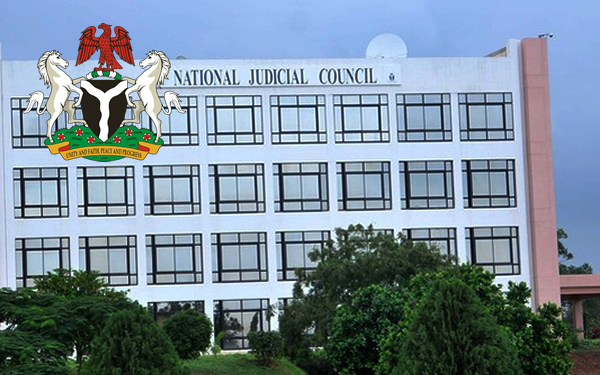
Sequel to the slew of disciplinary actions rolled out yesterday by the National Judicial Council (NJC), law teacher and rights lawyer, Chidi Anselm Odinkalu has accused Nigeria’s judiciary of being “complicit” in official corruption, noting that the sanctions meted out to the judicial officers were a mere slap on the wrist.

Lambasting the NJC in a series of tweets posted on his X (formerly Twitter) page, Odinkalu, who remarked that “This is just not good enough. NJC is the problem,” added: “It shd be quite clear now that @njcNig is complicit in judicial corruption in #Nigeria.”

the law teacher’s criticism comes after the NJC slammed one year suspension without pay on three Judges of the High Court in the country for various acts of judicial misconduct.

Law & Society Magazine reported that the affected judges include Hon. Justice Jane Inyang of the Court of Appeal, Uyo Division, Hon. Justice Inyang Edem Ekwo of the Federal High Court, Abuja Division and Hon. Justice Aminu Baffa Aliyu of the Federal High Court, Zamfara Division.

However, Odinkalu, in a post on his X handle on Thursday, expressed displeasure about the sanctions meted out by NJC against the affected judges.

He specifically stated that what the NJC has done in those cases is just not good enough, arguing that its dispositions are evidence of the deep malaise that currently afflicts the country’s judiciary.

Odinkalu’s words: “Jane Inyang became Justice of @CourtOfAppealNG in Sept 2023, less than 2 yrs ago. Yesterday, @njcNig suspended her for just 1 yr for egregious acts of judicial corruption while she sat in @FederalHigh. How can she still be a judge?!

“This was part of the last minute elevations masterminded by the baleful Olukakayode Ariwoola was he made his way out of office as the Chief Justice of Nigeria, #CJN, in Aug 2024.

“The only miracle in the case of Inyang Ekwo is how he has remained on the bench until now. He’s bn one of the more predictable judges in @FederalHigh. For the past year, he has bn under caution by @njcNig. Now, he has bn suspended for delivering judgment without hearing parties!

“Many will see these dispositions by @njcNig as progress; May be. But, these dispositions are evidence of the deep malaise that currently afflicts the #NigerianJudiciary. 1st, if a person is as crooked as Jane Inyang or as Inyang Ekwo, how can that person be a judge to begin with?

“2nd, if a judge can behave with such manifest impunity & disregard for the basic rules of judicial comportment as these 2 & still remain a judge – that’s what suspension for 1 year means – what wld it take for a judge to be relieved of their position? May be commit murder….?

“3rd, how did Jane Inyang manage to make it to @CourtOfAppealNG while the complaint about her conduct was still pending? @njcNig says it has suspended her from elevation for 5 yrs. U know what that means? She can still get to @SupremeCourtNg. U see the mess we are in?

“In plain language, the @njcNig is now deeply complicit in judicial corruption. It is handing out these irresponsible slaps on the wrist with utter disregard for their effect on judicial integrity or the damage that these entrench in the judiciary. This rot is deeply criminal.

“The conclusion is inescapable that @njcNig as currently constituted is part of the problem not part of the solution.
What it has done in these cases is just not good enough. If it is not willing to root out judicial crookedness, then it should be rooted out.”

Multi ‘zero-party’ democracy

By Olusegun Adeniyi

In his book, ‘From Opposition to Governing Party: Nigeria’s APC Merger Story’, Dr Ogbonnaya Onu (now of blessed memory) discussed the delicate negotiations that eventually culminated in the registration of the APC. Each of the merging parties and groups came with their own proposals, especially regarding the party’s acronym. “Each emerging partner wanted the new name to be as close as possible to its old name. In accepting the new name, each merging partner became satisfied only when it contributed at least one word. In accepting the name, All Progressives Congress (APC), the Action Congress of Nigeria (ACN) was satisfied that it contributed ‘Congress’. The All Nigeria Peoples Party (ANPP) was happy that it contributed ‘All’. Even though ‘All’ had only three letters, it was the leading word in the new name. The Congress for Progressive Change (CPC) felt satisfied that it contributed ‘Progressives’. Also, the All Progressives Grand Alliance (APGA) was satisfied that it contributed ‘All Progressives,’” wrote Onu. “The acronym, APC, became acceptable because all merging partners saw a bit of themselves in it. Most of them contributed two of the letters. None contributed more…”

======================================

The foregoing, excerpted from my 2017 book, ‘Against The Run of Play: How an Incumbent President was Defeated in Nigeria’, tells a compelling story about political parties in Nigeria. If the discussions that succeeded in unseating an incumbent president in 2015 were not about issues but rather the party’s acronym, should anybody be surprised about the current situation in the country? The more unfortunate thing is that almost every day, our politicians reinforce the fact that party platforms mean nothing to them. With that, we have ended up with a multiplicity of political parties that are mere aggregations of strange bedfellows, simply for the purpose of securing power. 

On Monday, while defecting from the main opposition Peoples Democratic Party (PDP) under which platform he won the 2023 general election to the ruling APC, Governor Sheriff Oborevwori anchored his decision on the ‘love’ President Bola Tinubu “has shown to us in Delta State”. Aside from the presidential ‘love’ that required reciprocity ahead of 2027, the governor also alluded to the presence of fellow governors at the ceremony to justify his decision. “This is a movement, this is not a defection; we (governors) have agreed we will move together and when we move together, what is at the national we will be able to grab it.”

Nigerian politicians are very good when it comes to ‘grabbing’ all sorts of things! Incidentally, in grabbing the APC platform which he now leads in the state by virtue of the party’s convention, Oborevwori has pushed aside former Deputy Senate President, Ovie Omo-Agege who was the APC flagbearer in the last election. Nobody would be surprised if Omo-Agege also defects to the PDP where he began his political journey and ‘grab’ the party’s ticket in 2027. There is a precedent to that. Godwin Obaseki won the September 2016 gubernatorial election in Edo State on the platform of the APC. He defeated Osagie Ize-Iyamu, then the PDP candidate. Four years later, in 2020, after he was edged out of the APC, Obaseki pushed Ize-Iyamu aside to grab the PDP ticket. Within a matter of days, Ize-Iyamu also grabbed the APC gubernatorial ticket!

Meanwhile, with its power of patronage, APC is only copying what the PDP did in the past. Some of us can remember that in 1999, the PDP won the presidency, 241 of the 360 seats in the House of Representatives, 71 of the 109 senatorial seats, and its members were elected governors in 21 of the 36 states. Four years later, with politicians from other parties trooping in for their slices of the federal pie, PDP won the governorship elections in 28 of the 36 states and 76 senatorial seats. Now the tide has turned. From 11 governors two years ago, PDP has been shrinking. After Delta State, Akwa Ibom may soon follow with Governor Umo Eno speaking in parables about deboarding from ‘a faulty aircraft’ to enter ‘a different plane’ in the coming days. There are reports of others also plotting the same move.

Ordinarily, procedures as to how people should obtain power and how they can be replaced is what distinguishes democracy from other forms of government. Political parties are central to this, with their principal role of aggregating ideas on how to solve the problems of society. But in Nigeria, political parties essentially represent the personal interests of powerful individuals with the primary motivation to ‘grab’ power. Invariably, what should serve as platforms for constructive engagement on how to meet the aspirations of the people have become mere vehicles for trading positions between and among politicians and their cronies/family members.

Even in smaller African countries, political parties are more than mere platforms for winning elections. But in a milieu in which public service has been reduced to ‘eating’, as I wrote last December after Ghana’s presidential election which revealed the strength of their political parties, a Nigerian politician could be a PDP member in the morning, decamp to the LP or SDP in the afternoon and by evening, be attending the APC meeting as the board of trustees’ chairman. “Rarely in Ghana do you see people moving from one party to another with every general election,” the Independent National Electoral (INEC) Chairman, Mahmood Yakubu said while wading in on this same issue last year. “There are people who have supported political parties for many years. So, whether the party is in power or opposition, they stick to the political party.”

For all the noise about recent defections, this has been the pattern of our politics in recent years. As former Delta State Governor and PDP presidential running mate in the 2023 general election, Ifeanyi Okowa reminded former Senate President Bukola Saraki on Tuesday, no Nigerian politician can cast a stone when it comes to jumping from one party to another. Okowa is right. There is hardly any politician in the country today who has been in the same political party since 1999. When it comes to political parties, they have all adopted a nomadic disposition, jumping from one to another based on cold calculations about which would be the easier route to power. That perhaps explains why the primaries to secure the tickets of these parties are no more than bazaars for the highest bidders. But for our democracy to survive and thrive, things must change.

To wean the country of this transactional ethos in politics, we need to have a conversation about the minimal expectation of governance, and the values that should drive public office. And that cannot be done without reforming the political parties.

 Osinachi, Homicide and Matters Arising

The three-year trial in the death of popular gospel singer, Osinachi Nwachukwu, was concluded on Monday with the conviction of her husband, Peter Nwachukwu. While sentencing him to death by hanging, Justice Njideka Nwosu-Iheme of the FCT High Court relied on oral testimonies of 17 witnesses during the trial (among whom were two children of the couple) as well as documentary evidence.

In the homicide charge against Nwachukwu, he was accused of forcefully ejecting the late Osinachi from their home, contrary to the Violence Against Persons, VAP (Prohibition) Act, 2015. He was also accused of pushing the late Osinachi out of a moving vehicle, restraining her movement and locking her up in the house while denying her access to her money for medication and household necessities. He reportedly forced her into begging and borrowing to survive. Nwachukwu was also accused of subjecting his deceased wife to emotional, verbal and psychological abuse, even as he prevented her mother and siblings from visiting their home. Nwachukwu was further charged for cruelly beating his children (two of whom testified against him in court), recording their cry and playing it on his phone. While all this was going on, Nwachukwu was said to have threatened the children from reporting acts of violence against their mother to Dr Paul Enenche, the Senior Pastor of Dunamis International Gospel Centre (where he and late wife worshipped) or any other person.

This is a tragedy that might have been averted. From what transpired after Osinachi’s death on 8th April 2022, many were aware of the violence to which she was subjected by her husband. But apparently because of the patriarchal nature of our society, she had to endure the abuse until she paid the supreme price. With many people putting the blame on churches where forgiveness and reconciliation are often recommended in cases of domestic abuse, Enenche publicly exonerated himself. The General Overseer of the Omega Fire Ministries International, Apostle Johnson Suleman, also waded in by prescribing a novel solution to such challenge. “All those women that their husbands are beating, don’t they have brothers? If they don’t have biological brothers, they have Christian brothers,” Apostle Suleman told his congregation at the time. “If you are in this church and you are beating your wife, stop it. If she reports you to me, we will beat you. I will go to the police station and take permission before I gather brothers in this church to beat you.”     

Following Nwachukwu’s conviction and sentence, some commentators have expressed concerns about the issue of death penalty in Nigeria. But they miss the critical issue – the growing number of lives that have been lost to domestic violence. It is something we must take more seriously. Four years ago, following the reconciliation between a battered wife and her journalist husband at the instance of then Benue State Governor, Sam Ortom, I made my position clear on this issue. The woman had posted her battered and bruised face on social media (X and WhatsApp) before Ortom and members of the Benue State Executive Council intervened to ‘reconcile’ the couple after which a public statement was released. While I had no problem with the reconciliation, I nonetheless raised several pertinent issues in that column, https://www.thisdaylive.com/index.php/2020/12/17/re-ortom-and-the-wife-beater/ which interested readers can access.

The fear of being ostracized and the general lack of sympathy for divorced women have contributed immensely to the growth of domestic violence in Nigerian homes, I wrote in the column which underscored many of the things our mothers endured. Unfortunately, the prevalent culture of stigmatization and cajoling the wife to return to the batterer, without addressing the deep-seated issues that continue to disrupt family life so violently, has only resulted in tragedies like that of the late Osinachi.

We cannot continue to perpetuate the notion that women should assume a preponderance of responsibility for making their marriage work. This absolves husbands of their concomitant duty of love, support and care. In the Osinachi case, the tragedy is compounded by the traumatic experience of the children who saw their mother being violently abused by their father and the role they have now played in bringing him to justice.

For no fault of theirs, the lives of those children have been turned upside down. If care is not taken, they could end up being further victimised by a society where the line between right and wrong has been completely blurred. I hope they have the needed support at this most difficult period in their lives.

 • You can follow me on my X (formerly Twitter) handle, @Olusegunverdict and on www.olusegunadeniyi.com   

NJC says appointment of judicial officers now open to public scrutiny, directs Imo State Governor to reverse the appointment of Acting Chief Judge

  • 3 serving Judicial Officers, including Appeal Court Justice, placed on 1-year suspension without pay
  • 27 Judicial Officers under investigation for various allegations of misconduct
  • Issues letter of caution to Federal High Court Judge

Rolling out a string of marching orders, after its 108th meeting held on 29th and 30th April, 2025the National Judicial Council (NJC) has directed the government of Imo State to reverse the appointment of the Acting Chief Judge, requested the Imo State Acting Chief Judge to show cause within 7 days why disciplinary action should not be taken against him. and also asked the State’s President of the Customary Court of Appeal to show cause within 7 days why disciplinary action should not be taken against him for presiding over the JSC meeting that recommended the appointment of the Acting Chief Judge, contrary to the provision of the Constitution.

A 30th April 2025 press release from the NJC signed by Kemi Ogedengbe Babalola, Esq., Deputy Director, Information reads:

At its 108th Meeting held on 29th and 30th April, 2025, the National Judicial Council, directed the Imo State Governor, Senator Hope Uzodinma to appoint the Most Senior Judicial Officer in the State High Court’s hierarchy as the acting Chief Judge of the State in conformity with Section 271 (4) of the Constitution of the Federal Republic of Nigeria, 1999 (as amended).

The National Judicial Council under the Chairmanship of the Hon. Chief Justice of Nigeria, Hon. Justice Kudirat Motonmori Kekere-Ekun, GCON, at its 108th Meeting, also suspended three serving Judicial Officers without pay for one (1) year for various acts of judicial misconduct. It also empanelled nine (9) Committees to investigate pending complaints against 27 Judicial Officers for alleged acts of judicial misconduct.

The Council at its Meeting resolved that the constitutional provision on appointment of an acting Chief Judge of a State does not give room for discretion. Section 271(4) of the Constitution provides:

“If the office of the Chief Judge of a State is vacant or if the person holding the office is for any reason unable to perform the functions of the office, then, until a person has been appointed to and has assumed the functions of that office, or until the person holding the office has resumed those functions, the Governor shall appoint the most senior Judge of the High Court to perform those functions.”

Council also resolved that Hon. Justice Theophilus Nnamdi Nzeukwu should be issued a query to show cause within seven (7) days why disciplinary action should not be taken against him for presenting himself to be sworn in as the acting Chief Judge of Imo State.

Hon. Justice V. U. Okorie, the President of the Customary Court of Appeal, Imo State, who acted as Interim Chairman of Imo State Judicial Service Commission and recommended the appointment of Hon. Justice Nzeukwu is required to show cause within 7 days why disciplinary action should not be taken against him for his complicity in the recommendation.

Specifically, in its resolution, the Council suspends Hon. Justice Jane E. Inyang, Court of Appeal, Uyo Division, for one year without pay, as the Investigation Committee found His Lordship to have breached Rule 3 (5) of the Revised Code of Conduct for Judicial Officers.

Hon. Justice Jane E. Inyang was found to have abused his office by issuing inappropriate Ex parte Orders for the sale of Hon. Udeme Esset’s petrol station and other businesses at interlocutory stage of the case.

The act of judicial misconduct occurred while His Lordship presided over Suit No. FHC/UY/CS/46/2023, at the Federal High Court, Uyo Judicial Division, before his elevation to Court of Appeal.

Furthermore, Hon. Justice Inyang Ekwo of the Federal High Court, Abuja Division, has been placed on suspension for one (1) year without pay. His Lordship was also placed on Watch-List for five (5) years and barred from elevation for five (5) years.

The complaints against Hon. Justice Ekwo arose from Charge No. FHC/ABJ/CR/184/2021, wherein His Lordship delivered a Ruling in a pending application without hearing the parties. His Lordship ignored an application to set aside the proceedings of the Court conducted in the absence of the parties. Subsequently, His Lordship proceeded to deliver a ruling dismissing the Charge against the Defendants. Consequently, His Lordship was found to have violated Rule 3.1 and 3.3 of the 2016 Revised Code of Conduct for Judicial Officers of the Federal Republic of Nigeria.

The Council also suspended Hon. Justice Aminu Baffa Aliyu of the Federal High Court, Zamfara Division for a period of one (1) year without pay for judicial misconduct in breach of Rule 3 (1) and 5 of the 2016 Code of Conduct for Judicial Officers.

It also placed His Lordship on the Watch-List for three (3) years within which period he is barred from elevation.

Hon. Justice Baffa was found liable for act of judicial misconduct in Suit No. FHC/GS/CS/30/2021, the Government of Zamfara State vs EFCC, wherein His Lordship granted an order restraining security agencies from carrying out their statutory duties, and disregarded the doctrine of stare decisis in adjudication of the case.

The Council also issued a letter of caution to Hon. Justice A. O. Awogboro of Federal High Court, Lagos Division in a petition filed by one Kasali Azeez Olagoke and S. Hamza in Suit No. FHC/CS/2021 between Chief Adesanya Musediku against Assistant General of Police, Onikan, Zone 2.

The petition against Hon. Justice Othman A. Musa of the High Court of the Federal Capital Territory was put in abeyance pending the outcome of the decision of the Court of Appeal arising from Suit No. FCT/HS/BW/2274/15.

The petition against Hon. Justice C. N. Mbonu Nwenyi of the High Court of Anambra State by one Prof. Paul C. Obianaso was discountenanced after investigation revealed that there was no misconduct on the part of His Lordship.

Another petition against Hon. Justice I. E. Ekwo in Suit No FHC/ABJ/CS/321/2015 was put in abeyance pending the outcome of appeal before the Court of Appeal.

Council discountenanced a petition by Mrs Adaku Amadi against Hon. Justice R. B. Haastrup of the National Industrial Court, as the Petitioner withdrew her complaints.

Council equally considered the report of its Preliminary Complaints Assessment Committee, which contained a total number of forty-three (43) petitions. Nine (9) Committees were empanelled for further investigation of eleven (11) petitions, while twenty-nine (29) petitions were dismissed for lacking in merit. Three (3) petitions against Hon. Justice Abubakar Babashani of the High Court of the Federal Capital Territory; Hon. Justice Isaac Essien of the National Industrial Court; and Hon. Justice A. O. Musa of the High Court of the Federal Capital Territory by Henry Chinweike Okoro; Ikemefuna Stephen Nwoye, Esq.; and Lassborn Chichebem Orjiugo, respectively, were put in abeyance pending the decisions of the Court of Appeal.

Council also considered a petition by one Mahmud Aliyu against the appointment of three Judges to the High Court of Zamfara State.

The Petitioner complained that the exercise conducted in 2022 by the Zamfara State Judicial Service Commission which led to the emergence of shortlisted candidates was not transparent and was characterized by nepotism, high handedness and non-compliance with Rules 4, 5 and 6 of the NJC guidelines for the appointment of Judicial Officers 2014.

That the nominees were unilaterally picked by the Chairman of the Zamfara State Judicial Service Commission (JSC) in disregard to the NJC guidelines on merit-based assessment.

Council however, deliberated on its Committee’s findings on the petition and resolved that the Petitioner was an interested party who had indicated interest but was not selected as a candidate.

Council noted that the Petitioner’s allegations were unsubstantiated and substantially based on falsehood.

It therefore, resolved that the Petitioner who was a candidate for judicial appointment and intentionally peddled falsehood against another aspiring Judicial Officer will be barred from participation in any future exercise.

In a petition to probe the recruitment exercise for the appointment of six (6) Federal High Court Judges in 2021 by one Abdullahi Liman, the Council noted that the petition violated Section 11 (1) of the Judicial Discipline Regulations which stipulated that a complaint must be filed within six (6) months of the occurrence of the event or matter complained of, whereas the Petitioner filed his complaints on the 22nd day of January, 2025.

It also resolved that a petition on the unconstitutional composition of Oyo State Judicial Service Commission written by Monday Adjeh has been overtaken by events.

The Council also accepted the voluntary retirement of Hon. Justice Babatunde Ahmed Ademola Bakre and approved the notification of change of name of Hon. Justice I. A. Osayande to Hon. Justice I. A. Dika of the Edo State High Court.

Council at the meeting, finally resolved that henceforth, the names of candidates being considered for appointment as Judicial Officers to Superior Courts of Records will be published for information and comments by the public.

The primary objective of this initiative is to solicit comments from the public where there is objection to the integrity, reputation and/or competence of the candidates by opening the process to public participation and scrutiny.

Kemi Ogedengbe Babalola, Esq

Deputy Director, Information

Alarm as UNICEF says Nigeria has the world’s highest unvaccinated children

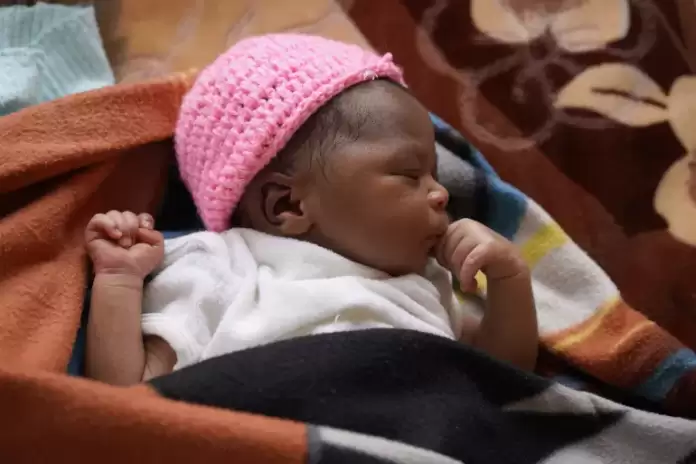
The United Nations Children’s Fund (UNICEF) has revealed that Nigeria currently has the highest number of unvaccinated children in the world.

Bashir Elegbede, a health officer at UNICEF, disclosed the figures during a media dialogue in Damaturu, Yobe State, as part of activities to mark the 2025 World Immunisation Week. 

Elegbede said an estimated 2.1 million Nigerian children, representing 24 percent of the country’s under-one population of 8.7 million, have not received a single dose of routine vaccination. These children, referred to as “zero-dose” children, have missed all immunisations scheduled under the national routine immunisation programme.

According to him, the global goal is to reduce the number of zero-dose children by 25 percent by 2025 and by half by 2030. He described the situation in Nigeria as alarming, saying the prevalence of zero-dose children threatens public health and undermines efforts to control vaccine-preventable diseases. 

Elegbede identified areas affected by conflict, climate change, the COVID-19 pandemic, and hard-to-reach rural communities as the primary locations of these zero-dose children. Urban slums and regions with underperforming health systems also contribute significantly to the national figures.

He warned that children without vaccinations are more susceptible to illnesses such as polio, measles, meningitis, yellow fever, and viral hepatitis, stressing that vaccines are essential to reducing child mortality and ensuring healthy development. He added that despite global progress, Nigeria remains the most affected country, with Borno and Yobe states among the hardest hit. 

UNICEF, he said, continues to support Nigeria’s government in improving routine immunisation and strengthening the country’s health infrastructure. In 2024 alone, the agency helped vaccinate approximately 20,000 zero-dose children in Yobe State with the pentavalent vaccine, which protects against five life-threatening diseases.

In Borno State, 145,000 unvaccinated children were reached, and a broader campaign known as the Big Catch-Up targeted another 165,000 children across the North-East in March and April 2025. Of that target, 138,000 children—representing 95 percent—were successfully vaccinated.

The Emir of Damaturu, Shehu Hashimi II Ibn Umar Al-Amin El-Kanemi, through his representative Maisanda Lawan, praised UNICEF’s intervention and reaffirmed the traditional institution’s commitment to ensuring vaccine accessibility in all communities across Yobe. 

World Immunisation Week, observed globally from April 24 to 30, is aimed at promoting awareness and access to vaccines. This year’s theme, “Immunisation for all is humanly possible,” underscores the World Health Organisation’s call for greater investment and collaboration to ensure equitable vaccine coverage for every child.

Lawyers in Rivers State stage peaceful march for return of democratic governance

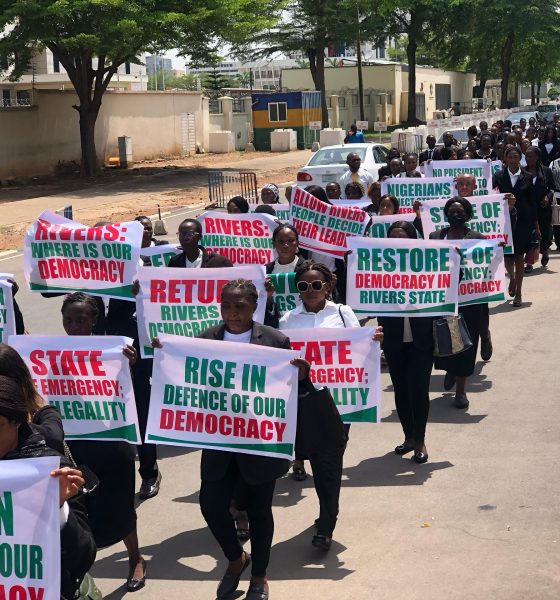
A group of lawyers, under the aegis of Lawyers in Defence of Democracy, took to the streets on Wednesday,  April 30, to demand the restoration of democratic governance in Rivers State.  

The group is calling on the United States and the international community to pressure the Federal Government to rescind its decision to suspend Governor Siminalayi Fubara and the Rivers House of Assembly. 

The lawyers, led by their Country Director, Barr. Uche Chukwu Udeh Sylvester, argued that the declaration of a State of emergency in Rivers State by President Bola Tinubu is unconstitutional.  

In a letter to United States President Donald Trump, they urged him to intervene and pressure the Nigerian government to restore democratic rule in Rivers State. They argued that the suspension of Fubara and the Assembly is a brazen attempt to undermine constitutional order. 

The lawyers also condemned the National Assembly for ratifying the President’s decision, describing it as an assault on democracy. 

They asked Tinubu to reconsider his stand and allow Governor Fubara to continue his work as democratically elected governor of the state. 

The letter partly reads: “In an era where democracy is supposed to reign supreme giving democracy dividends to the masses, we have found ourselves at a crossroads, a sober moment of reckoning where constitutional order is being tested most brazenly. 

“This could only have happened during the days of military juntas but we are not under the firm grip of a military dictatorship. At the moment, the country is being governed under a constitutional democracy that operates a presidential system of government. 

“President Bola Tinubu should not have taken the decision because democracy is a learning process, and the judiciary has demonstrated the capability to resolve issues. 

“The president should have allowed the various state organs to resolve the issues. It is not worthy that until recently, there was a crisis of local government administration in Osun State, which has not led to a declaration of a state of emergency.”

How Trump’s Canada as ’51st State’ talk made Carney’s turnaround victory possible

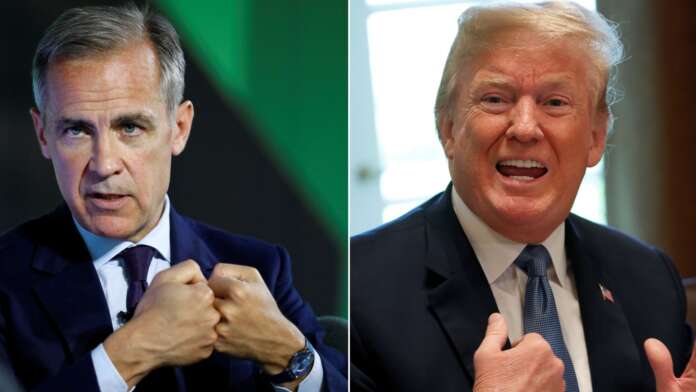
Mark Carney and the Liberal Party have claimed a remarkable victory in the Canadian election – and it appears to have come with a big assist from Donald Trump.

The US president’s constant badgering of America’s northern neighbour and taunts about making it the 51st US state since his return to office in January coincided with a dramatic reversal in fortune for the centre-left party.

Carney has been almost singularly focused on his neighbour, and this was reflected in his victory speech. After warning that the US wanted Canada’s land and resources, Carney declared: “President Trump is trying to break us so that America can own us. That will never ever happen.”

Until Trump’s return to power, Pierre Poilievre’s Conservative Party had held what looked like high and insurmountable ground in voter preference polls amidst general dissatisfaction with the state of the Canadian economy and almost a decade of Liberal government under then leader Justin Trudeau.

The past year has been devastating for incumbent governments around the world, with parties all along the political spectrum losing ground or outright control – with the US, UK, Japan, Germany, France and India among the most prominent examples.

This Canadian general election broke that trend, as the Liberals forced Trudeau to resign and picked a political outsider, former Bank of England chief Carney, as their leader.

He ran hard against what the party continuously characterised as the real threat Trump posed not just to their economy but also to Canada’s very sovereignty.

No one should expect those Liberals to say thank you to the American leader, however – or for Trump to soften his rhetoric, even though last month he said he preferred a Liberal prime minister. (He would go on to say that he really didn’t care who won.)

Instead, more of the same is the likely result – more pointed quips about Canada joining the US, more threats of a trade war and more willingness to cast longstanding ties and agreements with America’s northern neighbour into doubt.

The irony, however, is that Trump’s derisive focus on Canada may have denied him a northern neighbour run by, if not a kindred spirit, at least a politician more in line with his populist conservative priorities than Liberal Carney.

While Poilievre, a veteran politician, will never be mistaken for the American businessman-turned-president, they have some similarities – a goal of shrinking government, lowering taxes and trimming social services, a desire to promote fossil fuel production, and a distaste for what they both deride as “woke” leftist culture.

A Conservative victory in this election would have been viewed by many – in America and throughout the world – as a new sign that the Trump win last year was more than just a singular American event. It would have represented what many in Trump’s orbit like to believe is a global movement toward their brand of culturally conservative, anti-elite, anti-immigration, and pro-working-class politics.

Although Trump doesn’t appear to have the same distaste for Carney that he clearly held for Trudeau, his political and policy interests and those of Canada now appear destined to continue to diverge.

Already there are indications that Canada is looking more toward Europe as a reliable partner, rather than Trump’s America – a move that is sure to irk the American leader.

Carney has pledged to quickly begin new trade negotiations with Trump in an attempt to stave off US tariffs on Canadian auto exports set to kick in on 3 May.

The Canadian economy, which heavily depends on exports to the US, is at considerable risk if a full trade war erupts, and Carney – an economist by training and a veteran central banker – has promised voters that he will do everything in his power to keep Canada from tumbling into a recession.

Meanwhile, Trump belly-flopped into Canadian politics one more time on Monday, while voters were casting their ballots, again calling the US-Canadian border “artificially drawn” and saying the nation would be better off as a “cherished” American state.

Carney ascended to political power quite suddenly, at a time when his country is facing a generational challenge from its superpower neighbour. Many world leaders are still working out how to deal with Donald Trump in his second term, but few will face this kind of test.

Credits: BBC

An Enduring Tragedy of Blood, Tears & Pain, A Rejoinder: “I was running to soldiers who were supposed to protect me; they drove me away…”

By Uloko Victor Itodo

I graduated from the University of Jos. I remember a very tragic experience during my stay in Jos.

I was running away from some assailants during a crisis; running to soldiers who were supposed to protect me; they drove me away, saying that they have orders not to interfere.

That period, there were so many allegations against the military for being biased or corrupt. The GOC ordered his men to stand down. It was Crazy. Thank God for using one Hausa Mallam who whisked me with his Okada. I never knew him from anywhere, but if I were to choose between Pharaoh and his chariots and the deep red sea, I will march forward in the Name of Jesus into the Red Sea.

Thank God for opening the Red Sea, as I was panicking on the bike, hoping the man would not betray the trust I decided to give him to carry me through Bauchi road to the Main campus.

For those who don’t know Plateau state, you may not understand how bad or painful it is that people’s lives are being used for political gains and wins. But the poor masses will continue to give their lives. It’s not just for plateau; it’s a human and a global pandemic, corrupting the soul and fibre of our evolution and human existence.

Is any life less meaningful and important?!!!?

How long!!!!!! 😭😭😭😭😭😭😭🥲🥲🥲🥲😭😭😭😭

Uloko Victor Itodo is an Abuja-based lawyer.

The king’s Brother in Love With a Married Woman: A most scandalous royal love triangle revealed!

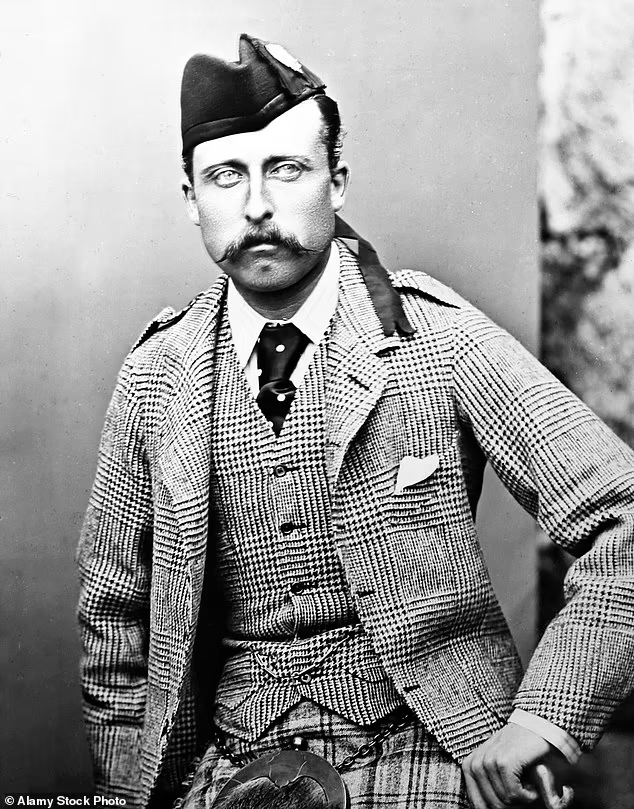
Queen Victoria's dashing son, Prince Arhur, Duke of Connaught who was happily married to Princess Louise Margaret of Prussia but it was Lady Leonie Leslie that gripped him

By Christopher Wilson

It was the weirdest of love triangles – a king’s brother, desperately in love with a married woman. His wife doing her best to befriend the mistress, writing what amounted to love-letters to her. The mistress knocking on her prince’s bedroom door while his wife slept in an adjoining room.

Sex, back in the Edwardian era, was done differently.

Hiding behind a bulbous moustache and looking pompous and old before his time, Prince Arthur, the Duke of Connaught, looked as strait-laced as you’d expect the favourite son of Queen Victoria to be.

Far from it. He hid his passion for women so that – even a century later – it’s impossible to know exactly what he got up to when left alone in bedrooms, drawing-rooms, on board ships and in darkened corners.

The key to Arthur’s colossal passion lay in hundreds of letters he wrote to his mistress Leonie, Lady Leslie – letters which, when he died, were urgently ordered to be destroyed by King Charles‘s grandfather, George VI.

Though apparently happily married to a German princess, Louise Margaret of Prussia, it was Leonie who gripped him.

Bizarrely, Leonie equally forced her worldly charm on the duchess. ‘For decades Leonie ruled the Duchess, and ran the Duke,’ wrote her granddaughter Anita Leslie.

‘He thought of her by day, and dreamt of her by night,’ wrote Arthur’s biographer. And Arthur’s wife, known as Louischen, seemed just as smitten – ‘This was an unusual relationship because the Duchess joined in it to the full, and was quite as enchanted by Leonie as was Prince Arthur.’

Arthur and Leonie were introduced at a party in Ireland given by Lord Rossmore at a time when, after 20 years of marriage, Louischen had become bad-tempered, introspective, and unwell.

It took no more than a minute for him to fall for her charms.

Leonie Jerome was a dazzling, outspoken American heiress married to Jack Leslie, heir to Castle Leslie in County Monaghan, Ireland. Her sister Jenny Jerome was married to aristocratic politician Lord Randolph Churchill and was the mother of Winston Churchill.

Though nine years Arthur’s junior, Leonie became a mother-figure to a prince who was nervy and prone to depression.

‘As an American she was untarnished by the staleness of British etiquette,’ wrote biographer Noble Frankland. ‘She was gifted and amusing, and married to a husband who could scarcely be described as anything more than ordinary.’

The relationship hotted up quickly, and though Arthur continually protested it was ‘pure’, that was because he was doing his best not to be compared with his older brother with his scores of mistresses and concubines. 

‘He relied on her for the advice and encouragement,’ wrote biographer Noble Frankland, ‘and the Duchess too was increasingly depending on Leonie for advice and friendship’.

Click here to continue reading.

TIPS