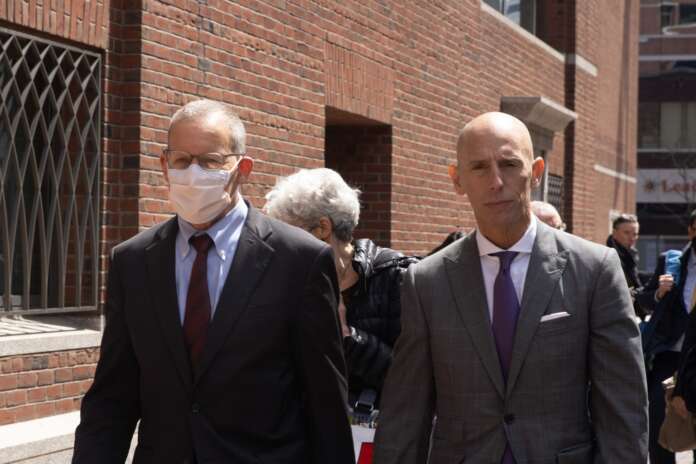
Former Harvard professor Charles M. Lieber, left, and attorney Marc L. Mukasey leave John J. Moakley Courthouse following Lieber's sentencing hearing in 2023. By Elias J. Schisgall
Former Harvard Chemistry professor Charles M. Lieber, who was convicted of lying to federal authorities about his ties to China in 2021, took a new job as a professor at a Chinese university last week.
Lieber started his new role at Tsinghua Shenzhen International Graduate School, where he now holds the school’s highest faculty rank, in Shenzhen, China, on April 28.
“Shenzhen’s dynamism and innovative spirit align perfectly with my vision to co-create a global scientific hub here,” Lieber said during an April 28 ceremony welcoming Lieber to the university, according to a press release.
Lieber was found guilty in 2021 of six felony counts of concealing his ties to the Thousand Talents Program, a Chinese government initiative which brings overseas researchers to the country, in misleading statements and falsely reported tax returns. In 2023, Lieber was sentenced to one day in prison, a $50,000 fine, and two years of supervised release, including half a year of house arrest.
He had been actively searching for a job in China since at least last June. In October, a federal judge granted him permission to visit China for “employment networking” and to deliver a lecture in Beijing.
Lieber, a pioneer in applying nanotechnology to biology and medicine, once held Harvard’s highest faculty rank as a University Professor and was an internationally celebrated chemist.
He was arrested on Harvard’s campus in 2020 and charged with making false statements about his involvement with TTP. Immediately following his arrest, the University placed Lieber on paid administrative leave and replaced him as chair of the Chemistry and Chemical Biology Department.
Lieber’s conviction marked a high-profile victory for the Department of Justice’s China Initiative, a controversial series of prosecutions launched in 2018 under the first Trump administration that attempted to crack down on alleged intellectual property theft perpetrated by China. The initiative was shuttered in 2022 amid allegations that it targeted individuals of Chinese descent and strayed from its initial goals.
His arrest drew backlash from many prominent scientists, including seven Nobel laureates and more than two dozen Harvard professors, who signed an open letter calling his prosecution “unjust.” The letter cautioned that similar legal actions could have a “chilling effect” on global scientific collaboration.
His new position in China comes as the country attempts to catch up — or even surpass — advanced industrial economies, including the U.S., in its technological prowess by investing heavily in research and scientific education.
Tsinghua SIGS Dean Ouyang Zheng said during the April ceremony that Lieber’s new appointment would “advance SIGS’s academic excellence and contribute to the establishment of a world-class scholarly community,” according to the press release.
Roberts is studying to be a dermatologist. Photo Credit: Erika Roberts.jpeg
While Erika Roberts was a high school student growing up in the suburbs of Philadelphia, she participated in a two-week exchange program that took her to Munich, Germany. She didn’t know it at the time, but that experience would shape the rest of her life.
Fast forward to 2016, when Roberts was a freshman in college, studying biochemistry with a pre-med focus in Massachusetts. Even as she worked towards earning her Bachelor’s degree and attending medical school, she was feeling unfulfilled.
“I was a young adult who wanted to experience the world and all that came with it,” she tells CNBC Make It. “All the places I toured in high school promised diversity, community and personal growth but the reality felt different. I decided I needed to seek out my own challenges if I wanted to truly experience this. I just didn’t feel like I was working towards a future that I was excited about.”
Worry as Federal Colleges of Education to now award Bachelor’s degrees
An ex-Anambra State governor and 2023 Labour Party presidential candidate, Mr. Peter Obi, has expressed deep concern over the poor performance in the recently released Unified Tertiary Matriculation Examination (UTME) results, calling them a reflection of Nigeria’s deteriorating education system.
According to data from the Joint Admissions and Matriculation Board (JAMB), 1,955,069 candidates sat for the 2025 UTME. Of this number, only about 420,000 scored above 200, while over 1.5 million candidates failed to meet the 200-mark threshold — representing more than 78% of all candidates.
In a statement shared via his verified social media handle, Obi described the results as symptomatic of deep-rooted issues in the nation’s education sector, citing years of neglect and underinvestment.
“These results highlight the consequences of decades of underinvestment in education, a sector that should be central to our national development strategy,” Obi said.
He contrasted Nigeria’s education outcomes with those of other countries. While Nigeria’s total university enrollment stands at about two million students, Bangladesh’s National University alone enrolls over 3.4 million students, despite the country having only 75% of Nigeria’s population.
“Bangladesh, which once lagged behind Nigeria in virtually every measurable development index, now surpasses us in all key areas, including the Human Development Index (HDI),” he noted.
Obi also cited Turkey, with a population of around 87.7 million, and over seven million university students — more than three times Nigeria’s total.
Reaffirming his stance, Obi emphasized that education should not be viewed merely as a social service but as a strategic national investment.
“Education is the most critical driver of national development and the most powerful tool for lifting people out of poverty. If we are serious about building a prosperous, secure, and equitable Nigeria, we must invest aggressively in education at all levels,” he said.
And despite the fact that Colleges of Education in Nigeria are facing a decline in standards due to factors like inadequate funding, poor infrastructure, and low teacher motivation, the Federal Government on Friday said it has officially commenced the implementation of the Dual Mandate Policy across all Federal Colleges of Education, following the enactment of the Federal Colleges of Education Act, 2023.
According to a statement by the Director of Press, Federal Ministry of Education, Folasade Boriowo, this legislation, signed into law by President Bola Ahmed Tinubu, empowers FCOEs to concurrently award the Nigeria Certificate in Education and Bachelor’s Degrees in Education, marking a significant milestone in Nigeria’s teacher education reform.
Announcing the policy rollout in Abuja, the Education Minister, Dr. Tunji Alausa described the implementation as a bold and progressive step.
“The Dual Mandate Policy represents not just a reform but a revolution in teacher preparation — enabling FCOEs to offer both NCE and Bachelor’s degrees. This initiative empowers institutions, broadens access, and enhances the quality of classroom instruction across Nigeria.”
According to the Act, all FCOEs that meet the National Universities Commission standards are now eligible to operate under the Dual Mandate. This inclusive policy ensures that institutions, regardless of their establishment date, can participate once the stipulated requirements are met.
The Minister emphasized the policy’s impact, noting that offering degrees within FCOEs equips educators with higher competencies to meet the evolving demands of the education sector. It also expands access to higher education by providing an alternative route to earn Education degrees outside the traditional university system.
The Dual Mandate addresses multiple challenges simultaneously, including curbing declining enrolment, preserving institutional relevance, and eliminating the need for university affiliations in the issuance of degrees.
Furthermore, the policy grants greater autonomy to FCOEs in curriculum development and implementation, enabling them to respond more swiftly to emerging trends and needs in the teaching profession.
Reaffirming the government’s commitment to revitalizing education, the Minister stated: “No nation can rise above the quality of its teachers. This policy strengthens the foundation of our education system—ensuring that every teacher is trained, qualified, and prepared.”
The inclusion of eligible FCOEs in the Dual Mandate Programme marks a vital step toward advancing Nigeria’s educational development.
However, inadequate leadership and oversight leading to inefficiencies and mismanagement of resources; lack of qualified teachers and resources, which result in subpar teaching and learning experiences for students, are said to have contributed to the decline in standards in COEs.
“At this rate, even if Jesus comes to give any testimony, who will believe Akpabio’s Testimony when such eyewitness testimony is not submitted to a court of law?”
By Dr. Tonye Clinton Jaja.
In a recent press statement, Senator Natasha Akpoti-Uduaghan stated that she would not respond to any newspaper reports that appear online or in traditional news media.
She said that all such enquiries should be directed to her lawyers and that she would only respond to enquiries that are issued to her by a court of law.
That is how any lawyer would respond and behave when there is an ongoing litigation!!!
Hon. Justice Binta Nyako, of the Federal High Court, Abuja, had previously issued an Order that prohibits both His Excellency Godswill Obot Akpabio-GOA and Senator Natasha from granting any press interviews.
Lawyers who are “real” lawyers, professionally trained and ethically responsible, would understand that the reason why all eyewitness testimony must be submitted as affidavit evidence to a court of law is because the deponent can be charged with PERJURY in the event that such a statement turns out to be false!!!
It is absolutely shocking, bemusing and heart-breaking that a Senior Advocate of Nigeria-SAN would write a full article in praise of Prof. Mgbeke (Dr. Sandra Duru) for her latest testimony against Senator Natasha Akpoti-Uduaghan!!!
A testimony that was not submitted to any of the courts of law that are adjudicating the issues between Senator Akpabio and Natasha!!!
The testimony of Prof. Mgbeke (Dr. Sandra Duru), has not even met the minimum threshold of being submitted as an affidavit sworn before a Commissioner of Oaths!!!
The testimony was submitted as a video testimony on social media, Facebook, wherein we all know that videos and images can be generated through the use of Artificial Intelligence (AI)!!!
On the basis of the said FACEBOOK testimony, a Senior Advocate of Nigeria-SAN (in clear usurpation of the adjudicatory role of the courts of law) is boldly proclaiming that the Senate President is innocent of all allegations and his accusers will soon be DISGRACED!!!
I shudder in utmost disbelief!!!
This Senior Advocate of Nigeria-SAN is harming the case of the Senate President more than he is helping the Senate President.
Anyone with two brain cells can discern that it appears that it for his this reason that the Senate President recently hired the services of Dr. Olisa Agbakoba SAN (as a member of his legal team), so that Dr. Agbakoba, SAN can handle the case properly, while allowing that other SAN to focus on the peripheral aspects of the case, which he is better at namely FACEBOOK, Television and Social Media commentary!!!
Let me conclude as follows:
A very renowned psychologist, Carl Sandburg, who studied human nature and provided an accurate description of the behaviour of lawyers, once wrote as follows:
” If the facts are against you, argue the law. If the law is against you, argue the facts. If the law and the facts are against you, pound the table and yell like hell “
As we would say in pidgin English, the desperation of this SAN in this Akpabio matter, eh no get part two”!!!!
Can this SAN not even have the decency of submitting this newfound evidence to any of the courts of law that is handling the Akpabio matter? And PATIENTLY wait for them to deliver a judgment on the truthfulness or otherwise of the testimony of Prof. Mgbeke (Dr. Sandra Duru)!!!!
The views expressed by contributors are strictly personal and not of Law & Society Magazine.
The beloved pontiff who embraced Africa’s vibrant Catholicism left behind a strong legacy on a continent that is the Church’s future and present.
Unless you have been in hibernation until recently, you are likely aware that Pope Francis died last month. His death was not especially surprising, as he was 88 years old and in poor health for the better part of the past five years.
In February, his condition took a dramatic turn for the worse when he was hospitalized with bronchitis. During Francis’ admission, Catholics around the world devoted Masses and prayers to the pontiff. He was discharged from the hospital in late March amid reports of a gradual improvement of his condition, but there was a polite, unstated acknowledgment among Catholics and non-Catholics alike that his end was nigh.
The seeming imminence of Francis’ death did not make it any less weighty when it eventually happened. His passing and subsequent burial was followed by an outpouring of condolence, and evaluation of his leadership of the world’s largest Christian church.
Perhaps the most significant part of Francis’ legacy was his effort to bring the Catholic Church into closer communion with the non-Western world, where most of its adherents reside.
In Africa, whose Catholic population is commonly said to be the fastest growing in the world, Francis’ papacy was consequential in more ways than statistics would indicate. It did not escape me that his death came nearly 20 years after that of his predecessor, John Paul II, who retains an iconic status among African Catholics for overseeing the most significant expansion of Catholicism on the continent.
This post is a rough summary of my reflections on Francis’ papacy, its impact on the Catholic Church in Africa and his overall effort to create a more inclusive faith.
The individual roots of my admiration of Francis
Catholics generally revere the papacy as an institution and hold whoever occupies the office in the utmost regard by virtue of being an apostolic successor to St. Peter, to whom Jesus conferred a position of preeminence among the Twelve Disciples in the Bible’s New Testament. None of this diminishes the special fondness I had for Francis, who was the third pontiff of my lifetime.
It began with the fact that he shared his papal name with an uncle who is a senior priest in the Archdiocese of Lagos in Nigeria. Like the late pope, my uncle has earned a reputation for humility, disciplinarianism and commitment to the downtrodden, in keeping with the example set by St. Francis of Assisi, the 13th century friar after whom they were both named.
The immense affection I have always had for my uncle led me to the seminary — the same one he attended and later served as its vice-rector — where I spent five years in preparation to join him in the priestly vocation. I was keen to enter a religious order like the Missionary Society of St. Paul; a mendicant organization like the Franciscan Order and the Order of St. Augustine, a society created to honor the North African saint whose name I took for the sacrament of Confirmation; or the Society of Jesus — better known as the Jesuits — which Francis famously belonged to and became the first of its members to become pope.
While my plan to become a man of the cloth did not materialize, the admiration I had for the commitment of these orders to ministry, scholarship and serving the less privileged did not waver. The rise to the papacy of a prelate who was the kind of cleric I hoped to be immensely endeared Francis to me.
As a lifelong adherent of Catholic Social Teaching and one whose political views could be classified as socialist, I appreciated Francis’ critiques of free-market fundamentalism and his outspoken commentary on issues like poverty, migration and ecology. Francis’ papacy was defined by a Christ-like compassion for and solidarity with the most vulnerable “outcasts,” whether they were migrants and refugees seeking sanctuary in foreign lands, internally displaced victims of war, transgender sex workers or incarcerated inmates. In his final public appearance, he called for a ceasefire in Israel’s latest war in Gaza and we learned that he made daily calls to the only Catholic Church in Gaza until his death.
These gestures were not symbolic or contrived, but were acts rooted in his unyielding belief in the humanity of every human being as well as what he saw as his mission to proclaim the good news of the Gospel. Francis’ death on Easter Monday — the second day of the Eastertide which follows Lent — one day after making what turned out to be his final public appearance on Easter Sunday struck me like a glorious transition that symbolized his completion of what John Paul II described in his apostolic letter Salvifici Doloris as the share of every human in the redemptive suffering of Jesus Christ.
Ghana as a symbol of the “Pentecostal factor” that animated Francis’ agenda in Africa
According to the Vatican, the number of Catholics in Africa grew from 176 million at the beginning of Francis’ papacy to approximately 281 million when he died. In addition, one in five of the world’s Catholics lives in Africa. On a continent where churchgoing and other forms of religious practice are high, the Church’s dynamic growth has led many to declare that Africa is Catholicism’s future—and its present.
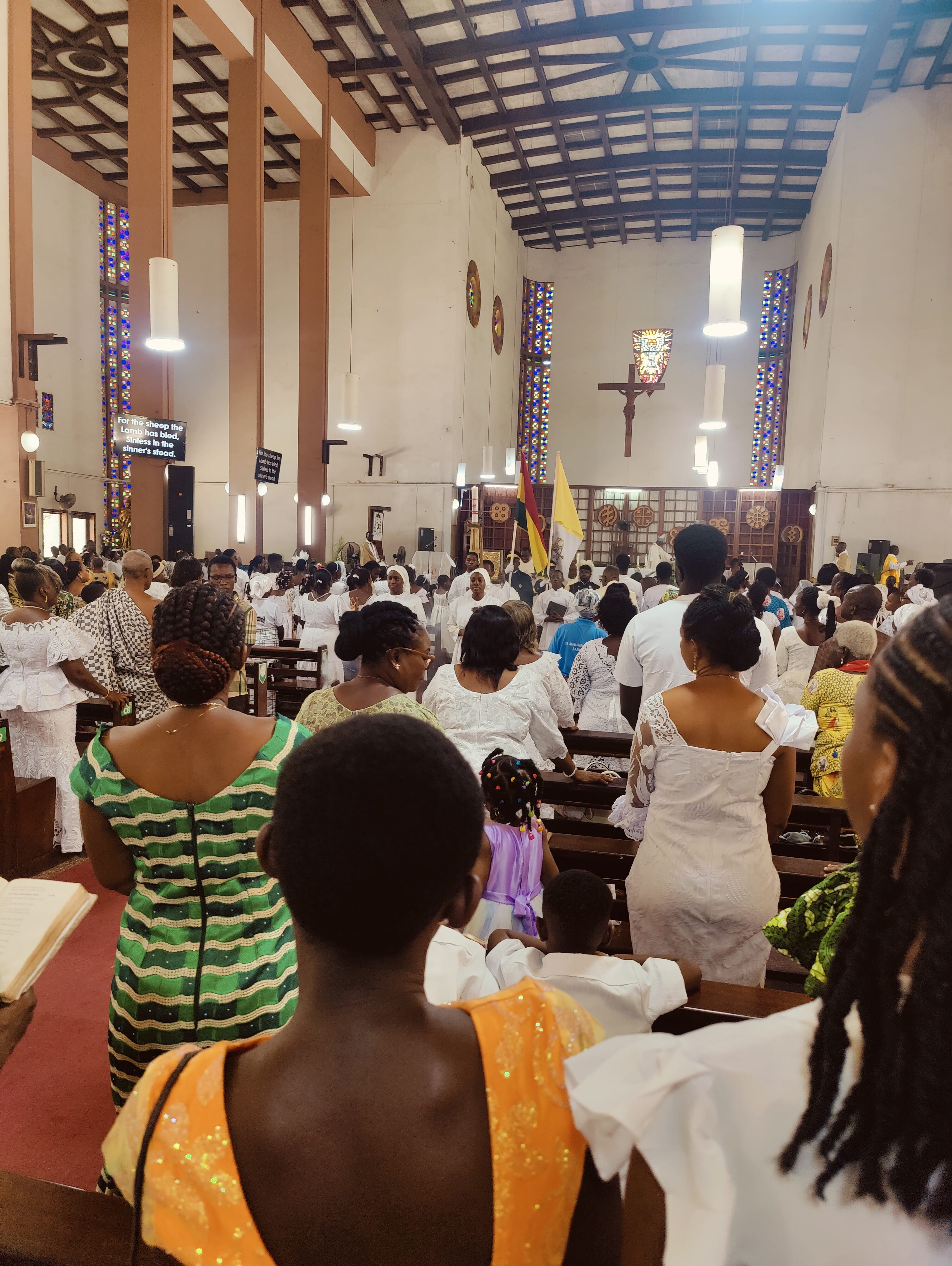
On April 25, the day before Francis’ funeral, I joined a congregation of Catholics who assembled at the Holy Spirit Cathedral in Accra, Ghana for a requiem Mass honoring the late pontiff. The ceremony brought together government officials, religious leaders and lay Catholics from across the country. Ghanaian Foreign Minister Samuel Ablakwa, who led the government’s delegation, spoke at the gathering and recalled Francis’ exhortation for an end to the continent’s economic exploitation by foreign powers.
In many ways, Ghana is symbolic of many contemporary trends in African Catholicism, most of which predated Francis’ papacy and with which he sought to engage. According to data from the 2021 census, 10% of Ghana’s population identifies as Catholic. This makes Catholicism the second-largest Christian denomination in Ghana, and the largest among the so-called historic missionary churches.
Shot taken on Easter Sunday at Holy Spirit Cathedral in Accra, Ghana
However, the percentage of self-identifying Catholics in Ghana has been on a downward trajectory for some time, falling from 15% in the 2000 census to the 10% figure identified in the 2021 census. For good measure, one of the names generating buzz amid speculation about who will succeed Francis is Cardinal Peter Turkson, a Ghanaian prelate who is widely respected among different factions in the Vatican.
In recent years, Catholic bishops in Ghana have expressed concern about the declining number of Catholics in the country, many of whom have defected to the Pentecostal and Charismatic churches whose proliferation has dramatically altered the religious landscape in Africa.
Those fears have been echoed elsewhere like Congo-Brazzaville, where a leading archbishop described Pentecostal churches as waging a “guerrilla war” on the Catholic Church. Although the Catholic Church is the single largest Christian denomination on the continent, Pentecostalism is believed to be growing at a faster clip and has overtaken Catholicism as the largest Christian denomination in many African countries including Ghana.
The reasons for the remarkable growth of Pentecostalism in Africa vary from country to country and continue to be debated, but they generally have to do with a combination of demographic changes, technological advancements, sociopolitical factors and shifts on the continent away from missionary-led inculcation and toward an Africanized form of Christianity that resonates with “indigenous” worldviews.
The role Francis played in the growth of Catholicism in Africa
In Evangelii gaudium, a document Francis released in the first year of his papacy as a blueprint of sorts, he wrote extensively about the challenges Catholicism faced around the world including some of the factors mentioned above. In one excerpt, he wrote that the Catholic faith was being challenged “by the proliferation of new religious movements” and called for “an evangelization capable of shedding light on [these] new ways of relating to God.”
Francis launched the Synod on Synodality, a process of reforms that, if ratified, would bring the most sweeping changes to the Catholic Church since the Second Vatican Council. Many of the reforms Francis implemented during his pontificate were contextually relevant to conditions in Africa. “Faith must be inculturated and culture must be evangelized,” he once said, underscoring his belief in the importance of a Catholic faith that was tailored to the experience of its adherents.
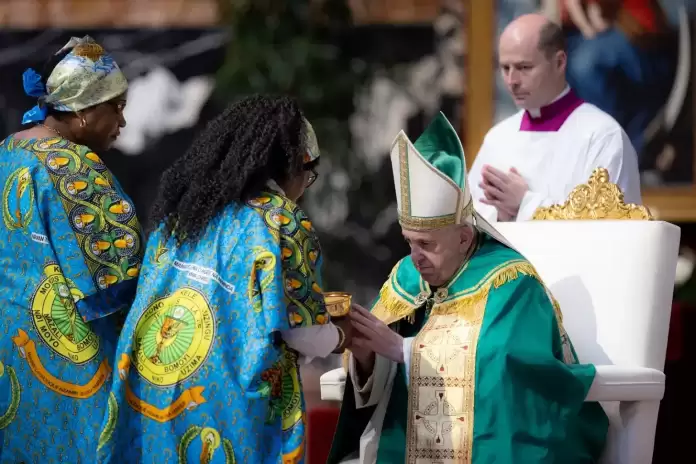
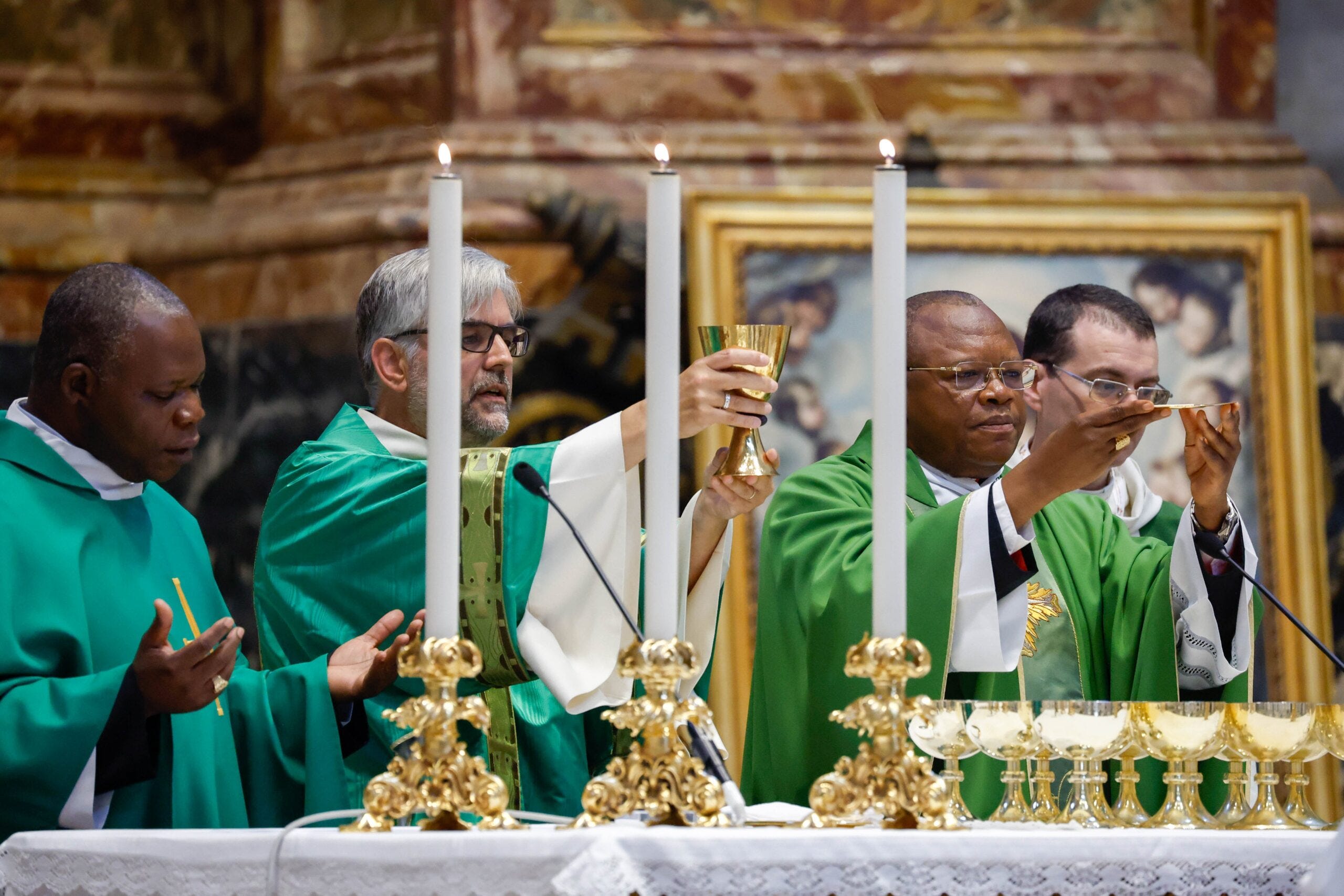
On a number of occasions like the commemoration of the 25th anniversary of the Congolese Catholic Chaplaincy in Rome, Francis administered Mass using the Zairean Rite, a version of the Catholic Church’s traditional Roman Rite that was approved in the 1980s for dioceses in what was then known as Zaire, now called the Democratic Republic of Congo. He regularly cited the rite as a model for inculturation of Catholic liturgy across the world.
Francis appointed 19 African cardinals during his papacy, most of whom will take part in the conclave that will choose his successor. His willingness to entertain the possibility of revising the Catholic Church’s longstanding practice of clerical celibacy in order to address a shortage of priests was pragmatic from the prism of a continent where many adopt a “don’t ask, don’t tell” attitude toward the covert but far from anomalous notion of Catholic priests who are non-celibate and non-chaste.
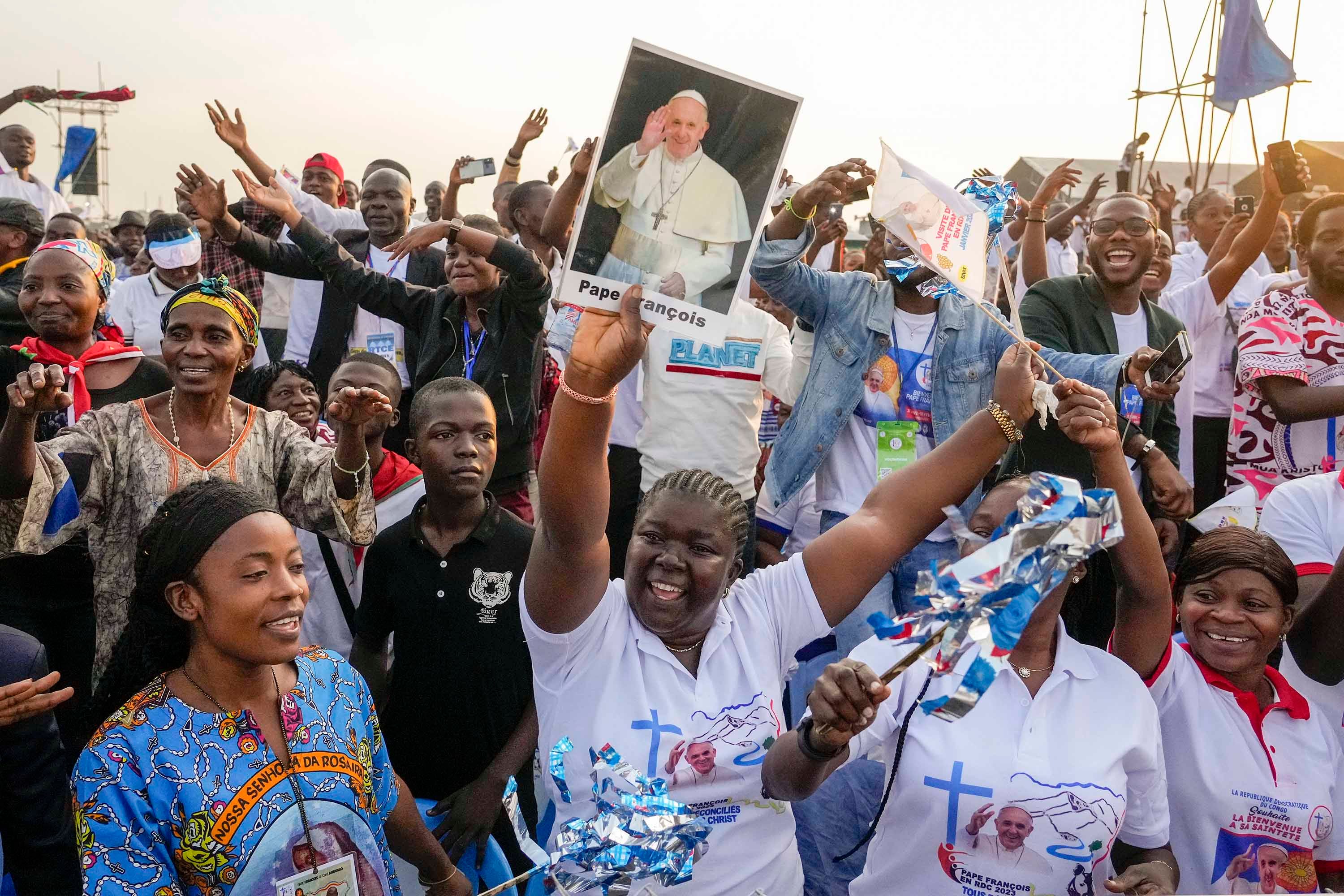
Francis’ visits to the African continent were among my fondest memories of his papacy. He visited 10 African countries in total including Kenya, Uganda, Central African Republic, Mozambique and Congo. He selected his destinations to emphasize the themes he advocated like interfaith dialogue and poverty and to raise international awareness about devastating conflicts, as in the case of Central African Republic and Congo. I wrote about Francis’ visit to Congo in 2023, and you can read that piece here.
Unlike many visiting foreign dignitaries to African countries whose appointments are limited to meetings with local elites and urban professionals, Francis went out of his way to include the poor, victims of war and other socially disadvantaged people in his agenda. Those engagements were devoid of the “slum tourism” by outsiders that is all too common on the continent. Indeed, their common denominator was Francis’ unfailing ability to humanize the people he met, his rebuke of the structural factors that brought out their material conditions and unequivocal calls for powerful elites to change the status quo.
Francis’ engagement with Africa was not always an unqualified success. His effort to reduce clericalism in the Catholic Church flopped on a continent where clergymen retain saintlike authority and the Church as an entity has more capacity and legitimacy in many places than formal state institutions. The idea of female Catholic priests that he ruled out during his papacy but considered a possibility in the future is not widely shared on the continent including by many Catholic women.
Francis’ approval of Fiducia Supplicans, a declaration by the Dicastery for the Doctrine of the Faith — the department in the Roman Curia responsible for enforcing Catholic beliefs — that created the possibility for priests to bless same-sex couples, created a firestorm in African dioceses that is still talked about to this day.
Cardinal Fridolin Ambongo Besungu, a Francis ally who is the archbishop of Kinshasa and the president of the collective body of Africa’s Catholic bishops, spearheaded their rebellion against the declaration. The strong pushback compelled the Vatican to issue a rare “clarification” of its position and essentially forced Rome to affirm the right of local bishops to implement the guidance as they saw fit, including prohibiting the imparting of blessings on same-sex couples.
In media outlets, on WhatsApp and other social media platforms as well as in parishes across the continent, the objection of many African Catholics to Francis’ permissive attitude toward LGBTQ rights was one that I regularly encountered during his papacy, and they saw his inclusivity on the issue as another example of what many on the continent have long viewed as an imposition of Western values on African societies.
Notwithstanding the daylight between Francis and many African Catholics on LGBTQ rights and other cultural issues, he was a beloved figure whose advocacy for the downtrodden and embrace of the continent earned him the affection of millions of Africans, Catholics and non-Catholics alike. While Francis’ popularity in Africa never quite reached the high-water mark of John Paul II (a topic for a future post), he will likely be remembered fondly for the steps he took to position Africa in his vision of Catholicism’s future.
What is the future of the Catholic Church?
The process to select Francis’ successor is expected to begin this week. The possibility of the first African pope of the modern era has been a regular topic of discussion for as long as I can remember and has reemerged ahead of the upcoming conclave. The names of several African cardinals have made the rounds in the ongoing speculation including that of Turkson, Ambongo and Guinea’s Robert Sarah.
I have been asked several times in the recent weeks who I think will be the next pope and whether he will be African. My honest answer is that I have no idea, given how notoriously secretive and opaque papal conclaves tend to be. I would not be all that surprised if an Italian cardinal was selected, given the considerable clamor for the papacy to “return” to the nation that has produced 80% of the Church’s popes but none since John Paul I in 1978.
Regardless of who succeeds Francis, the next pope will have big shoes to fill. He will be faced with the task of leading a Church that is different today from what it was when they were ordained as a priest. While watching Francis’ funeral, I was reminded of several things that underscored the significance of his papacy.
For one, I realized that I’d sometimes taken for granted that a pope is still a remarkably influential global figure who commands a great deal of authority. I was struck by how many people — a good number of them non-Catholics and even non-believers — reached out to me to offer their commiserations after Francis’ passing, which spoke to the virtue of a man who appealed to all kinds of people. Secondly, the unmistakably Eurocentric — and specifically Italocentric — institutional culture of the Catholic Church is deeply woven into its fabric in ways that will take some undoing despite Catholicism’s changing demographics.
The child sexual abuse scandal cast a shadow over Francis’ papacy, and his inability to take firmer action against those who were complicit in the culture of abuse was a major failure. The next pope must be willing to make unpopular but necessary choices that might potentially rope in some close allies but will go a long way in bringing justice to victims.
Another reform that is sorely needed despite my suspicion that it is an unpopular opinion is the question of papal term limits. It is not a particularly novel idea and has been discussed decades before, but its urgency has come into sharper focus.
The Catholic Church is bigger, more far-reaching and complex today than it has ever been. Its leaders including the pontiff need all the vigor in the world and if the Church is to adapt to the modern world, it cannot afford to have vacuums due to the incapacitation of its stewards.
The pope should be mandated to retire at the age of 80 while bishops and cardinals should do so at 70. The latter category of prelates should lose their eligibility to be electors in a papal conclave at 75, the age at which they were previously required to retire.
This might invariably mean that the episcopacy as a whole needs to be younger, which would be more than welcome and was common in Africa and other parts of the Global South in the 20th century, when the first wave of “indigenous” priests and bishops emerged. Catholics must get used to the idea of an ex-pope that Benedict XVI set as a modern precedent, and it should not take another 600 years before the next papal resignation.
As for the Catholic Church in Africa, it will probably continue to grow at a significant pace. It is the largest non-governmental provider of many vital social services like education, health care, humanitarian services, election integrity, peacebuilding and skills acquisition, and the Church’s continued growth is strongly linked to its embeddedness in African societies. However, the “competition” from Pentecostalism is unlikely to diminish anytime soon.
The next pope should not view that challenge as a zero-sum game but instead embrace it as part of the “apostolic zeal” that Francis described as a measure of the Catholic Church’s spiritual health. If millions of Africans including Catholics are turning toward Pentecostal churches, it is because it fulfills a need in their lives above and beyond a yearning for financial prosperity, as some critics simplistically argue.
Across the continent, the Catholic Church is a revered institution that many have great expectations of and which it evidently does not always succeed at meeting. It must find a way to renew its relevance to those who believe it is unconnected to their contemporary priorities or a relic of the past. Like many other African Catholics, I shall pray for the next pope and wish him well in his leadership of a Church we hold dear in our hearts.
Yoruba name for fever is Ibà. There is also a town in Yorubaland called Ibà (the same pronunciation as fever), in Ifelodun Local Government Area of Osun State. And there are different types of Ibà. If my syntax is correct, especially in pluralisation of nouns, the plural of Ibà in Yoruba lexicography will be Ibàs. This, of course, is achieved by mere inflection.
Yoruba medical taxonomy says there is Ibà apóntò (the fever that makes one urine to be yellowish – Malaria Fever). There is also Íbà pónjú (the fever that makes one eyeball to be yellowish – Yellow Fever). The third is the worst. It is called Ako Ibà (male fever) which causes one’s urine and eyeballs to be yellowish and the skin to turn pale.
Ako Ibà in modern medicine will be Typhoid fever. Ako Ibà is cerebral, and it kills faster than any other type of fever. An Ako Ibà patient is close to a psychiatric patient. Whoever is afflicted, especially at its advanced stage, talks about things out of this planet. He thinks he is something that he is not.
A little cousin who suffered from Typhoid years back claimed that he was the husband of his elder sister and demanded for conjugal benevolence. His mother wept bitterly, thinking that her precious son had gone gaga. But the elders around knew it was an Ako Ibà. Whoever has it thinks that he is the husband of the reigning Queen of the land!
I swear down, no pun is intended here. This headline is a mere coincidence. My mind, no, my pen, pleasantly sorry, my keyboard, is the one playing tricks here. But the devil is a liar!
The Scripture is true. That is what the Christian Faith teaches. Less than a week ago, the scripture as contained in Acts 19:15, to wit: “…Jesus I know, Paul I know; but who are ye” (KJV), was made life by some women. Women have always been at the centre of the Gospel. Little wonder they were the only set of people who sought Jesus out after His crucifixion! Those our mothers have a way of making seemingly complex matters simple!
The iconoclast of this epoch, Abami Eda (the weird one), Fela Anikulapo Kuti, in 1971 released his lampoon album, Yellow Fever, where he sang about different fevers. The maverick musicologist was in his best wits in that album.
Something happened in Rivers State last Friday. As we all know, a lot has been happening in Rivers State since March 18, 2025, when President Bola Ahmed Tinubu decided to afflict the people of the state with an Ako Ibà in the name of a thoughtless state of emergency. He sacked all the democratic institutions in the state and replaced the democratically elected governor, Siminalayi Fubara, with a Sole Administrator (Solad), a former Chief of Naval Staff, Ibok Ekwe Ibas.
Like an Ajélè (envoy) of a feudal lord, Ibas has been carrying on in Rivers in manners that make nonsense of the axiomatic expression of one who is sent on an errand like a slave delivering it like a freeborn. In a way that is typical of someone suffering from Ako Ibà, Solad Ibas has been carrying on as if he was elected by the people of Rivers State.
Give a leper a handshake, our elders say, he will request for a warm embrace. Because the people of the state, especially the menfolk, refused, or were/are too complacent to resist the illegality of a Sole Administrator in the state, Ibas has carried his sacrifice beyond the mosque. Treating Rivers State like a conquered territory, the impostor in The Brick House has been acting in manners that suggest that Nigeria is still under a military regime.
First, Ibas dissolved all statutory Boards of parastatals in the state. He went ahead to dissolve the State Independent Electoral Commission, appointed Special Advisers for himself, and started going into areas that his illegal appointment did not envisage in the first instance. The worst of it all is that President Tinubu, in his morbid disdain for the people of the state, did not find any worthy Rivers State indigene to appoint as the Solad, a position that yells blue murder in our democracy!
A lot has been said and written about the unconstitutionality of the declaration of a state of emergency in Rivers State. Many people have opined, and correctly too, that Tinubu’s action was, and is still informed by his ambition to have all the 17 states in the South under his armpits for the 2027 presidential election. He needs the entire South to fight his estranged friends in the North. The argument, which events in other states have proved to be valid, is that there is nothing altruistic in the impulsive action of the President.
Many, including yours sincerely, keep wondering why President Tinubu is still retaining Nyesom Wike and his pathologically infantile behaviours as a minister in his cabinet despite his obvious roles in the crises in the state. Why the President chose to be an Adájó owú (the unrighteous judge) in this matter remains a mystery. The only plausible reason for retaining Wike is that the President is compensating the tempestuous minister for a job well done!
What, in my estimation, betrays President Tinubu’s ulterior motives in Rivers State is the killings in Plateau and Benue States in the past few weeks. If President Tinubu could declare a state of emergency in Rivers State where there was no single killing, why not in Plateau and Benue States? What else does Tinubu want to happen in those two states before he would be convinced that laws and orders have broken down there? If we juxtapose this with the fact that President Tinubu stayed put in France where he had gone to ‘reflect’ on his two years in office while Plateau, Benue Borno States were on fire, one can then understand how our leaders reason!
And before I am accused of crying more than the bereaved, especially when Governor Fubara is said to be holding nocturnal meetings with his traducers, let us take a detour back to the main gist of the Ako Ibàs that is afflicting the oil-rich Rivers State.
The appointed Solad, forgetting that he is a butterfly and cannot fly like a bird, decided to rub salt on the injury of Rivers State and its people by promoting the obnoxious office of a First Lady. The retired Vice Admiral did not only relocate to the state bag and baggage, he decided to come along with his wife, Theresa Ibas.
Don’t blame ‘Madam Excellency ‘, the wife of Rivers State Solad. When the farm becomes desolate, the lizard makes the palm fruits its delicacy (Ilè dà fún alángbá je eyín). Mrs. Ibas, like her husband, thinks that she is entitled to all the pecks of office for the wife of an elected governor is illegally getting in our political system. So, she stepped up her games and started acting like the First Lady of the state, summoning meetings, directing women and carrying on with the full complement of the office of ‘Her Excellency, the First Lady of Rivers State’.
But trust Rivers women. They are strong-willed. They have seen and treated different types of fever in their motherhood. They have different antidotes for Ako Ibà. And when they saw the symptoms of a chronic Ako Ibà in Mrs. Ibas last Friday, the women, like the good mothers they are, decided to administer the right concoction in prescribed dosage.
The event was the Renewed Hope Initiative (RHI), whatever that means in the face of the current hopelessness, under the control of the First Lady of the Federation – another misnomer of this era – Mrs. Oluremi Tinubu. That charade of women empowerment has been going on across the states of the Federation in the last couple of weeks.
Last Friday was the turn of Rivers State. The RHI office in collaboration with the Millennium Development Goals (MDGs), gathered the women at the EU Event Centre, Port Harcourt, with the intention that Mrs. Tinubu would be there to empower 500 Rivers State women with “livelihood empowerment equipment.”
Matters took a dramatic turn when Mrs. Theresa Ibas stepped up to the podium to deliver Mrs. Tinubu’s address. The women were shocked. They stayed rooted to their chairs as Madam Ibas made her way to the state lectern. Then suddenly, the alarm blew in their heads. Something snapped! The women realised that a stranger was about to address them instead of the wife of the governor they elected.
Just as the evil spirit told the sons of Sceva that tried to imitate the apostles, to wit: “…Jesus I know, and Paul I know; but who are ye?” (Acts 19:15), Rivers women rose up and chorused, like the days of the Bible: “Valerie Fubara we know. Remi Tinubu, we know. Who are you?” Before the distraught Mrs. Ibas could recover from the shock, the women all stood up and began to sing: “”We want Sim/Give us Sim/We want Valery/We want Remi Tinubu to speak to us.” And they walked out, singing, gyrating and twerking!
Ask me a million times. I love those Rivers women! They are not just beautiful; they are simply courageous. I watched the video of the encounter several times. It reminds me of the old evangelism song of our Anglican crusades of yore where we affirmed the position of women in the propagation of the Gospel. The song played in my head again as I penned this. The lyrics easily came to mind: Obìrin yíó gbe, obìrin yíó gbe; b’ókùnrin bá ko Jésù sílè, obìrin yíó gbe (the womenfolk would carry Him if the menfolk refused to lift Jesus, the womenfolk would carry Him).
One of the courageous women, Ekpeye Favour, while speaking with journalists after the heroic walkout said that the women had nothing against the wife of the President, but the impostor who came out to address them.
“We were told to come out and welcome Her Excellency Senator Remi Tinubu and be dressed up…. We wore shirts with her picture and our First Lady’s imprinted on the shirts…. only to be addressed by someone claiming to be our First Lady in this state. And women could not sit down and watch such things happen. So, they stood up and left.” Ekpeye then sent the women’s message in clear terms: “We have a governor. We love our governor. We support our governor. We have a First Lady. And we are just saying one governor at a time. We have a president, one president at a time…”
Those beautiful women of Rivers have sent the challenge. It is an unmistaken challenge. If Rivers men are acting like they don’t have balls anymore, the women are there for the rescue. The men can continue to fall over one another to curry favour from Solad Ibas. Rivers women would have no such buffoonery! If anyone approaches the women with any symptoms of Ako Ibà, no matter how severe the symptoms are, they have the antidotes in full dosage!
How did the legendary widow, Nwanyereuwa, who led the Aba women riot of November 18, 1929, react in her grave? The Amazon, Olufunmilayo Ransome Kuti must have turned in her grave to give the victory salute to those women of valour! Mother Moremi Ajasoro, the beautiful princess from Offa, who sacrificed all she had to save Ile-Ife, must be proud of the Rivers women. Queen Idia, the late Iyoba (Queen Mother) of Benin Kingdom during the reign of Omo N’Oba Esigie (1504-1550), is no doubt giving a thumbs up for the Rivers women. Our adorable Dora Akunyili, as she moved the motion to make the then Vice President Goodluck Jonathan the acting President on February 17, 2020, easily came to mind as I watched the video of the Port Harcourt encounter. Nigerian women have always given a good account of themselves whenever the hearts of men failed. Those women in Rivers State re-enacted that resilience last Friday. I am proud of them!
Nigerians have a lot to learn from that singular incident. Rivers State people can arrest the illegality of a Sole Administrator in their dear state if all of them would do what those beautiful women did last Friday. Ibas is acting as if he has the mandate of the people because whenever he calls, some people respond. Rivers State people need to stop that abnormality. Ibas’ orò (deity) can only whimper if it has people behind him.
The consciousness that President Tinubu has no right to suspend an elected governor should be registered in the minds of the people. They need to be reoriented that it is illegal for Tinubu to dissolve a state legislature and appoint a Sole Administrator. The people must realise that Tinubu cannot and does not have the power to suspend democracy in any part of the country. Nigeria, or any part thereof does not belong to the President. It doesn’t matter what Fubara is doing behind the curtains. The mandate he holds belongs to the people; only the people can retrieve it from the impostors usurping the people’s sovereignty!
If Rivers State people want their elected governor back, and the dismantled democratic structures in the state restored, the women have shown the way. It is not rebellion; it is not even a call to action. It is no incitement. It is eternally legal to resist all unconstitutional acts. No where in the world such a despicable act is carried out except in the Nigeria of Tinubu. General Olusegun Obasanjo did it and we all condemned him. Tinubu cannot be an exception.
If there is any rebellion against Rivers State, it is the March 18, 2025, state of emergency. We should get it right. With the failure of the Tinubu administration in all facets of our nationhood, the President ought to have declared a state of emergency in the Presidency itself and handed it over to a National Sole Administrator! We copied this present Presidential system of government from America. In its 249 years (from 1776) of democracy, no American President has ever removed a state governor! It is rather unfortunate that a so-called democrat is the one perpetrating this illegality in our nation. So, resisting Ibas and boycotting or walking out on him and his wife at events is legal and one of the inalienable rights of the people of Rivers State.
For those courageous and beautiful women of Rivers State, as they move about with their pots of concoction to cure all Ako Ibàs in their state, I evoke here, the spirit of Birago Diop, the… poet, who in “Viaticum”, evokes: “Go into the world; go! They (spirits of the ancestors) follow your steps in life.” May the spirits of Nwanyereuwa, Olufunmilayo Ransome Kuti, Moremi, Akunyili and all departed heroines continue to watch over those women with nerves! May Nigeria and Nigerians survive the Frankenstein monster we inadvertently imposed on our nation!
The views expressed by contributors are strictly personal and not of Law & Society Magazine.
Court bans Nnamdi Kanu’s sister-in-law for live-streaming trial proceedings
There was a mild drama in court on Tuesday when the detained leader of the proscribed Indigenous People of Biafra (IPOB), Mazi Nnamdi Kanu, disowned a lawyer, one Charles Ude, who claimed to be representing him.
Also, the trial judge, Hon. Justice James Omotosho, banned Favour Kanu, the wife of Prince Fineboy Kanu, younger brother of Kanu, from attending the next three court sessions after she streamed the proceedings live on her Facebook page.
Kanu is facing terrorism-related charges before the court.
During the trial, the presiding judge drew the attention of the parties to a letter from one Charles Ude, claiming to be counsel on record for the defendant.
However, the defence legal team denied knowledge of Ude, a stance Kanu himself affirmed, insisting Agabi remained his counsel.
The court also addressed the issue of the overcrowded defence team.
According to the judge, only 16 of the 26 lawyers listed would be allowed, citing a previous agreement and threatening to move the proceedings online if decorum was not maintained.
“I don’t want to be pushed to take the case virtually; we have the facility,” the judge warned.
In the incident involving Favour Kanu, Justice Omotosho recounted how he had previously warned her and refrained from charging her for contempt.
Although Chief Kanu Agabi begged the court for forgiveness on her behalf, Justice Omotosho maintained that she must be barred for three sittings.
He expressed disbelief that she still went ahead to post the video online despite her phone being seized during a previous court date for a similar offence.
“I want to hear from her. Were you not the one who took your phone?” the judge asked.
“I did not give the order to forfeit that phone.”
Favour, when called upon, claimed ignorance of the court still being in session and stated that she had stopped recording immediately after the warning.
“I didn’t know the court was still sitting. The moment you cautioned me, I stopped because it was a livestream,” she said.
The judge, while listening to both explanations, temporarily excused Favour from attending the next three sittings, reiterating the need for order and respect for the court’s process. “We must do things properly. Justice will be done,” he said.
Earlier, lead prosecution counsel, Chief Adegboyega Awomolo, SAN, raised concerns about a motion served on them for the release of certain exhibits tendered in court.
He noted the prosecution objected only to the release of non-perishable items.
During cross-examination of the first prosecution witness (identified as AAA), the defence counsel, Agabi, grilled the witness on his awareness of the charges and previous rulings.
The witness admitted knowing little about the details of the 15-count charge, including several that had reportedly been struck out by the court.
The witness acknowledged awareness of IPOB’s role in enforcing Monday sit-at-home orders, which the defence suggested were among charges that had been dismissed.
Agabi repeatedly highlighted that several serious terrorism-related allegations — including disruption of elections and attacks on federal property — were part of the struck-out charges, a point the witness said he was largely unaware of.
In re-examination, Awomolo asked the witness what he understood by “agitation” in the context of Kanu’s actions.
The witness responded that the defendant was pushing for the secession of parts of Nigeria.
The Joint Admissions and Matriculation Board (JAMB) has released the official results of the 2025 Unified Tertiary Matriculation Examination (UTME), which was conducted from Thursday, April 24.
According to the examination body, over 1.9 million candidates sat for the UTME nationwide.
Data published by JAMB on Monday disclosed that 420,415 candidates scored above 200 out of the 1,955,069 who participated in the exams, representing 21.5 percent.
Over 75 per cent scored below 200, while fewer than one percent scored above 300.
Among those who sat for the exam were 40,247 underage candidates, but only 467 (1.16%) met the minimum benchmark for exceptional ability, and further assessments are pending.
Below is a step-by-step guide on how to check your JAMB result
For candidates eager to access their results, JAMB has provided two official methods: via the eFacility portal and by SMS. Here’s a clear, step-by-step guide on how to check your 2025 UTME results:
Method 1: Checking UTME Results Online via JAMB eFacility Portal
In what many considered to be a groundbreaking move, the National Judicial Council (NJC) introduced a policy aimed at enhancing transparency and accountability in the appointment of judicial officers to Superior Courts of Record in Nigeria.
A statement issued today by the NJC announced that all judicial appointment memoranda—previously received from various Judicial Service Commissions and pending before the Council—will now be published at the initial stage as part of comprehensive reforms in the judicial appointment process.
In line with its 30 April 2025 pledge that the names of candidates being considered for appointment as Judicial Officers to Superior Courts of Records will be published for information and comments by the public, the NJC has released the list of candidates for appointment.
However, an ex-Chair of the National Human Rights Commission and law teacher, Prof. Chidi Odinkalu, in a series of tweets today (5 May, 2025) via his X (formerly Twitter) handle, alleged that the publication is subterfuge as the preferred candidates have already been selected.
Odinkalu also revealed that in a particular round of appointments, the request to the Nigerian Bar Association went out as the process formally closed. Then the responses as well as the applications of candidates who were not insiders went into the bin.
“The @njcNig has released names of 80 candidates for judicial office in superior courts of record, including 53 to the High Court; 20 to Sharia Courts of Appeal; 7 to Customary Courts of Appeal & 2 state CJs. That’s useful but far from enough….
“The announcement by @njcNig invites the public to provide information or feedback on the candidates within 14 days & rightfully warns that spurious or false information will attract consequences. It also provides an e-mail address for those interested: [email protected].
“There are some issues that @njcNig must address. 1st, the announcement does not disclose what will follow at the end of the 14 days. Ppl who don’t have a credible assurance as to how information that they provide will be handled, are unlikely to respond with enthusiasm.
“2nd, it’s not clear that @njcNig has the capacity to credibly handle or process a possible deluge of #OpenSource information of the kind it is asking for in the digital age. While the intention may be good, the process needs to be more carefully thought through if it’s to help.
“3rd, previous experience lends credence to these. It was a requirement until now that the Council had to invite feedback on appointment rounds from @NigBarAssoc. In most of the appointments in the tenure of the immediate past #CJN, nothing was done with the comments from NBA.
“Indeed, in 1 particular round of appointments into a popular High Court in the country in the past 2 yrs, the request to @NigBarAssoc went out as the process formally closed. Then the responses as well as the applications of candidates who were not insiders went into the bin.
“As it turned out, the ‘slots’ had all been allocated to the sons, daughters, wives & relatives of some ‘owners of the judiciary’ & the process of inviting @NigBarAssoc to comment was a cover for affording a figleaf of legitimacy to brazen looting of judicial appointments.
“What needs to change is more than just inviting the public to send comments to @njcNig with no indication as to what happens next. If @njcNig wants to be taken seriously, it needs to show a capacity to process what it’ll get & the will to assure that what it gets will matter.”
The NJC approval given during the Council’s 108th Meeting held on April 29-30, 2025, resulted in the publication of 80 shortlisted candidates for various judicial positions across multiple states.
The list includes two candidates for the position of Chief Judge in Ekiti State and 78 other nominees for positions as Judges of High Courts (53), Kadis of Sharia Courts of Appeal (20), and Judges of Customary Courts of Appeal (7) across nine states including Cross River, Delta, Kano, Katsina, Niger, Ogun, Plateau, Zamfara, and Ebonyi.
In line with the new transparency initiative, the NJC has invited public participation in the vetting process, requesting written comments on the candidates’ integrity, reputation, and suitability for judicial appointment within fourteen days.
“Each complaint or comment must be specific and supported with sufficient particulars,” the statement noted, adding that submissions must be accompanied by a verifying affidavit deposed to before a Superior Court of Nigeria or any Notary Public.
The Council warned against false and unsubstantiated complaints, emphasizing that “there will be consequences” for such actions.
Written submissions can be sent to the Office of the Secretary of the NJC at the Supreme Court Complex, Three Arms Zone, Abuja, or via email to [email protected].
APPOINTMENT OF JUDICIAL OFFICERS TO SUPERIOR COURTS OF RECORD CALL FOR COMMENTS
As part of ongoing efforts toward comprehensive reforms in the judicial appointment process, the National Judicial Council (NJC), at its 108th Meeting held on 29th and 30th April 2025, approved a groundbreaking policy aimed at enhancing transparency and accountability in the appointment of Judicial Officers to Superior Courts of Record in Nigeria.
Under the newly adopted policy, all memoranda on judicial appointments—previously received from various Judicial Service Commissions and pending before the Council—shall now be published at the initial stage.
List of Shortlisted Candidates
I. For Appointment as Chief Judge
S/N
Name
Jurisdiction
1
Hon. Justice Adekanye Lekan Ogunmoye
Ekiti
2
Hon. Justice Ogunyemi Olusegun Isaac
Ekiti
II. For Appointment as Judges of the High Courts, Kadis of the Sharia Courts of Appeal, and Judges of the Customary Courts of Appeal
HIGH COURT JUDGES (Total: 53)
Glory Bassey Edu – High Court, Cross River
Melody Bassey Irem – High Court, Cross River
Ukuli Irene Boeye – High Court, Delta
Otite Jonah Akporuaro – High Court, Delta
Adamidenyo Otome Benjamin – High Court, Delta
Sam-Oligida Jereoma – High Court, Delta
Ogbimi Samuel Okpighe – High Court, Delta
Etanabene Gloria Oghoteru – High Court, Delta
Nafisa Yusuf Hassan – High Court, Kano
Halima Yahuza Ahmad – High Court, Kano
Musa Ibrahim Umar – High Court, Kano
Abdulkadir Mustapha – High Court, Kano
Amina Bashir Albasu – High Court, Kano
Abdullahi A. Bature – High Court, Kano
Fadila Muhammad Dikko – High Court, Katsina
Abdulrahman Yammama Shamsuddeen – High Court, Katsina
Amina Ibrahim Danmusa – High Court, Katsina
Maryam Umaru Abdullahi – High Court, Katsina
Mustapha Hassan Ruma – High Court, Katsina
Basira Umar Faruk – High Court, Katsina
Abdur-Rahman Umar – High Court, Katsina
Abubakar Mohammed Dikko – High Court, Katsina
Ahmed Ndajiwo – High Court, Niger
Sa’adatu Gambo – High Court, Niger
Adamu Abubakar – High Court, Niger
Suleiman B. Wushishi – High Court, Niger
Isah Adamu Evuti – High Court, Niger
Abdullahi Alkali – High Court, Niger
Murtala M. B. Ibrahim – High Court, Niger
Hauwa Kulu Isah – High Court, Niger
Adebayo Julius Ojikutu – High Court, Ogun
Adejumoke Oluwatoyin Adewole – High Court, Ogun
Oluyemisi Olukemi Adebo – High Court, Ogun
Fatimat Adeola Daudu – High Court, Ogun
Oludotun Olaniyi Osho – High Court, Ogun
Olakunlehin Luqman Oke – High Court, Ogun
Andrawus Maikai – High Court, Plateau
Tongret N. Kparbong – High Court, Plateau
Kingsley Mangai Mallan – High Court, Plateau
Diane Ngummal Nkwap – High Court, Plateau
John Ishaku Mantu – High Court, Plateau
Gavou Bature Musa – High Court, Plateau
Tapmwa Gotep – High Court, Plateau
Eric Rinmial Naron – High Court, Plateau
Pekes Habila Ezekiel – High Court, Plateau
Dajan Manasseh Dakogol – High Court, Plateau
Lyop Plyo – High Court, Plateau
Zakka Dung – High Court, Plateau
Sirajo Garba Aliyu – High Court, Zamfara
Rabi Bashir – High Court, Zamfara
Nasiru Abdullahi – High Court, Zamfara
Aishatu Jibrin – High Court, Zamfara
Rukubatu Aliyu Kanoma – High Court, Zamfara
Abubakar Aliyu Salisu – High Court, Zamfara
CUSTOMARY COURT OF APPEAL JUDGES (Total: 6)
Ojeikere Bridget Onome – Customary Court of Appeal, Delta
Okah Stella Ovuorieroro – Customary Court of Appeal, Delta
Okeri Efe – Customary Court of Appeal, Delta
Tomoloju Ojigho Dorcas – Customary Court of Appeal, Delta
Ogodo Lynda Nneka – Customary Court of Appeal, Ebonyi
Amaka Dickson Edmund – Customary Court of Appeal, Ebonyi
SHARIA COURT OF APPEAL JUDGES – KATSINA (Total: 6)
Mutawakkil Mustapha Salis – Sharia Court of Appeal, Katsina
Isah Usman Ibrahim – Sharia Court of Appeal, Katsina
Uzairu Muhammad Dauda – Sharia Court of Appeal, Katsina
Ibrahim Abdullahi Yakubu – Sharia Court of Appeal, Katsina
Musa Sani Mara – Sharia Court of Appeal, Katsina
Bala Salisu – Sharia Court of Appeal, Katsina
SHARIA COURT OF APPEAL JUDGES – NIGER (Total: 6)
Jibrin Alhaji Usman – Sharia Court of Appeal, Niger
Hassan Ibn Muhammad – Sharia Court of Appeal, Niger
Suleiman Ibrahim Muhammad – Sharia Court of Appeal, Niger
Usman Abdulrahman Aboki – Sharia Court of Appeal, Niger
Ya’aba Mohammed – Sharia Court of Appeal, Niger
Muhammad Nasir Ibrahim – Sharia Court of Appeal, Niger
SHARIA COURT OF APPEAL JUDGES – PLATEAU (Total: 2)
Badamasi Adam Kabir – Sharia Court of Appeal, Plateau
Lawal Suleiman – Sharia Court of Appeal, Plateau
SHARIA COURT OF APPEAL JUDGES – ZAMFARA (Total: 6)
Jibril Ibrahim – Sharia Court of Appeal, Zamfara
Sanusi Muhammad Magami – Sharia Court of Appeal, Zamfara
Sha’aban Mansur – Sharia Court of Appeal, Zamfara
Sharif Ibrahim Jangebe – Sharia Court of Appeal, Zamfara
Abdullahi Usman – Sharia Court of Appeal, Zamfara
Aliyu Muhammad Madacci – Sharia Court of Appeal, Zamfara
Total Number of Candidates: 80
Key Guidelines for Public Participation in Judicial Appointments
The NJC invites the public to submit comments on the shortlisted candidates on their integrity, reputation, and suitability for judicial appointment.
All comments or complaints must be submitted IN WRITING to the Office of the Secretary of the NJC or via email within fourteen (14) days from the date of publication of this notice.
Postal address: National Judicial Council, Supreme Court Complex, Three Arms Zone, Abuja
Each complaint/comment shall be accompanied by a verifying affidavit deposed to by the writer before a Superior Court of Nigeria or any Notary Public. Accordingly, the public is advised
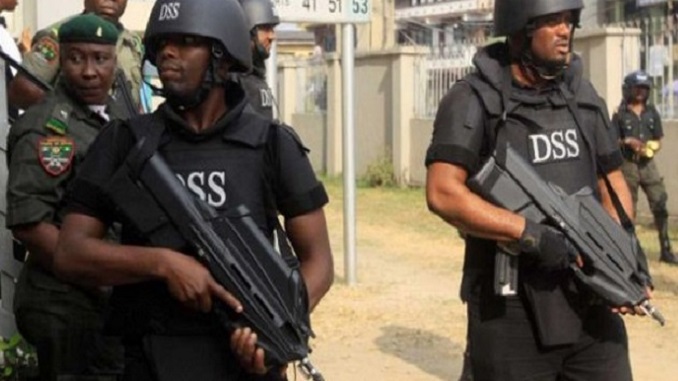
The Department of State Services (DSS) has come under fire for its recent arrest and detention of Marxist activist Kola Edokpayi and several others in Benin City, Edo State capital. The activists were preparing to stage a solidarity protest in support of Captain Ibrahim Traore, the President of Burkina Faso, and against imperialism and neo-colonialism.
According to sources, the DSS operatives invaded Edokpayi’s office, ransacked it, and arrested him and several others. The action was reportedly taken despite the fact that the Commissioner of Police, Edo State, had already met with Edokpayi and his team the previous day, and the planned protest was called off.
Concerns are growing over Edokpayi’s welfare, as he has been denied access to food, water, and visitors since his arrest. His wife was reportedly turned away when she attempted to visit him, and there are fears that he may have been relocated to Abuja to face treason charges.
The planned protest, which was meant to highlight the dangers of imperialism and neo-colonialism, was peaceful and did not pose any threat to national security. The DSS’s actions have sparked outrage and raised questions about the state of human rights and freedom of expression in Nigeria.
Key Issues:
Unlawful arrest and detention: Edokpayi and others were arrested without justification, raising concerns about the DSS’s powers and accountability.
Denial of basic rights: Edokpayi’s access to food, water, and visitors has been restricted, sparking concerns about his welfare.
Freedom of expression: The DSS’s actions may have a chilling effect on freedom of expression and the right to peaceful assembly.
Calls for Action:
Release Edokpayi and others: Human rights groups and activists are calling for the immediate release of Edokpayi and others arrested in connection with the planned protest.
Investigate DSS actions: There are calls for an investigation into the DSS’s actions and for accountability for any human rights abuses.
Protect human rights: The Nigerian government is urged to take steps to protect human rights and freedom of expression, and to ensure that security agencies operate within the law.
The incident has sparked widespread outrage and raised concerns about the state of democracy in Nigeria. As the situation unfolds, it remains to be seen how the government will respond to these concerns and ensure that human rights are protected.
Our site uses cookies. By clicking “Accept All Cookies”, you direct Law and Society Magazine to store cookies on your device and disclose information in accordance with our Cookie Statement: cookie policyACCEPTREJECT
Privacy & Cookies Policy
Privacy Overview
This website uses cookies to improve your experience while you navigate through the website. Out of these cookies, the cookies that are categorized as necessary are stored on your browser as they are essential for the working of basic functionalities of the website. We also use third-party cookies that help us analyze and understand how you use this website. These cookies will be stored in your browser only with your consent. You also have the option to opt-out of these cookies. But opting out of some of these cookies may have an effect on your browsing experience.
Necessary cookies are absolutely essential for the website to function properly. This category only includes cookies that ensures basic functionalities and security features of the website. These cookies do not store any personal information.
Any cookies that may not be particularly necessary for the website to function and is used specifically to collect user personal data via analytics, ads, other embedded contents are termed as non-necessary cookies. It is mandatory to procure user consent prior to running these cookies on your website.