Home Blog Page 361

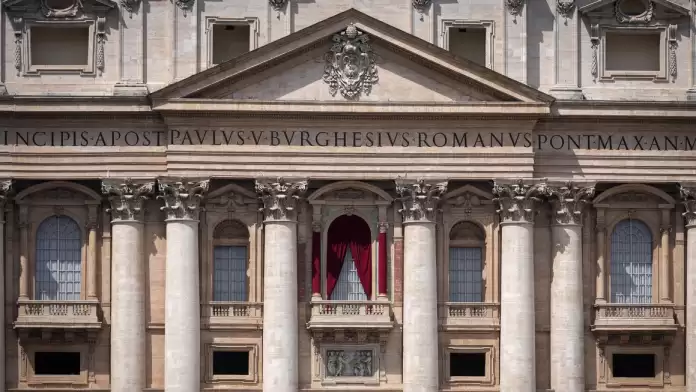
Cardinals choosing the next pope have been offered a dossier on candidates – with a subtext

By CNN

When the cardinals enter the Sistine Chapel on Wednesday at the start of conclave, the process of electing a new pope, they will be sealed off from the world.

But that doesn’t stop people trying to influence the thinking of the 133 prelates who will choose a successor to the late Pope Francis. The electors are allowed to take in written materials and, in the days leading up to the conclave, have been offered a book on their fellow cardinals – one which contains a clear message.

Titled “The College of Cardinals Report,” it offers profiles on around 40 papal candidates, including a breakdown on where they stand on topics such as same-sex blessings, ordaining female deacons and the church’s teaching on contraception. The subtext: Choose a pope who will take the church in a different direction to Pope Francis – whose progressive reforms angered some conservatives.

The College of Cardinals report is freely available online but has also been produced as a large format book. One retired cardinal, not eligible to take part in conclave, told CNN he had received a hard copy.

Click here to continue reading.

How African popes changed Christianity – and gave us Valentine’s Day

Now predominantly Muslim, North Africa was once a Christian heartland, producing Catholic popes who left their mark on the Church to this day.

Their papacies were in the era of the Roman Empire, which stretched across modern-day Tunisia, the north-east of Algeria and the coast of western Libya.

“North Africa was the Bible Belt of ancient Christianity,” says Prof Christopher Bellitto, a historian at Kean University in the US.

Many Catholics in Africa are hoping that the papacy will return to the continent for the first time in more than 1,500 years, as a successor to Pope Francis is chosen.

Here, we look at the three previous African popes – and how they got Christians to celebrate Easter Sunday and St Valentine’s Day.

All three have been recognised in the Church as saints.

Click here to continue reading.

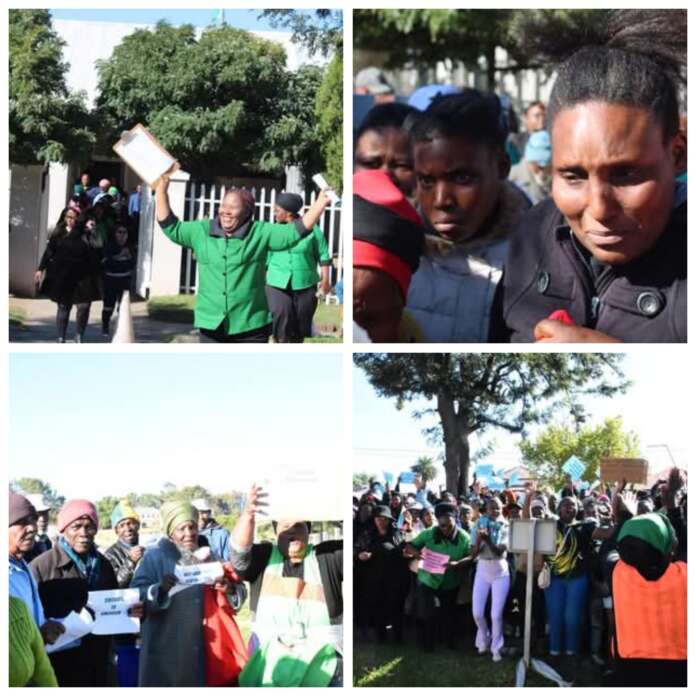
Charges withdrawn against South African woman who allegedly killed disabled daughter’s rapist

A 44-year-old South African woman who allegedly murdered her disabled daughter’s rapist, has been cleared of all charges.

The Eastern Cape woman made a brief appearance in the Lady Frere Magistrate’s Court in the Emalahleni Local Municipality on Monday, May 5, 2025.

LIB reported that she was arrested after the incident which occurred early last month in Cacadu, and was later released on R500 bail.

Eastern Cape Premier, Lubabalo Oscar Mabuyane, who attended the court proceedings alongside Social Development MEC Bukiwe Fanta, welcomed the National Prosecuting Authority’s decision.

“While we acknowledge the independence of the judiciary and respect the legal processes that were followed, we commend the NPA for its sensitivity and careful consideration of the extreme circumstances that led to this tragic incident,” said Premier Mabuyane. 

“This decision reflects a compassionate understanding of the context and the instinctive protective actions taken by a mother in a moment of unimaginable trauma.”

The Premier described the matter as one that “has resonated deeply across the province and the nation, touching a collective nerve and highlighting the immense emotional and psychological toll that gender-based violence continues to inflict on families and communities.”

He emphasized that no parent should ever be forced into a position where they must physically intervene to protect their child from harm

“We must ensure that our communities are safe places where children can grow without fear and where women are protected and supported. No one must live in fear in their own home,” Mabuyane said.

“This is a call to all sectors, government, civil society, traditional leaders, and especially men in our communities, to take active responsibility in ending gender-based violence.”

The provincial government also pledged to continue providing support services to survivors of gender-based violence and their families, including trauma counselling and access to social welfare programmes through the Department of Social Development and its partners. 

Charges withdrawn against South African woman who allegedly k!lled her disabled daughter?s rapist

The TRUTH about Hitler’s suicide and whether he had one testicle is revealed in bombshell new book detailing Fuhrer’s grisly end

A researcher claims in his new book to have uncovered the ‘truth’ about Adolf Hitler’s death – and it’s even more grotesque than the rumours and conspiracy theories.

Top German forensic expert Professor Klaus Püschel has drawn upon long-buried secret Soviet autopsy files, KGB archive material and never-before-seen photos of Hitler’s skull.

And now he has confirmed that the Nazi Führer poisoned himself and then shot himself in the head as the murderous Third Reich collapsed in flames around him.

‘There’s no doubt anymore. Hitler bit down on a cyanide capsule and seconds later shot himself in the temple with a Walther PPK,’ said Prof Püschel, former head of Hamburg’s Institute for Legal Medicine who has spent years digging into the files hidden behind the Iron Curtain.

Now, his bombshell new book with journalist Bettina Mittelacher – ‘Der Tod geht über Leichen’ (‘Death Walks Over Corpses’) – lays out the macabre evidence about Hitler’s death.

Forensic reports from a Soviet field hospital in Berlin describe a bitter almond smell – the classic sign of cyanide – and glass shards in Hitler’s mouth, from the crushed poison capsule.

But Hitler, did not just stop at that. The morbid details he then picked up his pistol and fired a bullet straight into his right temple, a brutal belt-and-braces suicide to make sure the job was done.

According to Püschel, the terrifying fascist leader had up to two minutes to act after swallowing the poison – and he used them to pull the trigger.

Click here to continue reading.

Picture of British-Nigerian nursing student’s killer in Texas released

The photo of the flatmate of British-Nigerian student nurse Tamilore Elizabeth Odunsi has been released after he was charged with her murder.

Tamilore Elizabeth Odunsi was found with multiple stab wounds on the kitchen floor of a property in Texas at around 3.50 pm on April 26, according to Houston Police. 


 Her 40-year-old flatmate Chester Lamar Grant was taken to the hospital in a critical condition following the incident in Goforth Street, Houston, the force said. 

He has now been charged with her murder. 

Detectives were called to the property above an apartment complex for a welfare check and did not receive an answer when they knocked on the door, police said.

As well as discovering the body of Ms Odunsi when they entered the address, officers also found a man in a bedroom with at least one stab wound.

Tamilore, 23, was pronounced dead at the scene. Her murder occurred “just days before she was set to graduate from university.”

She was allegedly attacked following a row with her flatmate over their pet cats.

Bride in Kano apprehended for allegedly murdering husband nine days after wedding

  • Ugandan woman kills husband, buries body under bedroom floor

“It is only when caught in the swift, sudden turn of death, that mortals realise the silent, subtle, ever-present perils of life.” — Herman Melville

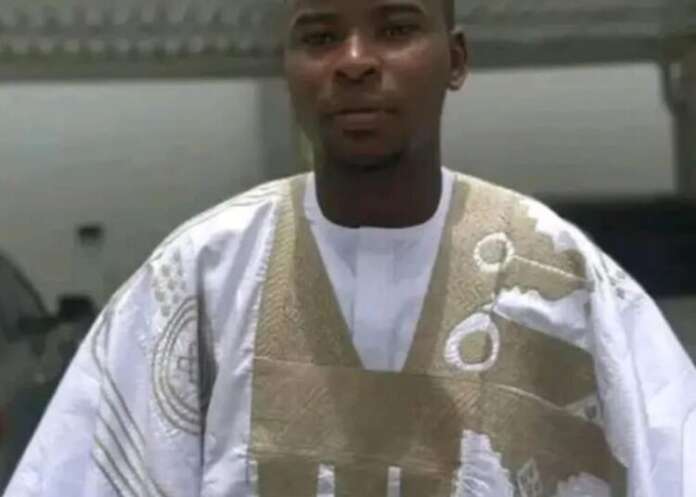
Security operatives in Kano State are said to have apprehended one Saudat, a newly wedded bride, for allegedly stabbing her husband, Salisu, to death just nine days after their wedding.

Leadership reports that the tragic incident reportedly took place in Farawa community of Kano days after the couple’s wedding, which was held on Sunday, April 27, 2025.

The marriage was reportedly arranged by relatives of the couple, but lacked mutual affection between both parties.

According to reports, the deceased had initially expressed reservations about the union but he was said to have been persuaded by family members to go ahead with the marriage.

Although the circumstances surrounding their dispute leading to the death remain unclear, community members, however, alleged that Saudat may have poisoned her husband before stabbing him during an argument.

Tensions flared in the community as angry youths attempted to lynch the suspect, but prompt intervention by security operatives prevented mob action as the suspect was taken into custody.

The Kano State Police Command is yet to respond officially to the incident.

In a related development, a 43-year-old Ugandan woman is accused of murdering her husband and burying his body beneath the floor of their bedroom, a crime that has shocked a quiet rural community and unearthed a web of unanswered questions surrounding land deals, paternity, and hidden motives.

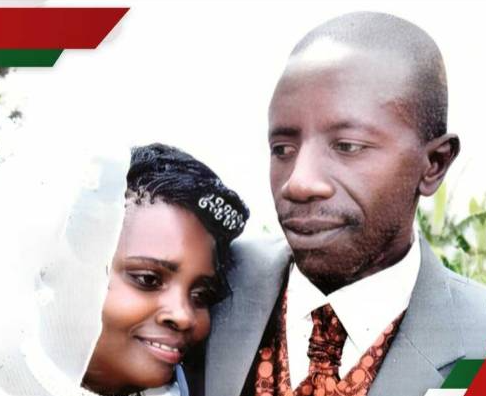
Sharon Nshemereirwe is alleged to have killed her husband, Beinomugisha, in their mud-and-wattle home in Kaniga I village, Buhweju district, Rwengwe subcounty. 

According to police investigations, the motive remains unclear, but the details emerging from the case paint a grim picture of betrayal and concealed truths. 

The disappearance of Beinomugisha initially prompted inquiries from friends and relatives. 

Nshemereirwe reportedly told them her husband had gone to South Sudan for work.

“He got a construction job and is working hard for us,” she consistently claimed.

However, family members grew suspicious.

Investigators believe the murder occurred on the night of Thursday, April 13, 2025.

Nshemereirwe allegedly struck her husband in the head with a hammer while he slept. Afterwards, she is said to have wrapped his body in bedsheets, a blanket, and a tarpaulin before burying him in a shallow grave dug under their bedroom floor. The burial site was then covered with more tarpaulin.

Before allegedly burying her husband, Nshemereirwe reportedly sent her 13-year-old son, Silver Beinomugisha, away for the day, instructing him to stay at the family’s roadside shop after school. Silver later told police he was told not to come straight home.

The silence surrounding Beinomugisha’s disappearance was eventually broken when Nshemereirwe reportedly confessed to the crime.

“I thought I could keep it to myself forever,” she allegedly told investigators. “But I broke down and told one of my siblings. I didn’t think they would tell.”

Following the alleged murder, Nshemereirwe reportedly locked the bedroom and began sleeping in the sitting room, meters away from her buried husband.

Further investigation revealed that five individuals were living in the home at the time: a two-week-old baby, Silver, a nine-year-old daughter with a mental disability, the deceased husband, and Nshemereirwe.

The case took another turn with the discovery of a 33-year-old woman, Caroline Kansiime, in the home when investigators arrived.

Nshemereirwe claimed Kansiime was a maid, but Kansiime said she was just visiting. She revealed she met Nshemereirwe through her sister in Kampala.

Kansiime also noted that Nshemereirwe was breastfeeding a three-week-old baby, claiming it belonged to one of her children but not specifying which one.

At Beinomugisha’s funeral, a relative, Federiko Mubangizi, claimed the baby was Nshemereirwe’s, alleging she concealed the pregnancy and later claimed the infant was abandoned by an in-law. Mubangizi pointed to a scar on Nshemereirwe’s stomach as evidence.

Local village chairperson Michael Tindyebwa said the late Beinomugisha had long doubted the baby’s paternity, leading to frequent arguments with Nshemereirwe. The couple had also reportedly fought over finances and a proposed land sale.

Frank Mukama, the local council chairperson for the area, urged police to thoroughly investigate Nshemereirwe and raised concerns about whispers that Beinomugisha had sold land shortly before his death. Tindyebwa confirmed the land sale but could not identify the buyer, raising Mukama’s suspicions.

Greater Bushenyi regional police spokesperson, Martial Tumusiime said Beinomugisha’s body was exhumed on April 31 following a court order, and a post-mortem examination was conducted.

Beinomugisha, a builder and businessman, is survived by eight children from three relationships. At the time of his death, he was reportedly helping to lay tiles at a local church.

The Death of Public Trust and the Rise of Nigeria’s New Messiahs: From supplicatory docility to digital defiance

-Bulus Y. Atsen, fsi

In the 1980s, the late Claude Ake, a renowned political scientist, lamented that the Nigerian people had been rendered politically passive by the culture of “supplicatory docility”—a condition where the masses, battered by colonial subjugation and postcolonial betrayal, knelt before their rulers rather than demand accountability. In Ake’s view, this docility was not the absence of political consciousness, but a conditioned silence born of fear, futility and survival.

Today, four decades later, we are witnessing a dramatic shift in that posture. The Nigerian people are standing again—angry, defiant and unafraid. They are speaking not through parties, parliaments or policy papers, but through digital voices and messianic figures who claim no institutional loyalty. This is not mere resistance; it is the death cry of public trust and the emergence of a new political theology, one that elevates messianic dissenters above decrepit state institutions.

The Collapse of Trust

Nigeria’s institutions have suffered a long and painful decline. The pillars of democracy, the Executive, Legislature and Judiciary are perceived by the public to stand as monuments to elite self-interest.

Lawmaking is reduced to a self-serving ritual. Courtrooms are manufacturers of conflicting judgments. The Executive, across all levels, seems bent on extracting value from a withering population. Elections—once thought to be the sacred rituals of democratic renewal—have degenerated into transactional contests lubricated by personal and corporate greed.

This is not new. It echoes to a time in our colonial past when warrant chiefs supplanted traditional rulers, and indirect rule corrupted communal governance. The Colonial State ruled through coercion and compromise, and post-independence Nigeria inherited that legacy.

Just as colonial authorities demanded obedience without legitimacy, today’s political class demands loyalty without service. The people, long betrayed by both foreign and local rulers, have turned their gaze elsewhere.

The Old Messiahs: Conscience and Culture as Resistance

In times past, when institutions failed, the Nigerian conscience found expression in the voices of lone dissenters—men and women who refused to bow to power.

In 1928, the Warrant Chiefs, through the Native Revenue (Amendment) Ordinance of 1928, sought to impose tax assessments and administrative controls alien to local traditions, extending direct taxation to women among other things. The law sparked the mass protest in 1929, now known as the Aba Women’s Riot, where the people protested the arbitrary use and abuse of power. The people resisted then, just as they are resisting now.

Chief Gani Fawehinmi, the “People’s Lawyer,” spent his life in courts and prisons fighting for rights and reason. In 1989, Fawehinmi single-handedly sued the Federal Government over the arbitrary banning of the Newswatch Magazine under Decree No. 4, a repressive media law that unconstitutionally tried to stifle press freedom. Will today’s Judiciary stand with the people when the elite unconstitutionally try to stifle social media?

Fela Aníkúlápó Kuti, Premier of Kalakuta Republic, sang truth to power. He was not deterred when his home was raided by soldiers in 1977 for criticising the military government in his album “Zombie,”. During the raid, soldiers threw Mrs. Ransome-Kuti, Fela’s mother, out of a window. Fela did not relent.

These men and women did not wait for the people to choose them; they chose the people. Their resistance was steeped in ideology, sacrifice and cultural symbolism.

Professor Chidi Odinkalu follows in this tradition—an intellectual par excellence whose eloquence is matched only by his unyielding commitment to human dignity. His dissent is rooted in law and history, not hysteria. In other polities, such personalities would be called upon to lead institutions; in Nigeria, they stand apart, precisely because those institutions are broken.

The New Messiahs: Viral Voices in a Virtual Republic

Today, the world is a global village. A new breed of social critics has emerged—not from the Ivory Towers or Bar Association, but from the new town square: Social Media. These critics use Instagram, X (Twitter) and YouTube to channel public rage at a disconnected elite through raw and unfiltered expressions. The new messiah is exemplified in the form of VeryDarkMan (VDM), a polarising figure with an enigmatic past who speaks for a youth demographic that has never known a functional Nigeria.

These new messiahs are not polished; they are not ideologues. But they are trusted—because they speak the language of pain and impatience. They do not merely criticise the government, they embody protest. In them, the poor find a voice, the betrayed find vengeance and the disillusioned find something to believe in.

In precolonial Nigeria, griots, town criers, and masquerades performed the role of social critics through songs, satire and symbols. In today’s digital age, memes have replaced masquerades and tweets have replaced town criers. But the message remains the same: the king is naked, and the people are watching.

Why the State Fears Them

Messianic dissenters rise where institutions fail— they thrive because institutions have failed. They expose the myth of state legitimacy. Where they cannot be co-opted by contracts or silenced by patronage, the State meets them with coercion. Like Fawehinmi and Fela, VDM and Sowore have been arrested, humiliated and vilified. But these methods no longer deter—they embolden.

Nigeria’s political elite, schooled in suppression, have yet to learn that dissent in the digital age multiplies under pressure. A viral post cannot be suffocated with a teargas canister. A hashtag is harder to arrest than a protester. The state’s old tools no longer work.

From Docility to Defiance

Claude Ake warned us that docility was not eternal. And now, across Nigeria’s social terrain—from the campuses to the ghettos—the docile are rising. They are armed not with guns but with cameras, satire, solidarity and hashtags. They are impatient with incrementalism. They do not ask for reform; they demand revolution.

Whether this movement will mature into structured change or spiral into chaos depends on the trajectory the government proceeds. The age of supplicatory docility is over. The messiahs have risen—not from churches or palaces, but from timelines and trenches.
They can only be quietened by good governance and empirical development, not by statistics.

The views expressed by contributors are strictly personal and not of Law & Society Magazine.

Court remands woman in Kano for marrying two husbands

A woman identified as Harira Muhammad Tudun Murtala has been arraigned before a Kano Upper Shari’a Court sitting in the Post Office area of Kano Municipality for allegedly marrying two husbands at the same time.

Harira and her first husband, Sagiru Shuaibu T/Murtala, have been married for six months and have been living separately.

It was during his visit to her that he allegedly found a man on his matrimonial bed, where he alerted neighbours to the situation.

When she appeared before the court, the woman first denied being married to her first husband, but when the judge ordered her to swear by the Qur’an, she retracted her statement.

The second husband, Bello Abdullahi Yankaba, also told the court that his marriage with her was contracted by her uncle, one Abdullahi Umar, upon the payment of a dowry of N100,000.

The judge, Khadi Munzali Tanko Soron-Dinki, directed further investigation by the police and ordered that the woman and the second husband be remanded in a custodial facility till May 16.

Student loan: Minister meets VCs as NANS blocks Lagos-Ibadan highway

With the deepening controversy over the alleged mismanagement of the Federal Government’s student loan scheme, the Minister of Education, Dr. Tunji Alausa, will today (Tuesday) meet with Vice-Chancellors and heads of tertiary institutions accused of misappropriating funds disbursed through the scheme.

At the top of the agenda for the meeting is the training of bursars and Information Communication Technology heads from these institutions to ensure the smooth running of the programme.

The ministry will also launch a compliance tracking webpage to foster transparency and accountability in loan disbursement.

The student loan scheme has come under intense scrutiny following allegations by the National Orientation Agency that some institutions, in collaboration with banks, have been making fraudulent deductions from student loan disbursements.

Last week, the Independent Corrupt Practices and Other Related Offences Commission said its preliminary probe revealed that while NELFUND had released N100bn as stundents loan, N71bn is accounted for.

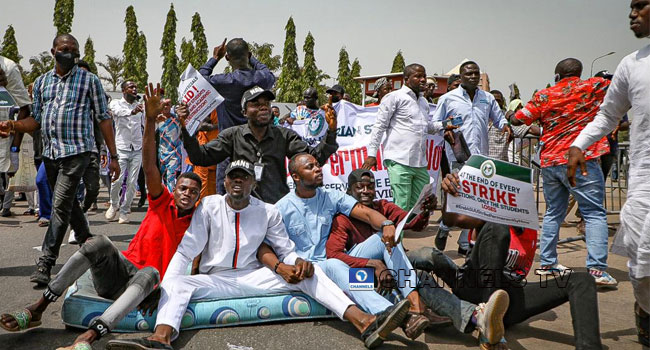
These allegations triggered a wave of outrage, culminating in a protest on Monday by members of the National Association of Nigerian Students, who blocked the Lagos-Ibadan Expressway.

The students, led by the NANS Ogun Joint Campus Committee Chairman, Gabriel Abiola, decried irregularities in the disbursement of the funds.

“We are demanding proper accountability in the student loan programme. The issue is affecting Nigerian students, especially students from my state. Many of our students applied for the loan, and it has been approved, but it has not been disbursed to them, and they are not allowing some of the students to write the exam,” Abiola said.

He continued, “We raised the alarm over the issue about a month ago, asking the ICPC to set up an investigative committee, and we were aware that the ICPC disclosed that out of the over N100bn disbursed, only N28bn was released to the students. We demand that the President, Bola Tinubu, gear up the ICPC and EFCC to investigate the matter, and the ICPC should release the names of the 51 institutions that they have identified so that we will know the enemies of Nigerian students.”

Abiola warned that protests would persist if authorities failed to act: “We have sent our message, and they are all aware. If they fail to yield to our demands, we will not hesitate to continue with the protest.”

The protest caused a temporary disruption to traffic before being called off following intervention by the Ogun State Commissioner of Police, Lanre Ogunlowo, who engaged with the demonstrators and appealed for calm.

A statement from the command’s spokesperson, Omolola Odutola, read, “The demonstrators barricaded the expressway, causing a temporary disruption to vehicular movement. Their primary grievances included the lack of transparency and accountability in the disbursement of the Federal Government Tertiary Education Trust Fund, meant for student loans. Protesters also decried the rising cost of tuition and called for improvements in learning conditions and facilities across tertiary institutions.”

She added that “no incidents of violence were reported during the protest,” and that the students later met with the Commissioner at the State Command Headquarters in Eleweran for further dialogue.

Meanwhile, the ICPC has launched a full-scale investigation into the allegations.

According to the commission’s spokesperson, Demola Bakare, ICPC’s Special Task Force has commenced investigations immediately upon receiving the allegations.”

Preliminary findings by the ICPC indicated that while NELFUND disbursed N100bn for student loans, only N28.8bn reached actual beneficiaries—leaving N71.2bn unaccounted for.

There have also been allegations that some institutions released funds to students who had already graduated, further fuelling the controversy.

However, the Managing Director and Chief Executive Officer of NELFUND, Akintunde Sawyerr, rejected claims that N71bn was missing.

Speaking at a stakeholders’ workshop on system automation and loan processing in Abuja on Monday, he stated: “We have to adhere to our processes. If a person has already paid their fees in their final year, and we’ve paid their tuition, it is the obligation of that individual to go to school. I know my fees are now being paid by an officer. But to complain that you’ve already graduated and you’ve left—the fact of the matter is, people applied in their final year. You have to go through a process that allows us to make sure that they are the ones who are actually applying and who actually need it. Again, let me just point out this thing about delays.”

He described the ongoing meeting and technical workshop as “a critical milestone in the collective journey to deliver a fully digitised, transparent, and student-centric financial aid system for Nigerian higher education.”

Also speaking at the event, Chairman of the House Committee on Students Loan, Scholarships, and Higher Education Financing, Ifeoluwa Ehindero, emphasised the need to modernise fund disbursement:

“This is essential for the success of the initiative and will go a long way in ensuring that our students benefit in a timely and accountable manner. As members of the House of Representatives Committee on Student Loans, we have been working tirelessly to ensure that the legislative framework supports and facilitates these reforms. However, legislative efforts alone are not enough.

“We need your expertise, your feedback, and your active participation to make sure that we have a system that works for everyone from the students applying for loans to the institutions managing the funds. This workshop is not just a platform for training but also an opportunity for collaboration.”

Earlier, NELFUND’s Executive Director of Operations, Mr. Iyal Mustapha, disclosed that over 576,058 students had registered for the loan, with applications totaling N170.4bn. He urged institutions in the South-East and South-South to step up awareness campaigns to ensure eligible students apply in time.

Also speaking, Lawal Mohammed Faruk, a representative of the National Universities Commission, described the scheme as “one of the best policies of the Federal Government,” adding, “Our dream is to see NELFUND one day onboard all the students in the country, whether public or private.”

However, in a statement last Thursday, NELFUND’s Director of Strategic Communications, Oseyemi Oluwatuyi, condemned what he called “inaccurate, misleading, and dangerously speculative reports” on the scheme.

He said, “The reports, which suggested misappropriation and mismanagement of funds, are entirely false, grossly irresponsible, and deeply damaging to the integrity of an institution established to deliver financial hope to millions of Nigerians.”

The student loan controversy continues to unfold even as the Education Ministry convenes key stakeholders today in a bid to restore public trust and improve the scheme’s delivery.


Fear grips international students in Alabama after researcher with no political ties is detained

Immigration officials detained Alireza Doroudi in March.Courtesy Sama Ebrahimi Bajgani via AP

The visas or legal statuses of more than 1,000 international students across the U.S. have been revoked since late March.

By The Associated Press

Sama Ebrahimi Bajgani and her fiancé, Alireza Doroudi, had just spent an evening celebrating the Persian New Year at the University of Alabama when seven armed immigration officers came to their apartment before dawn and arrested Doroudi.

In a moment, the young couple’s life was upended.

“I was living a normal life until that night. After that nothing is just normal,” Bajgani said.

Details about Doroudi’s detention spread through the small Iranian community in Tuscaloosa, where Bajgani and Doroudi are doctoral students. Other Iranian students say they have been informally advised by faculty to “lay low” and “be invisible”, — instilling fear among a once vibrant cohort.

Doroudi is among students across the U.S. who have been detained in recent weeks as part of President Donald Trump’s immigration crackdown. Bajgani said the couple does not know why Doroudi — who has no criminal record or public political views — faces deportation, adding that Trump’s recent visit to the school made her feel like the university was “ignorant of our crisis.”

One Iranian civil engineering student and close friend to Doroudi said he has lost over 10 pounds due to stress and depression in the six weeks since Doroudi was detained.

“It’s like all of us are waiting for our turn. It could be every knock, every email could be deportation,” said the student, who spoke on condition of anonymity because of concerns about losing his legal status.

He now avoids unnecessary trips outside. When he was in a car crash last month, he begged the other driver not to call the police, even though he wasn’t at fault, because he didn’t want to draw attention to himself.

‘I stayed with their permission’

Bajgani said Doroudi, 32, is an ambitious mechanical engineering student from Shiraz, Iran.

He entered the United States legally in January 2023 on a student visa. Bajgani said he often worked 60-hour weeks while still making time to run errands for loved ones.

“If someone like him doesn’t get to the place he deserves, there is nothing called the American dream,” she said.

Doroudi’s visa was revoked in June 2023, but the embassy didn’t provide a reason and ignored his inquiries, Bajgani said. The university told him he could stay as long as he remained a student but that would not be allowed to reenter the U.S. if he left, she said.

He was operating under that guidance when immigration officers came to the couple’s door in March.

The University of Alabama didn’t comment on Doroudi’s case, but said it offers resources to help immigrants on campus comply with federal law. It also offers guidance to students whose visas are revoked.

“Our international students are valued members of our campus community,” university spokesperson Monica Watts said in a statement.

Doroudi told Bajgani he spent three days in a county jail, sleeping on a tile floor and feeling panicked.

He is now in a Louisiana immigration detention facility over 300 miles from Tuscaloosa while he awaits a deportation hearing scheduled for next week. At least one other high-profile international student is there.

“I didn’t deserve this. If they had just sent me a letter asking me to appear in court, I would’ve come, because I didn’t do anything illegal. I stayed with their permission,” Doroudi said in a letter he dictated to Bajgani over the phone to provide his perspective to others. “What was the reason for throwing me in jail?”

Trump’s immigration crackdown

More than 1,000 international students across the U.S. have had their visas or legal status revoked since late March, according to an Associated Press review of university statements and correspondence with school officials. They included some who protested Israel’s war in Gaza. Immigration and Customs Enforcement has since reversed those revocations, including those of four University of Alabama students.

“University staff closely monitors changes that could affect them and has communicated updates related to new protocols and procedures,” Watts said.

A Louisiana judge who denied Doroudi bond in mid-April said he didn’t sufficiently prove that he wasn’t a national security threat, Doroudi’s lawyer, David Rozas said. Rozas said he was “flabbergasted” because the government hasn’t presented evidence that Doroudi is a threat, though that is what the Department of Homeland Security has alleged.

A familiar sense of fear

International students make up over 13% of the statewide University of Alabama graduate program, according to the school’s website. Over 100 Iranian students attend the university, according to an estimate from the Iranian Student Association.

Every year, many gather for a picnic to celebrate Sizdah Bedar, the thirteenth day of the Persian new year, which begins with spring.

This year, the typically festive holiday “felt like a funeral service,” one Iranian doctoral student said. At one point, silence fell over the group as a police car passed.

“It’s becoming too hard to be living here, to be yourself and thrive,” said the student, who spoke on condition of anonymity because she fears retaliation.

She has criticized the Iranian regime since arriving in the United States over five years ago, so she suspects she is no longer safe in her home country. Now, she has those same doubts in Alabama.

“All of a sudden it feels like we’re returning back to Iran again,” she said.

Credit: The Associated Press.

TIPS