Home Blog Page 360

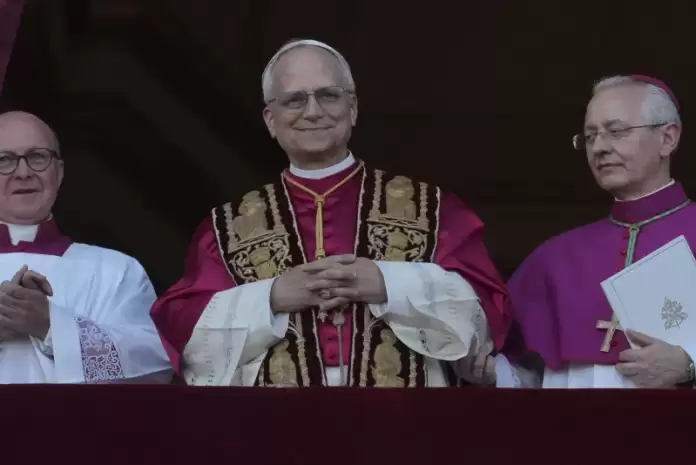
What to know about the new Pope Leo XIV

  • How Trump’s AI joke precedes historic election of American pope Robert Francis
  • Leo XIV: Mathematician, missionary, first American Pope

Following the death of Pope Francis on April 21, the 133 cardinals — the church’s highest-ranking clergy — gathered to elect a new pope for the Catholic Church in the secret conclave in Rome.

On Thursday afternoon local time, white smoke billowed from the stovetop chimney atop the Sistine Chapel and the bells of St. Peter’s Basilica rang out, signifying the cardinals had elected a new pope. The cardinals cast at least four ballots at the Vatican before a cardinal received at least two-thirds of the vote.
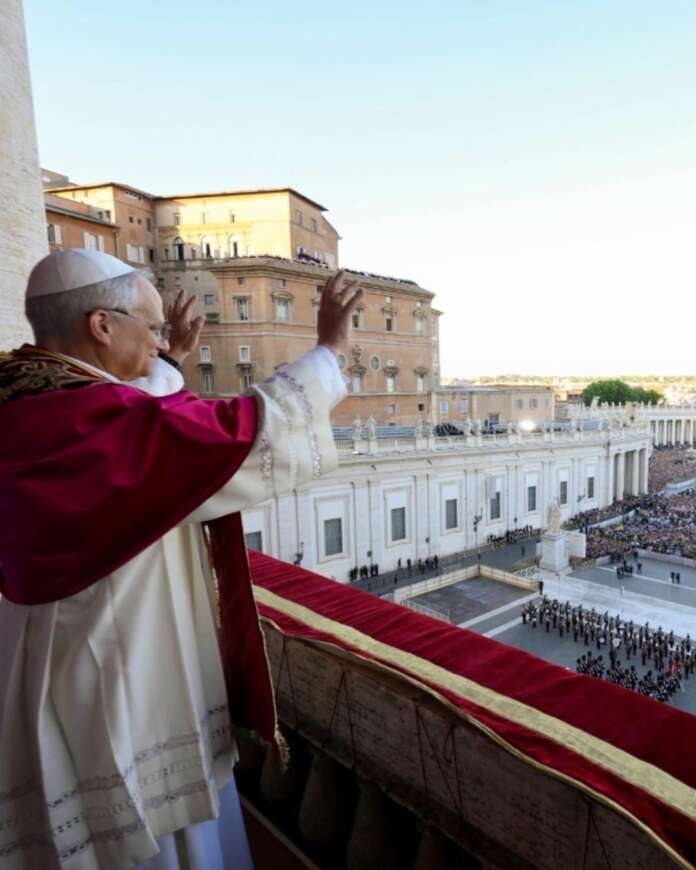
Over an hour after the white smoke emerged, the new pope, a 69-year-old American from Chicago, Illinois, and the first-ever pontiff from America, clad in his papal vestments, stepped out onto the balcony of St. Peter’s Basilica and greeted the world.

He was elected with two-thirds of 133 voting cardinals. Before his election, he was Prefect of the Dicastery for Bishops, and he spent much of his career as a missionary in South America and served as bishop in Peru.

He holds a Bachelor’s degree in Mathematics from Villanova University in Pennsylvania and a diploma in Theology from the Catholic Theological Union of Chicago.

He later studied Canon Law at the Pontifical Saint Thomas Aquinas University.

He was ordained a priest at age 27, and spent many years working in Peru and later became a bishop

He mentioned Pope Francis twice and explicitly said he wants to pick up where the late pope left off on that very balcony on Easter, before giving Urbi et Orbi blessing — meaning to “the city and the world.”

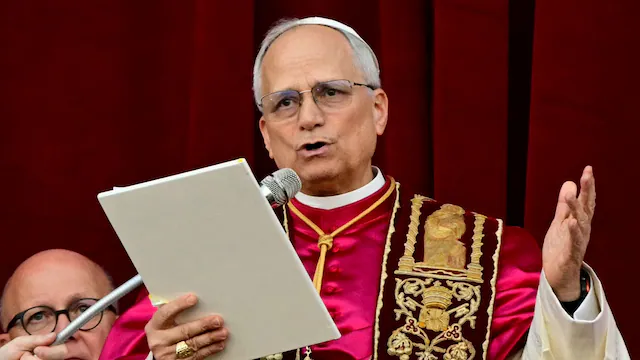
“We have to be a church that works together to build bridges and to keep our arms open, like this very piazza, welcoming,” Leo told the crowd while speaking in Italian.

His full authority and jurisdiction begin immediately upon his acceptance of the office, prior to the public announcement.

Significance of papal name

Leo is the fifth-most-popular name chosen by popes.

Pope Leo XIII, who headed the Catholic Church from 1878 until his death in 1903, was a founding figure of the Catholic social justice tradition.

While popes aren’t obliged to change their name, every pontiff for the past 470 years has done so, usually choosing the name of a predecessor to both honor them and signal their intention to emulate his example. Pope Francis was a notable exception, choosing not the name of a former pope but that of St. Francis of Assisi, the 13th century cleric and patron saint of animals and the environment.

White smoke rises from the chimney on the Sistine Chapel, indicating that a new pope has been elected at the Vatican, May 8, 2025.Tiziana Fabi/AFP via Getty Images

Seen as front-runner

Pope Leo started to emerge as a front-runner for the papacy in the days before the conclave began, according to the Rev. James Martin, a papal contributor to ABC News.

Following the announcement of the new pope, Martin told ABC News on Thursday that he knows Leo, describing him as “very down-to-earth” and a “very kind person, very reserved.”

Pope Leo was the only U.S. cardinal on a short list of front-runners for pope, also known as “papabiles,” compiled in the aftermath of Pope Francis’ death by The Associated Press.

Brought to work at the Vatican by Pope Francis

He received priestly ordination on June 19, 1982, after studying canon law at the Pontifical Saint Thomas Aquinas University, according to his bio on the Vatican Press website.

Francis brought Pope Leo to work at the Vatican after first appointing him in 2014 to serve as the bishop of Chiclayo, Peru. He has spent a majority of his time in Peru, where he has also worked as a teacher, missionary and parish priest.

In April 2020, Francis appointed him to be the apostolic administrator of the diocese of Callao, also in Peru, his profile said.

Since 2023, he has held the position at the Vatican as Prefect of the Dicastery for Bishops, in charge of vetting nominations for bishops around the world.

Pope Leo told Vatican News in October 2024 that a “bishop is not supposed to be a little prince sitting in his kingdom, but rather called authentically to be humble, to be close to the people he serves, to walk with them and to suffer with them.”

He also currently serves as the president of the Pontifical Commission for Latin America.

In a 2023 interview with the Catholic News Service, he was asked how he responds to problems with bishops or dioceses — to which he said he reminds clergymen to reflect on their oath to “live and work in communion with the Holy Father.”

“The spirit of synodality includes a need and desire to listen to not only the bishop himself, but to many people in the diocese to see what’s the best way to promote authentic church in each and every diocese in the world,” he said at the time.

In a historic turn of events, Prevost was elected as the first American pope, just days after US President Donald Trump sparked controversy by posting an AI-generated image of himself dressed as the pope on his Truth Social platform.

Trump’s AI-altered image, showing him in full papal attire, sparked laughter, confusion, and criticism online on Saturday.

The image was later reposted by the White House’s official X account, accompanying Trump’s remark to reporters: “I’d like to be pope; that would be my number one choice.”

This comment was made just before the conclave to choose a successor to Pope Francis, who passed away on April 21 after 12 years as head of the Church.

The newly elected Pope became a Peruvian citizen in 2015 and speaks several languages, including Italian and Spanish.

abcNews/PUNCH

Breaking!!! Meet the 1st American Pope, Cardinal Robert Prevost who chose the name Leo XIV

Watch Video

Cardinal Robert Prevost has been elected pope, the first time an American will lead the Roman Catholic Church. He chose the name Pope Leo XIV.

The 69-year-old new pontiff appeared at the balcony of St. Peter’s Basilica and said “Peace be with all of you!”

He said he wanted his message of peace to “enter your hearts, reach your families and all people, wherever they are.”

He thanked his fellow cardinals for selecting him, and spoke in Italian, Spanish and Latin. Having spent years working in Peru, he thanked his former diocese in the South American country, “where a loyal people has shared its faith and has given a lot,” he said.

He also spoke warmly of the late Pope Francis and concluded by leading the crowd in prayer.

He appeared after white smoke streamed from the chimney atop the Sistine Chapel, signaling the 133 cardinals inside had elected a new pope.

A roar erupted from the crowd when they saw the white smoke, which was shown on several large screens in St. Peter’s Square. Enormous bells of St. Peter’s Basilica began to ring, tolling the news that the Catholic Church has a new pope.

The vote came on the second day of the papal election process known as the conclave. Church experts had named other possible candidates and had not expected an American to win the papacy.

President Trump quickly congratulated the new pope. “It is such an honor to realize that he is the first American Pope. What excitement, and what a Great Honor for our Country,” Trump said on social media.

Brandon Johnson, the mayor of Pope Leo’s hometown of Chicago, expressed his excitement, writing: “Everything dope, including the Pope, comes from Chicago!”

Rome has been brimming with elation, as thousands gathered near the Via della Conciliazione to be present for the historic moment when the new pope is announced and presented to the world.

Once a successful vote was complete, the most senior cardinal asks the newly elected pope, “Do you accept your canonical election as supreme pontiff?”

After he accepts, he is then asked: “What name do you wish to be called?”

The cardinal electors then paid homage and pledged obedience to the new head of the church, and thanked God while the new pope was taken into a sacristy and fitted with papal attire.

Finally, the pronouncement was made in Latin — “Annuntio vobis gaudium magnum: Habemus Papam!” (“I bring you tidings of great joy: We have a pope!”) — and the new pope gave an apostolic blessing to throngs of faithful.

NPR.org

Wanted: Real justice for Bamise

By Ebun-Olu Adegboruwa, SAN

Bamisile’s Death and Conspiracy

On Friday, May 2, 2025, the High Court of Lagos State delivered judgement in the case of a driver in the employment of Lagos State who raped and killed a lady passenger in cold blood. This came after a protracted trial that started in 2022. The deceased, Oluwabamise Toyosi Ayanwole was a young Nigerian lady who left her hometown in Ekiti State in search of greener pastures in Lagos, like many other Nigerians. She was 22 years old and the last child of her parents, Joseph and Comfort Ayanwole. She had nine other siblings and worked as a fashion designer before her untimely death.

On February 26, 2022, after leaving work at Ajah area of Lagos State, Bamise boarded a Bus Rapid Transit (BRT) system at Chevron, Lekki heading to Oshodi on the Lagos mainland around 7:30pm, with the intention of going to visit her elder brother’s family to spend the weekend. After boarding the bus, the driver flirted with her and told her to sit at the back. At the time, she was the only passenger in the bus and she observed that the interior was dark. She also noticed that at least two other male passengers entered the bus afterwards. The driver did not pick more passengers. There were no CCTV cameras in the bus. She immediately sent voice notes to her friend via WhatsApp revealing her concerns. She also sent some video recordings of the bus interior with the bus plate number identifier to her friend who advised her to alight as soon as possible at the next bus stop.

Afterwards further attempts by her friends and relatives to contact her via phone calls were unsuccessful. Prior to this, one of her last recorded conversations with her friend was “… Please, pray for me.” After several failed attempts to communicate via her phone, the last known sound heard after a caller picked her phone revealed her struggling with an unidentified man. The following day, she was reported missing. On March 7, 2022, her lifeless body was discovered naked near the Carter Bridge on Lagos Island. An eyewitness stated that Bamise was still alive after she was thrown out of the BRT bus but she couldn’t be treated or rushed to the hospital before she died. There are conflicting reports in the media as to whether her corpse was found whole or mutilated.

Arrest of the Culprit

The driver of the BRT was eventually traced and identified as 50-year-old Andrew Nice Omininikoron. He kept mute after the incident. After Bamise’s disappearance was made public, he fled and went into hiding in the neighbouring Ogun State. He was tracked down and arrested by the Department of State Service (DSS) Operatives and handed over to the police for questioning and custody. He initially confessed to raping Bamise and abandoning her but he later changed his story, denying any involvement in her murder. He claimed that his bus was hijacked by armed robbers (referring to the men who entered the bus) who also kidnapped Bamise at gunpoint. His claims were challenged by Bamise’s relatives, friends and Nigerians. Accusations of rape and sexual assault were brought to light by at least two other female victims of Andrew in similar circumstances. His suspected accomplices are also yet to be identified till date. Public protests led to the suspension of BRT Transport operations in Lagos State for some days.

The Criminal Trial

There was considerable public outrage regarding the circumstances leading to Bamise’s death and demand for justice on her behalf. Initially, some mystery was woven around the incident which tended to masque the truth of what transpired but due to the vigilance of Bamise’s family, protest by Nigerians and extensive, relentless media coverage, the Lagos State Government swung into action. Working with the police and the family, investigation was expedited and the rapist killer was arraigned in Court on a five-count charge of conspiracy, felony, sexual assault, rape and murder.

At the arraignment, the Honourable Attorney-General of Lagos State made a personal appearance and vowed to ensure dutiful prosecution. He led the first prosecution witness, one Madam Odezulu, who narrated the vivid details of how Andrew (BRT driver) picked her up in Ajah the previous year on November 25, 2021 and forcefully raped her inside the same bus. In demonstration of the commitment of the government to the trial, the Lagos State Director of Public Prosecution was also involved in the trial as well as other experienced counsel from the ministry. I was present in court on one occasion to witness the trial proceedings. The police and the other law enforcement agencies teamed up with the ministry of justice to ensure dutiful prosecution.

Mr. Kayode Aluko, a fleet operational manager with the Lagos State BRT, also testified in court and identified Andrew as the driver of the bus in question. He was employed in 2021 through an outsourcing company. The case of the prosecution was very detailed and well packaged such that one could reasonably predict the verdict of the court. On the other hand, the defence was very weak and porous. This resulted in delay tactics and filibustering by the defence to weary the prosecution and prolong the trial, leading to several adjournments, but the public kept vigil with the court proceedings.

Upon the close of the prosecution’s case, the defence made a feeble no case submission which was promptly dismissed by the trial Court, prompting the defendant to mount the witness box to testify in his defence. His case was very porous, weak and rather unconvincing. It therefore did not come as a surprise to all that he was given the maximum sentence by the court, to give a sense of justice to Bamise’s family, to act as deterrence to other Andrews who may be lurking around and also as a reward for the painstaking investigation and prosecution of the case. In its judgment, the trial court held that the prosecution successfully proved its case, relying on the doctrine of “last seen” and the deceased’s dying declarations to establish Ominikoron’s guilt.

The Lessons from Bamise’s Case

In the course of investigation of this case and the trial, several issues have been thrown up which deserve to be addressed. First is that there are many unreported rape cases, due mainly to negative public perception and profiling, cultural limitations and religious constraints. Had the first victim Odezulu reported her case to the police and the BRT authorities, Andrew may have been promptly checkmate.

Second is the mentality of the police and their lame responses to citizens’ complaints. Usually, the police should be a friendly institution that will encourage victims to speak out but that has not been the case. Indeed, there is a trending story that complainants are forced to pay Fifty Thousand Naira before they are permitted to submit their petitions at a police formation in Lagos. Then the complainant has to fund the investigation, which has no standard measure but is always dependent on the benevolence of the investigating police officer and the status of the complainant.

When Odezulu was asked by the defence counsel during her cross-examination if she reported the case at the police station, she said she did not do so because she has had a bad experience with the police at Jakande Police Station and that if she had reported they would have insulted her. The common experience of rape victims is to be accused of indecent dressing, prostitution and such other degrading epithets.

Third is the distrust for public commuting and public transportation generally. If what befell Bamise could happen in a government facility, what then is the fate of commuters who patronize private operators daily? Hear Madam Odezulu: “After the incident, whenever I’m coming back from work and see any BRT bus, I used to look inside to see if it was him. I have seen him like four times at the Chevron Tollgate when he passed.” Imagine the trauma! Another major lesson to learn from the Bamise case is the intolerable delay in the administration of criminal justice.

The trial started in 2022 and it was not concluded until 2025, spanning a long period of about three years. In the usual chequered history of trial of cases in Lagos, Bamise’s case is considered to have enjoyed accelerated hearing perhaps due to the direct involvement of senior officials of the Ministry of Justice and the public attention given to the case. The lesson here is to develop a mechanism of speedy adjudication of cases in the courts so that parties will know their fate within a reasonable time.

Holistic Justice for Bamise

Justice in the Bamise case cannot and should not end with the verdict of the court, but should be extended to the family and her survivors. During the trial, the defendant was confirmed to be an employee of Lagos State, which brings the issue of vicarious liability of the employer into focus. The crime took place right inside the BRT facility owned and operated by the Lagos State Government. All worthy commendations go to the governor, the law enforcement agencies and the ministry of justice for following up with the case to the end. However, a life has been lost and it cannot be replaced. The concept of justice will not be complete in this case if there is no compensation for the Bamise family, in very reasonable proportions. Governor Sanwo-Olu paid compensation for all victims of EndSARS caused primarily by police officers not under state control. It should therefore not be difficult for the governor to pay Bamise’s family in a case which is directly connected to and perpetrated by an agent of government. That will be real justice for Bamise.

Let’s beg civil servants, By Funke Egbemode

In January 2022, the Nigerian government discovered more than 500,000 secret bank accounts it suspected were being used by civil servants in ministries and government agencies to hide stolen funds. According to a presidential press release that spoke about the discovery, civil servants in different states of the federation were working with their governors to hide stolen funds meant for the people, their own friends, family and even children in secret bank accounts.

In June 2021, the then Chairman of the Economic and Financial Crimes Commission, Abdulrasheed Bawa, disclosed that the commission found N1b (one billion naira) in the account of a civil servant. For emphasis, here is how Bawa captured the discovery: “A billion naira, sitting in an account, not properties, cash. Just to tell you the problem we have.’’

In February 2017, civil servants, working with bankers were found to have stashed $151m in different fictitious bank accounts. The then Attorney General of the Federation, Abubakar Malami, said the culprits included civil servants and bank officials who all connived to stash away these recovered monies.

In October 2024, concerned Nigerians under the aegis of Nigerian Coalition of Civil Society Organisation (NICOCSO) drew Nigerians’ attention to $20b that Nigeria had spent on turnaround maintenance of four local refineries since 2007 while importing more than 1.6 billion litres of Premium Motor Spirit (PMS).

For decades, funds, huge funds had been released to contractors to fix our refineries, and nothing was fixed. There are civil servants working with politicians and PMS contractors making money from our suffering. They all made it look like these refineries that once delivered 85 percent of our needs, now need rocket science to function. Worst still, they made it look like new ones can’t be built until Aliko Dangote built one and made us look like a nation of incompetent fools.

It is good to want to live well. It is good to desire the good things of life. It is even good to want to save for the rainy day. But to rob a three-year-old to achieve all that is absolutely evil. And that is the kind of evil that the thieving evil servants do. They take money that belongs to the sick, the aged, the helpless and buy mansions in choice parts of the cities. They sized themselves up, decided that their N500,000 per month salary means they can own properties on the same lane with Mike Adenuga and Femi Otedola. In their reprobate minds, billionaires do not have two heads and so they deployed their ‘one-one’ heads to undo the few good things our ancestors left for us.

They steal pensions, the sweat of pensioners, which my mother of blessed memory equated with taking away the walking cane of the aged or blind. They steal from lepers, even lepers. How do evil civil servants sleep knowing that their evil is killing, maiming, destroying destinies, enlarging the numbers and ranks of orphans, widows and widowers all over the country?

I keep asking myself how a man who earns N5m per annum can drive a N120m Mercedes Benz.

‘Ijo n ru, alufa n sanra.’

Members of the congregation are losing weight while the cleric gains weight. Who does not know that the priest is robbing the altar? It is okay to see an altar full of offerings and be tempted. It is even pardonable to take a few pieces to the burnt offering and justify it by saying you do not want the altar to collapse. But when those we trusted with the altar decided to double-cross the live cows and take it to set up private farms, what do we call that?

The altar men, the priests we pay with our taxes and IGR, are eating both the sacrifice and the altar. That is exactly why nothing is working. And before you start the line of argument of how politicians are the real thieves, ask yourself how the political head of a ministry or an agency can steal without his or her Permanent Secretary’s signature. Those who know and you will too, if you ask former Ministers or Directors-General who tried to do things on their own. Then ask yourself, who provides the information and documents that ICPC, Police, EFCC, DSS use when they go after any government official? Yes, only civil servants know where all the dead bodies are buried. They know what to do; they are in charge of policy and funds disbursement.

They can actually fix this country if they decide to. They can make this country work if they want, starting tomorrow. But will they?

Our education sector has failed but civil servants who earn N10 million in a whole year have two children in UK varsities where they pay N50 million. We do not have working refineries as a nation that discovered oil in 1956, but our civil servants in the Ministry of Petroleum and its agencies have properties in Maitama, Asokoro, Lekki, Ikoyi. EFCC is currently investigating how three billion dollars could not fix our refineries and how a former MD became the owner of N80 billion. Our roads are death traps but top civil servants in the Ministry of Works are living large. They are not satisfied with a piece of the offering. They want everything. How do they sleep, pray and fast when they hear of accidents on the roads whose contract files they took huge kickbacks on and left undone, unfinished and half done?

We are bad people, really. That’s why we work with politicians to steal from our own children. Ask yourself again, what is the essence of all the stolen wealth if your children are jobless in Nigeria or become minimum wage workers in UK who you still have to support from Nigeria?

I put it to all civil servants (I was one for few years) that no politician can steal without your consent.

The views expressed by contributors are strictly personal and not of Law & Society Magazine.

Men, stop joining your ancestors

By Funke Egbemode

For many years, women were held responsible for men not living to ripe old ages. Grieving women were subjected to the most inhuman cultural or traditional widowhood rites, which I insist point to the backwardness and wickedness of those who inflict them. I mean, what kind of woman forces a fellow woman who had just lost her husband to drink the water used to bathe a corpse? My friends, if your mother had ever participated in doing this evil to another woman, go and pray, so that God will not ask you to pay for what you did not buy.

Anyway, this is not about widowhood rites. It is about men dying in their prime. It is sad and saddening. All these stories of men slumping and dying suddenly must stop. That there are more widows than widowers is nothing to celebrate. Life is already too hard without a man joining his ancestors prematurely when there is so much work to be done here. I am sure even the ancestors are shocked each time they are forced to welcome their young descendants who themselves have young children.

I will start with the city dwellers. Cities kill. You live in Ikorodu and work in Lekki Phase 1, or worse still, you live in Ogombo and work in Alausa. Old boy, your ancestors are worried. You sat through that demonic traffic daily for 20 years. The World Health Organisation is worried too. We know you have to work and your own home state is underdeveloped, so you have to come to Lagos. But when last did you check your blood pressure, your blood sugar? Too many men are walking corpses, logging around 150/100 BP even as you read this. High blood pressure enjoys promoting itself and it does not do it slowly. Soon, that BP will climb to 200/120 and gbam, oga slumps while watching football.

Do you know you are diabetic? Each Ankara aso ebi and fila you buy is 15 and you have bought four this year but you have no glucometre. You drink beer, eat fufu and eba and you are too busy to exercise or do medical check-up. Only you have both hypertension and diabetes. You are taking roadside herbal concoctions and telling yourself all is well and reciting ‘I shall not die’. Bros, you are dying. Get help. Go get checked. Don’t let another man walk your daughter down the isle. Don’t let another man do unto your wife what you can’t do to her.

TO BE CONTINUED.

Re: 18-Year-Old Young Man Impregnates 10 Girls in Five Months: Tackling rape, sexual perversities, child sexual molestation and so forth

By Sonnie Ekwowusi

You know, the above vices are symptoms of a deep-seated problem- a dysfunctional family system and promotion of safe-sex by the government and Western-sponsored NGOs.

Therefore, if we persist in tackling symptoms instead of the deep-seated problems, we would continue to be overwhelmed by the increasing vices.

The real solution to all these sexual perversities, rape and sexual objectification of women is raising up of children in strong values-imbued families and family values. Mere condemnation of rape or sexual perversities or child sexual molestation is not enough. The court sentencing of some of the perpetrators of the vices is not even a deterrent.

We must tackle the problem from its root. The family is the fundamental unit of society. Therefore, if the family is morally upright, it will translate to the moral uprightness of the society. Whereas if the families are perverse, then the society becomes perverse too.

I hope I am understood. Today’s crisis in Europe, Africa and other continents is a crisis of dysfunctional families and broken homes. If we fail to fix families, we are just wasting our time.

Read Also: 18-year-old young man impregnates 10 girls in five months

Another solution is for the Nigerian government and these money-miss-road NGOs to stop promoting the so-called ‘safe-sex’, condom sex, and sexual reproductive rights in Nigeria. By promoting these immoralities over the years, the government and all these useless NGOs have succeeded in luring many young people into sexual perversities and rape.

It is unfortunate that we live in a sexual State. We live in an immoral society that teaches that there is nothing wrong with sexual escapism and marital infidelity, and prostitution. We live in a society that depicts women as sexual objects. I am yet to see any women’s NGO protesting the treatment of women as sex objects on TV and in commercial adverts.

Any small boy who calls himself a musician can afford to hire dozens of nude or semi-nude girls to dance naked for him on TV. The paradox is that while the small boy is properly dressed, the girls dancing for him are not properly dressed. This is the sexual objectification of women on TV and in commercial adverts. As I said earlier, I am waiting to see women NGOs protest this sexual objectification of women. Girls and women are NOT sexual objects: like men, they are created in the image and likeness of God. Therefore, they possessed intrinsic worth.

We must respect girls and women in the way we respect our mothers, wives and daughters.

Sonnie Ekwowusi

The views expressed by contributors are strictly personal and not of Law & Society Magazine.

In Pursuit of Justice: The legacy of Joseph Otteh

By Sonnie Ekwowusi

In the death of Joseph Otteh, we have lost a bosom friend, a prominent public-interest and conscientious senior lawyer. Joseph stood out like a fine firmament in the legal profession in Nigeria. He was a renaissance man, a justiciable mind, and a righter of wrongs.

How can one truly capture the essence of Joseph and his impact on the justice delivery system in Nigeria? True to the name of his institution, Access to Justice, Joseph was a tireless advocate for ensuring access to the courts as a means of seeking justice. It pained Joe that, contrary to Section 6(6) of the 1999 Constitution, aggrieved Nigerian citizens are often shut out from accessing justice in our law courts due to inefficiency and corruption within the judiciary. To Joseph, the so-called “Nigerian question” revolved around the failure to dispense justice in Nigerian courts.

He was right. Without justice, it is impossible for Nigeria to make meaningful progress. Cicero extolled justice as the highest of virtues, stating that “the brightest of virtues shines above all in justice.” According to St. Augustine, “Justice being taken away, what are kingdoms but great robberies?” If justice is removed in Nigeria, then what is Nigeria but a great robbery?

One of the four pillars of economic freedom and prosperity in any country is a strong rule of law. According to The Heritage Foundation, a leading think tank based in Washington, D.C. in the United States of America, there is ample evidence around the world that the rule of law is a critical factor in empowering individuals, ending discrimination—especially against women—and enhancing competition.

In short, the Foundation teaches that to improve the human condition, preserve peace, respect individual human rights, and achieve greater prosperity, government policies that promote the rule of law may well deserve priority over even the most important desirable objectives. Specifically, The Heritage Foundation attributes Nigeria’s low level of economic prosperity to its weak rule of law. For example, when a litigant files a lawsuit in a Nigerian court, unless the litigant or their lawyer submits to extortion, the case may never even be assigned to a court for hearing.

Mind you, corruption in the Nigerian judiciary transcends corrupt judges. In fact, it encompasses the entire age-long structure or tapestry of wrongdoing within the judiciary—starting from the corruption of court gatekeepers, bailiffs, clerks and registrars, messengers, typists, and others—who all play important roles in the dispensation of justice. For example, it is not uncommon for some court bailiffs to refuse to serve court processes simply because they were unable to extort money from the litigant or their counsel.

Today, there are numerous missing case files in our courts. Many litigants arrive at court only to discover, to their utter dismay, that their case files have either been misplaced or are completely lost. These are administrative injustices that give rise to legal and even social injustice. Therefore, disciplinary actions against corrupt judicial personnel should be routinely carried out to salvage the judiciary from moral degeneracy.

For years, I had known Joseph as a passionate fighter for substantial justice—a fighter whose excellent ideas were conveyed through his oratorical brilliance, all in a bid to restore the dignity of man. The most unanswered question on Joseph’s lips before death struck was: Who will save the Nigerian judiciary?

This is neither a jurisprudential riddle nor a mere philosophical question aimed at the intellectual excitement of idle minds. It is not just an academic question for theoretical exercise either—it is a deeply pertinent and urgent question. So let no one dismiss or trivialize it. With every passing day, the question remains ever more relevant, especially in the light of the scandalous and monumental ruin overtaking the Nigerian judiciary.

If one critically examines the nature of the crisis that has engulfed the Nigerian judiciary over the past year or more, it becomes clear that it is a crisis of integrity—a crisis rooted in the character of those occupying high judicial offices. During the military era, the judiciary was under siege by external enemies: the military, with their ouster clauses, draconian decrees, intimidation, and arrests. But now that the military has exited power, the new enemies tarnishing the judiciary’s image are insiders—those who should protect its integrity and prestige.

The saddest aspect is that the Supreme Court, which ought to be the bulwark of justice and an impartial arbiter in the causes of citizens, has been compromised in some political cases under the balkanizing influence of corrupt politicians and public figures. The grim truth is that the current Supreme Court is enmeshed in a crisis of confidence—arguably the most serious crisis it has faced since its inception.

And what of the lower courts? We have witnessed a High Court judge fighting in public, in broad daylight. A respected judge has sworn to an affidavit in court, claiming that a more senior judge was pressuring him to subvert justice. A judge has been seen visiting a prosecutor, soliciting for cooperation. What haven’t we seen lately in our courts? We have seen decency thrown overboard and judges descending into the arena in open court. We have seen ex parte orders put up for sale, rampant abuse of court processes, injustice meted out to punish perceived enemies, and judges communicating by phone with parties in a case to manipulate the outcome. We have heard eccentric judicial opinions that undermine impartiality and judicial independence.

In light of all this, Joseph ceaselessly advocated for a complete overhaul—or reinvention—of the Nigerian judiciary, to enhance judicial efficacy and efficiency, and to promote the dispensation of substantial justice that would restore public confidence. He called for a review of the current mode of appointing judges and judicial officers. He believed that the judiciary must be cleansed of corrupt, unworthy individuals. Judgeship, he argued, should be reserved for the best and brightest—not for never-do-wells or those who have failed or become frustrated in law practice.

First, as Joseph advocated, the process of appointing judges in Nigeria must be transparent. It should not be shrouded in secrecy. Whenever a judicial vacancy arises in any division, it should be widely advertised so that qualified lawyers can apply for consideration. As is done in some countries, candidates should be required to sit for a compulsory “Bench Examination.”

Furthermore, the annual continuing education programs for judges and magistrates should include courses in basic logical reasoning, basic psychology, legal ethics, writing skills, and philosophy. Erring or corrupt judicial personnel—such as bailiffs, clerks, messengers, and others—should be regularly disciplined to serve as a deterrent to others.

It is sad that the Woolf front-loading system, adopted in almost all jurisdictions across Nigeria to fast-track court processes, is not yielding its full benefits. Why? Because of the inefficiency and corruption within the Nigerian judiciary. Our judiciary has become an object of derision by the very people who should labour to uphold its prestige.

Therefore, the Chief Justice of Nigeria and other stakeholders are respectfully urged to do everything within their capacity to restore the judiciary to the path of integrity and honour. To this end, the judiciary must jealously guard its independence and impartiality. It should be fully insulated from partisan politics. Political office holders must be stopped from interfering in the affairs of the judiciary. Our democratization experiment will be aborted if the State—which is supposed to be exemplary in obeying the law—continues to willfully disobey it. The current disobedience to court orders is paving the way for the reign of anarchy and disorder in Nigeria.

Surely, when the remains of Joseph Otteh are wheeled out for interment, tears of sorrow will roll down the cheeks of his wife, children, siblings, learned friends, acquaintances, and many mourners—upon the recognition that he lived an exemplary life. But let those tears give rise to the promotion of the ideals for which he lived and died.

Breaking!! After 25 years, Nigerian Police announce special promotion exercise for over 4,300 inspectors

The Nigeria Police Force has announced a Special Departmental Selection Board exercise for Inspectors who were recruited in 2000 and have not been promoted to the rank of Assistant Superintendent of Police (ASP), SaharaReporters has learnt.

A document dated May 5, 2025, and signed by AIG Fom Pam Joseph, the Force Secretary, on behalf of the Inspector-General of Police, announced the long-overdue move.

The directive, which was sent to all Deputy Inspectors-General of Police, Assistant Inspectors-General of Police across 17 zones, Commissioners of Police nationwide, and Commandants of all police training institutions, instructs that the interview exercise be conducted between May 19 and May 30, 2025.

The letter, with reference number PSC/PP/1095/III/226, partly reads: “I refer to Inspector-General of Police approval vide letter No. CE:2300/IGP.SEC/ABJ/VOL.30/48 dated 23rd April, 2025, CP Welfare Letters No. CE:2300/WEL/FHQ/ABJ/VOL.47/20 DTO: 021000/04/2024, CE: 2300/WEL/FHQ/ABJ/VOL.47/49 DTO: 231330/05/2024 and Police Service Commission Letter PSC/PP/1095/III/226 dated 15th February, 2025 and forward herewith List of Inspectors of Police scheduled for a Special Departmental Selection Board for recruits enlisted in year 2000 who are yet to be promoted ASP.”

The document further outlines that zonal Assistant Inspectors-General of Police will chair the selection board in their respective zones and are mandated to ensure that only officers listed in the attached schedule under their jurisdictions are interviewed.

The memo reads: “Attached herewith is the distribution of the Inspectors according to their Zonal commands (appendix ‘A’ to ‘R’). The Zonal Assistant Inspectors – General of Police are to serve as Chairmen of the Board in their respective Zones and ensure that only Inspectors in the attached List under their Zones are interviewed and the exercise is to commence from 19th to 30th May, 2025.”

A total of 4,395 police personnel have been enlisted for the interview, cutting across various zones. The details are as follows: Abuja HQ – 368, Zone 1 Kano – 153, Zone 2 Lagos – 760, Zone 3 Yola – 126, Zone 4 Makurdi – 212, Zone 5 Benin – 542, Zone 6 Calabar – 92, Zone 7 Abuja – 452, Zone 8 Lokoja – 90, Zone 9 Umuahia – 188, Zone 10 Sokoto – 60, Zone 11 Osogbo – 243, Zone 12 Bauchi – 55, Zone 13 Ukpo Dunukofia – 194, Zone 14 Katsina – 298, Zone 15 Maiduguri – 114, Zone 16 Yenagoa – 323, and Zone 17 Akure – 125.

This announcement comes amidst growing frustration among rank-and-file officers, some of whom have spent years stuck in the same rank despite fulfilling all requirements for promotion.

SaharaReporters had also reported how some disgruntled officers of the Nigeria Police Force raised the alarm over what they described as a systemic exclusion of grassroots officers from career progression in the force, following the cancellation of the Advanced Studies Command (ASCON) programme.

The ASCON is a path once available to degree and HND holders who entered the force using their Senior Secondary Certificate Examination (SSCE).

In exclusive interviews with SaharaReporters, the officers—initially recruited into the force with SSCE qualifications but who later earned university degrees—lamented that their hopes of career advancement have been dashed by a policy shift they allege now favours “children of politicians and the elite enrolled in the Nigeria Police Academy.”

According to one of the officers who spoke with SaharaReporters, the Nigeria Police Force once had a clear pathway for career advancement through the ASCON programme, especially for officers who joined with SSCE but later acquired higher qualifications such as HNDs or university degrees.

Under the old system, such officers could apply for ASCON training, and upon successful completion, were automatically promoted to the rank of Assistant Superintendent of Police (ASP).

SaharaReporters

18-year-old young man impregnates 10 girls in five months

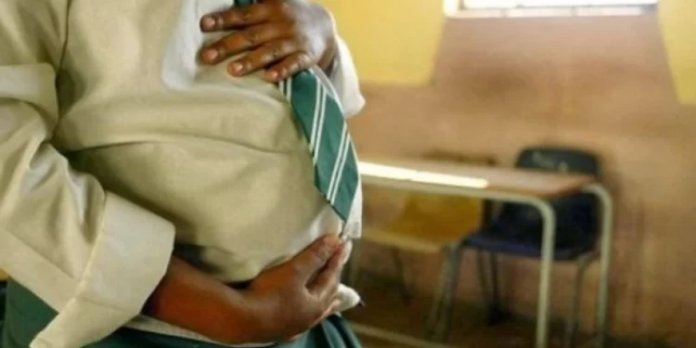
An 18-year-old apprentice has allegedly impregnated 10 girls in five months, including his master’s daughter and a salesgirl in Anambra State.

Reports say he was first sent to learn a trade under a master, but within three months, he got both his boss’s daughter and a salesgirl pregnant.

This, however, led to his dismissal from the apprenticeship.

The state Commissioner for Women and Social Welfare, Ify Obinabo, disclosed this in a live video on social media on Wednesday.

Obinabo said the situation got worse after he returned to his village.

She said, “I want advice from the public because this one is beyond my capacity.

“This boy was sent to learn a trade at the age of 18 and three months of apprenticeship, and he impregnated his master’s daughter and his salesgirl. He was sent packing. Two months after that, he impregnated eight other girls in the village.”

Obinabo also said the boy’s mother came to her office to report the issue.

According to her, the mother said, “‘Anytime I see a girl coming towards our house nowadays, my heart would jump, please, I need help.’”

Obinabo said, “This matter is beyond me, the reason I want the public to help me come up with a solution. Is it spiritual?”

She said she asked the boy how he was able to convince the girls.

“I asked the boy the magic he uses in luring the girls to bed, but he told me he always tells them that he loves them and would like to marry them any time he acquires wealth.

“This problem is beyond me because of the boy’s age and the number of pregnant girls involved; that’s why I need help to solve it.”

Obinabo did not mention the name of the boy, his mother, or their community, but she called on the public to suggest solutions.

PUNCH

Court holds that matrimonial home is jointly owned

  • A man who decides to marry a widow must be willing to take her children along with her and treat them as his own

An Upper Customary Court of Kaduna State in the Kafanchan Judicial Division has held that a matrimonial home is jointly owned and should be valued and sold with proceeds shared equally between the parties when the relationship breaks down irretrievably.

The court also held that since “the parties’ marriage has been dissolved, living together in the flat and in the same compound becomes difficult. It is therefore necessary that a solution is provided to ensure that justice is done to the parties in connection with their matrimonial home.”

This was part of the judgment delivered on 5 May 2025 by His Worship Emmanuel J. Samaila, Esq., the presiding judge of the Upper Customary Court, Kafanchan and Mr James K. Kajang, a member of the panel.

Following the dissolution of the marriage between Akila Iliya (the Petitioner) and
Martina Aboi (the respondent), he court held:

“…the respondent has credibly established her right to share in their matrimonial home and we so hold. Therefore, judgment is hereby entered as follows:

“1.   The parties’ matrimonial home, a flat located at Angwan Wakili, is hereby declared the joint property of the Petitioner and the Respondent.

2.   It is hereby ordered that the house shall be valued, sold and the proceeds shared equally between the parties. The Registrar, in conjunction with the parties, shall oversee valuation, sale and distribution of the proceeds of the sale.  This order shall take effect after 30 days from today, 5th May 2025.”

Delving deeper into the matter, the court counselled that a “man must count the cost before marrying any woman, especially a widow with children.” Adding that “It is not a good thing to marry an enterprising woman with the subtle aim of benefiting from her wealth and sending her away after the goal has been accomplished.”

Part of the full judgment reads:

“We wish to state that it is an irresponsible act for a man to marry a woman of means only to frustrate her at a time he feels he no longer needs her as a wife. It is an inconsiderate and insensitive act for the Petitioner to take the Respondent and her two children from her previous marriage only to have them thrown out of the house subsequently. A man must count the cost before marrying any woman, especially a widow with children. A man who decides to marry a widow must be willing to take her children along with her and treat them as his own if he truly loves their mother.

“The reason why the Respondent agreed to marry the Petitioner could have included his willingness to take her along with her children. No widow who desires to remarry should be separated from her children just because a man desires to take her as wife. There is no way that such a woman will be happy and satisfied in the new marriage without her children whom she will feel she has abandoned because of the marriage.

“It is not a good thing to marry an enterprising woman with the subtle aim of benefiting from her wealth and sending her away after the goal has been accomplished. It became apparent in the instant case that the Respondent has landed properties.

“It is unfortunate that while the Respondent trusted the Petitioner to allow him to put his name in the documents of title of her properties, the Petitioner still had reason to maltreat her by sending her out of the matrimonial home they jointly build to a single room he allocated in the L- shaped building.

“He also sent her children from her previous marriage out of their (parties’) matrimonial home. As if that was not enough, the Petitioner had the Respondent and her child, his son, locked up in prison after a dispute over their matrimonial home. No woman who has invested in the progress of her marriage deserves to be so treated.

“These facts show to the court that the petitioner comfortably instituted this action with the hope of ultimately and absolutely retaining the sole ownership of their matrimonial home. No Court will endorse such act of injustice against the Respondent or any other woman.”                                                                                 

Akila-Iliya-v.-Martina-Aboi-2025

Click here to download the judgment.

TIPS