Home Blog Page 340

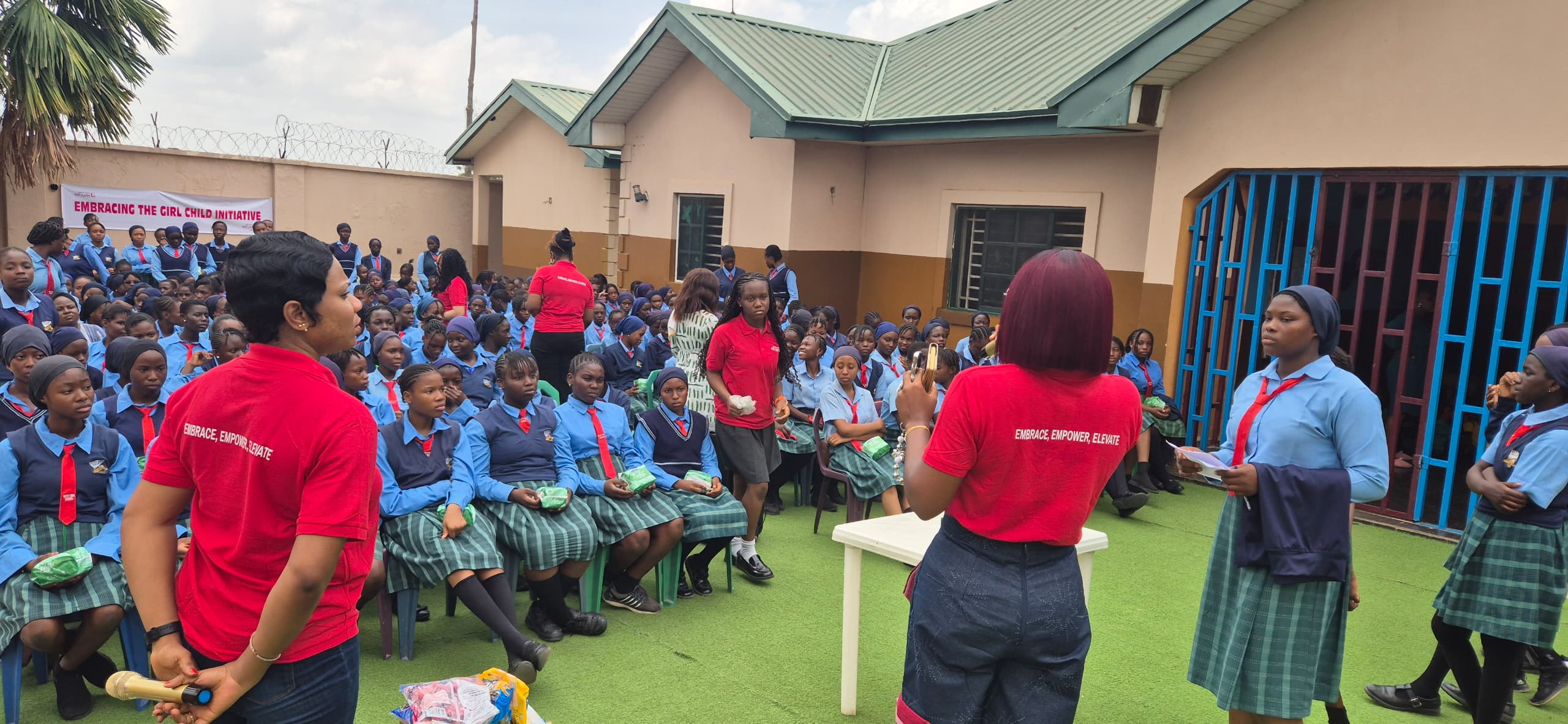
Embracing The Girl Child Initiative commemorates Menstrual Hygiene Day at Witty Kids Secondary School, Mararaba, Nasarawa State

In celebration of World Menstrual Hygiene Day—observed globally on May 28th—with this year’s theme –“Together for a Period Friendly World” – Embracing the Girl Child Initiative held a powerful outreach program at Witty Kid’s Secondary School, Mararaba, Nasarawa State, with the aim of empowering young girls through education, mentorship, and menstrual hygiene awareness.

Embracing the Girl Child Initiative is a non-governmental organisation in partnership with LinkedLegal Attorneys aimed at providing legal representation, counselling and rehabilitation of victims of sexual abuse and domestic violence; sensitizing the girl child with critical knowledge on various laws protecting them, menstrual hygiene, puberty, career choices/development, etc. and also the free distribution of sanitary towels.

Since 2019, the initiative has reached over 10,000 girls in school and young women on the streets across Nigeria through its school and street outreach, providing mentorship and distributing free sanitary towels.

This school outreach brought together professionals, community leaders, mentors, and eager students for an impactful day focused on breaking menstrual stigma, how to make reusable sanitary pads, promoting good hygiene practices, and inspiring young girls to dream boldly.

Proceedings began with a warm welcome and an address by the school principal, who commended the initiative for its timely and relevant mission.

Founder and Country Director, Barrister Nneamaka Onyema emphasized the need to prioritize health, education, and empowerment of girls in Nigeria, and called for safe spaces where they can ask questions and thrive.

Mrs. Ngozi A. Ukachukwu, a seasoned nurse, led the first session on the topic, “Puberty and Menstrual Hygiene”, demystifying puberty and menstrual health, addressing harmful taboos, and offering practical tips to help girls manage their periods confidently and with dignity.

Barrister Onyema later delivered an inspiring session on “Recognising the Path to Your Career”, urging students to follow their strength, interest and passion, believe in themselves, and rise above challenges. Her personal stories and motivational advice struck a chord with many students.

The day also featured an interactive panel session with professionals from diverse fields, where students asked insightful questions about career choices, personal growth, and overcoming gender-prejudiced societal expectations.

The highlight of the event was the free distribution of sanitary towels/pads, underscoring the commitment to alleviating period poverty and ensuring every girl can manage her period safely and with dignity.

The event closed with a group photo, capturing the joy, connection, and sense of new possibilities shared throughout the day.

This outreach is yet another testament to Barrister Nneamaka Onyema’s unwavering dedication to grassroots advocacy. It stands as a call to action for individuals, communities, and institutions to invest meaningfully in the lives of girls in Nigeria—nurturing a healthier, stronger, and better empowered future generation.

We appreciate LinkedLegal Attorneys, I Dey Com Tours and Travels Limited, Dr Innocent Ezuma – CEO, Eta-Zuma Group W/Africa Limited, Joseph Aro – C.O.O, Observatory Earth Analytics LTD, Emeka Terry Ibe – Legal Adviser, Nigerian Society of Engineers, Cyoda Kids Empire, Law & Society Magazine, and Charity Ibezim for their support for this outreach.

Email Address: [email protected]

Instagram:  @embracingthegirlchild

Facebook: Embracing the Girl Child Initiative

₦2.2bn Oil Subsidy Fraud: Two years after N30 million damages against Ex-PDP Chair, Ahmadu Ali’s wife for locking aide in dog cage, their son gets 14 years in jail

In March 2023, a High Court of the Federal Capital Territory awarded the sum of N30 million naira as damages against Dr. Mrs. Marianne Ahmadu Ali, wife of a former National Chairman of the Peoples Democratic Party (PDP), Senator Ahmadu Ali, for locking up her personal assistant, Ms. Deborah Longs Nanpon in a dog cage for three days days.

Days ago, a Lagos State Special Offences Court sitting in Ikeja convicted and sentenced Mamman Nasir Ali, their son, and a Sierra Leonean, Christian Taylor, to 14 years imprisonment each over a ₦2.2 billion oil subsidy fraud.

Justice Mojisola Dada sentenced the duo alongside an oil firm, Nass Man Oil Services Limited after the court found them guilty of an amended 57-count charge brought against them by the Economic and Financial Crimes Commission (EFCC).

The defendants were first arraigned before the court in 2012 on a 49-count charge of conspiracy to obtain money by false pretences, obtaining money by false pretences, forgery, and the use of false documents.

READ ALSO: For locking up personal assistant in dog cage, FIDA Nigeria secures N30 million damages against Ahmadu Ali’s wife

The anti-graft agency claimed that the offences violated the Advance Fee Fraud and Other Fraud Related Offences Act of 2006 and the Criminal Law of Lagos State 2011.

Through its prosecutor, Seidu Atteh, the EFCC also accused the convicts of fraudulently obtaining ₦2.2 billion from the Federal Government under the petroleum subsidy scheme on or about September 9, 2011.

The anti-graft agency had told the court that the convicts presented forged documents, including a falsified “Gasoline Analysis” report for MT Overseas Limar, purportedly issued by Saybolt Concremat.

In her judgment, Justice Dada said she found the evidence presented by the prosecution compelling.

She ruled that the actions of the convicts not only defrauded the government but also undermined the integrity of Nigeria’s oil subsidy programme.

Apart from the jail term, the court also ordered the forfeiture of identified assets and accounts linked to the fraud.

The judge further issued a warrant for the arrest of two other suspects, Oluwaseun Ogunbambo and Olabisi Abdul Afeez, who were said to still be at large.

Imo communities urge Tinubu to stop military siege on 30,000 hectares land under contention

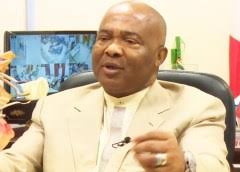
Imo Governor, Senator Hope Uzodinma

The Mbaishi autonomous communities in Ngor-Okpala local government area of Imo State have called on President Bola Tinubu to immediately stop the siege allegedly laid on their 30,000 hectares of land by some personnel of Nigeria’s Military.

The autonomous communities are Umuchie Eziama, Umulu, Umuegirige, Umuogba Eziama, Umuocham Ntu, Umuokpo Ntu, Umuhoko Ntu, and Alatia, all located in the Ngor-Okpala local government area of Imo.

Addressing a press conference on Wednesday in Abuja on the disputed land, the spokesperson of the communities, Dr Ugo Jim-Nwoko, alleged that fully armed military personnel arrived and have laid siege on their 30,000 hectares of farmlands for nine months.

He said that the traditional owners of the land have since been prevented from accessing their farms through a series of intimidation, harassment and brutalisation by the military personnel.

The community leader traced the land issue to 2006 when a former governor of the state, Achike Udenwa, indicated interest in acquiring 2,000 hectares of the land to build a Chinese Village but the project was abandoned due to opposition against the fraudulent acquisition.

Specifically, Jim-Nwoko said two villages dragged the Imo State government to court and got two judgments that annulled the acquisition of the land and also granted perpetual order against the government, restraining it from further trespassing on the land.

However, the community leader lamented that in spite of the subsisting order, the current government of Imo State under Hope Uzodinma suddenly made moves to forcefully take over the land by all means.

To worsen their plight, Jim-Nwoko alleged that Imo State government unlawfully allocated the land to a Zion Ministry Church to build a factory for the production of Red Candle, Olive oil, holy water and Worship Center without consulting the real traditional owners of the land.

He accused the Imo State government of breaching the 1999 Constitution, adding that such land can only be acquired by the government in the overriding public interest and not to serve the interest of any church or individual, no matter how highly placed or connected.

Insisting that the unlawful actions of Imo State government was capable of causing security challenges, the community leader pleaded with President Tinubu to wade into their plight.

He urged the President to order the withdrawal of the military personnel from the land so as to enable them to begin their yearly farming.

“We state further that ever since the deployment of the military, police and other security personnel, our indigenes are being intimidated and cowed, thereby giving the Imo State government and the Zion Ministry the latitude to encroach on our farm lands.

” They have in the process, destroyed all economic trees and other crops which are the main economic sustenance of our agrarian economy,

“We are a peace loving and law abiding citizens who will not take laws into our hands, hence, the need for the media to help us call on Mr President, the Chief of Army Staff and the Inspector-General of Police to withdraw the security personnel from our land and stop them from intimidating law abiding citizens.”

At the press conference were public affairs analyst and mediator, Dr Sam Amadi and Barrister Armstrong Ukwuoma, among other community leaders.

Man wrongly identified as Liverpool parade crash suspect lashes out at ‘keyboard warriors’

Peter Cunningham, the man who was wrongly accused of driving a car into a crowd of Liverpool FC fans on Monday, has hit out at the keyboard warriors who shared his photo online, blasting them for ‘making money’ with false accusations.

The father of three from Huyton on the eastern outskirts of the Merseyside city, found himself at the centre of an armchair detective probe after a man ploughed into fans on Water Street at 6 pm on Monday, injuring 79.

Mr Cunningham, 54, had his picture circulated online by keyboard warriors who were fervently trying to identify the suspect after Merseyside Police released information on the driver’s identity.

Ironically, the force is thought to have released some information on the suspect – a 53-year-old white British man from Liverpool – in order to avoid a repeat of the storm of misinformation online in the wake of the Southport attacks.

But Mr Cunningham was wrongly fingered by social media ghouls as the man responsible despite the fact he is the wrong age, and from another area of Liverpool.

He has, however, been forced to take the unprecedented and unusual step of denying that it is he to bat off amateur sleuths.

He told several media outlets today that he was not at the parade in Liverpool city centre on Monday afternoon – and has called on the police to release the name of the man currently under arrest.

He told the BBC: ‘It’s not me. The police need to do something.’

And speaking to the Liverpool Echo, Mr Cunningham said his phone began ringing off the hook as news of the incident in the city centre broke.

He said: ‘I’m stressed out, I don’t need it all. It’s a bad thing that has happened, and the police need to do something about it and get his name out there. 

‘Other people’s names have been shared. I was getting phone calls off family members and friends saying, ‘What the hell is going on?’.

‘These YouTubers and people on social media are just sharing it to make money.’

UK police forces do not typically release the names of individuals suspected of crimes until they have been charged.

A Merseyside Police spokesperson said: ‘We have arrested a 53-year-old man from West Derby and he remains in police custody where he continues to be interviewed.’

Earlier, the force said suggestions that anyone else has been arrested were ‘incorrect’.

Merseyside Police is thought to have released information on the identity of the suspected attacker promptly after its failure to do so in the wake of the Southport attacks stoked a fire of misinformation.

Trolls claimed a Muslim illegal immigrant had attacked at a Taylor Swift-themed summer holiday club last July.

In reality, the killer was Axel Rudakubana, a British teenager born to Christian parents – but the misinformation nevertheless fuelled anti-immigration protests outside asylum hotels and riots in town centres across the country. 

Amateur sleuths have also been criticised for trying to get involved in high-profile police investigations, such as that of missing mother Nicola Bulley.

TikTok trolls were seen trudging through areas close to where she disappeared, and had made cruel allegations that her friends were ‘crisis actors’ somehow covering up her true fate.

It prompted Lancashire Police, which investigated her ultimately tragic death, to hit out at TikTokers for ‘been playing (at being) their own private detectives’.

Nevertheless, social media continues to ferment with speculation as to the identity of the driver in the Liverpool incident.

A man thought to be the driver remains under arrest on suspicion of attempted murder, driving offences and driving while unfit through drugs.

Some 50 people, including four children, needed hospital treatment following the carnage at the end of the Premier League champions’ open-topped bus celebrations on Monday evening.

Eleven victims were stable and recovering well in the hospital last night, but police sources said it was a miracle no one had died.

The attack occurred just after 6 pm on Water Street, a road off The Strand – the main thoroughfare in front of the Royal Liver Building – which the team bus had passed moments before, as supporters walked home.

Horrifying footage shows fans being catapulted into the air, and some trapped under the wheels. Fire crews extracted four people, including a child, from under the vehicle.

Mobile phone footage from neighbouring Dale Street shows the driver blasting his horn at fans, some of whom strike the vehicle with their fists and feet.

He is thought to have tailgated an ambulance, rushing to help a suspected heart attack victim, through a roadblock and into the throngs of jubilatory fans. 

A source told the Mail that the incident was ‘more road rage, not terror’.

‘It seems the driver was panicked or frightened or both, but what happened next was terrible,’ they said.

Assistant Chief Constable Jenny Sims, of Merseyside Police, told reporters yesterday: ‘An extensive investigation into the precise circumstances of the incident is ongoing, and we continue to ask people not to speculate on the circumstances surrounding the incident and refrain from sharing distressing content online.’

Credit: Daily Mail

More than 4,000 Nigerians in prison over inability to pay N50,000 fine —Minister of Interior

  • Says: “A society that punishes poverty more harshly than crime has lost its moral compass.”

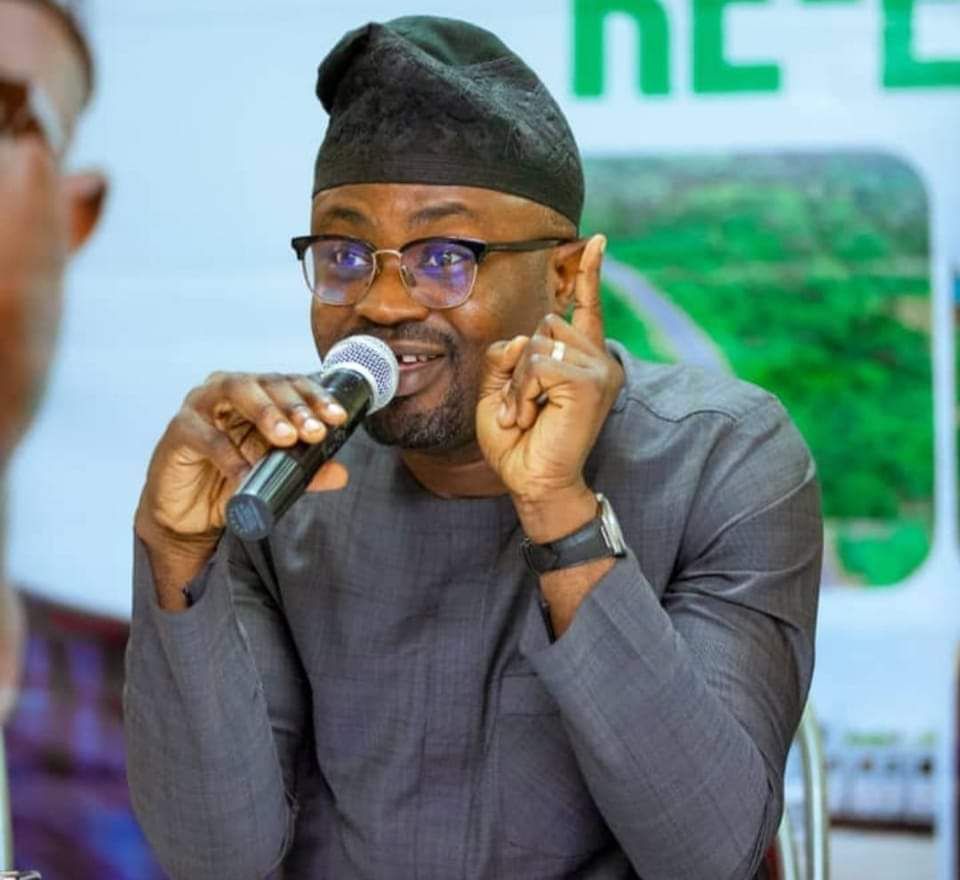
Minister of Interior, Dr. Olubunmi Tunji-Ojo, has revealed that over 4,000 inmates are being held in custodial centres across Nigeria due to their inability to pay fines as low as N50,000.

Tunji-Ojo disclosed this while speaking at the Access Bank Guest Lecture Series (GLS) held at the bank’s headquarters in Victoria Island, Lagos State, on Friday, May 23, 2025.

The minister, who spoke about the broken state of Nigeria’s correctional system, said: “This is not a legal crisis. It is a moral one.

“A society that punishes poverty more harshly than crime has lost its moral compass.”

Tunji-Ojo explained that the Ministry of Interior has since partnered private donors to secure the release of many of these non-violent offenders and is now pursuing structural reforms that prioritise rehabilitation over punishment.

According to him, these included digital case tracking to prevent indefinite detention, vocational training programmes within correctional centres, and public-private partnerships aimed at improving living conditions and operational efficiency.

“A correctional facility must correct, not condemn. Justice without dignity is injustice in disguise,” the minister was quoted to have said in a statement issued by Access Bank on Monday, May 26.

When courts overreach

BOOK SERIAL

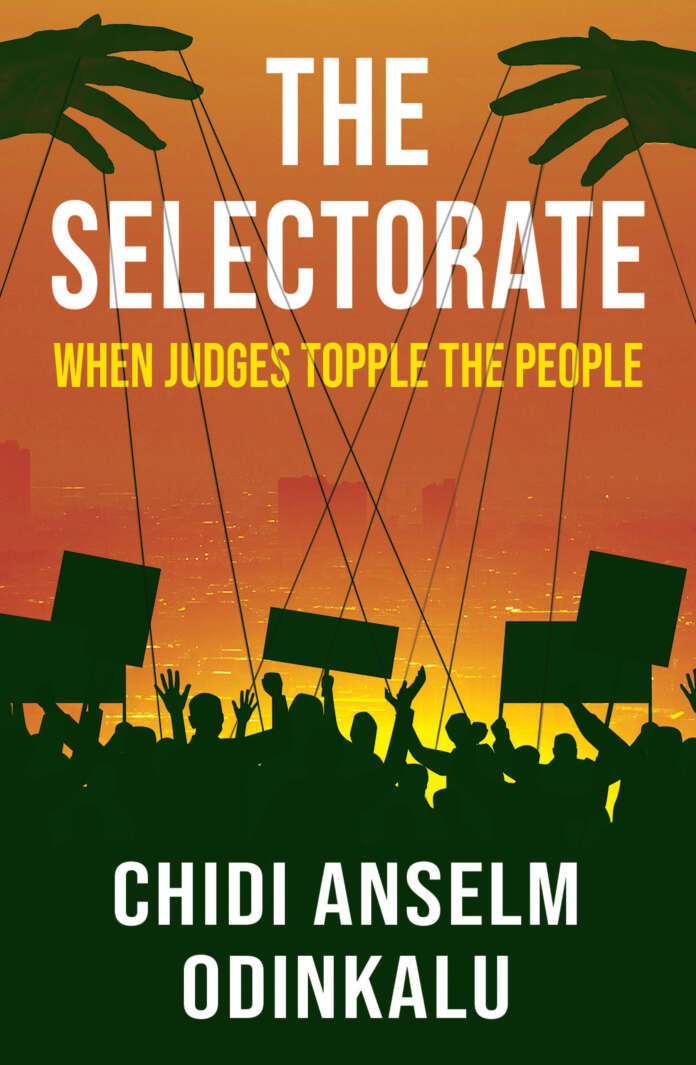
By Chidi Anselm Odinkalu

YESTERDAY

The author examined the concept of rule of law, the judiciary and their relationships to elective government, beginning with Albert Venn Dicey.

Today, he looks at how the courts in Africa have overreached themselves and the consequences, citing Malawi, Zimbabwe and Mali as examples before dwelling on Nigeria where the problem appears to be worst.

*******

The Universal Declaration of Human Rights (UDHR) guarantees that “the will of the people shall be the basis of the authority of government,” and that “this will shall be expressed in periodic and genuine elections which shall be by universal and equal suffrage.” This right to political participation is the anchor of electoral legitimacy, which is the basis of the right to govern. However, this norm is increasingly under threat from diverse forces leading to what has been described as  crisis of so-called democratic recession.” Such forces include a global rise in populist authoritarianism and, on the African continent, increasing incidents of unconstitutional changes in government.

Regardless, a focus on these forces can downplay more subtle trends that have enabled the corrosion of democratic participation, especially in emerging or transitional democracies. Following an era of constitutional instability in the aftermath of independence, Nic Cheeseman suggests that by the turn of the millennium, “elections and term limits replaced death and coup d’etat as the most common ways in which African presidents and prime ministers left office.”’

The fact that presidents leave office through elections, however, does not mean that their successors necessarily get installed through the popular will. Across Africa, judges are increasingly involved in determining the winners and losers of elections. Depending on the extent of this involvement, the consequence could be, first, a transfer of the ultimate decision on the mandate to rule from the people to the judges; and second, the creation of an incentive for the erosion of the independence and impartiality of the judiciary as a longstanding foundation of the rule of law. This trend bears close attention.

Courts can overreach in determining not merely the rules governing the validity of elections but also in making calls as to the winners and losers of specific electoral contests. This degree of judicialisation of elections enables democratic recession in three ways. First, it vitiates the right to democratic participation and retrenches the popular will as the basis for democratic legitimacy. Second, it enables the courts to expropriate electoral legitimacy from the people and transfer it to the judges. Third, it provides perverse incentives for political interference with judicial independence, increasingly making the judiciary a site of contest over the pre-determination of election outcomes in many countries.

In Malawi in 2020, for instance, the people had to take to the streets to resist the effort by the president to remove the Chief Justice in order for the president to secure a Supreme Court panel more solicitous of his will in the run-up to a presidential re-run following a rigged contest that had been struck down by the courts. The following year, in neighbouring Zimbabwe, the ruling party pressured the Constitutional Court to overrule an earlier decision of the High Court blocking an extension of the tenure of the Chief Justice after he had attained the mandatory retirement age, placing him on a contract, which made him manifestly subject to presidential whim. Ahead of contentious national elections two years later, the same president decided to advance $400,000 to all serving judges in Zimbabwe as “housing loan” with no repayment obligations. The beneficiaries included the chair of the Zimbabwe Electoral Commission (ZEC), herself a serving judge.

Unsurprisingly, such developments can endanger a government founded on the will of the people. In April 2020, Mali’s Constitutional Court overturned the results in thirty-one parliamentary seats won by the opposition. Its decision to hand these seats over to the ruling party sparked an uprising that led to the dissolution of the Constitutional Court;’” and was followed by the overthrow of the government in a military coup.

Electoralism and Judicial Independence in Nigeria

Among political scientists, there is a point of view that when EMBs are incapable or compromised, institutions of “oblique accountability,” such as courts, can step in to cure their deficiencies. This argument appears to overlook three issues. First, looking to courts to cure habitual deficits of will or capacity in EMBs casts a shadow over elections and their legitimacy because in deploying courts to cure substantial failures in election administration, the risk is that the site of electoral legitimacy is relocated from the people to judges. Second, the question could arise as to whether the same forces capable of compromising the independence and integrity of an EMB would be reluctant to extend the same treatment to the judiciary. Third, this does not reckon with any sense of what the consequences could be for both the effectiveness of courts and for public perceptions of the judiciary.

Few countries have been overtaken by this trend like Nigeria. When Nigerian judges began overturning the results of elections and declaring their own, many took a sanguine view of the development, describing it as “an instrument of democratic advancement and stability.” Since then, however, opinions have evolved and judges at the highest levels now complain that “the entire Nigerian judicial system is inundated with electoral litigation and adjudication almost all year round,” which are “taking a monumental toll” on the courts. This toll resounds both in metrics of judicial service provision as well as in the credibility of the courts and judges.

In Nigeria, for instance, over 80% of the contested offices in elections in any cycle can be decided by the judges. Nigerian courts can set aside official electoral returns and substitute their own or routinely re-compute returns by the EMB. This has created a situation described by the Economist as a “democracy by court order.” In 2011, for instance, the courts for the third time returned to the upper chamber of the national parliament a man who had never won an election.

Two cycles of elections later, they conferred the mandate in a state governorship election on a man who had been well beaten into fourth position. When it decided to replace a duly elected candidate for the position of state governor in a state in North-West Nigeria in 2019 with a candidate who was well beaten into a distant second, Nigeria’s Supreme Court incredibly crystallized a doctrine that the votes of the winning candidate whom it had chosen to oust on a preelection technicality were “wasted.” Surely, a democracy cannot be founded on jurisprudence that renders votes so casually expendable. Under the cover of “judicialism”, the use of courts in this manner subverts the will of the people in a manner not dissimilar to the effect of a military coup.

Among transitional democracies in Africa, few are as significant as Nigeria. It is not just the most populous African country, it is also the African country with the most extensive record of judicial immersion in election dispute adjudication, with a history that pre-dates the onset of presidentialism in 1979, and a jurisprudence of election dispute adjudication influential beyond its shores. In over half a century, election dispute resolution in Nigeria has metastasized to a level that now suggests that it is the primary preoccupation of the courts.

On its own, the dysfunction of courts derailed from their primary mission by a preoccupation with election dispute resolution is very much deserving of attention. A bigger concern, however, lies in the reality that the primary reason for this dysfunction is the fact that in Nigeria, courts have emerged as the predominant venue for acquiring the mandate to rule and judges have become the only people whose votes count for that purpose. Put differently, the Constitution may designate the people as the electorate, but they have been toppled by the judges who have installed themselves as a Selectorate. This book examines and illustrates the origins of this trajectory and its consequences for both right to participation and for judicial integrity and independence. Before proceeding to this inquiry, a brief institutional context of the place of courts in the political economy of Nigeria is essential.

TOMORROW…

We skip many juicy pages to Chapter 6, where the author tells exactly how judges became the selectorate. 

‘It’s selective justice amid multiple unresolved petitions’, Natasha’s lawyers allege bias over FG’s suit

Senator Natasha Akpoti-Uduaghan’s legal team on Wednesday raised the alarm over what it described as a disturbing pattern of selective justice, following the Federal Government’s decision to file criminal charges against her despite multiple unresolved petitions she lodged earlier this year.

In a statement released by her counsel, Uju Nwoduwu, the team outlined 12 petitions submitted by the senator between March and May 2025.

The petitions reportedly detail allegations including cyberstalking, defamation, threats to life, and an alleged assassination attempt.

According to the legal team, none of these complaints have been acted upon by the Nigeria Police Force or any relevant security agency.

“There is a legitimate public expectation that law enforcement and prosecutorial agencies uphold the principles of fairness, due process, and equal justice—regardless of who is involved,” the statement said.

The lawyers further expressed concern that while Akpoti-Uduaghan’s petitions remain unattended, counter-allegations filed by those she accused—including Senate President Godswill Akpabio and former Kogi State Governor Yahaya Bello—have been swiftly pursued, leading to criminal charges against her.

“This glaring disparity raises serious concerns about a biased and uneven application of justice,” the statement continued.

Some of the petitions, they added, involve high-ranking officials and incidents as grave as the abduction and attempted assassination of a protocol officer.

Though currently abroad on personal engagements, Akpoti-Uduaghan has acknowledged receipt of official communication regarding the charges and has pledged to make herself available for arraignment as soon as a date is set.

“She remains resolute in her commitment to due process,” the legal team affirmed, while also thanking members of the public who have voiced concern over what they called “an extraordinarily questionable criminal charge.”

The statement concluded with a renewed appeal for impartial investigations into all outstanding petitions and a call for justice to be applied equally, without fear or favour.

Japa: Raped, bound and beaten

By Funke Egbemode

Lazy husbands are ‘flying’ their wives to Syria to ‘work’. Greedy aunts and shortsighted mothers are pushing their children to go to Libya, Egypt, Mali, Iraq to do jobs that even they do not understand. The terrorism of the Sahel is an attraction for desperate Nigerians.

Nigeria is bad. It is not conducive for anything. In fact, you cannot realize any of your dreams here. Can you even dream here, let alone make them come true? This is the worst country a baby can be born to. These days, there are no good testimonies coming from our altars. Everybody wants to leave and in droves, they have left. Today, Nigeria is lacking every professional, from shoemakers to nurses. Both young and old will tell you that it is better to go ‘abroad’ to clean snot than to be a doctor in Nigeria.

But how has the market been for those who left the hell this place is?

Her boss raped her at gunpoint and when he found out she was pregnant, he forced her to have an abortion.

For three days after the invasion of her body (the abortion), she could neither sit down, bend or stand straight. Weeks after, her menstruation was still missing. So, what exactly was the violent procedure performed on her if her monthly period was missing? The lady is still in excruciating pain. She is only 27, a Nigerian, domestic worker in Iraq. Iraq? Yes. That Iraq that was all about wars and violence, bombed soldiers, dead women, children, the aged, the young. That Iraq is where 5,000 Nigerian women are, stuck like the akudaaya, the living dead. They are neither Iraqi nor Nigerians.

According to an Al Jazeera report, the woman in the story, Agnes (real name withheld) is one of thousands caught in the transactional labour network run by some opportunists who peddle the work-abroad-and-earn-dollars to Nigerians, those who believe that Nigeria is the worst place to be born or live. This ring of slave traders (I am calling a spade by its name) sweet-talks women into believing that Iraq is the Eldorado they had been dreaming of.

How did they find themselves in Iraq? The victims and their gullible families sell off properties to process visas, pay for this, for that and for flight tickets. The travellers are sent, or they unknowingly, sell themselves into international servitude. I insist, it is slave trade. Once in Iraq, these modern day slaves are made to sign two-year contracts with recruitment firms who assign them to homes and institutions where they are made to work 18-20 hours daily for a monthly salary of $200-$250.

Imagine the long hours, the s3xual abuse, the loneliness. Some of them are never heard or seen again, like the one sent to be a caregiver by her husband to Iraq. What kind of man sends his wife to be a caregiver in Iraq of all places? The man should be castrated; he deserves to be a eunuch. I would have said the woman, too, should be whipped on her bare buttocks for agreeing to go on the suicide mission. Except that she died in Iraq. Yes, she died, and the husband who sent her there could not afford to bring her body back to her children and parents for burial. Nigerians in Diaspora Commission (NIDCOM) had to step in to bring the corpse back to Nigeria. The poor commission is stuck with rescuing both the dead and the living from different corners of the earth.

Like Agnes, several Nigerian women are living like half-dead in the Middle East. They are kept in hostels or homes where they are barely fed. They are beaten black and blue if they protest their living conditions. They work long ungodly hours and have no access to medical care. They cannot report the abuse to the authorities. How exactly are these ones different from the slaves who work on sugar cane plantation all through the slavery and slave trade years. Well, except that today’s victims actually pay their ways into servitude.

Agnes said she paid N100,000 to a recruiting agent, hopped on a plane into the plain pain she now doesn’t know how to escape.

There is another related painful episode. Nigeria in April received 231 citizens criminally moved to Ghana under the guise of all kinds of fake job offers. Some were promised lucrative jobs working on mines. Many were recruited for cybercrime operations. The recruiting syndicate was reportedly operating from a certain 50-house estate in Ghana. Precisely in Kumasi. Fake job offers by Nigerians exploiting fellow countrymen for money. Some of the victims from Ghana paid up to N3 million just to relocate. Traffickers made all the money, preying on the ignorance and greed of those who could pass as their nephews or nieces. They lock the victims up, use them for whatever suited their sick tastes. Victims recruited from rural backgrounds are taken to dreaded shrines to take oaths that keep them from running away from their captors. Their passports are seized, their phones smashed. They are beaten and starved to keep them submissive.

I just got another report of yet another returnee who came back to Nigeria without her mind. Her family, still as poor as she left them, are now trying to raise funds to check her into a psychiatric ward. Yet, people continue to leave; in droves, too.

Nigeria should be worried because it is worn thin. Fashion designers can’t find apprentice or workers. Beauticians lose their young apprentice in days. Was it not just a decade ago that young men threatened women’s enclave of tying gele and donning make-up? These days, it’s hard to find a boy or girl who wants to learn a trade or practise such ‘menial job’. The hussle in Naija no longer pays. Everybody wants to Japa or die trying. My heart sank the day I heard an educated mother say she was ready to sell ‘anything’ to belong to the ranks of mothers whose children live abroad. My jaw almost dropped all the way to the floor. So there’s a rank of mothers of those who live abroad? Really, you should have heard how what she said sounded in Yoruba.

“The weight of stone and sand is nothing compared to the trouble that stupidity can cause (Proverbs 27:3-13). Desperate children are being aided and enabled by even more desperate parents to blindly relocate to anywhere that looks like an ‘abroad.’

Nigeria’s current situation is worse than the worst pandemic. That is why Ghana is abroad, Togo too and even Iraq. As how (in the voice of Mr. Pitipiti)? How is Mali better than Nigeria?

True, every country where you have to cross the sea to see is overseas. After all, Buoda Tokunbo was actually born in Ghana. The old Gold Coast was his parents’ across the sea. Things are hard here. True. The white man won’t have what it called merchant vessels if he didn’t travel. Travelling is good. But does that mean we shouldn’t ask questions about what lies ahead before jumping on any offer? How exactly is everywhere better than Nigeria for Nigerians? It is neither possible nor right.

Do I have anything against the Japa syndrome? Not a thing. We all must do what we need to do to get ahead. Nigeria is hard, rough, and things look bleak. Naira fell and took our hopes down with it. If Europe or Australia offers a better deal for our children, why not? But I draw the line with parents of children with no skills going to ‘funny abroad countries’.

The descendants of local chiefs who sold their nieces and sisters centuries ago are determined to carry on the evil trade. The money, two million or five million naira that the new slave dealers are taking from struggling families to rape and assault our children could be used to start little businesses in Nigeria. Many of the returnees who came back empty-handed have stayed back in Nigeria and rebuilt their lives with less than what they paid to follow users and abusers into the wilderness.

The 2023 Global slavery index ranked Nigeria 5th out of 51 Nations for modern slavery prevalence with 1.6 million people in different forms of labour servitude. Fortunately for us, Hon. Abike Dabiri-Erewa-led NIDCOM, NAPTIP and other agencies are leading the fight to rescue the nation’s reputation. Just imagine if we had no NIDCOM and NAPTIP to respond promptly. However, the real job is preventing the unreseached trip our countrymen and women are embarking on. All states of the federation must commence reorientation and awareness campaigns to let our family units know the traps these modern slave traders are launching everywhere. And the naming and shaming must commence as the NIDCOM Chairman suggested. Parents who sell their children must be paraded like armed robbery suspects. Husbands who send their wives to Kuwait and Iraq must be ‘interviewed’ on National Television.

Like Britain’s former Prime Minister, Theresa May, once said, ‘every one of those 50 million (slave trade victims) has talents, interests, hopes and desires that have been stripped from them. They deserve to live their lives just like everyone else.’

“He who sells sand as brown sugar will receive stones as payment”. This proverb is for the local agents who are recruiting Nigerians to become ‘shagalas’ (house workers in Arabic). They must be rounded up both in the court of law and in the court of public opinion. If they escape the present karma, how about tomorrow’s?

A report in the Saturday Tribune, some years ago, about slave trade in Badagry, Lagos, was captioned: ‘Descendants of foremost slave merchant now live in cells their ancestor built for his slaves.’ That is the future that awaits all who promise their relatives peace of paradise but sell them to the desert of destruction.

The judiciary and rule of law

BOOK SERIAL

By Chidi Anselm Odinkalu

YESTERDAY
The author laid the groundwork for his thesis that judges, whom he calls “the selectorate”, have toppled the people in deciding who rules them. Today, he examines the concept of rule of law, the judiciary and their relationships to elective government, beginning with Albert Venn Dicey.

The Constitution’s Design

The usual fare is to begin every examination of the judiciary and rule of law in the Common Law world with an obligatory genuflection before the altar of Albert Venn Dicey and his Victorian notions of the rule of law.

These were founded on benevolent notions of predictability and equality policed under an unwritten constitution by “the jurisdiction of the ordinary tribunals.” Inherent in Dicey’s concept of the rule of law is the idea of a judiciary whose effectiveness is essentially guaranteed by their notional independence, impartiality and predictability.

Dicey’s ideas were originally published in 1893 at the onset of the European occupation of Africa. The world that Dicey described and analysed, however, did not treat people of colour as humans, and the benevolence that he took for granted as a Caucasian was unknown to the interaction between his people and colonial subjects. This certainly was the case in Africa. For present purposes, therefore, an examination of the rule of law, the judiciary and their relationship to elective government is more usefully situated in the seminal distinction drawn by Ernst Fraenkel between the “Normative State” of credible institutions and rule constraint on the one hand and the “Prerogative State” of caprice on the other.”

Democratic process, as a rule-constrained system for the transfer and exercise of power in political society, assumes the existence of what Ernst Fraenkel called the normative state of the rule of law, which he distinguished from the authoritarian prerogative state.

The African Commission on Human and Peoples’ Rights has similarly distinguished between a state with rule of law and judicial independence on the one hand, and the “rule of power, which is typically arbitrary, self-interested and Subject to influences which may have nothing to do with the applicable law…,” on the other.

The state with the rule of law as described can only exist where there is a reasonably independent judiciary to arbitrate and interpret the norms applicable to the democratic process. It is possible, however, for courts to be instrumentalised in a manner that uses the appearance of a norm-constrained process to engineer into existence authoritarian conditions. In many African countries, this appears to be happening.

To understand how this occurs, it is essential to stress that the role of the judiciary in the democratic process of electing government is a narrow one. As pointed out by the Supreme Court of India, the role of the courts is to oversee the validity of the electoral process in order to ensure that while the rules are certain, the outcomes of elections are uncertain or not predetermined until the votes of the people are cast and counted. The Universal Declaration of Human Rights guarantees the rights of democratic participation and to vote as the basis of legitimate government. To implement these, countries establish election management bodies (EMBs), which supervise and organise their elections and declare their outcomes.

When elections occur in this manner, they ensure that democratic legitimacy resides with the people. The Supreme Court of the United States has rightly cautioned about “the vital limits on judicial authority” concerning “the Constitution’s design to leave the selection of the President to the people, through their legislatures, and to the political sphere.” In Nigeria, the Electoral Reform Panel chaired by former Chief Justice, Lawal Uwais, similarly warned in 2008 that “care should be taken not to drag the judiciary into the political arena too often as this can affect its credibility.”

Elections are, therefore, globally accepted normatively as how the people choose who governs them but the quality of what counts for elections varies widely across the globe. This most consequential of decisions in most countries around the continent increasingly involves judges in varying degrees of intimacy, if not capture.” Following the wave of democratisation around the continent in the 1990s, this role of the judiciary was largely seen in a positive light as a source of “hope.” This verdict proved to be premature at best.

Judges are supposed to be independent of politics. Yet, the assumption exists that they can continue to make the most consequential decisions in a democracy while retaining independence from external influence. Hakeem Yusuf strongly suggests that the immersion of the judiciary in political change “seriously tasks the institutional integrity of the judiciary.”

This book argues that the immersion of judges in election dispute resolution around Africa endangers the judiciary, imperils the project of building independent institutions, and retrenches the will of the people as the foundation of legitimate government. It illustrates these triple crises with a narrative of how the immersion of Nigeria’s judiciary in election dispute resolution has over time intensely altered the traditional assumptions that underpin the judicial function as we know it but first, it is important to explain why such an inquiry is essential.

Judges, Democracy and Elections

The judicial function is now globally accepted as foundational to the role of the state and essential to Iegitimate government but its delimitation is underpinned by both fluidity and contradiction.” Notionally, the judiciary embodies the very essence of what has been described in constitutional design as “politically neutral zones.” At the African continental level, State parties to the African Charter on Democracy, Elections, and Governance (ACDEG) undertake to “establish and strengthen national mechanisms that redress election-related disputes promptly.” They also agree to “strive to institutionalise good political governance through an independent judiciary.” In the African Charter on Human and Peoples’ Rights, they equally subscribe to a “duty to guarantee the independence of the courts.”

But what does an independent judiciary entail? Ordinarily, it imports structural and institutional assumptions that recognise the judiciary as an arm of government in a scheme of separation of powers coexisting in juxtaposition with the legislative and executive branches but free from interference or manipulation from the latter two.” To assure this, formal standards of judicial independence are recognised internationally,” and instituted in the constitutions of different countries, addressing such issues as processes of appointment; security of tenure, discipline and removal; remuneration; and preclusion of reprisals or liability for exercise of judicial function. By and large, judicial independence embodies at least three complementary elements. These include adjudication by “a neutral third”, institutional insulation from political interference or pressure, and guarantees of effective coexistence as a separate branch of government.” However, around the world, the judiciary is also widely seen as a political institution, which functions in the role of political accountability.”

Howsoever the judicial function is conceived, independence is widely seen as constitutive of its being. The United Nations Special Rapporteur on Independence of Judges and Lawyers has argued that judicial independence belongs to the domain of a peremptory norm of international law (jus cogens), although he stops short of explicating the elements of such a norm.

The scope and meaning of judicial independence exist in a zone of contradiction and dynamic ambiguity that encompasses institutional as well as procedural; inherent and instrumental; normative and situational; structural and behavioural; prophylactic and propositional: as well as formal and informal dimensions.

Yet, political rulers can often suborn the judiciary to legitimise themselves and the effectiveness of the judicial institution is reputedly shaped by political context. Courts and judges are at once institutions and employees of the state and yet, agents of the government. Notwithstanding its description by Baron de Montesquieu as “in some measure next to nothing,” the judiciary is nevertheless eulogised in comparative jurisprudence as the ultimate custodian of constitutional government, the “lifeblood of constitutionalism,” and as the avatar of the people against autocracy.”

The adjudication of election-related disputes tests the limits of these assumptions about the judiciary and has been delicately described as a “compromise between law and political expediency.” In many African countries, the people may vote but the question of who wins or loses the presidency is increasingly resolved as a judicial dispute in compelling spectacles of judicial pusillanimity. Uganda’s former Chief Justice, Benjamin Josses Odoki, “smiled when commenting that to nullify a presidential election would be suicidal,” suggesting that the independence of judicial decision making in any country is reflected in both the scope of judicial imagination and in its institutional psychology.

A mere seven years after this claim by Uganda’s Chief Justice, David Maraga, as Chief Justice in neighbouring Kenya, led the Supreme Court in that country to accomplish precisely that,” and less than three years later, the Constitutional Court did the same in Malawi, with a bench of judges dressed in bullet-proof vests.” It must be said that these could not have occurred under the constitutional systems bequeathed by colonialism at Independence. By the time these developments occurred, these countries had re-engineered their constitutional foundations forged in bitter experience.

But, if judges can be so powerful as to strike down election returns, it is natural to expect that assertions of their independence will not go without political pushback. Naturally, therefore, the involvement of judges in electoral adjudication makes their independence a zone of political contest.

TOMORROW…
The author discusses how the courts in Africa have overreached themselves and the consequences, citing as examples Malawi, Zimbabwe and Mali before zeroing in on Nigeria, saying “few countries have been overtaken by this trend like Nigeria.”


Man arrested, several injured after car ploughs into crowd at Liverpool FC victory parade

Liverpool Football Club’s Premier League victory parade descended into chaos on Monday evening after a car collided with pedestrians in the city centre, leaving nearly 50 people injured, including children.

A 53-year-old white British man believed to be the driver of the vehicle was arrested at the scene of the collision on Water Street in the heart of the city, metres from the Royal Liver Building and the town hall, after roads had been reopened after the main parade.

Scenes of jubilation with thousands of Liverpool fans lining the streets to celebrate their club’s Premier League victory were rapidly replaced with scenes of fear and confusion as emergency services arrived at about 6 pm.

Click here to continue reading.

Summary

TIPS