Home Blog Page 339

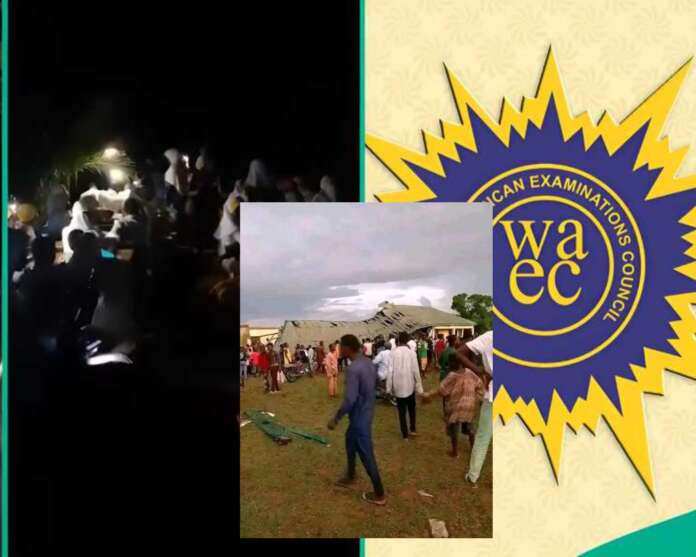
Trying times for Nigerian students as candidates write WASSCE exams late at night, examination hall collapses

It has indeed been a troubling time for Nigerian students.. After the JAMB debacle of the past few weeks, widespread confusion ensued across several exam centres in Nigeria on Wednesday, as candidates taking the West African Senior School Certificate Examination (WASSCE) faced hours-long delays in writing the English Language paper.

As if that is not bad enough, dozens of students sitting for the ongoing exams at Government Secondary School, Namnai, in Gassol Local Government Area of Taraba State narrowly escaped death on Wednesday evening after their classrooms collapsed during a downpour accompanied by a windstorm.

The students, along with teachers, corps members, and external supervisors, were reportedly trapped in the collapsed structures and had to be rescued by local residents who responded swiftly to the incident.

Several students, both male and female, sustained varying degrees of injuries, with some reportedly suffering fractures to their limbs.

The victims are currently receiving treatment at a nearby Primary Healthcare Centre in the town.

A resident, Alhaji DanAzumi Lauris, who spoke with The PUNCH in a telephone interview, said the incident happened around 6pm, shortly after the second set of students had begun their exams.

“It was the second batch of students still writing their exams that got trapped. The first set had already finished and left.

“The rain came suddenly with strong winds, and the old classroom structures couldn’t withstand it,” he said

He added that the windstorm not only brought down the school buildings but also destroyed several homes in the community.

In a related development, students in Jalingo, the state capital, were also affected by Wednesday’s heavy rainfall.

Some candidates were forced to remain at their exam centres until after 1 am, as the torrential rain made it impossible to return home earlier.

There was also a reported late arrival of WAEC paper for the day, which caused the delay in writing the exams until 8pm, when some centres received the paper.

Efforts were made to contact the Commissioner for Basic Education, Dr. Augustina Godwin, but her phone line was not reachable at the time of filing the story.

On the issue of exams that were written at night, the exam, scheduled to begin at 9:00 am, did not commence until midday at multiple locations.

Even at that, the last paper did not start until nightfall in some centres, with students in Lagos reportedly still writing as late as 11:45 pm under torchlight.

The disruption, which triggered anger among parents and sparked an online backlash, occurred in several southwestern states, including Lagos, Oyo, Ogun, and Osun.

Some sources report that the paper was leaked online, prompting the West African Examinations Council (WAEC) to replace it at the last minute.

Responding to the incident, WAEC issued a statement apologising to candidates, parents, and schools.

Moyosola Adesina, acting head of public affairs, said the disruption was a result of intensified security efforts to prevent question leakage.

“While we successfully maintained the integrity of the examination, it impacted the timeliness and seamless conduct of the English Language paper,” the statement reads in part.

The council said it is working with security agencies to prevent future lapses.

Addendum: A lawyer’s guide to authenticating electronic evidence

By Folarin Aluko

The admissibility of electronically generated evidence—particularly audio, photo and video files transferred and played from secondary storage devices—has become increasingly prevalent in Nigerian courts.

Following the publication of the initial article on this subject, a colleague sent an email highlighting a real-life scenario that illustrates several issues raised in the original discussion. The facts, now anonymized, are shared here for illustrative purposes.

The writer sought insight into the evidential implications of tendering an audio message recorded by an individual in the United Kingdom. The person who made the recording sent it to another individual in Nigeria. This second person copied the file onto a flash drive and forwarded it to a lawyer, who then played and tendered it in court through a witness.

Notably, the witness neither created the original recording nor had control over the device from which it originated. Despite this, the content of the flash drive was admitted into evidence by the court.

Interrogating Authentication

Authentication is not a ritual where one utters legalistic incantations from the Evidence Act, to make digital evidence admissible. In an age of deepfakes, metadata manipulation, AI rendering, and seamless video editing, digital evidence may appear persuasive but collapse under scrutiny.

Authentication becomes crucial when:

  1. The evidence has passed through multiple devices or formats;
  2. The author is unavailable for questioning;
  3. The medium is vulnerable to editing, compression, or mislabeling;
  4. The evidence is central to the case’s outcome.

In such situations, forensic reports, metadata, hash values, and system-generated timestamps become the building blocks of integrity. Without them, digital evidence may be technically admissible but practically untrustworthy.

Returning to the Scenario: Two Key Legal Questions Arise

a. Whether the evidence is hearsay, and

b. Whether the audio file was properly authenticated under our current legal framework.

Issue 1: Hearsay

Section 37 of the Evidence Act, 2011 defines hearsay as any statement—oral or written—made by a person not called as a witness, which is offered to establish the truth of the facts asserted in it.

Our Courts have consistently held that evidence is hearsay if the Maker of the statement cannot be cross-examined, and the statement is used to prove its contents. In the locus classicus case of Subramaniam v. Public Prosecutor, 1 W.L.R. 965 (1956) the Privy Council held that:

“Evidence of a statement made to a witness by a person who is not himself called as a witness… is hearsay and inadmissible when the object of the evidence is to establish the truth of what is contained in the statement.”

In the scenario presented above, we can deduce that

  1. The UK-based author of the audio message was not in court;
  2. The message was offered to prove what the sender allegedly said;
  3. The person who presented the evidence was neither the author nor the custodian of the original device.

By these standards, the audio message has the quintessential features of hearsay and unless it falls within one of the few recognized exceptions to the rule, it ought to have been excluded.

Issue 2: Authentication

Authenticating digital evidence involves more than confirming its existence. It requires proof that the document is what it claims to be and that it has not been altered during creation, storage, or transmission.

The Supreme Court, in Dickson v. Sylva (2017) 8 NWLR (Pt. 1567) 167, has affirmed the mandatory compliance with Section 84(2) and (4) as the legal threshold for authenticating digital evidence.

Authentication of Electronic Evidence requires an appreciation of the legal and the technical; the digital evidence must be shown to be genuine and reliable.

As previously established, the law provides two clear routes:

  1. Oral testimony from someone who can speak credibly to how the document was produced, stored, and transferred;
  2. A Certificate of Compliance under Section 84(4), issued by a person responsible for the system or device used.

In the case at hand,

  • The Tendering Party neither created the recording nor controlled the originating device;
  • No certificate was provided to explain how the message was generated or transferred;
  • The witness lacked the technical or factual basis to establish authenticity.

On this basis, we can conclude that the audio message was not properly authenticated. Merely copying a file onto a flash drive, without establishing chain of custody or verifying its digital integrity, falls short of the standard required by law.

In order to authenticate the audio file, the party seeking to tender same in the scenario would have to produce details of the original device, along with system logs or metadata showing when and how the message was created and sent, giving the Court a stronger footing on which to rely on the evidence. Opposing Counsel can reverse engineer these points to arrive at valid technical objections to raise- that is a story for another day.

Conclusion

To summarize

  1. Yes, the message is hearsay if tendered to prove the truth of what the UK sender said, and should be excluded unless it falls within a recognized exception.
  2. Mere documentary authentication is insufficient where the tendering party was neither the author of the content nor the custodian of the originating system—and failed to provide a certificate under Section 84.
  3. Even if admitted, such evidence may be accorded little weight and may be vulnerable to exclusion on appeal.

Proper authentication would require

  1. A Section 84 certificate from the custodian of the originating device or platform with documented Chain of Custody;
  2. Oral evidence from a person familiar with the creation and handling of the file;
  3. Forensic analysis where authenticity is disputed.

I remain grateful to the colleague who generously shared this scenario, and to the many others who continue to engage with these evolving questions—on social media and by email.

Folarin Aluko is an IP Lawyer, Digital Rights Expert, and Partner at Trumann Rockwood Solicitors. He can be reached at [email protected].

Ekiti man bags life jail for raping 14-year-old stepdaughter

A 56-years-old-man, Jaiyeoba Oluwafemi, will likely send the rest of his life in prison for raping his 14 years old stepdaughter.

An Ekiti State High Court, Ado Ekiti Division, gave the order on Monday.

Oluwafemi was tried and found guilty of the one-count charge bordering on rape preferred against him.

The charge read, “That the defendant on 26th October, 2020 at Ado Ekiti did rape a 14-year-old girl, contrary to Section 31(2) of the Child’s Right Law, Cap. C7 Laws of Ekiti State, 2012.”

In her testimony before the court, the victim, who was a primary six pupil at the time, said, “My mother got married to the defendant, we were not living together, but he used to sleep in our house, especially when my mother was not at home or travelled.

“On 26th October, 2020, my mother travelled to Lagos and the defendant slept in our house. At midnight, he woke and forcibly had sex with me. Thereafter, blood was gushing out of my private part. I called my mother when she returned the following morning, but he denied it.

“He continued the act anytime my mother was not around. I used to tell my mother on her arrival, but she did nothing about it. When he noticed that I was telling my mother about his continuous sexual activity with me, he started threatening me.”

The victim said that she reported the matter to the Governor’s Office following a woman’s advice, which led to the man’s arrest.

The prosecutor, Julius Ajibare, called six witnesses and tendered the defendant’s statement and medical report as exhibits.

The defendant, who was on bail two years ago, spoke in his own defence through his lawyer, Oladele Adedeji, called one witness.

In the judgment, Justice Adekunle Adeleye said that the court found the man guilty of the offence.

Adeleye said, “I am of the humble view that the sexual intercourse sessions were on several occasions, it was not a one-off affair.

“And upon careful analysis of the entire circumstance of this case, the change in story or outright denial by the defendant is an afterthought.

“The prosecution has established the offence of rape against the defendant beyond reasonable doubt. He is accordingly found guilty as charged and hereby sentenced to life imprisonment as provided for under the provisions of Section 31(2) of the Child’s Rights Law, Cap. C7 Law of Ekiti State, 2012.”

Police in Rivers arrests pastor for defiling 10-year-old girl

The Rivers State Police Command has confirmed the arrest of a 45-year-old pastor of a new generation church simply identified as Lucky, for allegedly defiling a 10-year-old girl in the Ihuaje community in Ahoada East Local Government Area of the state.

It was gathered that the arrest of the said cleric was carried out by members of a local security outfit formally called ‘ONELGA Security Planning and Advisory Committee’, led by its Commander code-named OSPAC.

According to Punch, the Commander of OSPAC in Ahoada East LGA, Precious Ihuruzu, led his men to the community after receiving the news of the incident.

The suspect, who is the pastor of a branch of the church in the area, was arrested and handed over to the Ahoada Police Division.

Speaking to newsmen on the incident, a member of the association Against Child Sexual and Gender-Based Violence, Dennis Otobo, said he had received a call from the gender desk of the State Ministry of Health about a case of child abuse which they wanted him to follow up; which he obliged.

“In the course of my investigation, I got to know that one Pastor Lucky (surname withheld), who is also the proprietor of a group of schools (private) in Ihuaje community in Ahoada East, has been having s3xual affairs with a 10-year-old girl in his care,” Otobo said.

“This got to the knowledge of the parents. When the parents visited her on that Saturday at the Pastor’s house, the girl now informed them of what she had been going through. That anytime he had affairs with her, he would give her N500 to keep quiet.

“Her parents immediately took the girl to the hospital, where they did a preliminary investigation.

“On that level, I decided to call the Divisional Police Officer for assistance and arrest. It was in the evening that the DPO told me that they should come on Sunday and that he was going to handle the case professionally. Truly, he did that because, as we are talking, the man (pastor) is in Ahoada Police station, Ahoada East.”

Otobo commended the DPO of Ahoada Police Division, the Chief Security Officer of Ahoada East LGA, Hector Ekeakita, the OSPAC and a rights activist, Prince Wiro, who is the National Coordinator of the Centre for Basic Rights and Accountability Campaign, for their various roles in ensuring the suspect’s arrest.

The gender advocate, therefore, called on the police to carry out a thorough investigation into the matter and if found culpable, the suspect should be charged in court for prosecution.

The spokesperson for the State Police Command, Grace Iringe-Koko, confirmed the pastor’s arrest, saying it followed a complaint of alleged defilement by the parents of the minor.

“Yes, I can confirm his arrest. The Pastor is with us here in the Command. We received a complaint from the parents of the girl, and our men, working with a local vigilante there arrested him. Investigations are ongoing,” the PPRO said.

Evil stepfather who defiled two-year-old stepdaughter in Gombe risks life jail

Sequel to the passage of the Violence Against Persons Prohibition Act (VAPPA) in Gombe, the State Government on Monday vowed to ensure justice over the rape of a two-year-old girl by her stepfather

Hauwau Usman, the wife of 47-year-old Mohammed Magaji, stepfather to the survivor, revealed that her husband took his stepdaughter to his room and sexually abused her.

The Police Public Relations Officer, DSP Buhari Abdullahi, in a statement on Monday, disclosed that upon the receipt of the complaint, a team of policemen was drafted to the scene and arrested Magaji.

“The survivor was rushed to the specialist hospital for medical attention.

The case will soon be charged to court upon completion of the investigation,” he added.

Leading a delegation of government officials to Jauro Abare Zirin Gaza, residence of the survivor, and Gombe State Police Command, the Commissioner for Women Affairs and Social Development, Asma’u Iganus, decried the act, promising that punitive measures will be meted.

She disclosed that the state had enacted the Child Protection Law and Violence Against Persons Prohibition Act, stressing that impunity would not be tolerated any more in the state.

“We heard about the rape of a two-year-old girl and the governor is unhappy about it. He has asked us to visit and assure the family of the government’s support.

“The state has enabling laws like the Violence Against Persons Prohibition Act with sanctions, the stepfather will face justice; the law allows for life imprisonment of offenders,” Iganus stated.

Continuing, the commissioner noted that aside from life imprisonment which the law allows, 14 years is also tenable. “I came to the command as a follow-up to the current GBV survivor, I had visited the mother. Raping a minor is life imprisonment; the least is 14 years imprisonment. We trust that the judiciary and the police will do their best so that he (suspect) can be charged for the offence he has committed,” she concluded.

The Gombe State Government on Monday vowed to ensure justice over the rape of a two-year-old girl by her stepfather following the passage of the Violence Against Persons Prohibition Act.

The 47-year-old Mohammed Magaji, stepfather to the survivor, was reported by his wife, Hauwau Usman, that her husband took his stepdaughter to his room and raped the minor.

The Police Public Relations Officer, DSP Buhari Abdullahi, in a statement, on Monday, noted that upon the receipt of the complaint, a team of policemen was drafted to the scene and arrested Magaji.

“The survivor was rushed to the specialist hospital for medical attention.

The case will soon be charged to court upon completion of the investigation,” he added.

Leading a delegation of government officials to Jauro Abare Zirin Gaza, residence of the survivor, and Gombe State Police Command, the Commissioner for Women Affairs and Social Development, Asma’u Iganus, decried the act promising that punitive measures will be meted.

She disclosed that the state had enacted the Child Protection Law and Violence Against Persons Prohibition Act, stressing that impunity would not be tolerated any more in the state.

“We heard about the rape of a two-year-old girl and the governor is unhappy about it. He has asked us to visit and assure the family of the government’s support.

“The state has enabling laws like the Violence Against Persons Prohibition Act with sanctions, the stepfather will face justice; the law allows for life imprisonment of offenders,” Iganus stated.

Continuing, the commissioner noted that aside from life imprisonment which the law allows, 14 years is also tenable.

“I came to the command as a follow-up to the current GBV survivor, I had visited the mother. Raping a minor is life imprisonment; the least is 14 years imprisonment. We trust that the judiciary and the police will do their best so that he (suspect) can be charged for the offence he has committed,” she concluded.

Akpabio remains in the Senate, yet A’court affirms 3-year jail sentence of professor who manipulated election results in his favour

Although the election of Senate President Godswill Akpabio into Nigeria’s Senate remains unshaken, the Court of Appeal Calabar division has affirmed the conviction of Peter Ogban, a professor of soil science at the University of Calabar, who was sentenced to prison for manipulating election results in his favour.

In March 2021, the High Court in Akwa Ibom State sentenced Ogban to three years in prison for manipulating election results.

Ogban, who was the returning officer in the senatorial election in Akwa Ibom north-west in 2019, was also fined N100,000.

The court found the professor guilty of altering the results of the election to favour the All Progressives Congress (APC) against the Peoples Democratic Party (PDP).

This finding notwithstanding, the injured party is still left in the cold.

The professor was accused of announcing false election results in favour of Godswill Akpabio, then-APC senatorial candidate.

Ogban had told the trial court that he did not influence the election but only collated the results as given to him by the polling officers of LGAs.

According to Premium Times, the appellate court affirmed the conviction and the three-year prison sentence handed down by the trial court.

In February 2025, the Akwa Ibom High Court in Uyo sentenced another professor, Ignatius Uduk of the University of Uyo, to three years’ imprisonment for falsification of election results.

Uduk was convicted for publishing false election results in the 2019 State House of Assembly election in Akwa Ibom north-west.

Salako Amekunlooye hails Tinubu’s landmark achievements in 2 years, begs Nigerians for understanding

Oyo-based entrepreneur and philanthropist, Chief Salako Amekunlooye, has extended his heartfelt congratulations to President Bola Tinubu GCFR on the occasion of his two-year anniversary in office.

In a statement released on Tuesday, Amekunlooye eulogized President Tinubu for his unique leadership style, commitment to national prosperity, socio-economic reforms/advancement, and the enrichment of Nigeria’s image and profile internationally.

Amekunlooye who is also a real estate merchant noted that Tinubu’s commitment to democracy and visionary leadership, encapsulated in the 8-Point Renewed Hope Agenda, have inspired confidence and trust among Nigerians, promising a new era of hope and transformation.

He however cautioned critics of government, even as he advised them to eschew divisive tendencies, while also admonishing them to concentrate more on being socially responsible and appreciate some of the positive impacts orchestrated by the current administration.

He added that reforms in any part of the world would be initially rough but in the end the citizenry would be better for it.

“Critics are not looking at what has changed for the better. They are only focusing on what remains to be achieved. There are pains to be endured, but there is light at the end of the tunnel.

“If the President had not assumed political control, the country could have been worse for it. Yet, for a political elite and unpatriotic confederates that have adjusted to governance as tea party and business as usual, the paradigm shift is confounding, unexpected and obstructive to wealth accumulation and appropriation of privileges to the detriment of the masses.

“To them, the reforms of the Federal Government across the vital sectors are burdensome. Indeed, the measures hinder the habitual pillage of the treasury and the promotion of institutionalised corruption. The result is an elite conspiracy against a government that is working for the people and laying a new foundation for a prosperous future.

“Ironically, the masses, who are in the majority and targets of the reformation process, are impatient, as they join the hardship chorus, many of them having been swayed by the antics of serial propagandists, saboteurs and barons trying to resist correction. The unscrupulous elements are fighting back, wiping sentiments and trying to intimidate a legitimate authority. It is a lost battle against an experienced leader, whose antecedents imply, in part, a resistance to intimidation and timidity.

“Tinubu’s life has been a lesson in courage, perseverance, foresight, focus, and loyalty to cherished progressive values and principles. He has been a great risk taker, a bridge builder, a thinker, a hunter for talents, a man bubbling with national outlook, and a total Nigerian.

“He has made a lasting impression in politics, and those aspiring to national leadership should be ready to pass through the same furnace. Even as president, Tinubu is still the most vilified politician in the land, with recruited social media ruffians waging the most virulent attack on his personality, spreading rumours and peddling falsehood, twisting facts and evading reality. The good news is that they have all failed.

“This is just two years in office of Mr. President, and thankfully, we are happy with the Renewed Hope Agenda which is undoubtedly a comprehensive strategy driving Nigeria towards sustainable development and improved quality of life. President Tinubu’s administration is impressively laying the foundation for lasting progress and a brighter future for all Nigerians through strategic investments, youth empowerment, and improved governance. I wish him best of luck and may God bless Nigeria. Congratulations sir”

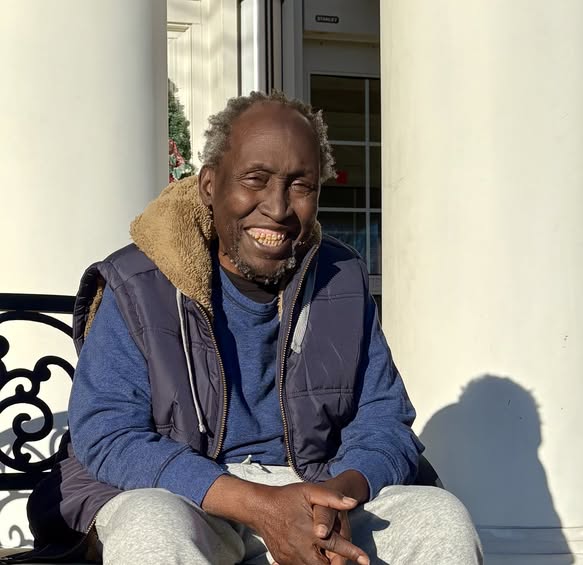
Notable Kenyan writer Ngugi wa Thiong’o is dead

The renowned Kenyan author, scholar, and activist Ngũgĩ wa Thiong’o has died.

His family announced his passing Wednesday evening, 28th May 2025, saying he “lived a full life, fought a good fight.”

“It is with a heavy heart that we announce the passing of our dad, Ngũgĩ wa Thiong’o,” her daughter Wanjiku wa Ngugi said in a Facebook post on Wednesday night.

“As was his last wish, let’s celebrate his life and his work. Rîa ratha na rîa thŭa. Tŭrî aira!”—a Gikuyu phrase loosely translating to “With joy and sorrow. We are proud.”

Plans for memorial services and public tributes are expected to be announced by the family in the coming days.

“The family’s spokesperson, Nducu Wa Ngugi, will announce details of his celebration of life soon,” Wanjiku said.

Ngũgĩ was 87.

A towering figure in African literature, Ngũgĩ’s influence stretched across continents, languages, and generations.

Known for novels such as A Grain of WheatPetals of Blood, and Devil on the Cross, Ngũgĩ championed the use of African languages in literature and resisted colonial and neocolonial systems of oppression throughout his life.

Born in 1937 in Kamiriithu, Limuru, Ngũgĩ’s work was deeply intertwined with Kenya’s struggle for independence and postcolonial identity.

In 1977, his radical play Ngaahika Ndeenda (I Will Marry When I Want), performed entirely in Gikuyu, led to his detention without trial by the Moi regime.

It marked a turning point in his career—he later abandoned writing in English altogether, opting instead to write in Gikuyu and translate into other languages.

Ngũgĩ spent decades in exile, lecturing at major universities abroad, including Yale and the University of California, Irvine.

Despite the distance, he remained tethered to Kenya through his language, activism, and unflinching critique of injustice.

Tributes have already begun pouring in from around the world. Writers, scholars, and readers are remembering him not only for his literary genius but for his unwavering commitment to truth and justice.

Tributes

Homa Bay Governor Glady Wanga: “Sad to learn of the passing on of a literary giant whose words shaped African thought and inspired generations. Prof. Ngũgĩ wa Thiong’o’s works challenged oppression and celebrated the power of indigenous voices with courage, globally advocating for African languages. Though he has left us, his legacy lives on in every story, every struggle, and every dream of a just world. Rest in power, Prof. Ngũgĩ. Heartfelt condolences.”

Kong’amano la Mapinduzi: “Thiong’o words, he gave voice to the oppressed. Through his courage, he challenged systems. He taught us the power of language, memory and resistance. His stories live on in books, classrooms and in the hearts of generations. Rest in Power comrade!wa NgugiThrough Prof.”

Dr Ezekiel Mutua: “Thiong’o became a towering figure and a celebrated thinker. My deepest condolences go out to his family and friends around the world. May his soul rest in eternal peace. Ngugi A literary legend and one of Africa’s greatest voices has passed away. Through masterpieces like Petals of Blood and Ngahika Ndenda, written in both Kikuyu and English.”

Ngũgĩ wa Thiong’o is survived by his children and grandchildren, many of whom have followed in his footsteps as writers, academics, and activists.

As the world mourns, it also celebrates. As he wished, his life and legacy will not be marked by silence, but by song, stories, and the enduring power of words.

Credit: The Star.co

The Court of Appeal Rules, 2021: Procedural impact on appeals emanating from Courts Martial to the Court of Appeal

By Obioma Ezenwobodo

Background:

Despite being an apex disciplinary organ of the Armed Forces, the decision of a Court Martial is not absolute but subject to review by the Court of Appeal. This is explicitly provided by section 240 of the Constitution of the Federal Republic of Nigeria (CFRN), 1999 (as altered), which provides thus:

“Subject to the provisions of this Constitution, the Court of Appeal shall have jurisdiction to the exclusion of any other court of law in Nigeria, to hear and determine appeals from the Federal high Court, the High Court of the Federal capital Territory, Abuja, High Court of a State, Sharia Court of Appeal of the Federal Capital Territory, Abuja, Sharia Court of Appeal of a State, Customary Court of Appeal of the federal Capital Territory, Abuja, Customary Court of Appeal of a State and from decisions of a court martial or other tribunal as may be prescribed by an Act of National Assembly.”

The import of this provision as it relates to courts martial was judicially noted in the case of Nigerian Army v. Yakubu (2013) 8 NWLR (Pt. 1367) where it was stated that the Court of Appeal has exclusive appellate jurisdiction over decisions of the General Court Martial and that such jurisdiction is not subject to the whims of any other quasi-judicial body or outfit.

By the clear provisions of section 248 of the CFRN, 1999 (as altered) and section 197 of the Armed Forces Act, the President of the Court of Appeal may make rules of court for regulating the procedure and practice to be followed in the Court of Appeal. By these far-reaching provisions, the President of the Court of Appeal enacted the Court of Appeal Rules (CAR), 2016, and for the first time made specific provisions regulating appeals emanating from decisions of courts martial and other tribunals. Order 18 of the CAR, 2016 contains provisions for appeals emanating from decisions of the Courts Martial and tribunals to the Court of Appeal, which is in pari materia to the extant Order 18 of the CAR, 2021.

Procedure for Appealing Against Courts Martial Decisions:

Order 18 Rule 1 (1) of the CAR 2021 provides that a person desiring to appeal to the Court against any decision of the court below shall commence his appeal by or sending to the registrar of the court below or other person or body imbued with or who performs such functions and powers as the registrar of a regular court a notice of appeal or notice of application for leave to appeal or notice of application for extension of time within which such notice shall be given.

Also, Order 18 Rule 2(1) of the CAR, 2021, provides for the signing of notice of appeal and other notices by the appellant himself or his Legal Representative, except as stipulated otherwise. Under Order 18 Rule 3, an appeal shall be deemed to have been brought when the notice of appeal has been filed at the registry of the Court Martial or Court of Appeal. Order 18 Rule 4 states that an application to the Court of Appeal for an extension of time within which notices may be given shall be in Form 7 in the Second Schedule. The Order also provides that any person making an application for an extension of time shall send it to the Registrar of the Court of Appeal, together with the proper Form of such application, a Form duly filled, notice of appeal, or notice of application for leave to appeal, or notice of application for extension of time to appeal, appropriate to the ground or grounds upon which he desires to question his conviction or sentence as the case may be.

Order 18 Rules 13 (1) states that where there is a further appeal to the Supreme Court, the Registrar of the Court of Appeal shall as soon as possible, after the compilation of the record of appeal, serve upon every appellant who has duly given a notice of appeal and paid the fess fixed by the Registrar to cover the record of the appeal or whose fees have been waived, a copy of the record.

In addition to the principles embodied in Order 18 Rule of the CAR, 2021 governing appeals from courts martial to the Court of Appeal, the Armed Forces Act (AFA) 2004 contains copious provisions regulating same. Section 184 (1) of the AFA provides that leave to appeal shall not be granted except in pursuance of an application made by or on behalf of the appellant and lodged within forty (40) days of the date of promulgation of the finding of a Court Martial in respect of which appeal is brought with the Registrar of Court of the Appeal, being an application in the prescribed form and specifying the grounds on which leave to appeal is sought and such other particulars, if any, as may be prescribed.

It is to be noted that the observance of this provision of the AFA is mandatory, and failure to do so may lead to the setting aside of an appeal on the ground of incompetence. This was decided in the case of Nigerian Air Force v. Shekete (2003) 2 SCM at 79, where the respondent appealed against the decision of the Court Martial at the Court of Appeal without observing the provisions of sections 183 and 184 (1) of the AFA. The Supreme Court, in setting aside the decision of the Court of Appeal based on non-observation of the provisions of AFA, found per Niki Tobi, JSC, after quoting sections 183 and 184 (1) of the AFA, stated thus:

“As it is the requirement of sections 183 and 184 (1) of Decree No 105 of 1993 as amended by Decree No. 15 of 1997 are clear. By section 183, leave of the Court of Appeal must be sought before an appeal can lie from a Court Martial to the Court of Appeal. Leave is however not necessary if the decision of Court Martial involves a Appeals sentence of death…”

“Section 184 (1) leans on section 183. The subsection gives the time within which an appeal should be lodged. It is forty days from the date the Court Martial promulgated its findings. In other words, an appeal lodged after forty days of the promulgation of the findings of the Court Martial will be incompetent.”

Further, section 184(2) of the AFA states that the Court of Appeal shall not entertain an appeal against a sentence of death unless the appeal is lodged by or on behalf of the appellant within ten (10) days of the date of the promulgation of the finding of the Court Martial in respect of which appeal is brought with the Registrar of the Court of Appeal in the prescribed manner. It is humbly submitted that the 10 days given for appeal against a death sentence to be lodged is not just too short, but will invariably cause hardship to the right of a convict to appeal. Death sentence being the highest capital punishment an accused can be convicted of, the convict should enjoy the same 40 days’ time limit, or even more, for which an appeal against his conviction should be lodged.

It is expected that the appellate courts would easily grant an extension of time in an appeal against death sentence. Section 184(3) of the AFA states that rules of court may provide that in some specified circumstances, as may be specified in the Rules, any application or appeal which is lodged with such person (other than the registrar) shall be treated as having been lodged with the registrar. Section 184(4) of the AFA gives the Court of Appeal the power to extend the period within which an application for leave to appeal can be made.

Section 184(5) of the AFA provides that in considering whether or not to give leave to appeal, the Court of Appeal shall have regard to any opinion of a Judge Advocate who participated in the Court Martial that the case is a fit one for appeal and in this case, may give leave to appeal. Section 184(6) of the AFA stipulates that when the Court of Appeal dismisses an application for leave to appeal on the basis that it is frivolous or vexatious, the court may order that any sentence passed upon the applicant in the proceedings from which it was sought to bring the appeal shall begin to run from the day on which the court dismisses the application.

Sections 185–202 of the AFA make further copious provisions regulating the powers of the Court of Appeal to determine appeals arising from Courts Martial decisions. An appeal emanating from a decision of a Court Martial proceeds to the Court of Appeal and may subsequently proceed to the Supreme Court. Section 187 of the AFA provides that the determination of any appeal or other matter that the Court of Appeal has the power to determine shall not be final. The final court to determine an appeal against a decision of the Court Martial is the Supreme Court of Nigeria. This is statutorily provided in section 202 of the AFA, which provides that an appeal shall lie from the decision of the Court of Appeal to the Supreme Court.

Conclusion:

The extant provisions deal with appeals from courts martial to the Court of Appeal relating to the procedure for initiating appeals, seeking leave and extension of time, and defining the powers of the Court of Appeal to determine same. They detail procedural steps to successfully seek the review of the decision of a courts martial, which is a specialised court.

Obioma Ezenwobodo LL.M

Lead Partner, Resolution Attorneys

Pioneer Chairman, Nigerian Bar Association, Garki Branch, Abuja (2022/24)

Author of the book: ‘Law and Practice of Court Martial in Nigeria’ that addresses and provides clarity to complex issues relating to practice of court martial.

[email protected]

FG says Tinubu’s $21.5bn borrowing request won’t increase debt burden

The Ministry of Finance has allayed fears about President Bola Tinubu’s $21.5 billion borrowing request.

On Tuesday, Tinubu wrote to the National Assembly requesting approval for a new external borrowing plan totalling over $21.5 billion.

President Tinubu also sought the lawmakers’ green light to issue federal government bonds worth N757.9 billion to settle outstanding pension liabilities under the contributory pension scheme (CPS).

But a statement issued by the Ministry of Finance’s Director of Information and Public Relations, Mohammed Manga, on Tuesday said the borrowing plan forms a key component of the 2024–2026 External Borrowing Rolling Plan, which outlines the financing needs of both federal and sub-national governments over two years.

The Ministry emphasised that the borrowing framework does not amount to immediate or blanket debt accumulation. Rather, it is a strategic, forward-looking tool designed to facilitate effective financial planning and ensure alignment with Nigeria’s Medium-Term Expenditure Framework (MTEF), under the Fiscal Responsibility Act, 2007, and the DMO Act, 2003.

“The Debt Rolling Plan is not an automatic green light for increasing the debt burden. It is a strategic framework that guides sustainable and purposeful borrowing,” the statement reads.

“This strategic method enhances Nigeria’s ability to implement effective fiscal policies and mobilize development resources.

“Importantly, it should be noted that the debt rolling plan does not equate to an automatic increase in the nation’s debt burden.”

Manga further disclosed that most of the funds will be sourced from concessional lenders and development partners such as the World Bank, African Development Bank, French Development Agency, European Investment Bank, JICA, China Eximbank, and the Islamic Development Bank.

“These institutions provide concessional financing with favorable terms and long repayment periods, which aligns with the country’s development needs,” the statement added.

According to Manga, the plan is designed to support critical investments in infrastructure, transportation, energy, and agriculture — “sectors central to achieving rapid, inclusive, and sustained economic growth”.

“Our borrowing strategy is guided not by the volume of loans but by their utility, sustainability, and the economic value they generate. Each facility will be strictly tied to growth-enhancing projects,” the ministry said.

TIPS