Home Blog Page 286

Intimate Affairs: When a woman padlocks her honey jar, By Funke Egbemode

For a woman, sex is not just physical. It is much deeper. Her orgasm is not just about reaching the peak of pleasure. It is about peaking happily and happily peaking. And for her to be roused and aroused, the arouser must be more than physically fit. He must be to her more than a warm and solid body. It is good for a man to be loaded downstairs but it is even better and more effective for him to be the man in whom she is truly pleased. That is why each time I hear that a man is complaining about not getting some or not enough, my counsel is that he should dig deeper beyond the surface and the physical. If your woman is happy, chances that she will make you happy between the sheets are high.

‘My wife just lies there like a log of wood.’

‘She does not respond to all the coaxing and kissing.’

‘Mine behaves as if she’s doing me a favour.’

‘Yours is better. My wife asks me, in the middle of the do, if I had finished. Can you imagine? Isn’t a woman supposed to know when her husband has finished?’

Sorry, there is no woman who does not know when her husband ‘has finished’, trust me. The height of the event is always celebrated by earth-shaking movements, right? Whether it is 33,000-litre delivery or a 100-metre dash, a man will deliver with some kind of bang. Therefore, if a woman asks her man if he was done, in the middle of the show, something is wrong, very wrong. One, she is not feeling him. Two, she just wants him to drop his load and get the heck off her. She is not happy, period. Of course, there are men who overstay down there, naturally or unnaturally. They pump and hump until the nozzle feels like it is going to catch fire. It is only when the poor woman feels that her center of excellence is liable to go up in flames that she begs for mercy and a quick finish. But when a woman is displeased, angry and or is just doing her duty, ah, she just wants the man to ‘do quick’ and get out of there.

I remember a friend telling me about her fire-down-there experience. I’m smiling even now.

I had not seen Joke for three straight days and we were next-door neighbours. What happened? Her sailor husband had just returned after being away for six months. My friend thought she was prepared for Tony. She thought she was the hungry one. But when Mr Sailor started paddling, she knew he was beyond famished. She told me how she had to do sit-baths that morning because ‘Tony had badly used the place.’ She had missed her husband and he had missed her too. The marathon was consensual.

Note, however, that the women we are talking about here are wives, women in committed relationships, not runs girls or those doing it for the money. Those ones will feign pleasure and pant in fake orgasms for as long as they can. They will endure a burning nozzle because sex for them is a business venture, a task that must be accomplished. This piece is about the women who do sex as if it is a duty and more importantly, wives who do not let their husbands lift their wrappers.

Yes, there are women who lock up the shop for days, months and I have heard of wives who denied their men access of any kind for years. It’s a mean thing to do, I agree but don’t forget where we started this discussion from. Intimacy is not what you can achieve with a woman who is upset with you. No, sex is an expression of affection and contentment for a woman. How your woman responds to you in bed, my dear brother, speaks to how she feels in her heart. A woman’s heart and her Centre of Excellence (COE) are linked and the two must agree to work together for the man to get maximum pleasure. A happy wife is a tiger in her man’s bed. She will go to his bed with pleasure and satisfaction on her mind. Even when he is aging and finding it difficult to put together a command performance, she helps him.

But how many men are willing to admit that it is their attitude in the living room that is causing trouble in the bedroom? How many men are considerate enough to do better during the day so they can get improved pleasure at night? Except women who have commercialized their territories, women cannot flip their sex life on and off like an electric switch.

There are many things that can make a woman unavailable in the bedroom. If she feels unloved, unprotected, cheated or taken advantage of, she will be too dry, too unwelcoming for her man.

Let’s look at the case of Wande. She had always been hardworking and focused. She knew where she was headed and she boarded the vehicle going to her proposed destination. She was a young doctor when she met Debola, a graduate of economics. She must have felt Debola and her were going in the same direction when they fell in love but she soon found out that her husband was lazy and unambitious. He did not care who wore the pants in their marriage as long as the pants got worn. If there was a need to change the car, it was okay if his wife bought a new one. Wande paid the rent, bought baby things for both their kids. All Debola did was impregnate her as at when due, after which he promptly returned to his couch potato status. He knew all the television programs. He knew who had just moved into the neighbourhood. He read newspapers from front page to the back page. After 10 years of waiting for her husband to wake up to his responsibility, Wande gave up on him. She simply stopped trying.

She even stopped praying for him to change. Ten years of the same prayer points? Wande simply gave up. She was sad and depressed but Debola didn’t care enough to change his ways. It was particularly irritating that he wanted sex so often, as if making love to his wife was the only physical exercise he needed daily. Wande said she felt cursed. She cried so much, her eyes were permanently blood-shot. The decision to stop him from touching her was not a conscious decision per se. She just found out she no longer found him attractive. His touch no longer turned her on. It was a gradual steady degeneration of what once was a passionate relationship. One week turned into months and she found out she no longer missed sex or her husband’s touch. Yet he did not change his ways. She continued to struggle with the responsibilities of the family. Then one day, she announced that she had been nominated to attend a women’s summit in Dubai and she would like to go with her children since they were on holidays. She left with her children and has since not returned. The last we heard of was that she was in Canada.

Debola almost ran mad when it dawned on him that his attitude had cost him his marriage and cozy life. Did you say it was a cold and mean thing Wande did? Maybe, maybe not. Not all women are cut out for life with a full-time house husband. There are women who love to wear the pants and call the shots but is that even a natural course of life? Whichever way you look at it, it is difficult to get in the pants of a woman you treat like a man. If you want her all soft and succulent behind closed doors, treat her like a woman all day, every day.

● Egbemode ([email protected])

From Lagos to Johannesburg, double awards for Datari Ladejo, Under-40 CEO

For Datari Ladejo, June was a month to cherish. From Abuja, the Nigerian capital to Johannesburg, the burstling economic capital of South Africa, Datari cleared two awards that situate the work she does and the passion she brings to what she does in context.

In Abuja she was honoured as Nigeria’s Most Notable Female Advocate. The award, conferred by the Nigeria Peace Advocate Network, highlights her remarkable contributions to legal advocacy, digital transformation, and humanitarian leadership—setting her apart as a beacon of inspiration across the African continent.

It was held at the Ministry of Foreign Affairs in Abuja, attended by high-profile dignitaries and policy influencers.

The second event, hosted by Mayorkings Charity Foundation in South Africa  was held to celebrate Africa’s Under-40 CEOs who have distinguished themselves in their various corporations.

Held at Johannesburg’s Sandton Convention Centre from June 26 to June 30 it was the 3rd edition of the prestigious Africa’s Under 40 CEOs Award and Summit.

In the letter announcing Ladejo’s  nomination and invitation to the Johannesburg event, Dr Temisan O. Louis, President/Founder, Mayorkings Agency, said the individuals considered for the honour “have demonstrated noteworthy accomplishments in various industries.Their commitment to business growth, development, professional excellence, community service, and philanthropy sets them apart as dynamic contributors to the African business landscape.”

In her speech at the Lagos event,  Ambassador Ladejo urged Nigerian and African women to “trust in their ability and vision,” assuring them that with God, success is achievable—even in the most difficult circumstances.

She expressed appreciation to the organisers for acknowledging her commitment to human development and promised to continue upholding integrity, leadership, and service excellence in all her endeavours.

“This recognition affirms that every effort to transform lives matters. I am deeply honoured and remain committed to using every platform I have to champion equity, empowerment, and opportunity —especially for women and youth,” she said.

Speaking with journalists after the award presentation, Ambassador Datari Ladejo shared a profound message of purpose and resilience, stating that “everybody has what he or she is called to do.” She said no matter one’s current path, it is never too late to change direction and pursue a meaningful calling. Drawing from her own journey—transitioning from a successful legal career into the dynamic world of digital innovation and humanitarian service—she encouraged others to remain open to growth and reinvention. Her words serve as a powerful reminder that with vision, courage, and faith, it is possible to redefine one’s story at any stage of life.

With qualifications that span continents, Datari Ladejo’s legal foundation is both rigourous and relevant. She holds an LL.B from the University of Staffordshire, a BL from the Nigerian Law School, and an LL.M in Dispute Resolution in International and Economic Law from the University of London Institute in Paris. These credentials have equipped her to operate confidently at the intersection of international law, economic policy, and social reform.

Her legal work extends far beyond traditional practice. Whether offering regulatory counsel to multinational firms or contributing to global legal think tanks, Ladejo consistently brings clarity and purpose to complex policy issues.

A Fruitful Journey from Law  into Digital Innovation

Ambassador Datari Ladejo’s foray into the world of digital innovation was not a sudden shift—it was a deeply personal, purpose-driven journey marked by courage, learning, and transformation. Having established herself firmly within the legal profession, with degrees and distinctions across prestigious institutions in the UK, Nigeria, and France, many expected her to remain on the traditional path of law practice and policy consulting.

But Datari saw something more—an emerging digital world brimming with untapped potential, especially for women and youth across Africa. With clarity of vision and an entrepreneurial spark, she made the bold decision to pivot from conventional law into the fast-evolving digital economy. It was a leap that many would have hesitated to take, but one that she embraced with fierce determination and faith.

Driven by the desire to create solutions, not just arguments, she immersed herself in digital transformation strategies, technology trends, and the powerful intersection between branding, communication, and social impact. She quickly recognised that digital literacy was not just a skill—it was a lifeline for emerging economies and marginalised communities.

Her journey bore fruit in powerful ways. Through the founding of Fernhill Digital Group, she built a consultancy that doesn’t just offer digital services—it reimagines how African businesses can evolve, grow, and compete globally. She didn’t stop there. With Evergreen Curators, she created a platform that fuses creativity with technology to help brands craft meaningful narratives in a saturated world.

But perhaps most impactful was her decision to create Digital Women Africa—a platform born out of her own experience navigating the tech space as a woman. She knew firsthand the barriers, the biases, and the lack of representation. Instead of waiting for the system to change, she began building her own ecosystem—one that trains, mentors, and uplifts African women to become not just participants but leaders in the digital space.

Internationally, Ladejo stands tall. She is a prominent member of the Women Executives group within the Forbes Agency Council, and currently the only Nigerian woman holding this seat. Through her involvement, she influences global conversations on digital communications, innovation, and female leadership. Her insights have been published on Forbes.com, BusinessDay, and other influential platforms.

Nigerian by Blood or Paper: How the Kemi Badenoch citizenship debate re-opened old wounds

By Prof Mike A. A. Ozekhome, SAN

INTRODUCTION

In a candid interview with CNN’s Fareed Zakaria on Sunday, Senior British Conservative politician of Nigerian descent Kemi Badenoch, offered a striking and controversial insight into the limitations of Nigerian citizenship law in an interview with CNN’s Fareed Zakaria. As a woman of Nigerian heritage serving as the UK’s Secretary of State for Business and Trade, Badenoch (formerly known as Olukemi Adegoke and who grew up in Lagos before going to stay in the UK at the age of 16) is no stranger to questions of identity, belonging and migration. But it was her deeply personal revelation and its legal implications that ignited a wave of public conversation not only among Nigerians in diaspora and those resident in Nigeria, but among leading scholars and constitutional analysts, particularly regarding gender equality in Nigeria’s citizenship.

THE INTERVIEW

With clarity and conviction, Badenoch remarked:

“It’s virtually impossible, for example, to get Nigerian citizenship. I have that citizenship by virtue of my parents. I can’t give it to my children because I’m a woman. Yet loads of Nigerians come to the UK and stay for a relatively free period of time, acquire British citizenship. We need to stop being naive.”

Her words, layered both with frustration and insight, and perhaps with political undertones, raise a poignant question: Can a Nigerian woman really not transmit her citizenship to her child as she said? Is Badenoch’s claim supported by the laws of Nigeria, or does it expose a longstanding misreading or worse, a structural gender bias within Nigeria’s legal framework itself?

BROADER CONTEXT: BADENOCH’S BACKGROUND AND POSSIBLE POLITICAL MOTIVES

Kemi Badenoch (45), married with 3 children to Hamish Badenoch (46), (a Scottish banker born in Wimbledon, London), was born in the UK in 1980 to Nigerian Yoruba parents and spent part of her childhood in Nigeria. This automatically makes her a Nigerian citizen by birth under section 25 of the 1999 Constitution. Her wild claim about Nigerian citizenship may have perhaps been driven by a rhetorical device to support her hardline stance on immigration in the UK.

By contrasting Nigeria’s supposedly restrictive laws with the UK’s “lenient” policies, she aims to appeal to the sentiments of British voters who are concerned about immigration matters. However, her misrepresentation of Nigerian laws to advance her political career clearly undermines the credibility of her argument and risks perpetuating wrong stereotypes about Nigeria’s legal system and constitutional order.

WHAT THE CONSTITUTION SAYS

Chapter 3 of the Constitution of the Federal Republic of Nigeria, 1999 (as amended), provides for citizenship in Nigeria. Every sovereign nation possesses the prerogative to determine the criteria for the acquisition of its citizenship. In the context of Nigeria, Chapter 3 provides a comprehensive legal framework governing citizenship. According to its provisions, Nigerian citizenship may be acquired through three principal modes: by birth, by registration and by naturalization.

CITIZENSHIP BY BIRTH

Citizenship by birth is articulated in Section 25 of the 1999 Constitution, which governs the acquisition of citizenship by birth. Section 25(1) stipulates that the following individuals are deemed Nigerian citizens by birth:

(a) any person born in Nigeria before the country’s independence, provided that either of their parents or grandparents belonged to a community indigenous to Nigeria. However, this provision excludes individuals whose parents and grandparents were not born in Nigeria;

(b) any person born in Nigeria after independence, where either of their parents or grandparents is a Nigerian citizen;

(c) any person born outside Nigeria, so long as either of their parents is a Nigerian citizen.

The Constitution defines “the date of independence” as the 1st of October, 1960.

Thus, by implication, citizenship by birth under Nigerian law may be established if:

  • both parents are Nigerians;
  • either parent is a Nigerian; or
  • any grandparent is or was a Nigerian citizen.

This position was affirmed in Shugaba v Minister of Internal Affairs (1981) 1 NCLR, 459, where Justice Oye Adefila held that the deportation of the applicant was unconstitutional. The court emphasized that once an individual establishes Nigerian citizenship under Nigeria’s constitutional provisions, such a person cannot lawfully be deported or expelled from the country. In the decided case of Willie Ogbeide v ArigbeOsula (2004) 12 NWWLR (Pt. 886) 138, Adeniyi, JCA held that:

 “…a citizen of this country by birth never loses his citizenship even when he holds dual citizenship of another country and cannot be disqualified from contesting election into the House of Representatives for reasons only that he holds such dual citizenship.”

BOTH PARENTS CAN LEGALLY PASS CITIZENSHIP TO THEIR CHILDREN

This provision is unequivocal. Both fathers and mothers, regardless of gender, have the equal legal capacity to pass Nigerian citizenship to children born outside Nigeria. In this regard, Kemi Badenoch’s claim appears to conflict with the clear text of the Constitution. By virtue of being born to a Nigerian parent, her children are automatic citizens of Nigeria by birth, provided she herself has not formally renounced her own Nigerian citizenship. Importantly, this section does not restrict the transmission of citizenship by birth to the child of a Nigerian father alone. A close reading of Section 25 of the 1999 Constitution reveals that citizenship by birth in Nigeria is grounded in inclusive and non-discriminatory language. The provision declares that individuals born in Nigeria, before or after independence, or born abroad, are citizens by birth if either parent or any grandparent is or was a Nigerian citizen. The deliberate choice of the phrase “either of whose parents” is constitutionally significant. It affirms that both Nigerian fathers and mothers enjoy equal legal standing in passing on citizenship to their children. Section 42(2) of the Constitution provides a broad safeguard against discrimination, stating that:

“No citizen of Nigeria shall be subjected to any disability or deprivation merely by reason of the circumstances of his birth.”

This anti-discrimination provision reinforces the constitutional guarantee of equality before the law, irrespective of gender, ethnicity, parentage, or social class. In Uzoukwu v Ezeonu II (1991) 6 NWLR (Pt. 200) 708, the Court of Appeal provided an authoritative interpretation of Section 42, holding that the section embodies the core values of non-discrimination and equal protection before the law and applies with full force against any policy or law that attempts to disadvantage a citizen on the basis of gender or lineage.

This constitutional position is unambiguous. No distinction is drawn between paternal and maternal lines of descent for the purpose of determining nationality. Consequently, the notion that gender plays a limiting role in the transmission of citizenship, at least in the context of citizenship by birth as alleged by Badenoch, is not only inaccurate but also misleading. Such a claim disregards the text of the Constitution and perpetuates an outdated, patriarchal reading of nationality laws that the framers of the 1999 Constitution intentionally rejected.

It is, however, possible that the lived experience of certain individuals (including Kemi) may not align with the constitutional guarantee. Bureaucratic inefficiencies, inconsistent enforcement, or lack of awareness among administrative officers may present obstacles in the practical exercise of citizenship rights, particularly for women in cross-national family contexts. But these challenges are procedural rather than legal. They stem from the failure to implement the Constitution faithfully, not from a flaw within the Constitution itself.

IS THE ACQUISITION OF NIGERIAN CITIZENSHIP “VIRTUALLY IMPOSSIBLE”?

Furthermore, Badenoch’s assertion that acquiring Nigerian citizenship is “virtually impossible” raises a separate but equally problematic narrative. While it is true that the process of naturalization or registration may involve stringent requirements, citizenship by birth remains one of the clearest and most secure forms of nationality under Nigerian law. For those with direct descent from Nigerian citizens, the law provides an unequivocal path to recognition. Hence, if a Nigerian woman like Kemi gave birth to children (as she did), whether within or outside Nigeria, such children are constitutionally and automatically entitled to Nigerian citizenship (section 25 of the 1999 Constitution).

In this light, Badenoch’s statement reflects not a legal reality, but rather a possible misinterpretation of Nigeria’s citizenship regime, one that risks reinforcing stereotypes about African and Nigerian legal systems as arbitrary or exclusionary. More importantly, it obscures the modest constitutional progress that Nigeria has made towards embracing gender equality, at least within the letters of the law (though not yet as expected).

Ultimately, the Nigerian Constitution, specifically in Section 25 reflects a commitment to non-discrimination and inclusivity in matters of nationality. The real challenge lies not in the law’s intent or wording, but in ensuring that its application is consistent, gender-sensitive, and resistant to political distortions. Public figures, especially those of Nigerian descent occupying high offices abroad, ought to exercise caution and clarity when speaking on constitutional matters. Misstatements, however unintentional, risk entrenching harmful misconceptions that weaken the integrity of legal reforms painstakingly built over decades.

Kemi Badenoch’s assertion during her CNN interview that she cannot pass on Nigerian citizenship to her children because of her gender is therefore clearly contrary to and conflicts with the express language of the Nigerian Constitution. It is not correct.

EXPLORING THE UNDERCURRENTS OF GENDER INEQUALITIES

While Section 25 of the CFRN 1999 clearly empowers both Nigerian fathers and mothers to transmit citizenship to their children born outside Nigeria, thereby rendering Kemi Badenoch’s specific claim legally inaccurate, it would be reductive to end the analysis there.

Indeed, the constitutional safeguard of section 25 of the Constitution against gender-based discrimination has also been firmly reinforced through judicial precedent. In the locus classicus case of Mojekwu v Mojekwu (1997) 7NWLR (Pt 512) 283, the Court of Appeal struck down the Olu-Ekpe custom of Nnewi in Anambra State, which denied female children the right to inherit property of deceased parents. The court held that such a practice was repugnant to natural justice, equity and good conscience, and therefore incompatible with the values enshrined in the Constitution. Justice Niki Tobi, delivering the lead judgement, emphasized that customs or norms that discriminate on the basis of sex cannot stand in the face of constitutional protections. Though the Mojekwu case concerned with inheritance rights, its broader constitutional significance lies in its clear rejection of gender-based disability in any form. It affirms the principle that no citizen, male or female, should be denied access to certain rights or privileges simply on account of their sex, whether under customary law or through statutory interpretation.

CITIZENSHIP BY REGISTRATION

Kemi’s sentiment, though misplaced under Section 25, may in fact reflect a broader and valid concern, one rooted in the gendered inequities enshrined in other parts of Nigeria’s citizenship laws, particularly section 26. Of the same 1999 Constitution. Under section 26 of the Constitution, a person may acquire Nigerian citizenship by registration, but this provision is strikingly asymmetric. Specifically, Section 26(2)(a) provides that any woman who is or has been married to a Nigerian man may be registered as a citizen of Nigeria, subject to satisfying the conditions prescribed by law. However, there is no corresponding provision for foreign men married to Nigerian women to be registered as citizens of Nigeria. For example, Mr. Hamish Badenoch cannot simply be registered as a Nigerian citizen like his female counterpart married to a Nigerian man. This is clearly inconsistent with the provisions of section 42 CFRN 1999 which establishes the right of every        Nigerian citizen to freedom from discrimination.

Thus, while section 25 recognizes gender equality, Section 26 re-entrenches gender disparity. A person may apply for Nigerian citizenship by registration if:


  • – They are of good character and have shown a clear intention to be domiciled in Nigeria.
    – They are married to a Nigerian citizen (typically applicable to foreign women married to Nigerian men).
    – The President has the authority to register such persons as citizens, subject to conditions set by the National Assembly.
  • This section allows a non-Nigerian woman married to a Nigerian man to apply for citizenship by registration. Specifically:
  • Section 26(2)(a): “a woman who is or has been married to a citizen of Nigeria.”

This gender-specific language has been widely criticized for being discriminatory. Notably:

  • It only grants registration rights to foreign women married to Nigerian men, not to foreign men married to Nigerian women.
    • A Nigerian woman cannot register her foreign husband for Nigerian citizenship in the same way a Nigerian man can register his foreign wife.

This supports the implication behind Badenoch’s claim: gender-based limitations exist, particularly in the transmission of derivative citizenship through marriage.

This constitutional inconsistency has therefore been the subject of sustained advocacy by civil society groups and legal scholars (including my humble self), many of whom argue that it violates Nigeria’s obligations under international human rights instruments, including the Convention on the Elimination of All Forms of Discrimination Against Women (CEDAW) and the African Charter on Human and Peoples’ Rights, both of which Nigeria has ratified

The silence of equality in section 26 of the 1999 Constitution is not just a technical oversight; it institutionalizes gender discrimination, effectively excluding Nigerian women from passing nationality to their foreign spouses, a right fully available to their Nigerian male counterparts. The discriminatory implication is that Nigerian women’s citizenship is seen as inferior or incapable of being transmitted, while Nigerian men’s citizenship is presumptively stronger and transmissible.

Political correctness aside, it is this historical and constitutional bias that may perhaps have partly framed Badenoch’s broader frustration. If a Nigerian woman’s spouse cannot be recognized as a citizen through marriage, and the process of transmitting citizenship to children is often hampered by bureaucratic inertia or patriarchal assumptions, then it becomes easier to see why she may feel disempowered, even in contradiction to the express language of Section 25 which makes her children automatic citizens of Nigeria.

COMPARATIVE PERSPECTIVE

Many countries have moved to gender-neutral citizenship laws, including:

  • Ghana, where both men and women can confer nationality to their spouses and children;
    • South Africa, which enshrines non-discrimination and has a rights-based citizenship framework;
    • Canada, UK, and most of the West, where nationality is conferred equally by either parent.

Nigeria’s colonial-era laws and post-independence constitution still reflect patriarchal biases, which now clash with modern principles of gender equality.

CITIZENSHIP BY NATURALIZATION – SECTION 27

This is open to any non-Nigerian adult who satisfies the following criteria:

          •        Has resided in Nigeria for at least 15 years;

          •        Is of good character;

          •        Has made or is capable of making useful contributions to Nigeria;

          •        Is familiar with Nigerian customs and language;

          •        Intends to reside in Nigeria.

Naturalization is not tied to gender or marriage, but is subject to executive discretion by the President of Nigeria. Invariably, women are at the receiving end as they do not receive equal treatment with the men.

RECOMMENDATIONS FOR REFORMS

  1. Amend Section 26 to allow either a Nigerian man or woman to register a foreign spouse.
    1. Clarify and enforce Section 25 to ensure that children born to either Nigerian parent—regardless of gender—have equal access to citizenship by birth.
    1. Review and harmonize immigration regulations with constitutional provisions and Nigeria’s international obligations.
    1. Launch a diaspora citizenship policy to ease the process for second- and third-generation Nigerians abroad.
    1. Educate consular officials to implement a gender-neutral interpretation of the law.

CONCLUSION

Kemi Badenoch’s statement that she cannot pass Nigerian citizenship to her children because she is a woman, though legally inaccurate under Section 25 of the 1999 Constitution, opens up an important and necessary conversation. The Constitution clearly provides that citizenship by birth can be transmitted through either parent, whether mother or father, regardless of where the child is born. Consequently, if Badenoch holds Nigerian citizenship and has not renounced it, her children are indeed Nigerian citizens by birth.

However, her remarks (though maybe politically expedient, having regard to her past negative statements about Nigeria) reflect a deeper frustration that is not entirely unfounded. While Section 25 affirms gender equality in theory, other provisions, particularly Section 26, which governs citizenship by registration, expose persistent gender biases in Nigeria’s nationality laws. The exclusion of foreign men married to Nigerian women from the registration pathway to citizenship demonstrates a clear constitutional imbalance. This asymmetry not only reinforces patriarchal assumptions but also undermines Nigeria’s commitment to international human rights obligations.

Badenoch’s experience, viewed through this lens, underscores the dissonance between constitutional promises and practical enforcement, especially for Nigerian women in the diaspora. It illustrates how systemic, bureaucratic and cultural barriers often prevent women from fully exercising the rights that the Constitution guarantees them.

In sum, while the law on its face protects the right of women to pass on citizenship, the structure around it does not always support or respect that equality. Kemi’s statement, though flawed in legal substance, serves as a catalyst for broader reflection and reforms; a reminder that constitutional rights must be matched with equal access, unbiased implementation and an unambiguous commitment to gender justice in law and in practice. Nigerian women, whether resident in Nigeria or in the diaspora, must be accorded equal rights, gender equity and equality within the Nigerian space. They remain our daughters, sisters and mothers.


How CCTV cameras helped in arrest of men who kidnapped Bayelsa High Court Judge

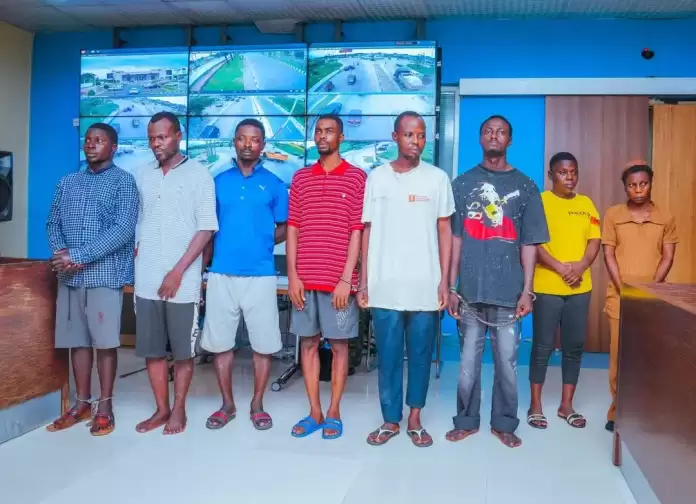
The suspected kidnappers of Bayelsa High Court Judge, Justice Ebiyerin Omukoro, on Thursday narrated how they committed the crime.

The News Agency of Nigeria (NAN) reports that eight suspects, including six males and two females, were paraded by the Commissioner of Police in Bayelsa, Francis Idu.

The Director of the Department of State Services, Adedapo Amao, was also present in Yenagoa.

The suspects are currently in the custody of the DSS, which coordinated the rescue of the victim and arrest of the abductors.

Gov Douye Diri of Bayelsa had, during the state executive council meeting on Wednesday, disclosed that all the suspects involved in the kidnap of the judge had been apprehended.

He, however, said that the gang leader was still at large.

One of the suspects, Justice Brodrick, who spoke to journalists during the parade, said he is an indigene of the Ozobo community in Delta State.

He confessed that he was part of the kidnapping operation after a man he referred to as his boss informed him about it.

The suspect stated that upon arrival in Yenagoa, they were given uniforms and vehicles for the operation and immediately swung into action.

He said that Justice Omukoro was taken from the premises of an eatery in the Ekeki area of Yenagoa and relocated to a location in a neighbouring state.

Brodrick, however, claimed that they had no particular target but stumbled on the Judge.

He said that the victim was immediately moved to their camp, and when he told them that he was an Ijaw from Ekeremor Local Government, they decided to “treat him well.”

According to him, the man whom they call “General” insisted that the victim should be kept in handcuffs, but as a fellow Ijaw, be treated with care.

“So, he called me on June 21 that I should come to Yenagoa. He also called John Uzi, the person who is beside me. And I called Kelvin Olu, my younger brother, to come with me to Bayelsa.

“We mobilised the vehicle for the movement, and uniforms were provided. We moved from our camp, but it wasn’t a fixed target.

“We were just patrolling before we met the Judge at Kilimanjaro. So we approached him and kidnapped him from there to our camp,” he said.

Another suspect, who identified himself simply as John, said he was contacted but did not join in the operation as he was not feeling well and that he was in the camp when the victim was brought in.

The Commissioner of Police said that the arrest of the suspects was a testament to the success of the security governance measures implemented by Gov. Diri. He stated that the governor consistently emphasized the importance of security agencies collaborating to ensure that Bayelsa was free from crime and criminality.

Idu stated that the DSS sent a special team from Abuja for the operation, which led to the arrest of the suspects, including the two females who were their accomplices.

The police chief lauded the governor for providing the necessary logistics for the operation.

He stated that the CCTV cameras installed by the government in certain parts of the state were useful throughout the rescue operation and the eventual arrest.

Idu warned those with criminal intentions to reconsider, as Bayelsa was no longer a safe haven for criminals.

NAN

Teenage boys murder 15-year-old girl in sickening sacrifice to Satan hoping ‘to earn a ticket to hell’

A group of teenage boys murdered a 15-year-old schoolgirl and left her body in the woods to decompose in a sickening plot to ‘earn a ticket to hell.’

Elyse Pahler was killed in Templeton, Florida, on July 22, 1995, by her fellow Arroyo Grande High School pupils Royce Casey, Jacob Delashmutt, and Joseph Fiorella.

She was stabbed to death as a sacrifice to the devil before her body was hidden in a field.

Elyse’s death is now the subject of ID’s true crime documentary series A Killer Among Friends’ latest episode, Devil in the Hallways.

Click here to continue reading.

Twist in the tale as alleged Killer of Kogi photojournalist commits suicide

An officer of the Nigeria Correctional Service, Ayo Aiyepeku, who allegedly killed a photojournalist, Jacob Adebayo Pelumi, is believed to have committed suicide in Kogi State.

The Kogi State Police Public Relations Officer, SP Williams Ovye-Aya, disclosed this on Thursday, July 24, 2025.

Ovye-Aya said Pelumi’s corpse was found in a hotel room in Lokoja, the capital of Kogi State, hours after police launched a manhunt for him on Wednesday.

Ovye-Aya stated: “The hotel management alerted us early Thursday morning to a corpse lying in one of the rooms.

“Upon responding, we discovered it was the suspect wanted in connection with the alleged killing of the photojournalist.

“We found a suicide note and a bottle of Sniper insecticide beside his bed in the hotel room.”

The police spokesperson added that Pelumi’s body has been deposited at the Federal University Teaching Hospital, Lokoja, for autopsy to determine the actual cause of death.

Ovye-Aya recalled that Aiyepeku was gruesomely murdered on Tuesday night in an office near the Government House/GRA area of Lokoja.

He said the Hilux vehicle allegedly used by Pelumi has been recovered and is now parked at the ‘A’ Division station.

A deep freezer found in the vehicle has also been taken into custody by the police.

Read Also: Photojournalist set up and brutally murdered in Lokoja

Regarding the whereabouts of Aiyepeku’s body, the police spokesperson said efforts to locate it are ongoing.

He stated that the Kogi State Commissioner of Police, Miller Dantawaye, has ordered the case transferred to the State Criminal Investigation Department.

“The discreet investigation will help us uncover what truly happened,” Ovye-Aya disclosed.

Fake News!! NAFDAC disowns audio claiming closure of Tummy Tummy noodles factory

“The claims are entirely false”, the National Agency for Food and Drug Administration and Control (NAFDAC) said in a formal disclaimer concerning an audio recording circulating on social media.

The audio recording falsely claims the agency shut down the Tummy Tummy noodles manufacturing facility in Anambra State.

In a statement released on Wednesday, the Director-General of NAFDAC, Prof. Mojisola Adeyeye, clarified that the viral recording was not only misleading but also a recycled falsehood.

According to her, the same audio first appeared in October 2023 and was thoroughly investigated at the time.

“The claims made in the recording are entirely false. The Tummy Tummy noodles facility in Anambra State was not sealed,” she stated.

Adeyeye explained that NAFDAC had conducted an unscheduled inspection of the facility, during which samples of four different noodle variants were collected and analysed at the agency’s Agulu laboratory.

 “The results were satisfactory, and no regulatory violations were found,” she added.

She further noted that the audio falsely alleged that NAFDAC banned other food products such as tinned tomatoes and seasoning cubes like Maggi.

“This is completely untrue. The individual who made these claims also falsely stated they were working in collaboration with NAFDAC and mentioned the presence of ‘acetyl methyl’ as a preservative, an assertion that is both unfounded and misleading,” she said.

Addressing public concerns about product safety, Adeyeye recalled that NAFDAC had already conducted a comprehensive investigation in 2023 following global alerts about the presence of ethylene oxide in instant noodles.

She said the findings confirmed that neither ethylene oxide nor its derivatives were present in any instant noodles or seasonings produced in Nigeria.

She also assured the public that tests for contaminants such as mycotoxins and heavy metals revealed levels well within internationally accepted safety standards, reaffirming the safety of Nigerian-made noodles.

“NAFDAC urged the public to disregard the audio and refrain from sharing unverified information.

“NAFDAC remains committed to its mandate of safeguarding public health by ensuring that only safe, high-quality, and properly regulated food and drug products are available to Nigerians,” the statement said.

NAN

Coming clean on the state of NNPC’s refineries

By Tribune Editorial Board

The state of the Nigerian National Petroleum Corporation Ltd (NNPCL)-owned refineries has always been a recurrent bother. This has over the years been accentuated by the perceived deliberate efforts by the NNPCL itself, in cahoots with the government, to put a shroud on the state of the refineries. Recently, there was renewed concern over what actually transpires within the corporation.

As he hosted members of the Global CEO Africa from the Lagos Business School after they toured the Dangote Petroleum Refinery in Lekki, Lagos, President of the Dangote Group, Alhaji Aliko Dangote, stirred the muddy waters of the refineries. At that forum, Dangote said he doubted the possibility of the state-owned Port Harcourt, Warri, and Kaduna refineries ever functioning again. Dangote stated that the infamous refineries had gulped up to $18bn of Nigerians’ hard-earned money, yet remained comatose.

According to Dangote, his own 650,000-capacity Dangote Refinery, constructed after late President Umaru Yar’Adua aborted his acquisition of the government refineries, now has over 50 percent of its output dedicated to petrol. Conversely, said Dangote, the government-owned refineries committed a mere 22 percent of their production to refining petrol. The industrialist recalled how he and his team had no option but to return the refineries to the Yar’Adua government after the cancellation of their purchase just a few months after the exit of the government headed by former President Olusegun Obasanjo in 2007. A consortium of Nigerian companies, namely Blue Star, Zenon Oil, Dangote Oil and Gas & Transnational Corp, had outbid the UK-based Indian steel baron, Lakshmi Mittal, for the Port Harcourt Refinery, which offered $550 million. The Dangote-led Blue Star paid $561 million for the acquisition of 51 percent of the government-owned stake in the refinery. Two other bidders, Oando Plc and Sahara Energy, in alliance with the Refinee PetroPlus, were disqualified in a Bureau of Public Enterprises (BPE)-conducted process. Bluestar went a step higher with its buy-in of the Port Harcourt refinery and acquisition of a 51 percent stake in the Kaduna Refining Company.

Dangote noted, perhaps with regret, that the former managers of the refineries had ostensibly misinformed the late president that the Obasanjo government had sold the refineries at give-away prices to Dangote and his team, as a parting gift from the exiting president. Instructively, President Obasanjo has always regretted the Yar’Adua government’s cancellation of that bid. In an interview, Obasanjo said: “The refineries are old and Dangote and some investors paid $750 million for two of the refineries. My successor came to office and reversed the sale. He even refunded the money they paid. So I went to him and asked him why he did this. He said it was because of pressure. I wondered if the pressure by some people was more important than the interest of the whole nation.”

Basing his decision to sell the refineries on a professional advice given him by Shell, Obasanjo was persuaded that the state-owned refineries would not work again. He said: “I was told not too long ago that since that time, more than $2 billion has been squandered on the refineries and they still will not work. If a company like Shell tells me what they told me, I will believe them. But here we are with over $2 billion squandered, and the refineries still won’t work.” Since the botched sale of the refineries, they have gone through various Turn Around Maintenance (TAM) exercises that have woefully failed to turn their destinies around.

Nigerians were excited when, in November 2024, the NNPCL declared the Port Harcourt refinery operational after a rehabilitation project which gulped a huge sum. But some were still sceptical. While the refinery initially operated at 70 percent of its installed capacity, the NNPCL said it had plans to increase its capacity to 90 percent. At the time, the corporation and Obasanjo were embroiled in an exchange of words. Responding to Obasanjo’s pessimism about the refineries’ resuscitation, NNPCL’s Chief Corporate Communications Officer, Olufemi Soneye, extended an invitation to the former president to tour the refineries. That invitation was perceived to be demeaning.

As if justifying the former president’s pessimism, no sooner had a loud applause been given by optimists than the Port Harcourt Refinery faced a one-month shutdown. As of this month of July 2025, the refinery is yet to begin operations. It has apparently exceeded the initially announced date for the restart of operations. The old Port Harcourt Refinery, which had undergone a significant rehabilitation project, was reported to have gulped $1.5 billion. Recently, however, the NNPC indicated that selling the country’s refineries was a possibility. The corporation’s Group Chief Executive Officer, Bayo Ojulari, acknowledged that the rehabilitation efforts on the refineries had proven to be more complex than anticipated, stating that the sale of the refineries was “not off the table”. He also said that all options were being reviewed. Ojulari’s announcement came after many had vociferously argued that the state-owned refineries were no longer viable, linking this to a history of mismanagement and the challenges posed by attempts to modernise their aging infrastructure.

Over the decades, Nigeria has continued to oscillate in a vicious circle on the apparent moribund refineries. This is why, at this stage, especially after the confirmation of their state by its GCEO, the NNPCL needs to come clean on the condition of the refineries. For years, the refineries have served as a conduit-pipe through which NNPCL officials drained scarce resources. The company’s activities in the oil industry are mired in controversy. That explains its persistent face-off with the National Assembly. The Ojulari-led management owes Nigerians the duty of going beyond rhetoric on the refineries’ state of health. That will prove crucial in righting the wrongs of the past. It will also save the country serial haemorrhage. Ultimately, those found guilty must be made to face the music.

Understanding Nigeria’s twin crises of democracy and demography

By Adaobi Obiabunmuo, Ph.D

The most important things in a democracy involve counting. Among these three stand out: people, votes, and jobs. These are essential for ensuring that the government is accountable, grounded in popular legitimacy, and takes the well-being of all seriously. Nigeria has been notoriously unreliable in undertaking all three. Unsurprisingly, the country’s democracy suffers a debilitating credibility crisis. It is useful to examine why.

Take jobs, for instance. With the introduction of the revised methodology in April 2023 by the National Bureau of Statistics (NBS) in its Nigeria Labour Force Survey, the unemployment rate experienced a sharp decline, dropping from 33.3% in the fourth quarter of 2020 to 4.1% in the first quarter of 2023. Since then, the figure has fluctuated—5.0% in the third quarter of 2023, 5.3% in the first quarter of 2024, and 4.3% in the second quarter of 2024.

The reactions from consumers of the report, such as the government, citizens, and other stakeholders, have shown remarkable divergence of opinion. For the government, the figures were proof that it was making progress on jobs. Statistician-General of the Federation, Semiu Adeniran, asserted that the new methodology used by the NBS, which classifies those engaged in part-time work as employed, is consistent with the standards of the International Labour Organization (ILO) and “should have happened much earlier.” On behalf of organized labour, the Nigerian Labour Congress has described the new numbers “as fiction, stressing that it contradicts reality.” For other stakeholders, the concern is that the government may de-prioritise efforts to tackle unemployment based on these optimistic figures. This highlights the importance of accurate and reliable data, without which a country may either fail to plan effectively or end up planning blindly.

Census figures underpin the task of planning for the provision of public goods, but no one knows how many people there are in Nigeria. The last effort to count Nigerians was in the 2006 census, which resulted in a count of 140,003,542. For planning purposes, we can use this figure and apply the annual population growth rate of 3.2% to arrive at a projected population; or we can rely on an estimated population of over 200 million, a figure produced by the United Nations Fund for Population Activities (UNFPA).

Successive governments have tried to account for the population of Nigeria through census, but the exercise has been plagued with lack of financial accountability, interference by political actors, alleged manipulation, and inflation of figures. This crisis is as old as the first post-independence census in 1962 that recorded a population of 45.26 million (Northern region 22.01million, while Western and Eastern regions had 23.25 million) but was cancelled as a result of alleged inflation of figures.

In 2006, during the administration of President Obasanjo, the National Population Commission (NPopC) deployed the geographical positioning System (GPS), satellite imagery and Automated Fingerprint Identification System (AFIS) and in a census which gave us a population of 140,003,542. Nigeria has not conducted a national census since then. However, there have been attempts to update population data through other means like the mop-up exercise, although the commission does not usually make the outcome of this periodic exercise public.

This raises the question of transparency on the part of the NPopC and of the nexus between demography and democracy. How is the government able to plan or allocate resources effectively without credible demographic data? In turn, this raises questions about the resources at the disposal of the data generating institutions in terms of the human and material assets at their disposal as well as the intangible asset of institutional independence. Implicit in these questions is the lingering suspicion of the politicization of data because politicians always indulge in a calculus of political gain from the manipulation of data. When looked closely, there is power, influence and wealth at the center of the equation, but where does this leave the citizens?

Counting methods may differ depending on who is conducting the count and not just with jobs data. During a press conference in 2019 to mark World Population Day, the then Director-General of the National Population Commission (NPC), a body established, among other things, to undertake the enumeration of Nigeria’s population, Dr. Ghaji Bello, reacted to an earlier report by the UNFPA, which projected the nation’s population at 201 million. According to Dr. Bello, Nigeria’s population was 198 million, adding that “the difference between the UNFPA figure and ours is a question of assumptions.”

In his pioneering work book, Planning Without Facts, Wolfgang Stolper, asserts that ‘one cannot make policy without politics and that politics quite naturally has priority.’ So, what is our priority in Nigeria?

Just as citizens are unclear about the country’s true population, data from the Independent National Electoral Commission (INEC), the body established by the 1999 Constitution to manage elections into various political offices, is also contested. According to INEC, the 2003 election had the highest voter participation since Nigeria’s return to democracy, with a 69% turnout, meaning 42 million out of 60.8 million registered voters cast their ballots. This was higher than in 1999, when 30.2 million out of 57.9 million registered voters voted. In 2007, the turnout dropped to 57.5%, with 35.3 million voters out of 61.5 million registered. In 2011, 39.4 million votes were cast out of 73.5 million registered voters. By 2015, the numbers declined further to 29.4 million votes out of 67.4 million registered voters. In 2019, although registered voters increased to 84,004,084, only 28.6 million voted. Then in 2023, the register stood at 93,469,008, and 87,209,007 people collected their Permanent Voter Cards (PVCs), yet only 25,286,616 turned out to vote.

Serious questions arise from this data. Despite the massive voter sensitization and mobilization efforts by INEC, Civil Society Organizations (CSOs), citizens, and other stakeholders, the last general election officially recorded only 28.6% voter turnout. Is this a clear case of voter apathy, unreliable data, or should the integrity of the voter register be interrogated?

Just like the 2023 election where INEC claimed that the introduction of the Bimodal Voter Accreditation System (BVAS) would be the game-changer, NPopC also claimed that the 2023 census will be Nigeria first digital headcount and would change how census is conducted in Nigeria. The Commission had planned a digital census in 2023, utilizing mobile handheld devices, Geographic Information System (GIS), geo-spatial imagery, and electronic forms hosted on Personal Digital Assistant devices. However, the outcome of this effort is not publicly available. Two years later, the NPC Chairman, Nasir Isa Kwarra, in a meeting at the State House on 24 February 2025 with President Tinubu and other stakeholders, discloses that it had acquired 760,000 tablets which it stored with the Central Bank of Nigeria.

Unwittingly, Chairman Nasir Kwarra may have disclosed the dysfunction that ails Nigeria’s ecosystem. It costs a lot of money to acquire 760,000 tablets. The process of procurement for that alone could be guaranteed to make many people rich. As gadgets and digital hardware become increasingly part of the infrastructure of data and demographics in Nigeria, their procurement may be more important than their effective deployment in a country in which contracts mean personal wealth and data has never been seriously governed in public policy making.

To change this, the country may need to address three things. First, politicians as well as the institutions created for that purpose, have to take data seriously. Second, it will be essential to take the procurement imperative out of the work of the data institutions. Third, to achieve this, those institutions must be endowed with financial and functional independence. Without the last measure, NPopC may continue in a cycle of habitual motion without movement, while the INEC and NBS will continue to gratify fantasy and fiction at the expense of fealty to facts.

Dr. Obiabunmuo, is Programmes Manager at the Progressive Impact Organisation for Community Development, PRIMORG

The views expressed by contributors are strictly personal and not of Law & Society Magazine.

Taraba State Signs Prohibition Against Human Trafficking Bill into Law: AAF applauds landmark victory for human rights

Press Release

In a historic move, the Executive Governor of Taraba State, His Excellency Dr. Agbu Kefas, has signed into law the Prohibition Against Human Trafficking Bill, reaffirming the state’s commitment to protect vulnerable populations and uphold human rights.

The Adinya Arise Foundation (AAF), a leading civil society organization and Anchor of the USAID Palladium SCALE Counter Trafficking in Persons Commission Cluster project, has welcomed this development as a landmark achievement, especially given that the SCALE project funding was halted following USAID’s closure of the program.

Despite the unexpected termination of donor funding, AAF sustained implementation of CTIP interventions through self-funding as part of its broader sustainability strategy. These efforts have culminated in the Assent of Bill a legislative milestone promised by the state government during the USAID SCALE Closeout Summit held on September 25, 2024.

“Nothing is as heartwarming as seeing your efforts come to fruition,” said Mabel Adinya Ade, Executive Director of Adinya Arise Foundation. “We commend His Excellency, Dr. Agbu Kefas, for keeping his promise and demonstrating that the protection of human dignity remains a top priority of his administration.

“Our gratitude also goes to the Taraba State House of Assembly for their unanimous support and legislative courage.”

The enactment of the PAHT Bill immediately strengthens the legal framework needed to prosecute traffickers, protect survivors, and prevent future trafficking, particularly among women, girls, and vulnerable populations.

In a related breakthrough, the Taraba State Ministry of Women Affairs recently rescued young girls who had been trafficked to Guinea and forced into sex slavery an early indication of the state’s renewed determination to take concrete action against human trafficking.

AAF extends appreciation to the Honourable Attorney General and Commissioner of Justice, Commissioner of Information and Reorientation, and the Commissioner for Women Affairs and many other stakeholders, for their leadership, advocacy, and strong coordination that helped bring this victory to reality.

As Taraba State celebrates this moment, Adinya Arise Foundation AAF and all Cluster Members (ECJP, NUJ, GERI, OSA Foundation and JDPC) calls on sister states Benue and Oyo to accelerate the passage and signing of their respective CTIP Bills. The momentum is now, and no child, woman, or man should be left unprotected.

Media Desk,
Adinya Arise Foundation (AAF)
8 Eket Close, Area 8, Garki, Abuja FCT, Nigeria
Email: [email protected]
Phone: +234(0)8036145535

TIPS