Home Blog Page 250

A Legacy Larger than Sport: Christian Chukwu, 4 January 1951 – 14 April 2025

By Chidi Anselm Odinkalu

On 6 December 1977, Olusegun Obasanjo, Nigeria’s military Head of State, received a group of young men from the east who had come to present him with a trophy won in the field of football contest against the rest of Africa. They were members of a football team known as Rangers International Football Club of Enugu.

The previous day, led by the charismatic Christian Chukwu,  by an aggregate margin of five goals to two, they had beaten arguably the most legendary generation of footballers from Cameroon’s Canon Sportif de Yaoundé to win the African Cup Winners Cup. On their way to the title, they toppled the defending champions, IICC Shooting Stars of Ibadan, who won the title the previous year by beating Tonnerre Kalara Football Club also of Yaoundé.

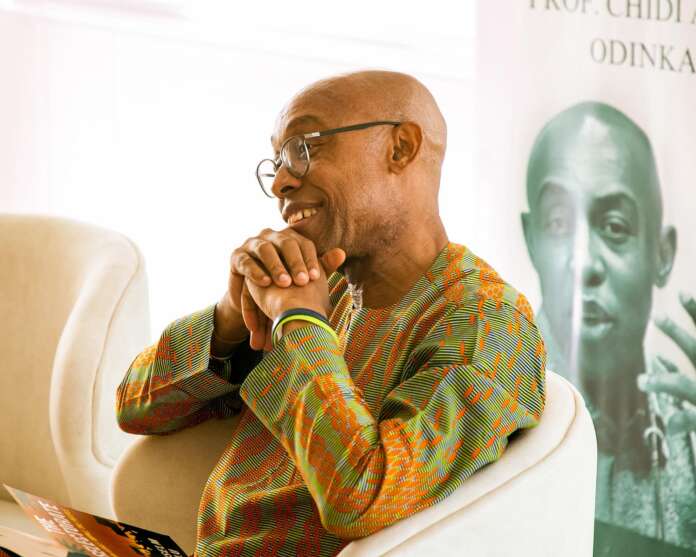
Odinkalu with the trustees of the Enugu Rangers Veterans comprising “Chairman” Christian Chukwu, captain of the @NGSuperEagles team that won the #AFCON1980; Emmanuel Okala, the goalkeeper of that team & Dr. Johnny Egbuonu

In reality, the full import of that Dodan Barracks encounter between the Christian Chukwu-led Rangers International team and General Obasanjo transcended sport. The last time a bunch of young men from the East and Obasanjo met at the same venue on 15 January 1970, it was in his capacity as guarantor of their safe passage as the make-shift leadership of the short-lived secession handed in their instrument of capitulation to then Head of State, Yakubu Gowon, bringing to an end the 30 months of the Nigerian Civil War. Separated by eight years, the contrast between the two scenes could hardly have been starker.

A mere five months after the end of the civil war, on 30 May 1970, a bunch of young men recovering from the traumas of the conflict, were handed a new mission by the visionary duo of sports administrator, Jerry Enyeazu and coach, Dan Anyiam. Unlike the civil war, the battles of the new mission were to be fought not with guns and bayonets but with natural talent, skill and grit on the football pitch.

To prosecute this mission, they christened the new team Rangers. Their base was in Enugu, the regional capital of east, which later became the capital of what was then called the East Central State. The name of the team was a memorial to an experimental “strike force” originally conceived in the embers of the war by Timothy Onwuatuegwu, a major in the Biafran army, but which became stillborn. Indeed, the team drew some of its original talent from the core of that strike force. Its motto was “never say die.”

The story that ensued could itself have been stillborn too. Their first official match was scheduled for 30 May 1970. It was the anniversary of the declaration by Emeka Odumegwu-Ojukwu in 1967 of the Biafran secession. The military authorities in Lagos were jumpy and appeared set to dismantle the team even before it played its first match. Ukpabi Asika, the political scientist who served as the Administrator of the East Central State at the time, persuaded them to stay their hand. It was a deft work of advocacy that would alter the lives of many young men and, even more importantly, the destiny of a people.

At the end of the war, General Gowon declared that there was “no victor, no vanquished.” In that spirit, presumably, he promised a programme of post-war reconstruction, reintegration and reconciliation. The reality was anything but. This was the context in which the Rangers Football Club began in Enugu. By the end of their first year, they had come close to upending the football hierarchy in the country, just coming up short of lifting the Football Association Cup.

In that year, 1971, however, the team from the East Central State successfully bested the rest of the country in a national academicals football competition in Lagos, then known as the Adebajo-Manuwa Cup. The leading talent in that team was a young man called Christian Chukwu, the son of a butcher whose mother was also a petty trader. He made the Academicals team of the East Central State from the National Grammar School, Nike, where he marshalled the defence and captained the football team with supreme talent and confidence. On his return from the Adebajo-Manuwa cup triumph, Dan Anyiam, then coach of the Rangers Football Club, recruited him into the team. He was 20.

Three years later, the team became national champions. In 1974, Christian Chukwu became the team captain and ushered in the profound period of success in the history of organized sports in Nigeria. Over the following decade, he would lead Rangers to a prodigious haul of nine championships.

In 1975, Christian Chukwu led the team to a national league and cup double and, in 1976, captained the Rangers to become the first team to win the Football Association Cup for an unprecedented three times. His surname made him a god on the football pitch. His leadership skills were commanding beyond it. In recognition of this unusual combination, Ernest Okonkwo, nicknamed him “Chairman”. He was the first truly pan-Nigerian superstar.

The achievements of that Rangers team transcended sport. Jim Nwobodo, the English language teacher who parlayed his success as the principal impresario for the Christian Chukwu-led Rangers and club chairman into a successful political career, described it as a “veritable instrument of Igbo diplomacy”, crediting the team with having “restored our people’s hopes…. Rangers pushed our people’s education, promoted our international commerce in Africa and beyond.” Researcher, Ugochukwu Ekemezie, puts it even more starkly: “Rangers played an essential role in postwar Igbo psychological victories and healing experiences, identity formation and dignified existence in Nigeria.”

For a people dispirited at the end of the war, the sporting conquests of Christian Chukwu’s Rangers International provided a foundation for the post-war rebuilding of Igbo dignity and humanity as well as constructive narratives of national coexistence. Around the country at this time, football teams helped to hew together constructive identities. In Ibadan, former regional capital of Nigeria’s Western Region, the IICC Shooting Stars held sway. In Kano, Nigeria’s north-west, Raccah Rovers did the same; and in Jos, north-central Nigeria, there was Mighty Jets. The contest between these teams and others around the country forged healthy competition, in which Christian Chukwu’s Rangers emerged pre-eminent.

Following their success in the African continent by 1977, the team acquired the moniker “international”, becoming known as Enugu Rangers International.

The previous year, in 1976, a mere two years old as a member of the national football team, Christian Chukwu emerged as the Captain also of that team. That year, he led the team to third place in the African Cup of Nations, a feat that the team repeated in 1978. In 1980, he captained Nigeria’s national team, then called the Green Eagles, to its first continental triumph. By this time, Shehu Shagari, the elected president who succeeded Olusegun Obasanjo the previous year as president of Nigeria again received Christian Chukwu at the head of the all-conquering national team. Christian Chukwu had also been voted the best player of the tournament.

In retirement from active playing days, Christian Chukwu went into management, coaching many teams at both club and national levels within including stints as the coach of the national teams of Kenya and of Lebanon. In 1994, he was Chief Coach of Nigeria’s national team when it won the continental trophy a second time, the first person to achieve that feat as both player and coach. The Technical Adviser of the team at the time was Dutchman, Clemens Westerhof.

In 1977, when he received Christian Chukwu and the Rangers team at Dodan Barracks, the military Head of State, Olusegun Obasanjo, announced a gift of N25,000 to each member of the team. At the time, the Dollar was worth 65 kobo. It was a lot of money, but the team never saw it. The distrust sown by the fate of that largesse hurt team morale and performance irretrievably. This mismanagement has been the bane of Nigerian sport and public life more generally.

For a man whose immortality transcends sport, Christian Chukwu and his generation of athletes and sports administrators deserved better. The greatest honour that the country can render to his memory at the end of his final earthly journey next week is to redress this lingering injustice to a selfless generation of athletes who, more than most, helped to bind the wounds of a people and heal the afflictions of a nation.

A lawyer and a teacher, Odinkalu can be reached at [email protected]

How poor infrastructure and long distance is hinder schooling in Abuja community

By Fortune Eromonsele

 At the Local Education Authority (LEA) Primary School, Dagiri, a community in the university town of Gwagwalada on the outskirts of Abuja, pupils sit on wooden chairs inside a classroom. When the pupils look up, they see that parts of the inner ceiling of their classroom have fallen off, and the rest hang loosely, threatening to collapse. It is not the school environment you expect to find in one of the six area councils of the Nigerian capital.

However, the damaged ceiling is arguably one of the Abuja school’s smallest problems. The school has no toilet, so the pupils use the open ground behind the classroom blocks when nature calls, putting the health of pupils and staff at risk. Also, because they also have no functional playground, they have adapted to kicking about sand, laughing, and running around an open space in the schoolyard during break.

The school also lacks a sickbay or library, and the computer laboratory, meant to introduce the pupils to digital learning, is inadequately equipped.

Research shows that missing or non-functional facilities affect quality education. According to UNESCO, the physical school environment, including health services, libraries, and access to technology, plays a vital role in shaping student outcomes. It is the bedrock of an inclusive and effective learning experience.

Infrastructures

The Dagiri school is one of hundreds of primary and secondary schools across Nigeria with dilapidated or inadequate infrastructure. Many of such schools also lack internet access.

UNESCO’s 2023 Global Education Monitoring(GEM) Report highlights that only 40 per cent of primary, 50 per cent of lower secondary, and 65 per cent of upper secondary schools globally have internet access for educational purposes, revealing stark inequities in digital infrastructure. UNESCO further notes that digital tools serve as key inputs for learning and planning and that their presence significantly impacts students’ performance, especially in under-resourced settings.

School health services are equally critical. A joint global report by UNESCO and partners shows that school health and nutrition programmes improve enrolment and attendance increase by as much as eight to nine per cent when meals are provided. There is currently no school feeding programme for children in Nigerian public schools, although the government has pledged to restart the programme it suspended about two years ago.

In areas plagued by malnutrition and parasites, interventions like deworming can add up to 2.5 years of schooling.

Also, libraries, though often overlooked, are essential hubs for literacy development and independent thinking. They provide a quiet, resource-rich space where students can cultivate research skills, deepen their understanding of subjects, and develop a lifelong love for reading.

The Sustainable Development Goals (SDGs), specifically SDG 4, call for the provision of safe, inclusive, and effective learning environments, including access to electricity, computers, the internet, libraries, water, and sanitation.

Overall, the state of many of Nigeria’s public schools reflects the country’s failure to meet global standards for basic educational infrastructure.

Visiting the School

When PREMIUM TIMES visited the Dagiri school in March, an uncompleted structure stood out behind the classrooms. Grass had begun to grow inside the plastered and partly roofed building, and parts of the roof’s wooden framework had collapsed.

The abandoned project behind the class room
The abandoned project behind the class room (PHOTO CREDIT: Fortune Eromonsele)

“That building has been there for four years now,” the head teacher, Abubakar Sadiq, said. “I reported to my head office late last year that there is an abandoned building on the premises. They asked me to do a video and take a picture, which I did. They also came for inspection themselves, but nothing has been done till now,” Mr Sadiq explained.

PREMIUM TIMES also observed that the computer laboratory was too small for a full class of pupils and poorly equipped to serve their needs. The laboratory’s head, Halima Ibrahim, described how the inadequacies had contributed to the challenges of digital learning in the school.

The Computer Laboratory
The Computer Laboratory at Gwagwalada Junior Secondary School (PHOTO CREDIT: Fortune Eromonsele)

She said that because the computers were insufficient, students had to work in groups and take turns just so each could “have a feel of it.” She added that the few available systems were ageing and unreliable. Many no longer retain battery power, making them unusable.

“Having a computer lab is very important for children; they are always happy to come here because of their curiosity,” she said.

According to the headteacher, the school has over 1,800 pupils — including 711 boys and 806 girls in the primary section, and 133 boys and 154 girls in the nursery.

Infrastructure, Psychological Impact, and Educational Access

In many parts of Nigeria, children are learning in classrooms that fail every standard of safety and functionality.

The consequences are not only visible in poor academic outcomes but also in deeper psychological harm and long-term systemic setbacks.

Hassan Soweto, the national coordinator of the Education Rights Campaign (ERC), highlighted the critical role of infrastructure in shaping educational outcomes.

He said quality physical and teaching infrastructures, a conducive environment, an up-to-date curriculum, and a highly motivated teaching and non-teaching staff are essential for a successful education system.

He warned that the absence of these elements can lead to “unsatisfactory educational outcomes” and even “permanently damage” students’ prospects.

This perspective aligns with a 2024 study in Gombe State, which found that poor infrastructure negatively impacts productivity, learner interest, and overall academic outcomes.

Mr Soweto emphasised the psychological toll of substandard learning environments, noting that students exposed to unsafe or dilapidated schools may develop a lasting aversion to education.

These concerns are echoed in a 2025 World Bank report, which notes that Nigeria spends only about $23 per capita on basic education, one of the lowest rates globally.

This chronic underinvestment results in severe shortages of classrooms, sanitation, and essential teaching materials.

The report revealed that only 27 per cent of Nigerian children aged seven to 14 demonstrate foundational reading skills, and just 25 per cent possess foundational numeracy skills.

It also highlighted institutional inefficiencies, with the Universal Basic Education Intervention Fund (UBEIF), intended to support subnational investments, plagued by poor governance, inequitable allocations, and overly complex procedures.

These bottlenecks deepen disparities in education access and quality, particularly in communities like Dagiri.

Financial barriers compound challenges

Safiya Alhassan (Abudulwassiu’s mother), (PHOTO CREDIT: Fortune Eromonsele)

Safiya Alhassan, a Dagiri resident, told PREMIUM TIMES that her third child, Abudulwassiu Alhassan, could not resume senior secondary school after the previous academic session due to financial difficulties.

Abudulwassiu Alhassan (PHOTO CREDIT: Fortune Eromonsele)

“My husband is unemployed; he just does anything he sees. And even now, he is not around. The school said it would cost N43,000 just to enroll Abdulwasiu. It is not easy for me”.

For the boy, the emotional toll has been difficult to bear. “I am not happy seeing my mates going to school while I am at home,” he said.

Millions of Nigerian kids face financial obstacles to their education. In a country where over 100 million people are multidimensionally poor, the cost of education, even in public schools that should be free, is a formidable barrier. From levies to books, uniforms, and exam fees, hidden expenses often derail a child’s educational journey.

Mr Soweto argues that economic pressures force parents to make painful decisions, often prioritising immediate survival over long-term educational investments.

He warns that this trend risks creating a generation ill-equipped for the demands of a modern, AI-driven world.

He advocates for increased public funding and the provision of free education at all levels and warned that without addressing issues of access and affordability, the goal of universal education remains unattainable.

Funding for the Dagiri primary school and other public primary schools in the six area councils of Abuja is inadequate.

PREMIUM TIMES reports that the schools’ teachers were on strike for three months due to poor remuneration and the area council management’s failure to implement the N70,000 minimum wage for the teachers. The strike was only suspended earlier this month following the intervention of the Minister of the Federal Capital Territory, Nyesom Wike.

However, schools in Abuja are not the only ones underfunded. In the 2025 fiscal year, the Nigerian government allocated N3.52 trillion to education, approximately 7.3 per cent of the total national budget. While this marks an increase compared to previous years, it still falls short of the 15–20 per cent benchmark for education spending recommended by UNESCO and supported by the World Bank.

Sub-Saharan African countries, including Nigeria, spend an average of $54 per student annually, compared to $8,500 in high-income nations.

Long distance and unsafe route

Ramatu Saidu, a junior student at Gwagwalada Junior Secondary School (PHOTO CREDIT: Fortune Eromonsele)
Ramatu Saidu, a junior student at Gwagwalada Junior Secondary School
(PHOTO CREDIT: Fortune Eromonsele)

It was a difficult Friday for Ramatu Saidu, a junior student at Gwagwalada Junior Secondary School. That afternoon, she became unwell after walking to her home in Dagiri from school. According to Ramatu, it takes her nearly an hour to trek the approximately 7km distance between her home and school, and the trip places considerable strain on her health. Ramatu, who lives with sickle cell anaemia, said she could not attend school for some days after the experience. Since then, her family gives her money for transport every day she goes to school.

Junior Secondary School Gwagwalada
Junior Secondary School Gwagwalada (PHOTO CREDIT: Fortune Eromonsele)

“That day, I didn’t take a bike; I trekked. I passed the flyover, and by the time I got home, my whole body was aching. My legs were aching. I felt like I could just die,” Ramatu recalled.

Ramatu’s elder sister, Fatima, told PREMIUM TIMES that the distance is a problem for the family.

Ramatu’s elder sister, Fatima (PHOTO CREDIT: Fortune Eromonsele)

“If you do not have N800 or N700 for transportation, you have to trek to school. It is not easy for them, especially my little sister. She is a sickle cell patient, so her own issue is a very critical one.”

Another parent, Salihu Saidu, said the children also face physical danger on the road to school.

Parent, Salihu Saidu (PHOTO CREDIT: Fortune Eromonsele)
Salihu Saidu (PHOTO CREDIT: Fortune Eromonsele)

“My heart always beats faster when it’s time for them to return. That road is a highway. It is dangerous. When your child does not return home in time, you will be scared,” he explained.

PREMIUM TIMES’ reporter took a motorcycle ride from Dagiri to the nearest secondary school.

She observed that the route cuts across a busy expressway frequently plied by speeding trailers and heavy-duty vehicles. Although there is a pedestrian bridge directly in front of the school, many students prefer to cross the dangerous road.

The senior secondary school is visible from the expressway, while the junior secondary school is located deeper in a more isolated area and is not easily accessible on foot, unless in the company of friends to ease the long and tiring trek. For a child, walking that distance alone is a gruelling task.

A 2022 UNESCO report on out-of-school children found long or unsafe journeys to school significantly reduce attendance rates, particularly for girls, children with disabilities, and those in poor rural communities. The report emphasised that when schools are not within a reasonable walking distance, dropout rates increase sharply.

This article was originally published by Premium Times.

Mrs. Tinubu and the fraying of Nigeria’s foreign policy and diplomacy

By Charles Onunaiju

Foreign policy and the machinery of diplomacy through which it is executed belong to the core or fundamentals of state policy, for which governments can refine, readjust, and even retool, but not abruptly abandon without undermining the integrity of the State among its peers with which it interacts on the global stage. Diplomacy is routinely sensitive, and gestures from key State actors or those closely associated with them can send strong signals on intentions and direction, all of which resonate with friends and foes alike and can alter the flows of anticipated inputs to the prospective beneficiary state.

For core and premium partners, gestures, signals, and directions must be unambiguously clear and even reassuring; otherwise, reciprocal actions would be restrained, hesitant and even timid to the point of stalemate.

Nigeria’s economic and security challenges have meant that the government’s prioritisation of a robust trade and investment drive with relevant international partners is the right way to go. Progress in this direction has been mixed, but the intervention and interruptions of Mrs. Remi Tinubu, the First Lady and former senator, mean that results would not be expected soon, and even the modest outcomes and gains so far may be lost.

Her latest intervention in Nigeria’s diplomacy, hosting the Trade Representative, Mr. Andy Yih-Pin Liu of the Taipei Trade Office at the State House in Abuja, brought the roof crashing on one of Nigeria’s enigmatic foreign relations and bilateral partnership, spanning more than fifty years. Since 10th January, 1971, when Nigeria established diplomatic relations with the People’s Republic of China (PRC), the basis of its long-enduring relationship and its contemporary fruitful engagement has been on the understanding of mutual respect for the core interests of each other while demonstrating abiding sensitivities to the fundamental concerns of each other.

On this basis, the bilateral relationship, which was recently elevated to a comprehensive strategic partnership, has developed and flourished. The People’s Republic of China has become Nigeria’s foremost partner, and this was demonstrated last year, when President Tinubu established the Office of the Nigeria-China Strategic Partnership (NCSP) in the presidency and appointed a Director General to coordinate the partnership to maximise its outcomes and integrate it into the national aggregates for sustainable development.

This was soon after President Tinubu’s State visit to China in September last year. In the document outlining the comprehensive strategic partnership, “The two sides reaffirmed their firm support for each other on issues related to their respective core interests and major concerns, particularly sovereignty and territorial integrity. The Chinese side supports the Renewed Hope Agenda of Nigeria and efforts made by Nigeria in maintaining national unity, peace, security and social stability. The Nigerian side firmly adheres to the One China Principle, acknowledges that there is but One China in the world, and the government of the People’s Republic of China is the sole legal government representing the whole of China, and Taiwan is an inalienable part of China’s territory”.

In the run-up to the first anniversary to this historic document, outlining the core interests of each sides and the trajectories to robust and mutually-beneficial partnership, Mrs. Tinubu hosted in the State House, a representative of a Taiwan separatist clique of the Democratic People’s Party (DPP) which is not at all, representative of the broad sentiments of the 22 million residents of the Taiwan region for national re-unification with their kit and kins at the mainland.

The Taiwan question is a product of China’s history and is universally acknowledged as China’s internal affairs. For more than 50 years, Nigeria has held tenaciously to the “One China” policy and has been bold and ambiguous about it. Nigeria’s engagement with the Taiwan region of China coincided with the preeminence of the so-called four Asian dragons in the 1990s, when the military government in Nigeria then, was then focused on what it called economic diplomacy.

Republic of Korea or South Korea, Singapore, China’s Taiwan and Hong Kong were the four dragons and without undermining Nigeria’s One China policy, the military government then was careful to craft only a trade agreement with the Taiwan region leading to the establishment of “Taipei Trade Office” in Nigeria to be headed by a person designated as “Trade Representatives”.

Beijing has not opposed cultural or trade cooperation of Taiwan with people of other countries but frowns at any optics that tend to convey the status of a diplomatic entity to the Taiwan regional authority as that would amount to endorsing “Two Chinas” or “One China, One Taiwan”, which as the Chinese see it, cut painfully at their national sovereignty and territorial integrity and abuse their national sensitivity. The Taipei Trade Office, for its activities that were considered inconsistent with its status as a strictly trade office, was kicked out of Abuja in 2017 by the Nigerian government and directed to relocate to Nigeria’s commercial hub – Lagos, to send an unmistakable signal about the integrity of Nigeria’s “One China Policy”.

Meanwhile, the economic rationale for the economic and trade outreach to the Taiwan region has dissipated. The People’s Republic of China has become the second-largest economy in the world and the largest trading partner to more than 120 countries in the world. In the past fifteen years, China has been Africa’s biggest trading partner with trade volume nearing 300 billion U.S dollars. While trade with Nigeria climbed to more than 20 billion USD last year, the trade with the Taiwan region stood at less than 400 million USD in the same period. More than two hundred Chinese companies operate in the different sectors of Nigeria’s economy and generate tens of thousands of direct jobs.

Only last March, 74 Chinese companies were reported to indicate interest in investing in Nigeria’s Oil and Gas sector. Nigeria is an important partner of the Belt and Road Initiative, a framework of international cooperation that focuses on building connectivity across vast areas of infrastructure, policy, people-to-people and financial integration. Nigeria’s deepest seaport in Lekki was built in a record time of three years under the Nigeria-China Belt and Road Cooperation.

Nigeria and China’s recent upgrade of their bilateral cooperation to a comprehensive strategic partnership opens a pathway to more fruitful and productive engagement. Mrs. Tinubu reckless forage into the realm of Nigeria’s diplomacy might have dangerously put all these prospects on hold, including the 20 billion U.S dollars gas park in Ogidigben except Nigeria initiate a bold measure to clarify her actions as misdemeanour born out of ignorance and also adequately penalize the Taipei Trade Representative for the impudence and affront on one of the pillars of the country’s foreign relations. For the avoidance, Mrs. Tinubu should be cautioned to halt her foray into Nigeria’s diplomacy.

Last year, while President Tinubu was engaging major Arab states for economic partnership and investment, Mrs. Tinubu went out of her way to host Israeli Diplomats in the State House at a very inauspicious moment when the Jewish State was conducting its most scorch-earth military operations in Palestinian Gaza, targeting women and children.

Notwithstanding that Nigeria maintains a policy of equidistance between Israel and Palestine and is well known for its advocacy of negotiated settlement to their long-running conflict, and has been relatively even-handed to both parties. Mrs. Tinubu’s meeting with the Israeli Diplomats at the State House would have unnerved the Arab States with whom Nigeria was cultivating a partnership for investment and trade, and since that notorious optics in the state House, nothing has been heard from the Arab states of their earlier boisterous assurances to invest in the country.

In most parts of the world, the First Lady or the spouse of the President is not the country’s Chief Diplomat but supports his or her spouse in diplomatic activities, including visits and receptions. There are several domestic worthy causes, the First Lady can support and promote without delving into the ultra-sensitive arena of diplomacy, which defines not only the efficiency of the government but the integrity of the State.

Mr Onunaiju is a foreign affairs analyst based in Abuja.

The views expressed by contributors are strictly personal and not of Law & Society Magazine.

Nigeria Police .v. Sowore: This is a murder plot in disguise, not law enforcement

PRESS RELEASE

We have been alerted to the unfolding horror being visited upon Omoyele Sowore ever since his invitation to the forces headquarters yesterday by the IGP Monitoring team.

It is now public knowledge and no longer news that Sowore, whose only “crime” is that he continues to hold the government accountable and speaks truth to power—especially regarding the current IGP Kayode Egbetokun’s prolonged and controversial stay in office—was invited by the police over some phantom allegations lacking in both substance and legitimacy.

In his characteristic law-abiding manner, Sowore honoured the police invitation yesterday, August 6, 2025. But what followed was not the normal process of the law—it was the reenactment of the dark days of military tyranny, where state institutions become weapons of vengeance and vendetta.

After honouring the invitation, Sowore was detained overnight, and in the early hours of this morning, he was forcibly moved to an unknown God-knows-where, with such violent handling that it dislocated and severely injured his right arm. As if physical injury was not enough, it was gathered in this calculated attack on his life what is believed to be noxious gas was reportedly released into the cell where he was being held and the information reaching us now is that he has been moved to an underground cell.

Let it be clear: these are not accidents, nor negligence, or incompetence—this playing out events are vivid attempts on his health, his life, and his dignity.

We remember how Gani Fawehinmi, one of Nigeria’s boldest patriots, suffered irreversible damage to his health from toxic chemicals sprayed on him while in detention at Gashua Prison. We remember how MKO Abiola was subjected to similar poison tactics while in state custody. These are not coincidences. These are tactics of silence, tools of assassination, deployed by desperate regimes to eliminate voices they cannot defeat in open contestation of ideas.

We are watching history repeating itself.

The Nigeria Police Force has now descended from being a constitutional law enforcement body to becoming an execution squad for the enemies of democracy.

Let it be known to all, both home and abroad, that any harm that comes to Omoyele Sowore, in body or in spirit, will be fully accounted for, and the Nigeria Police Force, the Inspector-General of Police, and those who ordered this atrocity will stand answerable before the law and before the people.

We warn the Nigeria Police to immediately shelve this satanic script of slow assassination, release Sowore unconditionally, and tender public apology for the cruel violation of his human rights and bodily safety.

This impunity will not pass silently.

SIGNED

TOPE TEMOKUN, ESQ.
Lawyer and Human Rights Activist.
August 7, 2025.

Dentist and engineer wife caught shoplifting at the airport

American dentist Husain Zoher Kapadia, 35, (pictured with a patient) and his engineer wife spent weeks behind bars after being caught red-handed stealing luxury items in an airport in notoriously strict Singapore.

An American dentist and his engineer wife spent weeks behind bars after being caught red-handed stealing luxury items in notoriously strict Singapore

The pair, Husain Zoher Kapadia, 35, and Amatullah Kapadia, 30, were arrested on June 23 after stealing from designer shops at Changi Airport. 

Authorities said the couple, who are both US nationals, stole more than $750 of upmarket items from Louis Vuitton and Dior at the airport before trying to board their jet. 

They made it to their seats on a flight set for Mumbai before airport police hauled them away. 

Cops said that CCTV from inside the airport captured the couple in the act, and both were swiftly prosecuted and subsequently pleaded guilty to theft. 

Kapadia was handed an 18-day jail sentence, and his wife was sentenced to a week behind bars for the brazen shoplifting. 

State Prosecuting Officer (SPO) Ng Chee Wee argued at their sentencing that Kapadia had stolen out of greed.

‘He had a habit of overspending, and he did not want to pay,’ the prosecutor said.

Authorities said the couple’s shoplifting spree began around 5 pm after they entered Changi Airport’s Terminal 1. 

They were seen on CCTV targeting a Louis Vuitton store first, where Kapadia stole a credit card holder worth $600. 

The couple then moved to Terminal 3 around 5:40 pm and went to Cosmetics & Perfumes by The Shilla, a designer store. 

Kapadia then took a bottle of Dior Sauvage perfume worth around $160 and slipped it into his pocket, with prosecutors saying he had his wife act as a lookout. 

According to an image of Kapadia at his dentistry practice, he works at a clinic in Houston, Texas.  

He and his wife got off lightly for their stealing frenzy. 

Singapore has one of the world’s lowest crime rates thanks to draconian laws that outlaw chewing gum, e-cigarettes and the failure to flush a public toilet.

People caught taking drugs face lengthy prison sentences and 24 strokes with a cane.

Anyone caught dealing illegal substances is executed.  

Zenith Bank slammed with N85m fine by court for freezing customer’s account with invalid court order

A High Court of the Federal Capital Territory (FCT) has imposed a fine of N85million against the Zenith Bank and the Nigeria Police Force (NPF) for freezing one of the bank’s customers’ accounts by relying on an invalid court order.

The court also ordered the bank to immediately unfreeze the account domiciled in its branch at 63 Usuma Street, Maitama, opposite Transcorp Hilton Hotel, and publish a public apology to the customer – Abhulimen & Co – in two national newspapers and its website..

Justice S. U. Bature issued the orders in a judgment in which he held, among others, that the bank’s decision to freeze the customer’s account, based on a supposed order by a Magistrate Court, but without notifying the said customer, was illogical and a betrayal of the banker-customers relationship between parties.

Justice Bature noted that it was unfortunate that a major financial institution like Zenith Bank, with a Legal Department, supposedly manned by lawyers, would claim to have acted based on an invalid order by a Magistrate Court that lacked the jurisdiction to entertain any banking-related case, including issuing orders for the freezing of a bank account.

The judgment delivered on sighted on Thursday, was on a suit marked: FCT/HC/CV/2194/2024 filed by Paulyn O. Abhulimen (SAN), with Zenith Bank and the Nigeria Police Force (NPF) as defendants.

Abhulimen had sued through the law firm of Kehinde & Partners LP, claiming that, in early 2024, after being unable to access the account of her firm – Abhulimen & Co – and make transactions with it, she discovered that the bank placed a post-no-debt (PND) on.

She claimed to have subsequently contacted an official of the bank, who is in charge of the account – Obi Okafor – who told her about the development, following which the bank, in March 13, 2024 claimed to have frozen the account based on an order obtained by the NPF from a Chief Magistrates Court in Mararaba Gurku, Nasarawa State.

Justice Bature, in the judgment found that the bank acted on an invalid order made by a court that lacked the requisite jurisdiction.

The judge said: “The said account was opened at the first defendant’s (Zenith Bank’s) Transcorp Hilton branch, here in Abuja, and the second defendant (NPF) is also domiciled in Abuja.

“The rationale behind seeking the said order at a Magistrate Court under the Nasarawa State jurisdiction cannot be understood, and the second defendant did not appear to be able to give any explanation or reason as to why they decided to follow this line of action.

“The said Magistrate Court lacked the territorial jurisdiction to entertain the application.

“And, regarding the substantive jurisdiction of the court to make the order, it is clear from the provisions of Section 251 of the Constitution of the Federal Republic of Nigeria (1999 as amended), that matters relating to banks and banking transactions are within the exclusive jurisdiction of the Federal High Court, and matters relating to banker-customer disputes are jointly under the jurisdiction of the Federal High Court, State High Courts and High Court of the FCT,” he said.

Justice Bature added: “From the foregoing, it is clear that Magistrate Courts lack the jurisdiction to entertain an application for an order to freeze a bank account of a person, and should not have entertained the said application in its entirety.

“The legal department of the first defendant (Zenith Bank), being lawyers, should have been aware of this position of the law and taken the appropriate action in this situation, as they ought not to have obeyed the court order in the first place.

“Thus, the first defendant was wrong to have placed a PND on the account of the claimant based on the order of a court lacking the requisite jurisdiction to do so. I so hold,” he held

The judge faulted the failure of the bank to inform the claimant about its decision to freeze her company’s account, describing it as a breach of the duty of care it owed to its customers.

Justice Bature said: “It is the humble opinion of this honourable court that, the first defendant owed the claimant a duty of care of duly informing her that her account had been frozen.

“The first defendant placed a post no debit on the account of the claimant’s firm, but same was not communicated to the claimant until she encountered difficulties in the use of the said account.

“It is the humble opinion of this honourable court that, the first defendant owed the claimant a duty of care of duly informing her that her account had been frozen

“The failure of the first defendant to inform the claimant of the state of affairs on her account amounts to negligence on the part of the first defendant and hence, a breach of duty of care and due diligence owed to the claimant. I so hold,” Justice Bature said.

Having found that the bank and the NPF acted unlawfully, the judge proceeded to declare among others, that an order to freeze a bank account cannot validly be granted ex-parte to last indefinitely.

He also declared that the Chief Magistrate Court of Nasarawa State, sitting at Mararaba Gurku, lacked the requisite jurisdiction to make an order to freeze the claimant’s Zenith Bank Plc’s account (Account Number: 1012272348) based on an ex-parte application.

The judge also declared that the act of freezing the claimant’s Zenith Bank Plc’s account (Account Number: 1012272348) without a valid order of a court of competent jurisdiction is a breach of the banker-customer relationship between the claimant and the first defendant.

He also declared that the bank’s failure to timely inform the claimant that her account had been frozen constitutes a breach of the duty of care the first defendant owes to the claimant.

Justice Bature ordered the bank to immediately vacate the Post No Debit (PND) order placed on the claimant’s account and “tender an unreserved apology to the claimant in writing in two National newspapers and on their websites for the grave inconveniences suffered by the claimant in this matter.

“The defendants are hereby ordered to jointly and severally pay the sum of N60million to the claimant as general damages for the embarrassment, psychological trauma, financial distress, emotional stress and grave inconveniences suffered by the claimant due to the defendants’ actions.

“The defendants are hereby ordered to jointly and severally pay the sum of N25m to the claimant as cost of this action,” Justice Bature said.

WAEC under fierce attack as results portal goes down

The West African Examinations Council (WAEC) has come under renewed fire following the temporary shutdown of its result checker portal on Wednesday evening, a move it attributed to “technical issues.”

The announcement, posted via WAEC’s official X handle, @waecnigeria, sparked fresh criticism as many Nigerians continue to express outrage over the poor performance recorded in the 2025 West African Senior School Certificate Examination, particularly in English Language.

“WAEC hereby informs the general public that the result checker portal @waecdirect.org is temporarily shut down due to technical issues.

“However, the Council is working assiduously to ensure that candidates are able to access their results in the next 24 hours. We apologise for any inconvenience this might have caused you,” the notice read.

Wednesday’s notice has further fuelled speculation and public discontent over the examination body’s credibility, especially after Monday’s announcement that only 38.32 per cent of the 1,969,313 candidates who sat the 2025 WASSCE obtained credits and above in five subjects, including English Language and Mathematics, the worst performance recorded in a decade.

Across social media platforms, many candidates and concerned Nigerians pointed fingers at WAEC’s logistics failures, especially the delayed conduct of the English Language paper, which reportedly held late into the night at many centres on May 28.

On X (formerly Twitter), several users shared screenshots of results showing credit passes in other subjects but failure in English, calling for a comprehensive review of the English Language scripts.

Tweeting at @sikimark, Mark Imohi wrote, “It is concerning that the English exam, which was delayed at centres nationwide, is now resulting in widespread failures. If JAMB could make amends, we hope you (WAEC) will take steps to rectify the situation. It was a national disgrace.”

Another user, @_samad1, lamented, “We wrote exams at 8 pm. We were given one hour or 30 minutes to answer questions that should last two and a half hours. There was no light, and everyone was in a hurry to leave. Please rethink.”

Some candidates expressed optimism that once the portal is reopened, there could be changes in the scores.

“When the portal is reopened, you will see magic,” tweeted Daniel Ebitimi (@ebitimi_da15726).

Others alleged deliberate manipulation and revenue generation motives behind the poor grading.

“Just like JAMB, WAEC is gambling with the future of Nigerians. If the majority of the D’s, E’s and F8’s awarded in English are rechecked, WAEC will pay dearly,” @JayTrezy posted.

Parents also joined the chorus of displeasure, expressing confusion over how students who excelled in other subjects could have failed English.

“My daughter got five A1 and two B2, only to get D7 in English and Physics (withheld),” tweeted a parent, @Johnway11145073.

Another user, @DEYHOT_official, pleaded, “WAEC, please I am begging, help us check the English Language exam again. I can’t accept this result. I struggled so hard to get money and pay for this exam, and now you failed me. This result is affecting my future.”

Some went as far as demanding a total recall of the 2025 results.

“We reject this year’s results, particularly the English and Maths. WAEC, please do the needful to avoid mass protests,” @pastorbtdaniels posted.

The Teacher, @MarquizDejavex wrote, “Students wrote English paper in the mid night and yet WAEC failed them.”

King Jeporphs, @e_okwori tweeted, “The students who were robbed and given abysmal grades in English should tag presidency, Minister of education to have an external body revise the whole exam process.”

WAEC has yet to issue any further clarification on the English Language grading or respond to the growing demands for a review of the affected scripts.

Snowflake solicitors are destroying a once proud profession

By Suella Braverman

Britain’s legal profession – once a byword for rigour, intellect and integrity – now finds itself the latest battleground in the war against excellence. A cohort of aspiring solicitors has taken to petitioning for the Solicitors Qualifying Examination (SQE) to be made easier. Their complaint? The exams are “too harddisproportionately challenging, and, of course, “biased towards certain backgrounds and learning styles. In other words: “We didn’t do well, and it must be someone else’s fault.”

There could hardly be a more telling parable of our times. The snowflake sensibility – once confined to undergraduate common rooms and the wilder fringes of social media – has now infected even the corridors of legal ambition. The future custodians of our justice system are not asking for a level playing field; they are asking for the pitch to be tilted until everyone scores.

The argument, if we can call it that, is that maintaining high standards will inevitably restrict “diversity” in the profession. And here we are again, at the familiar intersection where merit collides with identity politics – and where the latter is expected to triumph, no matter the cost. This isn’t about widening opportunity. It is about lowering the bar.

Having sat more than a dozen legal exams across three jurisdictions – from the halls of Cambridge to the benches of the Sorbonne, and ultimately the famously exacting New York bar – I speak from a place of experience. These were not fun. I lost a stone in weight during one set of particularly punishing exams. They were not “inclusive”. They were not designed to reflect my personal learning style. They were difficult. That was the point. And when I passed them, I felt a precious sense of achievement and readiness for the real world of legal practice.

And therein lies a truth we are fast forgetting: standards are not meant to flatter us, they are meant to test us. The whole premise of a professional exam is that it provides an independent measure of competence. It is meant to be hard. It is meant to discriminate: not on the basis of race or class, but on the basis of skill, preparation and effort. That is not injustice. That is fairness.

If I’m paying a lawyer, a doctor, or a pilot for their services, I do not want someone who merely feels entitled to the role. I want someone who has earned their place. Their colour, class or creed do not matter to me. What matters, and should matter, is their calibre. And if that view now makes me unfashionable, then so be it.

But the consequences of this race to the bottom go far beyond a few disgruntled exam-takers. Undermining legal standards risks hollowing out one of the UK’s most formidable exports: our legal profession itself. English law is the governing framework of choice for international commerce precisely because it has been shaped by a world-class profession. A profession forged through rigour, not rhetoric.

Flooding it with underprepared entrants – however well-meaning or well-intentioned – will not promote equity. It will diminish excellence. And it is the very people supposedly being helped who will suffer most, entering a crowded profession where oversupply drives down wages and erodes prestige.

Here, then, is the central paradox: in the name of inclusion, we exclude the very mechanisms that uplift. Hard work. Discipline. Ambition. Standards. The old virtues are being recast as vices: elitism, snobbery, oppression. And all to appease a cultural mood that seems to confuse equal opportunity with equal outcomes.

But Britain cannot afford this decline. Not in a century where the likes of China, India, and the United States are training their brightest and best to surpass us. While they chase excellence, we chase excuses.

This is not compassion. It is cowardice, disguised in the language of empathy. It is not progress, it is entropy. And unless we reclaim the idea that standards matter – that excellence should be earned, and that challenge is a feature, not a flaw, of a functioning society – then we will become a country incapable of producing not just good lawyers, but good professionals of any kind.

The question, then, is not whether the SQE is too hard. The question is: when did we become so soft?

Culled from The Telegraph

Abuja Lawyer raises alarm over alleged bail manipulation and systemic abuses in Magistrate Courts, petitions FCT Chief Judge

Dr. S. M. Oyeghe, Esq., an Abuja-based rights lawyer, has lodged a petition with the Chief Judge of the Federal Capital Territory (FCT) and the Director of Magistrates, concerning what he described as widespread irregularities and systemic abuses within the FCT Magistrate Courts.

The main plank of the petition is the controversial practice of allowing prosecutors to verify sureties’ addresses after bail has already been granted.

The petition, also copied to the Chief Justice of Nigeria, the President of the Nigerian Bar Association (NBA), and other key stakeholders in the legal profession, condemned the practice as “oppressive, unlawful, anti-justice, and exploitative.”

Dr. Oyeghe’s protest stemmed from his experience in the case IGP v. Owoupele Eneonekumoh (Charge No: CR/DUT/686/25) before Magistrate Abdullahi Ahmed Ilelah. Though the court granted bail, the defendant remained in custody as prosecutors insisted on personally verifying the addresses of the sureties—a process that stalled for days due to the absence and alleged unresponsiveness of the prosecuting counsel.

“Upon grant of bail, it was perfected; however in the process, we were informed that the addresses of the sureties must be verified by the Prosecution,” the petition reads. “We immediately raised concerns about the policy of subjecting the verification to the Prosecutor instead of the Court. The same prosecutor who opposed the defendant’s bail should not be accorded such a sensitive task.”

According to Dr. Oyeghe, repeated appeals to court officials to reconsider the practice were ignored. He recounted that the prosecutor, A. S. Oyeyemi, Esq., claimed to have travelled out of Abuja and then failed to respond to calls or designate an alternate contact, resulting in the defendant being held in custody since July 31, 2025, despite the court’s bail order.

He described the practice as one that compromises judicial independence by placing enforcement of a court order under prosecutorial control. “It is demeaning to the courts, as their order on bail is subjected to the whims and caprices of the prosecution,” he said. Dr. Oyeghe also alleged that the practice has, in some instances, been turned into a “money-making venture,” with some prosecutors delaying or obstructing the process unless bribes are paid.

Beyond the surety verification issue, the petition identified other alleged troubling practices at the FCT Magistrate Courts, including:

  • Refusal to entertain oral bail applications, a policy Dr. Oyeghe argued contradicts the fundamental nature of Magistrate Courts as courts of summary jurisdiction.
  • Prolonged adjournments for bail rulings, which he said defeat the goal of speedy justice.
  • Excessive bail conditions, such as mandating that sureties must be Level 16 or 17 civil servants or own property in upscale areas like Maitama or Asokoro—criteria Dr. Oyeghe described as tantamount to denying bail outright.
  • Forum shopping and irregular filing of First Information Reports (FIRs), where police allegedly file charges in distant or preferential courts rather than those nearest to the police station or location of the alleged offence.

Dr. Oyeghe concluded the petition by urging the Chief Judge of the FCT to launch a comprehensive review of these practices and initiate structural reforms. Among his recommendations was the implementation of a central filing system for FIRs, with assignments made solely through the Chief Magistrate to eliminate forum shopping and enhance public trust in the judiciary.

As of the time of this report, neither the FCT Judiciary nor prosecuting authorities have issued a formal response to the allegations raised in the petition.

Credit: BarristerNG.com

Group demands national database to track sexual violence offenders

Little girl suffering bullying raises her palm asking to stop the violence

A group under the aegis of Christian Women for Excellence and Empowerment in Nigerian Society, CWEENS, has called for the creation of a centralised database to track and prosecute offenders of sexual violence, especially in conflict areas.

The group also described sexual violence as a humanitarian crisis that demands urgent national attention.

This was disclosed by the National Coordinator of CWEENS, Prof. Oluwafunmilayo Para-Mallam, at an event to commemorate the International Day for the Elimination of Sexual Violence in Conflicts, held in Jos, the Plateau State capital.

She said, “Sexual violence has become a weapon of war, with victims ranging from internally displaced women to young girls and persons with disabilities.

“The crisis has extended beyond rape to include physical, emotional, and socio-economic abuse driven by systemic patriarchy and worsening insecurity.”

Para-Mallam, a gender advocate, maintained that, “The survivors of sexual abuse suffer lasting psychological scars including depression, suicidal thoughts, and societal rejection.

“Many victims face double tragedy when families disown them, and husbands divorce wives raped during captivity, leaving them re-traumatised and unsupported,” Para-Mallam said.

According to her, data from recent studies show that 95 percent of victims are female, especially disabled women who are at greater risk.

She said, shockingly, 82.3 percent of perpetrators were known to survivors, including family members, teachers, and neighbours, highlighting how violence was thriving even in homes and schools.

Para-Mallam said urgent steps that could be taken to curb the menace included deployment of gender-responsive policing and women-led task forces in IDP camps.

She also suggested funding for women’s agribusiness to reduce poverty-driven trafficking and mass awareness campaigns to challenge patriarchal norms.

TIPS