Home Blog Page 244

UNICEF drums up support for enhanced and effective breastfeeding in Nigeria

The United Nations Children’s Fund (UNICEF) has urged governments, families, employers, media, and other stakeholders to intensify efforts toward promoting effective breastfeeding practices across Nigeria.

Mr. Muhammad Okorie, UNICEF’s Social Policy Manager in Lagos, made the call in an interview with the News Agency of Nigeria (NAN) on Sunday.

He noted that breastfeeding requires a strong support system and collective commitment, stressing that women should be encouraged to exclusively breastfeed their babies for the first six months of life and continue up to two years and beyond.

Okorie urged governments to implement policies that foster a breastfeeding-friendly culture, including enforcing regulations on advertisements of infant formula and providing flexible working conditions for nursing mothers.

Creating a conducive working environment has become imperative in the face of multiple challenges faced by working mothers,” he said, while advocating for six months of paid maternity leave to be made universal across both public and private sectors.

The UNICEF official also emphasised the central role of families in supporting breastfeeding mothers, saying strong family backing helps to overcome stigma, misinformation, and cultural barriers.

“To improve breastfeeding practice, families must adopt love, compassion, and understanding, fostering a positive environment for mothers,” he said.

He encouraged parents to adopt the 1:6:24 approach — initiating breastfeeding within one hour after birth, exclusively breastfeeding for the first six months, and continuing alongside complementary feeding for 24 months.

Okorie highlighted the numerous benefits of breastfeeding, including improved infant nutrition, reduced child mortality, protection against diseases, and stronger bonds between mother and child.

He also underscored the role of the media in promoting accurate information on breastfeeding and countering misconceptions.

“Breastfeeding promotes healthy growth and development, reduces infant mortality, and contributes to the overall well-being of children,” he said.

Frustrated man cuts off penis after wife shunned reconciliation

50-year-old Modu Isa must have been deeply frustrated when his wife refused to return home after a marital dispute.

Last Saturday, security analyst and counter-insurgency expert, Zagazola Makama, disclosed via his X handle that tragedy struck in Bama, Borno State, when Mallam Isa, reportedly, attempted to take his own life by stabbing himself in the stomach and cutting off his genitals following a dispute with his now estranged wife.

According to residents of Hausari Ward, where the incident occured, Isa took the drastic step after Bayanxe Modu allegedly refused to return to their marriage.

“He said if his wife could not have him, then no one should,” a neighbour told reporters.

Isa was rushed to the General Hospital, Bama, where medical personnel performed an emergency operation to save his life and reattach his severed organ.

The bizarre episode has sparked mixed reactions in the community, with some residents expressing sympathy while others described the act as shocking and incomprehensible.

Meanwhile, security sources revealed that the case has been transferred to the Criminal Investigation Department in Maiduguri for further inquiry.

When contacted, the Police Public Relations Officer in Borno State, ASP Nahum Daso, said he was aware of the incident but declined further comment, noting that investigations were ongoing.

AFBA 2025: Have you registered? Ghana is waiting for you!

The 2025 Annual conference of the African Bar Association (AFBA) is scheduled to be held from Sunday, 19th October to Thursday, 23rd October 2025 in Accra, Ghana.

📌Have you registered? 📌

Below is a detailed schedule of Conference Registration Fees-

From August 1st – September 30th

  1. Members of AFBA – $600
  2. ⁠Non-Members- $800

From October 1st and at the Conference Venue

  1. Members of AFBA- $700
    Non-Members- $900

For Judges, Magistrates, and Academics
FLAT RATE- $500

For Young Lawyers [7 years post enrollment and below] FLAT RATE

  1. Members of AFBA- $300
    Non-Members- $400

Guests – [NON-LAWYERS ONLY]- $400

Registration can be made using the online platform only at http://www.afribar.org

Also, a notice signed by Faith Onyekperem Esq. ACArb, the secretariat administrator of AFBA, disclosed that membership renewal for the year 2025 is ongoing, and new members are welcome.

To register as a new member and or to renew your AFBA membership, kindly make payment using the online platform at www.afribar.org

📌PLEASE NOTE- There shall be no Manual NAIRA Payment at the Bank
Members are kindly requested to log in to use the online platform for all payment categories.

FEES

  1. New Membership for over 7 years. Post Call $200 and Annual Renewal- $100
  2. ⁠Young Lawyers 0- 7 years. Post call $100 and Annual Renewal- $50
  3. ⁠Student membership is $50, and Annual Renewal $25
  4. ⁠Non-Africans $500 and Annual Renewal- $250
  5. ⁠Bar Associations, Law Societies, and Corporate Members- $1000 Annual Renewal- $1000

For further inquiries, contact:

WhatsApp number-
+2348067820024
+2347030793742
+2348033918753
+2348034518185

OR by email to [email protected], [email protected]


[Again] “You Performed Excellently”, NJC to applaud National Industrial Court’s Justice Ogbuanya

The National Judicial Council’s (NJC) Judges’ Performance Evaluation Committee under the Chairmanship of HRH, Hon. Justice Bage Muhammad 1, JSC (rtd.), has once again applauded Hon. Justice Nelson Ogbuanya of the National Industrial Court of Nigeria for Excellent Performance for the  1st and 2nd Quarters 2024 Assessment of Return of Cases by Judges of Superior Courts of Record in Nigeria.

One of the core objectives of the Performance Evaluation Committee is to provide adequate mechanisms to enhance the performance of Judicial Officers through continuous monitoring, evaluation, accountability, and learning to improve effective and efficient productivity in our Courts.

In a two separate Letters of  Commendation dated 7th July 2025 addressed to Hon. Justice N.C.S Ogbuanya, through the Office of the President of the Industrial Court, and signed by Secretary to the NJC Committee on Performance Evaluation, Abdullahi Tafarki, Esq., on behalf of the  Chairman of the Committee, it was noted with admiration that Justice Ogbuanya performed excellently well by delivering 25 Judgments and 27 Judgments during the 1st and 2nd Quarters 2024, respectively.

According to the double commendation letters, the Committee urged His Lordship to keep up the stride. 

It would be recalled that the Committee had earlier in November 2023 commended Justice Ogbuanya for Excellent Performance by delivering 28 Judgments in the 2nd Quarter of the 2022 year of Assessment of Return of Cases by Judges of Superior Courts of Record in Nigeria.  

As one of our shining stars, the National Industrial Court celebrates Justice Ogbuanya for achieving this milestone of consistent excellent performance, which is not only a reflection of hard work but also in recognition of Justice Ogbuanya’s exceptional judicial sacrifice to justice development.

Source NICN

APC and lessons from Oyo by-election

By Lasisi Olagunju

The Cambridge English dictionary defines ‘carcass’ as “the body of a dead animal, especially a large one.” The People’s Democratic Party (PDP) was recently described as “a carcass” by one of its former governors, Mr Ayodele Fayose. Yet, that carcass defeated the reigning lion, the APC, in a decisive election in Oyo State at the weekend. PDP was dead; PDP is not dead. If I were the APC presidency, I would accept this reality as a divine warning. I would go back to work; I would talk and scheme less, I would start working truly for the people’s welfare. I would know that only this will kill the ‘dead’ enemy.

An APC leader told me that the Oyo election result was “the effect of bizarre developments in the APC.” He said the APC candidate “scored 6 (six) votes in his polling unit.” Oyo State APC truly has a huge reward problem. It has the liability of a Lagos-centric Abuja, unfair in appointments in Oyo, imperial in disposition. Does this solely explain the loss? It does not. Listen. I work and live in Ibadan and I know that the state governor, Seyi Makinde, has a firm grip on the politics of the state. His stellar performance as governor and his humility before the palace and the people have made it very easy for everyone to be his friend. It will take more than ‘federal might’ to defeat such a person now and in the future. Indeed, the by-election was a referendum on his six-year tenure as governor. It was also a pointer to how well the APC and its federal government have sold themselves to the people of Oyo State.

Defence Minister, Alhaji Muhammad Badaru Abubakar, is the immediate past governor of Jigawa State. His image handlers spent the night of Saturday and the whole of Sunday fighting off the news that he lost his Jigawa State polling unit to the PDP. Because bad news is good news, the story of the minister’s loss was quite popular on the internet. Then a report surfaced on Sunday that “Badaru did not vote at PU 001. His accredited polling station is PU 002. There, the APC secured 188 votes while the PDP scored 164 votes.”

The unit which the minister is disowning is Babura Kofar Arewa Primary School PU 001, very next to the one he claimed, and both situated in the same primary school compound. At that Unit 001, while APC polled 112 votes, PDP won with 308. Now, do the arithmetic. The minister did not vote in that unit, but his polling unit shares the same location with this unit where his party lost with a margin of almost 200 votes. Can we just add the two units’ votes together and ask the powerful minister to say something? Did his party win the election in that location? If I were the minister, I would keep quiet and nurse the wounds inflicted by a mere carcass.

The ruling party must be very unhappy at the pushback it got across the country on Saturday. The APC wants to go into the 2027 elections without opposition. And it is working really hard to achieve that. Poisoned carrots in the air; State of Emergency and defections down there; arrest and detentions here and there. Who will warn ‘them’ that what they desire is lethal? Where there is no opposition, there is no check upon corruption; the government itself becomes the opposition to good governance, and ultimately its own death. Find out why there are ample provisions for His Majesty’s Government and His Majesty’s Loyal Opposition in England. There was a reason why democratic Canada, in 1905, provided a good salary for the leader of the opposition. Parliament voted that year to give the incumbent an additional salary allowance, “equal to that provided to Cabinet Ministers.”

C. P. Bhambhri in 1957 wrote ‘The Role of the Opposition in the House of the People (1952-56)’. In that seminal piece, he warns that: “In a community where no opposition parties are permitted, the alternative government is one of courtiers, policemen, soldiers and gangsters and it is only by violent methods that the government may be ousted.” It is the Indian’s argument that “an effective opposition renders a government a going concern. It prevents the formation of monopolies in politics. It ensures a neutral and non-political civil service and armed forces.”

Flood should stop thinking it will sweep away the river. What we saw in Saturday’s by-elections was a reassurance that despite everything, the opposition is alive in Nigeria, and the people and their democracy are safe. But it is not enough to be alive; it will be enough only if and when the opposition is not a living dead. A vibrant opposition is needed against a creepy dictatorship slithering into the walls of our democracy. Listen again to Bhambhri: “To find out whether a people is free it is necessary only to ask if there is an opposition and if there is, to ask where it is. The existence of a strong opposition is the greatest guarantee that there shall be no tyranny of the ruling party.”

So, the dead can come back, fight and win a war? There is a story in the October 1856 edition of the Church Missionary Society (CMS)’s ‘Quarterly Token For Juvenile Subscribers’. The story has this convoluted headline: ‘The dead, alive—The lost, found: Dasalu’s Odyssey.’ It is a story of death and of not dying. It reads: “In the Yoruba country, which you know is in West Africa, there was a town called Igbore. The Apena, or judge of the town, was named Deri. One of his sons, born about 1810, was generally called Dasalu, but sometimes Ogan. By and by, Igbore was destroyed by slave wars; but Deri and his family escaped to Iro. Afterwards they went to Ijana, where Deri died. Dasalu’s mother, Lutumbi, then took him to Ilaro, and finally to Abeokuta. Many Igbore people had settled there. That part of Abbeokuta in which they live is called Igbore. The boy grew up a bold, active young fellow, and the head of a party who used to roam about the country, seizing all the people they could, and selling them for slaves.” He later converted to Christianity and dropped his wild ways.

During the Dahomian invasion of Abeokuta on March 2, 1851, Dasalu was at the war front, defending his land. After the war, he was discovered to be among the missing. His elder brother, Lujobi, on the fifth day, claimed that he had found a headless corpse in a bush. He then proceeded to seize “the poor fellow’s property, to the amount of fifty pounds, as the headless corpse was claimed to be his.” However, it was later discovered that Dasalu had been captured, not killed, and was taken as a prisoner toward the coast. “Great was the stir the news made in Abeokuta. Well it might! Had not his dead body been found? So, everybody thought at the time. Everybody? Did Lujobi? Or did he knowingly pass off some other dead body (it was headless, remember) for Dasalu’s? Lujobi’s cruel conduct afterwards seems to condemn him.”

From his place of captivity, undead Dasalu managed to send a coded letter (àrokò) to his wife: a stone, a piece of charcoal, a pepper-pod, and a grain of parched maize, or Indian corn, all tied up in a rag.” What did this mean? “It meant that he was quite well, and as hard or strong as a stone. The prospect before him was, however, very dark, like charcoal. This has made him hot as pepper, and his body had dried like parched maize. While as for his cloth, it was a mere rag.” All attempts to ransom the man failed because he was known by his other name, Ogan. Years later, freed Yoruba returnees from Cuba brought news that Dasalu was alive there, writing as “Dasalu, the lost one.” He had been shipped as a slave but ended up in Havana after his vessel was seized. The British Consul eventually found him, and he was taken to England, where his photograph was made. So, Dasalu, once thought dead in the Dahomian war, was actually captured and enslaved, later found in Cuba, and eventually freed to return to his wife, Martha, in Abeokuta. His case is a dramatic story of loss, faith, betrayal, survival, and redemption.

The grim content of Dasalu’s aroko to his wife aptly represents the state of things with the PDP today. Like Dasalu, the carcass of the PDP rose from the cemetery to defeat the ‘Dahomians’ on Saturday in Ibadan. The Ibadan North Federal Constituency by-election saw a “dead” party blindsiding the all-powerful APC with 18,404 votes; the Abuja party struggled and netted 8,312. Now, do the maths: the difference is 10,092 votes. When a contest records such a margin of win, the Englishman would say it was a shellac. I would have borrowed from the Germans the word ‘blitzkrieg’ (lightning war) but that would have been grossly inappropriate to describe the Oyo State operation. It was not ‘surprise’ that overwhelmed the defeated on Saturday. No. Ogun Àwítélè means a war foretold; the defeated knew they would fall.

Check how the newspapers reported the result of Saturday’s electoral contests across the country; read the headlines: ‘PDP clears all 12 wards In Ibadan North by-election as APC candidate loses PU’;

‘Violence, vote-buying mar by-elections in Ogun, Kaduna, Kano;’ ‘Kano by-election marred by electoral malpractice, APC alleges’. Indian scholar, Railul Ramagundam, in January 2005, did a paper on the relationship between newspaper headlines and how a society is run. He entitled the piece: ‘The ‘State’ Revealed in Newspaper Headlines.’ The man says: “From a newspaper headline one can draw not just news and views about a society, but also ascertain the nature of the society and the state itself.” Those headlines are proof that Nigeria is very far from what the enemy designed for it: a one-party dictatorship.

Ramagundam wrote about India, but because scholarship is universal, we feel the validity of his thesis here, daily. Take this headline from last week: ‘After spending N21bn, FG budgets 180x more for Third Mainland Bridge repairs’. Someone in government would read this and wonder who the ‘subversive’ sub-editor was that cast that headline for Business Day newspaper. To announce the latest trillion naira contract binge of the Federal Government is to tell us that because opposition has collapsed in the parliament, money has become rainwater here. Almost all federal roads in the South -West are ‘dead’, less than two trillion naira will fix all of them. But works minister, David Umahi, said recently that he was begging the president for funds to fix the collapsed South-West roads; yet our president casually and calmly approved N3.8 trillion for a bridge repair in Lagos. And he will campaign for 2027 votes outside Lagos.

Each of the parties in Saturday’s by-elections across Nigeria must have learnt some lessons in how not to take the people for granted. For parties that are rent by the dog-eat-dog posture of politics, I recommend the Bible’s Mark 3:24-25: “And if a kingdom be divided against itself, that kingdom cannot stand. And if a house be divided against itself, that house cannot stand.”

Folklorist Solomon T. Plaatje, in ‘English in Africa’ (September 1976) has this story for parties of the avaricious: Once upon a time a Bechuana village was attacked by an army, which chased the people from their homes. There remained among the ruins a cripple and a blind man. These two invalids agreed that the blind man should carry the cripple, that they should flee and follow the people. While they were passing through the country, the blind man carrying the cripple, the one who could see, saw some vultures hovering. So he told the one who had the use of his legs about it, and they went towards the place (where the vultures were hovering). There they found some vultures assembled round the carcass of a wild animal.

When they had driven away the vultures, a dispute arose between them (over the meat). The cripple said: “It was my eyes that found this anima”; the blind man said: “It was my feet that found it.” When their dispute became more heated, and they would not give in to one another, the cripple crawled away from the blind man. Then the blind man, being unable to see neither his companion nor the animal, called out: “My friend, it is evident that you are our eyes. Why should you lose your temper? I know that the animal was found by you.” The cripple heard his partner and came back and led the blind man to the animal, their food.

Our politicians will never step back as the blind man did. They quarrel over spoils, over positions, and over privileges, and won’t mind losing everything to birds of carrion.

The Bechuana tale speaks to the folly of selfishness and the wisdom of cooperation. It reflects directly on the greed of the avaricious in our politics. We wait to see which politician or party learns from this as we jog towards 2027, the year of the apocalypse. The cripple and blind man story teaches all scammers in power that collective survival depends on honest partnership; that those with vision need those with mobility, and vice versa. In 2015 and 2023, the wily among politicians forged alliances to take power; they succeeded in their mission; but the king and his men scammed many allies; they rewarded a few. They consolidated and moved further, scamming the people. Today, they elevate political 419 to state policy. With exclusive claims, they own a free meal they didn’t prepare. But do they know that their conduct invites vultures to come over, inherit and eat what should have sustained everyone?

Those who lost Saturday’s by-elections will lose the 2027 general elections unless they stop taking the people to be Shakespeare’s “blocks, stones… worse than senseless things.” The people may be hungry and powerless, but they are not stupid. They are waiting and watching. It is a cliché to say they will laugh last. Niyi Osundare says it better in ‘The Eye of the Earth’: the people always outlast the palace.

The views expressed by contributors are strictly personal and not of Law & Society Magazine.

‘God is too weak to protect?’ Odinkalu questions Wike’s heavy security escort to church

Law teacher, author, and rights activist Professor Chidi Odinkalu sparked a widespread debate on Sunday after criticising the heavy security escort that accompanied the Minister of the Federal Capital Territory, Ezenwo Nyesom Wike, to a church service.

The debate, which unfurled on X (formerly Twitter), highlighted the growing apprehension about Nigeria’s worsening insecurity and the seeming preference of public officials for armed protection, even in sacred spaces meant for worship, rather than tackling the monster head-on.

Sharing a photo of Wike flanked by security aides, the one-time Chair of the National Human Rights Commission (NHRC), added a pointed remark which suggested that politicians seem not to trust divine protection.

” ….these people who go inside church with a retinue of security protection, like God is too weak to protect them even when they are too inebriated to stay awake in church?” Odinkalu said.

Doctors successfully remove large knife lodged in man’s chest for eight years

A man in Tanzania who came to the hospital complaining of pain and pus discharge from his right nipple was shocked to learn that he had been living with a large knife lodged in his chest for eight years, the country’s media reported.

Doctors at the Muhimbili National Hospital in Tanzania recently published a most unusual case study in the journal, National Library of Medicine.

They wrote about a 44-year-old generally healthy man who came to the hospital with a 10-day-long history of white pus discharge from his right nipple.

He denied having any chest pain, difficulty breathing, cough, or fever, but when asked if he had anything notable to tell doctors, he recalled a violent fight eight years ago, during which he sustained several cuts to his face, back, chest, and abdomen.

 Doctors had managed to suture the wounds back then, and he had lived a mostly uneventful life ever since, up until his nipple started oozing pus.

Unable to determine the cause of the infection, doctors ordered an X-ray and were shocked to see a large knife lodged in the man’s chest.

“Initial imaging with a lateral chest radiograph demonstrated a retained metallic object in the mid-thorax, with surrounding opacification likely representing a resolving or chronic loculated haematoma or post-traumatic fibrosis, a sequela of the patient’s stab wound,” doctors wrote in their case study.

Somehow, the knife, which had entered through the right scapula, miraculously did not hit any major organs.

At the time of the man’s altercation eight years ago, the hospital he was treated at had no means of conducting a radiological investigation, and because he reported no pain after his wounds healed, no one bothered investigating further.

Even more bizarre is that the knife caused the 44-year-old patient no discomfort for so long. The pus was a result of the dead tissue that built up around the foreign object.

Following the shocking discovery, the knife was carefully extracted during surgery along with the dead tissue and the pus.

 The patient spent 24 hours in the intensive care unit before he was transferred to the general ward for another 10 days. His recovery went well, and subsequent follow-ups were uneventful.

Source: Tribune

Abdul Oroh and a durable coalition for hope in Nigeria

By Chidi Anselm Odinkalu

Abdul Oroh is an unlikely avatar of the Nigerian dream. An Afenmai from Ivbiaro in Owan West Local Government Area of Edo State in the south-south of Nigeria, Abdul had the privilege of seeing Nigeria’s promise at independence and its descent to the edge of the proverbial precipice. Born in August 1960, he was less than two months old at the celebrations when the country attained independence on 1 October 1960.

Six and a half decades later, Abdul has worked his way through many careers, managing not to quit any. After a decade as a senior journalist and editor in some of Nigeria’s leading newspapers (including the Guardian and Vanguard), Abdul spent the next decade leading Nigeria’s best known human rights organization, the Civil Liberties Organisation (CLO) during and after uniformed military rule. He then went into active politics, becoming elected as a member of the House of Representatives on the platform of the Peoples’ Democratic Party (PDP). Thereafter, he joined the executive arm of government at the state level, becoming the longest serving commissioner in the administration of Adams Oshiomhole in Edo State. Abdul trained as a lawyer and remains in active legal practice.

Abdul’s life as a serial detainee began under President Shehu Shagari. On the day that the NECOM House – headquarters of Nigeria’s telecommunications monopoly, NITEL – went down in a suspected arson in January 1983, he was a reporter on the beat when the then Chair of NITEL, Dr. Ibrahim Tahir, arrived the scene of the fire. As Dr. Tahir made his way into the burning building, Abdul joined the scrum, a reporter-witness in the company of Piranhas. It was not long before Dr. Tahir noticed him. When he confessed to being a reporter, Dr Tahir asked the police to arrest him. His first experience of detention lasted 16 days. Over the next one and a half decades, Abdul was detained successively by the military regimes of Muhammadu Buhari, Ibrahim Babangida, and Sani Abacha for his work both as a journalist and a human rights advocate.

Along the way, Abdul Oroh came across, interviewed and worked with many of the figures who defined post-colonial Nigeria. He was friends with Fela Anikulapo-Kuti and a close collaborator with Fela’s brother, Beko, in the fight against military rule. Legendary lawyer and Senior Advocate of Nigeria (SAN), Gani Fawehinmi, chaired his wedding reception, and he counts another celebrated SAN, Olisa Agbakoba, among his closest friends. Abdul was a confidante of Alhaji MKO Abiola as well as an ally of Bola Ahmed Tinubu in exile. Having survived military misrule, Abdul served in the National Assembly as a member of Olusegun Obasanjo’s PDP and in the Edo State cabinet first as a member of Bola Ahmed Tinubu’s Action Congress of Nigeria (ACN), and then of Muhammadu Buhari’s All Progressives Congress (APC).

In his memoirs just published, Abdul exhales with a tale of what he has learnt from a life of unusual coalitions and coincidences. The title, Demonstration of Craze, is a homage to his friend, celebrated musician Fela Anikulapo-Kuti. The book advertises itself as a tale about “Struggles and Transition to Democracy in Nigeria.” In reality, it is more a story about the triumphs and tragedies of post-independence Nigeria told from the vantage a ringside seat by a master craftsman in the art of storytelling. The 611 pages of the book, weighing 1.1 kilogrammes, could arguably have been two volumes instead of one and could put off all but the most committed of book-lovers, but the narration is both authentic and fast-paced to the point of being totally spell-binding.

Demonstration of Craze is arguably the most authentic account of the struggles against military rule and for democracy in Nigeria. It is easy to intermingle these two; they are related but not necessarily interchangeable. The central argument of the book emerges in the tension between the determined optimism of the author and the brutalities of the Nigerian condition or what the book describes as “the reality of our existence as children sharing the burden of a nation with congenital disabilities and managed by people ill-prepared for the tragic role.”

The trajectory of post-colonial Nigeria that emerges from the book is of a struggle between these forces which have prospered since before independence on the one hand, and the broad coalition of resistance against them on the other. The country has been beset for most of its post-colonial life by the experience of “colossal failure and grotesque waste of the nation’s resources.” To redress this, the author argues for “a conspiracy of hope.” What he leaves unsaid is even more weighty: that the country has been defined and defied by a conspiracy against hope.

The participants in this conspiracy have been an unusual alliance of soldiers, civilian politicians, judges and senior lawyers. As a pioneering judicial correspondent, the author saw the judges and lawyers up close at the beginning of the descent into judicial impunity under the military regime of Muhammadu Buhari: “I saw judges bending the law and the rules to achieve an inevitable end”, he testifies.

The human toll of this conspiracy against hope in the country is large, long, and traumatic. The story begins immediately after independence in the crises first in Tiv-land and then in the Western Region before peaking in the millions killed in the 30 months of the civil war.

Many people wonder how many were killed on the road back to elective rule in 1999. No one will ever be able to answer this for certain. In the aftermath of the annulment of the June 12 elections in 1993, the author illustrates with some numbers: “On a single day in July 1993, we lost 243 protesters in Ikorodu Road, Lagos. In other parts of Lagos, Ibadan, Benin, Ekpoma, and across the country, the number of people killed since the annulment was about 6,000.”

There were also the unacknowledged tragedies covered up, such as “the murder of a police Sergeant assigned to the residence of the Inspector-General of Police (IGP), Mohammadu Gambo”, who was “alleged to have stolen £50,000 belonging to the wife of the IGP who, consequently, tortured him to death.” The book narrates that “the police authorities tried to cover up the story, alleging that the Sergeant died of tuberculosis.”

One strength of the book is the author’s skilful management of the multiplicity of transitions between times, theatres, and titans. Much of the book is devoted to insightful vignettes on some of the leading characters in this conspiracy against hope in Nigeria. Olusegun Obasanjo, Muhammadu Buhari, and Anthony Anenih come out of the narrative looking pretty damnable.

Demonstration of Craze pulls no punches. Perhaps the most damned is Adams Oshiomhole, the former labour leader under whom Abdul served for two terms as Commissioner in Edo State. Upon becoming Governor, the author narrates, Oshiomhole was derailed by “absolute power and authoritarian impulses”, and “became intemperate and impervious to advice and good reason.” Having been propelled to the governor’s office by popular vote, Oshiomhole’s “appreciation of the one-man-one-vote campaign was short-lived” and he chose to turn election rigging into a national crusade.

Some may see in this book evidence that Nigeria is beyond salvage. Yet, the fact that someone with Abdul’s background and credentials could rise and live to tell this tale is itself evidence for hope. It is not the only such evidence in the book. The book bears ample testimony to the heroic leadership roles played by women in the struggles against military rule in Nigeria: Ayo Obe, Isabella Okagbue, Ama Ogan, Reverend Sister Anne-Marie Ezenwa, May-Ellen Ezekiel, Nkoyo Toyo, among many others.

In Demonstration of Craze, Abdul Oroh’s life and message merge into one theme. Arguably, one of the most surprising and hopeful revelations in the book is the scope of the unusual coalition of indigenous philanthropy that sustained the struggles against military rule. It is no surprise that one of the backers was Atedo Peterside, founder of Stanbic-IBTC. General TY Danjuma was a supporter too well before the death of Abacha. And Paul Ogwuma was surely a surprising funder. He was Managing Director of First Bank before General Sani Abacha appointed him to become Governor of the Central Bank. The struggle against military rule in the end was a struggle against Abacha.

The biggest message of the books is a positive one: It turns out that even the biggest beneficiaries of the conspiracy against hope themselves may harbour a wish for the success of the conspiracy for hope.

Abdul Oroh, Demonstration of Craze: Struggles and Transition to Democracy in Nigeria, is published in Ibadan by Bookcraft. Price: N30,000

A lawyer and a teacher, Odinkalu can be reached at [email protected]

The views expressed by contributors are strictly personal and not of Law & Society Magazine.

Intimate Affairs: Japa, Marriage, Sex and Money, By Funke Egbemode

Letty was a good girl who became a good wife, but the seasons changed, and this once-upon-a-time choir leader, like Lot’s wife, looked back and, right before the eyes of her Pastor and in the presence of her bewildered husband, is turning into a pillar of salt. The kind of salt no one wants to touch or taste.

It was all the fault of this Japa syndrome. Letty and her husband, Brandon, had decided that Nigeria, the way it was going, was going to ruin their plans for the future. As it was, their future was becoming more and more difficult to see, like a receding apparition. Rent was tough to come up with. Their two children were not attending the kind of school they had planned for them, yet they were owing school fees, term in, term out. Brandon, as a civil servant, could only hope for a sprinkle of naira notes every three years because that was all his promotion fetched.

The couple added two to three and decided that ‘Japa’ was the only available option. They added their savings to loans and sold as much valuables as they could find buyers for and Brandon was off to ‘the abroad’.

But we all know how ‘Japa’ itself can be like, the difficulties Brandon faced in the United Kingdom was like riding a second-hand Raleigh bicycle uphill a dusty road in the harmattan. One year became three years and Letty found herself really alone. Note that there’s alone and there’s really alone. Really alone is when you are married and sleeping alone, picking all the bills alone and crying alone into your pillows because you don’t want the children to hear you.

It was sad and bad. Brandon didn’t find it easy. Letty soon found out that the Christian walk is difficult when you are wearing shoes designed by lack. In the process of trying to cope, Letty started leaning on another man. Yes, one man who helped pick some of the bills. The guy also made her laugh, called her regularly, picked the children from school, and soon, was picking Letty from work too.

Do I need to spell the journey out? You can guess it wasn’t going to end well. It didn’t.

Letty got pregnant and is now confused. She will soon start showing, and that will bring with it damning and damaging explanation. How will she explain to her in-laws or children that she got pregnant without her husband? How does a married choir leader explain her pregnancy to her pastor when everyone knows her husband is hustling in the United Kingdom? Would she keep this pregnancy or terminate it? Is this the end of her marriage or what? If you were Brandon, would you accept Letty back or, with a broken heart, just let her and your marriage go? What will be the fate of the children who got caught up in the melee?

If you ask me, I’d say marriage is already a tasking business without you adding the Japa trouble to the mix. Couples who live together year in year out know how much work they have to put in to stay put. Japa is not for everybody and it is not all marriages that are subjected to Japa that will survive it.

For Letty and Brandon, it is not about the marriage breaking or being scarred only. It is also about a baby who didn’t ask to be born into confusion.

So, do you think it is Letty’s fault that this happened? I hear a resounding yes.

‘How could she get pregnant for another man?’

‘How could she open her legs for another man? ‘

‘She’s a married woman for God’s sake!’

‘What kind of Christian wife betrays her vows like that?’

‘No, she has to go.’

‘That marriage is over.’

‘Yes, the church must excommunicate her. ‘

‘She has brought shame on everybody, herself, her family and the church. ‘

Our predictable reactions. If you align with any of those reactions, you must also align with me that Japa isn’t for everybody. You must also agree with the Yoruba adage that states that it is what you leave lying around that the goat eats. Ohun t’a ba fi sile ni enu ewure n to.

In other words, Brandon and Letty should have known that their marriage would become easy prey for predators. Sometimes, a farmland left unused, unattended will soon find itself at the mercy of weeds. At other times, a daring strong man may dare the real owner and vigorously begin cultivating the land.

We must also admit that this side of the Japa syndrome will leave the marriage institution panting. It takes away intimacy and companionship which are at the core of a true union. What Japa couples are not willing to admit is they are now in open marriages. According to Wikipedia, ‘open marriage is a form of non-monogamy in which the partners of a dyadic marriage agree that each may engage in extramarital sexual or romantic relationships, without this being regarded by them as infidelity, and consider or establish an open relationship despite the implied monogamy of marriage.’

In the case of Japa husbands and wives, there’s no written or discussed agreement of sexual and romantic relationships with other people. It just happens. That evil just creeps in with time, the time created by distance. Putting money above companionship and not considering the long-term effect of japa on marriage is swelling the ranks of divorced men and women.

Look around you and sincerely appraise the lives of couples who have opted for love across the ocean.

I’ll really like to publish personal experiences of those in the living-apart boat. I promise to keep their real names out of print.

However, this does not mean there are no couples who have stayed committed to one another in body and spirit, even with the thousands of kilometers separating them. At least, the wives remain faithful. The men? I can’t vouch for them. They can’t vouch for themselves either. How these couples do the love across the ocean deal successfully is a matter for deep study.

A wife left behind in Nigeria or posted abroad is expected to be faithful. She must be of best behaviour, work hard to send money home to the man she left behind, even. If she dares to go on a date with her colleagues and one of them posts photos or videos, her in-laws and detractors will summon coven meetings to discuss this affront as if it’s a matter of urgent national importance.

Well, as this one-sided society is prescribing closed legs for the women, it pats the man on the back for keeping his fly open.

‘He’s a man now.’

Nonsense. Do women not also have libido? Women need love too. They crave the touch of their husbands. But all I can do is protest, right? It’s their world, according to some unwritten warped law. Men can have side-chicks, even mistresses or Nigerian wife while their wives are hustling or schooling abroad. But a wife must keep her legs close and stay on ice until God knows when. It’s not fair, totally unfair but it is what it is, until God knows when. If I protest from now till I go fully gray, nothing will change.

The summary of today’s homily, however, is this, if you are not ready for the full consequences of your partner Japa-ing without you, do not do it. Make sure you have all your facts. Hold an honest family meeting where all cards are laid on the table. Will he have girlfriends while she’s away? Will she be able to ‘hold body’ in winter and in summer? Will he wear condom until he joins her? If she must ‘do anything’ can she be discreet? Both parties must be realistic, honest and be ready to forgive all trespasses. Yes, all trespasses because the chances that adultery will show up in marriage when husband and wife live 2,000 km apart is high. Do not just think of the money angle, the improved lifestyle, the regular supply of electricity and generally living where things work. Japa for couple goes beyond the accent and dollar and pounds. It is not a business transaction.

Marriage, its joy, future and fulfillment side should not be reduced to naira, dollars or any foreign currency. Think deep. Look far ahead. Consider all the angles and truthfully answer this question: Is it a step worth the sacrifice?

Funke Egbemode could be reached via [email protected].

Niger State police lead 35 kidnap victims to reunite with families

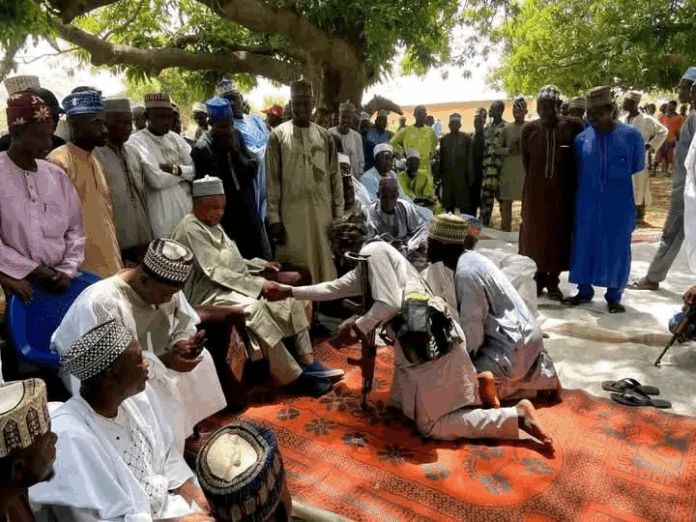
The Niger State Police Command has successfully reunited 35 kidnap victims — comprising 16 women and 19 children — with their families after weeks in captivity.

The victims were rescued while being relocated by their abductors from Birnin-Gwari and intercepted across various locations in Niger State.

Commissioner of Police, Adamu Abdullahi Elleman, represented by the Deputy Commissioner of Police (Investigation), Ibrahim Adamu, handed over the victims to the Chairman of Rafi Local Government Area, Ayuba Usman Katako, during a formal event in Minna.

The rescue operation, which began on July 3, was launched following credible intelligence that armed bandits were moving captives out of Birnin-Gwari.

The first group — five women and six children — was intercepted in Agwara, while a second group of four women and seven children was rescued on the Mekujeri-Tegina road.

A third group was found being transported by a commercial driver, Yusuf Abdullahi of Birnin-Gwari, who is under investigation by the State Criminal Investigation Department (SCID) to ascertain his possible links to the kidnappers.

The victims were placed under police care, where they received essential support, including food, bedding, psychological counselling, and deradicalization services in partnership with the Niger State Government.

In response to the growing concern of stigma faced by female survivors, the state’s Ministries of Humanitarian and Women Affairs, in collaboration with the Development Research and Projects Centre (dRPC) and the Federation of Muslim Women’s Associations of Nigeria (FOMWAN), organized a one-day sensitization workshop. The initiative, supported by the Ford Foundation under the “Muslim Opinion Leaders for the Prevention of Gender-Based Violence in Northern Nigeria” project, trained 40 stakeholders on preventing stigmatization against rescued victims.

FOMWAN’s State Amira, Hajiya Hauwa Kulu Abdullahi, urged service providers and officials to show empathy and help reintegrate survivors into society without prejudice. Malam Hassan Aliyu Karofi, dRPC’s Director of Partnership and Communication, emphasized that the training was in direct response to the recent rescue of 27 long-held female victims, some of whom returned pregnant or with children.

TIPS