Home Blog Page 179

Just In: Ahead of council poll, one dead, many injured in stampede as Niger residents jostle for Governor Bago’s cash

A little girl has reportedly died, and several others were injured following a stampede in Bida, Niger State, as thousands of residents gathered to receive cash handouts allegedly promised by Governor Umar Bago ahead of the November 1 local government area election.

The incident occurred near House 7, the governor’s usual lodge in the Bida Local Government Area, where he is currently staying ahead of the polls. 

SaharaReporters learnt that the large crowd had assembled after being asked to come and collect money reportedly to be shared by the governor.

“Look at our people, Allah this is a moment and a sign of hardship in Niger state,” an eyewitness said while lamenting the situation.

The resident added, “It’s very sad that our mothers, our sisters, our brothers, and fathers are here waiting for a small talk on the Niger State governor Umar Bago, a small talking precisely to be like 10 thousand or five thousand or even two thousand naira.”

Describing the huge turnout, the source said, “Just look at the amount of people that are here, this tells about how people are suffering and I can’t even mention the number of people here. There are more than five thousand or 10 thousand.”

According to eyewitnesses, the crowd became uncontrollable when word spread that the governor had arrived to distribute money. 

“The governor asks them to come around because he wants to share money. He said there is money,” another witness stated.

Other sources told this newspaper that the casualties might be more than one, adding that two additional persons were feared dead, although this could not be independently confirmed. 

It was gathered that the recent incident followed the governor’s arrival in Bida on Thursday, during which he met with some youths and stakeholders and directed them to inform residents to gather on Friday to receive cash handouts.

It could not be confirmed if the governor eventually distributed the money or not. 

However, as of the time of filing this report, the governor had not stepped out to address the mammoth crowd.

This is not the first time such an incident has been reported. In the early days of Bago’s administration, shortly after he assumed office, he regularly invited people to the Government House every Friday, where he shared ₦5,000 to residents. 
That exercise was reportedly discontinued after a woman lost her pregnancy, several people fainted, other injured and other unforeseen incidents occurred.

Sahara Reporters

Gunmen slay pastor, kidnap dozens in Kaduna — Church warns of silent Christian bloodbath

  • U.S. lawmaker insists Trump designate Nigeria as Country of Particular Concern

The United Church of Christ in Nigeria (HEKAN) reported a deadly attack in Farin Dutse, Kauru LGA.

Early on October 28, 2025, heavily armed bandits stormed the quiet community and fired indiscriminately.

Consequently, they killed Reverend Yahaya Kambasiya and abducted more than twenty residents, HEKAN said.

The attackers also seized worshippers from the HEKAN church, witnesses told the church leadership.

Meanwhile, U. S. lawmaker Reiley Moore has urged President Donald Trump to designate Nigeria a Country of Particular Concern, citing reports of the killing of a pastor and the abduction of other church members in Kaduna.

Mr Moore described the killing of Yahaya Kambasya, the pastor of the United Church of Christ in Nigeria (UCCN), popularly known as HEKAN, and the abduction of his church members as “horrific” in a post on X.

“Horrific news out of northern Nigeria. A pastor was shot and killed, and 20 Christians were abducted. This is the second attack on this same Christian community just this month,” Mr Moore said.

He added, “Enough is enough. It’s time to designate Nigeria a Country of Particular Concern, @SecRubio.”

Reverend Dr Amos Kiri, national president of HEKAN, in a statement on Thursday labelled the assault callous, inhumane, and wicked, and demanded action.

He added that the pastor’s remains lie in a morgue pending burial discussions with the family.
Previously, bandits abducted about fifty people on December 4, 2024, including Reverend Francis Lawal.
Lawal later died in captivity, illustrating the region’s escalating danger, HEKAN warned.
Similarly, on October 19, 2025, kidnappers seized four members of HEKAN Kakude Local Church.

Earlier, US Senator Ted Cruz accused Nigeria’s government of enabling massacres against Christians.
He claimed 50,000 Christians died since 2009, and many churches and schools were destroyed.

However, the federal government strongly rejected genocide claims as false and divisive, Minister Idris said.

Dr Kiri urged security agencies to pursue the bandits and rescue those still captive.
He also called on Nigerians to pray for grieving families and abductees.

On a related note, Evangelist Ezekiel Dachomo accused authorities of ignoring ethnic violence in Plateau State.

Dachomo showed a viral burial video and alleged that Fulani herdsmen killed eleven people near Jos.
He blamed imported militias for systematic attacks and demanded urgent military intervention.
Furthermore, Dachomo condemned public figures denying the killings and threatened divine judgment.
He vowed to present evidence, including photographs, at a future press conference.
Overall, church leaders said Nigeria’s Christians live in rising fear and need protection now.

Agba Jalingo alleges that prison officials sell cell spaces for N300,000 or more to rich inmates

Journalsit and civil rights activist, Agba Jalingo, has alleged that some officials of the Nigerian Correctional Service sell cell spaces to wealthy inmates for as much as N300,000.

Jalingo, who made the allegation during a two-day Investigative and Accountability Journalism Masterclass organised by the Agba Jalingo Foundation in Calabar, said the act was part of the widespread corruption plaguing the nation’s correctional centres.

“I am saying emphatically that some prison officials across the country sell cell spaces to richer inmates,” he said. “Some charge N250,000, N300,000 or more. I know this because I spent time there and saw how it works.”

The journalist and human rights advocate, who was once detained at the Afokang Federal Correctional Centre in Calabar, described the experience as an eye-opener that exposed the depth of systemic corruption within the prison system.

According to him, many inmates are unjustly incarcerated or have long demonstrated good conduct but remain behind bars because they cannot afford legal representation or bribes.

He noted that his recent appeal to Governor Bassey Otu of Cross River State to show mercy to such inmates was borne out of his personal encounters with them while in detention.

“While I was in Afokang, I took down the names of several inmates who were either wrongly imprisoned or serving sentences for very minor offences. I promised to fight for them when I regained freedom,” Jalingo recalled.

He expressed delight that Governor Otu heeded his appeal by granting amnesty to 54 inmates of the Afokang facility, describing the gesture as an act of genuine compassion.

“Before my birthday, I wrote to Governor Otu, asking him to extend mercy to deserving inmates. I must say he surprised me positively by acting on that appeal and releasing 54 of them,” Jalingo said.

The activist urged authorities of the Nigerian Correctional Service to investigate and curb corrupt practices within their ranks to ensure fairness and dignity for all inmates, regardless of social or financial status.

Video: NBA Ikorodu holds memorial walk, as Mrs. Felicia Odu becomes another “fallen” victim of domestic violence

Members of the Nigerian Bar Association (NBA), – Lagos State Chapter, as well as friends and advocates, gathered on Monday for a Transitional Walk in memory of Mrs Felicia Temitope Odu, a 56-year-old woman who tragically lost her life to domestic violence at the hands of her husband.

Mrs Odu, who was called to the Nigerian Bar last month (September 23) was reportedly a victim of domestic abuse for more than 25 years.

Participants in the walk described her death as a painful reminder of the dangers of remaining in abusive relationships, regardless of religious or cultural beliefs.

Speaking at the event, organisers emphasised that the walk was not only to honor Mrs. Odu’s memory but also to raise awareness about the urgent need to confront and end domestic violence in society.

“Felicia stayed in her marriage because of religious convictions — but today, she’s no more,” one participant said. “We want everyone, especially women in abusive marriages, to know that religion should never be a reason to stay and endure violence. Instead of remaining in an abusive home and losing your life, it’s better to leave to live.”

The walk served as both a tribute and a call to action — urging communities, religious leaders, and authorities to strengthen support systems and advocacy efforts to protect victims of domestic abuse across the country.

Watch the video below.

Accelerating Nigeria’s Growth: NDIS 2025 poised to mobilise diaspora investments

By Kachi Okezie

The 8th Nigerian Diaspora Investment Summit (NDIS 2025) is being positioned as a transformative force, ready to inject momentum into Nigeria’s economic growth by strategically harnessing the wealth and expertise of its global diaspora. Set to hold from November 11–13, 2025, at the State House in Abuja, the summit, convened by the Nigerians in Diaspora Commission (NiDCOM) and the Nigeria Diaspora Summit Initiative (NDSI), is operating under the compelling theme, “Fast Tracking Regional & National Development by Mobilising Diaspora Investment.”

This hybrid event is designed to be a crucial convergence point for diaspora Nigerians – investors, business leaders, and policymakers – offering keynote addresses, investment pitches, exhibitions, and targeted networking sessions aimed at connecting the Nigerian global community with viable opportunities across vital economic sectors.

The event’s prestige is underscored by the presence of the Special Guest of Honour, His Excellency Asiwaju Bola Ahmed Tinubu, GCFR, President of the Federal Republic of Nigeria, and the Chief Host, Hon. Dr. Abike Dabiri-Erewa (OON), Chairman/CEO of NiDCOM.

According to the NDCOM boss, Honourable Dabiri-Erewa, “The Nigerian Diaspora Investment Summit continues to be a catalyst for change, connecting our diaspora to tangible investment prospects and sustainable partnerships that drive economic growth, create jobs, and inspire national development.”

Further emphasising the summit’s commitment to real economic impact, the keynote address will be delivered by Professor (Dr) Bartholomew Nnaji, former Minister of Power and current Chairman of Geometric Power Limited, while Mr. Temi Popoola, Group Managing Director/CEO of the Nigerian Exchange Group, will share insights on innovative investment frameworks.

The commitment from key financial institutions is substantial, with Zenith Bank Plc as the lead event partner, alongside Rainbow Heritage Group (RHG), AG Mortgage Bank Plc, and First Bank of Nigeria Limited (FBN Group).

Group Managing Director/Chief Executive officer of Zenith Bank Plc, Dame Dr. Adaora Umeoji, OON, said: “Our sponsorship of NDIS 2025 underscores our unwavering commitment to the Nigerian diaspora as key partners in national development. We recognize their immense contributions to investment, innovation, and remittances, and we are proud to support a platform that fosters deeper economic and developmental ties with home.”

Managing Director/CEO, First Bank of Nigeria Limited (FBN Group) Mr. Olusegun Alebiosu, stated: “FBN has played significant roles in the development of Nigeria and in ensuring that MSMEs received needed support to grow their businesses. As the foremost financial institution in Nigeria, First Bank remained the trailblazer in providing the diaspora with viable options for wealth creation by leveraging the First Bank strategic partnership with over seventeen (17) leading money transfer operators around the world as well as through our own home-grown remittance platform – First Global Transfer (FGT).FBN will continue to support NDIS and investment in various strategic partnerships aimed at improving the economic development of Nigeria.”

In a statement, Rainbow Heritage Group (RHG), said: “Through this partnership with the Nigeria Diaspora Investment Summit (NDIS), RHG is reaching out to Nigerians in diaspora to showcase our commitment to delivering developments that meet and surpass global lifestyle expectations. Our flagship project, The New Port City, is a purpose-driven, sustainable city designed to be smart, functional, and future-ready and a true centre of excellence where everything works.”

On his part, the Managing Director/CEO, AG Mortgage Bank Plc, Mr. Ngozi Onyemuwa Anyogu, said: “At AGMB, we recognise the invaluable contributions of the over 17 million Nigerians in diaspora and contributing to both the local economy and globally, remitting over 20 billion dollars in one year… What is most important now is how to make the remittances positively impact the local economy, which is where AGMB Plc comes in, with its dedication to and experience in delivering financial solutions that meet the unique needs of diaspora Nigerians, such as buying homes or investing in their communities.”

Building on the success of the 2024 edition, which secured approximately N673 million in investment commitments for home-based small businesses and channelled N500 million into local service providers, NDIS 2025 is committed to highlighting new frameworks and incentives that make Nigeria an increasingly attractive destination for both diaspora and foreign investment.

Speaking on the impact of NDIS on the local economy, the summit Coordinator, Dr Badewa Adejugbe-Williams said that “About N673m worth of investment commitments to home-based small businesses was secured from diaspora-based Nigerians at NDIS2024 alone, with a further N500m going directly into local businesses including videographers, media, event curators, printers, performing artistes, hotels and catering firms, who supply it with goods and services.”

“As a multimedia outfit, we’ve leveraged NDIS to successfully expand our network, secure investor support, grow our team, and drive significant revenue growth,” says Joshua Samuel, Creative Director, Artestify Multimedia, an Abuja-based firm that has been positively impacted by NDIS.

Also impacted is Sarah Amana, Founder/CEO, Rich Aunty Finance: “NDIS was a pivotal launching pad for my brand, offering me exposure to a wealth of knowledge, networks, and experiences that became instrumental in shaping my entrepreneurial journey. It equipped me with the tools and insights I needed to seize the opportunities that came my way, allowing me to scale my business and build it into a strong, resilient company. The foundation I gained through NDIS not only accelerated my growth but also provided me with the confidence and clarity to navigate the challenges of entrepreneurship with success. Today, as I unveil my innovative $250,000 Savings and Investment App, I remember how pitching at NDIS gave me the confidence to take on new possibilities.”

Through its platform, which promotes collaboration in sectors like agriculture, technology, real estate, and healthcare, the summit continues to serve as a credible bridge, inviting over fifty small businesses and enterprises to showcase Nigeria’s economic promise.

Interested media, stakeholders, and investors can register to participate either onsite or virtually via www.ndis.gov.ng

Plateau State Internal Revenue Service V. Jos Electricity Distribution Plc: Do the tax appeal tribunal and federal high court have jurisdiction over tax disputes relating to the revenue o a state government?

By Esther Dania and Praise Ntem

BACKGROUND

The question of the exercise of jurisdiction by the Tax Appeal Tribunal (“TAT”) and the Federal High Court(“FHC”) over disputes relating to the revenue of a state government, especially personal income tax, has elicited conflicting judicial decisions. (For example, see most recently Skye Bank v Kwara State Internal Revenue Service (2021) 12 NWLR (Pt. 1789) 27 (“Skye Bankcase”) and RECTARS (Ile-Ife) v Osun State Board of Internal Revenue (2021) LPELR-55942(CA) (“Rectars case”).) This has arisen partly because the Personal Income Tax Act (“PITA”), which is a federal legislation, enables state governments to collect personal income tax of individuals resident within each state. In Plateau State Internal Revenue Service v. Jos Electricity Distribution Plc (2025) 90 TLRN 01, the Court of Appeal held that the TAT and the FHC have jurisdiction to hear and determine disputes relating to personal income tax (and other federal taxes) payable to a state government – but not disputes relating to revenues accruable to a state government pursuant to a law made by a state government.

FACTS

Plateau State Internal Revenue Service (“PSIRS”) as appellant commenced an action at the TAT against Jos Electricity Distribution Plc (“JED”) for the recovery of taxes payable to the Plateau State Government (or “State”) under the PITA and other tax laws enacted by the Plateau State House of Assembly, including alleged unremitted pay-as-you-earn (“PAYE”) tax, withholding tax (“WHT”) on contracts and supplies, purchase of energy and other contracts, and development levy for2015 and 2016. JED challenged the jurisdiction of the TAT to hear and determine the appeal on the ground that the taxes in dispute were not taxes payable or due to the federal government. The TAT however assumed jurisdiction over the matter and granted part of the reliefs sought by PSIRS. Aggrieved by the decision of the TAT, JED appealed to the FHC. The FHC allowed the appeal holding that neither the TAT nor the FHC has jurisdiction over disputes arising from taxes payable to the State. Dissatisfied with the FHC judgment, PSIRS appealed to the Court of Appeal.

THE APPEAL

On appeal, PSIRS argued that the FHC erred in law when it held that the TAT lacked jurisdiction over the dispute. PSIRS contended, amongst others, that (a) the claim brought before the TAT was initiated pursuant to the PITA, and (b) by s. 59 of the Federal Inland Revenue Service (Establishment) Act (“FIRS Act”) and s. 60 of the PITA, the TAT had jurisdiction over all matters arising from the operation of the PITA, including disputes concerning PAYE tax payable to the State. PSIRS further argued that the lower court ought to have relied on the Rectars case, which was decided on 5 November 2021 rather than the Skye Bank case decided earlier on.

In response JED argued that the FHC rightly held that the TAT did not have jurisdiction over disputes relating to taxes payable to the State. Regarding s. 60 of the PITA, JED argued that the jurisdiction of the TAT in respect of disputes arising from the PITA was restricted to personal income tax payable to the federal government and that a state law (i.e., the Plateau State Revenue (Consolidation) Law, 2020 (“Plateau State Revenue Law”) could not confer jurisdiction on the TAT.

In deciding the appeal, the Court of Appeal considered, inter alia, whether the FHC was right in holding that the TAT does not have jurisdiction in disputes arising from taxes due to a state government. In resolving this issue, the Court of Appeal considered the following:

  • The conclusion of the FHC that PAYE is governed by state law – not by the PITA
  • Section 251(1)(b) of the Constitution
  • Section 60 of the PITA
  • Section 87 of the PITA
  • Jurisdiction of the High Court of a state over disputes relating to state revenue.

The conclusion of the FHC that PAYE is governed by state law – not by the PITA

The Court of Appeal disagreed with the conclusion reached by the FHC that (a) state laws govern PAYE tax payable to a state and that any related dispute should be determined by the court specified by state law, i.e., the Plateau State Revenue Law in the instant case, and (b) the jurisdiction over PAYE tax is therefore vested in the High Court of Plateau State as provided in the Plateau State Revenue Law because the tax is payable to the State. In arriving at this position, the Court of Appeal drew a distinction between the “the power to impose tax” and “the power to collect tax”. Accordingly, the fact that personal income tax is payable to, or collected by, a state government (power to collect tax) does not make it a state tax: the question whether a tax is a state tax or federal tax is determined by reference to whether the tax is imposed (power to impose tax) by a state government or the federal government. The Court of Appeal therefore concluded that the PITA is a federal legislation because it was enacted by the federal government pursuant to its power under the Constitution (item D, paragraphs 7 and 8, part II, second schedule to the Constitution); and it is not within the legislative competence of a state government to make laws on the taxation of income and profits. It therefore determined that PAYE tax (and WHT in this instance) is a component of personal income tax, which is imposed by the PITA.

Section 251(1)(b) of the Constitution

The court also considered s. 251(1)(b) of the Constitution, which provides that the Federal High Court shall have exclusive jurisdiction in all civil matters “connected with or pertaining to the taxation of companies and other bodies established or carrying on business in Nigeria and all other persons subject to Federal taxation”. (Emphasis supplied.) In interpreting s. 251(1)(b) of the Constitution, the lower court did not properly consider the phrase “and all other persons subject to Federal taxation”. The lower court however implied that federal or state taxation was dependent on “whom the tax accrued to” when it concluded that the “PITA governs federal taxation, whilst the State Board of Internal Revenue Laws govern State Pay-As-You-Earn tax”.

Having determined that the PITA is a “federal legislation”, the Court of Appeal further determined that personal income tax is a federal tax or federal taxation. Considering therefore that s. 251(1)(b) of the Constitution grants exclusive jurisdiction to the FHC over civil matters concerning or pertaining to persons subject to federal taxation, the Court of Appeal held that the FHC has exclusive jurisdiction over disputes arising from the PITA, including disputes relating to PAYE tax and WHT (which form part of personal income tax).

Section 60 of the PITA

The Court of Appeal traced the history of s. 60 of the PITA, which extended the jurisdiction of the TAT to all matters arising from the PITA and concluded that the amendment of the PITA in 2011 to include s. 60, (which provides that “The [TAT] established pursuant to Section 59 of the [FIRS Act] shall have the powers to entertain all cases arising from the operations of this Act”) extended the jurisdiction of the TAT to all disputes or controversies arising from the operation of the PITA. The Court of Appeal further considered the Skye Bank case and the Rectars case and found the decision in the Rectars to be consistent with the legislative intent in the s. 60 amendment.

Section 87 of the PITA

Section 87 of the PITA established for each state of the federation a State Board of Internal Revenue. Many states have in addition to the PITA enacted state laws that not only provide for the establishment (or reestablishment) of a state tax authority but also confer jurisdiction on state courts over taxes accruing to the state, including personal income tax. The Court of Appeal held there was no legal basis for the Plateau State Government to make laws on any aspect of income tax or the PITA, including provisions for the resolution of disputes arising under the PITA. This is because, by item 59, part I, second schedule to the Constitution (i.e., the exclusive legislative list), the National Assembly has exclusive power to legislate on taxation of incomes, capital gains, and stamp duties. The State therefore had no power to confer jurisdiction to adjudicate disputes arising under the PITA on a court other than as provided in the PITA.

The jurisdiction of the High Court of a state over disputes relating to state revenue

Although the Court of Appeal held that the provisions of the Plateau State Revenue Law were subject to the PITA with regard to matters covered by the PITA, it however held that the State High Court has jurisdiction to determine disputes relating to taxes imposed by the State, being taxes and levies that do not come under the exclusive legislative list, such as land related taxes, development levy, and infrastructure levy. In the words of Affen JCA who delivered the leading judgment:

“In the light of the foregoing, the inevitable conclusion to which I must come is that the lower court did not get it right when it adjudged the [TAT] as being bereft of jurisdiction to entertain the claim of PSIRS in its entirety. Quite the contrary, the [TAT] has jurisdiction in respect of reliefs (a) and (e). Issue 2 is resolved in favour of the Appellant to that limited extent.”

In the result, the Court of Appeal sustained the decision of the FHC on the reliefs founded on the PITA and struck out the reliefs founded on the Plateau State Revenue Law for want of jurisdiction.

COMMENT

It would appear that the primary contribution of the PSIRS case to tax jurisprudence in Nigeria is the interpretation and application of the phrase “persons subject to Federal taxation” (“federal taxation phrase”) in s. 251(1)(b) of the Constitution in determining the jurisdictional challenge in tax litigation – usually between the TAT and the FHC on the one hand and the High Court of a state on the other hand. The courts determined the dispute in previous cases by reference to s. 251(1)(a) of the Constitution, (b) s. 251(1)(b) of the Constitution (but without attention to the federal taxation phrase), and (c) s. 251(1)(r) of the Constitution.

The resolution of the jurisdictional dispute in these earlier cases was therefore based on whether (a) the revenue in issue accrued to the federal government (in which an agency of the federal government was a party to the suit) or a state government, and or (b) the dispute arose from the taxation of companies. For example, in A.G. Lagos State v Eko Hotels Limited (2018) 7 NWLR (Pt. 1619) 518, Kekere-Ekun JSC (as she then was) who delivered the leading judgment held that the FHC had jurisdiction in the matter based on s. 251(1)(b) and (r) of the Constitution, i.e., that the liability sought to be enforced was that of a company, and an agency of the federal government, i.e., FIRS, was a party to the suit. The majority decision of the Court of Appeal in Lagos State Internal Revenue Board v. Motorola Nig. Ltd & anor (2012) LPELR-14712(CA) was also based on s. 251(1)(a) of the Constitution.

In the Skye Bank case Saulawa JCA (as he then was) who delivered the leading judgment of the court relied on s. 59 of the FIRS Act and s.60 of the PITA to hold that the TAT did not have jurisdiction to entertain disputes relating to revenues accruing to a state government, including disputes that arose from the PITA as follows:

“It is obvious, that by the combined effect of the provisions of the First Schedule to Section 59 of [the FIRS Act] and section 60 of PITA do not envisage conferring jurisdiction upon TAT in respect of dispute arising from taxes that are due to the State Government. It only relates to dispute arising from taxes and levies that are due to the Federal Government of Nigeria under [the FIRS Act]. See Wilbros (Nig.) Ltd. v. A.-G., Akwa Ibom State (2008)5 NWLR (Pt.1081) 484; Shittu v. N.A.C.B. Ltd. (supra)”. (Emphasis supplied.).

The decision in the Skye Bank case is however difficult to follow. First, the effect of s. 59 of the FIRS Act and s. 60 of the PITA is the opposite of what the Court of Appeal decided. Further, neither Wilbros (Nig) Ltd v. A.G Akwa Ibom State & anor (2007) LPELR-8182(CA) (“Wilbros case”) nor Shittu v N.A.C.B. Ltd (2001) 10 NWLR (Pt.721) 298 (“Shittu case”) on which the Court of Appeal relied decided that s. 59 of the FIRS Act and s. 60 of the PITA confine the jurisdiction of the TAT to “taxes and levies that are due the Federal Government of Nigeria under the [FIRS Act]”.

The Wilbros case was decided based on s. 251 of the Constitution. And the Court of Appeal resolved the jurisdictional tussle in favour of the High Court of Akwa Ibom State because the revenues in issue in the suit accrued to the Government of Akwa Ibom State. The Shittu case, on the other hand, did not consider s. 59 of the FIRS Act or s. 60 of the PITA.

The PSIRS case is also remarkable for bringing into focus the distinction between the “power to impose tax” and “power to collect tax” – on the basis of which it established the framework for determining “federal taxation”. (The Court of Appeal appeared to have conflated these powers in Lagos State Internal Revenue Board v. Motorola Nig. Ltd & anor (supra).)

The decision in the PSIRS case provides a formidable legal basis (anchored on s. 251(1)(b) of the Constitution, s. 59 of the FIRS Act, and s. 60 of the PITA) for the proposition that the TAT (and by extension the FHC) has jurisdiction over all tax disputes arising from the PITA and other federal tax legislation, notwithstanding that the taxes are collected by, or accrue to, a state government. (Although the federal taxation phrase in s. 251(1)(b) of the Constitution was canvassed in Lagos State Internal Revenue Board v. Motorola Nig. Ltd & anor (supra), the majority decision did not consider it, but rather decided the case based on s. 251(1)(a) of the Constitution.)

Therefore, the PSIRS case may have conclusively provided a clear framework for resolving the jurisdictional challenge in tax litigation between the TAT and the FHC on the one hand and the High Court of a state in respect of taxes collected by, or accruing to, a state government. The case has also decided the point that the TAT (and by extension the FHC in exercise of its appellate jurisdiction) does not have jurisdiction to determine disputes arising from taxes created or imposed by a state government pursuant to a law validly made by the House of Assembly of a state.

The content of this article is intended to provide a general guide to the subject matter. Specialist advice should be sought about your specific circumstances.

Credit: Mondaq

Outrage erupts as Nigeria’s top legal rank becomes a “Millionaire’s Club”

Nigerians are fuming over the Legal Practitioners’ Privileges Committee’s (LPPC) new application fees for the Senior Advocate of Nigeria (SAN) rank.

Private lawyers must now pay a staggering N5 million, while public service lawyers will part with N2.5 million. Last year, applicants paid N1 million.

The massive increase has sparked widespread anger, with many calling it an attempt to commercialise one of Nigeria’s most prestigious legal honours.

Critics argue the move will make the SAN title accessible only to wealthy lawyers, not the most qualified.

Human rights lawyer Professor Chidi Odinkalu condemned the policy on X, asking, “How do they expect an honest public servant to find this money?” He warned that the title could soon be “priced into extinction.”

Many Nigerians on social media have labelled the fee “extortionist” and accused the LPPC of turning the legal profession into a marketplace. Some even claimed bribery would remain a hidden requirement.

“This is how corruption starts — when merit is replaced with money,” one user wrote.

Public speaker and gender advocate Olufunke Baruwa described the new policy as “heartbreaking,” saying it forces honest lawyers out of contention.

“How can a public servant earning less than N500,000 monthly afford this?” she asked. “Unless we expect them to be corrupt.”

She urged SAN titleholders to advocate scrapping the fees, warning that the rank risks losing all credibility.

Meanwhile, the LPPC has remained silent on the outrage.

Some legal experts defended past fee increases, claiming the SAN process must be self-financing and reflective of inflation.

However, this latest hike—five times the previous year’s fee—comes as Nigerians battle record inflation and rising government service costs.

Many now fear that the legal profession’s highest honour is becoming the preserve of the elite—another victim of Nigeria’s deepening inequality.

As one social media user put it, “The SAN title used to symbolise excellence. Now, it’s just for those who can afford the price tag.”

Enough of Darkness! FG tells states to generate their own power as energy crisis deepens

Apparently overwhelmed by Nigeria’s worsening electricity crisis, the Federal Government has asked all 36 states to take charge of power supply.

Minister of Power, Adebayo Adelabu, said states must now generate, transmit, and distribute their own electricity.

He spoke at the Nigeria Energy Leadership Summit in Lagos, declaring that power centralisation “can never work” for a country this large.

According to him, the Electricity Act 2023 has ended Abuja’s monopoly over the power sector.

“The Act decentralises electricity and gives states full control to generate and regulate power within their territories,” he said.

Adelabu insisted that only decentralisation can solve Nigeria’s persistent electricity failures, adding, “From Abuja, you cannot guarantee light for everyone.”

He explained that the new law allows states to set up their own electricity markets and attract private investors.

So far, 15 states have gained regulatory autonomy, with Enugu leading the way through its own Electricity Regulatory Commission.

Adelabu challenged governors to stop waiting for the Federal Government and start driving power generation in their regions. “You must take steps to activate this autonomy,” he urged. “Cows don’t make milk; you milk them.”

He called on states to woo investors into building solar, wind, hydro, and thermal plants to secure local energy independence.

“Many Nigerian states are bigger than some West African countries,” he said. “They should run their power systems like nations.”

Adelabu also asked governors to challenge distribution companies and the Transmission Company of Nigeria for better grid supply.

“Get closer to the DisCos. Track them. Challenge them,” he charged. “Electricity is an electoral promise.”

He noted that 21 states have yet to establish electricity markets despite the powers granted by the 2023 Act.

Enugu’s power regulator, Chijioke Okonkwo, confirmed that states are ready to take over electricity delivery. “States must drive this revolution. That’s the way forward,” Okonkwo said, inviting investors to build mini-grids in Enugu.

Lagos Governor Babajide Sanwo-Olu also pledged readiness to partner with investors willing to power the state’s industries.

Katsina Governor Dikko Radda made a similar call, promising to invest heavily in renewable and local power generation.

Adelabu disclosed that the power sector earned N1.7 trillion in 2024, with revenue projected to exceed N2 trillion next year.

He said private sector investment remains vital, warning that government funds alone cannot sustain the power industry. “We must open the door to private capital,” he said. “No government can fund this sector alone.”

Nigeria currently flares over 241 million standard cubic feet of gas annually—enough to power several cities. Despite having 20 power plants, generation now fluctuates between 2,000 and 3,500 megawatts.

Experts blame gas shortages, unpaid debts, and ageing infrastructure for the country’s declining electricity output.

Nigeria owes gas suppliers $1.3 billion, even as gas worth $1.9 billion was flared between 2020 and 2024.

Analysts call this a national tragedy and an act of economic sabotage.

“The irony is painful,” an energy analyst said. “We flare what we need and borrow to buy it back.”

The minister admitted that Nigeria’s 10GW of stranded power capacity could light up industries and boost exports. “We are open to partnerships to unlock this potential,” Adelabu said.

Energy experts say renewable energy could finally end the nation’s electricity nightmare.
They argue that solar, wind, and hydro power—backed by the Electricity Act—could secure energy and cut emissions.

“The answers are here,” one expert said. “What Nigeria lacks is the will to act.”

As power generation drops and tariffs rise, Nigerians wait for light—literally and politically.

As NBA Eket branch begins its 2025 BAR week…

As we gather for the 2025 BAR week in the heart of Akwa Ibom State, I join the esteemed members of the Nigerian Bar Association, Eket Branch, in celebrating the power of law to shape a brighter future through the theme: Justice and Governance Beyond Rhetoric: The True Mandate of the Bar.

May the discussions ignite a renewed passion for justice, echoing the rhythms of the Qua Iboe River and the resilience of the Ibibio people. May the deliberations inspire a new wave of lawyers committed to serving the cause of justice, and may the bonds of fellowship forged here strengthen the fabric of our profession.

Wishing you a blessed BAR week, filled with inspiration, camaraderie, and a deepened sense of purpose.

Sincerely,
Audrey Chinelo Ofoegbunam, Esq, ACIArb(UK), ANICArb, ACIS, AICMC, ACTI.
Treasurer, NBA Abuja Branch (2022-2024)
Assistant Secretary, NBA Abuja Branch (2020-2022)

AWLA Nigeria celebrates Her Worship Mrs. Onome Nwankwo, Nigeria’s best Magistrate 2025

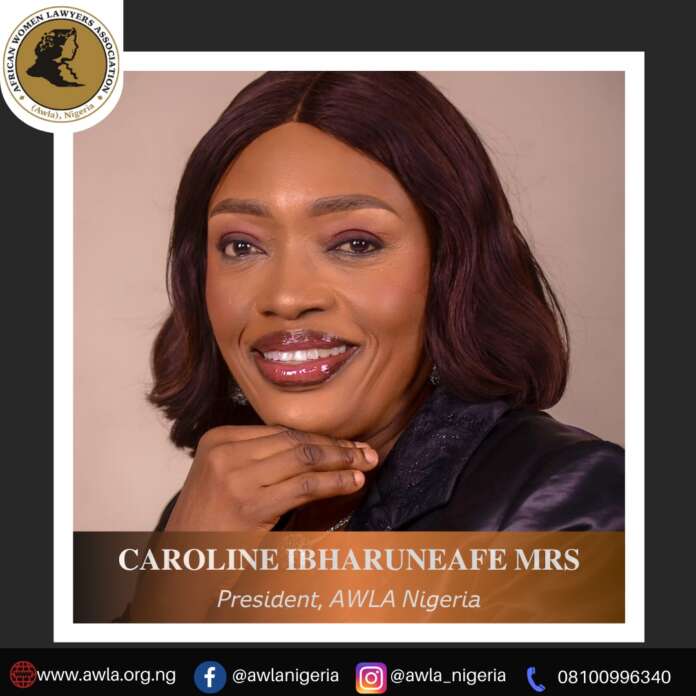
On behalf of the African Women Lawyers Association (AWLA) Nigeria, our President, Mrs Caroline Ibharuneafe, heartily congratulates Her Worship, Chief Magistrate Onome Nwankwo, on being honoured as the Best Magistrate in Nigeria 2025 by the Nigerian Christian Pilgrim Commission (NCPC) in collaboration with the Independent Corrupt Practices and Other Related Offences Commission (ICPC).

This recognition is well-deserved and truly fitting for a woman whose integrity, brilliance, and dedication to justice continue to inspire many.

Your Worship, you are not just a magistrate; you are a beacon of excellence and a role model to women in the legal profession.

AWLA Nigeria proudly celebrates this remarkable achievement and applauds your unwavering commitment to fairness, courage, and ethical leadership in the judiciary.

Congratulations once again, Your Worship! You have made us all proud.

TIPS