Home Blog Page 175

Again, court gives Nnamdi Kanu Nov. 7 to defend terrorism charges or waive rights

The Federal High Court in Abuja has again given the Biafra nation agitator, Nnamdi Kanu, until 7 November to defend the terrorism charges brought against him by the federal government, or waive his right to do so.

This is as Kanu stood his ground in the open court on Wednesday, that there were no valid terrorism charges against him and would offer no defence to the one against him.

Justice James Omotosho, who offered Kanu another opportunity, stated that he granted the fresh opportunity in the interest of justice to both the defendant and the nation.

At Wednesday’s proceedings, when Kanu was called to open his defence, he instead faulted the charges, insisting that he had nothing to defend in respect of a repealed law.

Kanu addressed the court, insisting on why the charges against him cannot stand.

Among others, he said that the Supreme Court in the judgment that ordered his trial made it abundantly clear to the federal government to amend the charge because the one against him had been repealed

He said that until now, the charge had not been amended by the prosecution, thereby violating the order of the apex court.

He maintained that the refusal of the federal government to amend the charge was fatal to his trial, adding that no trial can be held with a repealed law.

“Terrorism Prevention and Prohibition Act has been repealed. I cannot put in defence under a repealed law. I won’t do that”.

At this point, Justice Omotosho reminded him of the need to keep his gun powder dry, but he declined, maintaining he had not seen any reason to open defence in the instant charge.

At a point, he agreed to open up the defence and that he would need to consult with his four legal consultants.

He named Nnaemeka Ejiofor, Aloy Ejimakor, Maxwell Okpara and Mandela Umegborogu as his four legal consultants to consult.

Based on this, the Judge repeated his plea to him to consult with legal practitioners conversant with criminal laws to aid his defence.

Earlier, counsel to the federal government, Adegboyega Awomolo SAN, had requested the Judge to stand on the order of the court that Kanu should open defence or waive his right to do so.

Justice Omotosho, however, said that he was inclined to bend backwards again to give Kanu another opportunity to have a rethink to open defence or forget it.

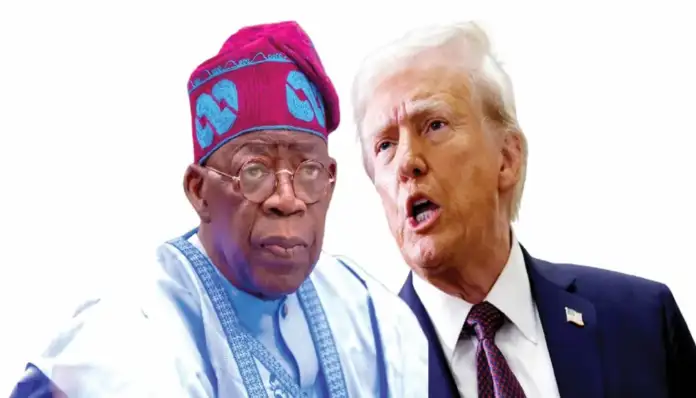
Nigeria responds to Trump’s “Disgraced Country” remark with urgent national action

  • As Peace Corps Seeks United Nations Intervention in Trump’s threat

Nigeria’s political leaders are turning U.S. President Donald Trump’s stinging rebuke into a call for reform and unity.

Trump had slammed Nigeria over insecurity and killings, labelling it a “Disgraced Country” and hinting at possible military action.

The statement sparked outrage but also stirred determination among Nigeria’s political and civil society leaders.

Under growing pressure from activists, organisers of next week’s National Political Summit in Abuja expanded their agenda to address Trump’s threat.

The summit, earlier planned to focus on credible elections, will now include national security and diplomacy as urgent priorities.

In a statement, publicity manager James Ezema said the decision aims to “convert anxiety into positive national action.”

The gathering, convened by the National Consultative Front (NCFront) and key civic groups, seeks to shape Nigeria’s democratic future.

Tagged “National Electoral Reforms Summit for Credible Elections in 2027,” it will hold on November 11 at the NICON Luxury Hotel, Abuja.

Former President Goodluck Jonathan is billed to chair the summit, while former Vice President Yemi Osinbajo will deliver the keynote address.

Confirmed speakers include Prof. Attahiru Jega, Femi Falana, Oby Ezekwesili, and Pat Utomi, among others.

Organisers say the summit aims to drive constitutional reforms that will strengthen electoral credibility and transparency before 2027.

But recent global criticism has reshaped the conversation. Trump’s remarks, they said, exposed Nigeria’s deep governance and image crisis.

Civil society leaders argue that instead of outrage, the nation should use the moment to rebuild its integrity and institutions.

They urged Nigerians to see the insult as a wake-up call, not an attack.

Summit organisers added that the agenda now includes strategies to manage the diplomatic fallout and rebuild trust with international partners.

Government officials, state governors, and the INEC chairman are expected to attend alongside over 700 delegates.

Meanwhile, the Peace Corps of Nigeria appealed for diplomacy, warning that Trump’s threat of military action could worsen insecurity.

National Commandant Dr. Dickson Akoh said such intervention “would expose vulnerable Nigerians to greater danger and suffering.”

He urged the United States to pursue dialogue instead of force, describing diplomacy as the only sustainable path to peace.

“The deployment of troops will only escalate violence,” Akoh said. “What Nigeria needs is support for peace-building and development.”

He called on the United Nations to mediate between both nations to prevent rising tensions from spiralling into conflict.

Akoh also congratulated Nigeria’s new Service Chiefs, pledging Peace Corps support for their efforts to strengthen national security.

He said the group would work with the military to promote youth-driven, non-violent strategies for peace.

As Nigeria faces global scrutiny, leaders say the moment demands unity, reform, and diplomacy — not denial or division.

The message is clear: Nigeria must rise from criticism to chart a stronger, more credible future.

Sowore’s defamation arraignment holds Dec. 2, escapes arrest warrant over absence in court

Rights activist and presidential candidate of the African Action Congress (AAC) in the 2023 presidential poll, Omoyele Sowore, on Wednesday at the Federal High Court in Abuja, escaped an arrest warrant on account of his failure to appear in court for arraignment on defamation charges.

During proceedings on Wednesday, Counsel to the Department of the State Service DSS, Akinlolu Kehinde, SAN, had urged Justice Mohammed Umar to issue a bench warrant against Sowore for being absent in court without justification, having been served the charges and hearing notice from the last adjourned date.

The senior lawyer said that the action of Sowore, publisher of Sahara Reporters media, staying away from court despite being served with the charges is an affront to the sanctity of the court and must be treated with punishment such behaviour deserved

Kehinde said that Sowore’s case was disturbing and unacceptable because no lawyer appeared for him as required by law.

He urged the Judge to invoke his inherent power to issue a bench warrant for the arrest of the defendant by security agents wherever he may be.

Justice Umar, however, noted that the order for a bench warrant will not subsist for now, following the submission of the 2nd defendant, X Corporation, that they have not been served the charge sheet even though they received a hearing notice.

The trial Judge then directed that all parties should be duly served and then adjourned the case to December 2, 2025, for arraignment to take place.

Meanwhile, counsel to X Corporation, Christabel Ndiokwelo, told the court that the complainant had yet to serve the formal charges on their client, noting that only a hearing notice had been served earlier.

Earlier in the proceeding, the DSS lawyer had drawn the attention of the court to a letter by Deji Adeyanju, calling for an adjournment in the case, hence his request for a bench warrant, noting that Sowore is only taking the court for granted.

META (Facebook) Inc., through their lawyer, Tayo Oyetibo, SAN, aligned himself with the prosecution’s request for a bench warrant against Sowore, stating that the 1st defendant had accused them of taking sides with the prosecution.

Oyetibo noted that the letter for adjournment is a form of distraction, as Sowore knows what he is doing.

After listening to the arguments, Justice Umar fixed the arraignment for 2 December for all the defendants and also directed that a hearing notice must be served on them.

Sudan descends into horror as militants commit mass rape and kill 40 at funeral

Sudan’s conflict has taken a chilling turn as militants unleashed mass rapes and massacres across war-torn regions.

Eyewitnesses described unimaginable brutality in El-Fasher after its fall to the Rapid Support Forces (RSF).

Amira, a mother of four, said militants carried out public gang rapes, leaving entire families traumatised.

“They raped women in front of everyone,” she said during a webinar organised by the group Avaaz.

She recounted how fighters seized young girls from families unable to pay extortion fees.

“If you couldn’t pay, they took your daughters,” she said.

Doctors Without Borders reported treating over 300 sexual violence survivors after a previous RSF assault in Tawila.

That same attack displaced more than 380,000 people from the nearby Zamzam camp.

Aid groups say children as young as one have been victims of brutal sexual violence.

The United Nations confirmed another atrocity—40 people slaughtered at a funeral in El Obeid, North Kordofan.

The UN’s humanitarian agency OCHA condemned the killings and demanded an immediate ceasefire.

Shocking videos circulating online show militants laughing as they gun down civilians pleading for mercy.

In another clip, a fighter identified as Abdullah Idris executes unarmed people one by one.

Gunmen also stormed a maternity hospital, killing 460 patients, mothers, and newborns.

Observers say atrocities have been committed by both the army and the RSF.

The war, which erupted in April 2023, has killed tens of thousands and displaced millions.

In just two days last week, over 2,000 civilians were reportedly killed.

Survivors described militants executing entire families inside their homes.

The RSF, after capturing El-Fasher, now controls all five state capitals in Darfur.

Analysts warn this could divide Sudan into rival territories controlled by the army and the RSF.

The RSF dominates the west and south, while the army holds the north, east, and central regions.

The UN accuses the UAE of supplying arms to the RSF, an allegation Abu Dhabi denies.

Meanwhile, Egypt, Saudi Arabia, Turkey, and Iran reportedly back Sudan’s army.

Defence Minister Hassan Kabroun vowed to continue fighting after rejecting a U.S.-backed ceasefire plan.

He said the army’s preparations for war were “a legitimate national right.”

The U.S. said it is working with Egypt, Saudi Arabia, and the UAE to push for peace.

White House Press Secretary Karoline Leavitt called the situation “deeply complicated but not hopeless.”

The International Criminal Court expressed alarm, warning that the atrocities may constitute war crimes.

UN Secretary-General Antonio Guterres urged both sides to end what he called Sudan’s “nightmare of violence.”

He appealed for immediate peace talks, saying, “The world cannot look away any longer.”

The war has created the world’s worst humanitarian crisis, with millions displaced and countless lives shattered.

Trump, threats, terrorists and tomorrow, By Funke Egbemode

A long time ago, when the harmattan still remembered how to bite, a thunderous blinding lightning and thunder flashed across the sky. It was followed by chilling bellow. Who could that be or were the ancestors descending on an angry ladder. It was the voice of Trump the Thunderer, the one whose voice could not be ignored whether you love it or not. Trump the Thunderer was the ruler of faraway golden empire called Merikaland. Holding a huge trumpet, he stood on his shining hill and shouted:

“It is finally judgement day and I shall send fire to destroy all the terrorists in Nigeria!”

The echo of his words crossed farmlands, seas and deserts until it reached the ears of king and people of Naijaland, a place where everyone carried a radio in their tongue and a drum in their arms. There was always something going on, something to be told and retold.

The Gathering at the Village Square

The people quickly gathered at the village square. The men abandoned their pepper soup bowls and concubines. The women dropped their baskets of plantain,  wrapped and re-wrapped their wrappers. Children and young adults left their chores and games. They all gathered under the old mango tree where arguments grew faster than fruits.

The Elder of the Talking Stick asked.

Soon, the talking stick arrived with the leaders of the market square. In Naijaland, the talking stick was a sign that it was time for serious talk time. Not that all the talks were serious all of the time, though.

“Did you hear the Oyinbo giant? He says he will kill our terrorists.”

Immediately, the market square divided like oil and water.

The first group, the Thunder worshippers, shouted,

“Let him come! Our leaders fear only white thunder. Maybe this foreign fire will cleanse the land!”

“Since our leaders are behaving like all is well, let the white warriors come and bail us out.”

“The Thunder has bigger guns and he will not look at anybody’s face.”

The second group, the Countrymen, retorted,

“Is our country his backyard? Even a stranger must knock before entering a compound! Today it’s terrorists, tomorrow it may be us!”

Then came the third group — the A-don-care, who love the taste of every soup. They nodded to both sides and said,

“We only want peace, whether it comes from heaven or Washington.”

“If after the thunder and lightning, there is rain, what is wrong with the arrangement?”

Then came the Spirit of the Land.

That night, as lightning danced across the sky, the Spirit of the Baobab rose from its roots and sighed:

“Ah, children of Naija, you quarrel over every thunder, but forget that the rain falls on both the just and the unjust.

Did you not once cheer when outsiders armed your soldiers? Did you not also weep when the same guns turned on your villages?

The fire that promises to burn your enemies may not stop at your neighbour’s fence. Indeed, the fire will become a fiery furnace and engulf the village. Or hasn’t anyone told you that fire, does not respect even the one that kindled it?”

The Morning After

By dawn, the people were still arguing — on radios, in buses, in WhatsApp groups, even in dreams.

The Thunderers still shouted “Let the fire fall!”

The Countrymen still cried “No foreign flames!”

And the a-don-care fellows still sipped tea and said, “We are watching.”

But the Spirit of the Baobab chuckled softly and whispered to the wind:

“A nation that quarrels over every thunder will one day forget to repair its leaking roof.”

May the rain fall — not from Thunderer’s heaven, but from Naija’s own sky to drench everyone equally. It is the only rain that will not sweep away both the good and the bad.

Moral of the story?

When strangers quarrel about your home, you must first ask yourself who left the door open.

It is okay to speak English, test our rich diction against President Trump’s warning. It is our thing. Once a problem pops up, we dive for our book of rhetorics.

How dare Trump?

This is a sovereign nation, as sovereign as the United States of America.

Trump has no right to threaten Nigeria.

The National Assembly and the Presidency must respond promptly in strongly-worded statement.

All of that have been followed by copious references to the Nigerian constitution, United Nation treaties and agreements and other self-righteous grandstanding. I guess all of them are part of the fight or diplomacy banters. But noise of any kind, whether by motor park conductors calling passengers or the ones by politicians claiming they have been insulted or disrespected, can or will not make a dent when there is real trouble. And Trump and his warning of war is a real and present danger. We can deny it all we want, even assure ourselves that ‘nothing will happen’, we know deep down in our mind that an American warning is different from a Donald Trump warning. One can be reasoned with, the other cannot.

The views expressed by contributors are strictly personal and not of Law & Society Magazine.

Nigeria must rethink security or risk collapse – Gen. Dambazau warns

Former Chief of Army Staff, Lt. Gen. Abdulrahman Dambazau (Rtd.), says Nigeria must overhaul its security system to survive.

He delivered the warning at the 7th Annual Public Lecture of the Just Friends Club of Nigeria in Abuja.

Speaking on “Nigeria’s Security Challenges and the Quest for National Cohesion,” Dambazau urged a complete rethink of national security.

He said true security goes beyond the military and must prioritise people’s welfare, rights, and development.

“Security is about lives, property, and human dignity,” he declared. “It is the primary duty of government.”

He lamented that despite huge defence budgets since 1999, Nigeria remains plagued by fear, violence, and poverty.

Dambazau questioned why insecurity persists despite massive investments and constant military deployment.

He asked: “Can we build a people-centered, intelligence-led security system that respects our diversity?”

He explained that global understanding of security now centers on people, not territories or weapons.

Military strength alone, he said, cannot solve poverty, hunger, and illiteracy, which breed instability.

“Human security means freedom from fear, freedom from want, and a future of opportunity,” Dambazau stressed.

He linked rising poverty and unemployment to worsening violence and weak governance.

Nigeria’s poverty rate, he noted, could hit 46 percent by 2024, with over 90 million citizens below the poverty line.

He said lack of education, healthcare, and jobs fuels desperation and crime.

“Neglecting human development is itself a national security threat,” he warned.

The retired general also raised alarm over cybercrime and illegal arms proliferation.

He said weak border control and local gun manufacturing have worsened terrorism and banditry.

“Technology can be our ally or our enemy,” he said, urging the government to invest in cybersecurity.

Dambazau blamed persistent insecurity on poor governance, weak coordination, and political interference.

“Corruption and bad governance cripple our security institutions,” he said. “Our agencies operate in silos, not synergy.”

He called for intelligence-led operations and community-based policing that build public trust.

“Security cannot be centralised in Abuja,” he said. “Communities must own their protection.”

On climate change, he warned that droughts and land loss are fueling farmer-herder conflicts.

“Environmental degradation drives hunger, displacement, and violence,” he said.

He urged policymakers to link environmental management with security reform.

Dambazau also decried the growing ethnic and religious divisions across Nigeria.

He said political elites exploit religion and ethnicity to divide citizens.

“This lack of unity gives terrorists room to thrive,” he warned.

He condemned foreign claims of a “Christian genocide” in Nigeria, calling them divisive and misleading.

“Terrorists kill Muslims and Christians alike,” he said. “We must unite to confront them.”

Dambazau criticised the U.S. designation of Nigeria as a “Country of Particular Concern,” calling it political interference.

He noted that most Boko Haram victims in Borno and Yobe are Muslims.

“Our enemies are criminals, not Christians or Muslims,” he insisted.

He said insecurity should not be viewed as a northern or southern problem but a national one.

Dambazau then turned to Nigeria’s outdated security architecture.

He said decades of military rule left the system rigid, centralised, and out of touch.

“The police lack professionalism, equipment, and trust,” he said. “The military is overstretched and misused.”

He accused governments of prioritising regime security over national security.

“Our agencies often protect politicians instead of the people,” he said.

He urged reforms that ensure professionalism, accountability, and respect for human rights.

Dambazau called for smarter investments in intelligence, technology, and youth empowerment.

“Bullets cannot solve social problems,” he said. “Only inclusion, education, and opportunity can.”

He also supported involving non-state actors and civil society in peacebuilding.

“They can be partners, not just threats,” he said.

The retired general said modern security must integrate AI, drones, and digital surveillance responsibly.

“Technology should protect, not oppress,” he warned.

He emphasised that democracy requires the protection of civil liberties and rule of law.

“The state must respect rights even while fighting insecurity,” he said.

He urged the National Assembly and judiciary to strengthen oversight and ensure accountability.

Dambazau proposed a “new paradigm” focused on decentralisation, transparency, and local intelligence.

“Security must start from the grassroots,” he said. “Communities are our first line of defence.”

He called for integrating local customs, traditional justice, and youth engagement into national strategies.

“Every Nigerian has a role in building peace,” he concluded.

He summarised his message in three points: unity, good governance, and people-driven reform.

“Security is everyone’s business,” Dambazau said. “Without national cohesion, Nigeria cannot stand.”

Earlier, the President of the Just Friends Club of Nigeria, Mr Fred Ohwahwa, called for urgent national action on Nigeria’s deepening security crisis.

He thanked Professor Tonnie Iredia, the former NTA Director-General, for stepping in as Chairman on short notice and praised his unwavering support for national dialogue and civic progress.

Ohwahwa said the Just Friends Club, founded in 2013, remains committed to social good, responsible citizenship, and nation-building.

According to him, open dialogue and collective engagement are crucial to solving Nigeria’s toughest problems.

He noted that insecurity—ranging from insurgency to kidnapping and cyber threats—continues to threaten national stability.

“Ohwahwa warned that Nigeria must put its house in order or risk external interference,” he said, referencing recent global remarks about the country’s instability.

“Our failure to address banditry and kidnapping does not speak well of us as a serious nation,” he added.

The president emphasized that the fight for peace and progress must involve both government and citizens.

He urged Nigerians to engage actively and leave the event inspired to become part of the solution.

Ohwahwa also thanked the keynote speaker, Lt. Gen. (Rtd.) Abdulrahman Dambazau, for his service and insight.

‘Defend terrorism charges against you by Nov. 5 or waive your rights’ — Court to Nnamdi Kanu

Nnamdi Kanu, leader of Indigenous People of Biafra, IPOB.

Hon. Justice James Omotosho of the Federal High Court has given the leader of the Indigenous People of Biafra (IPOB), Nnamdi Kanu, till November 5 to defend the terrorism charges against him or waive his right to do so.

The Judge pleaded with him to consult with legal practitioners conversant with criminal laws to aid his defence or opt for a lawyer to handle his case for him.

The decision of the Judge followed the persistent refusal of Kanu to put in his defence to the terrorism charges on the grounds that there was no valid charge against him.

Kanu, who announced his appearance for himself on Tuesday pointed told the court that he would not go back to the detention unless the charges against him are clearly shown to him.

Kanu maintained that his detention at the facility of the Department of State Service, DSS, was illegal and unlawful because there was no known law he had breached.

He accused the court of violating the Supreme Court judgment that condemned his extraordinary rendition from Kenya and demanded that the judge must unfailingly and immediately discharge him.

When reminded that the Supreme Court remitted the case for a fresh trial, he went back to his insistence that the terrorism charge against him was incompetent, invalid and illegal.

Citing section 36(12) of the 1999 Constitution, Kanu said that there was no written law on terrorism offence in Nigeria today, hence, there is nothing for him to defend.

“In Nigeria today, the Constitution is the Supreme law; there is no provision for terrorism offence in the Constitution. There is no valid charge against me. I will not go back to any detention today.

“Terrorism Prevention and Prohibition Act has been repealed. I cannot put in defence under a repealed law. I won’t do that”.

“Tell any lawyer to show me the valid charge. I appeal to you, to please take judicial notice of the repeal of the terrorism charges. I am not ready to go back to detention today unless I am shown the valid charge against me. “

“I cannot be tried under a law that has been repealed. A law that is not written in our Constitution. Prosecuting me under a repealed law is a violation of my fundamental right”, he said repeatedly.

After much persuasion and his insistence not to defend the charge, Justice Omotosho, in a brief remark, shifted the further hearing till November 5 for Kanu to either enter his defence or waive his right to do so.

At Tuesday’s proceedings, counsel to the federal government, Adegboyega Awomolo SAN, had drawn the attention of the court to some documents served on him by Kanu, adding that the documents are worthless and have no probative value because they were not signed and endorsed by the court.

He urged the court to discontenance the documents, permitting him to adopt his final address and fix a date for judgment.

The Judge overruled him, stating that the documents in the court records are signed with evidence of payment.

Passport Drama: Senator Natasha accuses Akpabio of blocking her travel at Abuja airport

Tension rose at the Nnamdi Azikiwe International Airport, Abuja, on Tuesday morning after officials held Senator Natasha Akpoti-Uduaghan’s passport.

The senator, representing Kogi Central, claimed immigration officers seized her passport on the orders of Senate President Godswill Akpabio.

In a live Facebook broadcast, a visibly angry Akpoti-Uduaghan said she was stopped from boarding her flight without any legal reason.

“There’s no court order against me,” she said. “Yet they withheld my passport again.”

She described the incident as “an embarrassment” and accused Akpabio of abusing his power to silence her.

According to her, an officer told her that Akpabio instructed security agents to seize her passport whenever she tried to travel.

“The officer said Akpabio believes I damage Nigeria’s image abroad through media interviews,” she alleged.

The senator called the action “an abuse of power” and demanded the immediate release of her passport.

“Why should he overstep his boundaries?” she asked. “No one has the right to stop me from leaving my own country.”

Akpoti-Uduaghan said the presidency had earlier directed the attorney-general to withdraw two politically motivated cases against her.

“The president admitted the cases were political,” she said. “So, why am I still being harassed?”

She insisted she had obeyed all court summons and was not a flight risk.

“I’ve attended every court session,” she said. “Why treat me like a criminal?”

Akpoti-Uduaghan vowed to take legal action over what she called “continuous humiliation” by airport authorities.

“I may have to sue,” she said. “Sometimes you must be a rebel to make things right.”

Her passport was later returned by an immigration officer during the live broadcast.

Efforts to reach Akpabio’s media aide, Jackson Udom, were unsuccessful as calls and messages went unanswered.

This confrontation adds a new twist to the long-running feud between Akpoti-Uduaghan and Akpabio.

Earlier this year, the two clashed in the Senate chamber over seating arrangements, leading to her six-month suspension.

She also accused Akpabio of sexual harassment — a claim he denied.

Since her reinstatement in September, the senator has resumed legislative duties but says political persecution persists.

“Many colleagues were too afraid to identify with me,” she said. “But I will continue to speak the truth.”

The dramatic airport incident has reignited public debate over power abuse and the rights of lawmakers to free movement.

US lawmaker accuses Kwankwaso of complicity in Christian killings

  • As Nigerian cleric allegedly received death threats after testifying on “silent genocide” in the U.S

Tensions are rising between Nigerian and US officials over allegations of Christian persecution in Nigeria.

United States Congressman Riley Moore has accused former Kano State governor, Senator Rabiu Kwankwaso, of complicity in the killing of Christians.

The lawmaker accused after Kwankwaso criticised former US President Donald Trump’s decision to list Nigeria as a “Country of Particular Concern.”

Trump’s decision was based on reports that Christians are being killed in record numbers across Nigeria.

Kwankwaso dismissed the designation, saying Nigeria faces insecurity that cuts across religion, ethnicity, and politics.

“The insecurity we face doesn’t distinguish between Christians or Muslims,” Kwankwaso said. “We are all victims of outlaws.”

He urged the United States to help Nigeria with advanced technology to fight insecurity rather than issue threats.

Kwankwaso also called for the appointment of special envoys and ambassadors to strengthen Nigeria’s engagement with Washington.

“This is a time to unite, not divide,” he said on his official X account.

But Congressman Moore fired back, accusing Kwankwaso of hypocrisy.

“Governor,” he wrote on X, “do you care to comment on your complicity in the death of Christians?”

Moore alleged that during Kwankwaso’s tenure as governor, he instituted Sharia law, which made blasphemy punishable by death.

“You signed that law,” Moore said. “You cannot now pretend innocence.”

His comments came just days after US Senator Ted Cruz announced new legislation targeting officials who enforce blasphemy or Sharia laws in Nigeria.

“I’ve fought for years to stop the slaughter of Christians,” Cruz said. “This bill will hold Nigerian officials accountable.”

Meanwhile, disturbing new reports from Benue State have intensified the international spotlight on Nigeria.

Catholic Bishop Wilfred Chikpa Anagbe of Makurdi Diocese recently testified before the US House Foreign Affairs Subcommittee on Africa.

He described what he called “genocidal persecution” of Christians in Nigeria’s Middle Belt.

Accompanied by Reverend Father Remigius Ihyula, Bishop Anagbe detailed massacres, kidnappings, and church burnings allegedly carried out by Fulani jihadists.

He said more than 1,000 Christians were killed in recent months, while over 160 churches were destroyed in ten years.

According to him, the attackers have seized Christian farmlands without government intervention.

Bishop Anagbe accused the Nigerian government of maintaining a “conspiracy of silence” and enabling an “Islamic agenda.”

After his testimony, both clerics reportedly received death threats from unknown sources in Nigeria.

In April 2025, foreign embassies, including the US, warned of potential arrests if Bishop Anagbe returned home.

The Nigerian Foreign Ministry denied any role but promised to investigate.

A month later, tragedy struck the bishop’s home village, Aondona.

Between May 24 and 26, Fulani jihadists attacked the area, killing at least 42 people and displacing hundreds.

Some reports claimed the death toll exceeded 70, describing it as retaliation for his testimony in Washington.

In early June, coordinated attacks in Gwer West and Apa counties killed over 300 people, including children.

Many victims were burnt alive, despite earlier security warnings from local communities.

Activists accused the Nigerian government of trying to downplay the Yelwata massacre near Makurdi.

Social media influencer Verydarkblackman later shared graphic footage that forced national attention on the tragedy.

During Holy Week, another 92 Christians were killed in Benue, deepening fears of ethnic cleansing.

Critics have accused the Muslim-led federal government of ignoring or excusing the killings.

Despite hundreds of attacks, no Fulani jihadist has been publicly prosecuted.

Outrage grew after a Fulani leader appeared on TVC News — a station linked to the president — giving conditions to end the violence.

He demanded the removal of a military commander overseeing security in Plateau State.

Weeks later, the officer was reportedly replaced, fueling claims that the government bowed to extremist pressure.

Activist Charles Ogbu condemned the government’s silence, calling the situation a “Christian genocide.”

He said, “The killing of some Muslims doesn’t erase the truth. No Muslim community is being targeted like southern Kaduna or Benue.”

Sometime in 2021, Islamic cleric Ahmad Gumi stated that bandits require money, land compensation to stop killings. He argued that bandits have refused to end hostilities against the Nigerian government because they were not given land and “enough money”

As the debate intensifies, calls for justice grow louder — both in Nigeria and abroad.

US and FFK’s drum of war

By Suyi Ayodele

On our way we are going to fight

On our way we are going to war

If it happens, we die on the battlefield 

Never mind we shall meet again

Kóláwolé agbára únbẹ 

A lè ja o

Fuji icon, Abdulrasaq Kóláwolé Ilori, popularly known as General Ayinla Kollington, waxed the above lyrics in his 1986 album, E Bá Mi Dúpé.

Kollington left the Military as a non-commissioned officer. When such a man says he is heading to the front lines, his relations have every reason to worry, given his limited or non-existent experience he possessed in real combat.

But the fuji crooner’s case is far better than the position of Femi Fani-Kayode (FFK), former Minister of Aviation, who, on Sunday, warned the United States of America, USA, that there would be war should the Big Brother, US, make good its threat to intervene in Nigeria’s plight in the hands of insurgents, militarily.

Here is what FFK said about the impending military action threatened by President Donald Trump of America: “… if he carries out his abominable threat, there will be a war. We shall not leave the country, but we will fight it out with them…”

When a man promises to give you a cloth to wear, our elders caution that you should first look at the rag your would-be benefactor puts on. What is FFK’s pedigree that he would threaten war with the US? Who prepared pounded yam for him and asked him not to worry about the soup with which to eat it (ta ló gún iyán fún un tó ní t’obè ò sòro)? Could it be that the Ile Ife-born politician listens more to the lyrics of Kollington above? Or is there an intoxicating spirit somewhere ministering to his sanguinary needs?

FFK’s father, the Late Chief Victor Babaremilekun Adetokunbo Fani-Kayode, known simply as Remi Fani-Kayode, was elected the Deputy Premier of the defunct Western Region in 1963. His principal was the late Aare Ona Kakanfo of Yorubaland, Chief Samuel Ladoke Akintola. Remi Fani-Kayode was so powerful in the Akintola administration that he was nicknamed, Fani Power. He was, indeed, a great power wielder, consummate politician, brilliant lawyer and alternate Premier of the most cosmopolitan region. He was romanticised such that friends and foes feared him.

But on the night of January 15, 1966, some young military boys under the leadership of the late Major Kaduna Nzeogwu, decided to overthrow the government of Alhaji Tafawa Balewa, Nigeria’s first Prime Minister. When the soldiers struck in Ibadan, capital of Western Region, the man known as Fani Power was picked up effortlessly!

Accounts of that mid-night raid across the capitals of the three regions of Nigeria and Lagos, say that Chief Remi Fani-Kayode did not fire a single catapult at the mutinous soldiers who came for him! Neither did he scratch the skin of the soldiers with his fingernails. Remi Fani-Kayode simply obeyed as he was thrown, like a bag of Kano onions, into the trunk of the van the soldiers rode to his place.

Those who witnessed that era and who knew Fani Power, say that FFK is nowhere near his father in terms of reach, boldness and dexterity. Yet, when the old Fani-Kayode saw guns, his ‘boldness’ evaporated as he begged for his life and led the rampaging soldiers to the residence of his principal, Akintola, where the late Yoruba Generalissimo was said to have shot several times at his assailants before he was overpowered and killed.

Almost six decades after his father surrendered willingly to a few Nigerian soldiers that came for him at the dead of the night, FFK is boasting that should Trump make good his threat to send troops to our shores, “We shall not leave the country, but we will fight it out with them!” Pray, from whom did he inherit the boldness? Has he ever used a catapult to kill a lizard before such that he would boast of a full-blown war with the US?

How did we get to this stage in our nation’s history that the American President, Trump, would have to warn our government to wake up and halt the ‘genocide’ of Christians in the country, otherwise, America would rise to the occasion? 

In a series of tweets over the weekend, Trump threatened to send military help, promising that he would be coming to Nigeria “gun-a-blazing.” I checked the semantic implications of the phrase, “gun-a-blazing”, and my dictionary says it means: “to do something with great energy, force, and enthusiasm or be very aggressive…”

Ask me a hundred times, I will tell you that Trump means business. Yes, the motive may not be altruistic; it can never be, not with the Western world. But his choice of diction indicates a man who will do what he has said. And, sincerely, I pray that it doesn’t get to that level. Should it happen, the jubilation among Nigerians will make the jubilation when General Sani Abacha expired to pale into insignificance. This will be so, not necessarily because Nigerians are less patriotic. But more because the present administration has not demonstrated any strand of leadership in protecting the lives of the people!

Trump went ahead to say: “I am hereby instructing our Department of War to prepare for possible action. If we attack, it is going to be fast, vicious and sweet.” Other top Pentagon officials and political advisors of Trump had also spoken in that direction. It appears an American interest is at risk in Nigeria. The signs are ominous enough for any serious government to ignore. More worrisome is the fact that the Tinubu government’s vuvuzelas who are always quick to respond in aggressive manners to this kind of threat, are loudly silent!

The US, we all know, does not joke with its interests, anywhere in the world. Moreso in “a disgraced country” like Nigeria as Trump christened us. Who do we blame for this? Nobody should be naive enough to think that the US is talking because it loves us. Something is at stake; something that is of a huge benefit to the US, I dare say! So, how did our cock demystify the comb on its head for the Fox to play with? Remember the fable of the cock and the Fox? 

Our mothers told us that at the beginning of life, the Fox feared the cock because of the redness of the comb on the cock’s head. The Fox believed that the comb was fire, and it avoided the cock, accorded it its due respect. 

But when a man has what it does not value, it gives it out cheaply. For whatever reason, the cock, one day, approached the Fox and told the Fox that it had no reason to fear him because the comb was nothing but a soft mound of flesh. To prove that, the cock asked the Fox to touch the comb and when the latter did and was not scourged, it descended on the cock and made a feast of it. Of course, chicken venison is usually delicious, and the Fox does not forbid a good meal. This is why the cock, and other of its avian family members, are delicacies for the Fox. 

Right from our independence, Nigeria has played major roles in the maintenance of peace and tranquillity on the continent of Africa. We were not just christened Giant of Africa for fun. In the Congo crisis and other crises that threatened the existence of Africa, the Nigerian Military distinguished itself. We restored order in many countries and stabilised democracy in not a few others.

But for the roles of Nigeria in the West Africa sub-region military intervention codenamed the Economic Community of West African States Monitoring Group (ECOMOG), probably, countries like Liberia and Sierra Leone would have been in tatters today. Our military personnel distinguished themselves in those campaigns and were awarded laurels by the United Nations (UN). 

Also, when the apartheid White overlords held on to the jugulars of our South African siblings, Nigeria was the rallying point. The nation committed personnel and resources to get South Africa its independence. The entire world acclaimed our feats, and we savoured the moments, beating our chests that we are indeed, the Giant of Africa in deeds. 

Now, in the year of the Lord 2025, America is issuing us a threat to fix the insurgency ravaging our nation or it sends troops to come and fix it for us in a fast, vicious and sweet manner! How did we get here? What happened to the wonders our Military performed in foreign lands? Why can’t we replicate what we did to help others in our own land? 

In answering these questions, we draw strength from the table of the cock and the Fox and more in the moral lesson of an old man and his son on why no man should lend himself as an instrument in any evil machination. 

The aged man, according to the story, gathered his children and told them that in all they did, their names must not be mentioned when evils were being planned. When asked why, the old man said that no evil perpetrated by any man would go without a full remittance to the plotters. 

Next door, the narrative says, was an equally old man who terrorised the community. But contrary to the projection that no evil man would die without reaping the fruits of his evil deeds, the old, wicked man prospered, had seven sons and five daughters; all of them also prosperous, and he died peacefully. 

While his funeral rites were underway, one of the children who took the moral lesson from his father reminded the father that his theory was wrong and cited the case of the dead wicked old man. The father looked at his son and said: “No man who has not been successfully buried can be said to have died a peaceful death.”

The father and son were still at the a-tete-a-tete, when they heard a loud bang from the wicked man’s compound. What followed was a great burst of flames and the corpse lying in state together with the 12 children of the deceased, were trapped in the inferno and burnt beyond recognition! At his funeral, the wicked old man lost all he had here on earth!

The story states further that what ignited the fire was a spark from the gunshot fired in traditional salute to the deceased. The spark dropped in a keg of gunpowder and the resulting flame spread rapidly to the thatched roof, where gallons of palm oil were stored on the rafter, fuelled by the harmattan wind.

The man who relayed this story to me said that it was from that cradle that he made up his mind that never would he join anyone in any evil plot. Such comes back to haunt and harm their perpetrators. 

This is what the President Bola Ahmed Tinubu administration is reaping as Trump threatens military action. It is the reward of the evil voyage of 2014 Tinubu, the late General Muhammadu Buhari, Rotimi Amaechi and Chief John Odigie-Oyegun, as opposition leaders then made, when they approached the US Government of Barrack Obama to block President Goodluck Ebele Jonathan from accessing military fighter jets and other arms and ammunition needed to confront the Boko Haram and other insurgent groups of that period.

Through destructive opposition and the desperation to get Goodluck out of the way, the Tinubu gang sold Nigeria cheaply to the US Government. I have checked the photo of the foursome with John Forbes Kerry, the US Secretary of State under Obama, as they negotiated away Nigeria’s sovereignty in their bid to gain control of power.

Eleven years down the line, that evil voyage has come to collect its IOU from Tinubu. Unfortunately, of the four who sold out Nigeria to the US in 2014, one of them, Buhari, is no more. Today, both Amaechi and Oyegun are poles apart from Tinubu, who is left to carry the ant-infested firewood of that desperate misadventure!

So, what do we do in this circumstance? One, we must agree that there is a genocide of Nigerians across the Federation. This genocide may not necessarily be targeted at the Nigerian Christians; the fact remains that the proportion of Christians killed so far towers far above their Muslim counterparts. Someone, somewhere, is waging a war against the nation and our government remains lethargic!

The second admittance is that in its response to these mindless killings, the Nigerian Government, in the last 11 years of the All Progressives Congress (APC) administration, has been non-existent. Truth be told, the Tinubu government’s emphasis on politics above the welfare and safety of Nigerians, gives credence to the designation of Nigeria as a slaughter slab. There is no way anyone will be able to rationalise the unfeeling reactions of President Tinubu to the calamities bandits and insurgents are visiting on helpless Nigerians.

This is therefore the best time for Tinubu to show that he has the aptitude to lead this country. He should make no mistakes about it: the US will strike if the situation continues. That will be too bad, not only for the President, but for all of us. The cost will be too much for us to bear. Our government must act, and act decisively.

Rather than asking us to prepare for war against the US as FFK suggested in his response, the Tinubu administration, I suggest, should show more seriousness in the fight against the killings going on across our nation. It is an embarrassment to the nation, and more to the Commander-in-Chief, for bandits, armed with sophisticated weapons, to flood our cities to attend the wedding ceremonies and other social engagements of their ‘commanders’ and our armed forces did nothing!

It is a shame that while the rain and bad roads would not allow the President to visit the victims of the attacks in Benue communities where over 200 Nigerians were slaughtered, the same elements allowed him to attend the state banquet the Benue State Government organised in his honour. He ate, drank, belched and flew back to Abuja, leaving the living to bury their dead! That shows the priority of the president at that critical moment, politics above the people’s safety!

The views expressed by contributors are strictly personal and not of Law & Society Magazine.

TIPS