Home Blog Page 149

Investigate Christians persecution in Nigeria, Trump to US Congress

The United States President Donald Trump has directed key lawmakers and the House Appropriations Committee to investigate the alleged persecution of Christians in Nigeria, prompting a joint congressional briefing scheduled for Tuesday.
Rep Moore confirmed the development in a post on his X (formerly Twitter) account on Tuesday.
Moore wrote, “President Trump asked me and @HouseAppropsGOP to investigate the persecution of Christians in Nigeria.

“As part of this investigation, the committee is hosting a roundtable to continue building on the work we’ve done so far.

“We will never turn a blind eye to our brothers and sisters in Christ who suffer for their faith.”
In a separate post on Monday night, the U.S. House Appropriations Committee also announced the president’s instruction, stating that several senior lawmakers would lead the inquiry.
The House Appropriations Committee said that on Tuesday (today), Rep Mario Diaz-Balart, who is the Chair of the National Security & Department of State, and member of the Defense subcommittee, alongside Robert Aderholt, who is the Chairman of House Appropriations Subcommittee on Labor, Health and Human Services, and Education, Rep Riley Moore, will lead a roundtable meeting on the matter.
The statement titled, ‘Appropriations Committee to Lead Joint Briefing on Persecution of Nigerian Christians and Threats to Religious Freedom’, read, “House Appropriations Committee Vice Chair and National Security Subcommittee Chairman Mario Diaz-Balart, joined by fellow Appropriators and members of the Foreign Affairs and Financial Services Committees, will convene a joint briefing with the U.S.
“Commission on International Religious Freedom and other experts to spotlight the escalating violence and targeted persecution of Christians in Nigeria.

“The roundtable will gather critical testimony to inform a comprehensive report directed by President Trump on the massacre of Nigerian Christians and the steps Congress can take to support the White House’s efforts to protect vulnerable faith communities worldwide.”
In October 2025, President Trump redesignated Nigeria as a “Country of Particular Concern” in response to alleged genocide against Christians in Nigeria.

“Christianity is facing an existential threat in Nigeria,” Trump posted to Truth Social. “Thousands of Christians are being killed. Radical Islamists are responsible for this mass slaughter. I am hereby making Nigeria a “COUNTRY OF PARTICULAR CONCERN” — But that is the least of it,” he posted.

Celebrating our ambassadors’ list

By Suyi Ayodele

About six months ago, I asked an elderly supporter of President Bola Ahmed Tinubu why his man had not appointed ambassadors almost two years into his administration. The politician asked me to relax. “Mr. President will shock all of you over that. You know he likes to have quality men around him.” I did not argue further.

True to the old man’s prediction, President Tinubu shocked the entire nation on November 29, 2025, when he sent the list of his would-be ambassadors to the National Assembly for approval. Immediately I saw the list, I put a call across to my old friend. He picked, and before I could say anything, the politician said, “I know why you are calling me, Suyi. Òrò p’èsì je (proposition kills response). We will talk later.”  We have not spoken since the telephone call!

When a man is accused of being light-fingered, the elders of my place caution that he should not be found in the dark playing with a kid (tí a bá pe ènìyàn l’ólè, kí ó mã fi omo ewúré s’eré l’ókùnkùn).

The saying speaks to the discretion of leaders and those in positions of authority. Only an insensitive leader, who is suspect among the led, ventures into the dark corner to play with a kid. Only a leader who pays no attention to the opinion of his subjects about his activities will be that audacious! It is not every time a powerful man shows how strong he is.

The brazenness of President Bola Ahmed Tinubu is becoming sickening. His audacity is becoming worrisome! Those who are close to him should tell him these facts. They should tell the President, like our elders warn, that a man accused of gluttony should make conscious efforts to control his gastronomic tendencies. There is wisdom in that.

Tinubu is a ‘master strategist’, his fans don’t spare any opportunity to tell us that. But there is a huge attribute of the President that they fail to bring to the fore. Beyond his ‘strategies’ skewed as they come, the greatest hubris of President Tinubu is his insensitivity!

From the first action he took on the removal of oil subsidy, to the latest ambassadorial list of controversy he submitted to the National Assembly last week, Tinubu has shown that the feelings of the people don’t matter. This is crass insensitivity in its illiterate form!

Alexander Hamilton (January 11, 1755 – July 12, 1804) was the first Secretary of the Treasury of the United States, under President George Washington between 1789 and 1801. In 1791, Hamilton formed America’s political party, the Federalist Party.

He was a great political philosopher and an avant-garde. He had fears that the American Presidency might be occupied by the wrong person with the wrong attributes. Together with his fellow Federalists, he posited that the US electoral system must have some in-built self-cleansing devices that would ensure that no single umpire is subservient to the ruling party.

The aim, according to him, is to ensure that “the office of the president will seldom fall to the lot of any man who is not in an eminent degree endowed with the requisite qualifications.” The in-built mechanism, he added, would ensure that “men with talents for low intrigue, and little arts of popularity” would be eliminated from the exalted office of the US Presidency.  

Should that happen, Hamilton posited that “history will teach us that of those men who have overturned the liberties of republics, the great number have begun their career by playing an obsequious court to the people; commencing demagogues and ending tyrants.”  And to escape the impending danger, Hamilton and his party proposed the insertion of Article II into the American Constitution on the Electoral College.

The Federalist Paper, on page 68, states: “The immediate election should be made by men MOST CAPABLE OF ANALYZING (emphasis mine) the qualities adapted to the station, and acting under the circumstances favourable to deliberation, and to a JUDICIOUS combination of all the reasons and inducements which were proper to govern them.” (See How Democracies Die, pages 39-40, by Steven Levitsky and Daniel Ziblatt).

The two authors argued eloquently that Hamilton’s Electoral College system, which was initially designed to be the “original gatekeeper” of American democracy, failed because of some flaws in the design. They submitted that the rise of political parties in the 1800s greatly affected the system such that “parties, then became the stewards of American democracy”, adding that because parties select the presidential candidates, they “have the ability… and the responsibility to keep dangerous figures out of the White House.” (Pg 41)

The US has, to a greater extent, however, remained the world’s template of how to run a democracy. However, we may argue that in recent times, especially with the coming of Donald Trump’s presidency, God’s Own Country has also demonstrated that the frailties of individuals could also be a threat to the long-cherished principles of American democracy.

The saving grace for America is the institutionalised system it operates. When it mattered most, the institutionalised principles of an independent judiciary and an impartial electoral umpire ensured that, regardless of how bad the occupant of the Oval Office turned out to be, the American system prevailed. This is what builds the confidence an average American has in the system and, by extension, in the country.

For as far as our voices could reach, we have shouted for the entire world to hear that the Independent National Electoral Commission (INEC) under the leadership of the immediate past Chairman, Professor Mahmood Yakubu, would go down in history as the worst ever in Nigeria! Under Yakubu’s leadership, the only thing beyond the pale INEC did not do was to mount the rostrum to campaign for the ruling All Progressives Congress (APC).

While it is true that Yakubu’s predecessor, Professor Attahiru Jega, laid the foundation for a crooked INEC, Yakubu took the perfidy to an irredeemable and most sick-making level with his open biases in favour of the APC. The shamelessness exhibited by INEC under Yakubu reached its peak in the 2023 general election.

Nigerians were scandalised in no small measure that INEC officials, obviously working on the ‘orders from above’, uploaded the results for the Senate and the House of Representatives elections held on the same day and at the same time, on its results viewing platform. But when it was the turn of the presidential election, which also took place at the same time as the National Assembly elections, the platform failed, and Yakubu and his men had to do manual collation of the presidential election!

Of course, and as expected, the judiciary stepped in and stamped Yakubu’s perfidy by affirming the election of the incumbent President Tinubu to the embarrassment of logic, common sense and the obvious infractions on the part of INEC and the glaring violent violation of the provisions of the electoral laws on the position of the Federal Capital Territory (FCT).

As usual, Nigerians sought solace in their innate resilience and put the 2023 elections behind them. The ultimate hope was that when he finally bowed out of INEC, having served his constitutional two terms, Professor Yakubu would retire to his Bauchi home to nurse the self-inflicted moral injuries and live the rest of his life with the consciousness that he presided over the most undesirable umpire in any human contest! But that was a long wish for all men of good conscience and a sense of responsibility.

Tortoise, the cunning being, once, in an argument with his fellow animals, submitted that his wife, Yannibo, was the worst human being ever created. Alarmed at such a claim, especially when other interlocutors had pointed out that their wives were promiscuous, liars, thieves, and brawlers, etc, they asked Tortoise what made his wife the worst being among the legion of sins enumerated.

Tortoise, without shifting his gaze from the basket he was weaving, asked the other animals to thank God for giving them good wives. He said that if his wife had been any of the negative attributes mentioned, he would have rolled out the drums in her celebration. He added that Yannibo was simply shameless and “a woman without shame is capable of anything.” That submission ended the argument, as all the other animals admitted that when caught in any of the negative acts mentioned, their wives still exhibited a sense of shame.

How do we reconcile the unblushing inclusion of Professor Yakubu’s name in the ambassadorial list President Tinubu submitted to the National Assembly? How do we explain to the comity of sane nations of the world that the leader of the umpire we accused of bias is now a beneficiary of the largesse of the very man we all queried for his accession to the presidency? How would the international community rate us? How do we convince them that we are not the “disgraced country” President Trump called us?

The Indian author, Arjun Appadorai (1902-1990), writing under the sub-topic, Politics and Ethics, in his “The Substance of Politics”, says “Ethics… deals with the rightness and wrongness of a man’s conduct and ideas towards which man is working”, adding that among other things ethics “concerns itself” with: “what is the basis of moral obligation? What do we mean by right action? How do we distinguish a right action from a wrong one? (Pg 9)

He further posits, stating: “If, as Lord Acton said, the great question for politics is to discover not what governments prescribe, but what they ought to prescribe, the connecxion between ethics and Politics is clear, for on every political issue the question may be raised whether it is right or wrong” (pp. 9–10).

So, how right or wrong is Tinubu’s appointment of Professor Yakubu as an ambassador? What does the President intend to achieve? A compensation for ‘a job well done’ or just crass impunity because Tinubu knows that Nigerians are already devastated by the shenanigans in government circles?

And just as Appadorai adds, “…If we agree that what is morally wrong can never be politically right,” we are tempted to re-echo the Indian’s postulation that “Politics is conditioned by ethics.” (Pg10). It is the ethics, nay the morality, of an unbiased entity that INEC ought to represent, that Yakubu threw to the whirlwind when he held sway as the Chairman of the electoral body. By this recent appointment, Tinubu has just reinforced the belief that among thieves, there is indeed no honour!

It would have been more than enough if Nigerians woke up to contend with the inclusion of the most blathering characters in the ambassadorial list. We would have been satisfied that since fools also grow old; it is not totally out of place for the President to have added Reno Omokri to the list.

We would have overlooked the fact that Omokri, on December 5, 2022, during the #HarassTinubuOutofLondon protest held at Chatham House, the ambassadorial nominee, wrote on his X handle then That: “The #HarassTinubuOutofLondon Protest Against Drug Lord Tinubu at Chatham House was a resounding success! The British media were there, and Tinubu was projected to them for what he is, a KNOWN DRUG LORD! That is what will be remembered of his @ChathamHouse event!”

Nigerians, home and in the Diaspora, would not have minded that the same Omokri, who on December 23, 2022, posted that: “Electing a man like Tinubu, who obviously shows signs of either drug or old age induced dementia, will have a very negative effect on our economy. He will not be able to supervise his own government. At Federal Executive Council meetings, he would be shouting bulaba” but now sees a transformed Tinubu as “The President”, who “has taught me the meaning of forgiveness and has helped me better understand what patriotism entails. In short, Christlikeness is demonstrated in him. He is the right man, at the right time, for the right job, and deserves the right hand of fellowship from all Nigeria”, curiously made the list!

This is just as we would all have forgiven the Delta man, who once vowed that “it would never happen” that he should work with Tinubu because, like he stated: “…. I told the person, it cannot happen, I can’t do it. It is just against my principles. People can do that. It is not just in my DNA. I can’t do it. It’s not going to happen. It is never going to happen,” now jumping because a transmogrified Tinubu appointed him an ambassador.

At least, while the appointment lasts, the Presidential candidate of the Labour Party (LP) in the 2023 election, Peter Obi, for whom Omokri, in the last two years, has become his ‘familiar spirit’, would be able to drink water and put the cup down.

The same would have been our feeling for the Ile-Ife born politician and former Minister of Aviation, Femi Fani-Kayode, who once swore before the gods and the ancestors thus: “I will rather die than join APC”, predicting with the accuracy of Prophet Elijah that  “as long as Jesus lives, Tinubu won’t be president,” now hailing the same Tinubu for extending the milk of kindness to him in his new nomination as an ambassador!

But having Professor Yakubu as an ambassador, less than six months after he left the INEC job as Chairman, threw ethics to the dustbin of thoughtlessness and amounts to nothing but the carte blanche that has become the hallmark of the Tinubu presidency! It is bad enough that this administration has rendered Nigerians politically impotent. It is worse if the president flashes that on our faces at any given opportunity. This impunity stinks to high heaven!

Ambassadors are the best representatives of any nation to other nations. That is why nations select men and women of irreproachable stance to be their eyes, mouths and noses in foreign lands. I wonder which country Tinubu would eventually send Yakubu to. I want to know how all those international observers and bodies which rated the 2023 election as the worst electoral heist would relate with Ambassador Mahmood Yakubu! The elders of our land, among whom President Tinubu numbers, say, if the thief has no modicum of shame, his family member should ((tí ojú ò bá ti olè, ó ye kí ojú ti ará ilé è). President Tinubu should occupy his position among the wise. This is my very wish for him!

The views expressed by contributors are strictly personal and not of Law & Society Magazine.

Breaking!!! Defence Minister, Badaru Abubakar resigns, cites health grounds

The Minister of Defence, Alhaji Mohammed Badaru Abubakar, has resigned from the Federal Executive Council.

In a letter dated December 1, 2025, sent to President Bola Tinubu, Abubakar said he was quitting on health grounds.

Presidential spokesperson, Bayo Onanuga, in a statement issued on Monday night, said
President Tinubu has accepted the resignation and thanked Abubakar for his services to the nation.

The President, he stated, will likely inform the Senate of Badaru’s successor later this week.

The 63-year-old Badaru Abubakar was a two-term governor of Jigawa state from 2015 to 2023. He was appointed as a minister by President Tinubu on August 21, 2023.

His resignation comes amid President Tinubu’s declaration of a national security emergency, with plans to elaborate on its scope in due course.

“Ambassadorial list and the uneasy arithmetic of bias”

TRIBUNE EDITORIAL

The newly released breakdown of ambassadorial nominees has reopened a debate this administration has never quite escaped: the question of balance, equity, and whether President Tinubu’s appointments reflect a commitment to national inclusion or an emerging pattern of bias.

The statistics circulating widely — including the graphic published by the Nigerian Tribune — tell their own story. Out of the total nominees:
• South-West: 11
• South-East: 6
• North-West: 5
• North-East: 5
• North-Central: 5
• South-South: 3

Even without partisan lenses, one number dominates the conversation: 11 nominees from the South-West, a figure almost double that of any other zone and nearly quadruple that of the South-South.

For many observers, this is not merely an imbalance; it is a reinforcement of an old grievance — that federal appointments have become increasingly tilted, feeding suspicion that personal, regional, or political loyalties are edging out the constitutional principle of federal character.

Critics argue that the distribution is particularly troubling because ambassadorial postings carry symbolic weight. Ambassadors do not represent states or regions; they represent Nigeria. For that reason, the public expects the selection process to model unity, not disparity. The appearance of over-concentration in one zone undermines that expectation.

The strongest reactions have come from the South-South, which received only three nominees. Leaders and commentators from the region note that this level of under-representation feels less like an oversight and more like a deliberate de-prioritisation — especially when compared with the South-West’s 11 slots.

Defenders of the administration counter that professional competence, experience, and geopolitical considerations — not raw numbers — drive ambassadorial choices. They insist that the list reflects the pool of qualified candidates and the diplomatic needs of the moment. But that argument has struggled to gain traction, largely because the government has not offered transparent selection criteria or provided any explanation for the sharp regional differences.

For a presidency already navigating public suspicion over earlier appointment patterns, silence is costly. In the absence of clarification, perception hardens into narrative — and the narrative gaining ground is that Tinubu’s government is drifting toward regional favouritism.

This is not a trivial matter. Nigeria’s unity requires more than speeches; it requires that every region sees itself in the architecture of power. Even if unintended, an appointment imbalance of this scale sends the wrong message at the wrong time, especially in a country where federal character was designed to prevent precisely this form of concentration.

The way forward is simple and achievable:
• The Presidency should publish clear criteria for ambassadorial nominations.
• It should address the noticeable disparities in the list.
• And it should commit to more balanced future appointments, matching competence with inclusion.

In a nation as diverse as ours, fairness is not optional — it is the currency of legitimacy. And where numbers raise questions, leadership must provide answers.

‘Misplaced Priorities’: Fintiri Under Fire: N19bn conference centre sparks outrage as Adamawa children learn Under Trees

Governor Ahmadu Umaru Fintiri of Adamawa State is facing criticism for continuing to channel billions of naira into the construction of an N18.97 billion International Conference and Events Centre in Yola, even as numerous schoolchildren across the state continue to learn under trees and in crumbling classrooms.

The controversial project, awarded to Lubell Nigeria Limited according to Sahara Reporters, is already under active construction. 

Commissioner of Housing and Urban Development, Abdullahi Prambe, described the facility as an ultra-modern complex featuring a 1,000-seat main hall, a 360-seat auditorium, seminar rooms, catering and retail areas, medical and support facilities, CCTV security systems, and landscaped surroundings.

But many Adamawa residents say the multi-billion-naira venture represents yet another showpiece of wasteful spending in a state where basic education remains in ruins.

Across several communities, pupils are seen sitting on bare floors or under tree shades due to a chronic lack of classrooms and furniture. Teachers, some with over two decades of service, are still awaiting promotion arrears.

Like many other schools where pupils still learn under trees across the state, Kubaje Dadon Primary School in Mayo-Belwa LGA stands as a stark example of neglect.

“This is reckless governance,” said one education rights activist in Yola. 

“You can’t justify spending N19 billion on a luxury event centre when our children don’t even have chairs or roofs over their heads.”

Critics have also questioned the logic of investing such a colossal sum in a hospitality and tourism project at a time when Adamawa remains listed by the United Kingdom and several Western governments as a high-risk travel destination due to insecurity and insurgent activities.

They argue that in a region still battling banditry and extremist threats, there is no realistic prospect of attracting foreign investors, conference tourism, or international events, making the project’s justification hollow and unsustainable.

“Who is this conference centre meant for?” a Yola-based policy analyst, Benjamin Tenang, asked. 

“Foreign investors are not coming to Adamawa, even locals barely travel at night due to insecurity. This project is simply a white elephant dressed in marble.”

Sources told SaharaReporters that the project was among the major capital works inserted into a revised 2025 budget, after the state government secured Executive Council approval earlier in the year. 

Insiders said the move was fast-tracked, with limited public consultation or legislative scrutiny.

Analysts and insiders familiar with state procurement patterns say such grandiose undertakings often serve as conduits for inflated contracts and political kickbacks disguised as “foreign investment drives.” 

They argue that governors across Nigeria have developed a taste for flashy capital projects, airports, stadiums, and convention centres, because they offer the easiest channels for self-enrichment through complex contractor arrangements and padded cost variations. 

In most cases, the so-called international investors or consultants linked to these ventures are merely fronts used to legitimise large-scale diversions of public funds.

“Projects like this are rarely about economic transformation,” a former finance ministry official told SaharaReporters. 

“They are designed to look good on paper, attract media attention, and create a pipeline for kickbacks under the guise of development partnerships. That’s why governors prefer concrete projects to real human investment. You can’t collect a percentage from a teacher’s salary, but you can from a billion-naira construction contract.”

Sahara Reporters disclosed that observers also accuse the Fintiri administration of using grand construction projects as political trophies while leaving core social sectors like education, healthcare, and rural development in deplorable condition.

“This government has chosen concrete over classrooms,” another civil society source lamented. “Adamawa doesn’t need an event centre right now; it needs functioning schools, qualified teachers, and a serious plan to lift the next generation.”

Despite mounting criticism, the state government continues to defend the project, claiming it will attract investors, boost tourism, and diversify revenue. 

Yet, many residents remain unconvinced, saying the so-called “legacy project” is a monument to extravagance in the face of poverty and insecurity.

Governor Fintiri officially flagged off the project on May 29, 2025, vowing it would be completed within a year. But as construction equipment hums in Yola, tens of thousands of Adamawa children continue to take lessons under open skies.

International observers note that Adamawa is currently rated a “Level 4 — Do Not Travel” zone by the United Kingdom’s Foreign, Commonwealth & Development Office (FCDO), alongside other high-risk areas in Northern Nigeria. 

The region also ranks among the least attractive destinations for foreign direct investment according to Nigeria’s 2024 security index. 

Analysts say this further weakens any economic justification for the N19 billion project, describing it as “a grand illusion built on insecurity.”

Sahara Reporters

Can Tinubu, our Eddie Kwansa, now come home?

By Festus Adedayo

Today’s Gen Z world may not know of “Eddie Kwansa”. It is a famous folk song Owerri, Imo State, donated to the rest of Nigeria. Released shortly after the piercing agony of the Nigerian civil war in 1972 by Dan Orji and his Peacock Band, the song should remind people of my generation of the equally famous NTA soap opera, Village Headmaster. The Orji song became the signature tune of that opera and it runs thus, “Eddie Kwansa oo, bia o, bia o (3ce) Izu ka nma na nneji oo, bia o, bia o…” Translated, the melodious song says, “Come, Eddie Kwansa; It’s good when blood brothers reason together.” Another version translates the lyrics into “Come, Eddie Kwansa, come; quarrels among brothers are best resolved at home.”

The legend behind it makes it an evergreen folk song among Owerri people. The legend, the claim of which has been disputed by those close to the musician who sang it, has it that a handsome young man named John Obik-we entertained Owerri people with his guitar before the civil war. Shortly after the war, he and his three brothers discovered that their late father left land for them in Port Harcourt. They then agreed to sell it and share the proceeds equally. Upon the sale of the land, however, Obik-we’s siblings short-changed him, giving him not even a dime. Downcast and frustrated, Obikwe relocated to Ghana where fate smiled on him. He then totally disconnected from his siblings. His successful life story, especially entreaties from his now repented brothers to him to come back home, became the legend strewn into a song by Orji.

I digress. Yoruba’s world of incantations is built round literary devices of alliteration, similes, metaphors, onomatopoeia, etc. When you are assailed from within and without by enemies, necessitating your running helter-skelter for remedy, my people deploy the imagery of the leaf called “àáragbá” to describe your situation. As an incantation, using the homophone in “gbã” which collocates with and is an alliteration to the name of the “aàárà-gbá” leaf, they sew together the poetic incantation of “ilé ò gbá, ònà ò gbàá níí se ewé àáragbá”. Translated, that incantation curses that, as the leaf of “àáragbá” moves hither thither in discomfort, so shall it be for the recipient of the incantation.

Buffeted at home by pellets from terrorists, and abroad by the razor-sharp tongue and gruff of Donald Trump, the American global policeman of democracy — apologies to General Sani Abacha — I suspect that political enemies must have cast the spell of a troublous presidency on my Yoruba kinsman in Aso Rock. In this piece, however, I volunteer to be there for my kinsman. It is at times like this that consanguines, whose blood is reputed to be thicker than water, ought to be there for one another.

Now that our kinsman in Aso Rock is being pummeled by artillery fire from everywhere, we hope his travails will enable him listen to our Eddy Kwansa call on him to let us reason like children of same Oduduwa parent. Didn’t the lines of Eddy Kwansa song say it is good when brothers reason together?

The truth is, when you think you have fooled the rest of the world, unbeknown to you, you are the greatest victim of your contrivance. When you luxuriate in such a fool’s paradise, my people have two very powerful sayings for you. In the first, they say you are Amuda’s concubine. She was a jester who gave birth to a child and named him Yésúfù — “Oníyèyé alè Àmùdá t’ó bímo tó soó ní Yésúfù”. Amuda is a colloquial rendering of “Ahmad” which in Arabic translates to a “thankful person,” while Yesufu is a collocation of the name “Ahmad”. The etymology of the phrase and the plot which gave birth to it are unknown. However, the phrase has widespread appreciation and affiliation with self-delusion and hypocrisy.

There is another saying of my people which explains and disdains self-conceitedness. It rests on the pedestal of the earlier saying’s format and, like it, euphemistically expresses bother about self-deception. It is woven round a woman, whose son is named Jimoh and who walks into a mosque on a Friday and, satisfied by its ambience, claims she had arrived the home of her son. Yoruba express this saying as, “Èèyàn ò tan ara rè bíi Ìyá Jímòh t’ó wo Mósálásí t’ó ní òhun dé ilé omo òhun.” Now, this is the link: “Jimoh” is a nativized rendering of the Arabic word “Jum’ah” or “Mosalasi” (mosque) among Yoruba Muslims. When Iya Jimoh gets so hypocritical and self-delusional as to conflate “Jimoh” the mosque with “Jimoh” her son, then her self-deception is perceived to have landed her in cloud-cuckoo-land.

Nigeria’s national pains knew no bounds as terrorists struck the country two weeks ago. It was one of the country’s most nightmarish weeks ever.

I pitied my kinsman. In my piece of last week, I reckoned that Karma was again shooting its shot. Not to worry. The Builder of Lagos had a response. When it comes to ‘effizy’ (showmanship), no one can surpass Lagos people. It is in their gene. The man who would not stop his flight in September, in spite of huge national clamour, but proceeded to Paris, the nestling home of his buddy and business partner, Gilbert Chagoury, for a “10-day working vacation,” stopped his plane from flying to South-Africa this time around. Pronto, the Minister of Defence, Bello Matawalle, was ordered to relocate to Kebbi State.

Many wondered what the minister, severally accused of being godfather of bandits, would do in Kebbi. Governor Idris of Kebbi was the first to burst our bubble. No single naira was paid in ransom, he said. The president too said he was relieved. Glad that the abductees are back home, Nigerians still wanted to know how the Tinubu wonder came about. On his X handle and on a national television interview, Onanug claimed it was the work of non-kinetics. Whatever that meant! Couldn’t he spare us of bombast? He said the Eruku 38 were released after security agents made direct contact with the kidnappers, maintaining that government always chooses to avoid direct armed assaults due to risk to civilians.

The Nigerian senate continued its grovelling pedigree. Senate spokesman, Yemi Adaramodu, said not only didn’t government pay a dime to the abductors, the “bandits fled when they saw superior power.” It reminds me of that evergreen James Hadley Chase counsel that liars must have a good memory. From Onanuga’s statement above, which clearly contradicts Adaramodu’s, you would imagine that the military team on a rescue mission and the bandits were in a ‘paddy-paddy’ detente while negotiating the abductees’ release. How did an expedition that was said to be ‘negotiation’ morph to become Adaramodu’s “superior power”?

The lead story headline of the Daily Trust newspaper of November 27 — “Released, Rescued or Ransomed?” — speaks directly to the anxiety and apprehension of Nigerians about the Tinubu wonder rescue. Knowing Nigerian governments’ predilection for the untruth and this particular government’s obsession for barefaced lies, interests in the mode of the rescue of the abductees went upswing.

Not long after news of the release of the Kebbi girls, their abductors released a bothersome video where they affirmed that there was indeed negotiation between them and the government. In the video, the gloating abductors said that, in spite of Nigerian fighter jets hovering over the captors, government security agents were helpless until they negotiated with the bandits. Like Amuda’s concubine and the woman who walks into a mosque on a Friday and claims she had arrived the home of her son, this government and its officials are on a roulette of lies. While they think they have made a fool out of us, little did they know that we watch them live in a fool’s paradise.

All over the world, state negotiation with terrorists is not only seen as an anathema, it is a weak alternative. It is also enveloped in dark motives. Most governments that choose to negotiate with terrorists do so in order to find a mediated way out of a conflict. In doing this, they merely postpone an imminent defeat, or a detour out of what is called a mutually hurting stalemate.

Negotiation is frowned at as a means of combating terrorists because, in the long run, it violates states’ domestic and international legitimacy. When a state credited with a monopoly of force goes to terrorists to negotiate, it, by that very fact, loses its regards.

From the other side, negotiations are ego-boosters for terrorists. They often seek it so as to drastically improve their popular standing and legitimacy. In the recent ransomed negotiation with the terrorists in Nigeria, they could be seen doing a video of their victory with the Kebbi girls and flexing their muscles. Negotiations thus legitimize their philosophy, if there is any, and strengthen them.

Moreover, in insurgency and counterinsurgency, the weaker party is perceived to be the one that engages in negotiation. When money is involved in negotiation with terrorists or bandits, it is even worse. The tactlessness of doing this is that it gives more legroom to the bandits. This we could see in the Papiri girls abductors who gloatingly and literally dragged Nigeria’s sovereignty and claim to being a powerful country in the mud in the viral video. Giving bandits money for a detente also affords them access to more resources for purchase of higher-grade weapons with which to launch the next attacks.

Those who argue from the angle of collateral damage fail to reckon with the fact that warfare has gone beyond this. With drones, targets can be taken out without any collateral damage.

While the apparently ransomed rescue of Eruku and Papiri abductees was going on, my kinsman ordered a sweeping nationwide emergency on security. He also ordered massive recruitment in the army and police, as well as a withdrawal of policemen from VIPs, which are very commendable steps. The presidential order that has had Nigerians clapping ever since is the go-ahead he gave the National Assembly to review extant laws disallowing states from establishing their own police forces.

However, shortly after the release of the abductees and after the president ordered a state of emergency on security, bandits again struck a rice farm in Palaita, Shiroro Local Government Area of Niger State. They abducted 24 persons, which included pregnant women. In Kano and Kwara States between Monday and Tuesday last week, 20 people were also said to have been abducted by bandits.

Now is the time to urge our own Eddie Kwansa to come home for a truthful discussion. Didn’t a line of that immediate post-civil war song say it is good when brothers reason together? First, let our Eddie Kwansa draw his pillow close to him and have a heart-to-heart talk with it. When all else fails, the pillow is man’s closest associate. A line of Juju music legend Ebenezer Obey’s evergreen song of the 1970s, K’á so’wópò, says even if nobody else knows, one’s undies know the whole gamut of one’s closely guarded secrets. Eddie Kwansa’s pillow would tell him things are not looking up at all under him, at least security-wise.

He and his “Oníyèyé Àlè Amùdá” security chiefs have told themselves lies that terrorists shook hands with them and released the hostages without ransom payment. Two persons cannot suffer a mutual colossal loss from a lie; either the person telling the lie or the person to whom it is being told is richer in the truth of it.

Let Eddie Kwansa ask for the tape of his predecessor, Olusegun Obasanjo’s speech at the Plateau State Unity Christmas Carol and Praise Festival held in Jos, Plateau State on Friday. Thereafter, let him ask for a meeting with him. Even if there was a quarrel, quarrels among brothers are best resolved at home, so says the lines of Eddy Kwansa. A breakdown of Obasanjo’s homily is this: Nigeria is burning under the feeble grips of our Lagos brother. Nigerians have the right to ask for assistance from other world leaders if theirs have shown incompetence. He left a capable government that could deal with the Mephistopheles. I agree with Obasanjo absolutely.

We do not hate our brother. We will share the glory if he destroys those who want to destroy Nigeria. God bless Eddie Kwansa.

Reaction from Worgu Boms Ex-AG Rivers State

 No!

Not Village Headmaster. Please, that epic song was the signature tune of the Masquerade of Chief Zebrudaya Okrigwe Wobo alias 430 starring Gringory and Clarus.

Secondly sir, The Village Headmaster was not a Soap Opera. It was Episodic- each subsequent one in the series did not naturally continue the narrative from the previous, like Mirrow in the Sun. remember that one?

Just wanted to contribute.

Understood and loved your piece, though but weighed in only for the purpose of these minor clarifications for purpose of accuracy.

Enjoy!

The views expressed by contributors are strictly personal and not of Law & Society Magazine.

Idiocracy, senators and children of food

By Lasisi Olagunju

For ten clean years (November 2015 to 7 October 2025), Mahmood Yakubu was the chairman of Nigeria’s Independent National Electoral Commission (INEC). On 29 November 2025, fifty-three days after he left that impartial office, he became a beneficiary of the election he refereed; he was made an ambassador by the president.

Yakubu is not a stand-alone actor. From July 2017 to December 2021, Nentawe Goshwe Yilwatda was the Resident Electoral Commissioner in Benue State. On 24 October, 2024 he became a minister of the Federal Republic. The man’s blessing blossomed on 24 July, 2025 when he was appointed the National Chairman of the All Progressives Congress.

Yakubu and Yilwatda are teachers. They are getting their rewards here and now on earth; not in heaven. There should be many more like them inside and outside INEC. The electoral commission is now well and properly fixed inside the chambers of power.

We wait to see who will match their regiment: INEC and politicians of all hues, gunners and gunmen and the court mass into a mega-camp. Has this happened? Has it not? You still wonder why every governor, every senator, their mistresses and concubines and paramours take their tent into the IDP camp named APC? Samuel Butler was right: Self-preservation is the first law of nature.

“Let your plans be dark and impenetrable as night, and when you move, fall like a thunderbolt.” It is no longer necessary for the ruling caste to scheme, manoeuvre and listen to the above counsel of Sun Tzu and his ‘The Art of War.’ Resistance is dead, opposition is buried, so why should the president’s battle plans be made again under the cover of darkness?

President Bola Tinubu does not pretend. Piss into the stream if you can; defecate into the pond. It is the lily-livered who asks toad and frog and their cousins to close their eyes before doing so. This is where we are.

But, this piece is not about those defecators. This is about the hollow men in Nigeria’s hallowed chambers. This is on our senatorial children of food; large, privileged boars in our Animal Farm.

Child of food is omo oúnje in Yoruba. When you take your seat at every dining table, when you become uncontrollable or overly excited at the sight of food, you are omo oúnje, and you get the label. And, you do not have to be a child to be so-called. Adults who forget themselves when food appears are children.

Senate president, Godswill Akpabio, read a letter to his colleagues last week, a dinner invitation from the First Lady to the Senate. The ‘overly excited’ Senate President concluded the reading on a note of self-revelation. He said: “This is like an invitation by a mother to her children. I wish you sumptuous meal and fruitful discussion…We all meet there on Friday.”

Our senators are children. Now we know.

I did not hear any of the other 108 senators say their president was wrong; that an arm of government paid and pampered to vet and check the acts and actions of the executive should not be found snoring in the kitchen of the Villa. They all love their status as nurslings; they flaunt it. Shame on the enemy who are jealous of the chummy, yummy relationship between Nigeria’s lawmakers and the president’s kitchen.

It is most likely that the First Lady rejoices at having almighty senators, big men and women of power, as her children. The Villa is a shrine; it exists to be worshipped by big men, small men; sycophantic sucklings. The air that keeps the bees there humming is flattery; its synonym is unctuous praise.

Flattery, my dictionary says, is “excessive and insincere praise, given especially to further one’s own interests.” That is the ‘gold’ coin which Akpabio offered the First Lady.

The author of ‘Maximes’ and ‘Memoirs’, François de la Rochefoucauld (1613 –1680) has a deprecating line: “Flattery is a counterfeit money which, but for vanity, would have no circulation.” No one should tell anyone that accepting and spending fake, adulatory notes have consequences. “He that loves to be flattered is worthy of the flatterer” (Timon in Shakespeare’s ‘Timon of Athens’, Act I, Scene 1).

Those who enjoy flattery deserve the consequences of sycophancy. That is what Timon says in the above quote, in bitterness and in regret.

Why would adults we invested with legislative powers look at themselves and say they are children of the president’s wife? And what are the implications for the recipient of the (un)solicited sycophancy?

One morning, a fox was walking through the woods looking for something to eat. He looked up and saw a crow sitting on a tree branch. He had seen many crows before, but this one caught his eye because she was holding a piece of cheese in her beak.

The fox immediately thought, “Perfect! That cheese will make a great breakfast.”

He walked to the base of the tree and looked up at the crow. “Good morning, beautiful bird!” he called out.

The crow looked down at him with suspicion. She didn’t trust him, so she kept her beak tightly closed around the cheese and said nothing.

The fox continued, pretending to admire her. “What a lovely bird you are! Your feathers shine, your body is perfect, and your wings are wonderful. A bird as perfect as you must also have a beautiful voice. If you would just sing one song, I would gladly call you the Queen of all Birds.”

Hearing all these sweet compliments, the crow forgot her doubts, and even forgot the cheese she was holding. Wanting to prove she deserved the praise, she opened her beak to let out her loudest caw.

Of course, the cheese fell straight down—right into the waiting mouth of the fox.

“Thank you,” said the fox, smiling as he walked away. “Your voice is great; if only you added brains and caution to all your other qualifications, you would make a great queen.”

Aesop, ancestral teller of the original of the story above, did not forget to add that its moral is that people who listen to flattery often pay the price for it.

That story and the caution it conveys are for the First Lady, Senator Oluremi Tinubu, because of whose food Senator Godswill Akpabio pronounced her “mother” and all senators her “children” last week.

English philosopher and statesman, Francis Bacon, in ‘The Advancement of Learning’, wrote of a senator who once stood up in a full Roman debate and proposed that Tiberius, their emperor, be declared a god. The philosopher used this incident to illustrate what he called the lowest form of sycophancy. Even in that world of excessive praise, Roman senators never thought of calling themselves the children of the emperor. For a modern democratic legislature to refer to the spouse of the head of the executive as “mother” is worse than the flattery Bacon mocked. What Akpabio blithely said is casual but deep. It collapses the constitutional separation of powers into a family drama where elected lawmakers become puny dependents seeking favour. If ancient Rome saw such gestures as the death of democracy and republican dignity, then the Nigerian Senate’s metaphor is an even clearer sign of institutional self-infantilisation.

Akpabio and his Senate’s excessive fawning inadvertently situate their chamber in the immature stage of infantile thinking, one ruled by deference and emotional dependence.

Yet, an independent legislature is the reason we say democracy is better than all other forms of government, including military rule.

‘The American Mercury’ was an American magazine which was on the newsstand from 1924 to 1981. Its July 1937 edition contains an article with the headline: ‘Crooks in the Legislature.’ The magazine withheld the name of the author of the article “for obvious reasons” but said it published his story “as a factual record, believing it typical of most state legislatures.” From the eight-page article I picked this paragraph in celebration of the legislative content of our democracy: “Putting summary ahead of detail, I may say that ten percent of legislators come perilously close to being racketeers; twenty-five percent are primarily venal in their attitude toward such legislation as is capable of being turned to advantage; another twenty-five percent will accept money for their votes on bills which do not vitally affect the general public and in which they have no personal interest; another twenty-five percent, who do not accept money, are moved often by personal and group relationships, including retainers, business arrangements, political advantage, patronage demands, etc.; and about fifteen percent are, or think they are, above suspicion of judging legislation other than on its merits –although I never have met one who could take an utterly detached viewpoint even when unconscious of personal interest. Unadulterated altruism has yet to come within my purview. Paradoxically, some of the crookedest legislators in my state are among the ablest in their consideration of measures.” That was democracy and the parliament in the United States of 88 years ago. Take a look at what we have in 2025 Nigeria.

Senator Akpabio and other children of food are not alone in the kitchen with the one who holds the yam and the knife of this feast. The press is the fourth estate of the realm; it routinely gets compelled (or it compels itself) to do what Akpabio did. The judiciary is the third leg of the dining table; it stands up for power and privileges and, for their songs of praise.

In ‘How Democracies Die, Harvard political scientists, Steven Levitsky and Daniel Ziblatt want to know if the American democracy is in danger. And, in every word, every sentence and every paragraph of that 2018 book are signs that suggest an affirmative answer to that question. They say: “This is how we tend to think of democracies dying: at the hands of men with guns…But (now) there is another way to break a democracy. It is less dramatic but equally destructive. Democracies may die at the hands, not of generals, but of elected leaders—presidents or prime ministers who subvert the very process that brought them to power.”

Lagbaja, the masked musician, sang at the beginning of this democracy that it must not die. But, if this democracy was a child, it would qualify as a foolish child. And a foolish child is as useless, lifeless as a dead child. There is a Yoruba proverb that explains it deeply: A child lacks wisdom, and they say the child must not die; what else kills faster than lack of wisdom? Dying is not the absence of life; it is the lack of useful existence.

Senators are children of the president. “Are we living in the age of stupid? The era of the idiot? The answer of course is yes, with examples of monstrous moronicism everywhere.” That is the verdict of film critic and Guardian Australia writer, Luke Buckmaster, four years ago. He thinks democracy has become a government of idiots, by idiots for idiots. “If this is already the era of the idiot, what comes next?” He asks, and the answer, according to him, is: “An Idiocracy.” Idiocracy is a pick on the title of Mike Judge’s 2006 dystopian comedy.

Do not hesitate to apply the above to my lot and to your lot. The ways and strays of this democracy remind me of the famous ending of T. S. Eliot’s ‘Hollow Men’, a 1925 poem about a state in paralysis: “This is the way the world ends / Not with a bang but a whimper.”

Democracy dies where the legislature celebrates its becoming the executive’s puny child, mother hen’s brood. That is what the “children” in our Red Chamber do. The rot is complete when you add to that tragedy the press paying to play with the Villa, and the judiciary upstanding in deference to the president’s personal anthem: ‘On Your Mandate We Shall Stand’.

The views expressed by contributors are strictly personal and not of Law & Society Magazine.
NBA SPIDEL welcome cocktail holds today as confab programme and bag unfurls

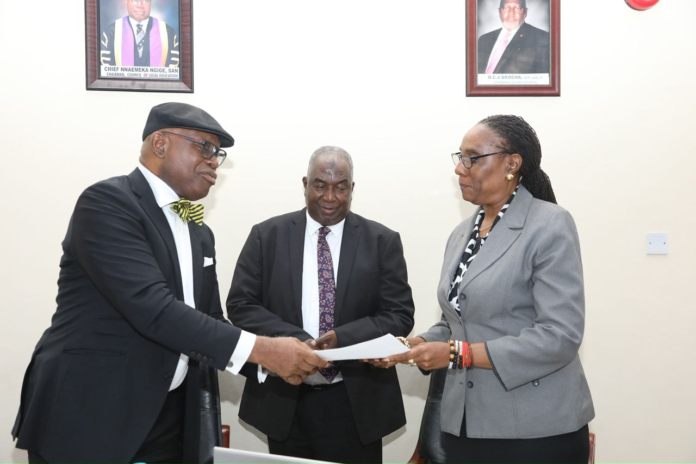
The leadership of the Nigerian Bar Association Section on Public Interest and Development Law (NBA-SPIDEL) 2025 Annual as Conference Planning Committee (CPC) has released the Official Programme for the conference, two days ahead of the Opening Ceremony.

Meanwhile, the CPC on Sunday unveiled the conference bag at a joint meeting of the CPC and the Local Organising Committee (LOC).

The exquisitely designed, 50-page conference programme contains a potpourri of crucial information that a delegate needs to know about the conference.

Aside from details on the eagerly awaited Opening Ceremony which holds on Tuesday at IBOM Hotel & Golf Resort, the programme has a comprehensive list of all the scheduled technical sessions and speakers.

It also contains a list of fun side events such as the Attorney-General’s Welcome Cocktail, Chief Assam Assam SAN “Justice Bash,” and a visit to Uyo Custodial Centre, to name a few.

Meanwhile, Agomoh has handed over the first-ever 2025 SPIDEL Annual Conference bag to the LOC Chair, Chief Godwill Umoh.

The handover took place at Ibom Hotel & Golf Resort during a joint strategic meeting of the CPC and LOC to put finishing touches to the forthcoming conference.

Agomoh assured that delegates would not have any difficulties collecting their conference materials, adding that the Registration Team is set to commence onsite Registration tomorrow at the NBA Uyo Branch Bar Centre.

The same venue will host the Attorney-General’s Welcome Cocktails today, Monday, 1 December 2025, at 6 pm, while the Opening Ceremony will be held on Tuesday, 2 December 2025, at 9 am.

Click here to download the programme of events.

NBA-SPIDEL-PROGRAMME-

Tinubu has a police palaver

By Chidi Anselm Odinkalu

When Olusegun Obasanjo returned as the president of Nigeria in May 1999, according to Mohammed Dikko (MD) Yusuf, a former Inspector-General of Police, (IGP) he “inherited a Police Force that was poorly equipped, decimated in numerical strength, deprived of necessary logistics, and lacking, as it were, moral and public support necessary for effective performance and the enhancement of the security of the nation.”

Former IGP, MD Yusuf said these in the report he submitted in 2008 to President Umaru Musa Yar’Adua as the Chair of the second Presidential Commission on Police Reform to report in as many years. Headed by former Deputy Inspector-General of Police (DIG), Muhammadu Danmadami, the first submitted its report in May 2006 to President Yar’Adua’s predecessor and benefactor, President Olusegun Obasanjo. In August 2012, another retired DIG, Parry Osayande, reported to President Goodluck Jonathan as the chair a third Presidential Commission on Police Reform to report in the six years between 2006-2012. The ritual of these reports achieved one thing: they crystallised a diagnosis of the problems of the Nigeria Police Force (NPF) and they are many.

When President Obasanjo returned to power as a civilian 1999 after 15 unbroken years of military rule, there were an estimated 137,000 personnel in the NPF, representing a police-to-population ratio of approximately 1:876.5. The UN Office for Drugs and Crime (UNODC) recommends a ratio of 222 per 100,000 or 1:450.

To address what he believed was a serious shortfall in police personnel, President Obasanjo directed the recruitment of 200,000 additional police personnel over five years from 2000 to 2004 at the rate of 40,000 recruits every year. By 2003, the police population was estimated to be 260,000 and by 2005, Human Rights Watch estimated that Nigeria had 325,000 police personnel.

President Obasanjo deserves credit for identifying the situation with the NPF as a priority and giving attention proactively to the need to fix it. In a mere five years straddling his two presidential terms, he had managed to completely redress the deficit of police-to-population ratio in the country. In 2007, the NPF claimed reported that it had achieved a police-to-population ratio of approximately 1:400, based on an estimated force strength of about 360,000 police officers. At the beginning of President Yar’Adua’s tenure in 2008, this had climbed modestly to 370,900.

But this came at a cost. At the time, all the training institutions in the NPF could only accommodate an intake of 14,000 per year. With no additional investments to upgrade police training institutions, it meant that standards of training, doctrine and orientation had to be sacrificed in the expedited recruitment. When he reported in 2008, MD Yusuf pointed out three consequences that have come to haunt the Force since then.

First, the expedited recruitment was “carried out in a very unwholesome manner without adherence to the established rules and guidelines governing the screening and recruitment of candidates”, which led to an influx of “suspected criminals, people with physical deformities, doubtful background, over-aged and educationally unqualified barely literate entrants into the Police Force.” This “grossly compromised standards and resulted in widespread abuse of established procedure”, resulting in “the enlistment of unsuitable candidates…. many of whose suitability to wear the respected uniform of the Force is in doubt.”

Second, it transpired that many politicians had used the opportunity to insinuate elements from their private networks of violence into the force for future political gain. As a result, the expedited recruitment created an internal market in the outsourcing of police assets. In its 2008 report, the MD Yusuf Presidential Commission on Police Reform estimated that 27% percent of police personnel were engaged in personal guard and protective duties for private individuals and VIPs, thereby creating a situation in which “the rich and powerful behave with impunity because of police protection.” When it reported in 2012, the Parry Osayande Presidential Commission on Police Reform put this proportion at over one-third.

Third, the Force was chronically underfunded to the extent that, as IGP Ibrahim Kpotun Idris pointed out in 2017, “budgetary allocations on paper [were] insufficient to meet the financial needs of the Force, [and] the actual releases are far below what is budgeted.” As a result, the outsourcing of police personnel for guard duties became a subsistence and wellbeing supplement for the officers so deployed and a source of revenue for the commanding officers deploying them, who were often privately rewarded for doing so but also got through that to secure the patronage of their rich and politically connected benefactors.

This is the structure that President Bola Ahmed Tinubu did not appear to have taken account of in designing his recent directive to the Inspector-General of Police to withdraw “police officers guarding VIPs for core police duties.” Four days after this directive, on 27 November, the IGP proudly announced that 11,566 of officers and men under his command had been ordered withdrawn in compliance with the directive. He cleverly failed to say how many had complied. Olusegun Adeniyi, who served as presidential spokesperson when MD Yusuf submitted his report in 2008, warned firmly that the police officers “may not obey” the president or their Inspector-General.

In his directive, President Tinubu had, somewhat naively, added that “VIPs who want police protection will now request well-armed personnel from the Nigeria Security and Civil Defence Corps.” The result will be that officer of the NSCDC across the board will now make more money at the expense of the police personnel whom they will be replacing.

A presidential directive cannot fix this political economy of policing in Nigeria. That requires imaginative and committed commitment of time and leadership. Police personnel depend on the crumbs from the table of VIP benefactors for survival and subsistence. With no functional police training facilities, Many of them have been denied exposure to basic training, formation, and professionalism. They are unlikely to see their uniforms as evidence of a bond to get killed in a gun-fight with Ansaru, Boko Haram, Mahmuda, or any of the number of nihilist groups that now afflict the country.

For many police officers, desertion will be a better alternative than compliance with the order. There will be no capacity to replace the number of officers who could choose to do that. For the leadership of the Force, therefore, discretion is likely to be the better part of valour. Moreover, the Force itself relies on the market that it has created in the commercialization of its human assets for significant informal funding.

For President Tinubu, this is evidence of a failure that he must own. It is not as if the crisis of insecurity in Nigeria is one that he was unaware of before he assumed office. On the contrary, he had weighed in on the matter repeatedly both as an opposition leader and as a senior member of the ruling APC before 2023. Yet, since assuming office over 30 months ago, he has failed to identify the issue as a priority or to address it with the forcefulness and imagination required. Many now believe that he is issuing incomprehensible and untheorized directives under pressure from the fulminations of a foreign leader.

The presidency is not one job. It is many jobs in one. Some of those roles are delegable. But the job of Commander-In-Chief is not. As president, Bola Ahmed Tinubu has excelled in the delegable dimensions of the office. But he has been mostly missing in action in relation to the non-delegable aspects of the presidency. In his most recent directives, he has been found out. It is well possible that his presidency will come to be defined by how he re-tools. That could begin with finding his way to coherence on the issue of police reform.

A lawyer and a teacher, Odinkalu can be reached at [email protected]

The views expressed by contributors are strictly personal and not of Law & Society Magazine.
AWLA NIG, FIDA leaders highlight rising threats to women’s rights at landmark conference

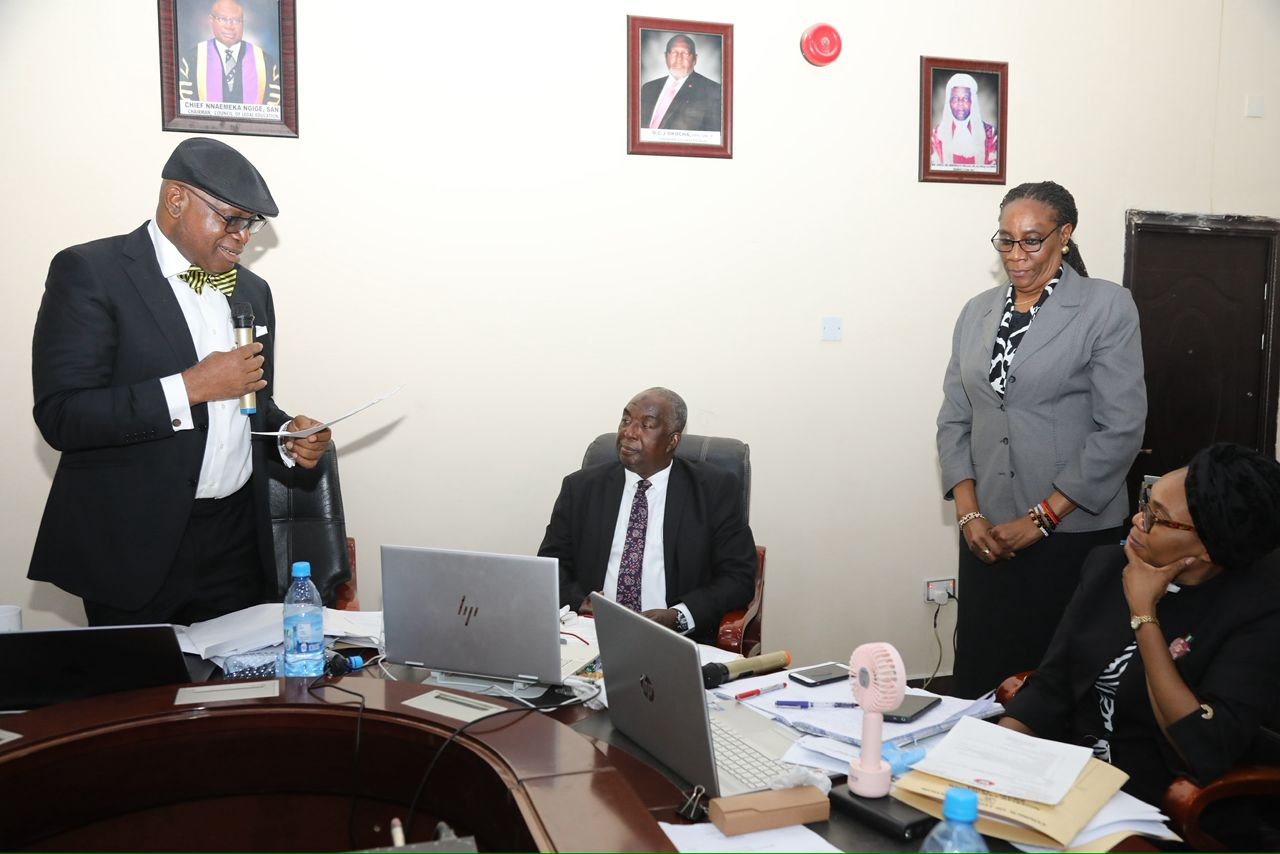
The President of the African Women Lawyers Association (AWLA Nigeria), Caroline Ibharuneafe, and Immediate Past National General Secretary, Bibian Aloba, joined a historic gathering of female legal minds at the opening ceremony of the International Federation of Women Lawyers (FIDA) Nigeria Annual General Conference, which took place in Lagos, Nigeria.

The four-day event, described by organisers as one of the most consequential assemblies of women lawyers in recent years, convened delegates from all 46 FIDA branches nationwide.

The conference, themed “Bridging Gaps, Building Futures: Women’s Rights, Justice and Sustainable Development in Nigeria,” marks another milestone for an organisation that has been at the forefront of protecting women and children’s rights since its founding in 1964 by the late Ambassador Aduke Alakija.

In her goodwill message, AWLA Nigeria President Caroline Ibharuneafe commended FIDA for its “unwavering commitment to justice” and urged deeper collaboration between women-led legal organisations.

“At a time when Nigerian women face mounting threats—from digital harassment to systemic discrimination—our unity is our greatest strength,” Ibharuneafe said. “Women lawyers are not just advocates; we are builders of a fairer future.”

A gathering rooted in history and urgency

The opening ceremony was led by FIDA Nigeria’s Country Vice President, Eliana Martins, alongside senior officers, including the Deputy Country Vice President, National Secretary, Assistant National Secretary Nnena Ibokwe, National Treasurer Beatrice Awa, and Financial Secretary Philomena Nneji. Delegates from Abuja, Lagos, Epe, Ikorodu, and other branches stood together as the hall resonated with the National Anthem, the FIDA Anthem, and the Women’s Anthem—a symbolic display of solidarity and purpose.

But alongside the ceremony’s celebratory moments was a stark reminder of the challenges facing Nigerian women. Day One opened with a sobering presentation on the rising tide of violence against women, revealing that over 2,700 cases were handled in the past year alone. These spanned domestic abuse, harmful traditional practices, sexual assault, and an alarming surge in online harassment targeting young women and girls.

Delegates described the figures as “troubling but unsurprising,” pointing to the urgent need for legal reforms, social protections, and coordinated multi-institutional action.

Women Lawyers Demand Justice and Reform

Throughout the morning sessions, speakers emphasised the central role of women lawyers in shaping Nigeria’s future, particularly in ensuring justice systems respond effectively and fairly to victims of abuse. Discussions also highlighted the crucial connection between gender equality, economic empowerment, and sustainable national development.

AWLA Nigeria President Ibharuneafe stressed that collaboration among women’s organisations is no longer optional. “If we are to bridge the gaps that hold Nigerian women back, our organisations must work not in parallel, but in partnership,” she said.

FIDA, now six decades into its mission, the charge remains steadfast: protect the defenceless, champion justice, and ensure that Nigeria’s women and children are never left behind.

TIPS