Home Blog Page 148

U.S. targets anti-Christian violence with new visa restrictions as Nigerian Senator alleges ‘external control’ of presidency

The United States has announced sweeping visa restrictions targeting individuals linked to violent attacks on Christians in Nigeria and across the globe, marking one of Washington’s strongest actions yet on international religious persecution.

In a statement released Wednesday, Secretary of State Marco Rubio said the new policy—authorized under Section 212(a)(3)(C) of the Immigration and Nationality Act—will bar entry to anyone who has “directed, authorized, significantly supported, participated in, or carried out violations of religious freedom,” including, where appropriate, their immediate family members.

The move follows years of escalating assaults on Christian communities in parts of Nigeria, attributed to extremist groups, armed militias, and other violent actors. Rubio said the U.S. “cannot stand by while such atrocities are happening in Nigeria and numerous other countries,” echoing remarks previously issued by President Donald Trump.

The policy is expected to apply not only to individuals in Nigeria but also to foreign government officials and non-state actors complicit in religious persecution worldwide.

Shockwaves in Abuja: Senator Claims Presidency ‘Run From Outside the Villa’

The U.S. announcement coincided with a political firestorm in Nigeria, where Senator Abdulaziz Yari of Zamfara West made explosive claims about the inner workings of the Nigerian presidency.

Speaking at the One Nigeria Project Conference in Abuja on Wednesday, the former governor alleged that President Bola Tinubu is “caged” within the Presidential Villa and that key decisions are being made “from outside” the seat of government.

“Those close to the Presidency know that the Presidency is being run from outside the Villa more than inside,” Yari said. “We already have the President caged there… we do the operations.”

Yari framed his comments as a call for unity and internal reform, insisting that Nigerians, not the United States, must confront the country’s political and security crises.

“Don’t call Trump,” he told the audience. “The problem of Nigeria can be solved by Nigerians.”

He argued that Nigeria’s survival through past political turmoil—referencing the 1993 June 12 crisis—shows that the nation remains “God’s own country,” capable of weathering internal conflicts and rebuilding institutions.

Yari also criticised the nation’s political elite, accusing them of misrepresenting President Tinubu’s situation and failing to take responsibility for Nigeria’s challenges.

“You have people abusing Tinubu because you know the problem more than the truth,” he said.

A Convergence of Pressure

The overlapping narratives, that is, Washington’s crackdown on religious persecution and Yari’s claims of political dysfunction, underscore the deepening tensions facing Africa’s largest democracy.

With U.S. scrutiny intensifying and domestic criticism mounting, the Tinubu administration enters a period of heightened pressure both from abroad and at home.

NBA-SPIDEL constitutes development law committee

The Nigerian Bar Association Section on Public Interest and Development Law (NBA-SPIDEL) has set up a Development Law Committee to drive the ‘development’ component of its mandate.

According to a statement signed by Prof. Paul Ananaba SAN and Mr Okey Ohagba, Chairman and Secretary respectively of the NBA-SPIDEL Interim Management Committee, the Committee is to be chaired by Bar Leader, Mr Andrew Odum SAN.

Below is the full text of the press statement.

CONSTITUTION OF THE DEVELOPMENT LAW COMMITTEE OF NBA-SPIDEL.

Recall that at the NBA-SPIDEL AGM of 28th August, 2025, at Enugu, the AGM approved the constitution of the NBA-SPIDEL Development Law Committee headed by Mr Andrew Odum. SAN and Yakubu Bawa as Secretary. The membership of the committee is hereby fully constituted as follows, to wit;

We urge all stakeholders and colleagues to accord them maximum support to deliver excellence on the assignment.

THE DEVELOPMENT LAW COMMITTEE OF THE NBA-SPIDEL

1. ANDREW OSEMEDUA ODUM SAN — CHAIRMAN

2. YAKUBU BAWA –  SECRETARY

MEMBERS

3. PROF. OGUGUA V. C. IKPEZE

4. MRS. JOYCE ODUAH

4. EDEDEM ANI ESQ

5. DR. IKENNA UKAM

6. HAJIA SADIA B. SALEH

7. UTOMOBONG INYANG

8. SAMUEL ETUK

9. IDRIS ABOYOMI SHEHU

10. OTUNBA OLUMIDE OLAIYA

11. NWABUEZE ESEAGWU

12. NWADIMUYA PRECIOUS

13. FATIMA KERE-AHMED

14. FRANCIS NWAORAH

14. VICTOR NWAKASI

15. NKEM AGBOTI

16. RAYMOND ISITOR

17. EZEALA CHUKWUMA

18. PHILIP NJETENE

19. CHISOM KEJE

20. FRANCIS IBEKWE

21. MUSTAPHA IMAM

22. LAURETTA IKUKA

23. TERHEMBA GBASHIMA

24. SUNNY EMEYEVEN

25. EZEBU OGUGUA

26.  JOY ONUKWUE

27. MARTHA EGEONU-AKABO

28. DR. (MRS.) EJIRO KORE-OKITI.

29. DR SAM AMADI

30.DR OZIOMA IZUORA

31 DR NGOZI NWANGWA

32. DR EZE ONWUNMA.

33. DR SAM AMADI

34. PRINCESS FRANK-CHUKWUANI

35. MONDAY ADJIE

36. LIKKO – AL BASHIR LAWAL

37. LUCKY WOSU –

38. UMAR SANNI SAN

39. NONYEM DAMULA

40. NNENNA OJIAKO

41.  ESTHER CHIEMEKA

42. NKWACHI ONWUTUEBE-MAD

43. BENSON IWUAGWU

44. EJIKE EZENWA SAN.

45. DANIEL ASOMEJI

We urge all stakeholders and colleagues to accord them maximum support to deliver excellence on the assignment.

DATED THIS 1ST DAY OF DECEMBER, 2025

Chaos on the Streets: Akwa Ibom police nab masquerade as government imposes strict ban

The Police in Akwa Ibom State have arrested a man identified as David Effiong for allegedly causing a public disturbance while appearing in full masquerade regalia despite the state government’s ban.

Effiong was taken into custody on Tuesday after residents reported that a masquerader was causing a nuisance and allegedly destroying property within the community.

Police Commissioner, CP Baba Azare, confirmed the arrest, noting that Effiong would be arraigned once investigations were concluded.

Meanwhile, Akwa Ibom State Governor, Umo Eno, has signed an Executive Order banning masquerade displays on streets and major highways across the state.

‎The move, according to the governor, follows rising incidents of harassment, extortion and public disturbances linked to masquerade activities in several communities.

‎According to a statement made available to newsmen on Wednesday, Eno, who announced the proscription last week, reaffirmed the ban while signing the order at Government House, Uyo, on Tuesday.

‎He directed the Commissioner of Police and other security agencies to enforce full compliance.

‎”By my office as the Governor of Akwa Ibom State, I am issuing an order that anyone caught will be arrested and prosecuted. They have used it to cause havoc in some local governments.

‎”As the chief security officer of the State, I am directing the commissioner of police and other security agencies to arrest and prosecute masquerades. Let it stop terrorising people, and let people have peace,” Eno stated.

‎The governor stressed that while he respects the state’s cultural heritage, no tradition should cause harm or infringe on the rights of citizens.

He said, “All of us are living witnesses to the embarrassment and nuisance that this has caused. If you have driven along the highways, you would have seen how they operate. It could cause accidents, and sometimes it brings cars to an abrupt halt.

‎”Last two weeks, we had a scene where a young woman was literally stripped naked and flogged by these masquerades. Yes, it is culture, but everyone has a right. No culture should dominate the other or cause harm to others.”

Eno noted that a 2022 law already requires police clearance for such displays, adding that those who wish to celebrate masquerades must restrict the activity to village squares.

‎”So if you want to play masquerade, go to your village square and play it, but not on the streets of Akwa Ibom.

‎”Don’t use that to disrupt public peace and order. We don’t want to have trouble in our hands,” he stated.

‎The governor urged residents to familiarise themselves with the new order and warned against further disruption of public order under the guise of cultural expression.

‎He appealed to the public to support tourism-boosting initiatives that align with his administration’s ARISE Agenda, especially as the state anticipates a surge in visitors during the festive season.

‎”We have visitors coming as we are trying to make our State a tourist destination. Let’s not scare people. Don’t make them feel that chaos is tolerated. It is on the strength of that that we sign this to bring public peace and order,” he stated.

‎Speaking earlier, the Commissioner of Police, Baba Azare, commended the governor for the directive, describing it as timely and necessary.

‎According to him, the order gives security agencies clear authority to curb masquerade-related violence, intimidation and obstruction across the 31 local government areas.

‎He assured that enforcement has already commenced, with instructions issued to area commanders and tactical units to ensure full compliance statewide.

Credit: The Punch, excluding the altered headline.

A world for everyone, By Olufunke Baruwa

Today, the world observes the 2025 International Day of Persons with Disabilities (IDPD) with an ambitious theme: “Fostering disability-inclusive societies for advancing social progress.” It is a reminder that social progress is not measured by GDP growth alone; it is measured by how societies include, protect and unlock the potential of those most excluded. Inclusion is a prerequisite for genuine development, not charity.

This year’s theme also builds on the momentum generated at the Second World Summit for Social Development in Doha, where global leaders recommitted to building societies anchored in equity and human dignity. The summit reiterated an uncomfortable truth disability advocates have long highlighted: you cannot claim social progress if millions of persons with disabilities remain locked out of education, decent work, public services, and community life. The IDPD observance at the UN this year is therefore focused on turning commitments into concrete action.

For Nigeria, where at least 15% of the population lives with one form of disability, this theme lands at a critical moment. It confronts a governance question central to national development: Can our national budget create a world for everyone, or will it continue to reproduce barriers for millions?

Budget as a Real Test of Exclusion

Persons with disabilities remain disproportionately represented among the poor, the unemployed, and those without access to essential services. The barriers are structural: inaccessible schools and hospitals, transport systems not designed for diverse needs, employers reluctant to hire, and social protection systems that fail to reach those facing the highest costs of living.

These exclusions compound over a lifetime. A child unable to attend school becomes an adult locked out of work. A woman unable to access reproductive health or assistive devices faces poor health and reduced autonomy. Families, especially women caregivers, bear hidden financial and emotional burdens. The result is not only a human rights crisis, but also a development and fiscal crisis. When millions cannot participate fully, nations lose productivity, talent, and economic dynamism.

Disability inclusion must sit at the heart of any credible social progress agenda. And for Nigeria, that inclusion must begin in the national budget. Budgets are moral documents. They reveal our priorities more honestly than speeches or policies when we put our money where our mouth is.

A disability-inclusive national budget allocates adequate and predictable funds for accessibility, assistive devices, inclusive education, rehabilitation, healthcare, and public infrastructure. Two, it mainstreams disability across all ministries, rather than confining responsibility to the National Commission for Persons with Disabilities (NCPWD). Three, it ensures participation, giving persons with disabilities and their representative organisations a meaningful role in planning, implementation, and monitoring. Four, it establishes transparency and accountability, so funds reach communities rather than being absorbed by bureaucracy.

Nigeria has made some progress with the NCPWD and Disability Act. However, the Commission’s allocations have remained far below what is required and its mandate, and most ministries still treat accessibility as an optional “add-on” rather than a standard requirement. Meanwhile, disability-specific programmes rely heavily on donor funding, making them vulnerable to discontinuity.

What “Disability-Inclusive” Should Mean in Practice

To build disability-inclusive societies, countries must move beyond rhetoric to systems change.

Laws without implementation plans, budgets, and enforcement mechanisms are hollow. Nigeria must fully implement the Disability Act, enforce accessibility regulations, and integrate disability targets into national development plans with dedicated financing lines.

Accessibility must become a standard feature of all public buildings, transportation, digital platforms, and public information. Ramps, braille, tactile paving, audio announcements, sign-language interpretation, accessible websites, and easy-read formats should be routine, not exceptional. Designing for everyone increases participation and reduces long-term costs.

Schools must be transformed into inclusive spaces equipped with trained teachers, accessible materials, assistive technologies, and flexible curricula. Inclusive education is not a niche concern; it is the foundation for future access to work and civic life.

Work is central to dignity and independence. Government and employers should establish inclusive recruitment pathways, offer reasonable accommodations, and support vocational training. Public procurement can prioritise businesses led by persons with disabilities. These are not favours, they unlock economic value.

Without accurate data disaggregated by disability type, gender, age, and geography, policymakers are navigating blindly. Equally, disability-inclusive budgeting must become standard practice across federal, state, and local levels. Persons with disabilities must meaningfully shape budget decisions that affect their lives.

Reframing disability inclusion as a public good is crucial. Inclusive societies are more resilient, more productive, and more cohesive. They draw on diverse abilities, increase labour force participation, reduce poverty, and strengthen communities. Inclusion is therefore not only a rights-based obligation but also good governance and smart economics.

Technology can be transformative, from screen readers to accessible learning platforms, telehealth, communication devices, and AI-powered assistive solutions. But technology can also widen exclusion if digital systems are designed without diverse users in mind.

Government and the private sector must ensure digital accessibility standards for all platforms, support for local innovators building assistive technology, affordable devices and repair networks, and training for users and service providers. Assistive technology is only useful when it is usable, repairable, and sustainably financed.

Businesses are not optional partners; they are essential actors. Inclusive recruitment, accessible workplaces, and disability-conscious product design open new markets and unleash talent. Persons with disabilities are consumers, entrepreneurs, and innovators. Through procurement, mentorship programmes, job redesign, flexible schedules, and workplace accommodations, the corporate sector can drive national change at scale.

Organisations like the Joint National Association of Persons with Disabilities (JONAPWD), disability rights NGOs and community leaders play a vital role in translating policy into practice. They can provide expertise, advocate for accountability, and co-design programmes that reflect lived realities. Governments must support them with core funding and meaningful seats at decision-making tables.

Beyond Budgets: Shifting Culture and Expectations

As the world marks IDPD 2025, Nigeria can take some immediate steps by issuing enforceable accessibility directives for public buildings, transport services, and digital platforms; create a Disability Budgeting Framework with ring-fenced baseline funding and mainstream disability funding across all ministries including education, health, labour, transport, housing, and ICT.

Government can also launch inclusive public employment programmes with support for employers; fund a national assistive technology strategy focused on local manufacturing and affordable distribution; require accessibility and inclusion clauses in major public procurement contracts; provide core funding for disability-rights NGOs and include them in monitoring and evaluation committees; strengthen disability data systems under the National Bureau of Statistics and use conditional federal grants to encourage states to implement accessible infrastructure and inclusive schools.

These steps are realistic, achievable, and aligned with Nigeria’s development priorities.

Even the best policies can be undermined by stigma. Cultural attitudes remain one of the greatest obstacles to inclusion. Media houses, faith institutions, schools, and community leaders must help shift public perception by highlighting leadership, achievement, and agency among persons with disabilities. Representation in politics, business, media and academia changes expectations and opens pathways.

If the Doha Summit and the UN’s 2025 IDPD theme teach us anything, it is that social progress will not be sustainable unless inclusion is central. National and subnational budgets must be designed to reflect the needs and rights of all Nigerians.

This IDPD should be the moment Nigeria matches rhetoric with resources, turns policy into practice, and builds a world where everyone truly belongs. Social progress that leaves millions behind is not progress at all. A world for everyone is possible, but only if we finance it deliberately, transparently, and with dignity at its core.

Olufunke Baruwa is an international development expert. She is a weekly columnist and writes at the intersection of gender, public policy and governance.

Ms. Winners’ curse and other stories, By Funke Egbemode

In a village long ago, there was a hunter who could kill any game with ease. Yet, whenever he succeeded, forest spirits were always there to whisper to him: “This win is heavy, but it comes with a shadow, a prize.” Hunter could have all the deers and duikers he wanted, but happiness seemed to elude him.

Just as the hunter’s prize carries a shadow, political victories in Nigeria bring their own curses: betrayals, irrational demands and rejections, compromised ideals, public expectations, personal sacrifices that take away private happiness. In public office, success grants power and prestige, but does it guarantee peace of mind and lasting fulfilment?

Anyway, today is not about politics of ambassadors, resignations and appointments and disappointments. It is about intimacy and intimate affairs.

Winners take all but every win carries a weight; and you must brace your neck to carry it. So it is with Ms. Winners. Her victories come at a cost; her prize is, indeed, a curse. In sports, the winner gets a trophy; in a beauty pageant, a crown; in politics, power.

Even Nobel laureates receive prizes. But for Ms. Winners, her prize comes with a sting— it is a curse.

She had her life all mapped out: graduate at 21, serve her nation, work for three years, then marry, ideally with three children by 30. Things started well. She graduated at 21, completed her NYSC, and landed a better job than she imagined. But her carefully plotted timeline derailed. Her three-year boyfriend impregnated a 19-year-old from a wealthy family studying abroad. Family loyalties, ambitions, and church politics intervened, leaving her heartbroken. Her dreams of early marriage and children were suddenly on hold.

Life moved on. By 28, she had an MBA and was climbing the career ladder, admired by peers for her brilliance and work ethic. She drove a car, earned more than she needed, and lived well. Yet her love life remained a desert. Men were drawn to her beauty and success, but rarely for the reasons she wanted. Many wanted her as a trophy, not a partner. Exhausted by disappointments, she took a year off from dating to reflect: Had she set her standards too high? Was her career intimidating? Was she looking for a man who did not exist? By 35, she was rich, still single, and still searching.

This is the Winner’s Curse—a place where success challenges self-esteem and tests faith.

It is harder when siblings are married, children running around, family gatherings filled with compliments, yet no eligible man notices her worth. Many women like Ms. Winners work long hours, run businesses, hold public office, earn well, live comfortably, and treat others with respect. Yet, when it comes to marriage, life seems unfair.

Why does this happen? Do men prefer less ambitious or less successful partners? Or is it society that quietly penalises women who achieve too much? Success comes through hard work, timing, and divine blessing. Should women reject these blessings because love has been elusive?

Should they turn down promotions, forgo degrees, or limit their lifestyle while waiting for a partner? Surely, even wealth and beauty should not be deterrents—yet, they often are.

Ms. Winners faces a paradox: the better she does, the lonelier she becomes. The men who remain are either taken, insincere, or ill-suited. Young gigolos seek temporary gain; older married men look for fleeting thrills. Sometimes a relationship works; often it doesn’t. Her victories — the car, the career, the accolades — become her albatross.

The Winner’s Curse is real. Hard work, beauty, wealth — these should bring freedom and joy, yet for many women, they bring loneliness. So, we might sum up Ms. Winners’ lot this way: she wins, she shines, she succeeds — but she is alone.

The views expressed by contributors are strictly personal and not of Law & Society Magazine.

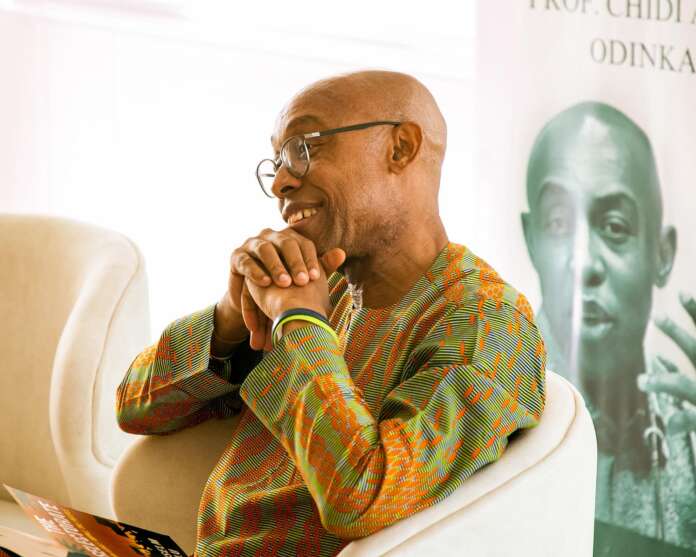
NBA-SPIDEL Conference 2025: “Atrocity, Impunity and a Fraying State: Odinkalu challenges Lawyers to lead reform

Nigeria is drifting into a prolonged crisis marked by mass violence, institutional weakness and collapsing public trust, and the country’s legal community must help pull it back from the brink, law teacher and rights advocate Prof. Chidi Anselm Odinkalu warned in a keynote address on Tuesday at the Nigerian Bar Association’s Section on Public Interest and Development Law (NBA-SPIDEL) conference in Uyo.

Speaking under the theme “A Banner Without Stain: Justice, Accountability, Development,” Odinkalu delivered a stark assessment of Nigeria’s trajectory, describing a country “at war or in a very active state of non-international armed conflict” and struggling to provide basic security to its citizens. The former chairman of Nigeria’s National Human Rights Commission argued that the country’s current condition demands urgent intervention—especially from the legal profession, which he said carries civic obligations embedded in its very existence.

“Civilian government is now in its 26th year, the longest unbroken stretch in our history,” he said. “Yet citizens are entitled to ask whom this longevity has actually rewarded beyond politicians themselves.”

A Country Counting Its Dead

Citing data from Nigeria Mourns, a coalition tracking nationwide violence, Odinkalu said 4,410 people were killed and 1,011 abducted between January and June 2025. Among the dead were at least 189 security personnel. The figures, he argued, resemble those of a country in an undeclared civil conflict.

He noted that October alone saw the killing of a Nigerian Army general and several soldiers in Borno State, along with separate attacks that forced school closures across several states. More than 339 students and teachers were abducted from schools in Kebbi and Niger States within weeks. The result, he said, is a spreading climate of fear in which education itself is becoming untenable.

“These are not abstract statistics,” Odinkalu told the packed hall. “They represent our neighbours, our colleagues, our fellow citizens.” He urged conference attendees to pause in silence to honour victims nationwide.

‘Crippling and Chronic’ Violence

The escalating insecurity, Odinkalu argued, exposes “levels of governmental incapacity reminiscent of Weimar Germany,” with non-state armed groups contesting the state’s authority to impose law, ensure safety, or even collect taxes. He noted that nearly half of the federal unity schools have been shut due to inability to guarantee student safety.

The trend, he said, is a direct attack “on enlightenment in Nigeria” and shows how extremist violence is undermining national identity.

A Dysfunctional State Revisited

Odinkalu traced the roots of the crisis to long-standing structural issues. He recalled that political scientist Peter Lewis described Nigeria as a “dysfunctional state” in 2006—an assessment Odinkalu believes has since hardened rather than diminished.

“In governance, elections, the economy, security, institutions, and civic ethics, the sense is clear that the country is not doing well,” he said. Nigeria’s extractive economic structure, he added, continues to privilege rent-seeking, producing a political culture in which “the wrong way of doing things” faces few consequences.

Odinkalu also invoked the 1975 Supreme Court case of Rauph Gaji v. State, a landmark criminal decision involving individuals from different Nigerian regions, to argue that the country once had stronger cross-regional cohesion. “What are the chances of a similar case being prosecuted at all in today’s Nigeria?” he asked.

Origins of SPIDEL and a Call to Action

Odinkalu recounted the founding of SPIDEL in 2008 under the administration of former NBA president Olisa Agbakoba. At the time, Nigeria was emerging from the widely criticised 2007 elections, and SPIDEL was envisioned as the NBA’s mechanism to address national issues beyond internal professional matters.

Seventeen years later, he said, the need for such engagement has only intensified. The country now faces a “triple crisis” of state fragility and legitimacy, institutional incapacity and multi-dimensional impunity—exactly the themes underpinning the current conference.

He argued that the legal profession must help rebuild the “shared ownership” required to give meaning to Nigeria’s national banner. Without a common identity, he warned, “the banner is guaranteed to suffer stain” from competing ethnic and regional interests.

Failure of Institutions and Elections

A significant portion of Odinkalu’s address focused on Nigeria’s justice system. He argued that the country’s democratic legitimacy is compromised by elections that are regularly disputed and decided in court. As a result, ordinary voters feel sidelined while the judiciary—increasingly accompanied by what he called “judicial consultants”—determines political outcomes.

The courts, he said, are burdened by delays, poor case management and declining public trust. He urged SPIDEL to pursue reforms aimed at improving judicial performance, including measuring and reporting how long cases take to move through the system. “It is no use going into court if you are stuck there until the day after eternity,” he said.

He also called for the revival of recommendations from the 2008 Mohammed Uwais Electoral Reform Panel, many of which originated from early SPIDEL advocacy and remain unimplemented.

Accountability for Atrocity Crimes

In the short term, Odinkalu urged Nigeria to confront the reality that it is engaged in multiple non-state armed conflicts. While politically sensitive, he argued that such recognition would allow authorities to apply the Geneva Conventions Act of 1960, enabling trials of insurgents under military law rather than the current “appeasement” approach.

“Appeasement will not end this reign of atrocities,” he said. “We must move toward genuine accountability.”

The Unfinished Work of Nationhood

Odinkalu situated Nigeria’s identity crisis in its colonial origins, highlighting the 1898 Selborne Committee Report and subsequent amalgamation of 1914 as the foundation of a political entity lacking organic unity. More than a century later, he said, Nigerians remain more committed to ethnic, regional or “indigene” identities than to national citizenship.

What results, he argued, is a zero-sum competition for federal appointments, security positions, university admissions and public funds. “The most endangered minorities in the country,” he said, “are those willing to identify themselves as Nigerians.”

Education, Legal Pedagogy and the Future of the Profession

Turning to the long term, Odinkalu called for major reforms to Nigerian legal education. He argued that law faculties still operate with inherited colonial frameworks that erase African legal traditions while failing to prepare students for a globalized profession influenced by the African Continental Free Trade Area (AfCFTA).

“The rank of Senior Advocate of Nigeria may one day fall into disuse,” he said, noting that global market forces and technology will reshape legal practice in ways Nigerian institutions must anticipate.

A Country Without Consequences

Odinkalu closed by warning that impunity threatens Nigeria’s very survival. Public officials respond to atrocities not with solutions but with silence, denial or “gaslighting,” he said, leaving citizens to negotiate their own safety. The NBA and SPIDEL, he argued, must lead by modelling reforms capable of slowing or reversing the country’s deterioration.

“Absent course correction,” he concluded, “the country on its present trajectory is not sustainable.”

Investigate Christians persecution in Nigeria, Trump to US Congress

The United States President Donald Trump has directed key lawmakers and the House Appropriations Committee to investigate the alleged persecution of Christians in Nigeria, prompting a joint congressional briefing scheduled for Tuesday.
Rep Moore confirmed the development in a post on his X (formerly Twitter) account on Tuesday.
Moore wrote, “President Trump asked me and @HouseAppropsGOP to investigate the persecution of Christians in Nigeria.

“As part of this investigation, the committee is hosting a roundtable to continue building on the work we’ve done so far.

“We will never turn a blind eye to our brothers and sisters in Christ who suffer for their faith.”
In a separate post on Monday night, the U.S. House Appropriations Committee also announced the president’s instruction, stating that several senior lawmakers would lead the inquiry.
The House Appropriations Committee said that on Tuesday (today), Rep Mario Diaz-Balart, who is the Chair of the National Security & Department of State, and member of the Defense subcommittee, alongside Robert Aderholt, who is the Chairman of House Appropriations Subcommittee on Labor, Health and Human Services, and Education, Rep Riley Moore, will lead a roundtable meeting on the matter.
The statement titled, ‘Appropriations Committee to Lead Joint Briefing on Persecution of Nigerian Christians and Threats to Religious Freedom’, read, “House Appropriations Committee Vice Chair and National Security Subcommittee Chairman Mario Diaz-Balart, joined by fellow Appropriators and members of the Foreign Affairs and Financial Services Committees, will convene a joint briefing with the U.S.
“Commission on International Religious Freedom and other experts to spotlight the escalating violence and targeted persecution of Christians in Nigeria.

“The roundtable will gather critical testimony to inform a comprehensive report directed by President Trump on the massacre of Nigerian Christians and the steps Congress can take to support the White House’s efforts to protect vulnerable faith communities worldwide.”
In October 2025, President Trump redesignated Nigeria as a “Country of Particular Concern” in response to alleged genocide against Christians in Nigeria.

“Christianity is facing an existential threat in Nigeria,” Trump posted to Truth Social. “Thousands of Christians are being killed. Radical Islamists are responsible for this mass slaughter. I am hereby making Nigeria a “COUNTRY OF PARTICULAR CONCERN” — But that is the least of it,” he posted.

Celebrating our ambassadors’ list

By Suyi Ayodele

About six months ago, I asked an elderly supporter of President Bola Ahmed Tinubu why his man had not appointed ambassadors almost two years into his administration. The politician asked me to relax. “Mr. President will shock all of you over that. You know he likes to have quality men around him.” I did not argue further.

True to the old man’s prediction, President Tinubu shocked the entire nation on November 29, 2025, when he sent the list of his would-be ambassadors to the National Assembly for approval. Immediately I saw the list, I put a call across to my old friend. He picked, and before I could say anything, the politician said, “I know why you are calling me, Suyi. Òrò p’èsì je (proposition kills response). We will talk later.”  We have not spoken since the telephone call!

When a man is accused of being light-fingered, the elders of my place caution that he should not be found in the dark playing with a kid (tí a bá pe ènìyàn l’ólè, kí ó mã fi omo ewúré s’eré l’ókùnkùn).

The saying speaks to the discretion of leaders and those in positions of authority. Only an insensitive leader, who is suspect among the led, ventures into the dark corner to play with a kid. Only a leader who pays no attention to the opinion of his subjects about his activities will be that audacious! It is not every time a powerful man shows how strong he is.

The brazenness of President Bola Ahmed Tinubu is becoming sickening. His audacity is becoming worrisome! Those who are close to him should tell him these facts. They should tell the President, like our elders warn, that a man accused of gluttony should make conscious efforts to control his gastronomic tendencies. There is wisdom in that.

Tinubu is a ‘master strategist’, his fans don’t spare any opportunity to tell us that. But there is a huge attribute of the President that they fail to bring to the fore. Beyond his ‘strategies’ skewed as they come, the greatest hubris of President Tinubu is his insensitivity!

From the first action he took on the removal of oil subsidy, to the latest ambassadorial list of controversy he submitted to the National Assembly last week, Tinubu has shown that the feelings of the people don’t matter. This is crass insensitivity in its illiterate form!

Alexander Hamilton (January 11, 1755 – July 12, 1804) was the first Secretary of the Treasury of the United States, under President George Washington between 1789 and 1801. In 1791, Hamilton formed America’s political party, the Federalist Party.

He was a great political philosopher and an avant-garde. He had fears that the American Presidency might be occupied by the wrong person with the wrong attributes. Together with his fellow Federalists, he posited that the US electoral system must have some in-built self-cleansing devices that would ensure that no single umpire is subservient to the ruling party.

The aim, according to him, is to ensure that “the office of the president will seldom fall to the lot of any man who is not in an eminent degree endowed with the requisite qualifications.” The in-built mechanism, he added, would ensure that “men with talents for low intrigue, and little arts of popularity” would be eliminated from the exalted office of the US Presidency.  

Should that happen, Hamilton posited that “history will teach us that of those men who have overturned the liberties of republics, the great number have begun their career by playing an obsequious court to the people; commencing demagogues and ending tyrants.”  And to escape the impending danger, Hamilton and his party proposed the insertion of Article II into the American Constitution on the Electoral College.

The Federalist Paper, on page 68, states: “The immediate election should be made by men MOST CAPABLE OF ANALYZING (emphasis mine) the qualities adapted to the station, and acting under the circumstances favourable to deliberation, and to a JUDICIOUS combination of all the reasons and inducements which were proper to govern them.” (See How Democracies Die, pages 39-40, by Steven Levitsky and Daniel Ziblatt).

The two authors argued eloquently that Hamilton’s Electoral College system, which was initially designed to be the “original gatekeeper” of American democracy, failed because of some flaws in the design. They submitted that the rise of political parties in the 1800s greatly affected the system such that “parties, then became the stewards of American democracy”, adding that because parties select the presidential candidates, they “have the ability… and the responsibility to keep dangerous figures out of the White House.” (Pg 41)

The US has, to a greater extent, however, remained the world’s template of how to run a democracy. However, we may argue that in recent times, especially with the coming of Donald Trump’s presidency, God’s Own Country has also demonstrated that the frailties of individuals could also be a threat to the long-cherished principles of American democracy.

The saving grace for America is the institutionalised system it operates. When it mattered most, the institutionalised principles of an independent judiciary and an impartial electoral umpire ensured that, regardless of how bad the occupant of the Oval Office turned out to be, the American system prevailed. This is what builds the confidence an average American has in the system and, by extension, in the country.

For as far as our voices could reach, we have shouted for the entire world to hear that the Independent National Electoral Commission (INEC) under the leadership of the immediate past Chairman, Professor Mahmood Yakubu, would go down in history as the worst ever in Nigeria! Under Yakubu’s leadership, the only thing beyond the pale INEC did not do was to mount the rostrum to campaign for the ruling All Progressives Congress (APC).

While it is true that Yakubu’s predecessor, Professor Attahiru Jega, laid the foundation for a crooked INEC, Yakubu took the perfidy to an irredeemable and most sick-making level with his open biases in favour of the APC. The shamelessness exhibited by INEC under Yakubu reached its peak in the 2023 general election.

Nigerians were scandalised in no small measure that INEC officials, obviously working on the ‘orders from above’, uploaded the results for the Senate and the House of Representatives elections held on the same day and at the same time, on its results viewing platform. But when it was the turn of the presidential election, which also took place at the same time as the National Assembly elections, the platform failed, and Yakubu and his men had to do manual collation of the presidential election!

Of course, and as expected, the judiciary stepped in and stamped Yakubu’s perfidy by affirming the election of the incumbent President Tinubu to the embarrassment of logic, common sense and the obvious infractions on the part of INEC and the glaring violent violation of the provisions of the electoral laws on the position of the Federal Capital Territory (FCT).

As usual, Nigerians sought solace in their innate resilience and put the 2023 elections behind them. The ultimate hope was that when he finally bowed out of INEC, having served his constitutional two terms, Professor Yakubu would retire to his Bauchi home to nurse the self-inflicted moral injuries and live the rest of his life with the consciousness that he presided over the most undesirable umpire in any human contest! But that was a long wish for all men of good conscience and a sense of responsibility.

Tortoise, the cunning being, once, in an argument with his fellow animals, submitted that his wife, Yannibo, was the worst human being ever created. Alarmed at such a claim, especially when other interlocutors had pointed out that their wives were promiscuous, liars, thieves, and brawlers, etc, they asked Tortoise what made his wife the worst being among the legion of sins enumerated.

Tortoise, without shifting his gaze from the basket he was weaving, asked the other animals to thank God for giving them good wives. He said that if his wife had been any of the negative attributes mentioned, he would have rolled out the drums in her celebration. He added that Yannibo was simply shameless and “a woman without shame is capable of anything.” That submission ended the argument, as all the other animals admitted that when caught in any of the negative acts mentioned, their wives still exhibited a sense of shame.

How do we reconcile the unblushing inclusion of Professor Yakubu’s name in the ambassadorial list President Tinubu submitted to the National Assembly? How do we explain to the comity of sane nations of the world that the leader of the umpire we accused of bias is now a beneficiary of the largesse of the very man we all queried for his accession to the presidency? How would the international community rate us? How do we convince them that we are not the “disgraced country” President Trump called us?

The Indian author, Arjun Appadorai (1902-1990), writing under the sub-topic, Politics and Ethics, in his “The Substance of Politics”, says “Ethics… deals with the rightness and wrongness of a man’s conduct and ideas towards which man is working”, adding that among other things ethics “concerns itself” with: “what is the basis of moral obligation? What do we mean by right action? How do we distinguish a right action from a wrong one? (Pg 9)

He further posits, stating: “If, as Lord Acton said, the great question for politics is to discover not what governments prescribe, but what they ought to prescribe, the connecxion between ethics and Politics is clear, for on every political issue the question may be raised whether it is right or wrong” (pp. 9–10).

So, how right or wrong is Tinubu’s appointment of Professor Yakubu as an ambassador? What does the President intend to achieve? A compensation for ‘a job well done’ or just crass impunity because Tinubu knows that Nigerians are already devastated by the shenanigans in government circles?

And just as Appadorai adds, “…If we agree that what is morally wrong can never be politically right,” we are tempted to re-echo the Indian’s postulation that “Politics is conditioned by ethics.” (Pg10). It is the ethics, nay the morality, of an unbiased entity that INEC ought to represent, that Yakubu threw to the whirlwind when he held sway as the Chairman of the electoral body. By this recent appointment, Tinubu has just reinforced the belief that among thieves, there is indeed no honour!

It would have been more than enough if Nigerians woke up to contend with the inclusion of the most blathering characters in the ambassadorial list. We would have been satisfied that since fools also grow old; it is not totally out of place for the President to have added Reno Omokri to the list.

We would have overlooked the fact that Omokri, on December 5, 2022, during the #HarassTinubuOutofLondon protest held at Chatham House, the ambassadorial nominee, wrote on his X handle then That: “The #HarassTinubuOutofLondon Protest Against Drug Lord Tinubu at Chatham House was a resounding success! The British media were there, and Tinubu was projected to them for what he is, a KNOWN DRUG LORD! That is what will be remembered of his @ChathamHouse event!”

Nigerians, home and in the Diaspora, would not have minded that the same Omokri, who on December 23, 2022, posted that: “Electing a man like Tinubu, who obviously shows signs of either drug or old age induced dementia, will have a very negative effect on our economy. He will not be able to supervise his own government. At Federal Executive Council meetings, he would be shouting bulaba” but now sees a transformed Tinubu as “The President”, who “has taught me the meaning of forgiveness and has helped me better understand what patriotism entails. In short, Christlikeness is demonstrated in him. He is the right man, at the right time, for the right job, and deserves the right hand of fellowship from all Nigeria”, curiously made the list!

This is just as we would all have forgiven the Delta man, who once vowed that “it would never happen” that he should work with Tinubu because, like he stated: “…. I told the person, it cannot happen, I can’t do it. It is just against my principles. People can do that. It is not just in my DNA. I can’t do it. It’s not going to happen. It is never going to happen,” now jumping because a transmogrified Tinubu appointed him an ambassador.

At least, while the appointment lasts, the Presidential candidate of the Labour Party (LP) in the 2023 election, Peter Obi, for whom Omokri, in the last two years, has become his ‘familiar spirit’, would be able to drink water and put the cup down.

The same would have been our feeling for the Ile-Ife born politician and former Minister of Aviation, Femi Fani-Kayode, who once swore before the gods and the ancestors thus: “I will rather die than join APC”, predicting with the accuracy of Prophet Elijah that  “as long as Jesus lives, Tinubu won’t be president,” now hailing the same Tinubu for extending the milk of kindness to him in his new nomination as an ambassador!

But having Professor Yakubu as an ambassador, less than six months after he left the INEC job as Chairman, threw ethics to the dustbin of thoughtlessness and amounts to nothing but the carte blanche that has become the hallmark of the Tinubu presidency! It is bad enough that this administration has rendered Nigerians politically impotent. It is worse if the president flashes that on our faces at any given opportunity. This impunity stinks to high heaven!

Ambassadors are the best representatives of any nation to other nations. That is why nations select men and women of irreproachable stance to be their eyes, mouths and noses in foreign lands. I wonder which country Tinubu would eventually send Yakubu to. I want to know how all those international observers and bodies which rated the 2023 election as the worst electoral heist would relate with Ambassador Mahmood Yakubu! The elders of our land, among whom President Tinubu numbers, say, if the thief has no modicum of shame, his family member should ((tí ojú ò bá ti olè, ó ye kí ojú ti ará ilé è). President Tinubu should occupy his position among the wise. This is my very wish for him!

The views expressed by contributors are strictly personal and not of Law & Society Magazine.
Breaking!!! Defence Minister, Badaru Abubakar resigns, cites health grounds

The Minister of Defence, Alhaji Mohammed Badaru Abubakar, has resigned from the Federal Executive Council.

In a letter dated December 1, 2025, sent to President Bola Tinubu, Abubakar said he was quitting on health grounds.

Presidential spokesperson, Bayo Onanuga, in a statement issued on Monday night, said
President Tinubu has accepted the resignation and thanked Abubakar for his services to the nation.

The President, he stated, will likely inform the Senate of Badaru’s successor later this week.

The 63-year-old Badaru Abubakar was a two-term governor of Jigawa state from 2015 to 2023. He was appointed as a minister by President Tinubu on August 21, 2023.

His resignation comes amid President Tinubu’s declaration of a national security emergency, with plans to elaborate on its scope in due course.

“Ambassadorial list and the uneasy arithmetic of bias”

TRIBUNE EDITORIAL

The newly released breakdown of ambassadorial nominees has reopened a debate this administration has never quite escaped: the question of balance, equity, and whether President Tinubu’s appointments reflect a commitment to national inclusion or an emerging pattern of bias.

The statistics circulating widely — including the graphic published by the Nigerian Tribune — tell their own story. Out of the total nominees:
• South-West: 11
• South-East: 6
• North-West: 5
• North-East: 5
• North-Central: 5
• South-South: 3

Even without partisan lenses, one number dominates the conversation: 11 nominees from the South-West, a figure almost double that of any other zone and nearly quadruple that of the South-South.

For many observers, this is not merely an imbalance; it is a reinforcement of an old grievance — that federal appointments have become increasingly tilted, feeding suspicion that personal, regional, or political loyalties are edging out the constitutional principle of federal character.

Critics argue that the distribution is particularly troubling because ambassadorial postings carry symbolic weight. Ambassadors do not represent states or regions; they represent Nigeria. For that reason, the public expects the selection process to model unity, not disparity. The appearance of over-concentration in one zone undermines that expectation.

The strongest reactions have come from the South-South, which received only three nominees. Leaders and commentators from the region note that this level of under-representation feels less like an oversight and more like a deliberate de-prioritisation — especially when compared with the South-West’s 11 slots.

Defenders of the administration counter that professional competence, experience, and geopolitical considerations — not raw numbers — drive ambassadorial choices. They insist that the list reflects the pool of qualified candidates and the diplomatic needs of the moment. But that argument has struggled to gain traction, largely because the government has not offered transparent selection criteria or provided any explanation for the sharp regional differences.

For a presidency already navigating public suspicion over earlier appointment patterns, silence is costly. In the absence of clarification, perception hardens into narrative — and the narrative gaining ground is that Tinubu’s government is drifting toward regional favouritism.

This is not a trivial matter. Nigeria’s unity requires more than speeches; it requires that every region sees itself in the architecture of power. Even if unintended, an appointment imbalance of this scale sends the wrong message at the wrong time, especially in a country where federal character was designed to prevent precisely this form of concentration.

The way forward is simple and achievable:
• The Presidency should publish clear criteria for ambassadorial nominations.
• It should address the noticeable disparities in the list.
• And it should commit to more balanced future appointments, matching competence with inclusion.

In a nation as diverse as ours, fairness is not optional — it is the currency of legitimacy. And where numbers raise questions, leadership must provide answers.

TIPS