Home Blog Page 1428

2019, human rights violations and Agba Jalingo

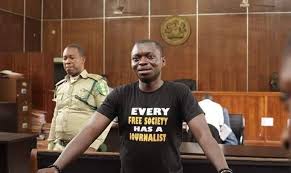
On August 30, 2019, a journalist and publisher of news website CrossRiverWatch, Agba Jalingo was arraigned in Cross River state for disturbance of public peace and treasonon account of his writing and social media posts about Cross River Governor, Prof. Benedict Ayade.

Jalingo could face up to three years in prison for the charge on disturbance charge and up to life in prison for treason. He was arrested in Lagos on August 22, 2019.

The arrest followed his news report alleging that the Cross River State governor diverted N500 million naira belonging to the state.

The charge on disturbance of public peace emanated from a July 12 CrossRiverWatch article which alleged corruption linking Ayade and the Cross River Micro Finance Bank. The treason charge equally alleged that Jalingo agitated for Ayade’s removal through “various malicious publications” on CrossRiverWatch and social media.
The said article contains an editorial note identifying Jalingo as the Cross River state chairman of the African Action Congress party, founded by Omoyele Sowore, owner of the Sahara Reporters news website. Police arrested Sowore on August 3 for allegedly planning protests throughout Nigeria.

On Christmas eve, Sowore was released on bail after months long imprisonment that heightened fears of deteriorating protections for free expression in Africa’s most populous nation.

Authorities also charged Jalingo on two counts for terrorism, stemming from his alleged plans to work with Sowore, “cult members,” and a local prince to “commit acts of terrorism” to unseat Ayade, according to the charge sheet.

Meanwhile the National Association of Nigerian Students amongst other voices have been calling for his release.

National Public Relations Officer of the association, Mr Adeyemi Azeez, in a statement said turning deaf ears to the plight of journalists is a dangerous trend and therefore urged those involved to do the needful to secure his release.

“On Friday, Oct 4, the journalist and rights activist, Agba Jalingo, filed a bail application but was refused by a Federal High Court. Although the court has autonomous powers on cases before it, this development further increased the widespread rumours that state powers are behind his travail.

“The activist has been kept in custody for over 119 days even when his case is yet to be ruled upon by a competent court.”

Igbo National Council a few days ago issued a 14-day ultimatum to Governor Ayade urging the release of the detained journalist.

The group’s president, Chilos Godsent, at a press conference in Owerri, the Imo State capital, warned that INC would storm Calabar, the Cross River capital in protest to demand for the resignation or impeachment of the governor if the detained journalist was not freed within 14 days effective January 1.

The PUNCH widely celebrated Editorial of December 11, 2019 titled, Buhari’s lawlessness: Our stand while criticising the regime of Major General Muhammadu Buhari (retd.) and its penchant for the disrespect of the rule of law had stated that “some governors have borrowed from this nefarious model, deploying security agents and perverting the law to punish critics and journalists.”

INC stated it would mobilise members of Civil Liberty Organizations and Human Rights Activists across the country to shut down the State if Ayade refuses to release Jalingo who had been in detention since August.

Sadly, the Nigeria Union of Journalists (NUJ), Cross River State Council disowned the embattled journalist.

The NUJ chairman in Cross River State, Victor Dan, reportedly said he is not a member of the union, apparently justifying why the union at the state level has been silent over the continuous incarceration of the journalist.

Jalingo’s trial was in November listed among 10 “most urgent” cases of threats to press freedom around the world. Amnesty International and several other organisations have been calling for his release from prison.

The implication of this silence by NUJ Cross River State Council is that the Council speaks only for its members and not the generality of the public even when the need to condemn rights abuses arise.

What then is the role of the press in the society? Who are the watchdogs?

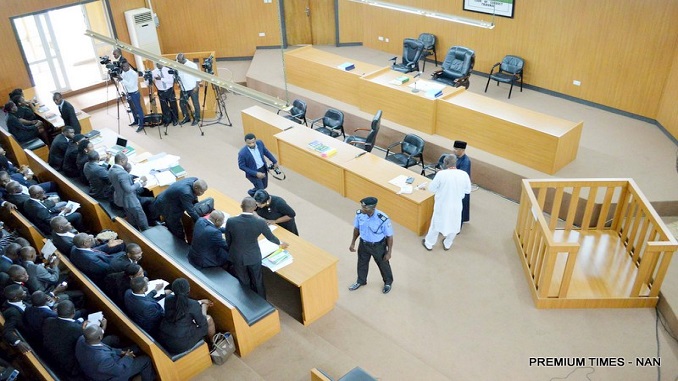
At the court appearance for his bail ruling, Agba Jalingo was brought in and taken away in handcuffs, by the prison officials. Outraged by that spectacle, many in the social and mass media have decried the treatment, denouncing same as immoral, since Agba Jalingo was thereby portrayed as a “common criminal”. They reason that being at worst a political offender or prisoner, he ought not to have been brought to court in such a humiliating circumstance, as if he were a violent criminal defendant, who is undergoing criminal prosecution.

Handcuffs and leg chains (manacles) are used in prison and correctional facilities, to restrain detainees and prisoners when they are held in custody or when they are in transit. Their use, as a form of restraint, must at all times be warranted. If a detainee or prisoner is violent, and his violent behaviour poses a grave danger not only to himself but also to prison officers or other co-prisoners or detainees, he may justifiably, for reason of safety, be restrained by handcuffs or manacles.
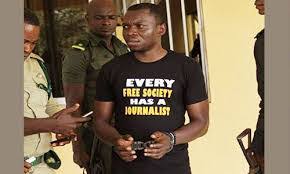
Jalingo in handcuffs

If a prisoner or detainee exhibits a jailbreak intent or actually attempts to escape from lawful custody, thus leading to a reasonable apprehension that he is likely to continue to search for opportunities to escape, he may, rightly, be restrained by handcuffs or leg chains.

Handcuffs and leg chains may also be used to restrain a prisoner or detainee who has attempted to commit suicide until such a time he may be cured of his suicide mindset. Fleeing, caught and injured armed robbery suspects may, subject to medical advice, and as may be permitted by their state of health, be chained to their recuperating beds, to prevent their escape, for example.

Handcuffs and leg chains are not meant to be used or misused as a tool of subjecting a detainee, a prisoner or a criminal defendant to inhuman and degrading treatment. It is not in law a means of subjecting a detainee or criminal defendant to humiliation, psychological torture or physical degradation. It is not and should not be used by the State and its law enforcement machinery or criminal justice system to criminalise political opponents, just to give political power wielders sadistic and narcissistic pleasure.

From available facts, the police, prosecution and prison authorities in Calabar have not told Nigerians that Agba Jalingo was violent; that since the day of his arrest and consequent incarceration, he has ever attempted to escape from lawful custody, attempted to commit suicide or endangered the life or safety of other co-detainers, prisoners and prison officers.

In the absence of any such information, the only reasonable conclusion we are compelled to reach is that the handcuffing of Agba Jalingo was calculated to humiliate and denigrate him, injure him psychologically, portray him as a common criminal and persecute him for his journalistic work, human rights campaigns, anti-corruption advocacy and political beliefs and activities. The law does not permit the State and its criminal justice system functionaries to do this to Agba Jalingo or any other Nigerian.

Section 5 of the Administration of Criminal Justice Act (ACJA) , 2015 provides as follows:

“ A suspect or defendant may not be handcuffed, bound or subjected to restraint except:

(a) There is a reasonable apprehension of violence or an attempt to escape;

(b) the restraint is considered necessary for the safety of the suspect or defendant; or

(c) by order of a court”

Section 271(2) (a) of ACJA provides that:

“The defendant to be tried on a charge or an information shall be:

(a) brought before the court unfettered unless the court sees cause otherwise to order; and the charge or information shall be read over and explained to him to the satisfaction of the Court by the registrar or other officer of the court”

For obvious reason and statutory construction logic, we submit that the word “may” in the opening of Section 5 should be interpreted as a “shall”, giving no room for discretion in the observance of the provision.

Section 5 of ACJA 2015 had no precursor in the repealed Criminal Procedure Code and Criminal Procedure Act, the two principal criminal procedure laws hitherto governing criminal prosecution and adjudication in Nigeria, before the advent of ACJA in 2015. Unlike Section 5, Section 271(2) (a) of ACJA had a precursor. It was a regurgitation of Section 215 of the Criminal Procedure Act and Section 161(1) & Section 187(1) of the Criminal Procedure Code, both laws now repealed and replaced by ACJA, 2015.

Section 5 was an innovation deliberately inserted in ACJA, 2015 by the lawgiver (the legislature) to curtail the brutality of the police and other law enforcement and security agencies when taking alleged criminal offenders through the criminal law enforcement and justice administration system.

The police had become very notorious not only in using handcuffs and leg manacles in restraining criminal suspects and detainees but also in misusing these restraints during investigation (or more appropriately torture) sessions to forcefully extract extra-judicial confessional statements from detainees. This use of handcuffs or leg chains as a torture enabler or enhancer was unlawful and obnoxious. Apart from the routine use of handcuffs and leg chains to restrain awaiting trial detainees while they were in transit, and when being taken to courts for their trials and back to prisons after their trial dates, to prevent imagined or anticipated escape, the State had started using it to humiliate certain “elite” or moneyed criminal defendants to send social or political message to the public.

In 2006, the former Inspector General of Police, Tafa Balogun, prosecuted by the FGN (EFCC) for fraud, money laundering and corrupt practices-related offences. He was brought to court in handcuffs, and when it appeared that he resisted being so brought for his image to be captured by the media and in the full glare of the public, he was forced out of the car and dragged on the floor and shoved into the courtroom.

Many Nigerians were outraged by that treatment, condemning the then Nuhu Ribadu-led EFCC for “its vindictive, highhanded and despicable media-craving and publicity-seeking showmanship”.

The very few that justified the handcuffing of IGP Tafa Balogun then did so on the ground that such treatment was standard practice in the criminal justice system of other common law jurisdictions, including those of the western democracies. Besides, they felt that such public disgrace and humiliation could serve as a potent dissuader to discourage public office holders from engaging in graft and corrupt practices.

Section 5 and Section 271(2) (a) of ACJA is the law on the treatment of suspects, criminal defendants and detainees when it comes to the use of handcuffs and leg manacles as a means of restraint. When read together with the provision of Section 34 (1)(a) of the Constitution of the Federal Republic of Nigeria, 1999, as amended, we have no hesitation in stating that the handcuffing of Agba Jalingo on October 4 while being brought to court and while being taken out of court was illegal, unlawful and unconstitutional.

 Section 34 (1)(a) of the Constitution provides that “every individual is entitled to respect for the dignity of his person, and accordingly-no person shall be subjected to torture or to inhuman or degrading treatment”.

Undoubtedly, Agba Jalingo was subjected to torture and inhuman and degrading treatment. His handcuffing was unwarranted, in the circumstances, and it was clearly calculated to break his “revolutionary” spirit as a “combatant” in the Revolution Now Movement.

On account of this apparent abuse of the law, a writer, Elias Ozikpu wrote an open letter to the Peoples Democratic Party (PDP) to which Ayade belong, entreating that justice be served.

“Part of the materials in the  course administered to  the Young African Leaders Initiative (YALI) made available by the US Department of State, titled: “Responsible Leadership on Transparency and Good Governance” had this to say on accountability and good governance:

“Good governance respects the rule of law and recognises that public office is a trust to be exercised in the public interest and not for personal or political gain.

“Trained, professional journalists are necessary to expose corruption and guard against the abuse of power. To do this, it is imperative that the press has access to government officials and the work they do.

“The workings of government must be shared with the public through objective actors who can report the news and provide honest analyses.

“A free and open press also means that journalists should not be censored, persecuted or subjected to unreasonably restrictive libel laws.”

“The arbitrary incarceration of citizens by Governor Ayade for merely expressing divergent opinions is unacceptable. Before the persecution of Agba Jalingo, Ayade had ordered for the arrest of Mr Paul Ifere who was driven by road from Abuja to Calabar where he was slammed with trumped-up charges of terrorism.

“Recently also, a lawyer, Joseph Odok, was arrested in Abuja and driven by road to Calabar for criticising Governor Benedict Ayade. Like Jalingo and Ifere, Odok has been charged with terrorism, all in a bid to strike fear in the hearts of Cross Riverians desirous to demand for accountability from a governor they voted into office.

“This is outright tyranny and a gross abuse of power, unprecedented in Cross River State.

“Whilst it is proper that your party, PDP, consistently calls out Major-General Buhari’s repressive regime for its consistent violation of human rights, you are without the moral competence to maintain sealed lips when a governor in your political party treads on the same path for which you lampoon the Buhari/APC regime.

“Dear PDP, it is an insult on our collective intelligence as Nigerians for your governor, Mr Ayade, to arrest every Cross Riverian, who criticises his anti-free speech regime and then invoke federal charges to create the false impression that his critics are being prosecuted by the Federal Government, when it is common knowledge that the governor is the executive complainant.

“Assuming without conceding that the Federal Government is behind the arrest of every Cross Riverian who criticises Ayade, why is it that they are always driven to Calabar, the Cross River State capital, as though there are no federal high courts in the different states of their arrests?

“For instance, Paul Ifere criticised Ayade, he was arrested in Abuja, chained and dumped in a truck and then moved to Calabar where terrorism charges were preferred against him.

“Agba Jalingo criticised Ayade, he too was arrested and moved from Lagos to Calabar and charged with terrorism.

“Joseph Odok criticised Ayade, he was arrested in Abuja and moved to Calabar and charged with terrorism.

“Are there no federal high court divisions in Lagos and Abuja? Why should Calabar be the ideal place to prosecute Ayade’s critics?

“Consequently, the PDP must prove by way of action that it is not a party to the ongoing fascistic reign in Cross River State by calling Governor Benedict Ayade to order. The Governor must as a result withdraw with immediate effect the trumped-up charges against Agba Jalingo and Joseph Odok who were denied the right to join their families for Christmas.

“Like I have stated on countless occasions, those who abhor scrutiny have no business in public office(s).

“Is it not a common African proverb that a forest that forbids baskets should never grow mushroom?

“Dear PDP, section 39(1) of the 1999 constitution, Article 19 of the Universal Declaration of Human Rights, and Article 9(2) of the African Charter on Human and People’s Rights all guarantee freedom of expression, including the right to hold opinions and to receive and impart ideas and information without interference. Has the PDP suspended these laws in Cross River State?

“Ayade, your governor, rode to power in 2015 on the strength of free speech, but soon afterwards he criminalised it and now jails every Cross Riverian who questions his policies and demands accountability.

“This is totally unacceptable in a 21st century democracy. The PDP cannot be preaching the sermon of freedom of expression and be found practicing the very antithesis of that which they preach about. Ayade’s high-handedness and anti-free speech regime reminds me of the words of Herbert Hoover, first president of the United States of America.

“Hear him: “It is a paradox that every dictator has climbed to power on the ladder of free speech. Immediately on attaining power each dictator has suppressed all free speech except his own.”

“We will not accept this degree of lawlessness and utter repression in PDP’s Cross River where anti-terrorism laws are being used to prosecute dissent. Before criticising General Buhari, the PDP must first purge itself of every trace of tyranny.

“Yours faithfully,

Elias Ozikpu

NB: Jalingo and Odok need to be freed, and they need to be freed now!”

Hopefully, someone is listening.

CAC Controversy: NBA President Condemns Azinge’s removal

… says ex parte order is questionable

As Nigerians continue to express outrage over the removal of Lady Azuka Azinge as acting Registrar-General of the Corporate Affairs Commission (CAC), President of the Nigerian Bar Association (NBA), Mr. Paul Usoro, SAN has condemned the removal describing it as an abnormality.

Usoro in his New Year speech remarked that the process leading to the recent removal of Azuka Azinge is an abnormality that does not portend good for the security of tenure of our public officers.

“Economic growth can only be attained in an atmosphere of predictability and certainty. This new practice of tripping and removing our public officers through contrived CCT ex-parte orders corrodes confidence in the system,” he warned.

The NBA President also called on the government to respect the rule of law while noting that it was reassuring that “Omoyele Sowore and Sambo Dasuki were finally released from confinement by the DSS, after being detained for prolonged periods against the orders of courts” in the dying days of 2019.

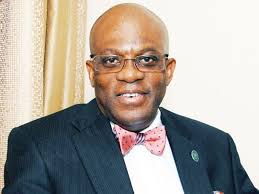
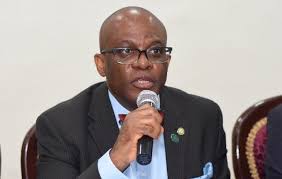
Paul Usoro, SAN

Part of his speech reads:

“2019 marked the year that removal of public officers through nebulous and reprehensible ex-parte orders of the Code of Conduct Tribunal (“CCT”) gradually became the norm in our national life. It started with the removal of erstwhile Chief Justice of Nigeria, Honorable Mr. Justice Walter Onnoghen, GCON through a purported CCT ex-parte order in the first quarter of 2019 and, towards the end of the year, this abnormality was repeated with the removal from office of the Acting Registrar-General of the Corporate Affairs Commission, Lady Azuka Azinge through a questionable ex-parte order.

“This is one “innovation” in our national life that does not bode well for the security of tenure of our public officers. Economic growth can only be attained in an atmosphere of predictability and certainty. This new practice of tripping and removing our public officers through contrived CCT ex-parte orders corrodes confidence in the system. It not only assaults our collective sensibilities when CCT exparte orders are used to ease out public officers but erodes due process, a fundamental plank of the Rule of Law. This is as disingenuous as the other unacceptable practice of tarring public officers to provide purported justification for their removal. That practice has been extended to private sector professionals including legal practitioners with potentially deleterious impact on wealth-creation capabilities.

“2019 was the year that our courtroom was invaded by officials of the Department of State Security (“DSS”) in an attempt to re-arrest a defendant who had been granted bail by the court and was released by the Department only the previous day. This was a horrifying assault on the Rule of Law and the sacred sanctum of our courts and judicial processes. It is somewhat reassuring that, in the dying days of 2019 and at the instance of the Honorable Attorney General of the Federation and Minister of Justice, Abubakar Malami, SAN, both Omoyele Sowore and Sambo Dasuki were finally released from confinement by the DSS, after being detained for prolonged periods against the orders of courts.

“It is our hope that, in 2020, we would build on this new resolve by Government and ensure that court orders are obeyed across board by our State officials and agencies.

“In 2019, our judicial officers and our courts continued to be disparaged, blackmailed and intimidated by State officials. Lawyers and the legal profession were not spared. Lawyers and retired judicial officers were prosecuted, hauled before law enforcement agencies and detained solely on account of their professional services to clients. Some lawyers were brutalized by law enforcement agents while carrying out their professional duties. Law was weaponized against lawyers and judicial officers and some of our judicial officers were kidnapped and assaulted by criminal elements, in an unabated assault on the Rule of Law and, in particular, the twin independence of the judiciary and the legal profession.

“These assaults not only erode the Rule of Law, they diminish us in the comity of nations and put our democracy and economic growth at risk. This endangers all of us in multiple ways. We demand that officials of State imbibe international best practices and join the NBA in protecting and promoting the Rule of Law through, amongst others, the preservation, fostering and protection of the independence of our judiciary, judicial officers and the independence of the legal profession.”

Also expressing concern over the speed at which the Federal Government replaced Lady Azinge, a legal practitioner O.G. Ogbom added his voice.

“I feel troubled, and I tremble whenever I read on social media how various security agencies and their minions spurn and treat the orders of certain courts with levity but recklessly or without delay, implements orders of Code of Conduct Tribunal that are in its favour, leaving the impression that since those other courts have neither the police nor guns nor the army to enforce whatever orders they make they could treat such orders with impunity.

“Recently, in his response to Femi Falana, SAN’s letter, the AGF, Malami, in his usual interpretation of our laws, has stated that the Executive arm enjoys certain rights, that these rights extend to rulings on bail and right to seek to vary terms of bail, among others, saying in any circumstance where this right is waived by the prosecution, it can only be for valid reasons, including compassion. The AGF did not state whether the right to appeal or to vary terms of bail automatically acts as a stay of execution or ‘stay of compassion.’

“Again, one wonders if the right to appeal which the FG interprets as a stay, is available only to the federal government or does not extend to the rulings or judgements of the Code of Conduct Tribunal?”

Ogbom further stated that: “Just recently, the Federal government in compliance with the exparte order of the code of conduct Tribunal, replaced the embattled Azuka Azinge with Saratu Shafii hours after the order was made without any recourse to her right of appeal as put forward by the AGF.

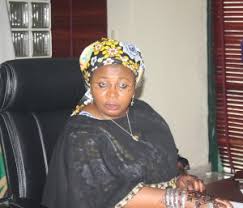
Lady Azuka Azinge

“The FG cannot continue to pick and choose, which favourable orders to obey or who to release on compassionate ground. It is troubling that the federal government invents all kind of reasons not based on any known law to justify a clear disdain for certain court orders.

“In GOVERNOR OF LAGOS STATE V. ODUMEGWU-OJUKWU (1986) 1 NWLR (Pt. 18) 621 at 633, the Supreme Court came down heavily, when Kayode Eso, JSC, stated unequivocally:

“I think it is a very serious matter for anyone to flout a positive order of Court ….. It is more serious when the act of flouting the order of Court, the contempt of Court, is by the Executive. …I think… for the Executive, which holds the physical powers, to put up itself in sabotage or deliberate contempt of the order is to stage an executive subversion of the Constitution it is to uphold.

“When we allow the very foundation of adjudication to be eroded with disdain then we should be ready to say goodbye to Rule of Law, Peace, and Orderliness and welcome to anarchy, and chaos, and the whole society suffers for it.

“The federal government should apply the same force it uses to enforce Code of Conduct Tribunal orders to other pending orders of court not in its favour without compassion.”

Some other schools of thought however insist that Federal Government has done no wrong by asking Azinge to step aside and face her trial after which she might be absolved and reinstated. This school of thought also posit that the appointment of Saratu Shafii is an indication that the present administration is not only gender sensitive but women friendly.

Shafii until her appointment approved by the federal government was the Director, Incorporated Trustee at the CAC.

In a statement released by the Media Unit of CAC, the appointment of Shaffi was approved by the Ministry of Trade and Industry, the supervising ministry of the Commission.

The statement signed by Mr. Moses Adaguusu, Head of Public Affairs of the commission, read in part:

“We wish to inform members of the public of the appointment of Hajiya Saratu Mama Shafii as the Acting Registrar-General,CAC. Her appointment was conveyed by a letter dated 30/12/2019 from the Federal Ministry of Industry, Trade and Investment, the supervising Ministry of CAC.”

The appointment of Hajiya Shafii comes a few days after the Code of Conduct Tribunal (CCT) ordered Azuka Azinge to step aside as acting Registrar-General of the commission over alleged false declaration of assets.

Hajia Saratu Shafii

Justice Umar, it would be recalled, had ordered Azinge to step aside pending hearing and determination of a motion before the tribunal on alleged contravention of the CCT

The order had read that, “the defendant/respondent step aside as the Acting Registrar General of Corporate Affairs Commission over allegation of contravening the provisions of Code of Conduct Bureau and Tribunal Act CAP C1 LFN 2004 pending the hearing and determination of the Motion on Notice dated and filed on the 17th day of December 2019.

“That the Hon. Minister of Trade and Industry and the Chairman of the Board of Corporate Affairs Commission to take all necessary steps to appoint the next most Senior Director to take over as acting Registrar General Corporate Affairs Commissions pending the hearing and determination of the Motion on Notice, dated and filed on the 17th day of December 2019.”

The new acting registrar-general is a graduate of Law from the Ahmadu Bello University, Zaria and was called to the Nigerian Bar in 1985.

She started her working career with the Niger State Ministry of Justice from 1986 to 1991, and later joined CAC in 1992 as a Senior Litigation Officer and rose through the ranks to become a director in 2012.

The full New Year speech of the NBA President is provided below:

  1. It gives me great pleasure to welcome all Nigerians to Year 2020 and to wish us all a most successful and prosperous Year ahead. It is my prayer and hope that 2020 will be kinder to us than 2019. We, nonetheless, have cause to thank the Almighty for the successes that we recorded, individually and as the Nigerian Bar Association (“NBA”), in 2019 and for keeping us alive and walking us through the perils and tribulations of 2019 into the New Year. A number of our colleagues and countrymen were not that fortunate or blessed; death snatched some of us away. We remember fondly and celebrate those our departed colleagues and countrymen even as we continue to condole and empathize with their families and loved ones.
  2. Minor consolation it may be, but I need to mention that, in 2019, we resuscitated the NBA Group Life Insurance Scheme that was moribund at the time we came into office in August 2018. We have, through that Scheme, made some financial payments to the families of our departed colleagues who had paid their Bar Practice Fees as at 31 March 2019 to salve the pains and distress of the loss their loved ones. We would renew and sustain the Insurance Scheme in this New Year and therefore urge all our members to ensure that their Bar Practice Fees are paid by and preferably before 31 March 2020.
  3. Year 2020 is a milestone year for Nigeria and the Nigerian Bar Association. It marks 60 years of Nigeria’s independence as a sovereign nation and it is apropos that we take stock, tell ourselves the truth, acknowledge our errors and misdirection even as we applaud the positives. 2020 provides us the opportunity to reposition ourselves for the greater good of our people and our beloved country. On a positive note, we have sustained our democracy, imperfect as it may be, and remained a united country albeit of diverse nationalities, religion, tongues and tribes. Our diversity, in truth, ought to be our strength if only our politicians and leaders will rise above parochial and selfish interests and resolve to weld us together as a united and indissoluble country where peace and justice can and will perpetually reign.
  4.  As the NBA consistently points out, we cannot have a country where peace and justice reigns if we keep paying lip service to the Rule of Law. In 2019, Rule of Law in Nigeria was persistently assaulted and lay prostrate, thanks mostly to executive misbehaviors and high-handedness. 2019 marked the year that removal of public officers through nebulous and reprehensible ex-parte orders of the Code of Conduct Tribunal (“CCT”) gradually became the norm in our national life. It started with the removal of erstwhile Chief Justice of Nigeria, Honorable Mr. Justice Walter Onnoghen, GCON through a purported CCT ex-parte order in the first quarter of 2019 and, towards the end of the year, this abnormality was repeated with the removal from office of the Acting Registrar-General of the Corporate Affairs Commission, Lady Azuka Azinge through a questionable ex-parte order.
  5. This is one “innovation” in our national life that does not bode well for the security of tenure of our public officers. Economic growth can only be attained in an atmosphere of predictability and certainty. This new practice of tripping and removing our public officers through contrived CCT ex-parte orders corrodes confidence in the system. It not only assaults our collective sensibilities when CCT exparte orders are used to ease out public officers but erodes due process, a fundamental plank of the Rule of Law. This is as disingenuous as the other unacceptable practice of tarring public officers to provide purported justification for their removal. That practice has been extended to private sector professionals including legal practitioners with potentially deleterious impact on wealth-creation capabilities.
  6. 2019 was the year that our courtroom was invaded by officials of the Department of State Security (“DSS”) in an attempt to re-arrest a defendant who had been granted bail by the court and was released by the Department only the previous day. This was a horrifying assault on the Rule of Law and the sacred sanctum of our courts and judicial processes. It is somewhat reassuring that, in the dying days of 2019 and at the instance of the Honorable Attorney General of the Federation and Minister of Justice, Abubakar Malami, SAN, both Omoyele Sowore and Sambo Dasuki were finally released from confinement by the DSS, after being detained for prolonged periods against the orders of courts. It is our hope that, in 2020, we would build on this new resolve by Government and ensure that court orders are obeyed across board by our State officials and agencies.
  7. In 2019, our judicial officers and our courts continued to be disparaged, blackmailed and intimidated by State officials. Lawyers and the legal profession were not spared. Lawyers and retired judicial officers were prosecuted, hauled before law enforcement agencies and detained solely on account of their professional services to clients. Some lawyers were brutalized by law enforcement agents while carrying out their professional duties. Law was weaponized against lawyers and judicial officers and some of our judicial officers were kidnapped and assaulted by criminal elements, in an unabated assault on the Rule of Law and, in particular, the twin independence of the judiciary and the legal profession. These assaults not only erode the Rule of Law, they diminish us in the comity of nations and put our democracy and economic growth at risk. This endangers all of us in multiple ways. We demand that officials of State imbibe international best practices and join the NBA in protecting and promoting the Rule of Law through, amongst others, the preservation, fostering and protection of the independence of our judiciary, judicial officers and the independence of the legal profession.
  8. 2019 was our National Election year, and, happily, the disputes that arose therefrom have been largely resolved by our courts but for a straggling few. With the settlement of these disputes by the courts, it is time for our politicians, particularly the winners of the 2019 Elections, to turn their attention from politics to governance and development. Nigerians voted in 2019 for improvements in their circumstances, not least, in their socio-economic circumstances. They voted for improved infrastructure in all its broad spectrum, to wit, power, transportation systems, pervasive potable water supply, quality health infrastructure etc.
  9.  They voted for an improved quality of education, from the primary to the tertiary levels and they voted, most importantly, for security of lives and property. They voted for food security and for a diversified economy beyond our over- dependence on oil exports. They voted men and women who they expect will govern with the fear of God, in justice and with fairness, taking into account our diversity, amongst others, in tribes, tongues, religion and gender. In 2020, these dividends of democracy must be made manifest to our people. Our lives and circumstances must improve in 2020 in all respects. We must demonstrate to the world that 60 years of self-governance has been fruitful and have not been wasted. We must make 2020 the year that we join the league of developed economies and showcase our maturity as a 60-year old Nation.
  10.  As Nigerians, our strength lies, amongst others, in our resilience and eternal optimism. No matter our circumstances and no matter the temptation, we must not lose those qualities even as we must persist in holding our governments to account. We must remind our leaders of the pledges that they made when they courted us in2019 for our votes.   We must demand for those rights that are guaranteed to us in our Constitution and in the social contract with our elected officials. We must harness the potentials of our teeming youth population – another of our core strength in building a strong and viable economy. In 2020, the Nigerian Bar Association will continue to speak for Nigerians. We will persist in holding governments to account, particularly as it relates to the promotion and protection of the Rule of Law and the delivery of democracy dividends to our people. We wish all Nigerians the very best of 2020 and pray for Divine Blessings, Guidance and Protection for all of us.
  11.  Long live the Federal Republic of Nigeria.
  12. Long live the Nigerian Bar Association.

Paul Usoro, SAN

President

Azuka Azinge: She fought, struggled to set commission aright – Top CAC Officials

…When women go zigzag, we (men) are the ones to control them – Hon. Kazaure

A Chieftain of the ruling All Progressives Congress (APC) and a member of the House of Representatives, Hon. Gudaji Muhammed Kazaure on the International Women’s Day 2018, stated on the floor of the House that: “giving women too much laissez-faire might lead to the eventual overthrow of men. It is good to give women opportunities, but not too much, if you give women the opportunity to take over this chamber, they will mess up, Mr. Speaker.”

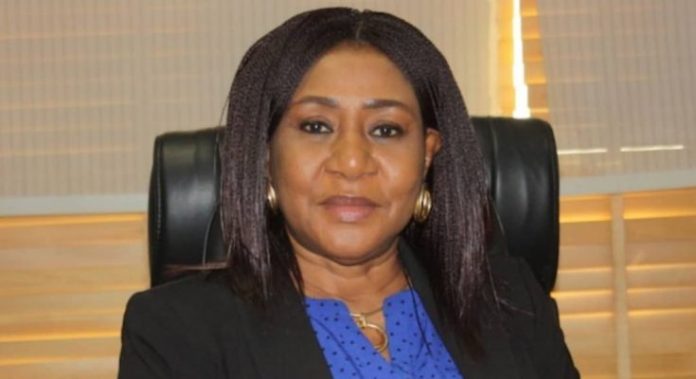
A couple of weeks ago, Hon. Kazaure presented a motion for the suspension of Lady Azuka Azinge, Acting Registrar-General of the Corporate Affairs Commission (CAC), who is currently facing trial before the Code of Conduct Tribunal (CCT).

In an ex-parte ruling on Tuesday, December 24, Chairman, Code of Conduct Tribunal (CCT), Mr. Danladi Umar before whom Lady Azuka Azinge had been arraigned on an 11-count charge, ordered the Minister for Trade and Industry to appoint a replacement for her.

Though unconnected with Kazaure’s motion, the CCT in a statement signed by its spokesperson, Ibraheem Al-Hassan says Lady Azinge is to remain on suspension pending the conclusion of her trial on charges bordering on the breach of the code of conduct for public officers.

Prior to all the furore, Azinge who until a few days ago was Acting Registrar General, Corporate Affairs Commission (CAC), in one year moved CAC from 88th position to 1st Position on the Freedom of Information Compliance Ranking by Public and Private Development Centre.

Some of her achievements include:

Industrial Harmony and Increased Productivity

Payment of the 2013 nine percent salary arrears which arose from tripartite agreement executed between the Commission, the Union, and the Federal Ministry of Industry, Trade & Investment. This restored industrial harmony which led to increased productivity. Demand for payment of the 9% arrears led to incessant strike before she assumed office.

Digitalization of Pre-registration Services

Closure of manual operations from March 2018 and deployment of online pre-registration services in all the states of the Federation to enable customers register entities from the comfort of their houses or offices.

Re-engineered Operations

These include complete decentralization of state offices operations to enable customers pick up their certificate at any of the Commission offices nationwide; improvement of service delivery time for name search from 12 hours to 4 hours; and re-organization of departments, units and state offices for efficient service delivery. It also includes the introduction and maintenance of functional communication with internal and external publics by way of functional website and periodic circulars.

Improved Incentives for Investors

This was done by the removal of the requirement for proficiency certificate in the registration of professional based firms to encourage investors invest in such business and hire professionals to manage them.

Effective Implementation of the Presidential Executive Orders on Ease of Doing Business

Faithful implementation of the Presidential Executive Orders on Ease of Doing Business in conjunction with other stakeholders which ensured that Nigeria improved on the Global Competitive Index ranking by 39 places from 2017.

Azuka Azinge

Improved Service Delivery System

These include deepened communication with customers and the general public through periodic customers’ forum, public sensitization, open market campaign and other forms of public engagement, as well as enhanced the Help desk to boost quality of service to customers and the general public.

The Commission also ensured consistent participation in the Micro, Small and Medium Enterprises (MSME) clinics under the office of the Vice President. Challenges of MSMEs are usually resolved on the spot at such clinics.

Similarly, CAC introduced Computer Based Test for the conduct of promotion examination for 2017 which ensured prompt release of results and transparency of process. It reviewed the publication of check lists, costs of services and other operational guidelines on the website to ensure transparency in operations and consolidated incorporation forms CAC 2, 3, 4 and 7 into One CAC 1.1 to make registration easier, faster and cheaper for customers.

Business Incentive Strategy

Successfully implemented the Business Incentive Strategy under which cost of registration of Business Names was reduced by 50% from N10, 000 to N5, 000 to encourage the formalization of informal business operating in the country. A total of 244,428 were registered in the nine months exercise.

Introduction of Sustainability Management Principle

This is in line with sustainable development agenda of Federal Government which requires organizations to be managed in the interest of all current stakeholders without compromising the needs of future generation. CAC also sustained Quality Management System (QMS) certification based on NIS ISO 9001: 2015 which ensures total quality management and continues improvement. For operational excellence to reposition the Commission, the maiden Management Retreat on Strategic Planning was conveyed.

Notwithstanding the above and many more innovations she brought to CAC, allegations have been made against her and Federal Government with speed that would have been most desirable in many ailing sectors of the country sent her on suspension.

In 2017 incidentally, Comrade Ibrahim Kirfi, Chairman, Amalgamated Union of Public Corporations, Civil Service, Technical and Recreational Services Employees at the CAC, Corporate Affairs Commission headquarters, Abuja made some weighty allegations against Mr. Bello Mahmud former Registrar General of the Commission during a surprise industrial action embarked upon by staff members of CAC. In the no-holds-barred interview with The Authority Newspaper, Kirfi alleged corrupt practices running into billions of naira with its attendant consequences on poor welfare package of members of staff that triggered the downing of tools on Monday July 17, 2017.

The union leadership accused the Bello Mahmud-led management of the CAC of wanton sharp practices and disregard for laid down government policies on monetisation and award of contracts in its daily activities at the commission.

Comrade Kirfi said CAC was bleeding badly from corrupt practices of the Chief Executive and other top management staff of the agency.

It would be recalled that business activities at the CAC were on Tuesday, July 18, 2017 grounded following the industrial action. The workers are protesting non-payment of allowances as well as poor welfare condition.

Kirfi in the interview disclosed that over 40 per cent of generated revenues by the commission is gulped by the management staff on luxury items including cars and household items, which he said was in blatant disregard for laid down monetization policy of the Federal Government.

He equally accused the Mr. Mahmud and his Special Assistant, Mr. AG. Abubakar of highhandedness and usurpation of schedules of other members of staff at the commission as well as contract sharing.   

“There are issues of serious corruption at the CAC. One, you can see this car park at the commission’s premises, they started building this car park at not more than N250 million at the initial sum to completion. But as it is now, over a billion naira has been sunk into the project because of contract variation. They refused to finish the project.

“I can also tell confidently that if you go to the commission’s Katsina State office, you would assess it to know if it is worth N300 million. If you go to Jigawa State, there is a plot of land that state government gave us free but to fence that land alone which is less than 1000 square metres, the commission’s management approved N16.5 million. Similarly, the commission spends billions of naira on ICT on annual basis, but you can confirm from the customers whether they are getting the kind of services that the management promised them.

“By policy, the commission is supposed to be remitting something to the Federal Government at the end of the year after doing all their activities. But they are not remitting any money to the FG; citing excuses of high staff cost, but more than 40 per cent of the staff cost is being consumed by the executive.

“There is a Federal Government circular on monetisation that is flagrantly disregarded by this commission. With the monetisation policy, all your entitlements are being subsumed into your salary structure. But as I am talking to you, they buy cars for themselves, fuel these cars and maintain these cars. They even use our drivers on weekends; they still enjoy DSTV subscriptions, recharge cards of N45, 000 on monthly basis, gas for their private homes, environmental sanitation (fumigation), and generator allowance. You would even wonder what they do with their salaries. And on weekly basis, they fill their local travelling allowance, while we (junior staffers) do everything from our salaries. Even if light bulbs go bad in their homes, it is the office that replaces the bulbs for the management staff.

“It is also pertinent to state that the commission’s management approves contracts beyond its approval limits, which is also another serious violation of the Federal Government’s policy on award of contracts. Every year, they approve N40 million for purchase of certificates. The approval limit of the commission is less than N5 million; any contract that is up to N20 million ought to go to Tenders Boards. But they award these contracts without recourse to the Tenders Board. While any contract up to N50 million has to obtain ministerial approval. And they also split contracts; which is a serious offence.”

Disputing the Union leader’s position, Mr. Mahmud said the allegations untrue positing that the commission’s inability to meet some of the workers’ demands was based on the difficulty his management encountered in securing approvals from the Salaries, Income and Wages Commission for some of the agreements it entered into with the workers.

On the issue of contract splitting and inflation, the former CAC boss who retired in October 2017 said “these are just mere allegations; our contracts go through due process. There are times when we need to advertise for contracts and we do that. There are situations whereby we need clearance, and we go ahead to the Public Procurement Bureau for the clearance, and we normally go for that clearance. There are situations that it is within my authority to approve; when it is less than N2.5 million, I approve. That is for supplies at the CAC. Any contract that is above N5 million, we go to tenders board and get approval. If it is above the limit of the tenders’ board, we go to the mother ministry for approval.

“And I can categorically say that we did not spend N1 billion on the car park as alleged by the CAC union. The records are there. We did not even spend near N1 billion. And we did not spend N300 million on the commission’s Katsina State office as alleged. The construction of the office didn’t take up to N40 million, including the fencing, the gatehouse and everything.”

Similarly, Mahmud debunked the allegation the commission’s management gulps over 40 per cent of the staff wage bill.

Top CAC officials who spoke under anonymity aver that Azinge since October 9, 2017 when she assumed office, fought, struggled and worked extremely hard to set the commission aright following the challenges she met when she became Acting Registrar General. They expressed concern that in spite of her tenacity to get things done, accolades from across the globe as well as from the presidency, all she worked for is about being rubbished.

Lady Azinge is one of the few to become Registrar-General of CAC, albeit in acting capacity, from the Southern part of Nigeria. Remarkably, the Federal Government for more than 2 years declined to upgrade her appointment to substantive Registrar-General.

Not long ago, the governor of Gombe State, Alhaji Muhammad Inuwa Yahaya  rather than confirm the Acting Chief Judge, Hon. Justice Beatrice Lazarus Iliya as the substantive Chief Judge, chose to appoint a junior male Judge as Chief Judge notwithstanding the fact that Justice Iliya is the most senior serving Judge of the State High Court.

What then is the fate of the Nigerian woman? Is there an undisclosed plot to frustrate hardworking educated women?

Gudaji Muhammed Kazaure while concluding his pitch stated thus: “When women go zigzag, we (men) are the ones to control them. That is why God says they should come under us. They should marry and serve under us. Women play a good role in our lives, they take care of our lives, they take care of our children, they cook for us and take care of every single thing for us.” 

Is this the lot of women in Nigeria?

Lady Azuka Azinge was arraigned before the tribunal on December 23, on an 11-count charge marked: CCT/ABJ/03/2019. She was accused of concealing her naira, euro and dollar domiciliary accounts in Access Bank Plc and Standard Chartered Bank.

Count one of the charges reads: “That you, Lady Azuka Obiageli Azinge, on or about 17th of July, 2017 whilst being a Director at Corporate Affairs Commission and thereby a public officer in the Service of the Federal Government of Nigeria, failed to submit a written declaration of your assets and liabilities four years after you declared your Assets in form CCB1 NO: CACOOO603 on the 17th July, 2013, you thereby contravened the provisions of paragraph 11 (1)(a) of the Fifth Schedule, Part 1 of the Constitution of the Federal Republic of Nigeria 1999 as altered and punishable under paragraph 18 (1) and (2) of the fifth schedule of the same Constitution.

Count two: “That you, Lady Azuka Obiageli Azinge, whilst being a Director and Serving as Acting Registrar-General at Corporate Affairs Commission and thereby a public officer in the Service of the Federal Government of Nigeria on or about 9th of April, 2019 did make a false declaration of your Assets in from CCB1 N0: CACO00713 by omitting and refusing to declare Domiciliary (US Dollar) AccOunt No: 0001586293 maintained with Standard Chartered Bank Nigeria (Ltd) which has been in operation since 6th of May, 2005 and you thereby commit an offence Contrary to Paragraph 11(2) of Fifth Schedule Part 1 to the Constitution of the Federal Republic of Nigeria 1999 as altered and punishable under paragraph 18 (1) and (2) of the fifth schedule of the same Constitution.”

She was also accused of receiving allowances she was not entitled to as an acting Registrar-General of the CAC.

She pleaded not guilty when the charges were read to her on December 23.

Though the tribunal adjourned till January 29, 2020, for commencement of trial, the prosecution, apparently eager to ease her out of office, approached the court for an ex-parte order.

A similar controversial order was what was used to remove the former chief justice of Nigeria, Walter Onnoghen

Ruling on the ex-parte motion suspending Mrs Azinge, the CCT ordered: “that defendant/respondent steps aside, as the Acting Registrar General of Corporate Affairs Commission, over allegation of contravening provision of Code of Conduct Bureau and Tribunal Act CAP C1 LFN 2004 pending the hearing and determination of Motion on notice dated on the 17th day of December 2019.

“That the Hon. Minister of Trade and Industry and the Chairman of the Board of Corporate Affairs Commission, is to appoint a replacement pending the hearing and the determination of the motion on notice, dated and filed on the 17th day of December 2019.

“That the matter is hereby adjourned to the 6th day of January 2020, for the hearing of the motion on notice, dated 17th day of December 2020, “the statement added.

Azuka Azinge And Question Of Women In Leadership In Nigeria

By Tomisin Binuyo

In a country where women account for 55% of the population and have a 10% higher life expectancy rate, the argument for women participation is neither cosmetic nor tokenistic.

Gender inclusion in political leadership is a fundamental aspect of modern democracy. Improved representation of women has been shown to have benefits such as improved policy changes, economic growth, enhanced peace building and a more egalitarian society.

In a shocking departure from its previous antecedent, this administration seems to have adopted a negative approach towards women in leadership. Female Leaders are rapidly becoming an endangered species.

Today, Nigeria has one of the lowest rates of female representation in leadership across Africa, and globally. For example, according to the International Parliamentary Union, Nigeria ranks 181 out of 193 countries in terms of equal participation of men and women.

To put the picture more clearly, in the current 9th National Assembly, under the leadership of the ruling party, women occupy a mere 7 out of 109 Senate seats and only 11 out of 360 seats in the House of Representatives.

Leadership is not gender-exclusive, the combination of traits, ambitions, and skills, are not unique to any gender. While there are plenty of challenges involved in being a female leader, there is no short supply of able and capable candidates.

Last week, the Gombe State Governor, Muhammad Inuwa Yahaya (elected under the platform of the All Progressive Congress) rather than confirm the Acting Chief Judge, Justice Beatrice Lazarus Iliya, chose to appoint a junior male Judge as Chief Judge notwithstanding the fact that Justice Iliya is the most senior serving Judge of the State High Court.

The records show that this administration’s highest achievers during its 1st term were women. We had Lady Azuka Azinge of the Corporate Affairs Commission (CAC) who successfully simplified the process of business registration, to other female high fliers such as Dame Julie Okah-Donli of the National Agency for the Prohibition of Trafficking in Persons (NAPTIP) and Mrs. Yewande Sadiku of the Nigerian Investment Promotion Commission (NIPC) among others.

These amazons have put Nigeria on the global map and won several laurels for the country. Unfortunately, there are some in the current administration who wish to relegate women to the background, notwithstanding the lofty heights these women have attained.

In a submission made by another APC Chieftain and a member of the House of Representatives, Hon. Gudaji Muhammed Kazaure on the International Women’s Day, “giving women too much laissez-faire might lead to the eventual overthrow of men. It is good to give women opportunities, but not too much, if you give women the opportunity to take over this chamber, they will mess up, Mr. Speaker,”

Recall that it was this same Hon. Gudaji Muhammed Kazaure who presented a motion for the suspension of Lady Azuka Azinge just a few weeks ago. My people say if a witch cries in the night and a child dies in the morning, we do not go to the soothsayer to ask what killed the child.

The sins of Lady Azuka Azinge are worse because she is not only a woman, she is also of Igbo extraction. It is on record that from the day Lady Azinge was appointed as Acting RG of CAC on 9th October, 2017, there have been several attempts to pull her down.

Notwithstanding being the most senior Director at the CAC. There have been news articles filled with frivolous stories and petitions allegedly directed to different quarters ranging from Head of Service of the Federation, Office of the Secretary to the Government of the Federation, the National Assembly, ICPC, EFCC, Ministry of Trade and Investment.

She was vindicated of any wrong doing.
It is a well-known fact that since its establishment in 1990, CAC has only been led by Northern Men. Is this the reason why the current administration has refused to confirm Lady Azinge? The most recent brouhaha involves an alleged summons to the famed Code of Conduct Tribunal where Lady Azinge is scheduled to receive the ‘Onnoghen Treatment’.

Is this the best way to treat a woman who has taken the CAC to greater heights? A woman who has been thrice awarded by the Presidency for her industry? A simple Google search will unleash all the achievements the CAC has recorded under her, from the introduction of online registration to the improvement of Nigeria’s ranking on the Ease of Doing Business rating, to the data sharing integration of CAC and FIRS.

In one year, under Lady Azinge, CAC moved from 88th position to 1st Position on the Freedom of Information Compliance Ranking by Public and Private Development Centre. The strides of Lady Azinge can be likened to the impact of the late Prof. Dora Akunyili who repositioned the National Agency for Food and Drug Administration and Control (NAFDAC). After her tenure, Prof. Akunyili was celebrated and appointed as Minister of Information. Why then is the Lady Azinge’s case different?

What is even more shocking is that during this 16 Days of Activism, when the whole world is speaking against Gender-Based Violence and Violence against Women, FIDA and the NBA Women’s Forum have been loudly silent in the face of the executive violence being carried out against our sister, Lady Azinge.

In a recent speech titled ‘Where Is Your Wrapper? Ekiti First Lady, Bisi Fayemi said “Our wrappers might all look different, with varying sizes, shapes and colours, but each and every one of us has a wrapper. Bring that wrapper out to shield another woman… Never let a day go by without bringing out that wrapper. The way God works is that the more wrappers you bring out for others, the more will come out for you. We don’t only need wrappers when we celebrate and buy Aso Ebi. We need the wrappers for our trials and tribulations and we all have them.”

What is the message this administration is sending to the millions of girls and women, young and old, all over Nigeria? Who will be next? How many more female leaders have to be persecuted before we rise up to speak? Is it an offence to be born a woman in Nigeria?

If these can happen to successful, powerful women, what hope do I have? Is this why the number of women in public leadership continues to shrink each year? Are we still in the Nigeria of Mojekwu v Iwuchukwu (2004) 11 NWLR Pt. 883, where the Supreme Court reversed the Court of Appeal and recognized the “Oli-epke” custom of the Nnewi people which excludes women from inheritance?

Has this government adopted the policy of Hon. Kazaure who said “When women go zigzag, we (men) are the ones to control them. That is why God says they should come under us. They should marry and serve under us. Women play a good role in our lives, they take care of our lives, they take care of our children, they cook for us and take care of every single thing for us.”

Are Nigerian women in 2019 only good for cooking, cleaning and the other room? My question to our womenfolk is “Where is your Wrapper?”

Tomisin Binuyo, a Legal Practitioner and Women’s Rights Advocate writes from Abuja, FCT
E-mail: [email protected]

As women in politics advance elsewhere, Nigeria's diminish

It’s election season in Nigeria, but where are the women? Screams a headline on the UN Women website.

Sequel to the February 16 presidential elections, UN Women and partners trained women candidates, documenting political violence and advocating for measures to boost women’s low representation in Parliament.

Did many Nigerian women eventually contest for the 2019 elections? The answer is in the Negative. But the few who made attempts have sour stories to tell. That is those who survived it.

Women were attacked, threatened with violence and forced to give up their places to men during the party primaries. Some party leaders pressured women to step down, while others irregularly removed winning women’s names from their lists of candidates submitted to the Independent National Electoral Commission (INEC).

INEC said only 62 women out of the 2,970 who contested for different political offices in the 2019 general elections were elected

Only about 18 Women are at the 9th National Assembly. The men are 451.

To underscore the situation, Mufuliat Fijabi, head of the Nigerian Women’s Trust Fund, an advocacy group in Abuja, said: “Nigeria is still strictly a patriarchal society and most times we find people paying lip service to the advancement of women political participation.’’

A number of women were assaulted. One was burnt alive. Natasha Akpoti was pushed down thrice during a meeting held at the instance of INEC while law enforcement operatives in that meeting did nothing. Several others have their story.

Mrs Salome Abuh, women leader of the Peoples Democratic Party (PDP) in Kogi State was set ablaze in her house on November 18, shortly after the announcement of the Kogi State governorship poll result, which the ruling All Progressives Congress (APC) won.

Meanwhile, the Universal Declaration on Democracy adopted by the Inter-Parliamentary Union in September 1997 states that: “The achievement of democracy presupposes a genuine partnership between men and women in the conduct of the affairs of society in which they work in equality and complementarity, drawing mutual enrichment from their differences.”

While this scenario persists in Nigeria, other countries are moving ahead; including Nigeians there.

Nigerian-born Chinyelu Onwurah won the first seat to be declared for Labour in the December 12 general election in the United Kingdom.

According to The Independent, Onwurah took Newcastle-upon-Tyne Central with 21,568 votes, compared to her Conservatives rival’s 9,290.

Chinyelu Onwurah

Onwurah’s victory was swiftly followed by success for Labour’s Bridget Phillipson in Houghton and Sunderland South.

Onwurah’s 12,278 margin of victory was down from 14,937 two years ago, the medium reported.

Also, the election witnessed a landmark victory for women in the UK as a record 221 women won seats as members of the Parliament.

As the UK celebrates the rise of women in its politics, recall Finland has also elected its third female Prime Minister, Ms. Sanna Marin.

34-year-old Marin, who was sworn into office on Monday December 10, is the youngest prime minister in Finland’s history, and the youngest sitting head of government in the world.

Before her, the New Zealand’s Jacinda Ardern, who was 37 years old when she took office in October 2017 used to be youngest head of state in the world.

Marin, who belongs to the Social Democratic Party of Finland, will form a coalition government with four other parties, which are also led by women, three of whom are younger than 35 meaning her cabinet will be dominated by young women.

Katri Kulmuni, 32, head of the Centre Party, will take on the role of Finance Minister, while Maria Ohisalo, 34, of the Green League, will serve as Finland’s Interior Minister.

Rounding up the female-dominated cabinet will be Left Alliance chairwoman Li Andersson, 32, as the Education Minister, and Swedish People’s Party leader Anna-Maja Henriksson, 55, who will be serving as the country’s Justice Minister.

Whither way Nigeria?

ECOWAS Court: Pregnant adolescent girls has a right to be in school

… As Ekiti takes the lead in Nigeria

The Community Court of Justice, ECOWAS, has upheld the right of pregnant adolescent girls to education and to attend main stream schools.

The court in a landmark judgment held that the government policy which barred pregnant adolescent girls from mainstream/regular schools was as discriminatory as the establishment of irregular schools for them.

ECOWAS court insists the establishment of separate schools for pregnant teenage girls with a three day a week attendance and four taught subjects is discriminatory and impacts on the right to education.

Meanwhile, Ekiti State in southwest Nigeria has in November adopted a policy to ban the expulsion of girls from schools during and after pregnancy.

Although Nigeria’s Child Rights Act protects the rights of girls to education during and after pregnancy, many continue to face expulsion because there is a lack of awareness and no policies in place to ensure their continuation in school.

Ordering that the prohibitive policy in the Republic of Sierra Leone be immediately revoked, the court also directed the abolishment of separate schools established for the pregnant girls.

Likewise, it instructed that the said girls be absorbed in the main stream schools.

The three member panel of the Court had held that the Respondent (Sierra Leone ) is in breach of Articles 2, 3, 17(1), 18(3) & 25 of the Charter; Articles 28(1) of the Convention on the Rights of the Child; Articles 1 & 3 of the Convention against Discrimination in Education and ordered the country as follows:

  1. To immediately revoke the prohibitive policy
  2. To abolish the separate school established for the pregnant girls and absorb the said girls in the main stream schools
  3. To develop strategies, programmes and nation-wide campaigns that will remove the negative societal attitudes that support the discrimination and bias against pregnant girls attending schools.
  4. To integrate sexual and reproductive health education into school curricula to minimise the high rates of teenage pregnancy.

Women Against Violence & Exploitation (WAVES), a Non-Governmental Organization (NGO) registered under the laws of Sierra Leone (the Respondent State) with focus on women and girls’ rights brought an action before the ECOWAS Court against the Republic of Sierra Leone on behalf of Pregnant Adolescent School Girls alleging violation of their rights right to education and non-discrimination as provided for under Articles 2, 3, 17(1), 18(3) & 25 of the African Charter; Articles 1 & 3 of the Convention against Discrimination and Articles 28(1) of the Convention on the Rights of the Child.

The Applicant alleged that the Respondent’s Minister of Education, Science & Technology via a policy statement bared all pregnant adolescent girls from attending school when their pregnancies became visible in line with the said policy.

While they were prohibited from attending the main stream schools, as an alternative the Respondent State established other schools for pregnant girls where subjects offered are limited to only four (4) and operating three (3) days a week, essentially offering limited education. Furthermore all such students are accommodated in one classroom irrespective of age and academic progress.

The Respondent State while challenging the jurisdiction of the Court to entertain the matter on the basis that the Applicant has no locus standi to institute the action on behalf of anonymous victims of the alleged violation, also submitted that the Minister’s statement released without due recourse to the cabinet, which is the final decision making body of the Respondent State should not be attributed to it. However, it did not deny that these special schools are operative in the State.

Delivering the judgement of the Court, Hon Justice Dupe ATOKI who read judgement dismissed the Respondent’s objection with regards to jurisdiction and admitted the case.

The court explicitly held in line with its jurisprudence that “the law recognises the rights of individuals and corporate bodies who are not victims to bring an action in a representative capacity under the principle of action popularis…”Thus under this principle, NGOs and public spirited individuals are allowed to institute action on behalf of class of victims based on public interest in so far as the relief sought is not to the benefit of the Applicant.

The court equally held that, contrary to the submissions of the Respondent, the Minister’s statement is attributable and imputable to the Respondent State and same amounted to a ban on pregnant adolescent girls from attending school.

It further held that the ban is discriminatory and impacts negatively on the actualisation of the right to education of the pregnant girls, similarly the establishment of separate school for the pregnant adolescent girls with four (4) taught subjects operating three (3) days a week not being at par with the main stream schools thus providing lesser quality of education is equally discriminatory and a violation of the right to education.

Insecurity, Christmas: Majiyagbe, others sue for peace

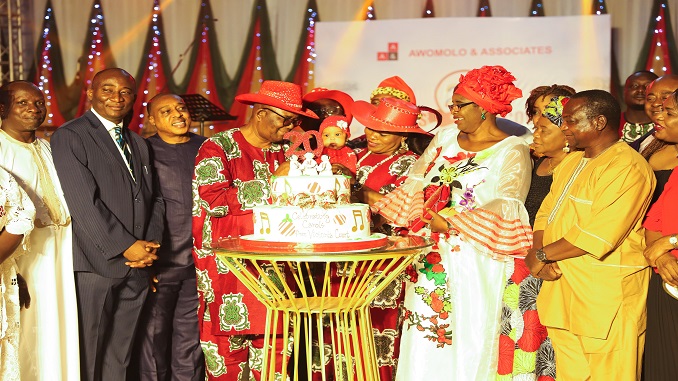
… as Awomolo & Associates host Christmas Carol

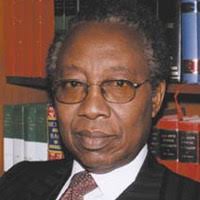
As insecurity remains an ever present threat to peace and development of Nigeria, notable Senior Advocate of Nigeria Mr Jonathan B. Majiyagbe, SAN has restated the place of peace, reconciliation and unity to political, social, economic development in a nation.

Mr. Majiyagbe, SAN

Majiyagbe who was special guest of honour at the 20th anniversary Christmas Carol of Awomolo & Associates in Abuja at the weekend cautioned that without peace and stability, Nigeria will be unable to attain the heights desired by its founding fathers.

Calling on Nigerians to emulate the sterling qualities of Jesus Christ, guest speaker at event themed: ‘Jesus, the fulfilment’, Rev. Dr. Akindeji Falaki disclosed that through the Christmas story, God demonstrated to man his capacity and faithfulness to fulfil His Promise.

Thereafter, it was all celebratory as lawyers and administrative workers at the firm constituted themselves into a mass choir led by Asiwaju Adegboyega Awomolo, SAN and his wife Chief Mrs. Victoria Awomolo, SAN.

Plaques and awards were equally given to many deserving personalities.

The event was graced by several members of the legal profession, technocrats and many more.  


Reminiscences with Jonathan Majiyagbe

By Yusha’u A. Ibrahim

Jonathan Babatunde Majiyagbe (OFR), 85, became the first lawyer practising in northern Nigeria to be elevated to the rank of a Senior Advocate of Nigeria (SAN) in 1980. After settling in Kano in the 1970s, he became a doyen of the legal profession in the state. He also rose through the ranks in the Rotary Club to become the president, Rotary International. In this interview he spoke about his early days as a lawyer, his experiences in the North, the civil war, and other interesting issues.

Tell us about your early years?

I was born on July 10, 1934 in Lagos, so I have just celebrated my 85th birthday.  My father, Jacob Mofolorunsho Majiyagbe was from Abeokuta, Ogun State, and my mother, Victoria Olatilewa Majiyagbe, also from Abeokuta, was a princess from the Ogunbona royal family.   My father was a civil servant who worked as an almoner in the health department. He was transferred from place to place.   I remember following him to Kaduna, Kano, Jos and Bamenda in Cameroon.  That was how I became very familiar with the northern part of Nigeria. I returned to the North when I graduated in England.

Which part of Lagos?

I was not there when I was born, but I was told I was born somewhere in Central Lagos.

Were you a favourite of your father or mother?

I was everyone’s favourite, especially my four sisters, because I was the youngest and the only son in the family.  They pampered me so much within the limits of what a humble family could afford.  I remember that they would not even let me go out to play football in the streets as young boys did in those days because they were worried that I would injure myself.

Where did you have your early education?

I started school at Holy Trinity, Ebute-ero in Lagos. When my father was transferred to Jos, I went with him and attended St. Joseph Primary School.  Not long after that, we moved again, this time to Kano, where I was enrolled into the Holy Trinity School. I vividly remember that the Seriki, Sabon Gari, Kano, was Mr. Ballat Hughes, a Ghanaian. Till date, there is a street named after him in Kano.  When we moved to Kaduna, I attended a Government School, which has been demolished, before proceeding to Ilesha Grammar School, where I completed my secondary school. I was quite a rascal in school.  I mimicked my teachers and played all kinds of pranks with other students.  I was a member of the Boys Literary Society, headed by Senior Lateef Jakande.   At Ilesha Grammar School, I met the late Michael Okuboye and former Chief Justice Alfa Belgore.  When we had any play or drama, we represented the North. I would sing Hausa songs and take Hausa roles.  We spoke English with an accent that was different from the others too.  They used to call Alfa Belgore, ‘Alkali’, because his father was a Qur’anic scholar and judge, and they called me ‘Yaro’.  I am very proud of Ilesha Grammar school, which trained such personalities as Justice Kayode Esho, G.O Adegoye, the late Fajemiroku, Wale Olanipekun, Ayo Oni and several other young men, who later in life held prominent positions.  Our principals in those days were strict disciplinarians. The Rev NOA Lahanmi and The Rev Akinyemi, the father of Bolaji Akinyemi, are the two I remember very well.

What about your tertiary background?

I travelled to England in 1957.  I did my advance level course at Kennington College, after which I read Law at the Council of Legal Education and was called to the English Bar (Middle Temple Inns of Court) in 1964.  Around the same time, I graduated as Bachelor of Law from Holbon College, University of London.  At that time the Law School in Nigeria was carrying out three-monthly courses for students from abroad.  I rushed back home in 1965 so that I could attend the last three-month course before it became a compulsory one year course for Law School. After Law School in Lagos, I came to Kaduna to my brother-in-law and worked with an old lawyer called Mr. Francis Ayinde Thanni.  He had offices in both Kaduna and Kano, so I was sent to the Kano office in 1966. In those days of working with Mr. Thanni, there were not many Nigerian lawyers. There was a preponderance of English and Pakistani lawyers over Nigerians, but gradually, Nigerians took over the practice of law from the foreigners, particularly when the indigenisation decree was promulgated.  In Kano, we had the law firms of Irving & Burner, E. Noel Grey, who dominated the practice and quite a number of lawyers like John Huges.  But when I got there, I began practising with legal giants like Agbamuche, who later became attorney-general, C.A.J. Nwajei, Ebele Nwokoye, E Lewis Thomas and a few others.   In 1971, I registered my firm, J.B. Majiyagbe & Co and opened my own chambers.  It is still there in Kano. My son, Mr. John Folorunsho Majiyagbe manages the branch in Abuja.

Majiyagbe seated with the late Emir of Kano, Ado Bayero at an official function

How would you describe your experience in the North, having come from Lagos?

It has been quite an interesting experience. My father was a civil servant, so travelling around Nigeria, particularly the North, gave me a sense of being an all-round Nigerian.   In other words, I became detribalised.  I understand some of the major languages.  It was a mixture of different tribes, but we were all Nigerians – there was no tribalism. And it was very peaceful in those days, particularly in Kano.  The indigenes were very kind and welcoming to everybody until we started seeing issues like Maitatsine, Aware, and others that followed after independence, particularly after the 1966 crisis that led to the war.

When I arrived in Kaduna, my brother-in-law, Mr. A.B. Salako, a land surveyor, was friendly with the late Alhaji Tijjani Hashim and the then minister of lands in northern Nigeria, Alhaji Musa. They both encouraged me to move to Kano, where I made a lot of friends, notably, Alhaji Haruna Kassim; Justice Wali; Mr. Abdullahi Ibrahim, who later became attorney- general; Justice Uwais, who later became Chief Justice of Nigeria, and the late Justice Mustapher Akanbi and Justice Dahiru Mustapha.  Others included Dr. Datti Ahmed, my personal doctor; Tanko Yakasai; Alhaji Garba Bichi; Alhaji Inuwa Wada, and of course, Emir Ado Bayero.  

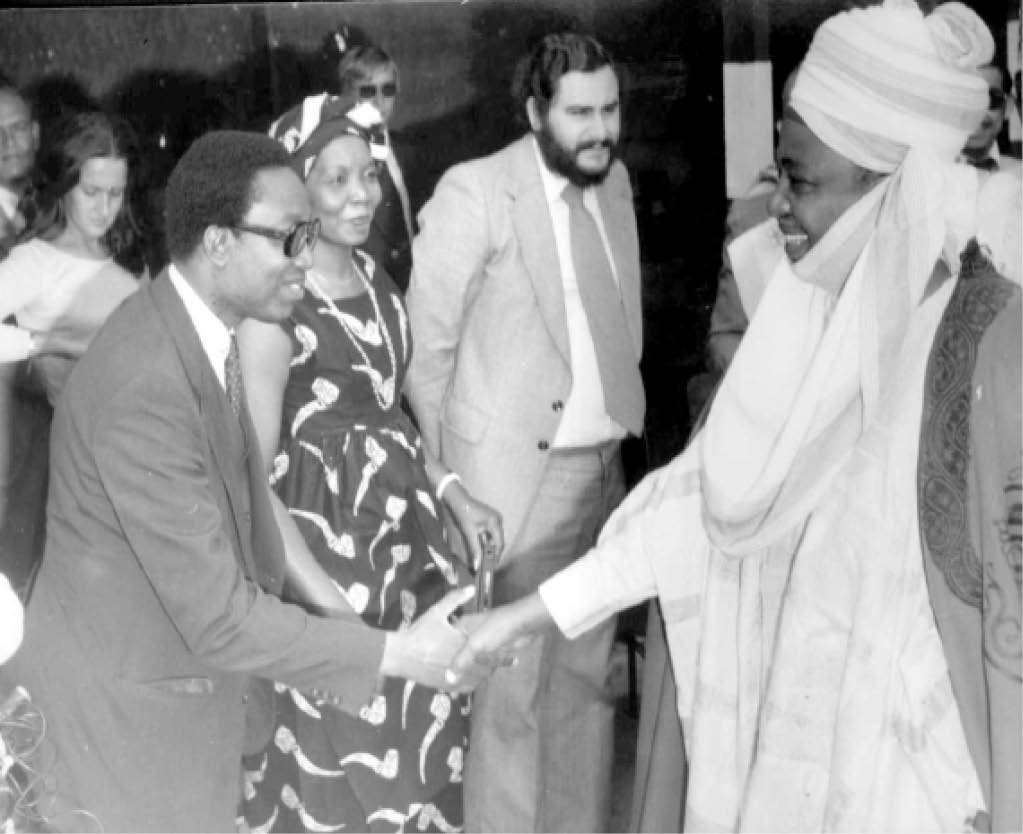
In fact, I was called the emir’s friend – Abokin mai Martaba.  Indeed, I was close to the emir, always visiting the palace and leading visitors and delegations to him. I was very proud of being acquainted with the late Alhaji Ado Bayero because he was a broad-minded person.  I invited him and he accepted to become the patron of the Rotary Club of Kano. 

I also remember Sabo Bakin Zuwo, former governor of Kano State; Miko Abdallah; Alhaji Danlami Zango and Alhaji Dan Bappa, to mention a few.  I cannot forget another old friend and ‘tutor’  Babba Dan Agundi, who was close to the late Aminu Kano and was always talking politics and Islamic law.  He would walk straight into my office unannounced and say ‘Zan Koya maka doka’ (I will teach you the law).  He was a very good friend.  Then there was Kaloma Ali, a lawyer, who later became a minister.  I was partly practising with him. I got a house close to Kaloma Ali in Fagge Ta Gabas, and people were bringing me clients through word of mouth. My landlord was a brother of Isiaka Rabiu, and that was how I became the lawyer to that family. I became a member of the Nigerian Red Cross.  I was also a member of the Kano Lebanon Club and the French Club.  My circle of friends grew. People hardly knew that I came from Abeokuta. Kano was my home and I felt very comfortable living there.

Did the civil war start while you were in Kano?

Yes, it came as a big surprise because we were living peacefully together before then.    Most people ran away from Kano, but I did not leave.  I felt safe. I still have many friends there.

What about your Rotary experience?

Rotary started in Kano in 1961 with people like Mandrides and other expatriates. When I got there and heard about Rotary, naturally, with my religious background, I knew there was the need to care for the less privileged people, so I became a Rotarian in 1967.  As I was celebrating 50 years of my practice in Kano, I was also celebrating 50 years as a Rotarian.

All these happened because of the friendship and sympathy I had for the under privileged, I got to know them very well, particularly some beggars in the street near the Kano post office. I never had to lock my car because the beggars would always watch over my car till I returned. I even sent one of them to school, intending for him to be a lawyer, but obviously, begging was more profitable because he went back to begging.  I sent him to Mecca, where he continued with begging. I paid for his marriage too.

Majiyagbe, left, in a handshake with the late Emir of Kano Ado Bayero

How would you describe your active years in law practice?

I had a wide commercial law practice all over the North. I represented many international companies like the KLM, British Airways, Nigeria Airways, Royal Exchange Assurance in courts and gave advice where necessary.  For many years, my firm has proudly represented ABU.  Several of the banks were among my corporate clients –  First Bank, Union Bank, Nigeria-Arab Bank, UBA.   People like Sheik Alhaji Isiaka Rabiu,   Alhaji Aminu Dantata, Alhaji Sanusi Dantata became our clients.

I was blessed by God and I give thanks to him. I was the coroner for Kano for many years.  I wasn’t paid, it was just a selfless service. I was also a notary public, and of course, we had a very strong Bar association, which I helped to build up.  I was the secretary for many years and later appointed chairman.  By then, people of Kano origin started joining. I am very proud of my background as a lawyer in Kano, especially as I became the first lawyer practising in northern Nigeria to be elevated to the rank of a Senior Advocate of Nigeria in 1980.

Were Kano conservatives averse to law?

Oh no! Kano people could be stubborn, but they were never averse to law.  They were sufficiently enlightened and took their grievances either to the sharia or regular courts.

When did you get married?

I got engaged just before my return to Nigeria.  I had met my wife in Nigeria years before we both worked for the Bank of British West Africa in Lagos. I worked there from 1953 to 1957. She was from the Rotimi Williams family.  She caught my fancy then, but I was just eyeing and admiring her from a distance.  I did not talk to her.  When we got to England, we met again and a romance started and blossomed.  We got married in 1966.  Sadly, my first wife, Adeola, died in 2000. My present wife, Abike and I got married in 2007.

When did you build your own house?

I left the Fagge area of Kano when my landlord started building another floor on top of us, then he put up another building in the front.  When he increased the rent I knew it was time to move on.  A friend told me: “Maigida, why don’t you apply for a plot of land?  They will give you.’’  I applied and was given a land in Bompai, where I built my own house in 1972.   The law chambers were on Ado Bayero Road until 1978 when I moved the office to the building adjacent to my house, close to Kano Club.

How did Rotary start in Kano?

The expatriates introduced it.  The Rotary Club of Kano got its charter as the first in Nigeria and held meetings at the Central Hotel.  Two or three weeks later, the Rotary Club of Ikeja was chartered.  I rose to become the secretary of the club, then a director and club president in 1972.  I took over from one Mr. Essam Moukarim of the Mouka Foam fame.

We started attending district conferences. The first one was in 1974, and eventually, I became a governor in 1980, responsible for 15 countries of West Africa. And I visited all those countries.  I served on the Rotary International scene first as a trustee of the Rotary Foundation, then director of the Rotary International Board.  In 200l, I was elected as president-nominee.  In 2002, I was president-elect and became president of Rotary Worldwide for 2003-2004.   I was the chairman of Rotary Foundation four years later.

As a governor you were responsible for 15 countries in West Africa and you visited all of them; how did you get all the energy to travel?

It was the help of God. Apart from Rotary I was also very active in the Bar association. I was going to become the president of the Nigerian Bar Association, but delegates came to Kaduna where the conference was holding and pleaded with me to let Babatunde Benson become president and I would become president the following year. In fact, there was much pressure from Mr. Coker, Nigeria’s High Commissioner to Britain,  that I gave in.  Thereafter, I lost interest, so the highest position I occupied was vice president.

Of all the cases you handled, which one stands out in your memory?

Yes, I represented the Isiaka Rabiu family when Nafiu Rabiu was accused of homicide. I was briefed to defend him.  I remember that I said the magistrate was not competent to try him; a case of murder must go to a higher court. I, therefore, applied for bail.  What I said probably annoyed some people as they kept threatening me, calling my telephone and saying, “You are defending someone that everyone knows is guilty of an offence. You are saying the magistrate is incompetent, and all that. They threatened to kill me, so I requested the commissioner of police to provide me with security. However, eventually, I had to withdraw.  I invited Chief Rotimi Williams to assist; he used to come to court from Lagos.  In the end, Nafiu Rabiu was convicted.   This case stands out. It’s a case I cannot forget.

Majiyagbe, second right, with prominent Kano citizens in the 1980s

Do you have district memories as a Rotarian?

Yes, when I travelled around the world, Rotarians always showed great respect. I remember that even as a district governor, when I visited Cote d’Ivoire, my aide came to meet me at the airport in his car, and the next day he brought a brand new Mercedes Benz.   He said his old car was not good enough. Again, during my visit to Australia, my next stop was New Zealand. When we got to New Zealand, my aide had to hand me over to another person because he was recalled to Australia.  

My new aide in New Zealand met us in a red car, but the next day he came with a brand new car too. As president of Rotary International you are privileged to meet heads of governments.  You are treated like royalty. Another incident was when I went to Fiji Islands and the Rotarians were showing me their projects. They took me to an old people’s home where I saw a funny looking young man. I asked what he was doing in an old people’s home and they told me they rescued him from his grandfather who had been treating him like a chicken because he did not like children. He had him tied and fed with the chickens.  The poor boy was picking food with his mouth. 

That’s man’s inhumanity to man. So they rescued him and there was no other place to put him than the old people’s home.

Is the stigma attached to Rotary all over the globe?

In the past, yes; they thought it was a secret society, but there’s nothing secret or cultist about it. Our activities cut across religion and politics. Everything is done in the open; that is why we meet in a hotel or restaurant so that people can see what we are doing.

What values have you learnt over the years?

One of the core values of Rotary is diversity. Our strength is to bring in all kinds of people, there is no barrier. And diversity is one thing I have come to admire.   One past Rotary president had as his theme, ‘Mankind is one.’   As RI president I emphasized that as well. Every month in the magazine, ‘The Rotarian’  I wore a different costume and hat to show that though we wear different garments, it is the same person. That’s what we need in Nigeria. Politics should not divide us, nor should religion drive us apart.

How did you spend your time away from work?

I was too busy working. In fact, it was only after one Alhaji Adidas came from Saudi Arabia that I travelled out after 11 years of practice without break.  Some Nigerians were owing him money, the amount was mounting and he was too old to travel to Nigeria, so with all expenses paid, I went to meet him; otherwise it was working hard all the time.

But as I mentioned before, I belonged to so many clubs, including the Lebanon Club and French Club, where my wife was secretary; so occasionally, we would go there, but mostly, it was my work, my Bar association, Rotary and my church. Incidentally, my church, St Georges, was just in front of my house, so I just crossed the road. I was a member of the Anglican Diocese and became the first chancellor of the New Kano Diocese.

When did you retire?

I did not plan to retire that early. Nine years ago, by force of circumstance, health challenges due to renal failure I had to take things easy. I am presently on dialysis, two or three times a week, which would affect my work if I had to continue in practice.  In search of the best medical facilities, I relocated to Abuja.

How do you see the legal profession as practised today?

There is no doubt that standards were higher. Those were the days of Justices Fatai-Williams, Kayode Eso,  Ademola,  Oputa, Bello, to mention few. There was FRA Williams, the doyen of the Bar.  Indeed, standards were high, both of the judges and the legal practitioners who appeared before them.  Lawyers were well dressed in their best tradition. I am saddened these days when I see how young lawyers dress and the standard of those joining the practice. What’s your favourite food? Tuwon shinkafa, egusi soup and pounded yam, Quaker Oats with raisins or kosai and pap for breakfast are my favourites.

What were your hobbies?

I started playing golf but later abandoned the game. I took up table tennis and enjoyed early morning walks as a form of exercise.  I have a piano but I can’t play much. However, I can make a few tunes on the mouth organ. I used to have a farm along Hadejia Road in Kano, where I kept cattle, poultry, rabbits, turkeys and peacocks.  I used to spend many peaceful relaxing weekends on the farm. These days, because of the pain in my knees, I only walk around the garden aided by my doting wife.  Once a week, I attend my Rotary meeting at the Rotary Club of Abuja Metro.

Read more: https://www.dailytrust.com.ng/reminiscences-with-jonathan-majiyagbe.html

No means No! Speak out! Group tells teenagers

the Constitution has failed the girl child! Says FIDA Abuja

As the 16 days campaign against gender based violence continues to heat up, teenagers and preteens in Abuja have been urged to speak out against rape and other violent behaviours.

Admonished never to assume the word ‘NO’ means another thing, they were re-orientated on the values of positively impacting their society.

Spurring students of Stella Maris International School, Abuja at their morning school assembly, Media & Teens Network (M&T) a not-for-profit organization geared towards values education and reorientation for young people in Nigeria drew attention to key provisions of the Violence Against Persons (Prohibition) (VAPP)Act, 2015 and its likely impact on violators.

Meanwhile, the International Federation of Women Lawyers (FIDA) Abuja has lampooned the Constitution positing that “the Supreme Law of Nigeria which should protect the girl child fails her.”

M&T in conjunction with Law & Society Magazine and FIDA Abuja encouraged the students to desist from violence and other anti-social conducts that could infringe on other persons rights, while charging them on the dangers of bullying, intimidation and forcing an action on someone against his or her will.

Leading the school children to resounding chants of “No means no!”, Co-ordinator of the organisation, Lillian Okenwa and some representatives of FIDA, Obianuju Peter and Sokoajirin Aleku tasked the students to maximise every opportunity to make a difference in their lives and their environment.

Okenwa who is also Editor in Chief of Law & Society Magazine donated copies of the magazine and VAPP Act, 2015 to the school.

Receiving the donation on behalf of the school, the School’s Vice Principal, Administration, Mrs. Njideka Ofoma expressed their immense appreciation.

The 2019 theme for the International Day of Elimination of Violence Against Women focuses on rape. This is given the high rate of rape cases reported all over affecting every category and ages of women and children.

According to UN Women, 35 percent of women worldwide have experienced physical and/or sexual violence in their lifetime while 11 percent of Nigerian women have experienced physical and /or sexual violence by an intimate partner in the last twelve months.

In view of the culture of silence, several cases of rape, defilement and violence go unreported. Stigmatisation of survivors, fear of intimidation and many more stand as a barrier.

This challenge according to the Chairperson of FIDA Abuja, Rachel Adejo-Andrew has become even more exacerbated when the Nigerian Constitution fails to protect young girls from all forms of sexual violence.

Speaking at Abuja during a press conference, Adejo-Andrew, noted that: “Section 29 (4) (b) of the 1999 Constitution of the Federal Republic of Nigeria as amended states that: any woman who is married shall be deemed to be of full age.

“This is recognition that a girl below the age of 18 years becomes a woman once she is married. This is unfortunate as the Supreme Law of Nigeria which should protect the girl child fails her and rather entrenches the trivializing of the place of women in Nigeria…

“We have received reports of rape of girls of two months old, three years old, 10 years old, 13 years old and 16 years old. This is not inclusive of adult women who have also been victims of rape who have come to us for help.”

She noted that the VAPP Act is a landmark legislation on the prohibition of all forms of violence against persons, especially the marginalised in Nigeria. “It is a great improvement on the Criminal and Penal Codes which are operational in Southern and Northern Nigeria respectively.”

The FIDA Abuja Chair further called for an overhaul and repeal of all laws that discriminate against women and girls adding: “there is no better place to start than by repealing Sections 29 (4) (b) of the 1999 Constitution of the Federal Republic of Nigeria as amended.

In all, FIDA Abuja made the following demands:

“The Federal Government should put in place necessary and appropriate mechanisms, facilities and processes to ensure safe spaces for victims and survivors of Gender Based Violence, particularly victims of rape.

“Quick proactive steps must be taken in the reform of our criminal justice system to ensure speedy investigation and prosecution of offenders.

“The different States of the Federation must fast track processes to adopt and implement the administration of Criminal justice act (ACJA) (2015) to ensure speedy dispensation of criminal trials…

“Rape is rooted in a complex set of patriarchal beliefs, power and control. This must stop.”

As governor swears in male judge, condemnation, anger trail non-confirmation of Justice Beatrice Iliya

Despite protests by women groups and rights activists, Gombe state governor, Alhaji Muhammad Inuwa Yahaya has defiantly sworn in Hon. Justice Mu’azu Abdulkadir Pindiga as acting Chief Judge of the state.

The deed drew wide spread outrage as various placard bearing groups stormed the streets of Gombe in protest.

Hon. Justice Beatrice Lazarus Iliya, the most senior judge in the state, yesterday completed her statutory three months period as Acting Chief Judge. Instead of being confirmed as the substantive Chief Judge (CJ) of the State, the governor went against convention and swore in a junior judge who is male.

Governor Yahaya claims the appointment was based on the fact that Pindiga was the most senior judge in the state, describing him as reputable judge who deserved to occupy the exalted seat.

Earlier, Rhoda Tyoden, National President, International Federation of Women Lawyers (FIDA and Eliana Martins, National Publicity Secretary in a press statement described the governor’s action as a violation of women’s rights.

In March 2018, the National Judicial Council (NJC) recommended the compulsory retirement of Justice Obisike Oji of Abia State High Court who was appointed by Governor Okezie Ikpeazu to serve as Acting Chief Judge when the state House of Assembly suspended Justice Theresa Uzokwe.

Justice Obisike Oji was queried by the Council for allowing himself to be sworn-in as acting Chief Judge, thereby colluding in, and aiding an unconstitutional process.

Likewise, in June this year, governor Atiku Bagudu of Kebbi state sacked the acting chief judge of the state, Elizabeth Asabe Karatu instead of confirming her as CJ. He replaced her with a junior male judge, Justice Muhtar Imam Jega.

Karatu had written a petition to the NJC alleging that she was denied her rights to confirmation because she is a Christian.

FIDA suspecting that Yahaya had hatched a sinister plot quickly condemned the delay and non-confirmation of Justice Iliya as CJ but the governor had refused to be swayed.

The organisation described the action as unjust, particularly in this period when the whole world is raising awareness against Gender-Based Violence and Violence against Women.

Part of the statement reads:

“Hon. Justice Beatrice Lazarus Iliya, a noble lady is not due for retirement for another three years minimum period; and has served diligently.

“We therefore strongly object to the planned swearing in of a junior male judge as Chief Judge in her place for whatever reason.

“FIDA Nigeria views the act of swearing in a male judge who is junior to other female judges as the substantive Chief Judge as act of gender discrimination!!

“This is more painful as the UN 16 days activism against Gender Based Violence and Human Rights Violations is on-going.

“We therefore call on His Excellency, the Governor of Gombe State to do the right thing in compliance with the Law by swearing in the most senior Judge who has been effectively acting. This is the only action that can prove that His Excellency is not gender biased and upholds justice.

“FIDA Nigeria stands against all forms of discrimination and injustice.”

Hon. Justice Beatrice Lazarus Iliya’s travails first came to light sometime in August this year when it appeared she would be sidestepped as the former CJ’s retirement became imminent.

Nigerian women rose in unison and criticised the attempt.

The then CJ was to retire in about three weeks. Beatrice Iliya was the most senior but some controversy arose to the effect that she is from the same senatorial zone (Gombe South) with the retiring CJ.

TIPS