Home Blog Page 134

The Nigerian Bar Association and the Nigerian Law Society: On the impossibility of parallel bar associations in a single jurisdiction

By Prof. Ernest Ojukwu, SAN

I have read reports of Chief Mela Audu Nunghe, SAN, President of the Nigerian Law Society (NLS), and his presentation at the public hearing on the Legal Practitioners Bill 2025. In his address, he urged the Senate Committee on Judiciary, Human Rights and Legal Matters to incorporate a pluralistic framework for national bar representation.

While I acknowledge and support the right of legal practitioners to establish and join professional associations such as the Nigerian Law Society, it must be clearly stated that there cannot be two Bar Associations within one jurisdiction. The establishment of lawyers’ associations is constitutionally protected under the right to freedom of association; however, this right does not extend to the creation of parallel Bar Associations with overlapping regulatory mandates.

There is nothing in the Nigerian Constitution that grants a right to establish more than one Bar Association within the same legal jurisdiction. To do so would be conceptually and institutionally wrong. The Nigerian Law Society, therefore, should not aspire to function as an alternative Bar Association. There exists no precedent for such an arrangement within the Commonwealth or the United States. Nigerian Bar Association leadership should stop blocking the establishment of the Nigerian Law Society, and the Nigerian Law Society should stop canvassing to be regarded as an alternative Bar Association. There is nothing like an alternative Bar anywhere else.

Comparative Jurisdictions

England and Wales
In England and Wales, the nearest equivalent to a Bar Association for barristers is the Bar Council of England and Wales, whose regulatory counterpart is the Bar Standards Board (BSB). For solicitors, the representative body is The Law Society of England and Wales, regulated by the Solicitors Regulation Authority (SRA).

Scotland
Scotland maintains a similar distinction. Barristers, known locally as advocates, belong to the Faculty of Advocates, while solicitors are represented and regulated by the Law Society of Scotland.

Northern Ireland
In Northern Ireland, the Bar of Northern Ireland represents and regulates barristers, while the Law Society of Northern Ireland performs similar functions for solicitors.

Canada
Canada’s legal profession is organized around voluntary bar associations for advocacy and professional development, and law societies that exercise regulatory control.
At the national level, the Canadian Bar Association (CBA) serves as the principal voluntary association for legal professionals, complemented by specialized associations such as the Canadian Association of Black Lawyers (CABL), Canadian Defence Lawyers (CDL), Criminal Lawyers’ Association (CLA), and the Canadian Corporate Counsel Association (CCCA).

Each province and territory also has its own branch of the CBA—e.g., CBA–Alberta, CBA–British Columbia (CBA-BC), Manitoba Bar Association, CBA–New Brunswick (CBA-NB), CBA–Newfoundland & Labrador (CBA-NL), CBA–Nova Scotia (CBA-NS), Ontario Bar Association (OBA), CBA–Prince Edward Island (CBA-PE), CBA–Québec (CBA-QC), CBA–Saskatchewan (CBA-SK), CBA–Yukon (CBA-YT), CBA–Northwest Territories (CBA-NT), and CBA–Nunavut (CBA-NU).

Regulation, however, is reserved to the provincial law societies, such as the Law Society of British Columbia, Law Society of Alberta, Barreau du Québec, Law Society of Ontario, and their counterparts across the provinces and territories. Membership in these bodies is mandatory for legal practice.

United States
In the United States, the American Bar Association (ABA) serves as a national voluntary professional organization but does not license lawyers. Each state maintains a single Bar Association—some of which are regulatory (mandatory), others voluntary. Examples include the Alabama State Bar, State Bar of Arizona, Colorado Bar Association, New York State Bar Association, and State Bar of California (regulatory), alongside the California Lawyers Association (voluntary). Where dual systems exist—such as in North Carolina—there is a clear distinction between the North Carolina State Bar (regulatory) and the North Carolina Bar Association (voluntary).
Across the U.S., there is no jurisdiction with two competing Bar Associations exercising regulatory authority.

The Nigerian Context

The Nigerian Bar Association (NBA) is sui generis. Although registered as a voluntary association, it enjoys statutory recognition and regulatory functions under the Legal Practitioners Act (LPA) and the Rules of Professional Conduct.

In Suit No. OB/27/2020 — Ben Oloko v. The Incorporated Trustees of the Nigerian Bar Association (judgment delivered on 29 July 2022), the Enugu State High Court, following the precedent in Chinwo v. NBA (SUIT NO FHC/PH/CS/518/2011), declared membership in the NBA mandatory for all legal practitioners upon call to the Bar and for continued practice. This decision reaffirmed the NBA’s special status within Nigeria’s legal architecture. It does not matter whether you agree with the decisions- that is the current status of the Nigerian Bar Association.

Nowhere within the Commonwealth does one find multiple Bar Associations operating within a single jurisdiction. The Legal Practitioners Bill 2025 reinforces the NBA’s regulatory role — a continuation of Nigeria’s long-standing legal tradition. While there may be debate over the scope and nature of these regulatory functions, the reality remains that the NBA occupies a unique and indispensable position in the professional governance of lawyers.

Nigeria’s regulatory framework for the legal profession already comprises several bodies — the Body of Benchers, Bar Council, Council of Legal Education, Legal Practitioners Privileges Committee, Legal Practitioners Disciplinary Committee, and the Supreme Court. Previous attempts, such as the 2018 Legal Profession Regulation Council Bill, to remove the NBA’s regulatory powers were rejected by the Body of Benchers when they rejected the entire bill and made attempt with their draft bill to become the complete regulator for the legal profession.

Comparative analysis from the Commonwealth and the United States confirms that, whether or not a Bar Association has regulatory powers, it remains a singular and foundational institution.

Accordingly, the Nigerian Law Society may validly exist as a voluntary professional association — promoting networking, welfare, and advocacy — but cannot share regulatory powers with the Nigerian Bar Association. To do otherwise would constitute a clear aberration in both principle and precedent.

Prof. Ernest Ojukwu, SAN (Teacher)

The views expressed by contributors are strictly personal and not of Law & Society Magazine.

The Supreme Court’s emergency politics

By Chidi Anselm Odinkalu

“All judges are politicians whether they know it or not.”

Enrique Petracchi, former Chief Justice of Argentina, (2002).

Among lawyers trained in the traditions of the Common Law, judicial power is often misunderstood. In Nigeria, the 1999 Constitution divides the powers of the federation between the legislature, the executive and the judiciary. The first two are elected. Judges are not. In the elected arms, it vests the legislative and executive powers of the federation. In turn, the same constitution vests the “judicial powers of the Federation” in the courts. This suggests that judicial power is political, not institutional.

Yet, the tradition of Nigerian law is largely to equate judicial powers with the jurisdiction of courts to both adjudicate over cases and fashion remedies in accordance with the pleadings of the parties and with judicial interpretation of the applicable laws. That is an error. Jurisdiction is inherent in the judicial office; judicial power is functional in how the judicial deploys its jurisdiction behind the party or cause that it prefers. This is the sense in which lawyers trained in the methods of the Civil Law system speak of le pouvoir judiciaire – the judicial power.

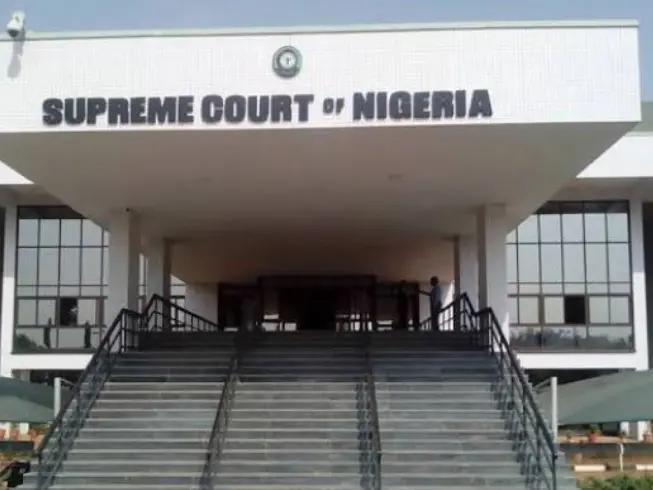
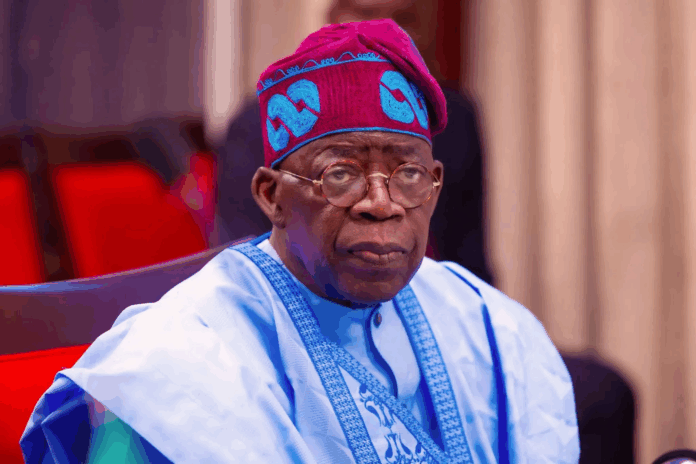
On 15 December 2025, Nigeria’s Supreme Court indulged in a dramatic demonstration of judicial power in a case in which it determined that it lacked jurisdiction on the facts. The dispute arose over the proclamation by President Bola Ahmed Tinubu of a State of Emergency in Rivers State on 18 March 2025. The declared duration of the emergency was an initial period of six months. In the proclamation, the president also pronounced the suspension of the elected governor and House of Assembly of the state.

At the time, the governor of Rivers State, Siminalayi Fubara – who has recently christened himself a lifelong “progressive” – was in supposedly retrograde company in the Peoples’ Democratic Party (PDP), on whose platform he was elected.

23 days after the emergency proclamation, 11 Governors elected on the platform of the PDP – naturally suffering from a profound bout of “there but for the grace of geography go I” – invoked the original jurisdiction of the Supreme Court to challenge the constitutionality emergency proclamation. Under Nigeria’s constitution, the Supreme Court is the final court of appeal in the country and most cases get to the court by way of an appeal from lower courts. However, the court also has original jurisdiction as a court of both first and final instance in legal disputes between the federation and states or between states among themselves.

When this case was filed, the emergency still had five months and one week to run. A Supreme Court which desired could easily have accorded it due priority and dealt with it expeditiously. The case concerning Local Government autonomy filed in May 2024 (which arrived the court by similar means), for instance, took only 45 days from filing to judgment on 11 July of the same year.

In this case concerning emergency rule in Rivers State, however, the Supreme Court chose a deliberately somnolent route to scheduling. Everything the court did subsequently appeared to have been underpinned by that imperative.

On 18 September 2025, the emergency proclamation in Rivers State became spent and the suspended institutions and officials were restored to office. By the time the Supreme Court found time to address the issues posed for it in the case three months thereafter, five of the 11 governors who filed the original action had relocated their party loyalty from the PDP to the president’s All Progressives Congress (APC). Two more would do so in the days immediately following the judgment. No one will ever truly know whether the jurisprudence of political coercion confirmed in this case had anything to do with the desperation of these gubernatorial acts of party political transfiguration.

After their judgment, the Supreme Court released an unsigned, 14-page media summary of the majority judgment of Mohammed Baba Idris, who led a majority of six of seven Justices. There followed a public race to unravel what the Justices had decided. The media reported that the Supreme Court had licensed the president to suspend elected state officials under colour of an emergency. Femi Falana SAN, provided a spin on the judgment from a segment of the legal profession initially in shock, which argued that the court did not go as far. In reality, it did that and much more and the initial media reports were very accurate.  

Five things are notable about the decision of the court in this case. First, in a mere four pages, all seven Justices made short shrift of the case as filed, declining jurisdiction on the basis that “the plaintiffs failed to disclose any reasonable or justiciable dispute between them and the federation capable of invoking the original jurisdiction of the court.”

At this stage, the job of the court was done. However, the Justices decided to “undertake a considered discussion on the scope and exercise of the powers” under the constitution concerning emergency proclamations. It is notable that the court framed what it undertook in the remaining two-thirds of its “summary” as a “discussion”, rather than an exercise in judicial decision making. Scholars and jurists will expend considerable froth in the years to come on the import of what may well become known as “Supreme discussion”.

Second, the court embarked on its self-appointed discussion by locating the bases of emergency powers in an invented doctrine of “a temporary expansion of federal powers” which lacks any foundations in the text or structure of Nigeria’s constitution. Indeed, emergency powers under Nigeria’s federal system are not an expansion of federal powers. On the contrary, they are contingent powers, ripe to be exercised upon the fulfilment of twin requirements of substantive and procedural compliance with constitutional pre-conditions.

Third, turning to the constitutional pre-conditions, the Supreme Court continued its disquisition by pronouncing the emergency proclamation in Rivers State as having fulfilled the substantive pre-conditions under the constitution.

Fourth, the Court turned to the procedural arithmetic preceding the emergency proclamation. Nigeria’s constitution requires an emergency proclamation to be sustained by a joint resolution supported by two-thirds majority of each chamber of the National Assembly. The court ruled that this implies that the voting “process adopted renders the attainment of the two-thirds majority clearly ascertainable.” In this case, the National Assembly used a voice vote to ram through its joint resolution in support of the emergency rule. The Supreme Court managed to see this as competent constitutional computation, not parliamentary voodoo.

Fifth, the Court discussed whether the president had the power under an emergency proclamation to suspend elected state officials, including the governor and legislators. It laid down one constraint to the effect that “emergency measures must be temporary, corrective, and proportionate”; and added that “any permanent displacement or abrogation of democratically elected institutions would constitute a constitutional aberration.” “Outside a validly declared state of emergency”, the court further discussed “the President possesses no power whatsoever to interfere with State executive or legislative institutions.”

It was an odd way to phrase arguably the most cynical and gratuitous expansion of presidential power in the history of the Nigerian Supreme Court. In other words, the Supreme Court clearly discussed its way to supporting the assertion by the president of a power to suspend any governor he does not like under colour of an emergency proclamation. It is also cynical because the court does not offer this as a decision but as a discussion, without even the ceremony of a declaratory import.

One of the seven Justices, Obande Ogbuinya, concurred in the decision that the court lacked jurisdiction but reportedly dissented on judicial tolerance of a presidential power to suspend elected state officials. Unlike the majority decision, the court did not bother to provide a summary of his dissent.

The decision of the Supreme Court to become a “discussion” forum on such an issue of extraordinary constitutional significance is guaranteed to roil governance and politics in Nigeria for a long time. As an exercise of judicial power, it supremely wilful, cynical, and political.

A lawyer and a teacher, Odinkalu can be reached at [email protected]

Demas Nwoko: A concrete thinker’s 90 dazzling years, By Max Amuchie

David Herbert Dale was a great artist, one of Nigeria’s greatest. He created artworks in beads, water colour, stained glass, etching and more.

I met Dale around 1998, when I got an appointment to interview him at his Adebola, Surulere Street, Lagos, residence for ThisDay Style. That first meeting marked the beginning of friendship that lasted for years and his house almost became a second home for me.

When Dale died on August 6, 2019 three months shy of age 72, I remembered our discussions which always centred on art. He belonged to a group in the Nigerian art community called the Zaria Art Society known to many people as the Zaria Rebels, and occupying a significant, magisterial position in that community of artists is Prof Demas Nwoko, internationally acclaimed artist, architect, designer and cultural icon, who is today marking his 90th birthday.

The Zaria Rebels were a group of art students at the Nigerian College of Arts, Science, and Technology (now Ahmadu Bello University), who fundamentally reshaped modern African art.
They led a “decolonisation” of the Nigerian art world, moving away from European imitations toward a style that felt authentically African.

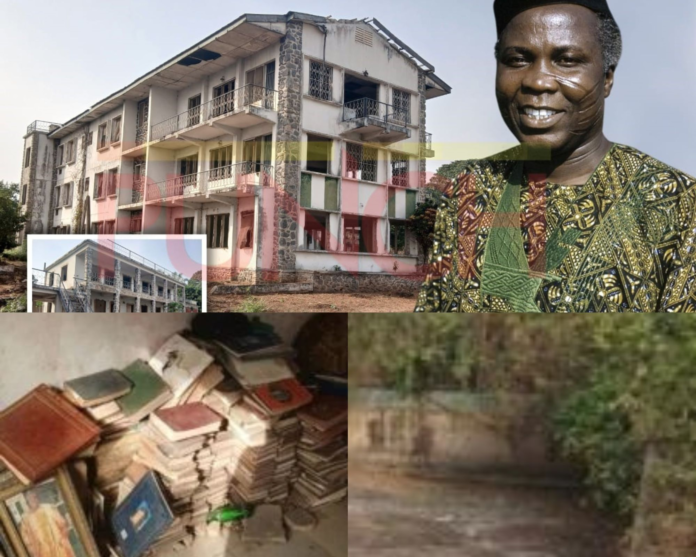
Demas Nwoko was born on 20 December 1935 at Idumuje Ugboko in Aniocha North Local Government Area of Delta State. His father, Obi Nwoko II, designed an architectural monument as his palace, among other building activities. This kindled his son’s interest in architecture from an early age.

But in 1957 he was admitted into the Nigerian College of Arts, Science and Technology to read fine arts, graduating in 1961.

The childhood love for architecture made him to pursue private studies in creative architecture from 1956 in Ibadan, Nigeria. He later moved to France where he first studied theatre architecture and design (scenography) at Centre Francais Du Theatre. At the Ecole Des Beaux-Art both in Paris, he studied Fresco Painting and architectural decoration from 1961 to 1962.

He became a pioneer staff of the School of Drama, University of Ibadan, Nigeria, teaching Designs, Directing and Applied Aesthetics from 1963 – 78.

He practised architecture alongside arts. Apart from private residences among his architectural and construction works are:
•The Independence Pavilion, 1960;
•The Dominican Institute, Samonda Ibadan;
•The New Culture Studios, Oremeji, Ibadan;
•The Oba Akenzua Centre for Arts and Culture, Benin City, Nigeria;
•The Benedictine Monastery, Ewu, Edo State;
•Pierce Chapel, Issele-Uku, Delta State Nigeria;
•Godfrey Okoye University, Enugu.

In art he carried out experimental production styles which resulted in ‘The Palmwine Drinkard’ for a travelling theatre troupe in 1963. This was also presented as Nigeria’s entry at the Pan African Cultural Festival held at Algeria in 1969.

He produced a dance play, ‘Dance’ which was presented at the first Negro Art Festival of Dakar, Senegal in 1966.

Demas Nwoko also produced a dance titled the ‘Olympic Dance’ and it became the Nigerian cultural presentation at the Olympic Games of Mexico 1968.

When Nigeria hosted the Second World Festival for the Black world, FESTAC in 1977, he presented another dance-play called the ‘Children of Paradise’.

In 1978, Nwoko left teaching at the University of Ibadan to establish the African Design Development Centre, a building component and materials development centre in his birthplace, Idumuje Ugboko. All theatre fittings for the Oba Akenzua Cultural Centre were designed and manufactured there. These include structural steel, wood works, theatre seats and some light fittings.

The Centre has trained and converted many artists, architects and technologists into entrepreneurs who produce culturally and industrially viable buildings, equipment and goods.

According to a statement shared by his daughter, Mrs Anyibofu Nwoko-Ugbodaga, Demas Nwoko along with other art giants like, Wole Soyinka, Chinua Achebe, Christopher Okigbo, J.P Clark (to mention a few) were pioneering members of the Mbari Club established in 1961 in Ibadan. It was a centre for cultural activity by African writers, artists and musicians. The Mbari Club became synonymous with optimism and creative exuberance of Africa’s post-independence era. It is worthy of note that it acted as the publisher of Black Orpheus magazine founded by Uli Beier in the 1960s.

Nwoko has been recognised and honoured internationally. One of such came in May 2023 when he received The Golden Lion for Lifetime Achievement at the International Architecture Exhibition of La Biennale Venezia, further cementing his global influence.
The Golden Lion for Lifetime Achievement is an award given at the Venice Film Festival. It is awarded to directors, actors and other personalities from the world of cinema who have distinguished themselves in the art.

In December 2023, he was invited to speak on architecture for the people and honoured at the Night of Ideas hosted by the Embassy of France in Nigeria and French Institute for research in Africa.

Even at an advanced age, Nwoko is still active, deeply engaged in design, writing, and mentorship. He founded The New Culture School of Arts and Design, dedicated to nurturing future generations of artists and architects. He has two published books—”Concrete Thinking” and “The Happy Little African Prince”—which give account of decades of artistic and architectural philosophy and offers an interesting account of his life and creative journey, respectively. This is a clear indication that he continues to shape global conversations on African creativity, architecture, and cultural identity.

Demas Nwoko, the nonagenarian, lives with his wife Eunice Nwoko and is blessed with five children, Adaoha, Ashim, Anyibuofu, Oluchukwu and Chibututu; 14 grandchildren and eight great grand-children.

39-year-old Ekiti teacher cries for help, after hospital surgery left him without kidneys

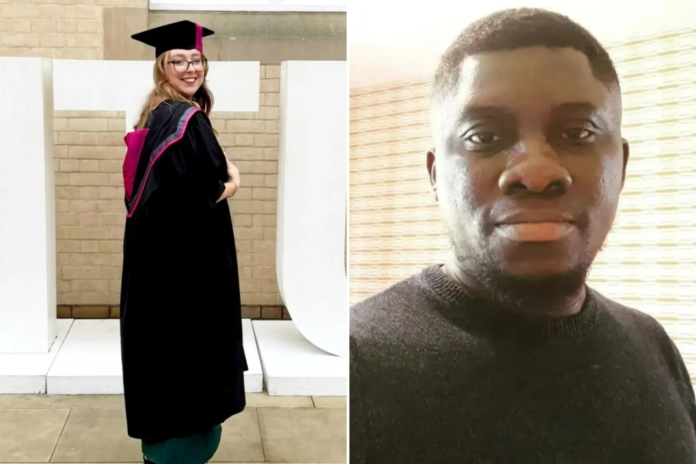
Although the Government of Ekiti State has ordered the dismissal of a surgeon at the Ekiti State University Teaching Hospital (EKSUTH) after a probe into claims that two kidneys of a 39-year-old teacher were removed without consent during surgery, the helpless teacher is crying out for help.

The surgeon’s dismissal followed the submission of a report by a seven-member Panel of Enquiry chaired by Professor Francis Faduyile, which was set up to investigate allegations by Joshua Afolayan, a staff member of the Ekiti State Teaching Service Commission.

Afolayan said he was admitted to EKSUTH in August 2025 after sustaining injuries in a road accident. According to him, medical tests showed that his right kidney was damaged and required removal, while his left kidney was healthy and functioning normally.

“I agreed to the surgery because we confirmed the other kidney was working 100 percent,” Afolayan said. “They were only supposed to remove the bad one.”

But after the operation, he said his condition deteriorated rapidly. Follow-up scans were allegedly withheld, raising suspicions that both kidneys had been removed. He said doctors later claimed he had a “horseshoe kidney,” an explanation he rejected, insisting multiple pre-surgery scans showed two separate kidneys.

“They were confused,” Afolayan said. “Later, they changed the story. That was when I went public.”

He said he now lives with chronic pain and depends on regular dialysis to survive.

“I want to live like others,” he said. “I’m 39 years old. I have a wife and three children. I want to eat, drink, urinate, sleep and take care of my family.”

In a statement signed by the Commissioner for Health and Human Services, Dr. Oyebanji Filani, the Ekiti State Government said the panel’s findings confirmed serious professional failures during the procedure.

The government approved the immediate dismissal of the surgeon who had primary responsibility for the operation. Other members of the surgical team present in the operating theatre were suspended for one month pending further administrative review.

The state also pledged to fund a kidney transplant for Afolayan and cover post-transplant care and related medical expenses for two years. In addition, authorities ordered a comprehensive reorganisation of relevant departments at EKSUTH to strengthen clinical governance, accountability and patient safety.

While rejecting claims that the incident involved organ harvesting, the government acknowledged that the case represented a grave surgical complication that warranted decisive sanctions.

“Following a thorough review of actions before, during and after the operation, it was confirmed without doubt that this was a case of surgical complication and not organ harvesting for rituals as alleged,” the statement said.

Hospital management, through Professor Jude Okohue, denied wrongdoing, insisting the medical team acted appropriately and provided emergency care, including blood transfusions from staff members.

The government said it remains committed to restoring public confidence in the state’s health system, warning that it would not hesitate to act where professional standards are breached.

Afolayan, however, said beyond free dialysis, he has received little intensive medical support and urged the state to move quickly, warning that further delays could be fatal.

Full List: As Nigeria, others are barred from U.S. green cards and citizenship

Following the proclamation signed by President Donald Trump on Tuesday, further restricting entry into the United States for nationals from countries deemed high-risk, the Trump administration has directed the US Citizenship and Immigration Services (USCIS) to suspend green card and citizenship applications filed by Nigerians and nationals of other countries newly added to the expanded US “travel ban.”

According to the US government, the decision was based on what it described as “demonstrated, persistent, and severe deficiencies in screening, vetting, and information-sharing” that pose risks to US national security and public safety. Citing national security concerns and an ongoing review of immigration vetting procedures, CBS News reported the development on Thursday.

Among the 15 additional countries newly subjected to partial restrictions is Nigeria.

Below is the full list of countries revealed to be affected by the suspension of green card and citizenship applications:

Countries affected

Full travel ban

  • Burkina Faso
  • Mali
  • Niger
  • South Sudan
  • Syria
  • Laos
  • Sierra Leone

Partial travel restrictions

  • Angola
  • Antigua and Barbuda
  • Benin
  • Côte d’Ivoire
  • Dominica
  • Gabon
  • Gambia
  • Malawi
  • Mauritania
  • Nigeria
  • Senegal
  • Tanzania
  • Tonga
  • Zambia
  • Zimbabwe

Previously affected countries

  • Afghanistan
  • Burundi
  • Chad
  • Cuba
  • Republic of the Congo
  • Equatorial Guinea
  • Eritrea
  • Haiti
  • Iran
  • Libya
  • Myanmar
  • Somalia
  • Sudan
  • Togo
  • Turkmenistan
  • Yemen
  • Venezuela

The latest suspension expands earlier restrictions announced in June, under which nationals of several countries faced partial limits on immigration processing. In the most recent proclamation, Laos and Sierra Leone — which previously faced partial restrictions — were upgraded to a full entry ban, prompting USCIS to extend the freeze on immigration petitions, including green card and citizenship applications.

PUNCH

Video: Court orders remand of Imo woman over savage abuse of 5-Year-old maid

A Chief Magistrate Court in Owerri, Imo State, on Thursday ordered the remand of a 38-year-old businesswoman, Mrs Juliet Igwe, at the Owerri Correctional Centre over allegations of grievous harm and attempted murder of her five-year-old maid, Onyinyechi.

Juliet Igwe had used candlelight to burn the victim’s private parts and inflict multiple injuries on her body.

She also used boiling water to peel off the child’s hands. 

Read Also: Nursing mother allegedly murders maid for watching TV with her children

Mrs Igwe was arraigned before Chief Magistrate B. U. Adikibe on a one-count charge of attempted murder by the Imo State Police Command, acting on the authority of the Commissioner of Police. 

The charge stems from an incident alleged to have occurred on November 25, during which the minor reportedly sustained severe physical injuries.

Read Also: Ugwuanyi offers scholarship, financial support to 10-year-old brutalized child

Police prosecutors informed the court that the offence is punishable by life imprisonment, prompting Magistrate Adikibe to rule that the court lacked jurisdiction to hear the matter. 

In line with this, she ordered that the suspect be remanded in prison custody and directed that the case file be transferred to the Director of Public Prosecutions (DPP) for legal advice.

According to information presented to the court, the child was allegedly left to wander in critical condition for several days before she was rescued.

The case drew public attention following the intervention of a human rights organisation, Stand For Humanity Foundation, which reportedly discovered the child in a dire state and facilitated her rescue. 

The group also assisted in the arrest of the suspect on December 4.

Led by activist journalist Chidiebube Okeoma, the foundation ensured the immediate admission of Onyinyechi to the Imo State University Medical Centre, Owerri, where she is currently receiving medical treatment. The organisation has continued to advocate for the child’s recovery and for accountability in the case.

Speaking briefly to journalists after the court session, Mrs Igwe expressed regret over the incident.

“I didn’t know that this child would be in such pains. I didn’t know. It is only God that will judge me. I don’t know what came over me. I have been crying and praying for God to heal Onyinyechi,” she said. 

Court remands Imo woman for burning 5-year-old maid

The 38-year-old businesswoman had candlelight to inflict injuries on the private parts of little Onyinyechi.

Before her arraignment, and while being paraded before newsmen, spokesperson of the Imo state command, SP Henry Okoye, revealed that apart from inflicting injuries on the minor’s private parts, she also used hot water to peel off the infant’s two hands and used candle wax to injure her body.

The suspects said her reason for inflicting the heinous injury was that the child stole meat from her pot. And that her action was to forestall future recurrence.

Senate confirms new oil regulators as Farouk Ahmed exits after explosive Dangote fallout

Following the resignation of Farouk Ahmed as Chief Executive of the Nigerian Midstream and Downstream Petroleum Regulatory Authority (NMDPRA), on the heels of the $5m school fees scandal raised against him by the Chairman of the Dangote Group, Aliko Dangote, the Senate has confirmed the appointment of Saidu Mohammed as the new Chief Executive Officer.

The Senate also approved the appointment of Oritsemeyiwa Eyesan as Chief Executive Officer of the Nigerian Upstream Petroleum Regulatory Commission (NUPRC), succeeding the resignation of its former boss, Gbenga Komolafe.

The confirmations followed the consideration and adoption of a report by a joint committee of the Senate, chaired by Senator Abdulrahman Kawu.

Presidential spokesman Bayo Onanuga had earlier disclosed that Gbenga Komolafe stepped down as Chief Executive of the NUPRC.

Following the resignations, President Bola Tinubu wrote to the Senate requesting the expedited confirmation of Eyesan and Mohammed to head the two petroleum regulatory agencies. The Presidency described the nominees as seasoned professionals in the oil and gas industry.

Read Also: $5m for children’s schooling in Switzerland by oil regulator reflects ‘economic sabotage’ in oil sector — Dangote

The controversy surrounding the former NMDPRA chief intensified after Dangote petitioned the Independent Corrupt Practices and Other Related Offences Commission, accusing Ahmed of corruption and financial impropriety. The petition, submitted through his lawyer Dr. Ogwu James Onoja, SAN, urged the anti-graft agency to arrest, investigate and prosecute Ahmed.

Dangote alleged that Ahmed lived beyond his means, claiming that four of his children attended secondary schools in Switzerland at a cost running into several millions of dollars. He alleged that about five million dollars was spent on their secondary education and upkeep over six years, in addition to about two million dollars on tertiary education. This included an alleged 210000 dollars spent in 2025 for a Harvard MBA programme for one of the children.

In the petition, Dangote listed the names of the children and the schools they attended and asked the commission to prosecute Ahmed in accordance with the law.

“We have no reservation that, being a matter that is in the public domain, the Commission will not close its eyes to it but act decisively to ensure that justice is done and the good image of the administration of President Bola Ahmed Tinubu is protected,” part of the petition read.

The ICPC confirmed receipt of the petition and said it would be duly investigated.

The dispute escalated further on Sunday when Dangote accused the NMDPRA leadership under Ahmed of economic sabotage. Speaking at a press conference at the Dangote Refinery in Lagos, he alleged that the continued issuance of import licences for petroleum products was undermining local refining capacity and sustaining Nigeria’s dependence on imports.

He also accused the regulator of colluding with international traders and oil importers to the disadvantage of domestic refiners. Ahmed, however, dismissed the allegations in a brief statement, describing them as unfounded.

“While I am aware of the wild and spurious allegations made against me and my family and the frenzy it has generated, as a regulator of a sensitive industry, I have opted not to engage in public brickbat,” he said.

How Tiger Base ‘demanded N15m’ to release father of two but still, killed Him

Isaiah Chukwuema, a father of two from Ebonyi State, was killed by operatives of the Anti-Kidnapping Unit of the Imo State Police Command, better known as Tiger Base, after his arrest 27 months ago, according to those familiar with the case.

Arrested on September 23, 2023, Chukwuema was kept incommunicado in a cell at the facility in Owerri, prevented from speaking with his wife, two kids and relatives.

The police unit alleged that he was an armed robber and kidnapper, dispossessing people of their vehicles and other valuables.

Abel, the suspect’s brother, told FIJ that the officers in charge of the case demanded N15 million for his release.

Read Also: My Tiger Base Owerri experience, By Chinedu Agu

Despite the allegations and the unit’s confident assertion that the suspect was involved in various crimes, they failed to produce him in court for a lawful prosecution.

Instead, he was kept in ‘Cell One’, which FIJ learnt is meant for suspects whose fate is death.

Abel, the suspect’s brother, told FIJ about the failure of the family’s efforts to secure his release or get the police to legally prosecute him.

“Even after involving Aboki Danjuma, the Imo police commissioner then; and the assistant inspector general of police at Zone 9 in Umuahia, the unit declined to obey the directives to arraign my brother,” Abel told FIJ on Wednesday.

FIJ earlier reported how Abel was detained at the facility for one month and six days after visiting his brother.

Chidi Igwe, an inspector, was the investigating police officer (IPO) over Abel’s case. A petition by Abel spurred Danjuma to invite him and the IPO into his office.

“Danjuma asked Igwe why I was detained, he said it was for investigation and that they had released me because they could not establish any case against me,” Abel said.

“The commissioner then directed Igwe to charge my brother to court. But this did not happen. My brother remained in the cell.”

According to the source, Isaiah was a car dealer. The police retrieved a vehicle they claimed belonged to a man who was robbed and murdered. But Isaiah told the police that the car was sold to him by a customer.

The police decided to use the suspect as bait to arrest the said seller, so they asked him to call the seller for another business.

“But the seller overheard their conversation in the background, got a hint of why my brother was calling and he escaped,” said Abel.

“My brother told the police he did not know the seller’s home address as their relationship was strictly business. On the day I was released, I bought garri, bread, water and other items for him and others in their cell. Until this point, I did not know the exact cell he was in.

“I just bought the groceries and told the policeman on duty who I wanted to give them to and he asked me to write down his name. When he said the name, he said Eeyah and you don’t know your brother is in this cell o.’”

He added that the police rebuffed the family lawyers’ enquiries about Isaiah’s presence at the facility until he paid N600,000 in cash.

“Even when lawyers were going there, they denied he was in their cell. Moreover, his name was not on the suspect board. They put him in ‘Cell One’, also called ‘Commander Cell’. Anyone inside it is not meant to live. If they put you in that place, you already know you are gone.

“The money made the officers allow people access to my brother. Considering their modus operandi, I doubt they are normal police officers because they take laws into their own hands.”

ISAIAH’s DEATH

Earlier this year, David Erinma, a lawyer, was at the station to press for the arraignment of Isaiah, but he received a shocking announcement from Oladimeji Odeyeyiwa, head of the station, known as ‘Commander Ola’.

“I don’t want to talk about it because I am highly disappointed in the police. It was an unfortunate incident when they said the guy was late. Where is his body?” Erinma told FIJ on Wednesday.

“Ola said it in the presence of Abel and Isaiah’s wife. Ola told us that we should not come to the station again. This is not a hearsay. I was there as their lawyer. Isaiah spent more than two years in detention. A lot of things are happening in that place.

“The CP even ordered the commander to charge the matter to court but he did not. My position as a lawyer was that they should take him to court with their evidence.”

Abel also corroborated the lawyer’s statement, adding that “they said my brother was sick and could not make it”.

“Was the family informed of my brother’s so-called sickness? Was the family informed of his death? And where was his body?”

Another lawyer who was also detained by Tiger Base in 2024 told FIJ he saw Isaiah in detention.

“I met Isaiah in the cell last year when I was in detention. When Abel went to check on him at Tiger Base and seek his bail, the police bundled him inside the cell and he spent over 1 month in detention before they released him after extorting huge amounts of money from him,” said the lawyer, who later challenged his own detention at the station in court and won.

‘I CAN’T TELL ABOUT HIS WHEREABOUTS’

Speaking on the phone on Thursday, Igwe, the officer responsible for the two brothers’ detention, said he could not tell FIJ where Isaiah was.

“There was a suspected murder incident in Imo State on August 16, 2023. The victims were one Akachukwu and Chubuike, who has not been seen since then but his vehicle was found with Isaiah in Edo State,” said Igwe.

“Before his arrest, he conspired with some people, attacked and killed one man. An autopsy was conducted. I have videos about all his criminal activities. Through tactical intelligence and the link we have with the Ebonyi State Police Command, CSP Bruno arrested Isaiah with the vehicle in Ebonyi.

“When the Ebonyi command could not get enough facts, they granted Isaiah bail and Abel stood surety for him. When we requested a transfer of Isaiah to us, they said they had released him.

“While they were making efforts to re-arrest him, he ran away, knowing what he did. They arrested Abel and handed him over to us. Four days after or thereabouts, we arrested Isaiah and released Abel.

“Isaiah confessed to the crimes in the presence of Abel, his wife and lawyer. I don’t want to talk much about this matter. The police authorities are going to react.”

When asked whether the suspect was prosecuted, Igwe said he did not want to tell FIJ “anything about it”.

“As I told you, if you want video evidence, I will show you the details,” he said.

This article was originally written and published by FIJ on 19.12.2025

Gains from Supreme Court state of emergency judgement 

By IfeanyiChukwu Afuba 

Finally, after nine months of waiting, the Supreme Court gave a verdict on the Rivers State emergency rule suit filed by some States against the federal government. Delivery of the judgment itself stands as the first victory for constitutional democracy. The action was filed by governors of eleven PDP controlled States on April 18, 2025, a month after the vexed suspension of democratic governance in Rivers State under guise of state of emergency. Perhaps, constitutional mandate vesting Supreme Court originating jurisdiction only on government versus government litigations, prevented Simnalayi Fubara, the elected Governor of Rivers State 

from instituting the action himself. If there was no legal constraint, vacillating Fubara did not seem willing to take the bull by the horns. He appeared concerned with survivalist maneuvers, focused on power – sharing deals rather than defence of democratic values. As a number of PDP governors succumbed to the APC’s power – flexing, decamping to the ruling party for cover, many wondered what fate awaited the suit. To complicate matters, the apex Court maintained shouting silence, bringing up the case for hearing, only after a stranger had acted as Governor of Rivers State for six months.

There had been widespread fear that the suit was not going to be heard. As illogical as it sounded, that was the feeling held by many. And that said a lot about the bewilderment with which Nigerians viewed the state of the nation. Season of anomie, Wole Soyinka, would have said in his less partisan days. Between Mohammudu Buhari’s contempt for the federal character principle enshrined in the Constitution, and President Bola Tinubu’s obsession with reelection, the reality of power was no longer lost on Nigerians. No one still says, it can’t happen here.

In 2007, Olusegun Obasanjo pulled the strings within his reach to become life President. Nigeria narrowly escaped being reduced to Paul Biya’s Cameroon, Yoweri Museveni’s Uganda and other political circuses of twenty – first century Africa. But the real assault lies not in the squalid scheme of self – succession. It is captured in the gimmickry by which the plotter in chief looks straight up and declares that no evidence shows a third term was attempted! In this climate of disorder, what would happen if the judiciary failed to pronounce on the emergency rule suit? Would you go to the present national assembly for intervention?

What do we make of the long – sought judgment? It represents a win for both the protagonists and antagonists of emergency rule. We will not be detained by the technicalities of law in our consideration of the judgment. With the English writer, Graham Greene, we opt to go for the heart of the matter. The contention was never about constitutionality of state of emergency but it’s practical meaning. The dispute, simply and squarely, is that the President does not have the power to suspend the Governor and or House of Assembly of a State, pursuant to state of emergency. After the conventional rigmarole of fair hearing of parties and juxtaposition of perspectives, the lead judgment addressed the substance of the matter.

It did so with a dose of doublespeak. First, the judgment affirms permissibility of the President to “interfere” with a State’s executive or legislative institution under emergency rule. The definition of interfere in the context is not given. The ensuing silence is aligned to the vague character of state of emergency in the Constitution. “Emergencies are inherently situational, varying in scope, intensity and threat. The Constitution therefore entrusts the President with discretion to determine the measures required to restore peace and security.” One thing is clear from the above. This declaration assigns a role to the President in State establishment, for the purpose of resolving emergency situation. According to the justices, the reality of this role is that it may interfere with constituted state authority.

Then, in another breath, the judgment laid out the incapacitation of the President on elected state authority even in the execution of emergency declaration. “No arm or tier of government is constitutionally superior to another, and none may lawfully usurp the powers expressly vested in another.” It went further to limit the President’s latitude on emergency measures. “The President’s discretion under Section 305 is not unfettered. Emergency measures must be temporary, corrective, and proportionate. They must be directed towards restoring constitutional governance, not extinguishing it.” 

Although this section of the majority judgment attempted to place restrictions on presidential emergency power, the boundaries it weaves around it, lack specifics. The judicial interpretations are imprecise; in fact elastic, as to throw up more questions on what were supposed to be answers to originating questions. It sounds contradictory to proclaim that the government of a State is inviolable and at the same time approve the intrusion of another tier of government in exercise of the same authority. 

How far does ‘interfering’ with state institutions go? Does interference cancel the existing order in the State? The act would cease to be interference if it sets aside the State’s constituted authority. Interference then would graduate from

involvement to usurpation. The jurists seem to have recognised the lacuna in their interpretation. A source of redress is presented in the submission: “The exercise of such powers remains subject to judicial review to prevent arbitrariness or abuse.” More questions. Was this review available when sought in the six months of emergency rule in Rivers State? Having come this far in determination of the application, was the appointment of a sole administrator “corrective, proportional (to the issue of checks and balances between arms of government)”? Was it “directed towards restoring constitutional governance?”

Mercifully, the dissenting judgment by Justice Obande Ogbuinya unequivocally held that the President is incompetent to suspend the government of a State of the federation. Constitutional provisions on state of emergency do not grant such powers. The verdict stands out for it’s brilliant and courageous contribution to Nigeria’s political civilisation.

Agreeing with this judicial interpretation comes naturally. Not even in a situation of war with another country does the 1999 Constitution prescribe the dismantling of democratic structures and institutions. The Constitution explicitly identifies resignation, death, impeachment, order of court of competent jurisdiction as the conditions by which the President or Governor vacates office. Nowhere in the several compilations is state of emergency listed as one of the ways of removing a Governor. 

It’s a point of irony that the same Supreme Court which views local government independence from States as a dogma does not see the current state of emergency model as an invasion by the federal government. On December 5, 2025, the Supreme Court had this to say in a case brought by Osun State against the federal government over local government funds. “Just as the federal government cannot interfere in the affairs of the States, being the second tier of government, the State government equally lacks the constitutional authorities to interfere in the affairs of the local government councils, which are autonomous bodies created by the Constitution” (The Nation.)

While many Nigerians consider the judgment on Rivers State emergency rule a case of closing the stable doors after the horse bolted, the belated intervention is still of some value. Concessions flowing from the engagement, however small, serve to shrink the ground of power abuse. The awareness, the pressure, the stakes on accountable democracy are building up. The APC – led federal government will think twice next time about embarking on a state of emergency trip. It was never about their being in doubt of the absurdity; but about political convenience, just as the PDP which made one of the most eloquent criticism of the highest Court’s judgment, had pontificated on the merits of emergency rule when it was in power. Democracy is alive when the people are not taken for granted.

The views expressed by contributors are strictly personal and not of Law & Society Magazine.

‘A true heroine’: How teenage girl shot in the Bondi Beach terror attack shielded children with her injured body as their mothers lay dead

Matilda's parents Valentina and and Michael attended a vigil for the victims on Tuesday night

A teenage girl caught up in the Bondi Beach massacre used her body to shield two children whose mothers lay dead nearby.

The 14-year-old was caught up in gunfire while attending ‘Chanukah by the Sea’ at 6.40 pm on Sunday when Sajid Akram, 50, and his son Naveed, 24, allegedly opened fire. 

The teenager was shot during the attack, but rather than trying to save herself, she stayed at the scene and shielded the children. 

The girl, who is in the hospital, has been hailed a hero in local social media groups. 

One post read: ‘A 14-year-old girl who was shot and injured in the deadly attack in Sydney, Australia, shared that after she was shot and injured, she lay over two young children whose mothers were murdered in the attack, thereby saving their lives.

Click here to continue reading.

TIPS