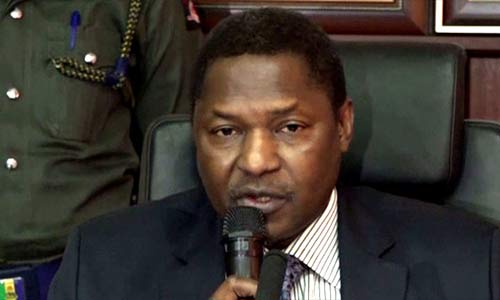
Barring any last-minute hitches, the Secretary of Nigeria’s Body of Benchers, Hajia Sadiya Turaki will tomorrow assume duties as the new scribe of the influential Federal Judicial Service Commission (FJSC).
Multiple and unimpeachable sources told CITY LAWYER that Turaki has been appointed by the commission chaired by the Chief Justice of Nigeria, Justice Tanko Muhammad as the new Secretary to replace Mr. Bassey E. Bassey who retired on September 23, 2020.
Turaki’s appointment is coming on the heels of allegations that the Nigerian Bar Association (NBA) may have been shut out of the appointment process, contrary to the provisions of Section 153(2) and 154(1) of the 1999 Constitution as well as Paragraph 12 Part 1 of the Third Schedule to 1999 Constitution.
While Paragraph 12 (6) Part 1 of the Third Schedule to the 1999 Constitution stipulates that the membership compositionof the FJSC shall include “Two persons, each of whom has been qualified to practice as a Legal Practitioner in Nigeria for a period of not less than fifteen years, from a list of not less than four persons so qualified and recommended by the Nigerian Bar Association,” CITY LAWYER gathered from impeccable sources that NBA has not participated in the decision-making process of the commission for over two years since the tenure of its former representatives ended.
Paragraph 13(c), Part 1 of the Third Schedule to the 1999 Constitution empowers the commission to “Appoint, dismiss and exercise disciplinary control over the Chief Registrars and Deputy Chief Registrars of the Supreme Court, the Court of Appeal, the Federal High Court, the National Industrial Court and all other members of the staff of the Judicial Service of the Federation not otherwise specified in this Constitution and of the Federal Judicial Service Commission.”
CITY LAWYER investigation shows that the last set of NBA representatives at the commission were Mr. Olumuyiwa Akinboro SAN and Hajia Fatima Kwaku (MFR) whose names were forwarded by then Chief Justice of Nigeria, Justice Aloma Mariam Mukhtar to former President Goodluck Jonathan for transmission to the Senate for confirmation. Their five-year tenure ended on 3rd July, 2018.
A source who is familiar with the matter told CITY LAWYER that though the immediate past NBA President, Mr. Paul Usoro SAN made spirited efforts to ensure NBA’s representation at the commission, such efforts did not yield fruits. The source stated that though Usoro had on at least three occasions submitted the list of NBA nominees to the Chief Justice of Nigeria, there are strong indications that the list was not transmitted to the Senate through the President for approval. CITY LAWYER also gathered from unimpeachable sources that the names of two NBA nominees are still currently pending at the all-important commission.
Though CITY LAWYER sought the views of NBA President, Mr. Olumide Akpata on the development through a short messaging service and WhatsApp message to his verified telephone number, he promised that “I will call you back shortly” but was yet to do so at press time.
Aside from NBA representatives, the commission’s membership comprises of the Chief Justice of Nigeria, who shall be the Chairman; President of the Court of Appeal; Attorney-General of the Federation; Chief Judge of the Federal High Court; President of the National Industrial Court, and “Two other persons, not being Legal Practitioners, who in the opinion of the President are of unquestionable integrity.” The non-lawyers are Senator Abba Ali and Malam Mohammed Sagir. However, only NBA is currently unrepresented in the 9-member commission.
The commission’s Secretary doubles as its Chief Executive and Accounting Officer.
The Gazette has uncovered a hiring anomaly that could potentially tip the ethnic and religious balance of national security in favour of a section of the country for decades.
Director-General Yusuf Bichi has activated a lopsided hiring process that could overfill the State Security Service with personnel from the northern parts of Nigeria, Peoples Gazette can report based on official documents and contributions of senior intelligence officials.
The Gazette’s findings obtained over a period of two weeks show that the North has a massive share of the roughly 1,300 Nigerians currently undergoing cadet training at two different camps of the secret police in Lagos and Bauchi.
Of the total 628 cadet trainees who had resumed at the Bauchi facility as of September 23, 535 identified themselves as trainees joining the service from either the Northeast or the Northwest. Only 93 were from either the Southeast, South-South, Southwest or North-Central, according to recruitment filings sighted by the Gazette.
The Gazette’s findings also show that at least 71 of those currently undergoing cadet training hail from Bichi Local Government Area, Kano State — the director-general’s home local government area. Officials said the number was more, but the Gazette could not independently confirm the higher figures — as well as a slew of other disturbing allegations of bigotry against Mr. Bichi — prior to this publication.
The list of candidates was not compiled by state, but officials believe a state-by-state breakdown would exist at the headquarters in Abuja.
In Lagos, the Gazette was unable to obtain official attendance records of trainees at the camp in Ojo, but multiple participants, including senior officials, said Mr. Bichi disregarded the federal character concept and skewed the process for Nigerians from the North.
A top official estimated 708 trainees were at the Lagos training facility as of September 26. Officials were unsure how many people were taken as cadet trainees in total because some were still arriving three weeks into the six-month exercise.
Senior intelligence officials said even though the sectional disparity mirrors Nigeria’s reality under President Muhammadu Buhari, they are, nonetheless, worried that the development could potentially tip the ethnic and religious balance of national security in favour of a section of the country for decades.
“Some of us are worried less about the audacity of focusing on one part of the country to bring in new cadets than we are about its long-term implications,” a senior SSS official told the Gazette via a secure video channel last week. “We know he might find it difficult, but the DG would leave a better legacy if he sees himself first as a Nigerian.”
All SSS officials who provided documents and inside information about Mr. Bichi’s sectional recruitment drive did so under strict anonymity, citing grave personal and career risks. The Gazette agreed not to name them in line with its editorial policy on anonymous sources.
Man and moment meet
In July, the Yellow House sent out a memo to all state and FCT commands, informing them that Mr. Bichi had ordered a fresh round of recruitment for the agency’s next generation of intelligence officers.
Mr. Bichi directed that each state command should conduct a rigorous selection process and forward four successful candidates to the headquarters for possible admission into the service. The DG also imposed strict entry guidelines for every potential recruit, according to the July 6 memo obtained by the Gazette.
The directive also cancelled a 2018 recruitment process that was underway at the time, but said those who were successful in that process may join the fresh exercise.
Mr. Bichi emphasised that the four candidates for each state must be below 30 years of age and be selected across the three senatorial districts that make up a state.
The Gazette confirmed that all commands complied with the directive, conducted a thorough selection of four candidates and sent the results to the headquarters.
But shortly after the candidates were cleared and sent to the headquarters before the July 15 deadline contained in the memo, Mr. Bichi seized the moment and initiated a recruitment process of his own, the Gazette learnt.
On September 1, Mr. Bichi told a few officials at the Yellow House to call people from a prepared list and offer them a role at the SSS. Those who were called were immediately asked to go to the Lagos or Bauchi training school, officials said.
Starting September 8, cadet candidates reported for training in Lagos and Bauchi, in some cases without the awareness of the director of state security in the state they applied from, documents and officials said.
“I just heard that some people from the state where I work, including some who did not make the cut for the four candidates we selected and passed to the headquarters, had reported to the training school either in Lagos or Bauchi,” an SSS chief said.
“Based on the four-per-state arrangement, only 148 people should have been employed across 36 states and the FCT,” the SSS chief said. “But we suddenly discovered that training schools in Lagos and Bauchi had over 1,300 between them.”
Mr. Bichi kept the list of those he had been sending to the training school secret, officials said. It was unclear how many people he intended to recruit, but they kept showing up.
Resume now, train later
Mr. Bichi has kept the process largely to himself, making it difficult for insiders to access his list or the criteria with which he was selecting cadet candidates, officials said.
For a long time, the SSS did not admit candidates who had a third-class university degree or lower into the service. Only those who did well in university and polytechnic were admitted as a security intelligence officer (level two), equivalent to an assistant superintendent of police.
SSS Headquarters, Abuja
In recent years, however, the service has been admitting candidates who graduated with a third-class, but it has been placing them on a rank below that of a security intelligence officer, officials said.
In Bauchi, some of the candidates were asked not to bother checking in for training at all, the Gazette learnt.
In at least one case, a candidate was asked not to go to Bauchi for training, but to resume directly at the SSS state command in Kano, the Gazette learnt.
A female third-class graduate resumed at the Kano State field office of the secret police on September 22 without undergoing training. Her employment letter said she should resume immediately as a cadet officer but go for a basic course training in 2021.
The Gazette’s findings show that the woman is also from Bichi Local Government Area. Her identity was redacted based on legal considerations.
In Lagos, the 708 candidates undergoing training are so many that some lecture halls have been converted to hostels, the Gazette learnt. The facility was not sufficiently equipped to take in as many trainees at once, officials said.
Catching up
Mr. Bichi’s regional recruitment agenda came three years after his predecessor implemented a similar hiring process that failed to reflect Nigeria’s diversity.
In 2017, Premium Times revealed how the 479 cadet officers that were commissioned from the 2016 recruitment exercise were substantially from the North. Lawal Daura was in charge of the SSS at the time.
Former Director General of the State Security Service (SSS), Lawal Daura
The SSS did not respond to the report because it had no substantive spokesperson at the time. But a spokesman for Mr. Buhari justified the lopsided hiring as a deliberate measure to correct an existing regional imbalance in the service.
Although the administration’s statement at the time was widely ridiculed as false, officials told the Gazette it is largely true that the SSS has more officers from the southern parts of the country.
Mr. Daura’s lopsided recruitment was never rescinded, although Nigeria is roughly split by population and religion between arid North and tropical South.
“It is true that there are more southerners in the service,” an official said. “But that is partly because more southerners were enlisting when the service was using stringent criteria.”
Since Mr. Buhari assumed office, however, more Nigerians from the North have been employed into the service, and officials said would soon outnumber southerners among the staff. Mr. Bichi has conveniently seized the general atmosphere of the administration to implement his own vision.
“At this rate, all we need is a short time,” the official said. “No one in service is really against having more officers from the North, but it has to be based on merit and equity.”
Officials also said Mr. Bichi, Mr. Daura’s long-time associate, was determined to take in as many people as he could before the country’s central government returned to southern control.
“He is determined to put many northerners in the system so they can be quickly regularised and firmly ingrained in the system before a southern president takes over,” an official said. “They will quickly become line managers and ready to take commanding roles anywhere they are posted to serve.”
“Those of us in national security practice know that Nigeria is controlled by the SSS and the Nigerian Army,” the official said. “It might sound controversial and it might change in future, but it is the reality today.”
‘One Nigeria’
The SSS declined multiple requests for comments from the Gazette for this story. Its spokesman, Peter Afunanya, repeatedly promised but failed to get back after seeing messages from our reporters.
President Muhammadu Buhari
Lopsided hirings were reported against previous administrations, but Nigerians are getting increasingly alarmed by how brazen and widespread they have become under Mr. Buhari.
Despite apparent imbalance in his appointments, Mr. Buhari has vigorously rejected criticism of a sectional agenda, often finding enough anecdotal evidence to advance his own narrative.
Officials said Nigeria’s overall interest would have been better served had Mr. Bichi allowed its diversity to guide his hiring policies.
The country will celebrate 60 years as an independent and united entity on October 1, and the administration has already unfurled a new emblem for the occasion.
An apparent reluctance of the political elite to rein in a tendency of bigotry amongst Mr. Buhari’s top aides has deepened fissures across ethnic and faith lines, said public affairs analyst Liborous Oshoma.
“It is quite shameful and unfortunate that Nigerians who were known to be vociferous are now quiet, leaving the ruling government to continue its divisive tactics unchecked,” Mr. Oshoma said. “We have now become so docile in the face of glaring inequality and nepotistic practices.”
Mr. Oshoma, a Lagos-based legal practitioner, said everyday Nigerians are not inherently bigoted, but many still take their cue from selfish political figures.
“Those who are oppressing us are fewer than those of us being oppressed,” Mr. Oshoma said. “Our leaders should be uniting us on the basis of equity, justice and fairness, rather than creating division and fanning the embers of discord.” (peoplesgazette)
LAWBREED ACADEMY is the educational and training arm of LAWBREED LIMITED, the authorized publishers of the official Law Report of the Supreme Court of Nigeria- SUPREME COURT REPORTS (S. C. Reports) invites you to a Webinar Seminar:
The objective of this webinar is to host a conversation to further enlighten lawyers on how to manage/handle some key issues of life, such as creating and managing wealth and doing so living a balanced life. A general and prevalent feeling of despondency no doubt can negatively impact justice delivery, so the need to do what we can in our own little way
Topic:MONEY MATTERS AND THE LAWYER’S WELL- BEING series 2
Date: 3rd of October, 2020
Time: 5-7 pm WAT
Our Panelists include:
Mrs. Toyin F. Sanni: GCEO, Emerging Africa Capital Group, and President CIIA
Dr. Maymunah Yusuf Kadiri: Consultant Neuro Psychiatrist, C.E.O Pinnacle Medical Services.
Mr. Ajibola Olomola: Partner & Head Deal Advisory, M & A, Tax Services KPMG in Nigeria
There is something strange about the way many people who are below 30 years introduce themselves in speech and in writing these days. During an interview for a job or other issues, if you ask the interviewees to introduce themselves, you would most likely hear something like: “My names are Balogun John.”
The first strange issue is that of one person saying “my names are”, implying that the person has many personalities or identities. Only people with a shady character have many identities. The second issue is that of saying the surname first and saying the first name last, thereby confusing the listener.
The challenge these days is that when one hears or sees a name, one cannot easily know which is the first name or surname. For those whose names contain names that are regarded as traditional surnames, it may be easier to decipher which is the surname, but for some other people, it may not be easy. Imagine a young man whose name is Ikenna Chukwuemeka or Ayodele Olayinka or Hassan Musa or John Emmanuel introducing himself this way. For you to ascertain which is his first name or surname, you have to ask him to clarify that. But it is not all the time that someone has the opportunity to ask the owner of a name to make this type of distinction. That is why a standard way of writing one’s name was developed a long time.
When you write your name, which should come first: Surname or first name? The answer is evident. Your given name is called your first name. It should always come first.
Question: “What is your name?”
Answer: “My name is Azuka Onwuka,” not “My name is Onwuka Azuka.”
Your surname or family name is also called “last name,” because it is meant to come last. If you write a book or publish an article in a newspaper, your first name or initials come first while your surname or last name comes last.
Remember that you grew up hearing of William Shakespeare (not Shakespeare William), Chinua Achebe (not Achebe Chinua), Wole Soyinka (not Soyinka Wole), Nnamdi Azikiwe (not Azikiwe Nnamdi), Florence Nightingale (not Nightingale Florence) Abraham Lincoln (not Lincoln Abraham), Dele Giwa (not Giwa Dele), Diego Maradona (not Maradona Diego), Michael Jackson (not Jackson Michael), James Bond (not Bond James), etc.
However, when names are written alphabetically on a school list, bibliography, voter register, recruitment list, etc, the surname may be written first by those compiling the list, to make it easy to locate people’s names. But note that whenever the surname comes first, something MUST happen: a comma must come after the surname, or the surname must be in uppercase.
Example:
Abdulsalam, Ahmed Sanni
Balogun, Temitope Yinka
Onwuka, Azuka P. I.
Osagie, Aifuwa Omoh
Yala, Pam Dalong
Or
ADAM John Thomas
BENSON Jane Mary
CLINTON Robert Peter
The trend among those who are under 30 to always introduce themselves or write their names with the surname first is queer. First name is called first name because it is meant to come first.
Based on which is your surname, someone will know how to address you officially. If you introduce yourself as Rashidi Yekini, the person can then address you as Mr Yekini, not Mr Rashidi. When only one name is used with your title, it has to be with your surname, not your first name: Mr Onwuka, Miss Akpabio, Mrs Jonathan, Alhaji Jakande, Professor Usman, Chief Lar, etc.
Furthermore, on the issue of whether to say: “My name is Azuka Onwuka” or “My names are Azuka Onwuka”, let it be reiterated that each human being has only ONE name.
Please take a look at these two expressions:
Edson Arantes do Nascimento
Mobutu Sese Seko Kuku Ngbendu Wa Za Banga
The first is the real name of the great footballer Pele of Brazil. The second is the full name of the former president of Congo when it was known as Zaire. However, in spite of the length of the names, each of them is ONE name. Pele has ONE name and Mobutu has ONE name.
You should never ask someone: “What are your names?” And you should never tell someone: “My names are….” You are one person, not two or more people.
Yes, like most people, you may have a number of identifiers under your name, but they all form a unit known as your name. You can break them down into first name (or given name), middle name (second name), third name, fourth name, and surname (or family name or last name). But you only have ONE name and nothing more.
Some factors have made this issue of writing the surname first prevalent now. The first reason is the practice of emphasising the surname in schools. It has always been the practice that teachers address their students by their surname: “Onwuka, come here. Where is Akpabio?” But based on the feedback I have received from my probe into the matter, many teachers these days specifically teach their students to introduce themselves with their surname first.
The second reason is that even when teachers have not expressly told their students to always write their surname first, they have not clearly made the students to understand that outside the school environment, they should introduce themselves first with their first name. There is no distinction made about how one should write one’s name when filling a form and when introducing oneself.
There is also the factor of the rise of the Internet. There is a rise in the number of places where one can fill one’s details online. There are email accounts to create, social media accounts to create, and different websites to register with for one thing or the other. In addition, the banks also lay emphasis on surnames in the opening of accounts and issuing of the ATM cards. Agencies that provide identification documents like the passport, driving licence, voter card, national identity card and company’s identification cards lay emphasis on the surname too.
However, in spite of all the challenges in the environment on the issue of the order of names, the first name still remains the first name, while the surname still remains the surname. If any institution requires the surname to be written first while filling a form, give it to them in that format. But do not let that confuse you to introduce yourself or have your name displayed on your social media platforms with your surname before your first name, unless you clearly mark the surname off with a comma. That is the standard way. In addition, even though you may have a first name, a middle name and surname, you have only one name. Therefore, you should not ask someone: “What are your names?” or introduce yourself with: “My names are ….”
These issues should be taken seriously by teachers from the primary school to the university, because when it comes to learning, teachers wield the biggest influence on children. To most children, whatever their teachers say is right is what is right.
Some residents of the twin Congolese capitals of Brazzaville and Kinshasa have long been known for their love of stylish dressing – in particular members of the Society of Ambience-Makers and Elegant People (Sape). These photographs by Tariq Zaidi reveal a whole new generation of “sapeurs”.
In the Democratic Republic of Congo’s capital Kinshasa, the son of famous sapeur Fiston Mahata, eight-year-old Natan, represents the new generation of style.
Across the River Congo in Brazzaville, 10-year-old Okili Nkoressa, middle, uses the dirt roads as his catwalk. “My favourite item of clothing is my Yves Saint Laurent suit which I am wearing today,” he says. He is accompanied by veterans of the Sape scene, 52-year-old businesswoman Ntsimba Marie Jeanne, left, and 39-year-old policewoman Judith Nkoressa, right.
Severin Mouyengo’s father was also a sapeur. “I Sape every day. It makes me forget about everything,” says the 62-year-old retired forester.”It brings peace and tranquillity to everyone… I don’t see how anyone in La Sape could be violent or fight. Peace means a lot to us.”
Elie Fontaine, a 45-year old taxi-owner says he started dressing in suits as a child in 1982. “They used to tell us that Sape was just a form of ‘juvenile delinquency’.”They gained international fame in 2014 when their style was featured in a Guinness advert.
“For me Sape is an art, Sape is a discipline, Sape is a job” says Maxime Pivot Mabanza, who has been a sapeur for 36 years.
Perreira Franchisco, a 37-year-old computer consultant in Brazzaville, calls himself “the greatest sapeur”.”I will now demonstrate, what is known as a clothing equation with 2 or 3 elements. So I will be wearing a Kenzo suit, made in Italy, with a backless vest by Jean Basinga, I’ll wear a tie blue, white, red by Pierre Cardin and a pair of varnished tectonic shoes by John Foster. I love wearing my Kenzo suit – made in Italy!”
More and more women are joining the dapper dressers, including 44-year-old businesswoman Ella Kiadi who started eight years ago.The women in the club are known as sapeuses.
Some women started decades ago, including 52-year-old housewife Clementine Biniakoulou, who has been a sapeuse for 36 years.
“It’s like someone who has an incurable disease and must take medicine, that’s what Sape is like,” says Nino Valentino.
Human resources manager Basile Gandzion, 51, has been a sapeur for 30 years.
“Out of all my clothes my favourite item of clothing is my hat,” says 58-year old bricklayer Yamea Bansimba. He has been a sapeur for 50 years.
“Jika is here. The clothes inspector, I have arrived, all the labels are here. A Y3 skirt, Zara and other labels, crocodile shoes, 40 cm socks, do you feel me. I am here, Jika the Parisian,” is how 28-year-old Serge Bakama Boke – aka Jika – introduces himself.
image captionSome start young with the sapeur style, like five-year-old Israell Mbona, in the red hat.
At just five years old, Israell Mbona (right) has been a sapeur for three years. Even at his young age, his kilt is from Scotland and his shoes are Versace.Photographer Tariq Zaidi’s book Sapeurs: Ladies and Gentlemen of the Congo is published this month.(BBC)
Reverend June Major has been fighting for justice for 18 years, ever since she says she was raped by a fellow South African cleric.She has undertaken various unorthodox protests in a bid to get the Anglican church of Southern Africa to open an investigation into her case and others.On 9 August 2020, South Africa’s women’s day, Rev Major was among several women and activists who hung up underwear along the fence of the residence of the Archbishop of Southern Africa, Thabo Makgoba.
The women were protesting against what they said was inadequate action from the church over allegations of sexual misconduct by priests in the Anglican church of Southern Africa, including one who Rev Major says raped her.”My fight isn’t against the church, it’s against the hierarchy and patriarchy that silences women, who tells us to keep quiet and who finds fault with us and allows the perpetrator to continue doing what they are doing,” she told South African media.But this was not the first time Rev Major had protested against the church’s alleged silence on the issue.
‘I was willing to die’
In 2016, Rev Major went on her first hunger strike.Four years later, in July this year, she went on another hunger strike, this time camping next to 20 Bishopscourt in Cape Town, the official residence of Archbishop Makgoba.”I was willing to die on that pavement, not only for myself, but for every woman and child who’s been denied justice,” she told the BBC.According to Rev Major, she was attacked in 2002, while visiting a seminary.Rev Major says the priest entered the room where they were being hosted by one of the families at the seminary and attacked her.”I fought him off but at some point he had his hands around my throat. I didn’t scream because there were children in the house. He left when he was done.”I was shaky and frightened after. I just wanted to die. I called our other friend and told him what had happened,” she explains, adding that her attacker came back a second time and only left after she told him that their friend knew about the assault.
A life of silence and fear
Since the attack 18 years ago, Rev Major says she has been living in misery.”[A] friend advised that we should keep the matter between ourselves and my rapist promised he would never attempt such a thing again. I agreed since in a few months’ time we would be living in separate towns and I thought that was enough closure.”However, two years later, Rev Major decided to ask the church to have the matter investigated.”I was again advised to keep quiet. I agreed, thinking I needed to protect the name of the church, an institution I loved very much. Unfortunately the silence took its toll on me.”Rev Major says she has constant nightmares and has a fear of staying in rooms that can’t be locked, sometimes even sitting with her back against doors that can’t lock.”I never let people get too close to me, let alone men, because I was hurt by someone I considered close,” she says.
Church accused of hypocrisy
It was only after someone she knew was involved in a rape case that Rev Major went public with her story, hoping that she would get some form of healing and inspire other victims to get the courage to report their attackers.She first took her fight for justice to the police to open criminal proceedings but that did not bear any fruit.She then took it to the church not only with the hope that the church would look into her alleged attack, but would address other allegations of sexual abuse.She says the reaction she got from the church was further silence, prompting her to go on her first hunger strike in 2016. Only then, she says, did the church react – on the the seventh day of her hunger strike, the church administration promised to look into the matter. Rev Major, however, says nothing came of the promise.The church says it urged her to ask the police to re-open investigations.On 1 July, four years after her first such action, she says she felt compelled to go on another hunger strike, after what she felt was hypocrisy on the part of the church.
image captionReverend Major set up camp opposite the archbishop’s residence during her hunger strike
“That same year I went on my first hunger strike, I lost my income as a priest. I wanted to move to a new job in Australia and hence resigned from my post. However, I needed a letter of recommendation to be able to start my new job.”My letter, which initially had been promised, never came and I haven’t been able to work as a priest ever since,” says Rev Major.She then opted to sue the church for loss of income. The matter is still in court.”What angers me is that the archbishop speaks up against sex- and gender-based violence, and patriarchy, yet the reason I am where I am is because of inaction from the church.”It’s sad that as a woman you have to go to such extremes and put your body in danger, but I needed to speak to Makgoba to know what he would do about it [the rape case] and demand an internal investigation and some kind of justice,” she says.
What the church says
Six days after Rev Major went on hunger strike, she agreed to call it off after meeting Archbishop Makgoba.He told her to put her demands in writing via email.”The following Monday, the archbishop responded to me saying that they will start a disciplinary hearing and contact the prosecutor in the town the rape took place to re-open the case. Based on that, I stopped my hunger strike.”
image captionArchbishop Thabo Makgoba (second L) met Reverend Major (third R) several times during her 2020 hunger strike
The church emailed her, saying it was “committed to ensure that the matter is addressed with the seriousness it deserves”.On its website, the Anglican Church of South Africa says it outlined the standards expected of clergy and office bearers in 2002. This was in a bid to address “the many forms of abuse of power that often affected women and children”.In 2018, a framework was put in place to address complaints and “create a safe church and in 2019, committed itself to create spaces where justice and restoration can take place”.
However, two years later, Rev Major and other gender activists hung underwear at the archbishop’s gate in protest at what she termed a conflict of interest by members of the safe church committee, who are also members of the Anglican church tasked to investigate her case.In a statement released on her Facebook page Rev Major said: “I believe that an investigation conducted by people who are on the payroll of, and aligned to the Church, would only serve to further victimize me.”She wants the investigation to be carried out by an independent body. She has resolved this with the church and has agreed to go through with the process.The church released its own statement, saying that Rev Major was free to hire lawyers and that the church was even willing to help her get support, should it deem it necessary.Additionally, the church says that in response to Rev Major’s concerns, it has “included a reputable part-time commissioner of the Gender Commission on the panel which will investigate her [Major’s] complaint. It is hoped that this will provide her with an added level of trust and comfort with the process”.
Past accusations
The Anglican Church of South Africa has faced several cases of sexual misconduct by its priests.
image captionArchbishop Makgoba has acknowledged that members of the church have previously been accused of sexual abuse
In 2018, award-winning South African author Ishtiyaq Shukri wrote an open letter stating he had faced years of sexual abuse at the hands of Anglican priests as a child.Archbishop Makgoba apologised on behalf of the church for what he called past wrongs and the failure to address sexual abuse claims. Days later he revealed that several other victims had come forward, accusing some of the church’s priests of sexual abuse.The church has also announced other cases that are being looked into.Rev Major has said that she is open to going through the Anglican church’s investigative process.In a statement, she said it was important for her and for the church that justice be served.She said she had often considered pursuing the matter through the courts, rather than the church “but God made the calling on my life in the Anglican Church and that is where I believe He still calls me to be of service as His humble servant.”
What links pop stars like Rihanna, Cardi B and Davido? You might be surprised to find that it is Sudan. All of them have been posting on social media about the killing of protesters in Khartoum who want the army to hand over power to a civilian government but how helpful is it to the demonstrators’ cause? Sara Alhassan is a Sudanese-American writer and editor in Arizona.
Omar al Bashir ruled Sudan for thirty years, surviving civil wars, the secession of South Sudan, and even an indictment by the International Criminal Court. He was brought down in April by peaceful protests provoked by anger about the state of the economy and decades of repression. There is a civilian government now, though the military retains significant influence. The revolution has changed the future direction of Sudan, and those who may reap the benefits are the youngest in the society, the children. Newsday’s James Copnall has been talking to12 and 13 yr old girls at the Khartoum International Preparatory School to find out their vision for the future. (Photo: School assembly at Khartoum International Preparatory School. Credit: BBC)
Sudan is changing. Former President Omar al Bashir was forced out by peaceful protests earlier this year. Following an agreement between the protesters and the military, a civilian government was set up. The presidency was replaced by a Sovereign Council, composed of 5 soldiers and 6 civilians. There are two women on the council – each achieving an unprecedented level of influence for a woman in Sudan. Newsday’s James Copnall had the rare opportunity to speak to one of them, Aisha Musa. She is a teacher, translator and women’s right activist who is now one of the most powerful people in the country. However, that hasn’t spared her from some awkward encounters… (Photo: Aisha Musa. Credit: BBC)
Three female lawyers have written to the Chief Judge of the Nigerian Federal High Court asking him to take action against the sexual harassment of women working in the courts – and to make sure women are given equal treatment to men.
In 2012 the then-Chief Justice of Nigeria said that women lawyers should not feel pressurised to declare if they’re married or not in court – but the practice still continues.
Gloria Ballason was one of the authors of the letter and is CEO of the House of Justice, a human rights radio call-in programme.
“Asking females to identify if they’re Miss or a Mrs is in itself problematic because that kind of comment is not needed for the male lawyers… You feel like you’re cattle for sale or taken so you feel objectified as a lawyer.”
Our site uses cookies. By clicking “Accept All Cookies”, you direct Law and Society Magazine to store cookies on your device and disclose information in accordance with our Cookie Statement: cookie policyACCEPTREJECT
Privacy & Cookies Policy
Privacy Overview
This website uses cookies to improve your experience while you navigate through the website. Out of these cookies, the cookies that are categorized as necessary are stored on your browser as they are essential for the working of basic functionalities of the website. We also use third-party cookies that help us analyze and understand how you use this website. These cookies will be stored in your browser only with your consent. You also have the option to opt-out of these cookies. But opting out of some of these cookies may have an effect on your browsing experience.
Necessary cookies are absolutely essential for the website to function properly. This category only includes cookies that ensures basic functionalities and security features of the website. These cookies do not store any personal information.
Any cookies that may not be particularly necessary for the website to function and is used specifically to collect user personal data via analytics, ads, other embedded contents are termed as non-necessary cookies. It is mandatory to procure user consent prior to running these cookies on your website.