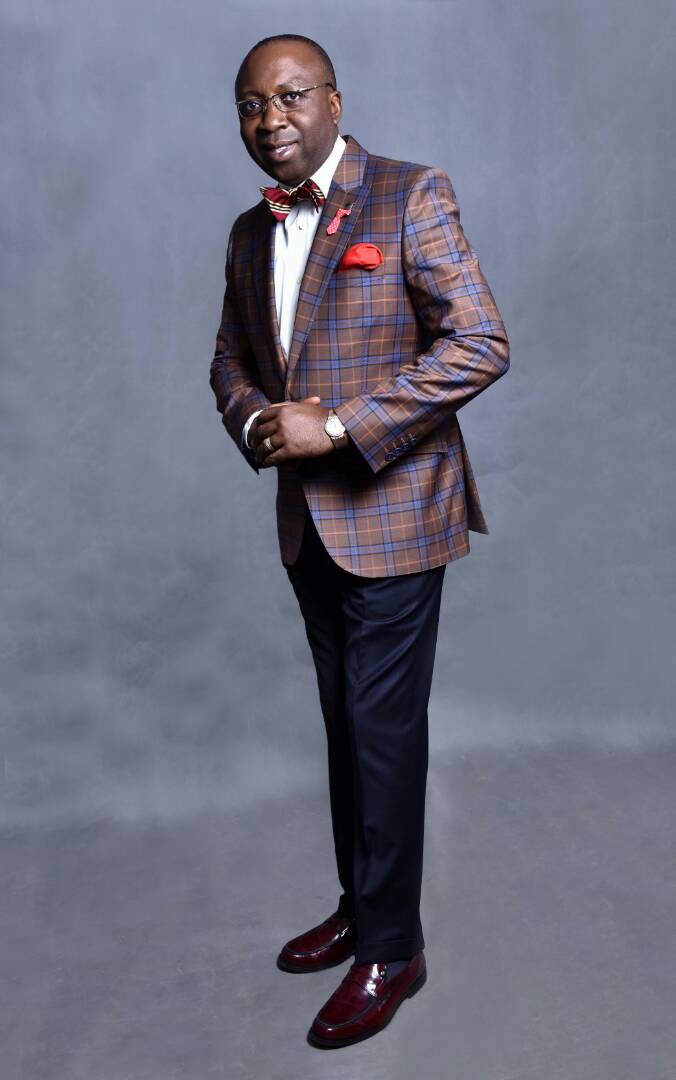
Yet on February 19, 1968, as bombs thundered across Nigeria during the civil war, a baby was born in Idah, now in Kogi State. The town was bombed the very day he arrived.
He was named Ogwu, the Igala word for “war”.
But the child who would become Ogwu James Onoja grew into something entirely different: calm, deliberate, disciplined, a man whose greatest weapon would be integrity.
On February 19, 2025, Dr Onoja turned 58. His life reads like a novel — one stitched together by bombs, betrayal, faith, football, law and an almost stubborn refusal to cut corners.
A Child of Chaos
His birth story is the kind history rarely pauses to record.
Moments after his first cry pierced the air, Idah came under attack. In the confusion, his father fled, a decision that would become family folklore.
Years later, his parents divorced. He was seven.
Relatives who encouraged his mother to leave later turned against her. Stability disappeared. Security faded. What remained was a young boy who understood early that survival would not be handed to him.
So, he made a decision.
“Through education and football, I would get my liberty,” he would later say.
He became football captain everywhere he went — from primary school to the Faculty of Law at the University of Jos. Leadership, even then, followed him.
He was called to the Nigerian Bar at just 22.
Orphaned, Alone — and Unbroken
Life tested him relentlessly.
He lost his father. Six months later, his mother died. Then came the deaths of his siblings. By his early thirties, he felt alone in the world.
At one point, he considered changing his name.
But he kept it.
And then came the season of hunger.
When he married, he had no car. The driver who brought them from their village wedding dropped them by the roadside in Yaba, Lagos. He carried his wife’s luggage on his head.
They sold wedding gifts to survive.
They sold old newspapers to suya sellers for extra cash.
And yet, they refused to fail.
“We knew people were waiting for us to fail,” he recalled. “So, we had every reason to make it work.”
The Integrity That Changed Everything
Working at a Lagos law firm in the early 1990s, he earned N600 monthly.
On trips, he returned every unused kobo to his principal. He refused hotel stays, sleeping instead at relatives’ homes to save money for his employer.
Colleagues thought he was naïve.
God, he believes, was preparing him.
Then came the turning point in 1998 — a failed bank tribunal brief. Though he lost the case, negotiations later earned him N400,000 — a fortune at the time.
His wife, heavily pregnant, climbed 18 floors to collect the cheque because there was no elevator.
The next day, their child was born.
He bought his first Mercedes 200.
But the real breakthrough came from something far less flashy: honesty.
After completing a property transaction, both buyer and intermediary vanished, leaving the original documents with him. Many would have kept silent. He searched for four years to return them.
When the rightful owner finally met him, his first words were telling:
“People like you are no longer available.”
That relationship changed his life. By 1999, he was a millionaire.
Today, he still attributes everything to integrity — not luck.
Scholar. Builder. Philanthropist.
Now a Senior Advocate of Nigeria, Dr Onoja holds a doctorate in law from Nasarawa State University and recently received an honorary Doctor of Laws from Salem University.
At the ceremony, presided over by Archbishop Sam Amaga, he did what defines him: he gave back.
The author and Agenyi Attah of the Igala Kingdom announced scholarships for law students.
The auditorium erupted.
Dr Onoja is the founder of the forthcoming Fortlugard University in Abuja, part of his mission to expand educational access and fight unemployment.
He is the Principal Partner at Dr O.J. Onoja, SAN & Associates. CEO of Bar and Bench Publishers. A benefactor to countless students.
Yet, ask him the secret.
“It’s not luck,” he says. “It is integrity, skill, contentment, and God.”
The Irony of His Name
In his culture, children named Ogwu were born during war. It is not considered an attractive name.
Few name their children after him.
And yet, perhaps no name fits better.
Because war did not define him.
It refined him.
From bombs in Idah to the corridors of power in Abuja, from selling newspapers to managing multi-million-naira properties, from orphaned youth to legal luminary — Dr Ogwu James Onoja turned chaos into character.
At 58, the boy born under air raids stands as proof that sometimes the fiercest battles are won quietly.
Nigeria’s customary courts — where millions of disputes over land, inheritance, marriage and community rights are decided — are not bound by the strict technicalities of the Evidence Act.
That was the blunt message delivered at a high-level judicial refresher course at the National Judicial Institute in Abuja.
In a lecture that could reshape how lower courts handle disputes across the country, His Worship Emmanuel J. Samaila, Judge of the Upper Customary Court, Kafanchan, warned that rigid reliance on technical admissibility rules risks miscarriages of justice in customary proceedings.
Samaila, who was the facilitator for the refresher course —Evidence under Customary Law: Handling Oral Testimony, Conflicting Traditions, Appellate Ambiguities, and Weight of Evidence —organisedfor judges of the lower courts on management of evidence in trial in collaboration with Judicial College of England & Wales stressed that “Technical justice must yield to substantial justice.”
Evidence Act “Guides — But Does Not Fetter”
Customary courts operate differently from superior courts of record. Their proceedings are informal, community-based and heavily reliant on oral testimony.
While the Evidence Act 2011 may offer guidance, it does not strictly bind customary adjudication.
Undue reliance on its technical provisions, participants were told, can become a ground for appellate reversal — a recurring problem in Nigeria’s lower courts.
Oral Testimony Takes Centre Stage
Unlike in common law proceedings, where documentary evidence often dominates, customary disputes are typically proved through:
Family elders
Traditional leaders
Community members
Neighbours
A single credible witness — male or female — may suffice to establish a fact or even a custom.
But judges were warned: credibility must be weighed carefully.
Demeanour, internal consistency, possible bias, community practice and corroborating circumstances all matter.
“Evidence must be weighed, not counted,” Samaila emphasised.
No One-Size-Fits-All Custom
One of the most striking reminders from the session: there is no universal customary “common law.”
Customary law is:
Flexible
Unwritten
Context-specific
What applies in one community may not apply in another — even within the same ethnic group.
Judges were cautioned against assuming the existence of a custom without proof, a mistake that has triggered appellate reversals in the past.
Where conflicting traditions are presented, courts must prefer the version that is credible, widely accepted and consistent with actual community practice.
However, any custom found to be repugnant to natural justice, contrary to public policy, or incompatible with written law remains unenforceable.
Why Decisions Get Thrown Out on Appeal
The lecture outlined common pitfalls that frequently lead to decisions being set aside:
Failure to resolve material contradictions in oral evidence
Improper evaluation of testimony
Over-reliance on procedural technicalities
Denial of fair hearing
Sitting with a non-statutory panel
Appellate courts generally respect findings of fact made by trial courts — but only where evidence has been properly evaluated.
Push for Reform and Training
The refresher course, organised in collaboration with the Judicial College of England and Wales, also highlighted the need for:
Continuous judicial education
Clearer procedural guidelines for customary adjudication
Stronger training in handling non-statutory evidence
The event was held under the leadership of the Chief Justice of Nigeria, Honourable Justice Kudirat Kekere-Ekun, who chairs the NJI’s Board of Governors.
For a legal system serving diverse communities across Nigeria, the stakes are high.
If customary courts mishandle evidence, justice is delayed, decisions are nullified, and disputes linger for years.
But if judges properly weigh oral testimony, resolve conflicts clearly and prioritise substantive justice over technicalities, Nigeria’s grassroots justice system may yet become stronger — and harder to overturn on appeal.
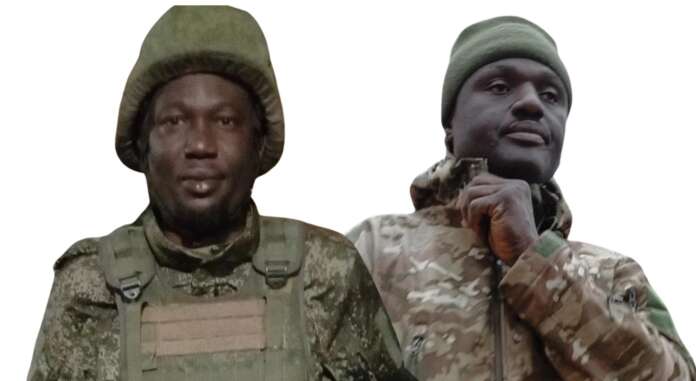
At least 36 Nigerians have been recruited to fight for Russia in its war against Ukraine, with five confirmed killed, according to a new investigative report that has prompted a stern warning from Nigeria’s federal government.
The report, published in February 2026 by investigative group All Eyes on Wagner and titled “The Business of Despair: The Russian Army’s Recruiting of African Fighters,” alleges that vulnerable young Africans—including Nigerians—have been lured with promises of lucrative jobs and migration pathways, only to be funnelled into frontline combat operations.
Drawing on a database of 1,417 African recruits between 2023 and mid-2025 obtained from Ukrainian sources, the report claims Russia expanded recruitment efforts across Africa after launching its full-scale invasion of Ukraine in February 2022.
Nigerians were among those allegedly deployed in high-risk assault units described in the report as “cannon fodder.”
The average age of African recruits was 31, with many reportedly coming from economically distressed backgrounds.
Five Nigerians Confirmed Dead
Among the confirmed Nigerian fatalities listed in the report are:
Abdoulaye Issaka Ismael, 27
Agbo Moses Omale, 43
Adamu Abdulai Ismail, 25
Mikael, 47
Fajobi Taiwo Omoniyi, 50
The report states that at least 316 African recruits have died, though it warns the figure may be higher, citing additional fatalities verified through social media investigations.
On February 12, 2026, Ukraine’s Defence Ministry released photographs of two Nigerians—Hamzat Kazeem Kolawole and Mbah Stephen Udoka—who were reported killed in combat in the Luhansk region.
According to Ukrainian authorities, both men had signed contracts with the Russian military in 2025 and reportedly had no prior military training before being deployed.
Lured by Promises of Jobs and Citizenship
The investigation alleges that recruitment pipelines relied heavily on social media campaigns across Facebook, Instagram, Telegram and TikTok. Videos and images reportedly showcased luxury lifestyles in Moscow—skyscrapers, expensive cars, and symbols of wealth—aimed at attracting job seekers.
Travel agencies in Africa and Russia allegedly advertised “fast-track procedures,” offering discounted flights and assistance with visas.
Recruits were reportedly promised:
Signing bonuses of several thousand dollars
Monthly salaries between $2,000 and $2,500
Higher pay for “specialists”
Health insurance
Fast-tracked Russian citizenship upon contract completion
However, the report says many fighters reported unpaid wages, withheld funds, or payments significantly below what had been promised.
“We Were Forced to Sign”
Families of affected Nigerians, particularly in Rivers and Ogun states, have expressed grief and anger.
In a video posted on X, a Nigerian man captured by Ukrainian forces claimed his phone was confiscated and that he was forced to sign enlistment papers written in Russian without an interpreter.
He said he believed he was travelling for training in his professional field before being abruptly deployed to the battlefield.
He recounted the case of another Nigerian, identified as Abubakar, who allegedly suffered a heart-related episode during training and refused to comply with deployment orders after realising he had been conscripted.
Separately, Abubakar Adamu, through his legal representatives, has petitioned the Nigerian government for urgent intervention, claiming he was lured to Moscow in October 2025 on a tourist visa for what he believed was a civilian security job.
His lawyers argue he signed documents he did not understand and is currently being held in a Russian military camp after refusing deployment to Ukraine.
They have demanded the return of his travel documents and his repatriation to Nigeria.
Nigeria Issues Warning
Nigeria’s Ministry of Foreign Affairs expressed “grave concern” over what it described as rising cases of citizens being misled into signing foreign military contracts under false pretences.
Spokesperson Kimiebi Ebienfa said victims were pressured into agreements in foreign languages and had their travel documents confiscated upon arrival.
The ministry warned that Nigerians who participate in foreign armed conflicts without government approval could face serious legal consequences.
The Nigerians in Diaspora Commission (NIDCOM) stated that its official repatriation program related to the Russia-Ukraine conflict concluded more than three years ago.
NIDCOM spokesperson Abdulrahman Balogun said individuals who voluntarily enlisted would have done so independently.
Alleged Recruitment Hub Denies Involvement
The report also names St. Fortunes Travels and Logistics, a Port Harcourt-based travel agency, as a suspected recruitment conduit.
The company’s owner, Fortune Chimene Amaewhule, denied recruiting Nigerians to fight in Russia.
He acknowledged that his firm once handled Russia-related travel packages but said the offering was discontinued after learning that some travellers were switching to military enlistment upon arrival.
“It was for teaching opportunities in Kazakhstan,” he said, adding that his company never directly facilitated recruitment into the Russian military.
Earlier this week, Russia’s Ambassador to Nigeria, Andrey Podyolyshev, denied any official Russian government involvement in recruiting Nigerians.
“If anybody has this information, we are ready to send it to Russian law enforcement authorities so they can investigate those cases,” he said in Abuja.
A Growing Transnational Pattern
In 2025, Ukraine’s Foreign Minister Andrii Sybiha said more than 1,400 nationals from 36 African countries were fighting for Russia, with some currently held as prisoners of war.
The All Eyes on Wagner report frames the recruitment drive as part of a broader strategy to supplement Russian troop numbers through foreign contracts, particularly targeting economically vulnerable regions.
Nigeria’s government has urged citizens to verify overseas job offers through official channels and to report suspicious recruitment activity.
As the war in Ukraine enters its fourth year, the investigation underscores how the conflict’s reach extends far beyond Europe—into African communities grappling with unemployment, migration pressures, and the allure of opportunity abroad.
For decades, the phrase “no near route to Arochukwu” was more than a saying in Abia State; it was a warning.
It captured years of isolation, fear and fatal accidents linked to the crumbling Omenuko Bridge and the treacherous Bende–Abam–Ohafia–Arochukwu corridor.
Last week, that phrase was symbolically buried.
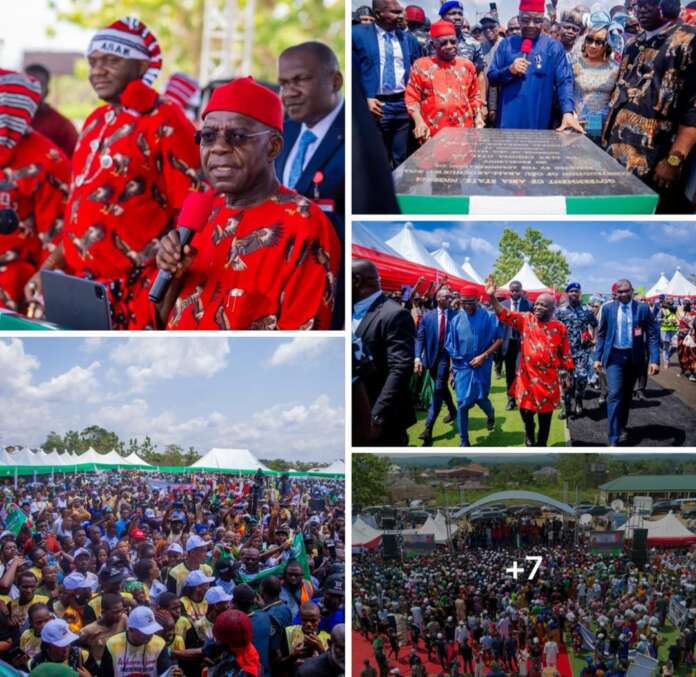
The commissioning of the newly reconstructed Omenuko Bridge and the 30-kilometre Amuvi–Ndi Okereke, Abam–Arochukwu Road marked what many described as the end of a 45-year cycle of neglect — and the beginning of a new chapter under Governor Alex Otti.
A Crowd Fuelled by Memory
From the moment the governor’s convoy arrived, the atmosphere was electric.
The old Omenuko bridge
Traditional ogene rhythms pierced the air. Ikpirikpi egwu dancers stamped the earth in unison. Chants rose from every corner:
“Record Breaker!” “History Changer!” “Son of Abam!”
But beneath the celebration was something heavier.
Many in the crowd had lost relatives on the old bridge — a narrow, barrier-less structure that had become synonymous with tragedy. Some came to celebrate progress. Others came to confront painful memories.
Among them were students, elders, business owners and families who had long avoided returning home because of the dangerous crossing.
For some, the day was personal.
One attendee recalled abandoning plans to marry from Abam years ago after turning back at the sight of the deteriorating bridge. “I would rather remain a bachelor than take that risk,” he had once said. This time, he came to see for himself if history had truly changed.
Delegating Glory
In a gesture that surprised many, Otti handed the honour of cutting the ribbon to retired General Azubuike Ihejirika, a former Chief of Army Staff who marked his 70th birthday that day. The project plaques bore Ihejirika’s name.
For political watchers, the move signalled a leadership style willing to share credit rather than monopolise it.
Observers noted that in a climate where political capital is fiercely guarded, the symbolism stood out.
An Emotional Breaking Point
If the commissioning signalled transformation, the governor’s speech defined the day.
As Otti addressed the crowd, he acknowledged those who had died on the bridge over the years — including families and schoolchildren lost in accidents tied to its decay. He called for a one-minute silence.
The mood shifted.
Celebration gave way to grief.
Then, visibly overwhelmed, Otti struggled to continue. His voice trembled. He paused. He wept.
For many present, it was the defining moment.
In that instant, infrastructure ceased to be concrete and steel. It became about human lives — about mothers who disembarked from vehicles to cross the bridge on foot, about families who never made it home, about communities cut off from opportunity.
“Leadership met humanity,” one attendee said afterwards.
Development and Political Momentum
The ceremony also carried political undertones.
During the reception, community leaders publicly pledged ₦500 million toward Otti’s re-election campaign — following a ₦100 million donation from another regional bloc weeks earlier. The announcement drew cheers and underscored the administration’s growing grassroots support.
Yet for many residents, the deeper significance lay beyond politics.
For over four decades, administrations came and went without resolving the Omenuko crisis. The bridge’s deterioration was widely seen as a symbol of governance failure.
Its reconstruction, residents argue, represents more than infrastructure — it signals responsive leadership capable of delivering tangible change.
A Test of Transformational Governance
Across Nigeria, decaying infrastructure often mirrors broader frustrations about governance. In Abia, the Omenuko Bridge had become shorthand for abandonment.
By reopening it — alongside the 30km arterial road linking Amuvi, Ndi Okereke, Abam and Arochukwu — the state government has altered economic prospects for trade, education and emergency access in the region.
The event also reignited a broader debate: can empathetic, responsive leadership translate into sustained transformation?
For the thousands who gathered, the answer seemed clear.
As drums echoed and traffic flowed across the new span, one message resonated through the crowd:
Arochukwu is no longer far.
And for many in Abia, that may be the most powerful transformation of all.
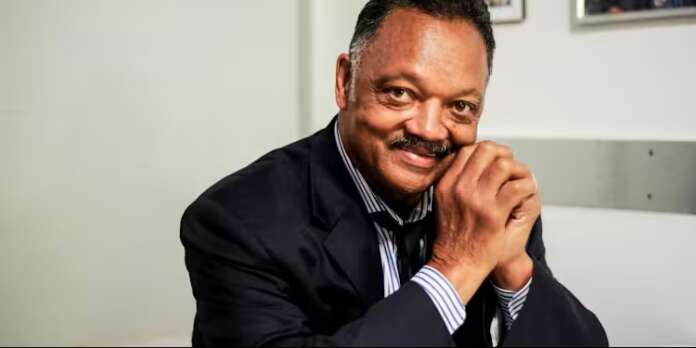
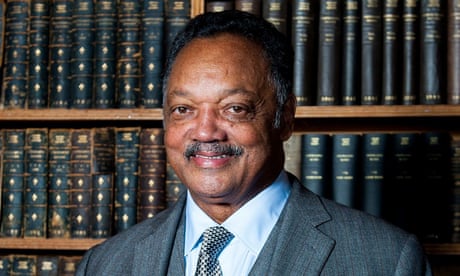
The Rev Jesse Jackson, the civil rights campaigner who was prominent for more than 50 years and who ran strongly for the Democratic presidential nomination in 1988, has died. He was 84.
“Our father was a servant leader – not only to our family, but to the oppressed, the voiceless, and the overlooked around the world,” the Jackson family said in a statement.
“We shared him with the world, and in return, the world became part of our extended family. His unwavering belief in justice, equality, and love uplifted millions, and we ask you to honor his memory by continuing the fight for the values he lived by.”
No cause of death was given.
Jackson had had progressive supranuclear palsy (PSP) for more than a decade. He was originally diagnosed with Parkinson’s disease. He was also twice hospitalised with Covid in recent years.
A fixture in the civil rights movement and Democratic politics since the 1960s, Jackson was once close to Dr Martin Luther King Jr.
In an interview with the Guardian in May 2020, Jackson said: “I was a trailblazer, I was a pathfinder. I had to deal with doubt and cynicism and fears about a Black person running. There were Black scholars writing papers about why I was wasting my time. Even Blacks said a Black couldn’t win.”
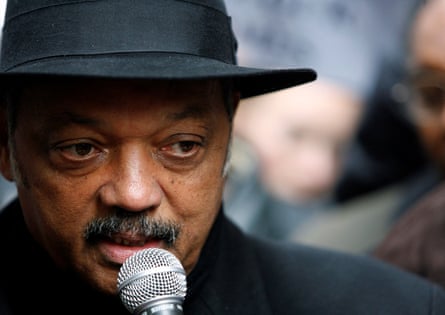
Jackson became involved in politics at an early age as he navigated the segregated south. Photograph: Jeff Zelevansky/Reuters
Twenty years after his second run for president, the first Black president, Barack Obama, saluted Jackson for making his victory possible. Obama celebrated in Chicago, also home to Jackson.
“It was a big moment in history,” Jackson told the Guardian, 12 years later.
During the Covid pandemic, he campaigned against disparities in care and outcomes, asking: “After 400 years of slavery, segregation and discrimination, why would anybody be shocked that African Americans are dying disproportionately from the coronavirus?”
He also said all past presidents had failed to “end the virus of white superiority and fix the multifaceted issues confronting African Americans”.
Born on 8 October 1941 in Greenville, South Carolina, Jackson became involved in politics at an early age as he navigated the segregated south. He was elected class president at the all-Black Sterling high school, where he also excelled in athletics. In 1959, he received a football scholarship to the University of Illinois. The Chicago White Sox offered the young Jackson a spot on their baseball team, but he decided to focus on his education instead.
During winter break his freshman year of college, Jackson returned home to Greenville and tried to obtain a book needed for his studies from the white-only Greenville public library, but he was turned away. The experience stayed with him. A few months later on 16 July 1960, Jackson and seven Black high school students entered the Greenville library for a peaceful protest. After browsing the library and reading books, the group later known as the Greenville Eight were arrested for disorderly conduct and later released on a $30 bond. A judge eventually ruled that they had the right to use the publicly funded institution, and the Greenville library system became integrated in September 1960.
Jackson did not return to the University of Illinois after his first year, and instead transferred to the historically Black North Carolina Agricultural and Technical College in Greensboro, where he playerd football as a quarterback, was the national officer for the Black fraternity, Omega Psi Phi, and was elected the student body president. While earning a sociology degree, he also continued his activism by participating in sit-ins at restaurants in Greensboro.
“My leadership skills came from the athletic arena,” Jackson told the Washington Post in 1984. “In many ways, they were developed from playing quarterback. Assessing defenses; motivating your own team. When the game starts, you use what you’ve got – and don’t cry about what you don’t have. You run to your strength. You also practice to win.”
During college, Jackson met his future wife Jacqueline, whom he married in 1962 and later had five children with – Santita, Jesse Jr, Jonathan Luther, Yusef DuBois, and Jacqueline Jr. He would later go on to have a sixth child, Ashley, during an extramarital affair with Karin Stanford in the early 2000s.
Jackson first met King, who would become his mentor, at an airport in Atlanta in the early 1960s. King had followed Jackson’s student activism from afar for several years.
In 1964, Jackson enrolled at the Chicago Theological Seminary, as he continued to be involved in the civil rights movement. Jackson travelled with his classmates to Selma, Alabama to join the movement after he watched news footage of Bloody Sunday, where King led nonviolent civil rights marchers across the Edmund Pettus Bridge in Selma, Alabama, who were then beaten by law enforcement. Impressed by Jackson’s leadership at Selma, King offered him a position with the civil rights group that he co-founded, the Southern Christian Leadership Conference (SCLC).
After a couple of years, Jackson put his seminary studies on hold to focus on SCLC’s Operation Breadbasket, an economic justice program that harnessed the power of Black churches by calling on ministers to put pressure companies to employ more Black people through negotiations and boycotts. In 1967, Jackson became Operation Breadbasket’s national director, and was ordained as a minister a year later.
“We knew he was going to do a good job,” King said at an Operation Breadbasket meeting in 1968, “but he’s done better than a good job”.
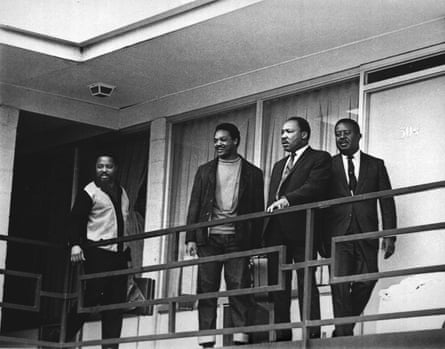
Tragedy struck soon after Jackson gained a leadership position at SCLC. On 4 April 1968, Jackson witnessed King’s assassination from below the balcony at the Lorraine Motel in Memphis, Tennessee.
Hosea Williams, Jesse Jackson, Martin Luther King and Ralph Abernathy on the balcony of the Lorraine Motel in Memphis, Tenness on 3 April 1968, a day before King was assassinated. Photograph: Charles Kelly/AP
The experience stayed with Jackson for the rest of his life. “Every time I think about it, it’s like pulling a scab off a sore,” he told the Guardian in 2018. “It’s a hurtful, painful thought: that a man of love is killed by hate; that a man of peace should be killed by violence; a man who cared is killed by the careless.”
Following King’s death, Jackson continued to work for SCLC until 1971, when he created his own organization to improve Black people’s economic conditions, People United to Save Humanity (Push). The organization hosted reading programs for Black youth and helped them find jobs, and also encouraged corporations to hire more Black managers and executives.
In 1984, Jackson ran as a Democratic candidate for president, becoming the second Black person to launch a nationwide campaign following Shirley Chisholm more than a decade earlier.
“Tonight we come together bound by our faith in a mighty God, with genuine respect and love for our country, and inheriting the legacy of a great party, the Democratic party, which is the best hope for redirecting our nation on a more humane, just, and peaceful course,” Jackson told an audience at the 1984 Democratic National Convention in San Francisco, California.
“This is not a perfect party. We’re not a perfect people. Yet, we are called to a perfect mission. Our mission to feed the hungry, to clothe the naked, to house the homeless, to teach the illiterate, to provide jobs for the jobless, and to choose the human race over the nuclear race.” He lost the Democratic nomination to former vice-president Walter Mondale, with the incumbent Republican president Ronald Reagan ultimately winning the election.
After his first presidential run, Jackson created the National Rainbow Coalition to push for voting rights and social programs. In the mid-1990s, Jackson merged his two organizations together to form the multiracial group Rainbow Push Coalition, which focuses on educational and economic equality. Throughout the years, the coalition has paid more than $6m in college scholarships, and gave financial assistance to more than 4,000 families facing foreclosures so that they could save their homes, according to their website.
Jackson ran for the Democratic nomination for president a second time in 1988, performing strongly but losing out to Michael Dukakis, the Massachusetts governor, who was beaten heavily in the general election by George HW Bush.
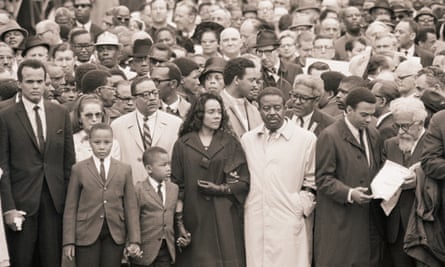
Jesse Jackson, centre of the second row, stands behind Coretta Scott King at the funeral of her husband, Martin Luther King Jr. Photograph: Bettmann/Bettmann Archive
“I cried because I thought about those who made it possible who were not there … People who paid a real price: Ralph Abernathy, Dr King, Medgar Evers, Fannie Lou Hamer, those who fought like hell [at the Democratic National Convention] in Atlantic City in 64, those in the movement in the south.”
In 2000, the then president, Bill Clinton, awarded Jackson the nation’s highest civilian honor, the Presidential Medal of Freedom for his decades of work focused on increasing opportunities for people of color.
Jackson took King’s work forward, staying to the fore in the worldwide civil rights movement through a tumultuous half-century of American history, through to the election of Donald Trump and the rise of Black Lives Matter.
“Dr King believed in multiracial, multicultural coalitions of conscience, not ethnic nationalism,” Jackson said in 2018. “He felt nationalism – whether Black, white or brown – was narrowly conceived, given our global challenges. So having a multiracial setting said much about his vision of America and the world, what America should stand for as well as the world.
“The arc of the moral universe is long and it bends towards justice, but you have to pull it to bend. It doesn’t bend automatically. Dr King used to remind us that every time the movement has a tailwind and goes forward, there are headwinds.
“Those who oppose change in some sense were re-energised by the Trump demagoguery. Dr King would have been disappointed by his victory but he would have been prepared for it psychologically. He would have said: ‘We must not surrender our spirits. We must use this not to surrender but fortify our faith and fight back.’”
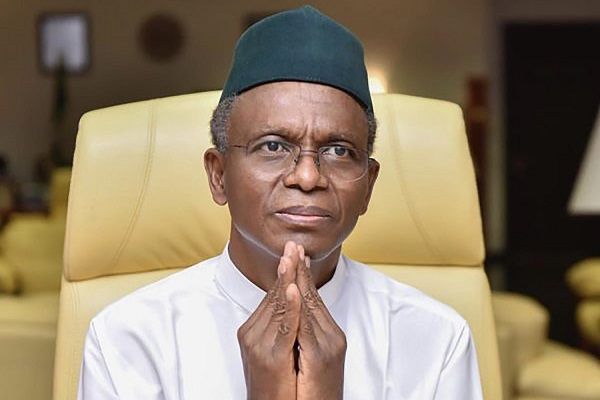
Nigeria’s political arena was thrust into fresh turmoil on Monday night after former Kaduna State Governor Nasir El-Rufai was detained at the headquarters of the Economic and Financial Crimes Commission (EFCC) in Abuja following hours of interrogation over an alleged N432 billion corruption probe.
The detention came as the Federal Government simultaneously filed criminal charges against him before the Federal High Court in Abuja over the alleged unlawful interception of phone communications belonging to the National Security Adviser, Nuhu Ribadu.
The convergence of corruption allegations, cybercrime charges and a reopened disappearance case marks one of the most consequential legal crises faced by a former Nigerian governor in recent years.
EFCC Grilling Over N432bn Allegations
Multiple sources within the anti-graft agency confirmed that El-Rufai arrived at the commission’s Jabi headquarters around 10 am in response to an invitation and was questioned over allegations arising from the 2024 report of the Kaduna State House of Assembly.
The legislative report accused his administration of misappropriating loans, violating due process in contract awards and plunging the state into heavy debt between 2015 and 2023.
A senior EFCC source said investigations had been ongoing for about a year.
“As a commission, we don’t just rush to invite suspects. Persons accused are always the last; that is, after we might have done our investigation to an advanced stage,” the source said, adding late Monday that the former governor remained in custody.
The EFCC spokesperson, Dele Oyewale, confirmed that El-Rufai honoured the invitation but declined to comment on the details of the interrogation.
What the Kaduna Assembly Alleged
In 2024, an ad hoc committee of the Kaduna State House of Assembly alleged that roughly N423bn was siphoned under El-Rufai’s administration, alongside disputed cash payments and contracts exceeding N155m and the alleged diversion of N1.37bn earmarked for a light rail project.
The committee recommended investigation and prosecution over alleged abuse of office, reckless borrowing, money laundering and contract irregularities.
El-Rufai has consistently denied wrongdoing, describing the probe as politically motivated and insisting that all loans were lawfully appropriated for infrastructure, education, healthcare and security reforms.
Cybercrime Charges Over Alleged NSA Phone Interception
As the EFCC interrogation unfolded, the Federal Government filed a three-count charge marked FHC/ABJ/CR/99/2026, accusing El-Rufai of offences under the Cybercrimes (Prohibition, Prevention, etc.) Amendment Act, 2024 and the Nigerian Communications Act, 2003.
Prosecutors allege that during a February 13, 2026 appearance on Prime Time on Arise TV, El-Rufai admitted that he and unnamed associates intercepted communications linked to Ribadu.
In one of the counts, the government alleges he failed to report those involved in the interception. Another count accuses him of using technical systems in a manner capable of compromising public safety and national security.
During the interview, El-Rufai claimed he learned of an alleged plan to arrest him through a leaked conversation from the NSA’s phone, stating: “The government thinks they are the only ones who listen to calls. But we also have our ways.”
Legal analysts warn that, if substantiated, unauthorised interception of a sitting National Security Adviser’s communications could constitute a grave breach of national security laws.
No date has yet been fixed for his arraignment.
DSS Reopens Dadiyata Disappearance Case
In a parallel development, the Department of State Services (DSS) has reportedly reopened investigations into the 2019 disappearance of government critic Abubakar Idris, popularly known as Dadiyata.
Security sources said investigators are probing El-Rufai and his sons over the unresolved case. His passport was reportedly seized at the Nnamdi Azikiwe International Airport to prevent foreign travel while inquiries continue.
El-Rufai has repeatedly denied any involvement, maintaining that he neither knew Dadiyata personally nor had any reason to target him.
Protests Erupt in Abuja and Kaduna
Monday’s dramatic developments triggered protests at the EFCC headquarters in Abuja and at the Kaduna State House of Assembly.
In Abuja, demonstrators demanded accountability over the alleged N432bn probe, while supporters of the former governor gathered nearby, chanting solidarity slogans.
In Kaduna, civil society groups pressed lawmakers for updates on the legislative findings that prompted the anti-graft referral.
Political Reactions and Presidential Backing for Ribadu
Opposition figures questioned the timing of the charges, with some suggesting the unfolding legal drama could heighten political tensions ahead of the 2027 elections.
Meanwhile, President Bola Tinubu publicly praised Ribadu during a visit to Adamawa State, describing him as “honest, bold, courageous and committed,” and vowing continued support in the fight against terrorism and banditry.
The statement came days after El-Rufai accused the Office of the National Security Adviser of procuring a toxic chemical, an allegation the office denied and referred to the DSS for investigation.
A Defining Legal Battle
Once a central figure in Nigeria’s ruling establishment and a vocal national commentator, El-Rufai now faces simultaneous investigations into alleged financial mismanagement, cybercrime and security-related controversies.
Whether the cases ultimately amount to lawful prosecution grounded in evidence or political persecution, as his allies contend, will be tested in court.
Rotarians, Rotaractors and friends of Rotary across District 9127 are set to roll out the red carpet for the President of Rotary International, Francesco Arezzo, and his spouse, Anna Maria Arezzo-Criscione, as they arrive in Abuja on Tuesday, February 17, for the final leg of their Nigeria-wide tour.
President Arezzo, who arrived in Lagos on February 13th and has since engaged with Rotary stakeholders in different parts of the country, will fly into Abuja from Port Harcourt to a colourful, carnival-like welcome at the Nnamdi Azikiwe International Airport.
In a statement signed by Dr. Max Amuchie, District 9127 Media Relations Chair, the Chairman of the Reception Planning Committee, Dr. Goddy Nnadi, disclosed that elaborate arrangements have been concluded to accord the Rotary leader a befitting reception. “Rotarians adorned in Rotary regalia, alongside cultural dance troupes, will be on ground to receive President Arezzo and his entourage in a vibrant display that reflects the warmth and hospitality of our district,” he said.
Among those expected in the presidential entourage are Rotary International President-elect Rotarian Yinka Babalola and his spouse, Preba Babalola; Trustee of The Rotary Foundation, Rotarian Ijeoma Pearl Okoro and her husband, Rotarian Kingsley Okoro; as well as the other five District Governors in Nigeria.
District Governor Dame (Dr.) Joy Okoro, host of the visit, expressed excitement at welcoming the global Rotary leader. She noted that the entire District 9127 family has mobilised to ensure a memorable and impactful visit. “We are honoured to receive President Arezzo in Abuja. This visit underscores Rotary’s commitment to service, peacebuilding and disease eradication, and we are fully prepared to showcase the impactful work of our district,” she said.
Following airport formalities, President Arezzo is scheduled for a private dinner later in the evening with philanthropist and Rotary leader, Sir Emeka Offor.
On Wednesday, the Rotary International President will visit Polio House in Area 2, Abuja, where he will address the press and receive a comprehensive briefing from the Nigerian National PolioPlus Committee (NNPPC) on the country’s polio eradication efforts. He will subsequently proceed to a Primary Healthcare Centre in Area 2 to participate in a symbolic polio immunisation exercise, reinforcing Rotary’s decades-long commitment to eradicating polio worldwide.
At noon, President Arezzo will address Rotarians of District 9127 at the Sir Emeka Offor Hall, Rotary Centre, Abuja, where he is expected to outline Rotary International’s vision, priorities and strategic direction. The visit will also include a courtesy call on President Bola Tinubu at the Presidential Villa, further strengthening collaboration between Rotary and government in advancing humanitarian and development initiatives.
President Arezzo will depart Nigeria on Thursday, February 19, marking the conclusion of a significant tour aimed at deepening Rotary’s impact and partnerships across the country.
District 9127, which covers the Federal Capital Territory and several states in North-Central Nigeria, continues to play a leading role in Rotary’s service areas, including disease prevention and treatment, maternal and child health, basic education and literacy, economic empowerment, and peacebuilding.
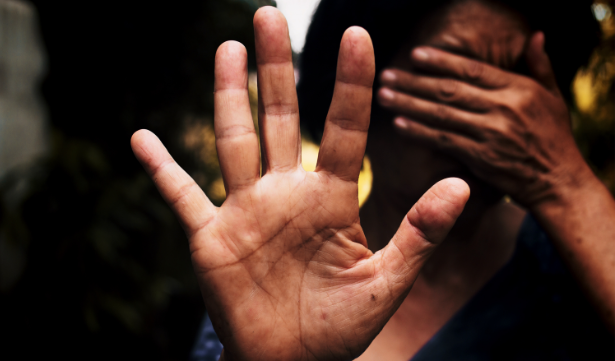
Afghanistan has ‘legalised’ domestic violence in a troubling crackdown on women’s rights.
A new 90-page penal code introduced by the Taliban allows husbands to physically punish their wives and children, as long as the abuse does not result in “broken bones or open wounds”.
Under the new laws, a husband faces a maximum of just 15 days in prison in cases of “obscene force”, such as visible fractures or injuries. Convictions will be sought only if the wife can successfully prove the abuse in court.
A married woman can also now be jailed for up to three months if she visits her relatives without her husband’s explicit permission.
The law uses language effectively, treating wives as the “property” or “slaves” of their husbands, and strips away vital protections, such as the 2009 law on the Elimination of Violence Against Women (EVAW), which was introduced during the previous US-backed regime.
Campaigners from exiled Afghan human rights group Rawadari, who obtained a copy of the Taliban’s new penal code, warned in a statement that it would legitimise the “abuse, maltreatment, and punishment” of women and children – and expose them to “continued domestic violence”.
Its new limits on women’s rights to see their families also remove one of the few protections available in a country where there are few “formal and legal remedies”, they added.
Rawadari demanded the “immediate halt of the implementation of the criminal procedure code” by the Taliban courts, and called for the international community, the United Nations, and “other relevant international bodies” to “utilise all legal instruments” to prevent it coming into force.
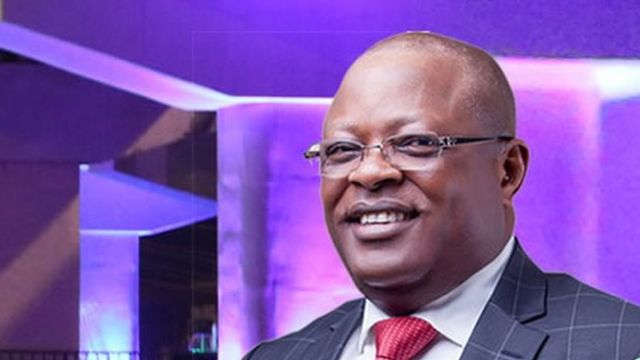
A video has surfaced where Nigeria’s Minister of Works, David Umahi, openly boasted about how he ordered the forceful acquisition of a woman’s land because she challenged his actions.
In the video sighted by SaharaReporters on Tuesday, Umahi, a former governor of Ebonyi State, was heard recounting how a dispute with a female land owner escalated into a government takeover of her property by force.
According to him, the decision to acquire the land was not initially part of the plan but was triggered by the woman’s resistance.
“I didn’t want to take the woman’s remaining land, but when she started making troubles, I said they should go and acquire the land. I’m the one, not any other person else,” Umahi said in the video.
The minister’s remarks suggest that the land acquisition was carried out as a direct response to the woman’s opposition, raising concerns about abuse of power, intimidation of citizens, and the misuse of government authority.
Trending Video of Minister of Works, Dave Umahi bragging about how he collected a poor woman’s land, to show her..
Although Umahi did not disclose the location of the land or provide details of any legal process followed before the acquisition, his statement showed deliberate human rights abuse that he and other officials in power carry out in the country.
A diaspora investor and CEO of Winhomes Global Services Limited, Stella Okengwu, had raised a public outcry against Umahi, alleging the forced takeover of her 20-hectare estate in Lagos. The dispute involves the Lagos-Calabar Coastal Highway project, with the developer claiming her legally acquired property was destroyed despite being outside the original designated legal corridor.
In December 2025, SaharaReporters reported how grief became a familiar visitor to Umuchima, the most populous of the 14 communities that make up Uburu in Ebonyi State’s Ohaozara Local Government Area, where Umahi hails from.
Residents lamented that their troubles deepened shortly after Umahi assumed office as governor in 2015.
As he serves as Minister of Works, community members lamented that a chain of demolitions, land seizures, and violent confrontations, carried out under government authority, has left them traumatised, uprooted, and bereaved.
Residents alleged that forced demolitions of homes, ancestral compounds and farmlands, purportedly for government purposes, have led to severe psychological trauma, poverty and, in several reported cases, death.
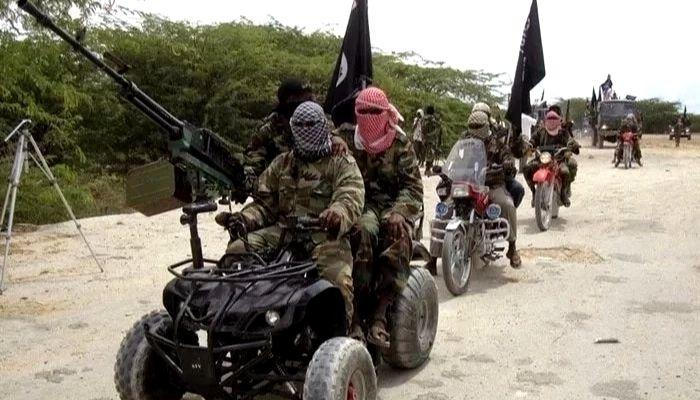
They came before dawn — dozens of armed men riding in formation on motorcycles, engines slicing through the silence.
By sunrise, at least 29 people were dead.
Gunmen stormed the villages of Tunga-Makeri, Konkoso and Pissa in Borgu Local Government Area of Niger State early Saturday, unleashing a wave of killings, arson and abductions in what officials fear could mark another escalation in Nigeria’s expanding rural insurgency.
Emergency authorities say the toll may rise as search teams comb surrounding forests for the missing.
“People fled into the bush,” said Musa Saidu, head of the Niger State Emergency Management Agency. “We are still accounting for them.”
A Calculated Operation
Security sources say the attackers arrived on 41 motorcycles, each carrying two or three heavily armed men — a level of coordination that suggests planning, not spontaneity.
In Tunga-Makeri, six residents were gunned down. In Konkoso and Pissa, at least 20 more were killed. Homes were torched. A police station was set ablaze.
Survivors insist the attackers were not looters.
“They were not interested in stealing,” said Abdullahi Rofia, who has been sheltering displaced residents in a neighbouring community. “They came to kill and terrorise.”
The assault occurred near the site of another massacre earlier this month, where more than 100 people were reportedly killed in a similar ambush — raising fears of a widening operational corridor for armed groups once concentrated in Nigeria’s north-west.
Terror Without Borders
For years, criminal gangs known locally as “bandits” have plagued rural communities with kidnappings and ransom operations. But security analysts say the violence is mutating — becoming more lethal, more brazen and less economically motivated.
The line between banditry and insurgency appears increasingly blurred.
Residents say daily life has collapsed.
“No one goes to the farm. No one goes to market,” Rofia said. “People are traumatised.”
Authorities have imposed emergency measures, including restrictions on late-night movement and a ban on commercial motorcycles after 8 p.m. Joint security teams have been deployed. Rescue operations are ongoing.
But in Borgu, official reassurances ring hollow against fresh graves.
‘We See Their Movements’: Zamfara Governor Points to Deeper Failure
As violence ripples across northern Nigeria, Zamfara State Governor Dauda Lawal argues that the crisis is not rooted in a lack of intelligence, but in the failure to act on it.
“We track their movements in real time,” Lawal said in a recent interview, describing the use of drones and satellite monitoring to trace armed groups. “Every movement is communicated to the relevant agencies.”
His frustration is palpable.
“You are telling me a bandit is superior to the state? That is not possible,” he said. “The first duty of government is to protect lives and property.”
Lawal inherited a state battered by a decade of killings, unpaid salaries and institutional collapse. He says his administration has stabilised finances and rebuilt schools — but security remains the existential challenge.
Without safety, he admits, investment and recovery are illusions.
“There is no investor that will put money where it is not secure,” he said.
Pressure Mounts on Abuja
Nigeria’s federal government faces mounting scrutiny as violence spreads beyond traditional flashpoints.
Security forces are battling jihadist factions in the north-east, armed gangs in the north-west and central regions, and separatist unrest in the south-east — a multi-front crisis stretching resources thin.
Last month, officials said 200 suspected bandits were killed in an operation in Kogi State. Weeks earlier, more than 250 children and staff were abducted from a Catholic school in Papiri in one of the largest recent mass kidnappings. Though they were later released, the episode underscored how vulnerable rural communities remain.
International involvement has added another layer of complexity. U.S. forces conducted Christmas Day strikes against Islamist militants in Sokoto State, with President Donald Trump warning of further action if attacks continued.
Yet many victims of jihadist violence in Nigeria are Muslim, according to monitoring groups — complicating simplistic narratives about the conflict.
Surveillance Politics, Insecurity Reality
Meanwhile, a domestic political storm over alleged wiretapping of senior officials has ignited debate about state power and misplaced priorities.
Columnist Lasisi Olagunju wrote pointedly that while political elites feud and monitor one another, “the people suffer unrelenting violence.”
“While the big men bicker, the people suffer unrelenting violence. El-Rufai, his friends and the government are very erect listening to conversations and banters across classrooms and newsrooms, but they are limp when bandits and terrorists carry on their business online and offline…
“When those entrusted with state power treat surveillance as sport, and those outside power treat it as justified revenge, when interception becomes culture, privacy becomes casualty. What we treat as bravado is actually erosion of trust, of law, and of the fragile peace that holds this democracy together.”
For villagers in Niger State, such debates feel distant.
Their concern is immediate: who protects them when the motorcycles return?
A Fragile State of Fear
The attack in Borgu is not just another statistic in Nigeria’s long security ledger. It is part of a pattern — coordinated, expanding and increasingly audacious.
Each raid chips away at public confidence. Each delayed response fuels suspicion. Each unprotected village deepens the sense of abandonment.
Before dawn on Saturday, the engines roared. By morning, families were burying their dead.
And across Nigeria’s rural heartland, one question lingers in the smoke:
If the state can see the threat coming, why does it keep arriving?
Our site uses cookies. By clicking “Accept All Cookies”, you direct Law and Society Magazine to store cookies on your device and disclose information in accordance with our Cookie Statement: cookie policyACCEPTREJECT
Privacy & Cookies Policy
Privacy Overview
This website uses cookies to improve your experience while you navigate through the website. Out of these cookies, the cookies that are categorized as necessary are stored on your browser as they are essential for the working of basic functionalities of the website. We also use third-party cookies that help us analyze and understand how you use this website. These cookies will be stored in your browser only with your consent. You also have the option to opt-out of these cookies. But opting out of some of these cookies may have an effect on your browsing experience.
Necessary cookies are absolutely essential for the website to function properly. This category only includes cookies that ensures basic functionalities and security features of the website. These cookies do not store any personal information.
Any cookies that may not be particularly necessary for the website to function and is used specifically to collect user personal data via analytics, ads, other embedded contents are termed as non-necessary cookies. It is mandatory to procure user consent prior to running these cookies on your website.