I am staring this article by assuming that President Muhammadu Buhari does not know the real state of affairs in the nation that he governs as President. I was forced to embrace that assumption because it is a given that any person who, like him, has been a former governor of a State North-Eastern State (which comprised of Bauchi, Borno, Gombe, Yobe, Taraba and Adamawa states), should feel deadly anger at the Boko Haram insurgency that has not only targeted that sector of Nigeria but has blanketed that area with deadly insurrection. Some of the schools, banks, markets, roads and other pieces of infrastructures that the Boko Haram terrorists have been destroying came into existence when Mr. President was the governor of the whole of that vast area.
Second, as former Minister of Petroleum, it must sound like hammer blows to the ear drums for him to hear that the nation’s petroleum refineries that he loves most intimately, and took real pride in (at least he has referred to them, and with high pride too, on several occasions in the past) are now redundant and that not even the government he presides over, has, five years and counting since he was first inaugurated President, has been able to resuscitate them.
Third, he was an active and war-tested General of the Nigerian Army. Moreover, I have seen a short video of his at the Chatham House in London, promising that he would make Nigeria safe if he was voted for to become President.
Fourth, he had been President before, so solving Nigeria’s problems should come easily to him… because of the long experience he has gained on the job.
Just last Friday, yes two days ago, some gunmen (which means that the particular group have not been identified), at least as at Saturday, 12 December 2020, abducted an unknown number of students from a secondary school boarding house …and simply marched them away. That reminds one of the Chibok Girls abduction, does it not? I know that there will be many out there who will charge that as the outrage over this particular abduction has not been as strident as that which the abduction of the Chibok girls raised, it shows that former President Goodluck Jonathan was held to a different level of criticism. But that would be decidedly wrong; that Chibok girls’ abduction was the first of its kind in Nigeria and so it rightly raised vociferous criticism everywhere. Then that sordid event repeated itself in Dapchi, and now Government Boys Science Secondary School in the Kankara Local Government Area of Katsina State.
Again, The National Assembly Lives Up To ExpectationsDec 14, 2020COLUMNIST
Insecurity: Outlaw All Arms-Wielding GroupsDec 14, 2020
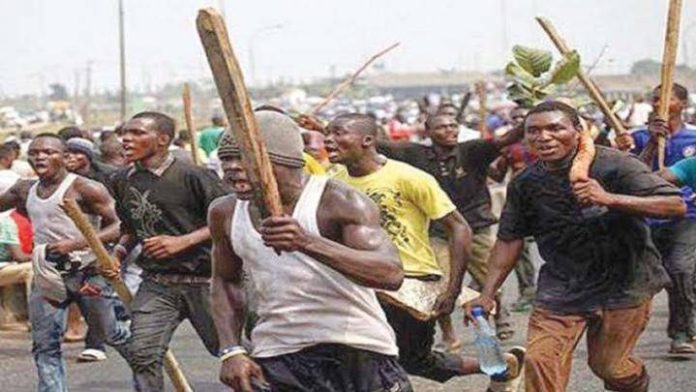
The human mind is being adjusted to the mayhem that has engulfed Nigeria. We are beginning gradually to adapt to living in the bedlam called Nigeria. It is fast becoming a hell. It is fast becoming a failed state because it is fast appearing that there is no government. Yes, it is fast becoming a state where pure anarchy rules. So, little by little the people are beginning to forget the reason why we joined the rest of the world in having a government.
Hey, why do governments exist in the first place? Before we answer the question, it does appear that the sole reason why the present government exists is to raise electricity tariff, taxes and petroleum pump prices. Or was the rate of VAT not raised? What about the petrol pump price?
What are the five main purposes of a government?
A government’s basic functions are providing leadership, maintaining order, providing public services, providing national security, providing economic security, and providing economic assistance. Explained further, governments were invented to protect the Natural Rights. The primary functions of government are to protect the basic human rights which include right to life, liberty and to possess property. Then and after then could one begin to talk about defending citizens against external aggression, then comes the task of managing economic conditions, redistribution of income and resources. Provision of public or utility goods and infrastructure
Beyond those rudiments of needs, really basic needs, what makes a government successful in this modern age? The success of a government in any modern society is measured by how it is effective government in investing in its people, advances opportunities for shared prosperity, and maintains law and order and upholds Human Rights of the citizens.
As English philosopher Thomas Hobbes wrote in 1651, life without government is “solitary, poor, nasty, brutish, and short.” Yet, even with the presence of a government in Nigeria, life is actually “solitary, poor, nasty, brutish, and short”. That shows that not only is there a terrible discord, but there is actually a terrible failure that principally involves governance.
Since the 17th century, philosophers have debated this very question; “What is the purpose of government?” According to the Philosopher, John Locke, everyone gains the security of knowing that their rights to life, liberty, and property are protected. The main purpose of government is to protect those natural rights that the individual cannot effectively protect in a state of nature.
Here is a quote from John Locke (Stanford Encyclopedia of Philosophy): “The aim of such a legitimate government is to preserve, so far as possible, the rights to life, liberty, health and property of its citizens, and to prosecute and punish those of its citizens who violate the rights of others and to pursue the public good even where this may conflict with the rights of individuals. In doing this it provides something unavailable in the state of nature, an impartial judge to determine the severity of the crime, and to set a punishment proportionate to the crime. This is one of the main reasons why civil society is an improvement on the state of nature. An illegitimate government will fail to protect the rights to life, liberty, health and property of its subjects, and in the worst cases, such an illegitimate government will claim to be able to violate the rights of its subjects that is it will claim to have despotic power over its subjects.”
At the dawn of American independence, republicanism came into being, backed by a constitution that opened with a wonderful exultation: “We the People of the United States, in Order to form a more perfect Union, establish Justice, insure domestic tranquility, provide for the common defence, promote the general welfare, and secure the Blessings of Liberty to ourselves and our Posterity, do ordain and establish this Constitution for the United States of …” Other constitutions, including Nigeria’s, have copied something from that model of national constitutions.
Locke used the claim that men are naturally free and equal as part of the justification for understanding legitimate political government as the result of a social contract where people in the state of nature conditionally transfer some of their rights to the government in order to better ensure the stable, comfortable enjoyment of their lives, liberty, and property. Since governments exist by the consent of the people in order to protect the rights of the people and promote the public good, governments that fail to do so can be resisted and replaced with new governments. Locke is thus also important for his defence of the right of revolution. But that has no place in Nigeria, for every four years, there comes a chance for the citizens to once again, freely and with coercion, choose the government that they want out of the political parties seeking their votes.
So, what does the President know about the state of the nation? I ask this because recently, the Information and Culture Minister, Lai Mohammed visited Lagos to gauge of thoughts of the newspaper Publishers and Managing Directors on the state of the nation. He so dwelt on his pet idea of those who are opponents of governments that one Publisher reminded him that the election has long ended and there is the nation called Nigeria, one Nigeria at that, to govern aright. And each person that spoke that day, told him point blank that the insecurity, a terrible level of insecurity has blanketed the nation. Actually, I am putting it mildly.Loading…
Then within the week, the state governors visited Aso Rock. They sang the same song; that Nigeria is bleeding badly because of national insecurity. And I do not want to believe what someone said he heard from a governor who was there; that Mr. President asked them to get the traditional rulers in their domains and the vigilante groups to stem the tide of national insecurity. I refused to believe it because that would mean that Mr. President has thrown in the towel in this fight.
Could it be that unfortunately, the Buhari administration will leave Nigerians with this sad conclusion: “Power and status exhilarated these men and their fellows? They enjoyed the urgencies even the exhaustion, of government; they liked to call themselves crisis manager, were reputed to be the best and the brightest and were sadly to discover that, that like those before them, that rather than their controlling circumstances, circumstances controlled them.”
No, Buhari must ensure that what follows should not be said of his administration: “that government in the words of J. K. Galbraith, was rarely more than a choice between the disastrous and the unpalatable.”
Both quotes came from Barbara Tuchman’s book; The March of Folly – which studied mal-administration over three thousand years; from the Trojan War to the American misadventure in Vietnam.