Home Blog Page 1139

Anxiety over CJN’s health as he misses SANs’ inauguration

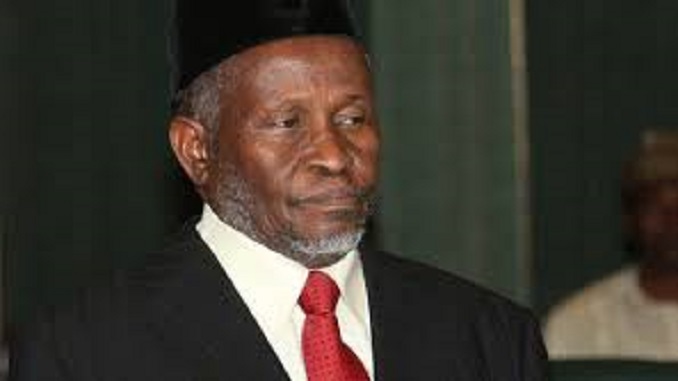
Where is Ibrahim Tanko Muhammad, the chief justice of Nigeria (CJN)?

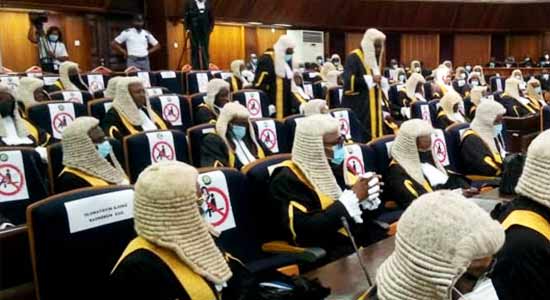
Amidst rumours that he had been ill, he was on Monday absent at the swearing-in ceremony of 72 senior advocates of Nigeria.

The 66-year-old chief justice has not been seen in public for weeks.

The special session for the swearing-in of SANs, which was held at the supreme court in Abuja, also marked the beginning of the 2020/2021 legal year of the apex court.Advertisement

The unavailability of the CJN is unusual as he is mostly known to carry out important functions such as this.

The CJN had inaugurated eight justices of the supreme court on November 6 but since then, there are conflicting details on when he was last seen in public.

Although no reason was officially given for his absence, TheCable learnt that he had been ill and was due to be flown abroad for treatment.

However, before he could be flown out, he reportedly caught an infectious disease.

TheCable was unable to ascertain his whereabouts on Monday as nobody was willing to volunteer information.

Represented at the swearing-in by Bode Rhodes-Vivour, justice of the supreme court, the CJN said: “The judiciary, like no other arm of government, had suffered a great deal of internal and external shocks in the course of the year.

“In the course of the year, we lost some of our colleagues in the bench and the bar.

“Our own Hon. Justices Karibi Whyte, JSC, CFR and Sylvester Umaru Onu, JSC, CON, died on Friday 23rd May, 2020 and Monday 30th November 2020 respectively.

“Similarly, we lost the chief judges of Yobe and Kogi states, Hon. Justices Garba Musa Nabaruma and Nasir Ajana.

“Within the same period, we lost the President, customary court of appeal, Kogi state; Justice Jude Okeke of the FCT high court, former chief judge of Niger state, Jibrin Ndatsu Ndajiwo; retired judge of Lagos state, justice Isiaka Isola Oluwa; justice Maikaita Bako of Katsina state high court; and Justice Fidelis Ngwu of Enugu state judiciary, among others.”

Muhammad said the SAN rank which is a fervent desire of every legal practitioner only comes by way of “hard work, perseverance, endurance and courage”.

“You must roll up your sleeves and get down to work with unrestrained enthusiasm and dexterity; then you can begin to coast home to victory,” he said.

However, he warned the senior lawyers not to use their position of authority to disobey court orders.

“Obedience of lawful court orders has no alternative in any sane society. A threat to this is simply a call for anarchy,” he said.

“I believe strongly that there is no right thinking citizen of this country who will tread that path of infamy. We must respect and duly observe all the tenets of an enduring democracy.

“Nigeria is not a lawless society and no one, irrespective of his or her status, should turn it into one.

“Most times, some persons who, by sheer stroke of providence, find themselves in position of authority, flagrantly disobey lawful court orders, and even make a boast of it.

“Such acts will henceforth not be condoned. In fact, they will be met with severe consequences. we must extinguish such raging fire before it consumes us.”

Some of the newly inaugurated SANs are Bolaji Owasanoye, chairman of the Independent Corrupt Practices and other related offences (ICPC); Uwemedimo Nwoko, Akwa Ibom state attorney-general and commissioner for justice and Peter Mrakpo, Delta state attorney-general and commissioner for justice.

TheCable

Ede Poly Rector Suspended for Installing King-size Bed in His Office (See Photos)

▪︎Board passes vote of no confidence in rector for sleeping on duty, others

The Academic Board of the Federal Polytechnic, Ede, Osun State, has reportedly passed a vote of no confidence in the rector of the institution, Dr John Adekolawole, citing 21 grounds for its decision.

The Chairman of the institution’s branch of the Academic Staff Union of Polytechnics, Adekunle Masopa, at an emergency congress of the union on Friday, said the academic board had submitted a paper containing 21 grounds for its decision to move against the rector.

Masopa said when he heard that members of the academic board had a rowdy session at their meeting, he quickly went to the venue, but was told not to intervene. He noted that the board members told him that a position paper on the decision taken at the meeting would be submitted to the union.

The ASUP leader further said, “We tried to intervene, but members of the academic board said they had taken a decision and that their decision would stand. They, however, said a position paper would be communicated to us. The said position paper has been communicated to us.

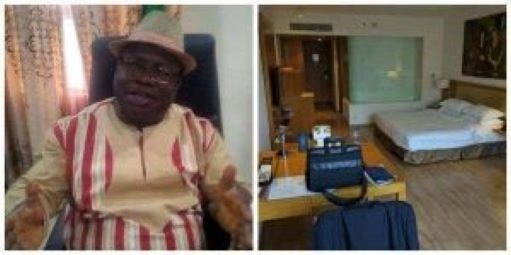
He said, “The following are some of the reasons adduced for the action: one, flagrant dereliction of duty by absconding from office for about a month. Two, the desecration of the highly respected office of the rector with the creation of a bedroom furnished with a king-size bed which has made it possible for him to be sleeping at work.

“Improper improvisation of dual award programme of National Diploma plus NCE (Nigeria Certificate in Education) programme in collaboration with a consultant.”

But Sola Lawal, the Protocol/Media Relations Officer of the institution, while responding through a statement, explained that the issues causing disagreements in the institution would be resolved.

The statement read in part, “Following the purported suspension of the Rector, Federal Polytechnic, Ede, by the Academic Board of the institution, I wish to first and foremost restate that the school is not in crisis in any way whatsoever.

While we are cognisant of the fact that there are pending fundamental issues to be resolved; as a one big family, I want to assure members of the public and the polytechnic community that the management is on top of the situation and working assiduously to douse the tension.

“Furthermore, it is imperative to inform the public and the academic community that the National Board for Technical Education in collaboration with eminent stakeholders within Ede Community are working round the clock to amicably resolve all contending issues without delay.”

The Academic Board of the Federal Polytechnic, Ede, Osun State, has reportedly passed a vote of no confidence on the rector of the institution, Dr. John Adekolawole, citing 21 grounds for its decision.

The Chairman of the institution’s branch of the Academic Staff Union of Polytechnics, Adekunle Masopa, at an emergency congress of the union on Friday, said the academic board had submitted a paper containing 21 grounds for its decision to move against the rector.

Masopa said when he heard that members of the academic board had a rowdy session at their meeting, he quickly went to the venue, but was told not to intervene. He noted that the board members told him that a position paper on the decision taken at the meeting would be submitted to the union.

The ASUP leader further said, “We tried to intervene, but members of the academic board said they had taken a decision and that their decision would stand. They, however, said a position paper would be communicated to us. The said position paper has been communicated to us.

He said, “The following are some of the reasons adduced for the action: one, flagrant dereliction of duty by absconding from office for about a month. Two, the desecration of the highly respected office of the rector with the creation of a bedroom furnished with a king-size bed which has made it possible for him to be sleeping at work.

“Improper improvisation of dual award programme of National Diploma plus NCE (Nigeria Certificate in Education) programme in collaboration with a consultant.”

But Sola Lawal, the Protocol/Media Relations Officer of the institution, while responding through a statement, explained that the issues causing disagreements in the institution would be resolved.

The statement read in part, “Following the purported suspension of the Rector, Federal Polytechnic, Ede, by the Academic Board of the institution, I wish to first and foremost restate that the school is not in crisis in any way whatsoever. (The Punch)

Okutepa, SAN Congratulates New SANs, Urges Them To Join Hands To Restore The Lost Glory of The Legal Profession

Mr. Jibrin Samuel Okutepa, a Senior Advocate of Nigeria (SAN) has congratulated the new silks who would be inaugurated on December 14.

This is contained in an open letter to the silks and made available to TheNigeriaLawyer

“My dear colleagues, Let me start this open letter to you by congratulating each and everyone of you for being found worthy in knowledge and character by the Legal Practitioners Privileges Committee (LPPC) to be conferred with the prestigious rank of Senior Advocate of Nigeria.

“There is no doubt that the rank is a rank of distinction. It confers on you a lot of privileges and responsibilities.”

He drew the attention of the new SANs to the fact that their elevation came at a time when the profession is facing some challenges ranging

He said, “I congratulate you all and I welcome you to the inner Bar. As you are all aware, the conferment of the rank on you is coming at a time when there are many challenges facing the legal profession.”

According to him, things are no more the way they were when he joined the profession. He said what attracted him to join the profession was its honesty and integrity. Members were regarded as beacons of hope.

In those days, according to him, no one lobbied to be made a judge, rather, deserving persons were approached to go to the bench.

“Permit me to say that when I decided to read law and by the grace of God I became a lawyer, I read and I was fascinated by the premium the legal profession placed on honestly, intergity and candour.

“Members of the legal profession were looked upon as the beacons of hope for humanity and the society at large. No charlatans or persons of questionable character were allowed to become or joining the legal profession. Judges too lived very secluded life and you don’t go visiting judicial officers anyhow. Judicial officers were quartered in GRA.

“There was no room for any lily livers judex and the auras surrounding judicial officers were so electrifying. When lawyers or judicial officers passed where people gathered or attended gathering of people, there were these mystical and awesome presence of spartan personality, who were considered as people next only the Almighty.

“The elders of the profession were very honest and straight forward. They placed professional intergity far above partisan and primordial selfish considerations. In those good olden days no-one lobbied to be made judicial officers.Those who were found fit and proper to be approached to go to the Bench accepted to do so not for the financial or other pecuniary considerations, but for the honours and dignity attached to the office of the judex.” he said

Furthermore, he recounted that justice was not compromised and the profession was the envy of all.

He said, “No one dared compromised justice. Justice in it’s purity of form was served from the Bench.It was undiluted.No-one dare to interfere with judicial processes.

“The legal profession was the envy of all. Everyone wanted to read and become lawyer.The profession was the pride of all. Leaders of the profession did not encourage and promote insubordination.

“You cannot assume or continued in the leadership of the profession then if there was a sword of impropriety hanging on your next. No members of the profession was allowed to support evil or impropriety.”

Mr. Okutepa said reverse has become the case. It is intolerant of truth and engulfed in corruption. He said the profession has reached a situation of if you cannot beat them, join them.

He said,. “But can we say or see all of the above of our profession today. I have my doubt. We seem to have become ‘Nigerianised’ where we take ownership of wrongs so long as we benefit from those wrongs.

“The profession has become intolerant of truth. It is difficult finding good examples to follow now in the profession.The legal profession that should and ought to fight and eradicate corruption has become so engulfed in corruption.

“The affairs of NBA for instance have become so surrounded with controversies of corruption that one begins to wonder whether we really have the legal profession of spartan rules where sanctions are applied or we now have the assemblage of people with selfish agenda to destroy the nobility of the legal profession.

In all of these the elders of the profession are just keeping quiet.

“The legal profession now is a case of ‘if you cannot beat them you join them’. The legal profession must rescue itself from the self destruct it is heading.”

Therefore, Okutepa urged the new silks to join hands in restoring the lost glory of the profession

“As you take the silk you have become leaders of the profession. I urge you to join hands with legal Practitioners of like minds not just to condemn the rots in the profession but to restore the profession back to its lost glory. The legal profession must be brought back to the glory of yester years where honour and integrity matter most.

“I congratulate you for making it to the top of your careers. You must avoid any conduct that will undermine the prestige and dignity of the rank. Welcome to the inner Bar.”

AGF Malami’s Comment On Buhari’s Invitation By NASS: Analysis Of His Other ‘Sins’

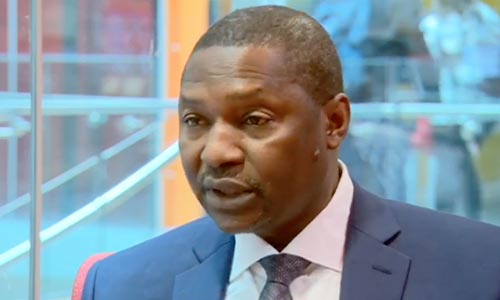
As usual, the Attorney-General of the Federation and Minister of Justice, Abubakar Malami, SAN, has thrown the media into frenzy with his statement that the National Assembly lacks power to summon president Buhari over his “operational use of the armed forces” adding that “summoning the President on National Security operational Matters, the House of Representative operated outside constitutional bounds.” According to Malami, appearing before NASS is “inherently discretionary in the President and not at the behest of the National Assembly”.

Malami’s position completely obviously overlooked Sections 217, 218, 219 and 220 of the Constitution which render operational use of the armed forces subject to the powers of the National Assembly. The NASS decides the establishment, composition, command and operational use of the armed forces.

To be more precise, Section 218(4)(a) of the Constitution provides that “the National Assembly shall have the power to make laws for the regulation of the power exercisable by the President as Commander-in Chief of the Armed Forces of the Federation” hence, the current Armed Forces Act.

Furthermore, sections 88 and 89 of the constitution empowers NASS to invite or summon “ANY PERSON IN NIGERIA” to answer questions relating to areas within its legislative competence and for the purpose of enabling it to “expose corruption, inefficiency or waste in the execution or administration of laws within its legislative competence and in the disbursement or administration of funds appropriated by it” Is Malami saying that President is not a “person in Nigeria”?

With profound respect, the argument in some quarters that summoning the President as required by section 89 of the constitution will run contrary to the immunity clause in section 308 of the constitution is beside the point. The reason why court held that Fayose could be subpoened by court to give evidence irrespective of his immunity in A.D v. Fayose (No 1) (2004) 26 WRN 34 is similar to the very reason why Malami’s argument that Nass lacks power to summon Buhari ought to fail. The reason is that both election petition and NASS investigation are provided by the same constitution so they bought constitute exception to the immunity clause. In fact, legislative investigation has Upper hand because unlike election petition, NASS is not even a court as mentioned in section 308 of the Constitution. If election petition which involves court can be exception to immunity, how much more the NASS proceedings which is not a court?

Assuming for a moment that the other legal of the argument that Nass lacks power to compel attendance of Buhari is correct, same cannot automatically mean that they lack power to summon the president. The power to summon is one thing and power to compel attendance is another. They are mutually exclusive. One cannot override the other. Even the US whom we modelled our constitution after, their Congress have many times summoned the US president.

Since his assumption of office in 2015 as AG and Minister of Justice, Malami has been raising one controversy or the other. Not long ago, while reacting on the EndSars Lekki incidence, Malami said “hoodlums”  wearing military uniforms may have shot Nigerian protesters campaigning against police brutality and even added that said it was “pre-emptive” to conclude that there had even been Shootings in the first place.

In a related development, Malami discarded a report of the National Human Rights Commission (NHRC) which indicted and recommended prosecution of 33 SARS operatives for various rights violations including, extrajudicial killing, death in police custody, unlawful arrest, biased investigation, unlawful intimidation, harassment, criminal assault, torture, cruelty, inhuman and degrading treatment, threat to life, extortion and confiscation of property, among others. NHRC debunked claim of the AGF that there are no sufficient evidence for the prosecution of the indicted officers.

There are allegations in the media against Malami of shielding 10 soldiers who allegedly killed three police officers and two civilians in Taraba to aid the escape of a kidnap kingpin, Bala Hamisu popular known as Wadume, from police custody. Malami has dropped charges against all the 10 soldiers.

It may be recalled the same Malami just of recent unilaterally ‘purportedly’ amended the Rules of Professional Conduct for Legal Practitioners in gross violation of the Legal Practitioners Act which gives such power to the General Council of the Bar.

Apart from the foregoing, Malami has serially defended Buhari’s disobedience to court orders. He supported the rearrest of Dasuki even when court granted Dasuki bail. He justified it on the basis that Dasuki’s ”personal right can be violated for the larger public good.” He accused Dasuki of being responsible for more than 100,000 deaths.

Even when Dasuki and Sowore were released from detention, Malami insisted that Nigerian government released the duo from detention as an ‘act of mercy’.

Malami has also been fingered in numerous attempts to shield Abdulrasheed Maina from being prosecuted by the Economic and Financial Crimes Commission on suspicion of embezzling billions of naira as Chairman of the Pension Reform Task Team. Malami was not only alleged to have met Maina at some obscure location in Dubai in the dead of night. At a point, upon hearing that the National Assembly was investigating Maina, Malami rushed an “ex parte” (without notice to the other side) application to the court to halt the investigation. Thankfully, the court refused and insisted that the National Assembly be properly put on notice of his brazen action.

The “sins” of Malami as Attorney-General of the Federation are too numerous to be counted. Of course the Head of the judiciary, Onnoghen CJN was disgraced out of office under his very watch as Chief Law Officer of the Federation.

It is our suggestion that the learned silk should strive to have his name written in gold as AGF, not otherwise. Agreeably, he is political appointee exercising delegated authority as determined by his appointor – the President, however, his commitment should strictly be to the rule of law and overall interest of the citizens. After all, in saner climes a political office holder resigns if his conscience doesn’t approve things he is assigned to do or if he fails the citizens.

Security situation of the country is bad. Advising the number one citizen of the country to dishonor invitation by members of the National Assembly who are elected representatives of the people doesn’t speak well of him as AGF. We have enough anarchy in the country already; we do not need to extend the frontiers of anarchy by allowing advising government not to give account to the people.

Refusing to honour invitation of the NASS by Buhari is a gross violation of the constitution. We so submit!

Musa Ansa writes from New york

The National Assembly Has The Unfettered Constitutional Power To Summon The President Of Nigeria

By Rilwan Saidu Salihu

Amidst the wave of controversies arising from the position taken by the Attorney General of the Federation ( Abubakar Malami, SAN), as regards the constitutional power or otherwise of the National Assembly to summon the President, for the purposes of investigation and enquires in the performance of its oversight functions, I take a swiftly contrastive position against the much weathered argument of the Learned Silk, respectfully though.

For clarity, appreciation and comprehension of the foregoing discourse, there is need to reproduce the purports of sections 88, 89 and 308 as sections materially inclnied to the vexed issue at hand. To start with, section 88 (1)/of the 1999  constitution provides:

” subject to the provisions of this constitution, each House of the National Assembly shall have power by resolution published in its journal or in the official Gazette of the Government of the Federation to direct or cause to be directed investigation into-

(a) any matter or thing with respect to which it has power to make laws; and

(b) The conduct of affairs of any person, authority, ministry, or government department charged or intended to be charged with the duty of or responsibility for-

(I) executing or administering laws enacted by the National Assembly and ;

(Ii) disbursing or administering moneys appropriated or to be appropriated by the National Assembly.

Sub- (2) of section 88 sumed up by providing thus:

” The powers conferred on the National Assembly are exercisable only for the purpose of enabling it to–

(a) make laws with respect to any matter within its legislative competence and correct any defect in existing  law ; and

(b) expose corruption, inefficiency or waste in the execution or administration of laws within its legislative competence or in the disbursement or administration of funds appropriated by it.

While dissecting the above provisions, it is unarguably clear that the National Assembly has the unruly power to summon the president. Taking a cursory look at sub- (1) (a) of section 88, it provides:

” any matter or thing with respect to which it has power to make laws” . Now, the simple rhetoric question is, didn’t the National Assembly has power to make laws on matters bordering on the office of Mr. President? Of course, they have the power. The answer here is beyond peradventure. Sub- (1) (b) of section 88, went further to provide thus:

” the conduct of affairs of any person , authority, ministry or government department charged or intended to be charged with the duty of or responsibility for….””.

The word “any person” here includes, generally, any person so to say. In fact, including the president of Nigeria. In an attempt to cover the ” any person ” contemplated by the constitution, the purports didn’t end there, it proceeded to add ” authority, ministry or government department charged or intended to be charged …”.

Assuming but not conceding that the president didn’t fall within the category of ” any person ” mentioned by the constitutio, is he not therefore Manning an authority or governmental authority saddled with the responsibility of governance within the legislative competence of the National Assembly?  These constitutional provisions are clear which suggest that the National Assembly can summon the president as part of their oversight functions. By extension, the power of the National Assembly to make laws, for peace, order and good governance traces it origin from section 4 (2) of the 1999 constitution, it provides:

“The National Assembly shall have power to make laws, for the peace, order and good governance of the Federation or any part thereof with respect to any matter included in the exclusive legislative list set out in part one of the second schedule to this constitution “”.

This sums up the arguments. It is equally a matter of both law and common knowledge that since the National Assembly can make laws for the whole Federation and can summon anyone serving within the laws enacted by it, can technically summon the president. In a bid to complement section 88 of the constitution, section 89 provides:

“For the purposes of investigation under section 88 of this constitution and subject to the provisions thereof, the Senate or the House of representatives or a committee appointed in accordance with section 62 of this constitution shall have power to–

(a) procure all such evidence, written or oral , direct or circumstantial as it may think necessary or desirable and examine all persons as witnesses whose evidence maybe relevant or material to the subject matter;

(b) require such evidence to be given on oath ;

(C) summon any person in Nigeria to give evidence at any place or produce any document or other thing in his possession or under his control subject to all just exceptions; and

(d) issue a warrant to compel the attenance who after having been summoned to attend, fails, refuses or negelcts to do so and doesn’t excuse such failure , refusal or neglect to the satisfaction of the House or Committee in question and order him to pay all costs which may have been occasioned in compelling his attendance or by reason of his failure, refusal or neglect .

(e) and any fine imposed shall be recoverable in the same manner as a fine imposed by a court of law.

A critical perusal of  the above section 89 even though it seeks to complement and supplement the provisions of section 88 of the constitution, there is a limit to the application of the section, that is to say, it can hardly be interpreted to include the president especially in the context of issuing warrant of arrest to compel his attendance. Allowing section 89 strictly to be applicable loosely on the president amounts to an infraction to section 308 of the constitution which guarantees executive immunity from civil or criminal proceedings in which case the gravamen of section 89 of the constitution.  For ease of reerence, section 308(1) provides:

” Notwithstanding anything to the contrary in this section but subject to sub- section (2) of this section —

(a) no civil or criminal proceedings shall be instituted or continued against a person to whom this section applies during his period of office .

(b) a person to whom this section applies shall not be arrested or prisoned during that period either on pursuance of process of any court or otherwise; and

(C) no process of any court requiring or compelling the appearance of a person to whom this section applies, shall be applied for or issued….””

From the combined effect of the above sections 88,89 and 308, it is glaring that the sections are blowing both hot and  cold, reason being that sections 88 and 89 are giving while section 308 is taking it away. In the light of the foregoing, it is my firm submission that sections 88 and 89 partly applies to the President but not to the extent of issuing warrant of arrest on him. The part of the sections 88 and 89 that doesn’t apply to the President has been fettered and water down by section 308 of the constitution which is the doctrine of immunity. Although, pursuant to section 88 of the constitution, the National Assembly can invite or summon the president for the purposes of investigation and the likes but shouldn’t overstretch its limit by issuing a warrant of arrest, taking oral or documentary evidence in pursuance of anything connected to the President which section 308 outrightly frwons at.  Issue of immunity clause has long been delt with judicially in plethora of judicial authorities. The Apex Court in Hon. Rotimi Chibuike Ameachi Vs INEC & 2 Ors (2007) NWLR (pt. 1040) , 504. Per Okoro JSC held:

” section 308 of the constitution is not designed to deny citizen of this country his right of access to court. Rather, it is a provision put in place to enable a Governor or executive while in office to conduct the affairs of governance free from hindrance , embarrassment and difficulty which may arise , if he is being constantly pursued or harassed with a court processes of a civil or criminal nature while in office. The court of Apeal followed suit without hesitation in Alhassan Vs Aliyu & Ors (2009) LPELR-8340(CA)  and host of other authorities, like:

A.D Vs Fayose (2004) 8 NWLR (pt. 876)639, Obih Vs Mbakwe(1983)1 SCNLR 192 and Ejura Vs Idris & 2 Ors  (2006)4 NWLR (pt. 971) 538.

In this wise, it can fairly be submitted that the National Assembly can summon the President for the purpose of investigation without the strict application of section 89 of the constitution, that is to say, not to the extent of issuing a warrant of arrest against him, because of the effect of section 308 of the constitution.


NASS INVITATION/SUMMON VIS-À-VIS PRESIDENT BUHARI’S IMMUNITY: A REVIEW

                       By


     O. G. Chukkol, ACIArb (UK)

Much has already been said on the power of the National Assembly to invite or summon President Buhari and weather has heavily been made on the immunity clause entrenched in section 308 of the Constitution of the Federal Republic of Nigeria, 1999 (as amended) to show that Buhari is not bound to honour the NASS Invitation.

Therefore, the points below may be relevant in clarifying some constitutional issues and whether there is need for the prolonged argument in the first place.

  1. Section 88 And 89 of the constitution empower the National Assembly to Investigate “ANY PERSON, AUTHORITY,” and to summon “ANY PERSON IN NIGERIA”. Is President Buhari a person and or authority in Nigeria? Yes he is.
  2. What is the scope of section 308 regarding summons and arrests? It applies only to arrests or summons relating to COURT PROCEEDINGS.
  3. Is National Assembly a court? No it is not a court.
  4. What are the status of the provisions of sections 88, 89 and 308 of the Constitution? Provisions of sections 88 and 89 are specific while provision of section 308 is general.
  5. Between a specific provision and general provision in the same constitution, which one overrides the other? Specific provision overrides general provision. See the case of Inakoju v. Adeleke (2007) 1 S.C. (Pt. 1) 1 where the position was confirmed by the Supreme Court of Nigeria thus:

“Where the Constitution or a statute contains a general provision as well as a specific provision, the specific provision will prevail over he general provision. In the instant case, the specific provision of section 188(9) of the 1999 Constitution will prevail over the general provision of section 102.”

See also CAC V. Davis (2006) LPELR-11411(CA) where it was held that the reason is because
“the specific provision will be deemed to have anticipated the issue as against the general provision. Thus in the instant case, even if the argument of the learned counsel for the appellant could be described as a case of two sets of provisions in an enactment, one special and the other general covering the same subject matter, a case falling within the words of the special provision must be governed thereby and not by the terms of the general provision”

The implication is that the power of the NASS to summon “ANY PERSON IN NIGERIA” including President Buhari is superior to the immunity provisions of section 308 of the constitution.

  1. Are the powers in sections 88 and 89 of the constitution exceptions to the immunity clause in section 308 just like election petitions? Yes they are exceptions and in fact another perfect way of looking at it. In A.D v. Fayose (No 1) (2004) 26 WRN 34 court declared that Fayose could be subpoenaed (ordered to come to court to give evidence) notwithstanding immunity under section 308 of the Constitution.
  2. Can NASS rely on section 88 and 89 to invite or summon Mr. President on security? Yes they can because sections 217, 218, 219 and 220 of the Constitution empower them to make law regulating how the President may exercise powers as Commander in Chief of the Nigerian Armed Forces.

8.
Some people argued that section 67(1) of the constitution says President “MAY” attend meeting of the NASS while 67(2) says Minister “SHALL” attend. Does that mean that the word “may” was used to make it discretionary for president to honour invitation by NASS?

With profound respect it is misconceived argument. Section 67(1) did not say that President “MAY” attend on INVITATION by NASS. Rather it made the visit to be initiated by the president. It is that of Minister that the constitution clearly says minister shall attend “if invited”. In other words, unlike section 67(2) of the constitution, section 67(1) did not say president may attend “if invited” but it says he may visit if it is of national importance.

Therefore, section 67 is completely irrelevant in discussing the power of NASS to invite President Buhari

  1. Does section 308 of the Constitution prohibit president from being accountable to the citizens? No it does not. He owe them a duty to give explanation on security State of the nation.
  2. Is the argument on the power of NASS to summon or invite President Buhari necessary? It is not. Such argument is capable of distracting people from asking president to secure his citizens.

11.
Should the argument continue? No. People should contrate on putting pressure on Buhari to fulfill the mandate given to him, i.e security and welfare of people should be on his priority list.

                          *✍*
    *O. G. Chukkol, ACIArb (UK)*
             Final Year Student, 
               Faculty of Law,
                   ABU, Zaria
    [email protected]
               08032470318
           December 13, 2020

Thugs disrupt Northern Groups’ security summit in Kaduna

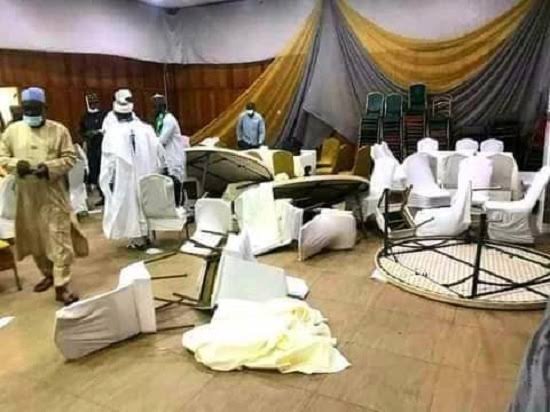
Thugs wielding dangerous weapons invaded the Arewa House Kaduna on Monday, where they ran after officials of the Coalition of Northern Groups, CNG, who were there for a security summit.

Abdulaziz Suleiman, spokesman of the CNG, in a statement, explained that even security guards had to run for their lives.

According to him, “We regret to announce that armed thugs numbering hundreds were unleashed on the Arewa House venue of the security summit hosted by the Coalition of Northern Groups on Monday, December 14.”

“The Summit aimed to discuss ways to achieve synergy between communities and government security and design a uniform approach to the current security situation in the North.”

“Participants at the meeting included retired military officers, Retired Police officers, religious leaders, traditional rulers, various women, youth and trade associations.”

The CNG said just as the meeting was kicking off, ” sponsored armed thugs stormed the auditorium after subduing the civil guards at the gate.”

“The overturned tables shattered glasses, attacked the guests and officials, wounding several people and smashing vehicles parked in the premises.”

“It is disturbing that a battalion of armed thugs can stroll free across the streets of central Kaduna wielding dangerous weapons without the intervention of the security. Security only arrived hours after the thugs had left.”

“It is quite obvious now that some powerful forces are benefiting from the current security situation and would do everything for it to continue.”

“We are now all the more committed to ensuring the safety and security of the North and its people.”

Katsina abductions: Nigerians knock Buhari as president visits cattle ranch, shuns school

Eniola Akinkuotu, Abuja

A video showing the President, Major General Muhammadu Buhari (retd.), visiting his cows in Daura Katsina State, barely hours after hundreds of boys were abducted by bandits has elicited criticisms from several social media users.

The pupils of Government Boys Science Secondary School in Kankara Local Government Area of Katsina State were abducted by gunmen who came on motorbikes around 11 pm on Friday night.

In a video posted on social media on Monday by Sahara Reporters with the time stamp December 12, 2020, however, Buhari is seen with his aides touring his ranch.

The video comes barely a day after Buhari, who is also in Katsina State, failed to visit the school but rather sent a delegation from Abuja to visit the school and sympathise with the families of the victims.

Sahara Reporters Publisher, Omoyele Sowore, said it was obvious that Buhari was not competent and it was time for him to go.

“600 Students got kidnapped in Katsina and he ignored them instead the lifeless President went to visit his cows! The moment we get it that the Buhari regime can’t be redeemed we will come to the inevitable conclusion that #Buharimustgo,” Sowore tweeted.

@TFatombi, “Cows with benefits. 600 lives meant nothing to him.”

“Where a man’s treasure is that’s where his heart is,” tweeted @AdemolaAgunbia3.

Another tweep wondered how Nigerians would ensure Buhari’s incompetence for the next three years.

@iamscorefield tweeted, “Is this the president you want to rule till 2023? Remember we are still in 2020. We better focus on #BuhariMustResign not #Endsars.”

@Thedarkhorse123 said the recent abduction of schoolboys could be worse than the kidnapping of Chibok girls in 2014 if urgent action is not taken.

“It appears if we don’t do something in the next 24 hours, we may have another Chibok case in our hands. Anytime this happens and is ignored for two to three days the window closes! The state government is saying 300 (are missing) while Garba Shehu is saying 10 students. We are in a mess,” he tweeted.

Punchng

CJN Swears-In 72 New SANs, Expresses Concern Over Unprofessional Conduct Of Legal Practitioners Within & Outside Court Rooms

Says Severe sanctions await unprofessional conduct by Lawyers

Justice Tanko Mohammad, the Chief Justice of Nigeria (CJN), said on Monday that lawyers who engaged in unprofessional conduct during court proceedings would be sanctioned.

Mohammad was represented by Justice Bode Rhodes-Vivour, while marking the 2020/2021 legal year and swearing-in the 72 newly conferred 72 Senior Advocates of Nigeria (SAN).

He appealed to lawyers, particularly the young ones to always observe all court rules and not mislead their clients for pecuniary gains.

“Apart from the mode of dressing which I have occasionally complained about, the conduct of some of them within and outside the courtrooms call for serious concern.

” Some have turned the court premises to press interview centres where they cast all manner of aspersions on judicial officers, especially when judgments do not favour them.

“Henceforth, severe sanctions will be meted out on them, therefore, they should always show the ability and capacity to counsel clients well.”

He said that obedience of lawful court orders has no alternative in any society.

“We must respect and observe all the tenets of an enduring democracy. Nigeria is not a lawless society and no one, irrespective of his or her status, should turn it to one.

” Most times, some persons, who by sheer stroke of providence find themselves in positions of authority, flagrantly disobey lawful court orders, and even boast about it.

“Such acts will henceforth no be condoned. In fact, they will be met with severe consequences and we must therefore extinguish such raging fire before it consumes us all”.

According to him, ‘the Correctional Centres are not there for decoration, such literally incorrigible and obstinate elements in our mist must be tutored in those centres to deter the several others eagerly waiting in the to embark on such inglorious expedition.

” The court will not only bark but will bite harder and deeper too,” he warned.

The CJN also added that the apex court in the 2019/2020 legal year had a total of 908 cases, comprising of motions and appeals.

“Out of the number, we heard 497 civil, 168 criminal and 35 political matters, thus amounting to a total of 700 motions.

” The court also considered a total number of 208 appeals, being 134 civil, 52 criminal and 22 political appeals and also, a total of 189 judgments were given within the legal year under review”.

He also noted the apex court disposed of 52 corruption and financial crime cases, the court of appeal, 121 cases, Federal High Court, 19, FCT High Court 10 cases and all state High Courts, 188 cases.

The News Agency of Nigeria (NAN) reports that all the speakers called for collective efforts for an improved and respectable judicial system.

The speakers included Abubakar Malami, the Attorney General and Minister of Justice represented by the Solicitor General, Dayo Akpata, SAN, and Prof. B. O Nwabueze, SAN, who represented the body of SANs.

Others are Olumide Akpata, President, Nigeria Bar Association (NBA) and Obafemi Adewale who spoke on behalf of the New Senior Advocates of Nigeria. (NAN)

COVID-19 Lockdown: Over 500 secondary school student pregnant in Benin

More than 500 pregnancies were recorded in secondary schools of Benin’s northeastern department of Borgou during the 2019-2020 school year, the Beninese news agency (ABP) reported from Cotonou.

“Altogether, 547 out of 36,487 school girls regularly registered were pregnant during the 2019-2020 school year as against 431 cases in 2018-2019,” ABP reported, quoting Thomas Adam, a Representative of the child protection department of Secondary education and professional and technical training ministry.

Adam attributed the increase in the cases of pregnancies to the long cessation of classes observed during the coronavirus pandemic.

Although no strategy linked to the phenomenon was yet made public, several analysts of the Beninese society fear that the crisis linked to the COVID-19 affected the measures taken to eradicate early pregnancies in schools.

Source: http://community.thenationonlineng.net/forum/covid-19-lockdown-over-500-secondary-school-student-pregnant-in-b?xg_source=twitter

TIPS