Home Blog Page 1118

Eleven Days After ‘Seven-day Visit To Daura’, Buhari Yet To Return To Office

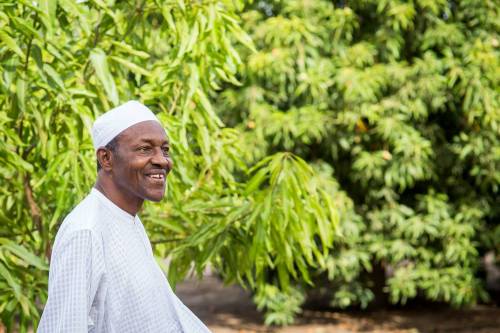
The President had on December 11 embarked on a seven-day private visit to Daura and was billed to return to work on December 18, 2020.

after he left Abuja for Daura, Katsina State, his hometown, for ‘a week-long private visit’.

The President had on December 11 embarked on a seven-day private visit to Daura and was billed to return to work on December 18, 2020.

“President Muhammadu Buhari is in Daura, Katsina State for a week-long private visit. The aircraft carrying the President from Abuja landed at 4:45pm on Friday at the Umaru Musa Yar’Adua International Airport in Katsina where he was received by the Governor, Aminu Bello Masari; his deputy, Mannir Yakubu; senior government officials and the heads of security agencies in the state.

“In Daura to receive President Buhari at the helipad were the Emir, His Highness Alhaji Umar Faruk Umar, leading the members of the Emirate Council and a parade of colourful horse riders and courtiers.

“While in Daura, President Buhari will carry out a number of private engagements but is expected to participate virtually in the meeting of the Federal Executive Council on Wednesday, to be presided over by the Vice President, Professor Yemi Osinbajo, SAN.

“The President last visited his hometown in December 2019, having stayed away largely due to the global COVID-19 situation,” Garba Shehu, Presidential spokesman had said in a statement.

But 11 days later, SaharaReporters gathered that the President has yet to return to the seat of power, with his media aides not saying anything about the extension.

Nigeria’s First Lady, Aisha Buhari, had been in Dubai, United Arab Emirates since September after the wedding of her daughter, Hanan.

SaharaReporters also gathered that the First Lady was not in a hurry to return home after spending over three months, as she reportedly stated that the Aso Rock Villa was not secure for her family.

A top source told the newspaper that Aisha has now relocated quietly to the UAE.

SaharaReporters

I Wish She Was Rescued Like Kankara Schoolboys, Leah Sharibu’s Father Recounts Grief As Daughter Spends 34 Months In Captivity

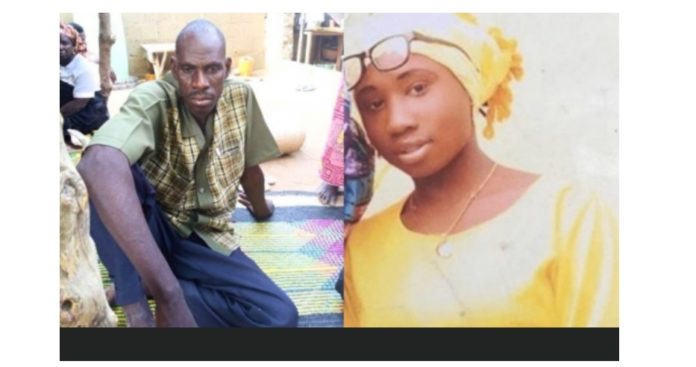
In an exclusive interview with SaharaReporters, Nathan Sheribu, called on the Nigerian government to do everything to secure Leah’s freedom like it did recently when it secured the release of the kidnapped 344 students of Government Science Secondary School, Kankara, Katsina State.

Boko Haram insurgents from the 2018 Dapchi school kidnapping who has not been released, has appealed to the Nigerian government to secure the release of his daughter.

Leah, who was 14 years old at the time she was kidnapped, will be spending her third Christmas this year in Boko Haram captivity if she is not released by Friday.

In an exclusive interview with SaharaReporters, Nathan Sheribu, called on the Nigerian government to do everything to secure Leah’s freedom like it did recently when it secured the release of the kidnapped 344 students of Government Science Secondary School, Kankara, Katsina State.

He said, “We’re pleading again, begging the authorities to help secure the release of my daughter. I believe it is possible because hundreds of schoolchildren were recently released in Katsina.

“We have been left in sorrow for almost three years now since Leah’s abduction. I know they (the government) gave us many promises but my daughter is still in the jungle.

“I believe in God, I believe He (God) can perform miracles; that’s why I still have hope that I will live to see my daughter return home to us.

“Yes, this is going to be her third Christmas since she was abducted in Dapchi, but we still have hope.

On whether he thought she had accepted Islam and believed she truly mothered a child for a top Boko Haram commander, Leah’s father, Mr. Sharibu, said, “All I’m saying is I’ll live to see her return home to us some day, God willing.”

Sadly, if nothing is done by the government to secure her freedom, it’s almost certain that Leah Sharibu would be spending her third Christmas in Boko Haram captivity.

In February 2018, a total of 110 girls were originally kidnapped in Dapchi, Yobe State, but five did not survive the ordeal. Leah, a Christian, was not released along with others because she refused to convert to Islam.

Despite promises by the President Muhammadu Buhari regime to secure her release, Leah has remained with her captors and has been confirmed to have mothered a child for a top Boko Haram commander.

On June 19, 2020, SaharaReporters broke the news that the teenage girl was delivered of a baby boy.

Confirming SaharaReporters’ story, Ahmed Salkida, a journalist with access to the terror group – Boko Haram – on Sunday, June 20, 2020, disclosed that indeed Leah Sharibu was now a mother.

Further confirming SaharaReporters’ story, Salkida in a post on Twitter, said, “Why, I wonder, do we pretend that leaving Leah behind won’t result in pregnancy?

“Since the terror group announced condemning her to slavery, is there any step or collective focus on preventing similar occurrences? She’s a mother, but I don’t know about the gender of the baby.”

A source had told SaharaReporters that the Christian teenager had given birth to a baby boy after being forced to convert to Islam and forcibly married to the unnamed Boko Haram commander.

SaharaReporters

EXPOSED: How Senior Police Officers Aided Escape Of 100 Robbery Suspects In Lagos

The suspects escaped from the disbanded Special Anti-Robbery Squad (SARS) detention centre in Ikeja.

during the #EndSARS protest, SaharaReporters has gathered.

The suspects escaped from the disbanded Special Anti-Robbery Squad (SARS) detention centre in Ikeja.

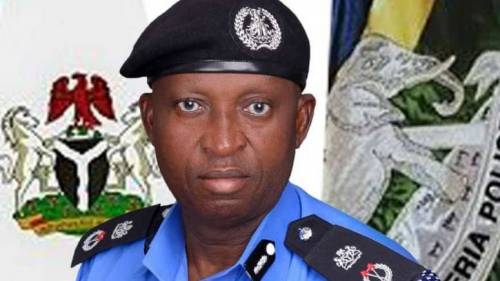
SaharaReporters learnt some senior police officers aided their escape a few days after the Inspector General of Police, Mohammed Adamu, announced the disbandment of SARS.

Adamu had on October 11 announced the disbandment of the police unit following nationwide protests over its brutality.

“About 100 of them were released by some senior police officers immediately the IGP announced the disbandment of SARS. We have arrested two operatives; one of them confessed they did it to increase the rate of crime in Lagos which they intended to link to the disbandment of SARS.

“So far, we have arrested about 20 of the suspects; some of them couldn’t jump the fence when they were told to run away. Others were arrested while committing another offence,” a police source told SaharaReporters.

A notorious robber and rapist, Adeniyi Ajayi, was said to be among the fleeing suspects.

It will be recalled that Ajayi, aka Ogologo, was paraded by the Commissioner of Police, Hakeem Odumosu, in August 2020.

Speaking on how the suspect was arrested, Odumosu said he had robbed some female and male staff of a company on June 16, 2020.

Rather than showing remorse for his action, Ajayi begged the police to kill him, instead of sending him back to prison.

He said his modus operandi was to break into victims’ homes, ordering them to cooperate with him or risk being killed by other members of his gang whom he claimed had surrounded the building.

He confessed to having operated at Sabo, Ijora Badia and Lagos Island areas.

SaharaReporters gathered Ajayi had already robbed two families and raped a lady after he escaped from SARS custody.

A source said, “They said he uses juju. I don’t know what to believe, but the guy is quite artful and very prolific. He knows how to escape and evade arrest. We were on his trail for a while until, with the help of SARS, he was recently arrested.

“However, during the #EndSARS campaign, a neighbourhood security person informed me that the guy had been released. I didn’t believe it. I made calls to some SARS officers at the Lagos State Command of Nigeria.

“They told me it’s a lie, but my security source was adamant. Just last week, we got information that he robbed two homes recently and raped someone. When I confronted the SARS officers, they owned up that the guy is no longer in detention as he had escaped in the course of a purported jailbreak.

“This explanation sounded fishy because there was no report of a jailbreak anywhere in Lagos during the #EndSARS protests. So how come? Our lives are now in danger.”

SaharaReporters

UN Probes Global Shipping Over Toxic Fuels

The United Nations (UN) has started investigation into human rights abuses associated with the global shipping industry and exposure to toxic chemicals without prior consent.

Through its Human Rights Agency (UNOHCR), it has appointed a Special Rapporteur to look into these issues and report back.

Earlier this week, a special investigation in Forbes revealed a growing scandal behind this year’s hasty introduction of a highly hazardous and experimental type of oil in ships.

The ship fuel is called Very Low Sulfur Fuel Oil or VLSFO. It contains a wide variety of undefined toxic chemicals, is now in 70per cent of all ships, and is likely to be an important focus for the inquiry. This fuel – which NGOs have referred to as a super-pollutant ‘Frankenstein Fuel’ – is already suspected as a leading root cause of many shipping disasters around the world, putting the lives of sailors and coastal communities at risk, due to the use of unknown and highly volatile chemicals.

The lead investigator for the UN Human Rights Agency has already begun interviewing officials at the global shipping regulator, the International Maritime Organization. The inquiry will continue collecting evidence through to January 31, 2021.

The investigation will cover both the human rights implications for seafarers on vessels who would have been exposed to the effects of toxic chemicals, as well as to those impacted by oil spills, such as islanders in Mauritius this year and Solomon Islands last year.

The global body has called the exposure of people to harmful substances without their prior informed consent a human rights abuse. It has also said it is a human rights issue for which solutions exist. The question the rapporteur will focus on is why known solutions had not been applied in the shipping industry.

The U.N. has been looking at human rights abuses linked to hazardous substances since a formal mandate was established by the U.N. Human Rights Council 25 years ago in 1995. On 6 October 2020, the U.N. Human Rights Council passed a resolution to look deeper into several issues associated with exposure to harmful substances without prior consent.

The Special Rapporteur on toxics and human rights is Dr. Marcos Orellana who was appointed earlier this year by the UN Human Rights body.

Orellana teaches Environmental Law at George Washington University School of Law in the United States, and had been involved in several high profile environmental justice cases. These have covered international human rights law and the environment including presenting at the U.N. Human Rights Council, International Tribunal on the Law of the Sea, and in participating in international negotiations on Climate Change. He was worked extensively with Governments and NGOs around the world.

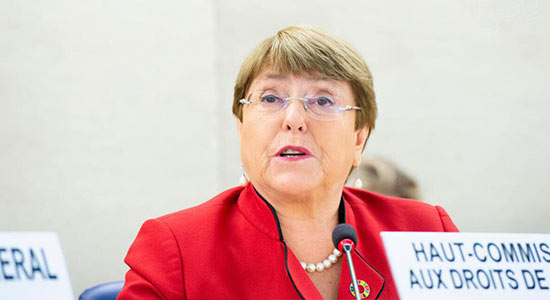
The Head of the UN Human Rights Commission – former two term President of Chile Michelle Bachelet – has been a strong advocate for protecting Human Rights of what she describes as the planet’s ‘Environmental Defenders.’

In 2019, Bachelet brought up these human rights issues against environmentalists at the U.N. Human Rights Council, specifically highlighting the verbal attacks against the then 16 year old climate activist Greta Thunberg.

In August last year, the UN Humans Right Office signed a formal agreement with the UN’s Environment Protection Program (UNEP) to strengthen human rights and the planet.

At the time, UN Human Rights Chief, Michelle Bachelet said, “Our planet is being recklessly destroyed, and we urgently need stronger global partnerships to take action to save it. We call on leaders and governments to recognize that climate change and environmental degradation severely undermine the human rights of their people, particularly those in vulnerable situations – including the generations of tomorrow.”

“We encourage every State to develop and enforce national legal frameworks which uphold the clear linkages between a healthy environment and the ability to enjoy all other human rights, including the rights to health, water, food – and even the right to life,” she added. “We also strongly encourage greater recognition that the actions and advocacy of environmental human rights defenders are deeply beneficial to all societies. They must be better protected against the threat of violence and intimidation.”

Reports suggest that more than four environmental defenders were killed across the world every week in 2019. This rate has doubled in the last 15 years. The latest death toll highlights the ongoing dangers facing those who are defending their environmental and human rights.

This is the first time the global shipping industry has been subject to such a wide ranging Human Rights inquiry over exposure to toxins without consent.

The inquiry will also look into many of the root causes for how the industry has allowed such a situation to develop in shipping, such as poorly drafted laws, little oversight and monitoring of these laws, deliberately weak enforcement, pressure on poorer nations and communities to be responsible for cleaning up the risks caused by large shipping firms.

There has been a growing spate of maritime incidents that many local communities around the world have been calling for justice on. These include communities in Trinidad, Venezuela, Sri Lanka, around the coast of the Red Sea, Mauritius and Lebanon just this year alone.

There are three themes that are likely to be particularly important for the investigation into shipping, human rights and toxins.

The Special Rapporteur has highlighted that he will look at both toxins spilled from ships, as well as air pollution released from ships that are adding to the climate crisis.

Climate crisis: Indigenous communities in Arctic nations, and coastal communities on low lying island nations are particularly impacted by melting ice caps, rising sea levels and more acidifying oceans impacting coral reef protection. This year, the global shipping industry not only decided to break with Paris Climate Agreement pledges, but the Secretary General of the IMO actively tried to undermine the EU’s own carbon emission regulations for shipping. This is in addition to the U.K. Parliament already calling the IMO no longer ‘fit for purpose,’ for its stance on climate issues. Global shipping has been particularly criticized for using toxic chemicals in ship fuels across the Arctic that could accelerate climate change.

Toxins in ship oil (especially the VLSFO ‘Frankenstein Fuel’): The Special Rapporteur will also be looking at the risk of oil pollution, which has been increasing as ships have become larger, and yet ship designs and protection have not kept pace, a sign of major regulatory failure. The fuel now used by 70per cent of ships, called VLSFO and which was introduced this year, is likely to be a major focus for the Special Rapporteur.

Tens of thousands in Mauritius were exposed to VLSFO in the summer, and the shipping companies responsible have not provided a full chemical analysis breakdown of the toxins that the population was exposed to, including what the health risks are. This represents a major human rights abuse, as many in South East Mauritius who were exposed have been reporting serious health conditions (e.g., skin infections, breathing difficulties and mental illness), that have not been taken seriously by the companies responsible for bringing the pollution to Mauritius. Other communities impacted by ship fuel spills like Solomon Islands last year have seen similar experiences.

Gender impact of oil spills: Oil spills have a disproportionate impact on women. The chemicals have a much more significant on female reproductive organs and health, affecting the health of unborn children. Many women faced greater social and financial pressures following the oil spill as they had been employed in the informal sector (e.g., supporting husbands in the fishing business or making tourist products to be sold on informal beach stands), and so were not eligible for any compensation from funds allocated to the response. The gender dimension was completely dismissed by the companies and countries responding to the oil spill disaster in Mauritius, where in over 100 international consultants, not one was female. This created additional conflict in a country like Mauritius, where it was actually many of the female leaders who had led the response to the oil spill and the fight for environmental and social justice.

Human rights abuses in the response to the oil spill: In what is likely to be a damning assessment of the corporate response to the oil spill in Mauritius, the Special Rapporteur’s scope includes evaluating potential human rights abuses in how the oil spill was responded to. In Mauritius, the response by companies responsible saw a massive disruption of the social cohesion of Mauritius. The grassroots led movement that built the artisanal oil protection booms were sidelined by over 100 unaccountable international consultants who never once held a joint press conference to explain what was going on nor allowed any independent oversight of the cleanup techniques they were deploying.


Ex-NERC Chair Calls for Regionalisation of Power Grid

•Says sector problems political, managerial

A former Chairman of the Nigerian Electricity Regulatory Commission (NERC), Dr Sam Amadi, yesterday advocated the regionalisation of power grid as part of the ways to solve the current problems in the Nigerian Electricity Supply Industry (NESI).

Amadi, who spoke when he appeared on The Morning Show, a breakfast programme on ARISE NEWS Channel, explained that the development will engender competition among the grid operators who will thrive to outdo one another.

According to him, though the regionalisation may create disparity in the quality of power supply across regions, eventually some of the region’s will catch up and become efficient.

He stated that the problems with the sector were multi-faceted, including managerial and political issues , misalignments as well as investment challenges.

He said: “There is acute and comprehensive shortages and there are issues of geography like in the North where you have sparsely populated and dispersed areas, which require long lines of network.

“If that is not looped, then total losses will be very high. We have shortage of quality of transmission network, shortage of generation, meaning that we don’t even have capacity. Some 4,000mw, potentially available and sometimes 2,300mw.

“We have distribution network problems. There’s low tolerance level in the sense that if something snaps, something quickly takes it up. There’s also poor managerial capability and maintenance culture, which means that we have not done any maintenance, oversight etc for a long time. They are old problems.

“But in solving them, we think there’s disruptive, disjointed approach in terms of reforms, (they) privatise this, privatise that instead of a gradual incremental managerial improvement on the managerial side and investment and project management will get underway.

“If you privatise the grid, like you have with the distribution companies, where you have scarcity, a market that’s almost non-existent, then you can be sure who comes to the market and have the managerial and financial capacity to make the kind of needed investment.”

In solving the problems, he said decentralisation could play a positive role, adding that as it is currently constituted, much of the financing in the sector goes into funding the bureaucracy as represented by the power minister and across the entire strata.

“We talk about decentralisation, we probably need to be thinking about it on the national grid. But one outcome is that there will be significant improvement in some grids and grid loss in some.

“Again, the problem is political; we get our power based on sharing formula. Not based on use. If I have control over the usage formula, Lagos zone will get much more power than Yola that is quite distant and removed from source of supply.

“Primarily, regionalisation will improve our supply, improve local competencies, give some gap for some people to catch up and grow. Technology is changing, moving from large scale to modular capacity in terms of embedded generation, isolated distribution network, convergence in transmission network.

“We need to rethink the grid. But the primary problem is elementary, managerial, capacity and investment and how much goes into the sector problem instead of financing the bureaucracy that’s wasteful and incompetent.

“Look at the leadership structure of the electricity market today, from minister downwards. Let’s have some incremental improvement before disruptive things. “Regionalising the grid could be a way to take the large-scale inefficiency away from the system,” he added.

He described the Siemens deal as a good move, but lamented that NERC was sidelined throughout the process, making it fail to exercise some prudency checks in it the execution.
Amadi said Nigeria should have commercialised, rather than privatise the power sector, like Egypt did, adding that the sector cannot move from N20 to N40 without commensurate improvement in quality of service.

“The Discos have failed in their duty because they are not able to improve services. They are not engaging their customers. We need a lot of communication,” he stated.
He said those who invested in the sector deployed short term or ‘hot funds’ into an industry that requires long-term returns, noting that they are now desperate to make quick returns on their investment because of the nature of the monies put into the business.

Thenigerialawyer

NANS Accuses Amotekun Man Of Killing Student

*Protest rocks Ibadan

Youths from Oyo town yesterday stormed the Oyo State Government Secretariat at Agodi to protest the alleged killing of a student of the University of Ibadan (UI), by an officer of the Oyo State Amotekun Corps.

The protesters, mostly students under the aegis of the National Association of Nigerian Students (NANS), mounted a roadblock on one side of the Agodi Secretariat-Bodija road, causing gridlock.

Motorists and road users on the Agodi-Secretariat-Bodija-Parliamentary road had a hectic time accessing the road, as the protesters, with the aid of a trailer, blocked a section of the road.

The protesters alleged that an Amotekun Corps officer yesterday killed the victim, Akolade Gbadebo. The demonstrators, who carried placards, urged the government to investigate the incident.

Leaders of the association accused officials of the Amotekun Corps of involvement in the circumstances leading to the death of Gbadebo.

The students were led by the NANS President, Oyo State chapter, Comrade Opakunle Mayowa and the Students’ Union Government (SUG) President, UI chapter, Comrade Akeju Olusegun.

Responding, the Special Assistant to Oyo State Governor Seyi Makinde on Student Matters, Mr. Olojede Victor, said the government had been briefed.

He advised the students to exercise restraint and allow investigation into the matter.

A source said the situation that led to the death of the 400-level student of the University of Ibadan affiliated with the Federal College of Education, Oyo (special), was that of suspected cultism and armed robbery.

The Information Officer of Amotekun in Oyo State, Mrs. Ayolola Adedoja, said the allegation was not true.

Thenigerialawyer

‘Air Force got 23 fighter jets in five years’

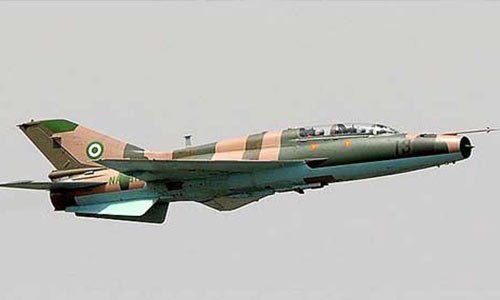
PRESIDENT Muhammadu Buhari has said his administration got 23 brand new aircraft for the Nigerian Air Force (NAF) to boost its fight against insecurity in the last five years.

President Buhari spoke on Thursday at the induction and commissioning of newly acquired NAF MI-171E helicopter and two reactivated Alpha jets and one L39ZA aircraft in Kaduna.

The President, who commissioned the aircraft virtually, said his administration would continue to support the Air Force and the entire Armed Forces to enable them become more effective in the execution of their mandate for the safety and security of Nigeria and Nigerians.

He said: “Today’s induction brings to 23 the number of brand new aircraft that have been added to the inventory of the Nigerian Air Force since we came on board in 2015 and is a clear reflection of our unflinching commitment to ensuring the security of Nigeria and Nigerians.

“These 23 new aircraft are aside the 15 additional aircraft, including 12 Super Tucano aircraft from the United States of America and three JF-17 Thunder Multi-Role fighter aircraft from Pakistan that have been procured and will soon be delivered.”

President Buhari said these achievements are aside the support towards reactivating over 25 erstwhile unserviceable aircraft “significantly boosting the capacity of the NAF to deliver robust air power in support of our counter-terrorism and counter-insurgency efforts”.

The President said he had released two Agusta 101 helicopters from the Presidential Air Fleet to the NAF to improve its tactical capability.

He reiterated the promise of his administration to remain committed to confronting the Boko Haram insurgency as well as other forms of criminality that have bedevilled the country.

President Buhari hailed the security forces for the successes they have recorded so far, especially by restoring “some level of stability not only in Borno and Yobe states but also in Adamawa State.

“Consequently, I want to sincerely thank Nigerians for believing in us and coming together as a nation, irrespective of political, religious and ethnic affiliations, to bring this scourge to an end,” he said.

President Buhari acknowledged the critical role the NAF has been playing in national and continental security and peace-keeping operations since its establishment in 1964.

“Her contributions in internal security, peace-keeping and humanitarian operations in places like The Gambia, Guinea Conakry, Mozambique, Liberia, Sierra Leone, Mali, Guinea Bissau and Cameroon have not only been a source of pride to us as a nation but has also projected us as a reliable regional power that has helped to stabilise other nations and stood firm in defence of democracy,” he added.

Court Remands Siblings For Money Laundering

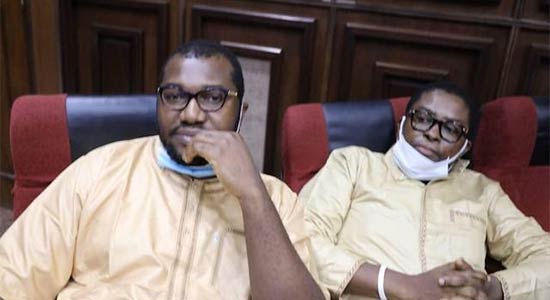
Justice N. E. Maha of the Federal High Court Abuja on Thursday December 24, remanded two brothers, Eze Olisaebuka Okwuchukwu and Eze Onyeka Nnadozie in prison following their arraignment on separate charges of money laundering by the Economic and Financial Crimes Commission, EFCC. While Eze Olisaebuka Okwuchukwu and his company, Berlus Resources Ltd were arraigned on a 11-count charge, Onyeka and his company, DYM Integrated Service Limited are facing 14-count charges.

According to a press release signed by EFCC Spokesman, Count five of the charge against Okwuchukwu reads, ” That you Eze Olisaebuka Okwuchukwu, between 26th September 2017 to 30th October, 2020, in Abuja, within the jurisdiction of this Honorable Court, did convert the aggregate sum of N319,709,807.00(Three Hundred and Nineteen Million, Seven Hundred and Nine Thousand, Eight Hundred and Seven Naira) to the credit of your Fidelity bank account No. 6052516415 which sum you knew forms part of the proceeds of an unlawful act and thereby committed an offence contrary to Section 15(2)(b) of the Money Laundering (Prohibition) Act 2011(as amended) and punishable under Section 15(3) of the same Act”.

Count four of the charge against Onyeka reads, “That you Eze Onyeka Nnadozie, between 21st November, 2014 to 4th December, 2014, in Abuja, within the jurisdiction of this Honorable Court, did convert the aggregate sum of £32,700( Thirty-two Thousand, Seven Hundred Pounds Sterling) to the credit of your Unity Bank Plc Account No. 3001732932 which sum you knew forms part of the proceeds of an unlawful act, and thereby committed an offence contrary to section 15(2) (b) of the Money Laundering (Prohibition) Act 2011 ( as amended) and punishable under the Section 15(3) of the same Act”.

The defendants however pleaded “not guilty” to the charges.

In view of their plea, prosecuting counsel, Samuel Chime asked the court for a date to commence trial, and remand the defendants in prison custody.

The application was not opposed by the defendants.

Consequently, Justice Maha ordered the remand of the defendants and adjourned the matter till January 5 and 6, 2021 for commencement of trial.

The defendants are also being prosecuted at the Federal Capital Territory High Court, Abuja on separate charges of stealing over a billion Naira from a businessman, Prince Arthur Eze.

Thenigerialawyer

Oyo CJ Distributes 10 SUVs To Magistrates

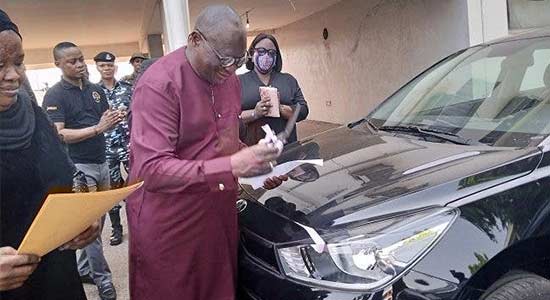
The Chief Judge of Oyo State, Justice Munta L. Abimbola, on Thursday distributed brand new cars to 10 magistrates in the Oyo State Judiciary to further enhance productivity and impact positively on justice delivery in the state’s judicial sector.

The distribution which took place in the premises of the High Court of Justice Complex at Ring Road in Ibadan was witnessed by key judiciary staff.

Speaking during the handover of the vehicles, Justice Abimbola stated that every good develop calls for celebration and acknowledging the mercy and Grace if God considering the peculiarity of the year 2020.

He thanked the state governor, Engr Seyi Makinde, for his support which he said will make the wheel of justice dispensation run more smoothly and prayed for God’s guidance and wisdom for him.

“This year is a peculiar one and the most difficult of all tears but we thank God and we give glory to the almighty that we can still celebrate.

“We thank Governor Seyi Makinde who had deemed it necessary to assist the magistracy by purchasing vehicles for the magistracy. Undoubtedly, that gesture will have a greater effect on the overall administration of justice in the state.

“We pray for God’s guidance and wisdom for the governor to be able to guide the state to greater heights. We also pray that the almighty in his mercy endow judges and magistrates in Oyo judiciary the wisdom to be able to arrive at just decisions,” Justice Abimbola stated.

Speaking on behalf of the 10 beneficiaries, Chief Magistrate Idowu Emmanuel Abiodun, the Chief Magistrate Administration, thanked the Chief Judge for his fatherly role and constant support for members of the judiciary and thanked the governor for extending the Goodwill to the judiciary.

He promised that they will continue to do their best to ensure speedy delivery of justice without fear or favour, reiterating that they will always ensure that the integrity of the judiciary is upheld at all times.

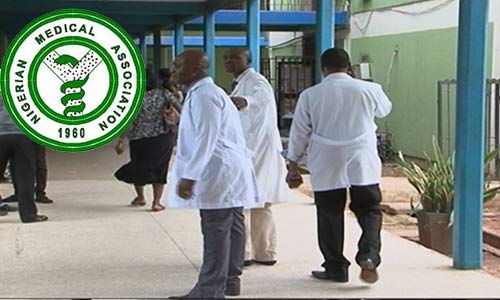
Court Perpetually Restrains MDCN From Allowing NMA Use Its Platform In Collecting Dues, Levies From Member

A Federal High Court sitting in Enugu has granted a perpetual injunction stopping the Medical and Dental Council of Nigeria (MDCN) from allowing other Associations like the Nigerian Medical Association, NMA, to make use of its platform in collecting dues, levies from one of its members, Dr. Awkadigwe Fredrick Ikenna.

The Court also restrained the MDCN from “continued placing of the building levy, on the online or offline platforms and ordered the association to issue him with all such necessary receipt and annual practicing license for which the plaintiff had made payment vide the remita platform”

The court presided over by Justice I. N. Buba also granted the sum of N250, 000 as cost in favour of the applicant.

This followed a suit filed against the NMA by Dr. Ikenna where he is asking for the sum of N500 million as general and exemplary damages.

Awkadigwe, sued the association for suspending him because he instituted a suit against it at the Federal High Court, Enugu Division, and National Industrial Court in 2019. The two suits, FHC/EN/CS/02/2019 and NICN/EN/26/2019 are still pending.

The applicant is also querying the association for suspending him while the two separate matters subsist.

In the suits, he is challenging the use of the Medical and Dental Council of Nigeria, MDCN, the regulatory body for all the medical doctors and dentists in Nigeria, for the collection of NMA building levy from doctors across Nigeria.

According to him, anybody who refuses to pay the levy was denied access to the renewal of the medical license in Nigeria, an action; he described as illegal and has also caused a lot of pain to doctors in Nigeria.

In the order, Justice Buba held that MDCN is not empowered by law in Nigeria to enforce collection of funds, fees, dues, levies and like collections as prescribed by another body or association from the applicant.

The Court declared that MDCN “is not empowered by law in Nigeria to enforce collection of funds, fees, dues, levies and like collections as prescribed by another body or association (inclusive of the 3rd Defendant (NMA) Association) from the plaintiff for the benefit of that body or association”.

The Court further declared that the MDCN lacks the power “to subject plaintiff’s payment or validation of payment of his annual medical practicing fee to the payment of fees, dues, levies and like collections as prescribed by another body or Association”.

Consequently, the Judge gave an order of “perpetual injunction restraining the 1st Defendant (MDCN) and its privies from the use of its instruments whatsoever and howsoever, online or offline for the purpose of collection or enforcement of collection of funds, dues, levies or another body and association from the plaintiff”.

In the suit at the National Industrial Court, Awkadigwe is challenging the powers and authority of the NMA branches and affiliates to invade the salaries of doctors to deduct the association dues and levies without the consent of the doctors.

TIPS