The Nigerian Immigration Service (NIS), FESTAC Office, has begun the issuance of new Enhanced e-Passports as part of efforts to enable Nigerians to have expanded avenue to apply for International Passports.
The service demonstrated its commitment with the inauguration of a new edifice for the purpose and the official roll out of first Enhanced e-Passport in the FESTAC, Lagos, Office.
The Comptroller-General of Immigration Service (CGIS), Mohammed Babandede, said he was delighted that Festac Passport office was able to achieve such a great feat in spite of challenges.
Babandede, who was represented by Mrs Doris Braimah, Assistant Comptroller-General, said he was happy that Festac office had been translated to modern edifice suitable for production of the Enhanced e-Passport .
Newsmen report that the Enhanced e-Passport replaced the Machine-Readable e-Passport.
“The Enhanced e-Passport is part of the new reforms approved by the Federal Government.
“It is an intensive review of the former e-passport booklet which has been in circulation for over 10 years and has only 5-year validity,” he said.
NAN reports that the CGIS, in his productivity drive on Sept. 30, had deployed Deputy Comptroller of Immigration (DCI) Mrs Adeola Adesokan, and some personnel from the service headquarters to overhaul the operations at FESTAC office.
The CGIS said that Festac Passport Office was established in May 2001 to meet the needs of Nigerians in South West.
“We knew that the Nigeria Passport has metamorphosed from manually written booklets to Machine-Readable e-Passport and now enhanced e-Passport.
”All these have been taken into consideration in order to meet the global operational standards at each season,” Babandede said.
According to the CGIS, the new Enhanced e-Passport has been rolled out in seven locations since 2019 when President Muhammadu Buhari officially launched the e-Passport.
“Lagos earlier had two which are Ikoyi and Alausa Passport offices.
“However, we are now rolling out the third one in FESTAC.
“All these were duly considered by NIS bearing in mind of the state strategic relevance of Lagos state.
“Lagos state houses three borders which are sea, land and air. Lagos is a state of commerce,” the NIS boss said.
According to Babandede, the new Enhanced e-Passport has the various features such as Enhanced and self tracking of application.
“It has: Polycarbonate Technology that eliminates damages and Enhanced security features and Compliance with latest International Civil Aviation Organisation (ICAO) standards.
“Ten years validity that save frequent visit to passport offices, automation of issuance process to bring about transparency, addresses touting and it is strictly online payment based.
“Notable among the requirements is the link with National Identity Number (NIN) as it enhances the national security in terms of data management among others,” he said.
The Passport Comptroller of FESTAC, Adesokan, thanked the CGIS for the opportunity to lead the office.
Adesokan reiterated determination to make the passport office the best in the country.
NAN further reports that the Passport Comptroller (PC) of Lagos state, Mr Sunday Fagbamigbe, the Comptroller, Muritala Mohammed Airport, Mr Usman Abdullahi, Lagos state command Comptroller and Seaport Comptroller were present at the occasion.
“What sort of ‘democratic’ government takes pride to openly deny citizens the rights afforded to them by the same constitution that bestows power on the same goverment? Shame on them ALL!” Ireti Bakare-Yusuf, Principal Partner of NottingHill Media, Member, NigerianWomenArise
“What do you expect in a country where some individuals can want to sue Jack Dorsey for the use of his apps and his support to Peaceful protesters in Nigeria. A country where people go to court to request for an Order to compel a governor to run for the presidential office, a country where no one takes responsibility for the lives of innocent. There is a lot of funny stuff going on in Nigeria. There is no precedence for the kind of folly I see on display in our beloved country.” BabatundeAdewusi, Managing Partner @ Law Sector & Partners
“An iconic court building was burnt to ashes, court documents were destroyed irretrievably and people generally suffered losses. If and when those who embarked on the massive destruction of government and private properties are identified, they ought and should be prosecuted and brought to justice. But for the #EndSARS protest organisers, whose bank accounts have been targeted and frozen, the question to ask is, ‘What offence have they committed?” Jiti Ogunye, Legal Practitioner
“Just few weeks after the inauguration of the panels by various states, in compliance with a resolution of National Economic Council (NEC), which was one of the conditions for the suspension or end or call off of the #EndSARS protest, the Federal Government turned around and started hunting or prosecution the key players in that civic engagement exercise by taking steps to strangulate the individuals and group members of the movement.” Osmond Ugwu, Rights Activist
facilities in 2020 following jail breaks in Delta, Edo and Ondo states.
Five inmates died while trying to escape from prisons in Kaduna and Imo states, according to a Daily Trust report.
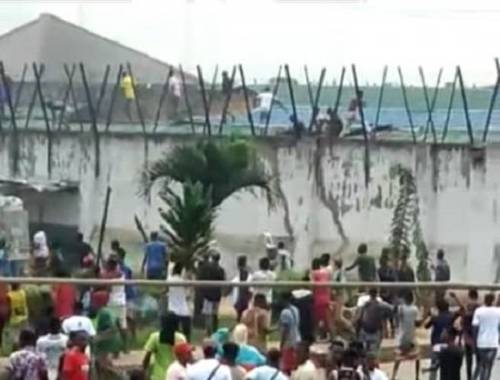
The most recent jailbreak was the escape of 1,993 prisoners from two correctional facilities in Edo State, on October 19, 2020, which the Comptroller of the facility, Andrew Egbobawaye, confirmed shortly after the jailbreaks.
Taking advantage of the #EndSARS protest, hoodlums using local tools and weapons, broke into the prisons and freed inmates.
It was gathered that the armed hoodlums overpowered the prison guards and then freed inmates from the prisons.
Sources said the guards repelled two attempts by the hooligans before they were overpowered.
Many correction officers were said to have sustained gunshot wounds in their effort to restrain the attackers.
The Comptroller of NCS in Edo State, Babayo Maisanda, a few days after the incident, said the number of inmates at large was 1,818, while 163 had either been recaptured or secured.
However, a few inmates surrendered themselves after the state Governor, Godwin Obaseki, gave a two-day ultimatum to the 1,818 at large to return to the facilities or face the full wrath of the law.
A day after the Edo jailbreaks on October 22, 2020, another prison was forced open at Okitipupa in Ondo State, where 58 prisoners escaped. But a similar attempt was foiled on the same day at the Ikoyi Prison in Lagos State.
A total of 2,051 inmates escaped after the jailbreaks in Edo and Ondo states.
Another jailbreak was recorded on Tuesday, April 29, 2020, at the NCS Custodial Centre in Sapele, Delta State, where two inmates escaped and six others were shot.
The jailbreak occurred a few days after the facility was set on fire by inmates who were protesting alleged ill-treatment and “selective amnesty” granted to some inmates of the facility by Governor Ifeanyi Okowa. They insisted that they all deserved equal treatment as prisoners.
On May 17, 2020, a prisoner was killed and many others injured during a failed attempt to escape from a prison in Aba, Abia State.
Sources revealed that in that attempt, the prisoners who were mostly old with a few years left for them to regain their freedom, inflicted serious injuries on some armed guards and that while trying to save their lives, the guards shot at the rampaging inmates and one died.
Also, on April 5, 2020, four inmates died while attempting to escape from a Kaduna correctional facility.
Spokesman for the NCS in Kaduna State, Sanusi Danmusa, said in a statement that four inmates sustained injuries while being restrained by correction officers, but that, “The four inmates later died in hospital from the injuries they sustained.” Danmusa added that, “For the avoidance of doubt, all the deceased inmates were from the condemned section of the custodial centre.”
It was gathered that the inmates at the facility attempted to escape over fear of suspected case of COVID-19 among them.
Other inmates subsequently staged a protest, demanding their freedom to avoid contracting the virus.
The spokesman said the command was not hiding any “truth” on the matter, noting that NCS was not trying to get the inmates infected with COVID-19 as alleged by social media posts.
Days after their escape, a number of convicts immediately returned to murder, armed robbery and posing serious threat to society.
On November 30, 2020, four out of the 1,993 inmates who escaped from Oko in Edo State were rearrested by the police for robbery, carjacking and unlawful possession of firearms in Kaduna State.
The police spokesman, Frank Mba, paraded the suspects in Abuja and gave their names as Adebayo Opeyemi, Onos Benjamin, Peter Felix and Alhaji Hudu Musa.
Also, one of the fugitives ran back to his village on the day he escaped and killed the person who stood as a prosecution witness in the case that took him to prison.
The Edo Commissioner of Police, Babatunde Kokumo, while parading the suspect alongside 126 suspected criminals, said that 10 of the suspects were the inmates who escaped from prison earlier.
A security expert advised that the recent prison breaks in the country should serve as a wake-up call to the executive arm of government to commence a total reformation of the prisons in Nigeria.
A research published in the International Journal of Science and Research Publication has attributed the recent prison breaks to two major reasons.
In the research by Onah Oliver O et al (2019) titled: “Increasing Cases of Prison Break in Nigeria: A Theoretical Explanation”, they argue that the Nigerian prison system has been captured by two high-stake interest groups:
One, wealthy prison inmates who live like kings within the prison walls; and two, a powerful cabal within the NCS authority who are involved in selling prison jobs and promotion to the highest bidders.
The researchers further argued that the trend had weakened the NCS operations and contributed to incessant jail breaks. The paper also highlighted the way forward for the NCS.(SaharaReporters)
Mr Odekunle, a member of the Presidential Advisory Committee Against Corruption, died Tuesday from COVID-19.
The frantic bid to save Femi Odekunle from COVID-19 complications yielded donations and pledges of over 170 cylinders of oxygen from his family, friends and close associates, PREMIUM TIMES has learnt.
Mr Odekunle, a professor of criminology and member of the Presidential Advisory Committee Against Corruption (PACAC), battled the highly infectious disease for 12 days.
PREMIUM TIMES reported how the professor was left gasping for air during his treatment due to shortages in oxygen supply at the isolation centre at the Abuja University Teaching Hospital Gwagwalada. He died on Tuesday evening at the facility.
In a bid to save him, his friends, largely top government officials and politicians rallied for oxygen from far and near to support his breathing, those familiar with the matter told PREMIUM TIMES.
This resulted in the donation of over 170 oxygen cylinders by friends and associates. It is unclear if some of the pledges were eventually redeemed since the professor died before a good number of the equipment are delivered.
The hospital’s Chief Medical Director (CMD), Bissallah Ekele, admitted there was shortage of oxygen in the facility, a situation he blamed on the recent surge in coronavirus infections officially declared the second wave.
He, however, said Mr Odekunle died because of the “severity of his infection.”
The medical director, in a text message Thursday afternoon to this reporter, said “when we had the crises last week, some patients and other Hospitals in the FCT supported us with cylinders of Oxygen but that was resolved as soon as the Presidential Task Force (PTF) on COVID-19 waged into the matter and we now have adequate supply!”
Scramble for Oxygen
According to details obtained by PREMIUM TIMES, there were multiple interventions by the governors of Lagos and Osun, Babajide Sanwo-Olu and Adegboyega Oyetola, the health ministry, the Presidential Task Force on Covid-19, and the Air Force to procure oxygen for Mr Odekunle.
Rauf Aregbesola, the minister of interior, led the intervention process, our sources said.
While efforts to get oxygen began over the weekend, many of them did not arrive before Tuesday evening when Mr Odekunle died.
Our sources said the Gwagwalada isolation centre hurriedly sent 100 big cylinders, through the efforts of the Nigerian Air Force, for refill in Yola, the Adamawa State capital. Those were billed to be delivered to Abuja on Tuesday.
The facility was also to receive about 50 big cylinders from Jos on Tuesday. It is unclear who made that donation.
PREMIUM TIMES learnt that 10 oxygen cylinders were delivered to Mr Odekunle’s bedside by a donor identified as NHA late Monday.
Also, four big cylinders were stationed at Air Force base, Ikeja, Lagos, to be flown to Mr Odekunle’s ward on Tuesday morning.
Another 10 big oxygen cylinders were also arranged by Olu Aina, a professor, and Mr Aregbesola, from Osogbo, and were scheduled to be flown to Abuja by special helicopter.
This newspaper also learnt that one big cylinder was donated by the Nigerian Air Force and was delivered to Mr Odekunle’s ward by his son, Dayo, and an official of the Federal Road Safety Corps (FRSC).
“A lot of the oxygen procured for Professor Odekunle were not delivered before he died,” an associate of the late University teacher said. “I think in the interest of humanity, his friends and family should ensure that all the oxygen cylinders donated and pledged are delivered to the isolation centre to save the lifes of patients still alive.”
In a statement he released after Mr Odekunle’s passage, former Minister Olu Agunloye said the late professor’s “friends rose stoutly to his support … but it was just too late.”
“Top Government functionaries amongst them led by Hon Minister Ogbeni Rauf Aregbesola along with President’s Spokesman, Mr. Femi Adesina, SGF Boss Mustapher and two sitting Governors tore through bureaucracies and red tapes and pulled stunts but the damages to Femi’s health appeared to have gone too far for remedy,” Mr Agunloye said.(premiumtimesng)
The sack of Emeka Ihedioha as Imo State Governor by the Supreme Court was a major political event in 2020 that generated ripples in the country’s political space.
The year 2020 was definitely one of the most dramatic years in Nigeria’s modern political history.
Despite the disruption caused by the deadly coronavirus, the country’s political sphere was filled with its usual twists and turns which led to defections, re-appointments, dismissals and more.
In the last 12 months, Nigerian political space witnessed two governorship elections,15 state and national assembly elections, death of key political figures, political ‘moves’ and engagements ahead of the 2023 general elections.
Below are some major political events of 2020 as reported by PREMIUM TIMES.
Nigeria’s Supreme Court in an unprecedented judgement early January dismissed Emeka Ihedioha of the Peoples Democratic Party (PDP) as the governor of Imo State and declared Hope Uzodinma of the All Progressives Congress (APC) as the winner of the March 9 governorship election in the state.
With the addition of the results from the excluded polling units, Mr Uzodinma polled a majority of the lawful votes and was declared the rightful governor of the state.
Mr Uzodinma came fourth at the March election but was favored because the Action Alliance, Uche Nwosu, who came second, was disqualified.
While Nigerians were savoring the January controversial judgment of the country’s apex court in favour of the ruling APC, the Supreme Court struck again in February, this time, in favour of the main opposition PDP.
Mr Lyon was disqualified on the ground that his deputy, Degi-Eremienyo, submitted false credentials to the country’s electoral body, INEC.
Obaseki, Oshiomhole, Osagie Ize-Iyamu
Edo political crisis
The Edo political saga took the central stage of Nigeria political discussions a few months to its 2020 governorship race.
At a side was the resounding drum of war between the then APC chairm, Adams Oshiomhole and his political protege, Godwin Obaseki, a development that caused factions among the party loyalists and leaders in the state and at the national level.
This fracas led to the defection of Mr Obaseki to the main opposition PDP after Mr Oshiomhole-led executives denied him a re-election ticket.
Caught in the web of his home state political brouhaha, Mr Oshiomhole was also sacked by the court, a case that lingered till the APC National Executive Council dissolved its excos and appointed a caretaker committee to paddle the affairs of the party for the next six months.
Former Emir of Kano, Sanusi Lamido
Emir Sanusi removed by Kano government
PREMIUM TIMES review of the 2020 major political events may not be complete without mentioning the controversial dethronement of the former Central Bank Governor, Muhammadu Sanusi, as the Emir of Kano state following a resolution of the stateexecutive council led by Abdullahi Ganduje, on March 9.
Mr Sanusi was removed on the ground of alleged insubordination to the state’s political authority.
The justification of his removal generated public outcry across Nigerian social media platforms and made headline discussion on the country’s daily.
Late Abba Kyari
COVID-19 makes Nigeria political space mourn
Still in the business of springing surprises, the Nigeria political space recorded not less than death of five prominent politicians as a result of the deadly coronavirus.
The virus was responsible for the death Nigerian president’s powerful Chief of Staff, Abba Kyari. His death was followed by that of the Oyo State immediate past governor, Abiola Ajimobi, who died in June at the age of 70 from underlying health conditions after contracting the virus.
In another news, the senator representing Lagos East Senatorial representative at the National Assembly, Bayo Osinowo and the Ondo state commissioner for health, Wahab Adegbenro, died after contracting the deadly disease in June and July 2020 respectively.
Obaseki and Ize-Iyamu
Edo 2020 Governor Election
In September, 2020, the country witnessed the much anticipated Edo State governorship election.
The election was less of a race between political party candidates and more of a contest between an adamant political son and his troubled god-father who was allegedly bent on correcting his former mistake through another ally.
Edo State was the last foothold of the ruling APC in the South-south region until the animosity between Messrs Oshiomhole and Obaseki eventually cost the party in the September 19 election.
Against all odds, Mr Obaseki surprisingly defeated his closest rival and the 2020 Edo APC governorship candidate, Osagie Ize-Iyamu, by a large margin.
Like a journey of two fated lovers, the Ondo State 2020 governorship election was also held almost a month after Edo.
Earlier in a turbulent and similar intra-party crisis like Edo, the Ondo chapter of the APC, weeks before the election reached a compromise and rallied round the incumbent governor, Rotimi Akeredolu, to secure his re-election victory.
Against popular predictions, the APC governorship candidate won in 15 out of the 18 local governments.
Ebonyi State Governor, David Umahi
Umahi, Dogara, Elisha Abbo ditched PDP for APC
Not less than five prominent members of the PDP defected to the APC in the second half of 2020 under the interim leadership of Mala Buni-led committee.
With the 2023 general elections in view, the former speaker of Nigeria House of Representatives, Yakubu Dogara, in July, defected to the APC, after alleging the PDP-led government in Bauchi state of poor governance.
The Ebonyi State governor, David Umahi and the Adamawa State senator, Elisha Abbo, also joined the growing list of politicians who defected from the main opposition PDP in the last quarter of 2020.
While many ascribed Mr Umahi’s defection to his 2023 presidential ambition many believed would go to the Southern region, the governor has argued contrary in his defense.
Mr Yakub is the first INEC chair to be re-appointed in the country’s political history.
He succeeded Attahiru Jega after the 2015 general elections and supervised 2019 general election and off-cycle elections in states such as Kogi, Edo and Ondo.
INEC legislative bye-elections, Labour leader’s death, PDP appointed Saraki reconciliatory led
The nine states House of Assembly and six senatorial bye-elections held across 11 states by INEC in November featured as one of the top political events in the year under review.
Even though the elections were characterised by low voter turn-out by election observers, the APC won seven of the 11 seats in Lagos, Imo, Kogi, Plateau, Katsina, Bauchi, Borno, while the main opposition PDP won in Bayelsa, Enugu, Zamfara, and Cross Rivers states in the federal and state legislative bye-elections.
Like a yearly tradition, President Muhammadu Buhari on Friday addressed Nigerians on the occasion of the new year.
The President in his speech, shared his administration’s goals for year 2021 and his expanded vision for his next two years in office.
He also addressed several burning issues in his New Year’s speech; He pledged that his administration will focus on revamping the economy, fight corruption among others. He also expressed commitment to ensuring that the lives and property of the citizens would be protected.
In this piece, The Nation highlights few takeways from the president’s speech;
2020 as a ‘tough’ year – The president admitted that 2020 was indeed a tough year. He lamented that novel COVID-19 pandemic tested the country’s resilience and ability to survive through tough times. He however called on Nigerians to observe COVID-19 prevention protocols to a resurgent cycle of the infection.
Nigeria’s struggle for survival – The president outlined how the nation has journey through as an independent and sovereign country despite the stormy waters. He noted in the 61 years sojourn of the country after independence, the country still stands tall in the comity of nations as one country united under the will of God and also actively growing that indivisible Nigerian spirit.
Recognising the roles of ‘youths’ – President Buhari affirmed that the youths are most valuable natural resource, at home and abroad. He reiterated the commitment of his administration to actively engage with the creative energies of youths by partnering with the legislature to develop an enabling environment to turn their passions into ideas that can be supported, groomed and scaled across regions.
Commitment to implementing demands of #ENDSARS protesters – President Muhammadu Buhari in his speech restated his commitment to implementing the five demands made by youths during the #ENDSARS protests that swept across the country in October, 2020. He equally reaffirmed his commitment to the people of Nigeria, especially the youth.
Re-organising the nation’s security apparatus – President Buhari in his speech, promised to re-energize and reorganize the nation’s security apparatus and personnel of the armed forces and the police with a view to enhance their capacity to engage, push back and dismantle the operations of both internal and external extremist and criminal groups waging war against our communities in some parts of the country.
Revamping the economy in 2021; President Buhari noted that his administration’s focus is on revamping the economy through the national economic diversification agenda that supports the primary goal of national food self-sufficiency, and also rebuilding the country’s infrastructure base.
Diligence and timely prosecution of corruption cases – President Buhari in his speech, promised to work with the Legislature to enact laws that would strengthen the fight against corruption. He promised to ensure diligent and timely prosecution of corruption cases.
Insecurity as a ‘monstrous’ challenge – President Buhari noted that the cycles of violence that have been unleashed by mindless groups like Boko Haram and others have thwarted the efforts of government to undertake the social policy and associated investments that could make a huge difference in the quality of life of our citizens.
Plans to procure COVID-19 vaccines – President Buhari while calling on citizens to take responsibility in keeping the country safe from a resurgent cycle of COVID-19, he noted that his administration is finalizing plans to procure, efficiently and effectively distribute the COVID-19 vaccines.
Play your ‘own’ part – President Buhari has promised to play his own part in 2021 as the elected President of the country without fear or favour. He equally urged every Nigerian to do the same stressing that this is what we all owe the founding generation of our beloved country and also to the coming generation.
I suspect that a good number of you at some point might have been dragged into that trivial and unnecessary exchange with someone that left you with huge regrets just moments later. I have. You held your ground firmly believing to be on the right. In the end, a highly cherished relationship became deeply strained and in some other instances you even got seriously bruised in the process. Few days before Christmas I witnessed the most scary road rage in human history.
Early that morning, my family and I were on our way to Ikeja airport, a less than five miles drive from our hotel room. Being that one was already familiar with the crazy and chaotic Lagos traffic, we started out a good two hours earlier than our scheduled departure, just to make it on time. Right in front of us was the driver of a fairly new Toyota 4Runner. He was a young man and I believed should be somewhere in his mid-twenties. In the midst of a long stack of vehicles waiting impatiently to make it through, he quickly dashed forward, maneuvering his way to block off an 18-wheeler attempting to cut through the line of traffic. Though he was right about everyone following the rules and angry at the errant driver just like the rest of us, it was such a deadly stunt that he excaped being totally crushed beyond recognition by the whiskers. Everyone watching was visibly shaken and the driver was beyond terrified. I was super thankful that my little ones were spared of what would have been a horror movie on the eve of Christmas . No amount of image laundering by me would have been able to convince them about the beauty of Nigeria and her people. Thereafter, I reflected on what had happened and how close we were to loosing many innocent lives. It reminded me of the famous lines about William Jay:
“Here lies the body of William Jay Who died maintaing his right of way He was right, dead right as he sped along But he is just as dead as if he were wrong”.
In those few moments when dad found time to spend with his children ,he always made sure to leave us with memorable life lessons. Those pearls of wisdom got passed down usually in the form of Igbo folk tales shared around the fireplace after dinner. In this one instance, it was the story of a man and his wife who had some little misunderstandings that ended up with disastrous consequence. Though the man was right in his own way according to the story, in the end he lost not just his wife but his entire family. He had insisted on claiming his right while ignoring the bigger picture of family unity and his ultimate happiness. In the end, dad posed the question; “Would you rather be right or be happy?” It was a such a sobering lesson that I have kept close to my heart till this day.
We all have met the likes of William Jay. He will debate you to a standstill at every opportunity, delivering sharp counter punches and poking holes in all your submission. He will stop at nothing to prove that he is right and in the end wears you out. You cave in feeling battered and ridiculed in the process and never forgets the way he made you feel. You may have all encountered him. Or maybe you were him that time it mattered more to prove your point than show respect to others and build bridges of better relationship.
A lot of people have relied over the years to get the job done on the strength of the intellect and superior argument. Whereas those are very essential , simple psychology sometimes proves a little more useful. Of course no one said it’s most important but just more useful.
Human ego is so fragile and sometimes suffers irrepairably when fractured. A fractured ego hardly forgives and is less receptive to friendly overtures. Whereas one does not advocate to compromise on solid principles, in many instances it may not be as important to be right than to live a happy life.
An Afghan journalist and human rights activist was shot and killed on Friday by unidentified gunmen in western Afghanistan, the fifth journalist to be killed in the war-ravaged country in the past two months, a provincial spokesman said.
Bismillah Adil Aimaq was on the road near Feroz Koh, the provincial capital of Ghor, returning home to the city after visiting his family in a village nearby, when gunmen opened fire at the vehicle.
According to the provincial governor’s spokesman, Arif Abir, others in the car, including Aimaq’s brother, were unharmed. Aimaq worked as the head of the local Radio Sada-e-Ghor station and was also a human rights activist in the province.
No one immediately claimed responsibility for the shooting. Taliban spokesman Zabihullah Mujahid insisted the insurgents were in no way connected with the shooting.
Aimaq was the fifth journalists slain in attacks in the past two months. Last week, Rahmatullah Nekzad, who headed the journalists’ union in eastern Ghazni province, was killed in an attack by armed men outside his home. Nekzad was well known in the area and had contributed to The Associated Press since 2007. He had previously worked for the Al Jazeera satellite TV channel.
Afghanistan’s intelligence department claimed two perpetrators in that attack were subsequently arrested and aired video recordings of the two, with their purported confessions to the slaying and to being Taliban. However, the Taliban denied involvement in the killing, calling it a cowardly act. Large swaths of Ghazni province are under Taliban control.
The Islamic State group, blamed for a series of attacks on a range of targets in Afghanistan in recent months, claimed it had killed another Afghan journalist earlier in December. Two assailants opened fire and killed TV anchorwoman Malala Maiwand as she left her house in eastern Nangarhar province. Her driver was also killed.
In November, two journalists were killed in separate bombings.
The Committee to Protect Journalists has condemned the relentless attacks on journalists in Afghanistan. The international press freedom group Reporters Without Borders has called the country one of the world’s deadliest for journalists.
Earlier this week, the Afghanistan Independent Human Rights Commission said the targeted killings of Afghan journalists have negatively impacted reporting in the country and led to self-censorship in the media community. The statement said a number of female journalists have left their jobs in the provinces due to ongoing threats.
The statement further says that majority of journalists are not able to go out in some provinces openly and government has neglected when they reported the threats they were facing.
Target killing and violence have increased across Afghanistan even as the Taliban and Kabul government continue hold peace negotiations that began in September. The talks, after some recent procedural progress, have been suspended until early January and there is speculation the resumption could be further delayed.
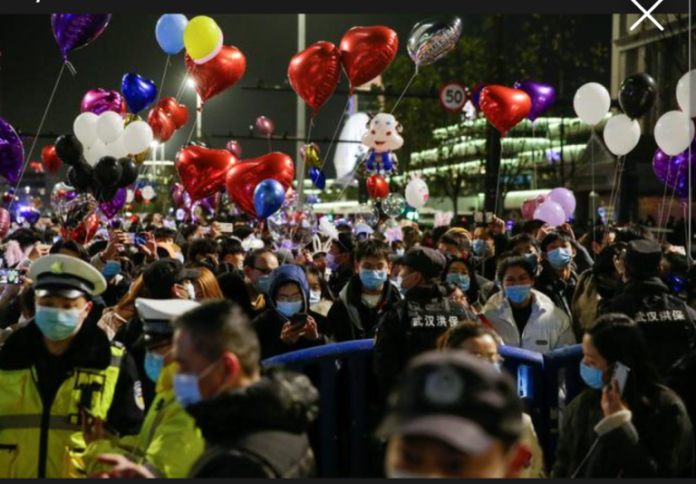
WUHAN, China (Reuters) – Large crowds took to the streets at midnight on Friday in the central Chinese city of Wuhan, celebrating the arrival of 2021 after a year marred by a deadly pandemic that killed thousands there and required the city to be locked down between the end of January and early April.
As per tradition, hundreds gathered in front of the old Hankow Customs House building, one of the city’s more popular New Year’s Eve spots. When the building’s old clock reached midnight many people released balloons into the air, cheered and called out “happy new year”.
“I’m so so so incredibly happy,” said 20-year-old student and tourist Yang Wenxuan. “This is my first time in Wuhan. But it (the countdown) was so spectacular.”
“I hope that I can successfully obtain my bachelor degree and I hope I can find a boyfriend,” Yang added.
There was a heavy police presence and strict crowd control. Some security personnel were seen telling several of the few people without masks that they must put one on if they wished to stay. Still, the countdown appeared to proceed peacefully, in a relaxed atmosphere.
The festivities came 12 months after the World Health Organisation (WHO) said it first received word of cases of a pneumonia of an unknown cause in Wuhan, which later became known as the world’s first outbreak of COVID-19. A team of WHO experts is scheduled to arrive in China in January 2021 to investigate the origins of the pandemic.
Wuhan has been largely virus free for months, and in recent days it has been vaccinating some specific groups of the local population. But a recent small rise in cases in various Chinese cities, including Beijing, has reminded people in Wuhan that the pandemic is not over yet.
“I hope that in 2021 everything goes well in the country and Wuhan can return to normal and I hope that the world can soon defeat the pandemic,” said Wuhan resident Anson Yang.
The 25-year-old ,who works in the international trade sector, said his earnings were hit hard in 2020 and he knows of many businesses in Wuhan who are yet to return to normal trading levels.
Several students yearned for an end to the pandemic so they could get on with in-person studies. One university student, however, drew some positive lessons from the fight against the pandemic.
“If we look at the measures people took, the things people did as part of the epidemic control and the like, a human or friendly touch, something that we would not normally see, was felt by everyone,” said 21-year-old Chen Mengfan.
The Central Bank of Nigeria depreciated the naira yesterday by N16.25 kobo depreciated in the Investors and Exporters (I&E) window. This represents the third and biggest daily depreciation of the naira since 2017.
Recall, the indicative exchange rate for the window jumped to N374 per dollar at the close of business from N368.33 per dollar on 11th of March 2020, translating to N5.67 depreciation for the naira.
Similarly, last month, CBN depreciated the naira by N7.75 in the window, as the FMDQ platform, showed that the I&E window rose to N393/$ at the close of business from N385.5/$ November 24 2020. Data from FMDQ showed that the indicative exchange rate for the window rose to N410.25 per dollar from N394 per dollar on Wednesday, indicating N16.25 kobo depreciation of the naira. However, the volume of dollars (turnover) traded in the window rose by 43 percent to $235.75 million from $164.81 million on Wednesday.
Our site uses cookies. By clicking “Accept All Cookies”, you direct Law and Society Magazine to store cookies on your device and disclose information in accordance with our Cookie Statement: cookie policyACCEPTREJECT
Privacy & Cookies Policy
Privacy Overview
This website uses cookies to improve your experience while you navigate through the website. Out of these cookies, the cookies that are categorized as necessary are stored on your browser as they are essential for the working of basic functionalities of the website. We also use third-party cookies that help us analyze and understand how you use this website. These cookies will be stored in your browser only with your consent. You also have the option to opt-out of these cookies. But opting out of some of these cookies may have an effect on your browsing experience.
Necessary cookies are absolutely essential for the website to function properly. This category only includes cookies that ensures basic functionalities and security features of the website. These cookies do not store any personal information.
Any cookies that may not be particularly necessary for the website to function and is used specifically to collect user personal data via analytics, ads, other embedded contents are termed as non-necessary cookies. It is mandatory to procure user consent prior to running these cookies on your website.




![Rauf Aregbesola [Photo Credit: Rauf Aregbesola on Facebook]](https://i2.wp.com/media.premiumtimesng.com/wp-content/files/2020/12/83552886_2714852001885149_6605330818422276096_o.jpg?ssl=1)


![FILE: Former Emir of Kano, Sanusi Lamido [Photo: Daily post]](https://i1.wp.com/media.premiumtimesng.com/wp-content/files/2020/03/sanusi.jpg?ssl=1)


![Akeredolu, Ajayi, Jegede [Photo Credit: Blueprint Newspaper]](https://i2.wp.com/media.premiumtimesng.com/wp-content/files/2020/10/Blueprint-Newspaper.jpg?ssl=1)