Mr. Chibuike Amechi, the Nigerian Transportation Minister, the Abuja Chamber of Commerce and Industry and railway professionals have called for an urgent passage of railway bills before the National Assembly to open up the sector for private sector participation.
They spoke on Thursday at the Transport Sector Webinar Series organised by the Abuja Chamber of Commerce and Industry (ACCI) with the theme Assessing Railway Development in Nigeria and moderated by Olawale Rasheed, Policy Centre Director of ACCI.
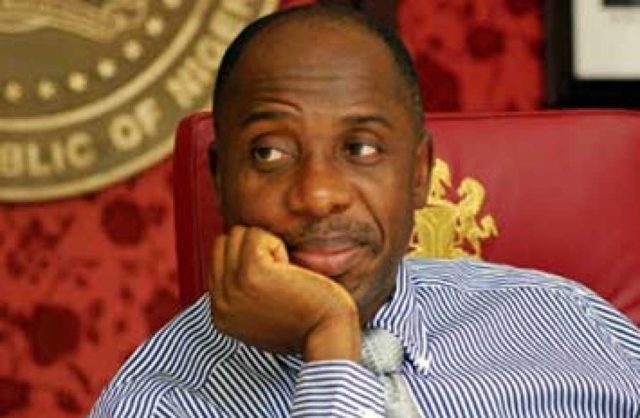
Chibuiki Amechii
Participants described the present legal framework as an impediment to rapid development of the sector.
The webinar which was attended by several stakeholders from around the globe included speakers like Abubakar Al-Mutjaba (Nigeria), Victorial Akai, Mr Jide Ehizele (UK) ,Prof Andrea Guirich (Italy), Mr Hussein Askary (Sweden), Michael Banjo(UK) ,Marcus Mukoro(USA) and Rowland Ataguba (UK) picked holes in the antiquated laws regulating the railway industry, pushing for a new legal and regulatory structures.
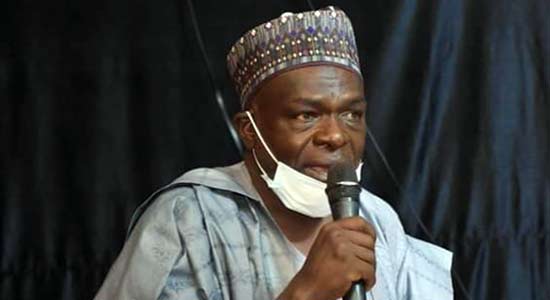
The president of ACCI, Alhaji Abubakar Al-Mujtaba, in his opening remarks, appealed for new legislative framework to allow private sector to construct and run railways whike also seeking constitutional amendment to move railway from exclusive to concurrent list of the constitution.
While recommending diversification of railway financing by the Federal Government , he urged deliberate support for the development of Nigerian local railway Industry value chains, adding “We seek enhanced localisation in the implementation of the various railway projects. This will deepen local capacity development.
The Minister who sent in his keynote speech sought the passage by the National Assembly of the new railway Bills namely “the Nigerian Railway Authority and National Transport Commission Bills” to provide legal framework that will facilitate the participation of private sectors and to sustain the rehabilitated and modernized railway networks in the country and in the end, reducing the financial burden on Government towards railway development.
While listing progress already made in the revitalization of the railway sector, Amaechi stated that “the administration is focusing at bringing about a functional and industrial transportation backbone that would aid economic growth, leading to the high capital investment and social economic impact associated with railways.
“It is my considered opinion that Nigerians should be aware of this development and how the outcome of Government’s effort would positively impact on their livelihood”, assuring that the ministry has fully embraced Public-Private partnership as well as reform of legal, regulatory and institutional framework.
Various speakers reiterated importance of reforms for sustainable railway system. Transport Economist, Prof Giuricin recommended Italian rail model for Nigeria, dwelling on issues of access, competition and market strategies.
Rail consultant, Ehizele recommended development of rural railway strategy, focussing on linkage of corridor development with rural economy and infrastructures. Mr Askary of Swedish Belt and Road Institute said Chinese loan for infrastructures cannot amount to debt trap as Africa needs Infrastructure to for out of under-development.
Banjo, a transport lawyer gave an overview of progress and challenges facing the sector, recommending continuous political will, conclusion of a national transport policy and the passage of railway bills within the legislature. The last speaker, Marcus Mukoro advocated for a national strategy to deploy diaspora railway resources to speed up Nigerian rail development.
The webinar was attended by 84 participants.(Africachinapresscentre)
The Minister of Health, Dr Osagie Ehanire, has approved 12 additional hospitals for chemotherapy in the ongoing Cancer Access Partnership Programme at over 50 per cent cost reduction.
He disclosed this in a statement he issued on Thursday in Abuja to mark the World Cancer Day, annually marked on Feb. 4 to raise awareness on cancer and to encourage its prevention, early detection, and treatment.
He said that the Federal Ministry of Health under his watch had continued to improve access to cancer care services, especially in diagnosis, chemotherapy and radiotherapy services.
Chemotherapy is an aggressive form of chemical drug therapy meant to destroy rapidly growing cells in the body. It’s usually used to treat cancer, as cancer cells grow and divide faster than other cells.
Radiotherapy, also another way of treating cancer, is where radiation is used to kill cancer cells. It may be used in the early stages of cancer.
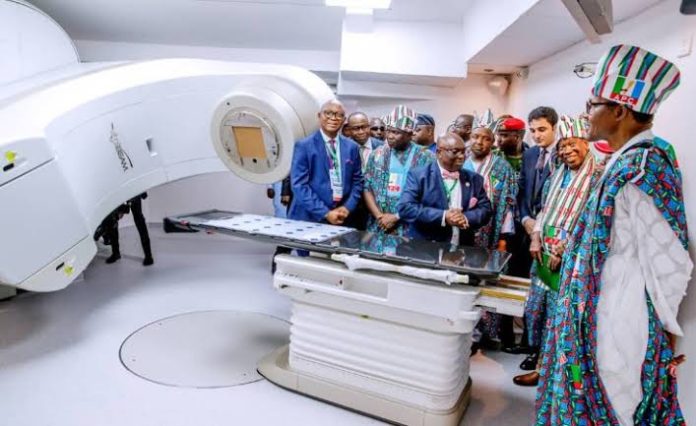
Ehanire, therefore, stated that “we are currently improving services in some hospitals across the country, with installation of radiotherapy machines already in advanced stages in UNTH Enugu, UBTH Benin, UDUTH Sokoto, UCH Ibadan and ABUTH Zaria.
“These would have been completed, but for the hitches caused by the COVID-19 pandemic.
“I also approved the inclusion of 12 additional hospitals in the ongoing Cancer Access Partnership (CAP) Programme; this will increase the number of hospitals offering this service from seven as at the 2020 World Cancer Day to 18 as at today.
“The initial seven hospitals offering the service were National Hospital Abuja, ABUTH Zaria, AKTH Kano, OAUTHC Ile-Ife, UCH Ibadan, LUTH Lagos and UNTH Enugu.
“The additional hospitals are FTH Gombe, UPTH Port Harcourt, UBTH Benin, UITH Ilorin, UCTH Calabar, AEFUTHA Abakaliki, JUTHJos, UDUTH Sokoto, FMC Birnin Kebbi, NAUTH Nnewi, ABUTH Bauchi and Kalgo Medical Centre in Kebbi.
“The CAP programme also improved from nine molecules from one manufacturer to 20 products in 29 formulations from three manufacturers.’’
According to him, the Federal Ministry of Health successfully developed a National Chemotherapy Safety (ChemoSafe) policy in 2020, which will be launched soon.
He said “we also developed a National Hospice and Palliative Care Policy to address the Palliative Care Need of cancer patients and other patients that may need the services.
“This policy will also be launched this year.’’
The minister noted that government established the Cancer Health Management Fund in 2020 to demonstrate its commitment to improving access to cancer care services.
He added that government had already developed an indigent patients’ selection criteria to ensure that only those who needed the fund benefit from it.
“This is meant to complement other patients assisted programmes like the National Health Insurance Scheme (NHIS) and the CAP programme.
“We are currently working out modalities to ensure that almost all cancer care services are covered by NHIS.’’
Ehanire urged stakeholders in the Cancer Ecosystem to join hands with the ministry to take the war against cancer to the next level. Globally, he said, there was continuous rise in the incidence of cancers, especially in low- and middle-income countries, including Nigeria.
He said “according to available statistics from our Cancer Registries, the Age Standardised incidence Rate (ASR) in males started rising at age 35-39 years and peaked by 70 – 74 years, while the rise in females startedat age 25-29 years and peaked at 65-69 years between 2009 and now.
“We have also started seeing increased incidence of childhood cancers, especially haematological cancers in our facilities.”
According to him, the theme of the 2021 World Cancer Day “I AM and I WILL” is still the theme that has been reflected on for 2019 and 2020.
He explained that the ministry had commenced full implementation of the “screen, see and treat” programme of the Federal Ministry of Health in collaboration with the Clinton Health Access Initiative (CHAI).
“The objective of this programme is to embark on massive awareness, free screening and treatment of precancerous lesions of 430,000 women in three pilot states of Kaduna, Lagos and Rivers.
“And in 2020, over 1000 Health Care Workers (doctors, nurses, Lab scientists, CHEWS and data collectors) in the three states and the Federal Capital Territory were trained and over one thousand women screened in the course of hands-on training of the health professionals.’’
In addition, he said, the ministry had intensified efforts to ensure wider accessibility and availability of Human Papilloma Virus vaccine through the National Primary Healthcare Development Agency (NPHCDA) within this year 2021.
“This will target our young girls and boys (9-13 years of age) to eliminate Human Papilloma Virus (HPV) which is known to be responsible for over 70 per cent of cervical cancer cases,” the minister noted. (NAN)
Miyetti Allah Cattle Breeders Association of Nigeria (MACBAN) has called on the Federal Government to leverage on the ECOWAS transhumance certificate protocol, to check influx of herdsmen from neighboring countries.
The call was contained in a statement, jointly signed and issued by Alhaji Muhammad Kiruwa, President, and Alhaji Baba Ngelzarma, National Secretary, of the association, on Thursday, in Abuja.
Ngelzarma, who explained that the advice was part of resolutions reached at the end of a one-day National Executive meeting of the association with its Chairman, Board of Trustees, Sultan of Sokoto, Alhaji Sa’ad Abubakar III, held in Abuja.
He said that the meeting was called to review the deteriorating security situation in the country, as it affected its members and the continued stereotyping, by the social and the mass media, that all herdsmen were criminals and bandits.
Ngelzarma also stated that the meeting called on the Federal Government to carry out sensitisation and re-orientation programmes for pastoralists, as well as revamp the nomadic education programme for their children.
Similarly, he urged the Federal Government to decisively deal with the issue of porous borders, which made it possible for the massive proliferation of arms.
” The meeting also calls on the Federal Government to introduce social support programmes, as is done to other sectors of the economy such as; farmers and miners, petroleum sector.
” This will alleviate the huge losses of livestock; taking into consideration the over five million cattle that have been lost as a result of banditry, cattle rustling, kidnapping and climate change.
” The meeting expressed its outrage at how 1,730 cows were allegedly rustled in Kafin Koro, in Mariga Local Government in Niger State, on Feb. 2, which rendered several families destitute, without any means of livelihood.
” The meeting once again calls on the Cooperate Affairs Commission to distinguish its name (Miyetti Allah Cattle Breeders Association of Nigeria) with that of a newly registered organization bearing the same Miyetti Allah, so as not to confuse the public.
” The meeting also appeals to the Federal Government to take immediate action against local criminal gangs known as “Yansakai” in Kebbi and Niger States, who are involved in wanton killings of 153 innocent pastoralists.”
He pledged the cooperation and support of the association to the Federal and State governments, traditional rulers and security agencies, in the fight against banditry and kidnapping in all parts of the country, saying that such cooperation would bring peace, stability and harmonious co-existence. (thenigerialawyer)
Goodness Adeosun, a medical student at the University College Hospital (UCH) and an entrepreneur, was raped twice on her 21st birthday. Medical and forensic examinations confirm so, as well as admittance of guilt by the perpetrator. However, because the offender was a medical practitioner at UCH, the victim is being denied justice, writes Kolajo Onasoga.
DR Olugbenga Anthony Olugbenga, and Goodness Adeosun.
On the night of December 9, 2019, when Goodness Adeosun was to celebrate her 21st birthday, her friends aired her. She had gotten a cake and invited a few friends for a hangout. They all gave excuses for not being available. That night, sad and dejected, she made a post on her Whatsapp status wishing her birthday quickly ended.
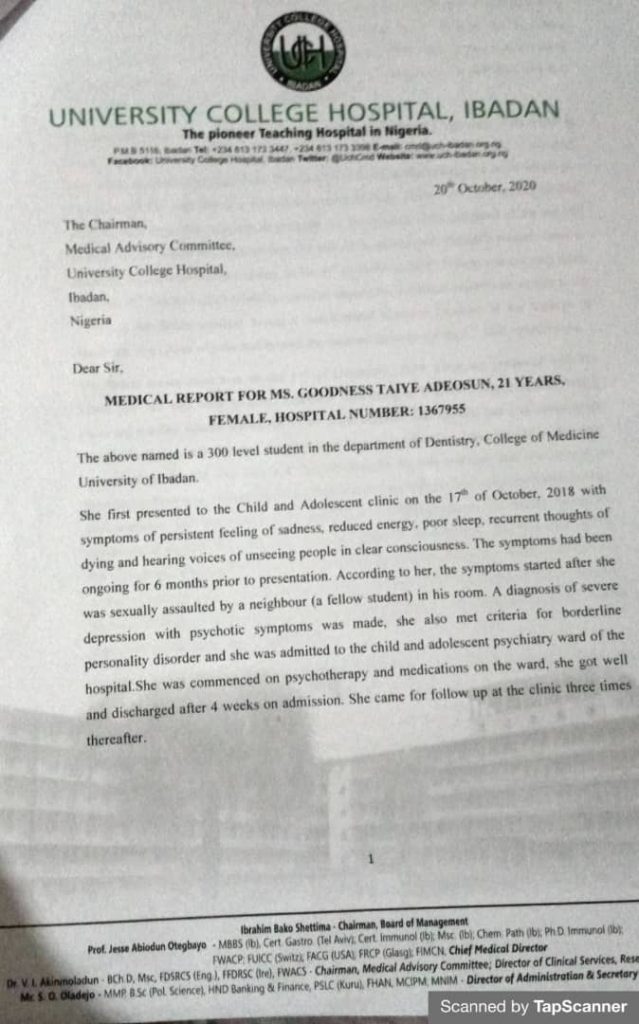
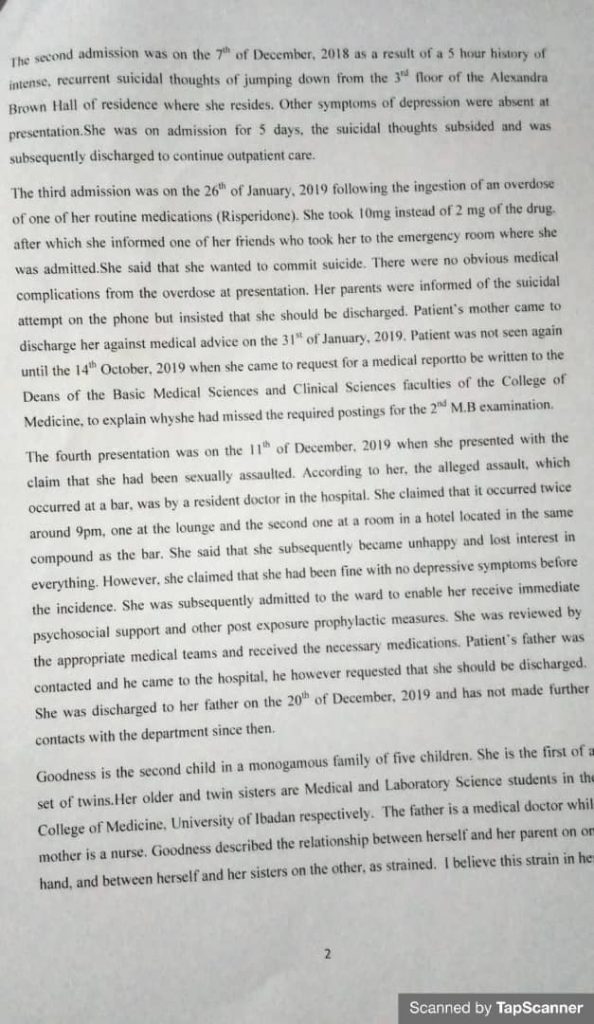
In 2018, Adeosun had spent her 20th birthday in a psychiatric hospital after she was raped by a neighbour, a student of the University of Ibadan. When she reported what happened to the university authorities, she was told to move on and forget the case. This had affected her mental health and she was admitted at University College Hospital, Ibadan (UCH) as a patient suffering from Post Traumatic Stress Disorder (PTSD).
Her 21st birthday was supposed to be more cheerful. She had hoped it would be. When she updated her Whatsapp status, Dr. Olugbenga Anthony, a junior resident doctor at the University of Ibadan College Hospital who has relocated to the United Kingdom, viewed it and suggested taking her out for a drink.
At 8pm, Dr. Olugbenga was standing in front of her hostel. Adeosun had come out with series of past question papers, she had a class to equally prepare for the next day. But for now, she needed to clear her head and talk about how she felt.
HOTEL 411, BODIJA
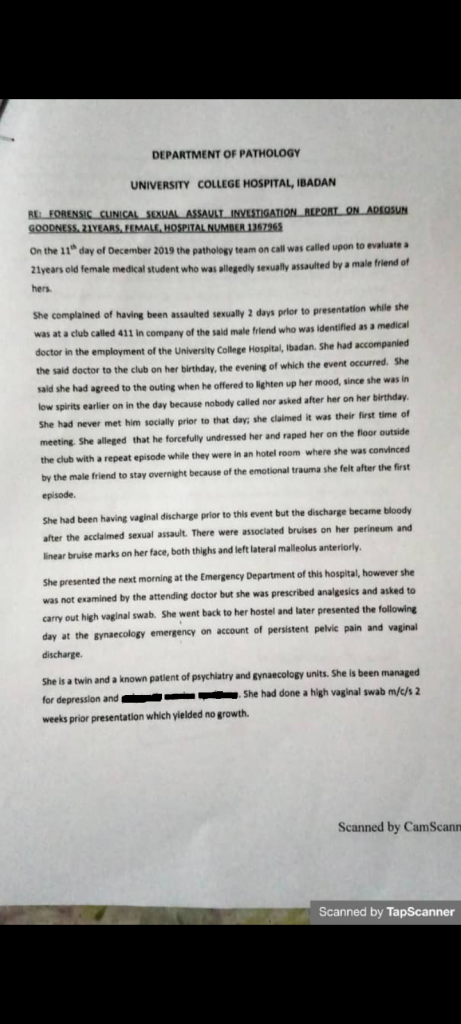
On their way to grab a drink, Dr Olugbenga suggested they go to a bar at Hotel 411 Bodija, Ibadan, as it was less rowdy. After they drank and spoke for a while, Adeosun requested to leave. She wanted to prepare for the class she was retaking. But Dr Olugbenga offered to help her revise for the course. While revising, he said he would give her a kiss for any question she answered correctly. This was an idea Adeosun rejected immediately. Suddenly, Dr Olugbenga grabbed her and started kissing her. Adeosun was unable to release herself from his grasp.
Adeosun first met Dr. Olugbenga on the 7th of December 2019. She had come late to class and missed ward round. Dr. Lawal, a Senior Resident doctor, directed her to Dr Olugbenga to be updated on what she missed that day. When they were done with the lessons, she explained that she had come late because she had to attend to the deliveries of customers.
Part of Adeosun’s dream was to become a successful doctor and one of the best shoe designers in the world. When she got admitted to the University of Ibadan to study Medicine, she felt closer to her goal. Her shoes were being sold across the country.
“He asked to see some of the designs I had made. After I showed him, he picked a design for his wife but wasn’t sure of her size, so he asked for my number to text his wife’s size later on,” she says.
They exchanged numbers and went to get a meal at the cafeteria in the hospital residence.
Prior to that night, Dr. Olugbenga had made comments about Adeosun’s body that made her feel uncomfortable. “I waved them off thinking they were nothing… maybe a mere compliment and I was overthinking. But now I know better,” she says.
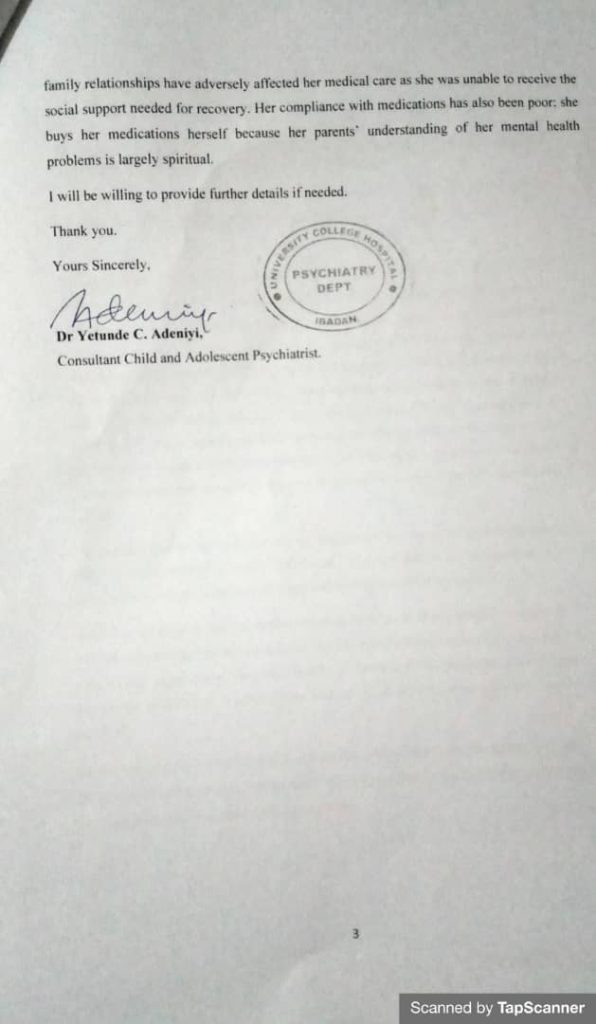
When he forcefully kissed her, she tried explaining to him that she long made a decision to be celibate, and that something tugged at her conscience every time her parents preached about virginity. Adeosun grew up in a religious middle-class family. Her family was rooted in the doctrines of the Deeper Life Bible Church, and shunned any “ungodly” or “immoral” acts. The first time Adeosun was admitted to a psychiatric ward, her father, a doctor, and mother, a nurse, discharged her against medical advice to take her for deliverance.
The second time she was raped (this time by Dr. Olugbenga) and admitted to a psychiatric ward, her parents discharged her against medical advice again. Her father questioned if she was the only one they saw on earth to rape. And her mother insisted that if she had prayed enough, she wouldn’t have been raped.
Due to a strained relationship with her family, she was unable to receive adequate medical care and social support and had to source funds for her medical care from strangers.
‘RE-RAPED’ AT THE BAR
On the night of her birthday, as she struggled to free herself from the grasp of Dr. Olugbenga, she told him of a terrible discharge she was still treating. But Dr. Olugbenga laid her down on the bar chair, unbuckled his belt, lay on top and held her legs together with his knees. She cried and begged, but all he kept saying was ‘‘don’t worry, forget about it, I love you…Just try to enjoy it”. When he saw she wasn’t cooperating, he got angry and carried her on top of him.
“As you can see, I look very small and I am kind of cachexia, I weigh 45kg and he weighs roughly 87kg, so you can imagine how powerless I was. I was so powerless. I was weak. I tried to scream but it was as if I had lost every strength in me to do so.”
As she cried, all she could mutter was “please stop”. He responded by saying “stop struggling, I have to release”. Dr. Olugbenga did not use a condom, putting Adeosun at risk of sexually transmitted infection.
When he finished the act, nobody was around the bar. The shops beside the bar had closed and the bar lights were dim blue. It was 10 pm. A man who was in the bar had left when the revision started. “I shouted but no one heard me,” she says. “I fought him with all the strength I had in me, but it turned futile because I was eventually overpowered.”
Hotel 411, Bodija, Ibadan, where the rape occurred.
Adeosun says when he was done washing himself outside after the forced sex, the first question he asked while she was still in tears was: “Do you want us to continue the revision?”
“I told him no,” she says. “I wanted to go to my hostel.”
Adeosun could not walk with her legs closed together due to the inflammation she was treating. After they got into his car, Dr Olugbenga, realizing how much pain she was in, decided to book a hotel room for her for the night. She Iinitially refused staying back at the hotel but after much persuasion from him, she agreed. After he booked a room for her, he called two of the hotel workers from the reception to come help her up to the room, while he set out to get pain relief drugs for her.
Few minutes after she got into the room, Dr Olugbenga came back but without the drugs. He went into the toilet and came out half-naked. He asked her to join him on the bed so as to feel her warmth. Immediately Adeosun realized he was going to be spending the night in the room with her, she burst into tears and coiled herself to the ground at a corner of the room.
He dragged her to the bed, held her hands and raped her again. When he saw she wasn’t breathing properly, he stopped and masturbated afterwards.
Unable to get help from anyone, Adeosun was forced to stay back in the room until 5am when he drove her down to her hostel. Throughout the night, she couldn’t sleep.
When Dr Adeola Olugbenga, one of the friends Adeosun called to pick that night, confronted Dr Olugbenga about raping Adeosun, Dr Olugbenga said he acted that way because he thought Adeosun wanted it. And he also thought she was just “forming” for him, but when he realized she was not breathing properly, he stopped.
When FIJ contacted Dr. Adeola, he declined to speak, saying he couldn’t do so without the permission of the provost of UCH.
A screenshot of the conversation between Dr. ‘Toni’ Olugbenga and Adeosun a day after the rape. He admitted to commiting the crime.
REFUSAL TO ATTEND TO A RAPE VICTIM
When she got home, Adesoun threw away her cake. She did not take her bath or take off the cloth she wore from the previous night. She wept and vomited all day until Toyin (not real name) came into the room later in the evening, and took her to the University College Hospital (UCH) for tests.
Dr Olufiade Adeniran-Oyerogba was on duty. When Adeosun told her she had been raped by Dr. Olugbenga, she said: “I can’t attend to you, this matter is a legal one and it involves my colleague; I’m sorry.”
She gave Adeosun paracetamol and recommended some pain relievers to use before sending her off. When Dr Oyerogba was contacted by FIJ, she claimed not to know what was being asked and hung up the phone.
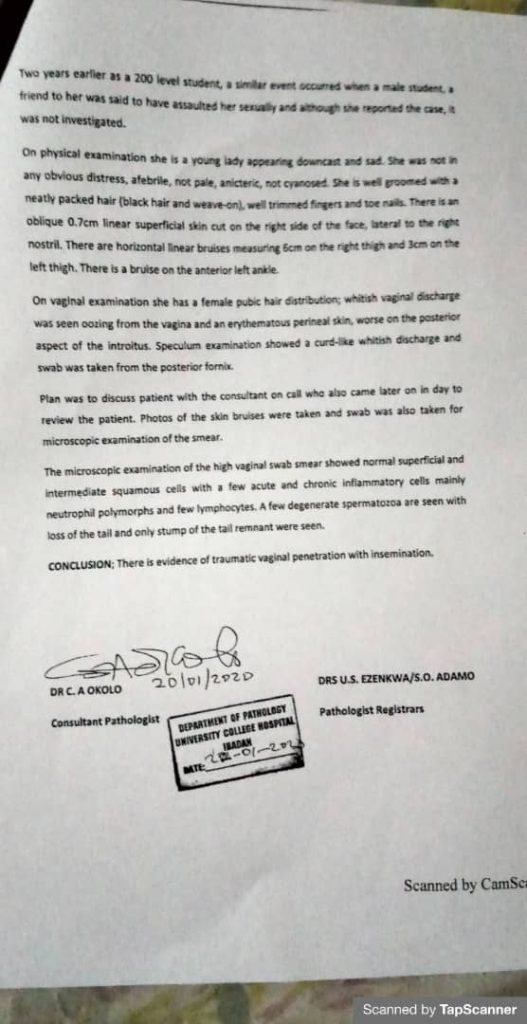
Adeosun’s consultant contacted her on December 11, 2020, after hearing of the incident from a colleague, and took her to a gynaecologist. Sperm was found inside her and on the trouser she wore that night.
She was admitted to the hospital and was given post-exposure prophylaxis (PEP) to prevent possible exposure to HIV. She developed migraine because of the effect of the drug on her, which made her start taking tramadol every day to stop the migraine.
THE SYSTEMATIC COVER-UP BY UCH DEPSITE FORENSIC EVIDENCE
At the hospital, Dr Osasogie Iyayi visited Adeosun. Adeosun had never met Dr Iyayi and didn’t know what she wanted until she asked Adeosun what she wanted as a compensation to keep her mouth shut about the rape.
When FIJ contacted Dr Iyayi, she claimed she visited Adeosun at the hospital to sympathise with her in the capacity of the Financial Secretary of the Association of Resident Doctors (ARD), which, by the way, Dr. Olugbenga belonged to.
Adeosun was transferred to the psychiatric ward, missing out on her final posting test, which meant she had to repeat the class again for the second time.
On January 9, 2020, a panel was set up to investigate the rape allegations against Dr Olugbenga. The panel consisted of the Provost of the University College Hospital, Professor Olayinka Omigbodun; the University lawyer; two social workers and a student representative, Irete Obaitan.
Forensic examination of Adeosun. It revealed that a traumatic vaginal penetration with insemination was found in her.
When Adeosun faced the panel, she was inundated with questions like why she wasn’t wearing pants that night if she knew she did not want something to do with Dr Olugbenga, how she knew the meaning of doggy if she wasn’t a promiscuous person, why the people she called to pick her up after she was raped were mostly guys, how she got money to get an iPhone. None of the questions offered her any hope for justice. They were questions that sought to further diminish her.
On January 27, 2020, the panel was adjourned but it has not met due to Covid-19. Dr Iyayi told FIJ that the panel’s decision (which is not yet known to the parties and the public) is that “there was no rape”. The panel advised Adeosun to attend to her mental health issues and also said they would punish Dr Olugbenga appropriately for having sexual intercourse with a medical student, but not for rape.
NO JUSTICE MORE THAN A YEAR AFTER
Adeosun has been fighting the battle alone. She made a thread on Twitter accusing UCH of withholding her medical test results. The UCH provost was outraged at the bad publicity the hospital was getting. But several comments under Adeosun’s thread showed that Dr Olugbenga had a history of sexual harassment.
Comments made individuals recounting their experiences with Dr. Olugbenga after Adeosun made a tweet about the incident.
Adeosun’s thread led to various reactions, including being told to pull down the thread by a popular Twitter user, Gbenga Wemimo-Samuel, who introduced himself as a lawyer from Sola Adio, another Twitter user popularly known as ‘Uncle Sola’. Few days later, Wemimo-Samuel made a thread on Twitter saying Adeosun made the first move and consented to sleeping with Dr Olugbenga. His thread insinuated that Adeosun lied about being raped and was merely looking to tarnish Dr Olugbenga’s image.
“It made me hopeless,” Adeosun said of Wemimo-Samuel’s thread. “I prayed that day like never before, because I felt like since he had 100k followers on Twitter and was a popular pastor, he had a lot of influence on people.”
Wemimo-Samuel told FIJ that after hearing both sides of the story, he believed Adeosun was telling a lie. He stressed on the fact that he never knew Dr Olugbenga and got to know him from Uncle Sola.
FIJ reached out to Uncle Sola, his explanation was different from Wemimo-Samuel’s. He said Wemimo-Samuel knew Dr Olugbenga and they had both reached out to him to plead with Adeosun to put down the thread and drop the case. He denied asking Wemimo-Samuel to talk to Adeosun.
“I want to categorically state that I never knew this individual to be a lawyer and I never sent him or any lawyer to Goodness Adeosun to prevail on her to drop the case,” he said. “That was a very BIG lie. I also never knew Dr Olugbenga from anywhere in my life till allegations surfaced.”
When FIJ reached out to Dr Olugbenga, he said he did not rape her but admitted to having “consensual sex” with her. He also said there was a “99 percent chance” that he would sue Adeosun for false accusing him of rape and tarnishing his image.
Dr Olugbenga also said that Adeosun’s mother knew the truth about the incident and asked that we contact her. However, when FIJ did, she denied Dr Olugbenga’s claim of Adeosun telling a lie. She added, though, that she was open to an amicable resolution of the matter between both parties, knowing the slow dispensation of justice in Nigeria.
“My husband and I have been battling with a case in the court for 15 good years; it’s been one big frustrating roller coaster,” she said.
“That case alone has drained life out of my family, I don’t think I have any energy left to pursue another court case when we know that at the end of the day, it is he who has money that will win the case.”
“Most times I hate myself for being small,” Adeosun told FIJ.
“Just maybe if I wasn’t this small, I wouldn’t have been taken advantage of or seen as vulnerable. I am not fine, I am dying slowly, I soak my pillows with tears every night,”
“Is it a crime to be a woman? Is it a crime to live alone? Is it a crime to go out to celebrate a birthday? I hate that the male gender always finds a way out around everything. It’s suffocating knowing I haven’t gotten justice when it’s possible to get it.”
One in five women and one in 71 men have, and would be raped at some point. In the last eight months, more than 700 rape cases have been reported all over the country and only very few of the perpetrators have been convicted. This is the story of many rape victims in Nigeria, just one being Goodness Adeosun.
Editor’s Note: This story has been updated to include Sola Adio’s refuttal of Dr. Olugbenga’s claims about him, as well as testimonies by Adeosun’s mum and Dr. Olugbenga’s threats to sue Adeosun, the journalist and FIJ.
The path has been cleared for Nigeria’s Ngozi Okonjo-Iweala to become the first woman and the first African to lead the World Trade Organization after South Korea’s candidate pulled out of the race for the job.Yoo Myung-hee, the South Korean trade minister, announced her decision to withdraw in a televised briefing on Friday.Okonjo-Iweala, an economist and former finance minister of Nigeria, already enjoyed broad support from WTO members, including the European Union, China, Japan and Australia.However, the United States, under the Trump administration, had favored Yoo, complicating the decision-making process since the selection of a new leader requires all WTO members to agree. Okonjo-Iweala’s formal selection may have to wait until after the United States appoints a new trade representative.Yoosaid that her decision had been reached after “close consultation” with the United States. The WTO had been without a leader for too long, she added.The Geneva-based body, tasked with promoting free trade, has been without a permanent director general since Roberto Azevêdo stepped down a year earlier than planned at the end of August after the WTO was caught in the middle of an escalating trade fight between the United States and China.
We read all day so you don’t have to.Get our nightly newsletter for all the top business stories you need to know.Sign Me UpBy subscribing you agree to ourprivacy policy.The Trump administration was highly critical of the WTO and undermined its standing by imposing tariffs on Canada, Mexico, China and the European Union. Okonjo-Iweala will thus assume control of an organization that has struggled to prevent trade spats between its members.While US President Joe Biden has already taken steps to restore support for multilateral institutions, he is expected to proceed with caution when it comes to signing any new trade deals.In a speech to the State Department Thursday, Biden pledged to put diplomacy back at the center of US foreign policy, but was also careful to emphasize that foreign policy should benefit middle-class Americans.
Okonjo-Iweala, who hails from one of the few parts of the world where free trade is ascendent, told CNN in August that trade would play an important role in the recovery from the coronavirus pandemic.”The WTO needs a leader at this time. It needs a fresh look, a fresh face, an outsider, someone with the capability to implement reforms and to work with members to make sure the WTO comes out of the partial paralysis that it’s in,” she said in an interview.Okonjo-Iweala spent 25 years at the World Bank as a development economist, rising to the position of managing director. She also chaired the board of Gavi, which is helping to distribute coronavirus vaccines globally, stepping down at the end of her term in December.— Eoin McSweeney, Yoonjung Seo and Stephanie Busari contributed reporting. (CNN)
THE Int’l Society for Civil Liberties and Rule of Law, INTERSOCIETY, a human rights group has said that appointment as non career ambassadors will not protect the newly retired Nigerian service chiefs from being held accountable for atrocities they committed while in office.
INTERSOCIETY stated this in a statement entitled: “Whether In ‘The Fourth World Countries’ Or Anywhere – No Immunity, Peace & Hiding Place For Atrocity Crimes Perpetrators” made available to Realnews on Friday, February 6.
The statement said: “The haste, desperation and panics behind the announcement by the government of Nigeria of the nomination of the immediate past Service Chiefs-particularly the immediate past Army Chief, Lt Gen Tukur Buratai as ‘non-career ambassadors’, are a clear indication that ‘the heats are on the horrendous crimes perpetrators and their patrons and their houses are on fire.
“It shows also that ‘Marabas’, ‘Pastors’ and ‘Talismans’ possibly hired by them for physical and spiritual fortification and protection have exhaustively lost the battle’.”
It noted that “The pro bloodshed activists or “killer-Army human rights contractors” have also not slept with their eyes closed.”
According to Intersociety, “The latest move by the Nigerian Government is not only suicidal and amount to inching the perpetrators closer to int’l iron bars of prison but also a clear indication that the spirits of thousands of the massacred and the disappeared are at work and very revengefully active.”
“It is a truism and popularly settled position that atrocity crimes such as crimes against humanity, war crimes and genocide and their sub-heads are better not perpetrated while in office than trying to cover them while out of office. Also atrocity crimes when perpetrated, investigated, published and archived automatically go with at least five damnable consequences on the personalities and characters of their perpetrators; namely: (1) image damage and ruination-reducing a perpetrator or perpetrators to the status of “walking corpse(s)”; (2) international pariah or baggage status, (3) victims or recipients of life jail, (4) spiritual damnation and restlessness and (5) ostracism in the land of their benevolent ancestors and perfect spirits.
“It must hereby be made boldly clear that whether in the ‘fourth countries” and battered republics or anywhere in the world, there are no immunity, peace and hiding place for perpetrators of crimes against humanity, war crimes and crimes of genocide. The Int’l Criminal Laws including the Rome Statute and the Geneva Conventions have no provisions for ‘diplomatic’ and ‘state office’ immunities for those accused of or involved in the perpetration of the crimes of genocide, war crimes and crimes against humanity-all of which were perpetrated in ‘industrial scale’ by the named key retired and serving military and police officers in Nigeria or any part thereof. Crimes of such gravity are also not bound or ousted by time. This is more so when the “ambassadorial nominees” will not die in office as ‘ambassadors of the Federal Republic of Nigeria’.
“Further, the ‘non- career and neophyte ambassadorial nominees’ and their nominators are tactless, panicky and suicidal in their calculations and decisions. This is because instead of ‘bringing them closer to international bars of prison’ by seeking to make them ‘non-career ambassadors’, they would have been better “protected” or “shielded” momentarily if a minor federal cabinet reshuffle was made to make them Ministers of Defense, Interior and National Security Adviser, but the gods and the spirits of the massacred and the disappeared are actively at work. Intersociety also wishes to point out that among the four ex Service Chiefs; there is no documented evidence at its disposal linking the former Chief of Naval Staff (Ibas) to the perpetrated atrocity crimes, but the trios of immediate past COAS, CAS and CDS have serious cases to answer.
“Finally, we see the Nigerian Government’s latest move as ‘a victory’ for the apostles of justice. Deciding to retain the atrocity crimes perpetrators as ‘non-career ambassadors’ with available spaces and diplomatic titles for them likely going to be ‘Nigerian envoys to the battered or failed republics’ or ‘the fourth world countries’ is keeping them at no hiding place with diplomatic tags-thereby making it difficult for them to go out of the prime eyes and advocacy searchlights of the lords and the apostles of justice. It would have been difficult to locate them if they are allowed to clandestinely relocate to their Afghanistan or Somali or Yemeni cave castles. It is therefore our firm promise that wherever the named perpetrators and others go or posted, we and other int’l justice apostles, through our golden pens, intellects and databases, shall avail the authorities of their host territories the catalogues of their atrocity crimes back home in Nigeria.”
The statement was signed for Int’l Society for Civil Liberties & Rule of Law by Emeka Umeagbalasi, Obianuju Igboeli, and Ndidiamaka Bernard, principal Officers. (realnewsmagazine)
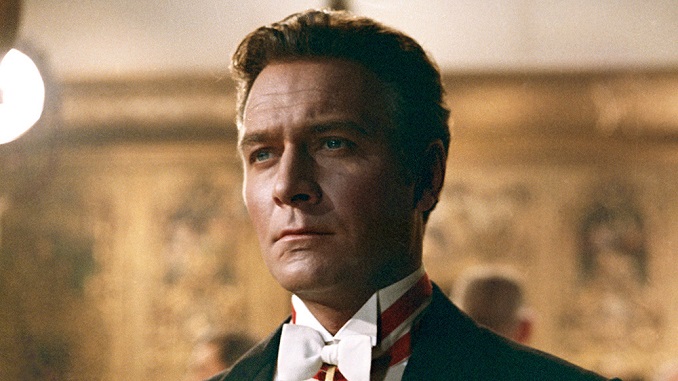
His performance as Captain von Trapp in one of the most popular movies of all time propelled a steady half-century parade of television and film roles.
Christopher Plummer as Capt. Georg von Trapp in “The Sound of Music.” It was his best-known film, but for years he disparaged the role as an “empty carcass.”Credit…Silver Screen Collection/Getty Images
Christopher Plummer, the prolific and versatile Canadian-born actor who rose to celebrity as the romantic lead in perhaps the most popular movie musical of all time, was critically lionized as among the pre-eminent Shakespeareans of the past century and won an Oscar, two Tonys and two Emmys, died on Friday at his home in Weston, Conn. He was 91.
His wife, Elaine Taylor, said the cause was a blow to the head as a result of a fall.
The scion of a once-lofty family whose status had dwindled by the time he was born, Mr. Plummer nonetheless displayed the outward aspects of privilege throughout his life. He had immense and myriad natural gifts: a leading man’s face and figure; a slightly aloof mien that betrayed supreme confidence, if not outright self-regard; an understated athletic grace; a sonorous (not to say plummy) speaking voice; and exquisite diction.
He also had charm and arrogance in equal measure, and a streak both bibulous and promiscuous, all of which he acknowledged in later life as his manner softened and his habits waned. In one notorious incident in 1971, he was replaced by Anthony Hopkins in the lead role of “Coriolanus” at the National Theater in London; according to the critic Kenneth Tynan, who at the time was the literary manager of the National, Mr. Plummer was dismissed in a vote by the cast for crude and outrageous behavior.
For years, until he came to share the widely held opinion of his best-known film — the beloved 1965 musical “The Sound of Music,” in which he starred as the Austrian naval officer Georg von Trapp opposite Julie Andrews — as a pinnacle of warmhearted family entertainment, Mr. Plummer disparaged it as saccharine claptrap, famously referring to it as “S&M” or “The Sound of Mucus.”
In 1964 Mr. Plummer starred in “Hamlet at Elsinore,” a television production filmed at Kronnorg Castle in Denmark. He is seen here in rehearsal with Jo Maxwell Muller as Ophelia.Credit…London Daily Herald
“That sentimental stuff is the most difficult for me to play, especially because I’m trained vocally and physically for Shakespeare,” Mr. Plummer said in a People magazine interview in 1982. “To do a lousy part like von Trapp, you have to use every trick you know to fill the empty carcass of the role. That damn movie follows me around like an albatross.”
Mr. Plummer as Captain von Trapp with Julie Andrews as Maria and their harmonious children in “The Sound of Music.”Credit…20th Century Fox Film Corporation
Mr. Plummer’s résumé, which stretched over seven decades, was at least colossal, if not nonpareil, encompassing acting opportunities from some of dramatic literature’s greatest works to some of commercial entertainment’s crassest exploitations. He embraced it all with uncanny grace, or at least professional relish, displaying a uniform ease in vanishing into personalities not his own — pious or menacing, benign or malevolent, stern or mellow — and a uniform delight in delivering lines written by Elizabethan geniuses and Hollywood hacks.Stream These Great Christopher Plummer MoviesFeb. 5, 2021
He played Hamlet, Macbeth, Richard III, Mark Antony and others of Shakespeare’s towering protagonists on prominent stages to consistent acclaim, and he starred in “Hamlet at Elsinore,” a critically praised 1964 television production, directed by Philip Saville and filmed at Kronborg Castle in Denmark, where (under the name Elsinore) the play is set.
But he also accepted roles in a fair share of clinkers, in which he made vivid sport of some hoary clichés — as the evil bigot hiding behind religiosity in “Skeletons” (1997), for example, one of his more than 40 television movies, or as the somber emperor of the galaxy who appears as a hologram in “Starcrash,” a 1978 rip-off of “Star Wars.”
One measure of his stature was his leading ladies, who included Glenda Jackson as Lady Macbeth and Zoe Caldwell as Cleopatra. And even setting Shakespeare aside, one measure of his range was a list of the well-known characters he played, fictional and non, on television and in the movies: Sherlock Holmes and Mike Wallace, John Barrymore and Leo Tolstoy, Aristotle and F. Lee Bailey, Franklin D. Roosevelt and Alfred Stieglitz, Rudyard Kipling and Cyrano de Bergerac.
‘Simply Stupendous’
Mr. Plummer’s television work began in the 1950s, during the heyday of live drama, and lasted half a century. He starred as the archbishop in the popular 1983 mini-series “The Thorn Birds,” appeared regularly as an industrialist in the 1990s action-adventure series “Counterstrike,” and won Emmy Awards — in 1977 for portraying a conniving banker in the mini-series “Arthur Hailey’s The Moneychangers,” and in 1994 for narrating “Madeline,” an animated series based on the children’s books.
In the movies, his performance in “The Sound of Music” as von Trapp, a severe widower and father whose heart is warmed and won by the woman he hires as a governess, propelled a parade of distinctive roles, more character turns than starring parts, across a formidable spectrum of genres. They included historical drama (“The Last Station,” about Tolstoy, and “The Day That Shook the World” about the onset of World War I); historical adventure (as Kipling in John Huston’s rollicking adaptation of “The Man Who Would Be King,” with Sean Connery and Michael Caine); romantic comedy (“Must Love Dogs,” with John Cusack and Diane Lane); political epic (“Syriana”); science fiction (as Chang, the Klingon general, in “Star Trek VI”); and crime farce (“The Return of the Pink Panther,” in which, opposite Peter Sellers’s inept Inspector Clouseau, he played a retiree version of the debonair jewel thief originally portrayed by David Niven).
Mr. Plummer won a belated Oscar in 2012 for the role of Hal, a man who enthusiastically comes out as gay after a decades-long marriage and the death of his wife, in the bittersweet father-son story “Beginners.”
“Simply stupendous,” Peter Travers of Rolling Stone wrote of that performance, in one of many prominent reviews that treated it as a triumphant valedictory. At 82, he was the oldest person ever to win an Academy Award in a competitive category.
“You’re only two years older than me, darling,” Mr. Plummer said, addressing the golden statuette during his acceptance speech. “Where have you been all my life?”
Mr. Plummer and Ewan McGregor in the film “Beginners.” Mr. Plummer’s performance as a man who enthusiastically comes out as gay after a decades-long marriage and the death of his wife earned him an Oscar in 2012 for best supporting actor.Credit…Focus Features
A dozen or more of his roles came after his 75th birthday, among them the thriller “The Girl With the Dragon Tattoo” (2011); “Barrymore” (2011), a screen version of the stage show for which he earned his second Tony Award in 1997 for his tour de force portrayal of the actor John Barrymore; the Rian Johnson whodunit “Knives Out” (2019); and the fact-based drama “The Last Full Measure” (2019), starring William Hurt.
In 2017 he starred as J. Paul Getty, the billionaire who refuses to pay a ransom for his kidnapped grandson, in the Ridley Scott movie “All the Money in the World,” a role he stepped into at the last minute to replace Kevin Spacey, who had been accused of sexual misconduct. His formidable performance, described as “so dominating, so magnetic and monstrous” by the New York Times critic Manohla Dargis, earned him an Oscar nomination.
“I’m not a superstar — thank God,” Mr. Plummer said in an interview with The Times in 1982. “Christ, to be a superstar must be extremely tiring and limiting.
“I prefer being half-recognized on the street and getting good tables in restaurants,” he added. “Unfortunately, the really good, smashing parts do not always come my way because they go to the first tier of superstars who are bankable.”
As accurate as that self-assessment was, it pertained only to the movies. Onstage, with a fierce intelligence, exemplary control of his body and voice, and a formidable command of language, Mr. Plummer had few equals.
“As T.S. Eliot measures his life with coffee spoons, so I measure mine by the plays I’ve been in,” he wrote in his expansive 2008 memoir, “In Spite of Myself.”
A Shakespearean Foremost
Mr. Plummer made notable Broadway appearances in works by Archibald MacLeish (the Devil-like Nickels in “J.B.” in 1958), Bertolt Brecht (the Hitler-like title role in “Arturo Ui” in 1963), Peter Shaffer (the Spanish conquistador Francisco Pizarro in “The Royal Hunt of the Sun” in 1965), Neil Simon (the Chekhov-like narrator in “The Good Doctor” in 1973) and Harold Pinter (“No Man’s Land,” opposite Jason Robards, in 1994).
He won a Tony in the title role of “Cyrano,” a 1973 musical version of Edmond Rostand’s “Cyrano de Bergerac,” and in 2007 he was nominated for a Tony for the Clarence Darrow-like role of Henry Drummond, opposite Brian Dennehy, in “Inherit the Wind,” his final Broadway appearance.
Mr. Plummer with Brian Dennehy in the 2007 Broadway production of “Inherit the Wind.” It was Mr. Plummer’s final Broadway performance.Credit…Sara Krulwich/The New York Times
Even so, that was the second tier of his theatrical portfolio; he was first and foremost a Shakespearean, one who brought febrile intensity and fierce intellect to his preparation.
“I disagree with the theory that he is a man of indecision,” Mr. Plummer wrote about Hamlet in an essay for Playbill in 1964. “The truth is that he has made his mind up many times over, and it is only through his self-analytical precision and towering imagination that he finds himself living the deed long before he commits himself to its performance.”
In 1955, he played Mark Antony in “Julius Caesar” in the inaugural production of the American Shakespeare Festival Theater in Stratford, Conn. The next year he played the title role in “Henry V” at the Stratford Shakespearean Festival in Ontario — where he became a fixture — and was declared by Brooks Atkinson of The Times to be “a Shakespearean actor of the first rank.”
For more than a half century, through 2010 — when, at age 80, he appeared at the Stratford festival as Prospero in “The Tempest” — Mr. Plummer’s performances, including those in New York and in London, where he lived in the 1960s, were more often than not appreciated in extravagant terms.
“The performance of a lifetime,” Ben Brantley wrote in The Times of Mr. Plummer’s “King Lear,” which arrived on Broadway in 2004 after first being produced at the festival. “He delivers a Lear both deeply personal and universal: a distinctly individual man whose face becomes a mirror for every man’s mortality.”
Ms. Taylor, his wife, said that at his death Mr. Plummer had been preparing to appear as Lear on film for the first time, under the direction of Des McAnuff.
But it was his portrayal of Iago in a 1981 Connecticut production of “Othello,” which starred James Earl Jones in the title role and came to Broadway in 1982, that defined his reputation as a Shakespearean of profound depth, worthy of comparison to the likes of Laurence Olivier, Michael Redgrave and John Gielgud.
“He gives us evil so pure — and so bottomless — that it can induce tears,” Frank Rich wrote in The Times. “Our tears are not for the dastardly Iago, of course — that would be wrong. No, what Mr. Plummer does is make us weep for a civilization that can produce such a man and allow him to flower.”
The praise was amplified by the senior Times critic of the day, Walter Kerr, who wrote, “It is quite possibly the best single Shakespearean performance to have originated on this continent in our time.”
A Rebellious Boyhood
Mr. Plummer as King Lear on Broadway in 2004, in what Ben Brantley of The New York Times called “the performance of a lifetime.”Credit…Sara Krulwich/The New York Times
Arthur Christopher Orme Plummer was born in Toronto on Dec. 13, 1929. His parents separated around the time of his birth, and he did not meet his father, John Orme Plummer, until he was 17, when the elder Plummer came to see his son perform in a play.
“Our paths would cross once or twice again in our lifetimes and then no more,” Christopher Plummer wrote in his memoir.
Mr. Plummer grew up in Montreal with his mother — Isabella Mary Abbott Plummer, a granddaughter of a Canadian prime minister and a railroad president — and her extended family in what he described as a colony of fading social aristocracy, where bird-watching and tennis were frequent recreational pursuits and the after-dinner activity was reading aloud. It was a background, he once said, that “made me want to be bad and rough and find the secrets rather than the gates.”
Pampered, gifted and rebellious, he aspired early on to be a concert pianist, though in high school, where his classmates included the future jazzmen Oscar Peterson and Maynard Ferguson, he gravitated to their musical style and a life at night that included heavy drinking.
“How often as a mere teenager, tanked to the gills on cheap rye whiskey and Molson chasers, did I stagger home in the blinding cold,” he wrote in his memoir.
He gave up the idea of a musical career because, he said, “I realized acting came easier.” He performed in high school shows — including as Mr. Darcy in “Pride and Prejudice,” in which he received a favorable review from The Montreal Gazette that “instantly went to my head” — and made his professional debut at 16 at the Montreal Repertory Theater.
Joining a troupe in Ottawa, Mr. Plummer performed in dozens of low-budget productions and, in what amounted to an extended education, took on roles in radio theater for the Canadian Broadcasting Corporation and spent a season with a professional company in Bermuda. The actor Edward Everett Horton, who had appeared with the company, secured him a role in a touring production of “Nina,” a French comedy, and opportunities accrued quickly.
Mr. Plummer appeared in “Medea” in Paris with Judith Anderson and made his Broadway debut in “The Starcross Story,” a drama that opened and closed on one January night in 1954 in spite of the lure of its star, Eva Le Gallienne. He toured in “The Constant Wife” with Katharine Cornell (who nearly had him fired for showing up for a performance late and hung over), and in 1955 appeared in his first commercial hit, as Warwick in “The Lark,” Jean Anouilh’s drama about Joan of Arc, starring an ascendant Julie Harris.
His first feature-film role was as a playwright in “Stage Struck,” a 1958 drama about the New York theater world, directed by Sidney Lumet and starring Henry Fonda, Susan Strasberg and Herbert Marshall.
Mr. Plummer in 2017. “I’m not a superstar — thank God,” he once said. “Christ, to be a superstar must be extremely tiring and limiting.”Credit…Tom Jamieson for The New York Times
By the early 1960s, Mr. Plummer had become allied with the bad boys of the British acting world — Richard Burton, Albert Finney, Peter O’Toole — motivated, he once said, by the cantankerous rage against propriety exhibited in the work of John Osborne.
In his memoir, a dishy, rollicking account of a life lived sensually and energetically, he was not shy in detailing his amorous adventures, or his drinking with fellow actors. In a 1967 interview with the CBC, he acknowledged himself to be a drunk — “though not when I’m working, producers take note,” he said — and considered the question of why actors in general drink.
“The more you give to an audience, which is a tremendous amount that you give during a night if you care about your work, the more you spill out of yourself with either loathing or loving them and getting loathing and loving back,” he said. “It’s a tremendous letdown when the evening is over. You’ve given an awful lot of your own personality with just the reward of applause at the end, which is a marvelous reward but it isn’t quite enough to fill the rest of the night.”
In the same interview he noted that he’d given up trying to be liked. “I’m not a difficult type to get on with,” he said. “I’m only difficult when I’m impatient with people who don’t understand temperament has nothing to do with lack of professionalism.”
Mr. Plummer’s first two marriages, to the actress Tammy Grimes and a British journalist, Patricia Lewis, ended in divorce. In addition to Ms. Taylor, he is survived by his daughter with Ms. Grimes, the actress Amanda Plummer.
By both their accounts, Mr. Plummer and his daughter became friends after she became an adult, though they had rarely seen each other while she was growing up.
“I didn’t want anything to do with the upbringing of a child,” he told The Times in 1982. “I am really very bad at responsibility of any kind. Unless it’s my work, I’m hopeless.”
It was Ms. Taylor, Mr. Plummer acknowledged many times, who curtailed at last his liquid nights and general profligacy.
“My long-suffering wife Elaine,” he called her, in closing his Oscar acceptance speech, “who deserves the Nobel Peace Prize for coming to my rescue every day of my life.”
The scene in the court room of the Family Division of the Lagos State High Court, Ikeja, evoked deep pathos. The judge, a Lady, was sobbing. And so were the parties, the lawyers, and everyone else in that rattled courtroom, including me! It was at the hearing of a case instituted by me on behalf of my client, Dapo, against his former consort. Their relationship more, than thirteen years earlier, had produced a baby girl, but it did not eventually lead to marriage, even though Dapo had assumed full responsibility for the child’s upkeep and maintenance, and was at the time of the hearing bearing full responsibility for her schooling and upkeep at the very expensive Turkish – American secondary school at Victoria Island, Lagos! Dapo was well – heeled, a chartered accountant, and loved the child – his only child – dearly.
The love affair between Dapo and Jumoke, the child’s mother had been steamy and passionate. Jumoke’s mother fully supported the affair. Not only was Dapo a comely lad, he had also been a very promising young man, from a very good family in Osun State. Graduating at the top of his class, with a first class in Chemical Engineering from the University of Ife, he had ventured into Accounting, and quickly became a fellow of the Institute of Chartered Accountants of Nigeria. Dapo was thus by every standard, a worthy suitor, and a welcome guest at his lover’s mother’s home in Abeokuta. It was in the course of one of those visits that the inevitable happened, and the lady took in, and eventually gave birth to the baby girl!
Dapo did not eventually marry his lover, but he continued maintaining both she and the baby, even after the lady found love elsewhere and married! And fortune was immensely kind to him. He rose quickly professionally, becoming the Managing Director of a major revenue collection firm in the city of Lagos – and super wealthy to the bargain. He himself had married, but the marriage had not produced any issue, even after several years. And he had begun to doubt whether he was ever going to be able to sire another child. But the thoughts of his very beautiful Angel from his earlier relationship always comforted and reassured him. The girl was almost his carbon copy, and he adored her.
When the little girl was thirteen years, Dapo honoured an invitation to attend a wedding in Lagos. His attendance at that wedding was to change his world forever. Dapo was invited to the high table to chair the occasion. From where he sat at the high table, he could see a daintily dressed couple swaying gaily to the beats and praises of the Fuji singer, as they waltzed their way to their seats at the high table. The master of ceremony had earlier, in calling them to the high table, introduced them as Mr and Mrs Abimbola. They, along with Dapo, were among the distinguished guests at the wedding reception. They took their seats right beside Dapo, with the husband sitting right next to Dapo.
Dapo instantly recognised his ex girlfriend, his baby’s mother, and waved at her in greeting. But when he took just one look at her husband, his heart sank. Sitting right there next to him was Ade. He had put on some weight, but there was no mistaking who he was. “Ade”, blotted out Dapo. “Na you be this? Wonders shall never cease!” Dapo, chairman of a wedding, lost control of his emotions, and began to sob, his dropped head in his palms. He regained composure, and took charge of the wedding proceedings!
Fifteen years previously, while he dated Jumoke, now Mrs Abimbola, Ade had also been a regular visitor at Jumoke’s house at Abeokuta. Ade was good looking and courteous toward Dapo whenever Dapo visited, and sometimes even ran errands for Jumoke’s mother. Both Jumoke and her mother introduced him to Dapo as Jumoke’s cousin, and in Dapo’s presence, Ade played the part perfectly. But there was one particular day that Dapo came to her house unannounced, opened Jumoke’s room without knocking, and caught Jumoke and Ade untangling from what he thought was an embrace and a kiss. Dapo reported what he thought he saw to Mama, but Mama and daughter quickly doused his suspicions, with Mama explaining that the duo had always been so close, right from infancy.
It was shortly after this time that Jumoke took in for Dapo, and birthed his adorable little baby girl!
But now, Ade and Jumoke were sitting right next to Dapo, introduced by the MC to the whole world as husband and wife! They were even dressed in the same uniformed attire, leaving no one in any doubt that this was a couple. When Dapo left the wedding party that evening, he wept like a baby, from the moment he entered his car, and up to the point he arrived home.
He was still weeping when he picked up his phone and called me, asking me to hop into the next available flight in Abuja to see him in his house in Lagos. When I inquired to know the reason for the urgency, he only retorted gravely: “Ken, my world has come crashing down. I am finished. And my life might even be in danger!”
PART 2
The atmosphere in the courtroom that early morning was calm, almost sombre.
I had arrived with Dapo in the same car. Just after alighting from the car, and as Dapo and I began to walk the short distance from the car park to the court room, a pretty little girl, fair complexioned and slight in build, much like Dapo, raced from the shade of the big mahogany tree not too far from the courtroom and flung herself at Dapo. Father and daughter locked themselves in passionate embrace that lasted almost five minutes.
“Daddy I love you”, said the young girl. “I love you too”, Dapo responded, almost choking on his emotions. From under the shade of the big tree, a fortyish looking woman, fair complexioned too and pretty, fixed her gaze at Dapo and daughter. She did not utter even a word to Dapo. Her face was expressionless. She only looked away when Dapo looked in her direction and began to walk into the courtroom with his daughter.
“Ken”, that’s Jumoke”, Dapo said almost in a whisper. I said I already knew. She was in court at the last court sitting which Dapo himself did not attend.
At that sitting the court had ordered that the only way to resolve one of the most contested issues in the suit was for a DNA test to be conducted on the young girl. The parties were to take the girl to St. Nicholas Hospital Lagos, accompanied by the Registrar of the Court, for samples to be obtained from the child and Dapo. The court further ruled that the result of the test be brought directly to the court in a sealed envelope by a qualified scientist from the Hospital’s laboratory who will open the result for the first time in court, tender same, interpret it, and be cross – examined by both parties! Dapo was to bear the logistical implications of the test in full.
A few months earlier, and on Dapo’s instructions, we had brought an action in deceit and paternity fraud against Jumoke and Ade, claiming humongous damages, alongside an awkward declaration that even if a result of a paternity test showed that the child was not Dapo’s, he was entitled to custody which Jumoke had disallowed him since the girl’s birth, since he loved the child dearly, had maintained her all along, and knew no other child all his life. The declaration sought was a clumsy one – and I felt uneasy drafting it. Infact, upon my arrival from Abuja after Dapo had summoned me, I had advised him, upon him telling his story amid sobs, to forget about going to court, and let sleeping dogs lie.
But Dapo was adamant. For some strange reason, he felt his life was in imminent danger, and that if he suddenly died, Jumoke and her husband would exploit his relationship with his daughter, descend upon his estate, and inherit all that he had laboured for in life. He calmly explained that this was possible since under Yoruba customary law, a girl – child was entitled to a share in her father’s estate. Jumoke’s daughter – his daughter – therefore stood to inherit everything, which will then pass on to Jumoke and her husband. And Dapo believed his death was imminent – unless the truth was quickly unmasked.
He was in no mood to entertain further arguments. I therefore proceeded to work, settled the originating processes, which we later filed at the Court Registry. The suit was then assigned to the Family Division of the High Court of Lagos State. It was on the very first day of the hearing that the Honourable Court ordered the DNA testing and gave a fairly long adjournment to enable the test to be conducted, and a result produced. It was therefore on the day of the production of the test result that Dapo and daughter met, and walked together into the court room, followed at a distance by Jumoke and two other women about her age, along with two men, none of whom was Ade, her husband.
The first case to be called on the day was the divorce petition brought by Festus Keyamo against his wife. It was quickly adjourned, and Dapo’s case was called. Counsel to both parties announced their respective appearances, with us then informing the court that the business of the day was for the scientist from the Hospital to produce and tender the result of the paternity test. The scientist was the court’s witness, and the parties had therefore refrained from seeking to know, or mingle with, him.
Fortuitously, the Court Registrar informed the Judge that the witness was in court, and signalled to him from where he sat among the throng in the packed courtroom to proceed to the witness box where the oath to speak the truth was immediately administered on him.
It was the Judge herself who led the witness in evidence. But just as she was about to begin, she looked toward where Dapo sat with his daughter immediately behind the lawyers row, and noticed the young girl. Her maternal instincts immediately kicked in. “Stand up, sweetheart”, the Judge told the girl in a sweet tone. “Why are you here again today?”, her Lordship inquired. “I think I told you last time not to come to court again until this case is over. Courtrooms are not good for small children. You will go to my office and stay. They will even give you ice cream and minerals there.” The young girl tried to explain that her school was on its long vacation, and that her ambition in life was to be a lawyer, and that she was therefore in court to see how the lawyers did their thing.
But the Judge was adamant, and at Dapo’s gentle prodding, the girl left the courtroom meekly and walked away, cutting a pitiable figure, and drawing sighs.
Her Lordship then turned her attention to the witness. She had suddenly transformed from the very gentle mother of a few minutes earlier to a stern faced arbiter, very much in control of the proceedings. She began by asking the witness his name, address, place of work, qualification and experience. As the witness spoke, she meticulously recorded all his answers.
“Your hospital was ordered by this court to obtain samples from the Plaintiff and his daughter and perform a DNA test to determine the paternity of the daughter”, her Lordship probed in grave but measured tones. “Yes, my Lord”, came the Reply. The witness confirmed that the samples were collected as ordered and sent to their correspondent laboratory in South Africa were the test was conducted, and the sealed result sent to his hospital, and that the result was still sealed. He fetched forth the envelope from a folder, and showed the Judge.
The judge then requested the witness to un – seal the envelope and bring out the result. As he did so, the tense courtroom became deathly quiet. I took a quick look in Dapo’s direction and saw him looking scared and lost. But Jumoke, who sat further back, was expressionless. Her face only came alive when she caught me looking at her. She met my gaze with a stern grimace, batting her eyelids rapidly at me in apparent rebuke of my effrontery. I quickly returned my attention to the proceedings.
The witness then tendered the DNA result, and counsel on all sides were shown the result by the Court official, and the Judge asked whether any of the counsel had any objection to its tendering. In the absence of any objection, it was received in evidence and marked. I looked back at Dapo again and saw him muttering a silent prayer, eyes closed, lips quivering in quiet supplication to the great maker of all things to avert his worst fears.
The judge ordered that the witness be given the result once more. “From the result in your hands, whose paternity test result was this?” The witness answered that it was the little girl’s. “Now, witness, from the result in your hand, is the Plaintiff the father of the little girl?”
There was once more pindrop silence as the witness began to answer, squelching the muted murmurs and whispers that had arisen moments earlier. Then came the bombshell: “My Lord”, the witness began slowly. He then paused for dramatic effect, a small smile playing by the corner of his thick lips, his dark face betraying the countenance of a man who had seen so much of the follies of this world. The judge rebuked him, and reminded him that he was there for serious business. He quickly bowed and apologised, and resumed his testimony. Looking at the result in his right hand, he read out some technical jargon, and began to interpret it, looking at the judge: “My Lord, what this means is that the Plaintiff here”, he paused and pointed at Dapo, “could not have by any chance in the world fathered this girl.” Instant howls could be heard across the courtroom.
The witness had hardly finished his last sentence when the little girl burst into the courtroom, shrieking and wailing. She rushed straight to where a now sobbing Dapo sat, held him tight in an embrace, and started wiping her father’s tears with her palm. As she did so, Dapo momentarily regained composure, stared keenly at his daughter’s face, kissed her on her forehead, shrieked in agony, and resumed crying, father and daughter still locked in harrowing embrace! “Daddy, it’s a lie”, she screamed, still crying. “Daddy, you are my father. Daddy I love you.” “I love you too, and always will”, Dapo moaned, the pain in his heart very much conveyed by eyes now reddened by anguish. As father and daughter grieved, tears running profusely on their faces, their noses also ran.
The police orderly had rushed to restrain the young girl when she first burst into the courtroom, but the Judge had ordered him to leave the girl alone. The poor girl had apparently not heeded the Judge’s instruction to go to her chambers for ice cream, but had lurked around the precincts of the court to espy the proceedings!
Now, as father and daughter sobbed and shrieked in pitiful embrace, the stern judge melted and brought out a handkerchief and sobbed along. The scene was so moving that everyone in the courtroom, with the exception of Jumoke, joined in sobbing, with some, especially the women, wailing! I reached for my white handkerchief, removed my glasses and began to wipe my own tears!.
“The court shall rise”, the Judge managed to announce, and immediately left the courtroom for her chambers, never to return for the day. It was the clerk of court who later returned to announce to a tumultuous courtroom that the matter had been adjourned for the day, and that counsel in the matter should approach the clerical desk for dates!
Ten years ago, Desmond Ovbiagele abandoned his career in investment banking to pursue his dream of making films. Now the Nigerian director’s movie about the jihadist insurgency in his country has been put forward as an Oscars contender.
“The Milkmaid” tells the story of two sisters who are abducted from their village during a deadly attack by militants in northeast Nigeria. It has been submitted by Nigeria as its entry for international feature consideration at the Academy Awards.
The Academy of Motion Picture Arts and Sciences will announce its nominations for the Academy Awards on March 15.
“Even having made it this far is a huge encouragement to filmmakers who don’t necessarily want to tell the most commercial type of stories,” Ovbiagele – who wrote and directed the film – told Reuters in an interview in Nigeria’s commercial capital, Lagos.
The insurgency by militant group Boko Haram has killed more than 30,000 people and forced about 2 million to flee their homes since 2009. The group attained global notoriety in 2014 with the abduction of more than 270 schoolgirls in the northeastern town of Chibok.
“I felt it was important that we put some backstories and some personalities behind all these casualty statistics,” said Ovbiagele.
The film has already won five Africa Movie Academy Awards, including Best Film. Although Nigeria is an English-speaking country, it is eligible for the Oscars best international film category because the characters address each other in the Hausa, Arabic and Fulfulde languages spoken locally.
Anthonieta Kalunta, lead actress in the movie, said she hoped those judging “The Milkmaid” would see the film as being told from “a very beautiful perspective”, despite the subject matter.
For Ovbiagele, the film’s success will draw attention to the plight of hidden victims.
“The victims of insurgency were not getting the attention that I felt they truly deserved,” he said.
Reporting by Angela Ukomadu in Lagos and Abraham Achirga in Abuja; Writing by Alexis Akwagyiram; Editing by Rosalba O’Brien (Everyday)
Our site uses cookies. By clicking “Accept All Cookies”, you direct Law and Society Magazine to store cookies on your device and disclose information in accordance with our Cookie Statement: cookie policyACCEPTREJECT
Privacy & Cookies Policy
Privacy Overview
This website uses cookies to improve your experience while you navigate through the website. Out of these cookies, the cookies that are categorized as necessary are stored on your browser as they are essential for the working of basic functionalities of the website. We also use third-party cookies that help us analyze and understand how you use this website. These cookies will be stored in your browser only with your consent. You also have the option to opt-out of these cookies. But opting out of some of these cookies may have an effect on your browsing experience.
Necessary cookies are absolutely essential for the website to function properly. This category only includes cookies that ensures basic functionalities and security features of the website. These cookies do not store any personal information.
Any cookies that may not be particularly necessary for the website to function and is used specifically to collect user personal data via analytics, ads, other embedded contents are termed as non-necessary cookies. It is mandatory to procure user consent prior to running these cookies on your website.