A broken road does not understand Igbo It will not maim the Fulani and let the rest of us go The accidents it will cause will take all lives For when a vehicle somersaults it breaks all bones
So, you can speak Nupe till morning comes It will not build libraries in our public schools And when a woman, a young woman, lies dying in childbirth Your fluency in Ijaw will not save her life
For Christian or Muslim, it makes no difference When you’re being driven around in an ambulance From hospital to hospital in search of oxygen Northerner or Southerner, you will die suffocating
You will die of causes easily preventable Like no fuel for police to respond to your distress call No water, no light, no nurses, no jobs Nothing kills as efficiently as bad governance
As Politicians in Office who do not pay salaries Whose response to bad roads is bigger SUVs Who set up committees, and publish white papers Presiding over affairs that never improve
Politicians in Jeeps, with minds in London Perpetual latecomers to every meeting Irritated by anyone with a different opinion Who see ‘The People’ as a throne to sit on
Politicians in Power, who personalize the State Who criminalize criticism, and terrorize dissent Nothing in society kills as efficiently As a Politician in High Office with low mentality
For you see? Boko Haram will burn down a classroom But a Politician can swallow the entire school system Can fold our Power Stations and put in his briefcase Can roll up the Railways and keep in her house
Politicians can file our sea ports away in a drawer Can cripple all our farms with no fertilizer No matter the passion you bring to your start-up Government can kill it with just one pronouncement
And no degree you hold, no grammar you speak No decision you make to just face your work No protest you stage can save you from those Elected to make and enforce our laws
The way they see things is a wall around you For you cannot drive faster than the person driving you No matter your wealth, education or achievement You are subject to the mentality of those in Government
Politicians in Office hold the yam and the knife For to elect is to give the elected power over life Which child will remain almajiri or become someone better? These things are in the hands of the people in Power
Politicians in Office hold the farm and the seed For to elect is to give the elected the power to decide Whether Security operatives can murder citizens and walk away free? These things are in the hands of those who run the country
So, if you are tired of it all, then strike at its roots… If you are tired of needing a letter from a Senator to get a job If you are tired of seeing your hustle frustrated by public policies If you are tired of insecurity, then fix the politics
If you’re tired of the hunger, the anger, in our streets If you’re tired of the number of children who die before age 5 If you’re tired of the dreams suffocated in our youths If you are tired of this shame, then fix the politics
For until they are there in Public Office Men and women with a heart for public service No tribe, no tongue – just a commitment to build A functional nation that fills us all with pride
Until they are there in the highest Office Men and women with a heart for selfless service No region, no religion – just commitment to Nation…
Governor Bello Matawalle of Zamfara State has explained that he didn’t mean to say that not all bandits who terrorise parts of the state and other neighbouring states are criminals.
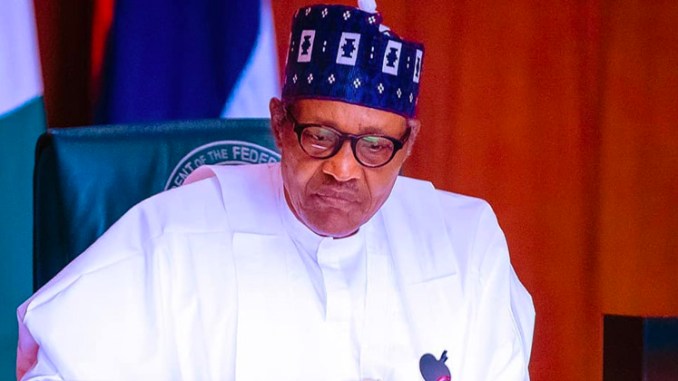
The governor was quoted as saying so on Thursday after meeting with President Muhammadu Buhari at the Presidential Villa, Abuja, that not all bandits are criminals.
But, the Special Adviser to the governor on Media and Communications, Zailani Bappa, said Mr Matawalle didn’t mean to say that not all bandits are criminals.
According to him, what the governor wanted to say was that not all Fulani people are bandits or criminals.
Mr Bappa said: “He [Matawalle] tried to make clear his known and popular view that not all FULANIS are CRIMINALS.
“He went on to explain the injustices meted on them such as rustling their cattle as reasons that pushed them to criminality.
“If indeed he mentioned the word BANDITS instead of FULANI, then it was an inadvertent mistake as common sense dictates that banditry cannot at any time be justified as a non-criminality.”
The governor’s media aide, therefore, called on well-meaning Nigerians to disregard the message, saying that, “that is not at all what His Excellency meant to say nor the kind of message he wanted to portray”.
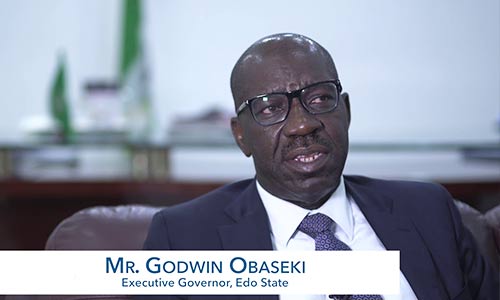
The Edo State Government has said that it will not cede any part of its land for grazing cattle in the state.
In a statement issued yesterday, the Secretary to the State Government, Mr. Osarodion Ogie, said that the government’s position on the matter is clear and has not shifted since it insisted that it would not cede its land to herdsmen.
According to him, “Our attention has been drawn to misleading and false media reports claiming that the Edo State Governor, Mr. Godwin Obaseki, has agreed to provide grazing land for herders in the state.
“Our position on the matter of grazing land is clear and has not shifted, which is that there is no free land for grazing in Edo State. Grazing is an economic activity just like poultry and piggery or any other agricultural enterprise. The Edo State Government will not cede any land in the state for grazing.”
“The governor has continually warned against the politicising of security issues,” he added.
Ogie noted that some political actors are trying to instigate the type of killings witnessed in some states in the country just because they are embittered by the heavy loss they suffered in the political space.
He continued: “Thankfully, their plans have failed because of the pre-emptive actions taken by Governor Obaseki and the security agencies.
“We condemn, in the strongest terms, the current futile efforts by these defeated politicians in the state to cause mayhem and chaos among our people.
“All peace-loving people of Edo State are enjoined to dedicate this Lenten period to pray for peace at this difficult time in the life of our dear country.”
The Southern and Middle Belt Leaders Forum (SMBLF), has berated Kaduna-based Muslim Cleric, Sheik Abubakar Gumi over his recent call on government to grant amnesty to bandits terrorising some states in the Northern part of the country.
The leaders in a statement jointly issued yesterday by Mr. Yinka Odumakin (South-west), Chief Guy Ikoku (South-east), Senator Bassey Henshaw (South-south), and Dr. Isuwa Dogo (Middle Belt), frowned at the statement made by the cleric during his appearance on a live television programme, asking for amnesty for bandits whom he said are fighting against the injustices Nigeria has done to the North.
The leaders argued that it is the Fulani and the core North that are doing pure injustice to the rest of the country.
It stressed that part of those injustices must have been electing President Muhammadu Buhari twice as President in spite of his scant regard for the sensitivity required of a multiple country like Nigeria.
The statement disclosed that the country for “almost six years has been soaking all manners of lopsidedness, nepotism”.
According to the leaders, as part of the injustices to the north, Fulani herdsmen have been killing people with reckless abandon in all parts of Nigeria with the administration defending them and giving them soft landing with the open bias of the president.
‘’Fulanis are daily pouring into Nigeria to change our demography and Nigeria is doing more in Niger Republic than Nigeria at the moment with resources from non-Fulani areas,” the statement added.
The leaders wondered if the injustices Nigeria has done to the North are so much that the bandits are doing what they are doing to the rest of the country, while Buhari is looking the other way.
“We want to know from Gumi if the Hausas are protesting the injustices Fulanis are doing to them and the rest of Nigeria or if it is Nigeria that is doing any injustice to the North.
The group insisted that the main injustice in Nigeria is what it described as the shrewd federalism that allows the North to be in almost total control of oil and mineral resources in the Niger Delta and the VAT from other parts of the country to the disadvantage of host communities.
The southern and middle belt leaders cited the Nigeria Ports Authority in Lagos and most of the agencies in charge of oil and gas as some of those in control of the North, saying “This is one of the major reasons SMBLF is in court to challenge the lopsided arrangement.’
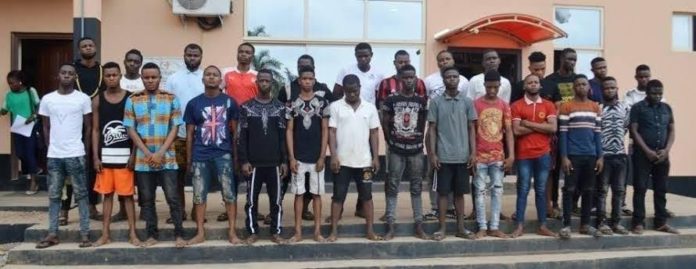
The International Society for Civil Liberties & Rule of Law (Intersociety) has announced the release on Monday of 63 abducted Obigbo residents, all males. They were abducted by the Nigerian Army at Obigbo in Rivers State and held incommunicado for four months, since October 2020 in Mogadishu Barracks and other security dungeons in Abuja.
The full statement reads:
Their release followed the landmark consideration of their bail application filed on Wednesday, 10th February 2021 before an Abuja Grade 11 Magistrate Court sitting in Wuse. They were freed from four different Army, DSS and Police dungeons in Abuja and environs; namely: Mogadishu Army Barracks, Annex B at Asokoro, DSS Training Center at Central Business District and its abandoned facility at Zuba and the Nigeria Police College at Suleja in Niger State. The freed victims were part of over 400 innocent and defenceless Obigbo residents including over 60 girls and young women abducted between Oct and Nov 2020 at their work places or on their way home from work or while engaging in other lawful social activities.
Commendable Efforts Of Barr E.R. Okoroafor
Army Lacks Power To Arrest, Detain & Investigate Citizens Not Subject To Military Matters
The release of the 63 abductees was made possible through the lawyerly and activist doggedness of Barr E.R. Okoroafor. Barr E.R. Okoroafor is a British citizen of Igbo nativity and international human rights lawyer. The efforts of the leadership of IPOB in this respect are also worthily recognised and appreciated. While it is hopeful that the newly located 53 young women in the DSS dungeons will soon regain their freedom, bringing the total number of the located or freed to 261; searches are still on to locate the remaining abductees numbering over 140. This is owing to the fact that the Nigerian Army and DSS have refused to speak publicly on the whereabouts of the abductees, the freed ones and why the over 400 residents were abducted at the first place and kept out of public knowledge till date.
•The 63 released abductees in court prior to their freedom
In arresting citizens wrongly or rightly suspected to have offended punishable laws bordering on crimes against persons or crimes against the State or crimes against properties – all categorised globally into “mala inse” and “mala prohibita”; the soldiering and policing authorities in any democratic Member-State of UN including Nigeria are inexcusably prohibited and barred from abducting citizens outside public knowledge and records, hatefully labeling them and taking them into custody, torturing, shooting and raping them to death and detaining them ad infinitum and beyond the limits prescribed in written laws. Such prohibitions also include stripping the abductees half naked and exposing their body systems to unfriendly weathers and other hostile circumstances including insect bites and infections; in addition to totally blocking them from their families, physicians and lawyers.
In Nigeria, apart from the country’s written laws restricting the activities of the military particularly the Nigerian Army to issues of defense of territory in situation of interstate or intra state armed conflict and barring them from trespassing beyond their defined duties including usurping the key duties of the Nigeria Police Force such as arrest, detention, investigation and prosecution of suspected civilian offenders and their offenses; there have also been several Decided Cases barring the Army/Military from “arresting, detaining and investigating citizens who are not subject to the Armed Forces Act or any other Military law”. As a matter of fact, a Federal High Court sitting in Abuja had in a landmark judgment delivered on Wednesday, 17th Feb 2021 held that “the Nigerian Army lacks the power to arrest, investigate and hold in custody anyone who is not subject to the Armed Forces Act or any other military law”. For more details, see the link here: https://thenigerialawyer.com/nigerian-army-lacks-power-to-investigate-crime-arrest-or-detain-suspects-court-rules/?fbclid=IwAR3mSxZyofU1wLgovP1VpO3P0AjTFd88kdD6y2yHnCq4Gln3Dtp6kTIeF_
Names Of The 63 Freed Abductees
Their names are: Paul Uche, Anozie Obinna, Ebubechukwu Kaima, Andrew Ekpere, Uka Obinna, Uche Emmanuel, Ekene Anayo, Bright Emma, Ikenna Uzoma, Olisa Chukwudi, Somtochukwu Ibe, David Joe, David Chukwu, Chikadibia Paul, Blessed Friday, Nwaogu Ekene, Charles Ikeogwu, Igwe Samuel, Gozie Samuel, Simeon Mbanefo, Eze Chike, Godwin Umeh, Tochukwu Umeh, Desmond Alphonsus, Ukauwa Irim, Sabinus Ula, Riguma Friday, Ekpan Sunday, Kezie Kelechi, Ifeanyi Otutu, Ambrose Anyanwu, Paul Chike, Tochukwu Obiekwe, Elochukwu Moses, Mike Anya, Echefuna Chukwu, Echefuna Uche, Gift Onyenkachi, Alozie Chukwunonso, Chukwuma Ibeano, Friday Nonso, Nebechi Kennedy, Imma Ochi, Stanley Igwe, Okoro Benson, Emeka Nwaogugu, Uchechi Emmanuel, Joe Boniface, Gregory Amokachi, Daniel Erinne, Samson Chinda, Victor Enrinne, Christopher Kachi, Uzoma Philip, Kainene Ernest, Ikechukwu Isaiah, Isaac Oriaku, Ekpere Mmadu, Uchenna Chris, Ebuka Silas, Honesty Gift, Osita Ifeanyi and Chibuike Robinson. Attached below are their photos taken after their release in Abuja.
Signed
For: International Society for Civil Liberties & Rule of Law
Emeka Umeagbalasi, Board Chair; Chinwe Umeche, Head, Democracy & Good Governance; Obianuju Igboeli, Head, Civil Liberties & Rule of Law and Chidimma Udegbunam, Head, Campaign & Publicity.
When the names of the new Commandant-General and Comptroller-General of the Nigeria Security and Civil Defence Corps (NSCDC) and Nigeria Correctional Service were released, there was graveyard silence at the headquarters of both agencies, as it may spell doom for the career of their seniors, especially those who acted, but were not found good enough to continue. Some others, however, celebrated the appointments.
Ethno-religious interpretations were brought in since it appeared the All Progressives Congress (APC)-administration has often acted that it preferred persons of particular colourations to head military and para-military outfits for yet unclear reasons.
A former minister and head of a federal agency saw it in different light. He noted that since the Ministry of Interior claims the men emerged from a transparent selection process,” the issue of educationally disadvantaged states should be scrapped since people from those states now top all selection interviews in Nigeria.
But the tokenism of announcing the elevation of Dr. Orji Ogbonnaya Orji to the headship of Nigeria Extractive Industries Transparency Initiative (NEITI), on the same Thursdat as that of the NSCDC and NCoS was not lost on some, even as applause greeted his appointment across a group of stakeholders.
“Why can’t other persons from Southern geo-political zones and religions head these agencies that are security in nature and can deploy men during elections and sensitive situations? Why can’t they head those places to balance the obviously skewed employment and placements there? What agenda is playing out in this country that it has to be people of a region and religion that have all the lucrative appointments,” an angry insider asked.
Recall that in a statement, the spokesman of the Ministry of Interior, Mr. Mohammed Manga, announced that President Muhammadu Buhari had approved the appointment of Ahmed Abubakar Audi as the new Commandant-General of the Nigeria Security and Civil Defence Corps (NSCDC) following the retirement from service of Abdullahi Gana Muhammadu.
The statement adds, “Ahmed Audi, emerged the top best candidate out of those that went through the transparent selection process initiated by the Ministry of Interior through the Board to ensure that the most suitable among the top-ranking officers in the service was appointed to replace the out-going Commandant-General of the NSCDC.
“Furthermore, President Muhammadu Buhari has also nominated Haliru Nababa mni, as the new Controller-General of the Nigerian Correctional Service (NCoS), subject to the confirmation of the Senate in line with the provision of the new Act establishing the Nigerian Correctional Service 2019.
“The Minister of Interior and Chairman, Civil Defence, Correctional, Fire and Immigration Board (CDCFIB), Ogbeni Rauf Adesoji Aregbesola who congratulated the new appointees, called on them to ensure full implementation of the mandate of their services as well as to ensure synergy with other security agencies in the country with the view to providing efficient internal security services and citizenship integrity for Nigerians and foreigners alike in line with the policy thrust of the President Muhammadu Buhari-led Administration.”
While applause was muted in the case of Audi and Abdulahi Gana, it came from stakeholders in extractive industries over Orji’s appointment as NEITI’s new boss. Orji replaced his former boss, Waziri Adio.
Nigeria National Petroleum Corporation (NNPC) the Group Managing Director of the NNPC, Mele Kyari, said his management welcomed Orji’s appointment.
It is “a wonderful decision of appointing Dr. Orji as the Executive Secretary of NEITI to continue the massive reforms currently in progress in the oil and gas industry,” he said in a statement through NNPC’s spokesman, Kennie Obateru.
The National Coordinator of Publish What You Pay (PWYP) Nigeria, Peter Egbule said of the new helmsman, “Dr. Orji has been like an engine room of NEITI, who has been involved in the implementation of global principles and standards of Extractive Industries Transparency Initiative (EITI) in Nigeria from its inception….
“Our organization, and coalition of civil societies in our network will work with him and his team to broaden the base of stakeholders’ engagement in the nation’s extractive industries.
▪︎Seeks N500M compensation; We Paid Your Late Husband’s Benefits, says Navy
An aggrieved widow, Mrs. Mary Aweh Agbor, has petitioned the Chief of Naval Staff over the alleged unlawful and forceful ejection of her family from the Navy Barracks by a retinue of armed military personnel.
In a reply to the widow’s lawyer, the Nigerian Navy claimed that full death benefits of her late husband have been paid into a Guarantee Trust Bank GTB account provided for the purpose of entitlements payment, and she could continue to remain in the barrack six months after death or as soon as benefits are paid.
Mrs Mary, wife of late Master Warrant Officer (MWO), Joseph Agbor, is challenging the brutal use of armed personnel to chase her, along with her three children, out of the Navy Barrack in Lagos when death benefits of her late husband had not been paid.
In the petition written by her family lawyer, Mr Oluchukwu Nnamuah, the aggrieved widow complained bitterly that her children, Esther Agbor, Blessing Peter and Favour, who were dependants of the late Agbor were humiliated, harrassed, traumatised, and thoroughly disgraced while been forcefully ejected.
However, in response to the petition, the Chief of Naval Staff described the claims of the widow as unfounded and an outright falsehood.
The widow alleged that the action of the armed military personnel against her children was barbaric, inhuman, uncivilised and a gross violation of their fundermental right and the prevailing law in the military.
Among other things, the widow claimed that all plea by her family and sympathisers to the armed men to allow them salvage their belongings fell on deaf ears as their properties were thrown out without mercy.
Insisting that her defenseless children did not deserve the inhuman treatment meted out to them while being kicked out of the barrack, the widow claimed that her late husband served the Nigerian Navy and the country diligently before he died in active service.
In the petition, copied to the Secretary to Government of the Federation SGF, Senate President and House of Representatives Speaker the widow chronicled how her apartment was cordoned off by stern-looking armed personnel before her family was thrown out of the barrack.
The widow therefore demanded from the Navy payment of N500M damages and compensation, written apology, as well as provision of accommodation in hotel of their choice in Abuja pending the payment of her late husband entitlements.
In a reply to the widow’s lawyer, the Nigerian Navy claimed that full death benefits of her late husband have been paid into a Guarantee Trust Bank GTB account provided for the purpose of entitlements payment.
The letter from the Chief of the Naval Staff Office and signed by Commodore Jas Malafa, read in part “pertinently, investigations revealed that your client and the family of late MWO Agbor Joseph S5303 were advised to resolve their disputes amicably after which the parties presented an agreed joint account to the Nigerian Navy.
“Consequently, the Military Pensions Board paid the death benefits into the agreed joint account presented by your client and the other contending dependants of the deceased rating.
“Accordingly, I am directed to inform your law firm, without prejudice, that the practice in the Nigerian Navy is that the next of kin or dependants of a deceased personnel is expected to vacate the official accommodation six months after or as soon as the death benefits are paid.
“In line. you are advised to convey the above position to your client and advise her to seek for alternative accommodation without further delay”
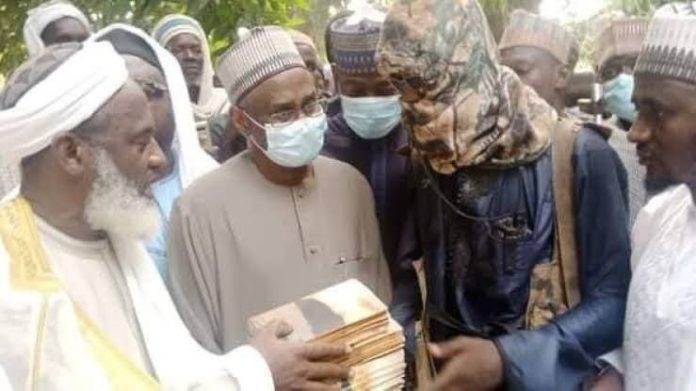
The 27 students of Government Science College, in Kagara, Rafi Local Government Area of Niger State that were kidnapped within the school premises by gunmen suspected to be armed bandits in the early hours of Wednesday, may have been released by their abductors late in the evening on Thursday, to a foremost Islamic scholar based in Kaduna State, Sheikh Ahmed Gumi and others after much persuasion by the Islamic cleric.
Tribune Online gathered that the lucky secondary school students who had been held captive in the hideout of the bandits around Bangi forest in Mariga Local Government Area of the state for about 48 hours after their abduction from their dormitories within the school premises on the outskirts of Kagara township, headquarters of Rafi LGA, on Wednesday were said to have been taken to some undisclosed public health facilities for medical checkup in Minna, the state capital in order to ascertain their health status and treatment shortly after they were set free.
It was further learnt that the students gained their freedom after Sheikh Ahmad Gumi had met and dialogued with the leader of the bandits identified as Dogo Gide in conjunction with some of his members after what seems to be a long hours before the two parties could reach a truce.
It could however be recalled that the foremost Islamic scholar had visited the Niger State Governor, Alhaji Abubakar Sani Bello at the Government House in Minna, some few hours after the incident had occurred on Wednesday and held a closed-door meeting with the governor in his office, alongside members of his entourage.
Some close top government officials at the meeting informed our reporter that the meeting was with the view to employ dialogue in resolving the ugly incident with the leaders of the dreaded bandits and the need for him( Sheikh Gumi) to reach out to the bandits on the need to release all the kidnapped students, their teachers and others from the school unhurt.
Further checks revealed that after the meeting with Governor Abubakar Sani Bello, the Islamic Scholar left the Government House with his entourage for the forest in Bangi, Mariga Local Government Area of the State and met with the leaders of the notorious kidnappers/ bandits, led by one Dogo Gide, where Sheikh Gumi ured them to live fruitful lifestyles.
SaharaReporters learnt that the airstrikes started on Thursday noon, and are connected with the military’s resolve to dislodge the Eastern Security Network operatives said to have strongholds in the forests.
Nigerian Air Force are conducting aerial strikes in Orlu communities in Imo State, which has worsened the already built-up tension in the areas.
SaharaReporters learnt that the airstrikes started on Thursday noon, and are connected with the military’s resolve to dislodge the Eastern Security Network operatives said to have strongholds in the forests.
The ESN operatives in January had a bloody clash with the Nigerian Army from Obinze barracks, where four soldiers were reportedly killed.
A video of the aerial bombardments on Thursday surfaced with fresh tension and anxiety building in the communities.
“Nigerian soldiers are currently conducting aerial strikes in our areas. Many innocent lives may be lost. They are probably looking for ESN operatives who are checking the activities of killer Fulani herdsmen,” a community head told SaharaReporters.
“People’s homes and market places may be affected. We don’t need aircraft in Orlu. They should go and find the stolen school pupils in Niger State,” another angry resident said.
“I have the video. There was an aircraft firing shots possibly in a nearby bush. Very reckless of the airforce; civilians are all over the place,” another person said.
SaharaReporters last December reported that the Nigerian Army deployed combat helicopters, gun trucks, and soldiers to search some suspected forests in the South-East states where the ESN, launched by Nnamdi Kanu, was said to be camping.
SaharaReporters also reported that the military search had been going on for days, and had no time frame, as the army was acting on “orders from above.”
A video, from the drones and hidden cameras believed to be installed by the ESN, had captured the Nigerian Army helicopters and their vehicles and soldiers searching for the camp of the ESN for possible arrests.
Kanu, leader of the Indigenous Peoples of Biafra, on December 12, launched the ESN, saying the regional security outfit, just like Amotekun in the South-West, would help to tackle crimes and criminalities.
“The Nigerian Army that is supposed to fight Boko Haram was seen everywhere searching for the camp of Eastern Security Network team. But they forgot they are dealing with sophisticated men. There are cameras and drones everywhere watching them,” an official had said.
“Music is in my family. My mother was a musician. My elder brother had a musical band and my younger brother was a bass guitarist for my elder brother. My sister was a leader in a musical group and so, music is my family. I have always enjoyed dancing from the James Brown days. I can still do the ‘camel walk’ and glide both ways. In fact, when James Brown came to Nigeria in 1970, I was working then at Auchi High Court. I came to Benin to watch James Brown live in 1970. I called James Brown my elder brother and gave myself a ‘guy name’ – ‘Mike Brown [MB]’. When Jimmy Cliff came to Benin too, I was there. I like music. Like I said, I can do Zanku, and my ‘carry body and gbese’ are not bad at all” – Prof. Paul O. Idornigie.
He arcs his upper body forward and stomps on the ground rapidly in harmony with the beat. Repeatedly, he taps his feet, with hands projecting forward like someone slicing. Then he finishes with one foot thrust as if to knock down a door; all the while, displaying vigour and attitude. His dexterity on the dance floor is as excellent as his academic prowess. Beginning life as a Typist Grade III, Prof. Paul Idornigie, tells Law & Society’s Lillian Okenwa the story of a Typist who rose to the dizzying height of three careers and more – Chartered Secretary, Professor of Law, Senior Advocate of Nigeria and Chartered Arbitrator.
L&S: Tell us about your childhood
Answer: I was born in a village called Ayogwiri-Izairue, Etsako West Local Government Area of Edo State on 24th February, 1951. I’m second to the last of my parent’s children. I had a memorable childhood and I enjoyed village life. At night, they gathered us and very interesting stories were told – real stories by moonlight. We played at night and after school if we didn’t go to the farm, we played football. At that time too, the road to my village was not too good so we played along the road especially at night. It’s not like now that the road is tarred.
I also enjoyed going to the farm because everything was in the farm. Everything was in the farm. We had a functional hut in the farm where we slept sometimes for as long as seven days. Around the hut we had vegetables which were cooked every day and we set traps. So ‘bush meat’ was not in short supply. Soup was cooked every day and nothing was preserved till the next day – no need for refrigerators or freezers. We were very strong and healthy – worked in the rain and sun. I am sure that if there was COVID-19 then, it would have been scared of our farm and hut!!!
Sometimes we spent two to three days in the farm working and then returned home. Most times after school, you will not find anybody in the house. But when you go to the farm, everybody and everything was there. The nearest medical centre in the village was a Dispensary where almost every medicine was in a big bottle. The main sickness then was either belly ache or head ache.
Life in the village is not so again now, because those in the Village are very lazy. We used to go to the farm very early and almost daily apart from market days and Sundays. We left home as early as 7am and not until about 4pm before we returned. Now they go to the farm by 7am and by 9am they are back, so why won’t there be hunger?
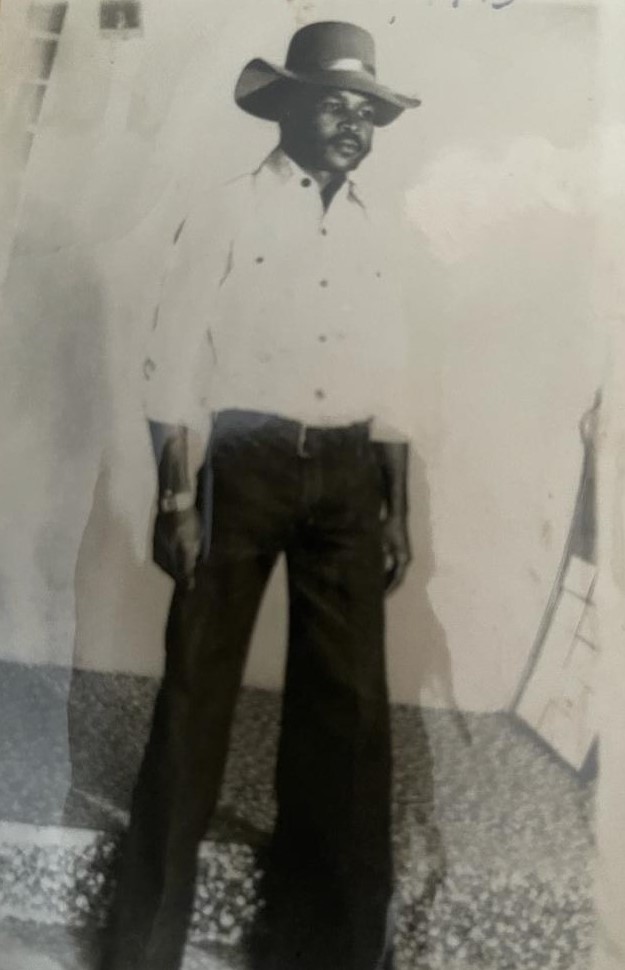
Paul Idornigie, Benin: 1975
L&S: What about the insecurity?
Answer: Insecurity in a village setting? That is recent. I am talking about going to the farm 40 to 50 years ago. The local thieves then focused on yams in the ban and chickens or goats in the village. Village life was very, very sweet growing up. But it’s different now. I still feel that village life prepared me for life in the city. My dad used to say to us that ‘work does not kill’ and that ‘hard work paid.’ As a role model, he was quite hard working. He advised that instead of looking at the size of the work to be done, we should simply bend down and be working. You know farm work essentially involves bending down to dig ridges and heaps or harvest. So today, I can sit down to work without looking at the size of the work.
L&S: Apart from your academic portfolio, you happen to be a good dancer.
Answer: Yes, I started dancing quite early. There were no stereos then but we had gramophones. I still remember one called ‘His Master’s Voice’ that had a needle for playing the records. I still remember also artists like Dele Ojo, IK Dairo, Sunny Ade, Ebenezer Obey and later Victor Olaiya, Victor Uwaifo, Rex Lawson, Stephen Osita Osadebey, among others. We danced ‘twist’, ‘akwete’, ‘palongo’, ‘rock steady’, ‘reggae’, ‘ekassa’, among others. Today, I think that I am still current as I can do ‘Zanku Dance’ especially when I am listening to Burna Boy (ft Zlatan) doing ‘Killin’ Them’.
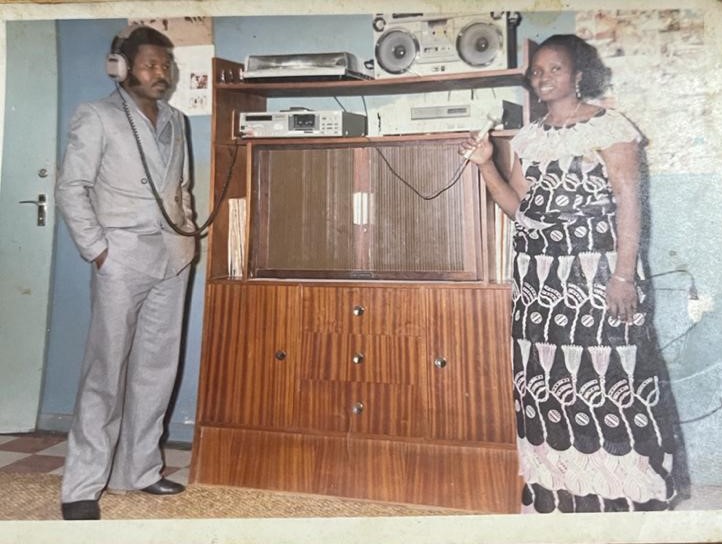
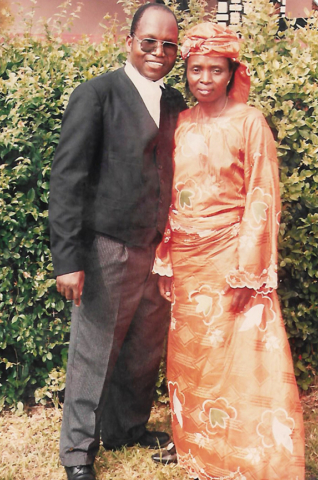
Paul Idornigie and his wife, Rose: Jos: 1982
L&S: How do you learn and do it so well?
Answer: Music is in my family. My mother was a musician. My elder brother had a musical band and my younger brother was a bass guitarist for my elder brother, my sister was a leader in a musical group and so, music is my family. I have always enjoyed dancing from the James Brown days. I can still do the ‘camel walk’ and glide both ways. In fact, when James Brown came to Nigeria in 1970, I was working then at Auchi High Court. I came to Benin to watch James Brown live in 1970. I called James Brown my elder brother and gave myself a ‘guy name’ – ‘Mike Brown [MB]’. When Jimmy Cliff came to Benin too, I was there. I like music. Like I said, I can do Zanku, and my ‘carry body and gbese’ are not bad at all.
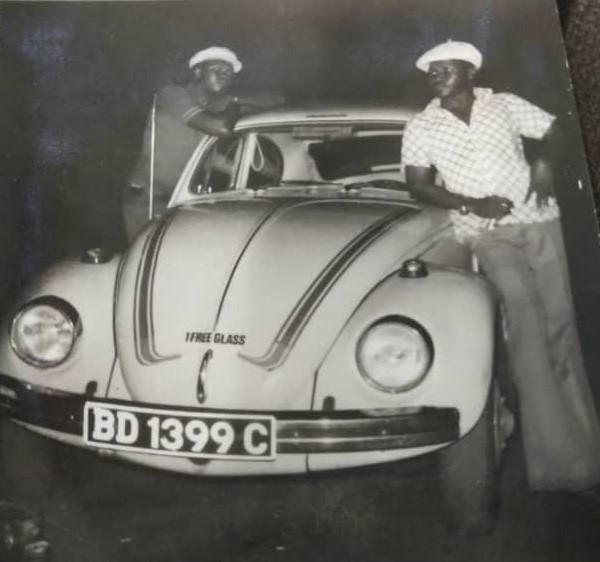
Paul Idornigie posing by his first car with a friend, Benin: 1976
If I didn’t go to school, I would probably have been a dancer, or I would have been a musician. In fact, when I was in Jos, I was a part time DJ in the University of Jos Staff Club. I’ll tell you why I had to slow down. When one of my friends in Jos wedded in 1981. I was the DJ at the bachelor’s eve. I went to a party in Abuja some time in 2014 where I met a son from that wedding where I was a DJ and I said no, it’s time to quit, time to slow down. And again because of my kids – they are big now; you go out and they start asking you about your children and all that and all that. But I like dancing any day.
L&S: Did your background in commercial and secretarial studies influence your interest in commercial law?
Answer: You know, and this is very interesting. As a young man in Benin, then, my ambition was to qualify as a Chartered Secretary. That’s all I wanted. I went to England in 1983 and I qualified in 1986 and returned in ’86. So by 1986, I achieved my life ambition. Anything that I acquired since 1986 is the Lord’s doing. We give God the glory and honour. But because I was trained by the University of Jos in the UK, I was bonded to serve the University for five years. I came back from the UK in 1986 and in 1987 the University of Jos started the Evening Law programme. So I said well, while serving my bond, let me be doing law. I had worked at Auchi High Court in the 70s but I had no inkling as to whether I would ever read law though I also had a guy name then – Lord Obingo of the High Court.
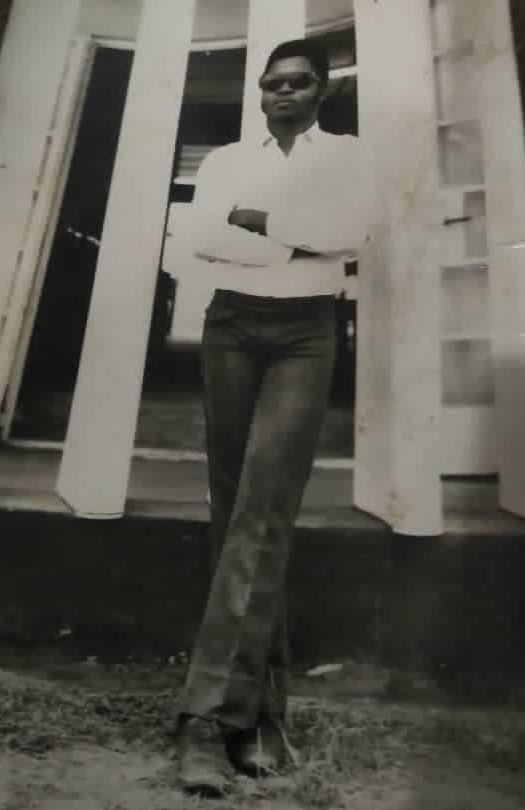
Lord Obingo of the High Court, Auchi: 1973
The Evening Law Programme was like a play thing. I just said while serving my bond let me read law and of course, as a Chartered Secretary, I was already a qualified Company Secretary. Besides, as a confidential secretary, I was used to running and organizing offices and while at Auchi High Court, I assisted lawyers in preparing court processes. Indeed at Auchi High Court, I could draft any pleadings and affidavits. Eventually the aim was to qualify as a Legal Practitioner and when this is combined with my chartered secretarial background, I will qualify as a Legal Adviser/Company Secretary. Now when I was doing my Company Secretarial training in the UK, I was strong in Commercial Law. Commercial Law or Business Law was one course. Under the Company Secretarial Stream, it was one course and under it was the Law of Contract, Law of Agency, Sale of Goods, Negotiable Instruments, Arbitration, Insurance Law, among others. Now when I read law in the University of Jos, these were individual Commercial Law courses but they were not as deep as one course called Commercial Law in the UK. So when I read law, it was a walk over for me in all the commercial subjects.
Barrister -at-Law and Mrs Rose Idornigie
When I finished the first degree programme in Jos, and I came back for Masters, I did my LLM in the area of Company Law. My thesis was titled: “The Codification of Duties of Directors under CAMA.” You know directors’ duties were essentially common law duties before CAMA. In fact, Nigeria is about the first country to codify common law duties in relation to duties of directors. I did my PhD in International Commercial Arbitration. When I was teaching in Jos, I taught Sale of Goods. When I was teaching at the Nigerian Law School, I taught Company Law and Law of Evidence. Then when I came to BPE in 2002 my background in company secretarial practice and law became handy.
I was Head of Secretariat (Company Secretary) – the Secretariat of the National Council on Privatization (NCP) headed by the Vice-President and General Counsel (Legal Adviser) from 2004 to 2009. Being a General Counsel at BPE exposed me to pure Commercial Practice, because, at BPE, I was involved in transactions across all the sectors of the economy – oil and gas, mines and minerals, roads, rail and ports, power and essentially both hard and soft infrastructure. For instance, I was involved in the concession of the Ports in Lagos, Port Harcourt, Warri and Calabar. I was involved in the drafting of all the lease agreements.
I was also a signatory to the contracts with the Director General. I was involved in the sale of NICON Hilton, NICON Insurance and NICON Luxury. I was involved in the liquidation of Steel Rolling Mills in Jos, Katsina and Osogbo; Nigeria Airways and Fertilizer Company at Onne. I did Ajaokuta, Itakpe and Delta Steel. The other luck I had was that in Jos in my final year at the University, I did both Private International Law and Public International Law. So when I was working in BPE as General Counsel, Private International Law was very handy.
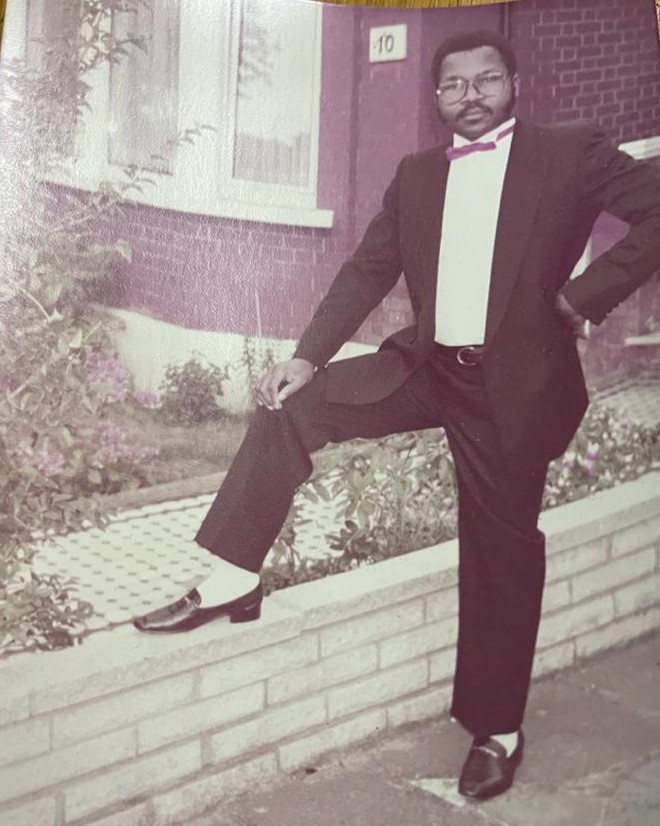
Paul Idornigie, London: 1985
L&S: What is the difference between Public and Private International Law?
Answer: In terms of Public International Law, we are talking of state to state transactions. But Private International Law has to do with state to private citizens. When I was negotiating contracts in BPE, there was always the problem of how to determine the governing law of the contract. If a Nigerian and a Ghanaian or a Nigerian and a Briton, or a Nigerian and an American or a Nigerian and a German for instance entered into a contract, which law governed it? That’s the Private International Law. It’s also called Conflict of Laws. My background in Jos, studying Private International Law helped. I owe a lot to the University of Jos.
I will not forget one transaction I did in the UK. We were trying to privatize the Aluminum Smelting Company (ALSCON) at Ikot Abasi, Akwa Ibom State. At the formation of the company, there were all kinds of contracts that were entered into between the Federal Government of Nigeria and the German entities. These contracts contained several restrictive clauses. One for instance was that, when the plant starts production, they will sell solely to the German companies. When we were going to privatize, there was the need to terminate these formation contracts especially the pre-emption clauses in the articles of association. If we did not do that, no investor would buy the public enterprise, in this case, ASCON. I travelled to the UK with my Director General for the purpose of terminating the formation contracts. Other than myself as a lawyer from Nigeria, there were others lawyers from the UK, USA, France and Germany.
We spent a week negotiating the termination of the contracts. On the last day, the issue of the governing law of the contract came up. All the other lawyers said the English Law would govern the transaction and I was alone as I said it should be Nigerian Law. What I was doing then in BPE was that when negotiating and there is deadlock, I resort to academics. When I found that I was in the minority, I said to them, let’s leave this transaction and look at generally how to determine the governing law of a contract. What are the connecting factors used in the determination of the governing law of the contract? One connecting factor is to look at the place where the contract is entered into. Another is the place where the contract is to be performed. And we can also look at the nationalities of the parties.
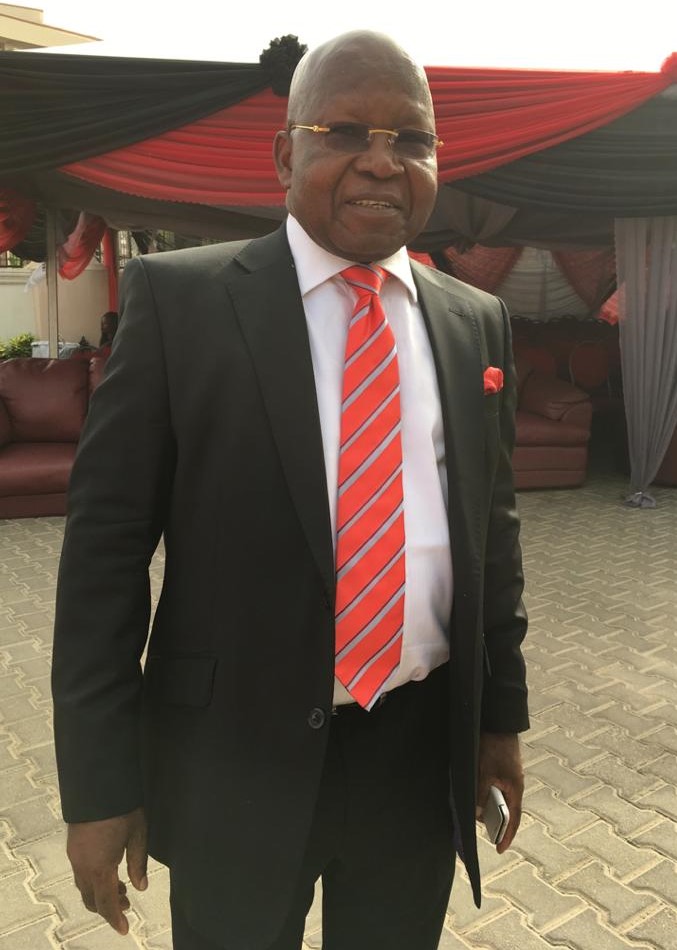
Prof. Idornigie, SAN
But if all these fail, we look at the legal system that has the closest connection with the transaction. I said to them, we were discussing Aluminum Smelting Company in Ikot Abasi, in Nigeria. I told them to focus on the connecting factors. Connecting factor is a factor that links a transaction to a particular legal system. For instance, we were discussing ALSCON in Ikot Abasi. What is the link between ALSCON and English Law? The contract was entered into in Nigeria and performed in Nigeria. The companies used for the transaction were Nigerian companies. I said to them, what is the link between ALSCON and English Law? Then I was not a Professor. I had a PhD, but they were calling me a Professor.
They said, ‘Professor, we agree with you on the legal principle, but we will not accept Nigerian Law as the governing law’. I then retorted: ‘deal breaker’! And my DG held me and said, let’s go on break. You know once you say that, it means the deal is all over. I said to my DG, we’ve been in the UK for one week for the negotiations; the only way I will accept that English Law governs the contract was, we go back to Nigeria and brief the President. If His Excellency agrees, fine, but I could not on my own, being the General Counsel, concede that English Law governed the transaction.
We came back to Nigeria and we did a memo to the President. His Excellency Olusegun Obasanjo was President then. When he saw the memo, he said, Ah! Ah! ‘How can English Law govern this contract’? He said he would refer us to Prince Bola Ajibola, and that whatever advise Prince Bola Ajibola gave he would accept. Prince Bola Ajibola came. He said we should follow him to his hotel at Hilton. He said to me, ‘young man, you know the law, we know the practice. Give me two weeks.’ I said, ‘ok Sir’. So I left him. Three days after we returned from the UK, these guys flew into Nigeria, came to the BPE and said ‘governing law, Nigerian Law’ and signed the contract.
L&S: They came without any prompting?
Answer: Yes. What I do when I want to negotiate with you is, I read my law and I read your own law. I read American Jurisprudence on governing law of the contract and of course, English law and ours are the same, so I was citing American Law to support my position on the issue of the connecting factors. They really had no reply to my position, other than, ‘we don’t want Nigerian Law.” That’s what I gained from studying Private International Law in the University.
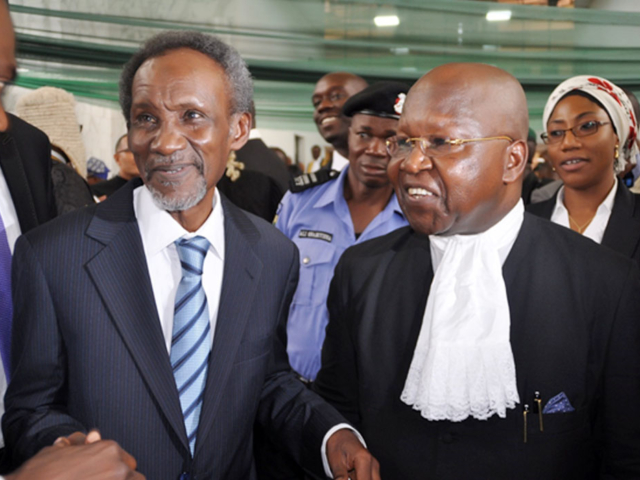
With former CJN Mahmud Mohhamed
At the Nigerian Institute of Advanced Legal Studies, I taught International Economic Law. That is a blend of Economics and Law. Again, because I did Public International Law of course, I am at home with the principles and today, I am into investment treaty, investment contracts especially at the International level because of my background.
Because my PhD is in Commercial Arbitration, I got involved with the practice of Arbitration and, my focus is commercial arbitration. I do purely commercial arbitration and the subset of that is Investment Treaty Arbitration which is what I am pursuing right now.
L&S: Prof, you’ve reached the zenith of three different careers; Law, Chartered Secretary and Arbitration.
Answer: Yes. When I qualified as a lawyer in 1993, I was still working in the Registry of the University of Jos. In fact, by the time I qualified as a lawyer, I had become a Senior Assistant Registrar in the Registry. But as soon as a qualified I wanted to do two things. I wanted to practice, I wanted to register for LLM, which they wouldn’t allow me to do in the Registry. So I opted to go to the Faculty of Law, University of Jos where as an academic staff, I will register for LLM and practice as well. Now my Registrar said to me, ‘no, don’t go to the faculty. You are already on GL12 as a Senior Assistant Registrar, by next year, I will make you a Principal Assistant Registrar on GL13. Don’t go to the faculty because you’ll be going to start as an Assistant Lecturer on GL9.’ I said sir, ‘can you do me a favour’? ‘Can you make my salary personal to me’?
L&S: What do you mean by making your salary personal to you?
Answer: It meant that if I left on Grade Level 12 in the Registry, they will not touch my salary and my salary will be personal to me and not that of a GL9 officer. He agreed that if that was my wish to go to the faculty, they would make my salary personal to me. That’s how I left the Registry as an Administrator. Now that was one major turning point in my life. When I took that decision in December 1993, I knew that I needed to move from Assistant Lecturer to Lecturer Grade II, Grade I before I get to Senior Lecturer position that was equivalent to my position in the Registry. However, the love of practicing and doing LLM was very, very strong. So in January 1994, I moved to the Faculty of Law, University of Jos as an Assistant Lecturer. I immediately registered for the LLM.
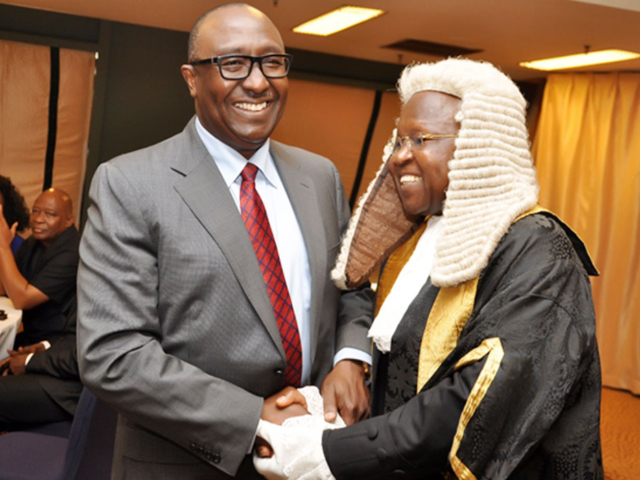
With former Attorney General, Chief Bayo Ojo, SAN during his conferment as Senior Advocate of Nigeria
In April 1995 I became a Personal Assistant to the then Honorable Minister of State, Works & Housing and that took me to Lagos. I was in Lagos till October 1997 when the Federal Executive Council was dissolved and instead of returning to the University of Jos as an Assistant Lecturer, I became a Lecturer Grade I at the Nigerian Law School, Abuja where I rose to the level of Senior Lecturer in 2000. Taking that decision to leave the Registry was a major decision that shaped my life.
L&S: What was the reaction of your colleagues at the Registry?
Answer: Some made fun of me. Nobody believed that one could leave GL12 and go start a career on Grade Level 9. I told them that in the Registry there will only be one Registrar, but in the faculty there are many Profs. On reflection, my colleagues at the Registry all retired a long time ago but I have traversed many aspects of the legal profession. I too would have since retired if I had remained in the Registry. I saw more prospects in the faculty than in the Registry. In any case, I was in the University of Jos, where the issue of indigeneship was very strong, so nobody was going to make me the Registrar. I knew that so I wasn’t deluded that if I had stayed they would make me a Registrar.
Like I said earlier, my ambition was to qualify as a Chartered Secretary, so I already had that in my pocket in 1986. By 1998, I was a Fellow of the Chartered Institute of Secretaries and Administrators. When I was called to the Nigerian Bar in December 1993, I started a career in Law. Now my PhD was in the area of International Commercial Arbitration. So very unlike my other colleagues in arbitration practice who were litigators, first before they became Arbitrators, I got a PhD in the area before I went to the UK to qualify professionally.
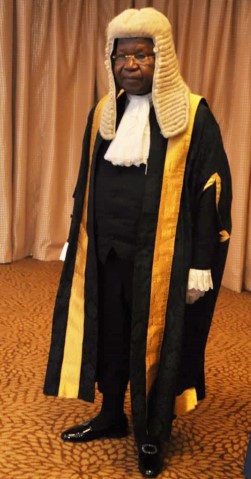
Senior Advocate of Nigeria
When I started teaching, because I had always been in the University system most of my life – I joined the University of Benin in August 1974; I knew that to progress, I must publish. And I was very, very aggressive. I gave myself a task of having at least 3 published articles every quarter. I was very, very aggressive in publishing, that by the time I applied to be a Professor, I had over 40 publications. By the time I applied for SAN, I had over 80 publications. When I then became a professor, in fact even becoming a professor was through the inspiration of Professor E. Azinge, SAN. When I was still a General Counsel in BPE, Prof. Azinge, SAN encouraged me to become a professor. As a matter of fact, although I was a PhD holder and published extensively, I simply published because I felt I could write.
On leaving BPE in February 2009, my interest was to go into full time consultancy and arbitration practice. However, Prof Azinge, SAN thought otherwise. He had seen my CV and believed that I had a professorial CV. Prof Azinge and I knew ourselves since 1975 in Benin.
L&S: How did you meet Prof Azinge?
Answer: It’s very interesting. The present Vice Chancellor of Igbinedion University, Prof. Lawrence Ezemwonye and I were staying in the same house in Benin between 1975 and 1978. Profs Ezemwonye and Azinge were friends from St Peter’s College (SPC), Asaba. Prof Azinge was coming to visit his friend, Lawrence and that’s how we met. We kept the relationship since then. We attend the same church too, so every Sunday, Prof Azinge would say to me, “Paulo go and get that thing now.” I said what? He said, “Go and take a Chair at any Nigerian University.” It got to a point, I was dodging Prof Azinge in church, because he was encouraging me to go and become a professor. I was not interested. It didn’t come to my mind really that I should be a professor as I was a ‘big boy’ at BPE where I was a Consultant under the Privatisation Support Programme supported first by the World Bank and later by the UK Department for International Development (DFID) – earning first in dollars and later in pounds. When he became DG NIALS, he said ‘Paulo, I’m going to advertise’. He advertised. Many of us applied and came for the interview. I already had a PhD plus publications. I was clearly qualified. That’s how I became a Professor.
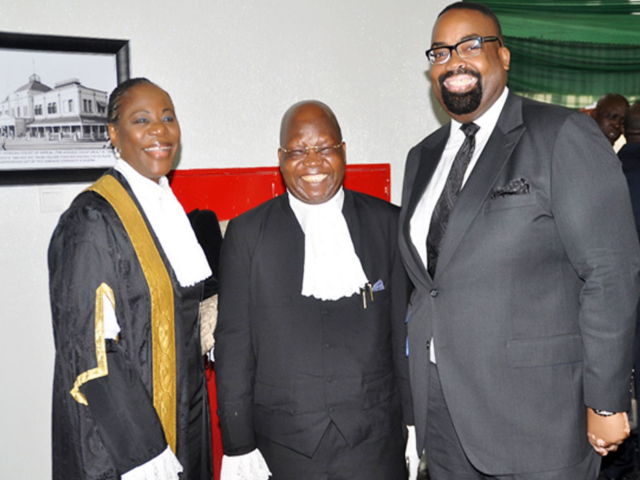
L-R: Funke adekoya, SAN, Idornigie, SAN and President Nigerian Bar Association, Olumide Akpata
Not too long again, he saw me and said, “Paulo, you have to become three things.” I said what again? He said, I must be an SAN, I must be a Chief and I must be a Knight in the church. I said only me? He said: “Yes, you can multitask. Senior Advocate is academic, Chief is in your village and Knight in church. So what’s your problem?” That was how the idea of becoming SAN crossed my mind. I dedicate being a Prof and a SAN to Professor Azinge because if not for him, I didn’t bother. Unfortunately, I am yet to become a Chief or a Knight. You know what? Prof Azinge, SAN has not given up on these as we speak. I believe that I have a dignifying prefix and suffice and do not need any other ‘award’ or ‘installation’. Furthermore the prefix and suffice are earned, not awarded or ‘dashed’.
I qualified as a Chartered Secretary in 1986, became a fellow in 1998, became a Professor in 2009, became a SAN in 2015. Now like I said, I had a PhD in International Commercial Arbitration before I registered with a professional body and eventually became a Chartered Arbitrator in 2016. Prior to this I became a Fellow in 2015. In the Chartered Institute of Arbitrators (UK), there are four classes of membership: Associate, Member, Fellow and Chartered. Because of my PhD, I didn’t start from Associate. I started from being a Member then a Fellow and today I’m Chartered. In Nigeria, we are less than 30 Chartered Arbitrators and that is the peak. That’s how I got to the peak of three professions – Company Secretarial Practice, Law and Arbitration.
L&S: Your entering into Law was through the evening law programme. What’s your take on the National Open University of Nigeria (NOUN) law graduates and the initial refusal to admit them into the Nigerian Law School?
Answer: I must say that the evening law programme was thoroughly abused. Many people who had made money saw that as a way to become lawyers and I think that some of them corrupted the system. They really corrupted the system. Retired governors, military officers, retired civil servants, businessmen and other professionals got involved and they had the resources. That was why and luckily for me, let me say this, although Jos had an evening law programme, we wrote the same exams with the full time students. There was no separate exam for us and on my personal level, from year one to year five, I was the best student. That’s how I became a University Scholar, and when we graduated in 1992, I was the best graduating student in the faculty. I got all the prizes for the Best Student in the Faculty of Law, 1992.
L&S: Best graduating student for both the evening and regular programme?
Answer: Yes. We wrote the same exams and when I became the best student then, someone said ‘why wouldn’t he be the best student when the lecturers were his friends.’ That really got me angry. That really hurt me because I knew how hard I worked. Notwithstanding, I said ok, the issue would be settled at the Nigerian Law School, then in Lagos. In the Law School, I was still the best from Jos. In fact, in the Law School, I was among the top six students of that year.
I later joined the Law School in 1997 as a lecturer. There I met these evening law students from other universities. Like I said, some of them really had no business being in that school. So I agree with the Law School that, they should stop the programme or overhaul it. But one thing I find interesting is, some of the senior lawyers from Nigeria who read abroad attended Holborn College and that college is a part time law college. Thus, some of the people who took the decision to cancel part time law students from gaining entrance to the law school, like me, read law part-time. The difference however is that those who went to Holborn College could not have scaled through without working hard. The way we corrupted the program in Nigeria, they couldn’t have done so in the UK. In fact, when the National Open University had this problem, I became their reference point. They were citing me as a product of an evening law program that had excelled. They were marketing their programme with my name. I think that most part time law programmes in Nigeria were not free from that allegation that they corrupted the programme.
L&S: A new law says NOUN law graduates can now do Bar Exam Part 1 exams and if they pass, they can now go to Bar Part II. Will that add up in your estimation?
Answer: Well on a patriotic level, like I said, it depends on how the National Open University runs its programme. If it is run efficiently, there will be no problem. But if the system is as corrupt as what I witnessed with the evening law programme, then, there’s a problem because it showed in the products of the various Universities running part time programmes. During my time at the Law School, I had many part time students who came to me to say “all I want is score 40.” I said to them, ’how can you come to school and your ambition is to score 40 percent’? That was not my ambition. Indeed in my final year in Jos, I had ‘A’s in all my courses. I won a prize in Jurisprudence as an evening law student, so I could not comprehend why a student would come to school and his sole ambition was to just score 40, 40, 40. Why not aim at 70 percent and then settle for 40. I said ‘If you aim at 40, where do you get to? That’s the last class of pass and you could fail.’ But like I said, I hope the National Open University will ensure that the process is not corrupted.
Prof and his latest Benz E-Class Coupé
L&S: How do you relax?
Answer: Dancing is one way I relax. I like football. I like lawn tennis.
L&S: Do you play football?
Answer: I used to play lawn tennis until I had a challenge with my legs. I was playing tennis three times a week at Rockview Hotel. Then I go for a walk early in the morning for one hour every day.
L&S: What happened?
Answer: In 2013 in a tennis court, I had a tear in my knee. I had to do what was a minor surgery then, but in the course of the surgery here in Abuja, I was given an infection. Luckily for me, I travelled to the UK. It was while I was doing the physiotherapy in the UK, I discovered that I could not move the leg. I told my son to call the GP as I was in serious pain. The GP came and said, ‘looking at your drugs, you shouldn’t be in pains, you’re gonna be alright.’ But the pain continued and I had to seek specialist attention. The specialist just took my blood samples to run some tests and said I had an infection. I quickly called Nigeria and the hospital there said just do whatever you are doing and give us the report. It became an emergency, so I was admitted at the University of Edinburgh Teaching Hospital for eleven days. I came back to Nigeria thinking that I was fit but the infection didn’t go. I kept managing it. It became expensive to handle. I was taking antibiotics that a week’s dose was over a hundred thousand naira and the injection I was taking was being given intravenously, thrice a day. A nurse came to the house at 6am, 2pm, and 10pm. I was paying about N15, 000 a day and I did that for about 6months.
L&S: Did the errant hospital defray the cost?
Answer: No, No, No! I’m telling you a story. I had to do a third surgery. I went back to the hospital where I did the first surgery and they billed me. That’s when I got annoyed. They charged me. I said look, ‘I came here with a torn ligament and left here with an infection and you’re billing me for this’? All they gave me was a marginal discount. They did the third surgery. Lillian, the infection refused to go. The infection didn’t go. I was on a wheel chair. I was on a walker. I was on crutches and all that, but the infection refused to go. Incredibly, they discharged me with the infection and said I should go back to the UK or go to South Africa or go to India, to do two more surgeries. One to cure the infection; the last one to do a knee replacement.
Father of four and nine grandchildren
L&S: Did the infection get into the bones?
Answer: God was faithful. I call myself a testimony of His faithfulness. Well, it was in my knee, for the two years, I had the infection. It didn’t go beyond my knee. That’s one major luck I had, although the leg was swollen, and I was in pains. I could not dance then and I lost a dancing competition. I was the reigning and defending champion. Before then, a friend in Jos had told me that there is a Catholic Monastery in Ewu in Edo State; the PAX Herbal. He said they had herbal antibiotics. I said ‘me, after going to Cedar Crest Hospital will go and take herbs?’ But when, I was discharged from Cedar Crest and I still had the infection, my wife said: “Before we decide where to go to next, let’s try this local medicine.”
I listened and incredibly, it cost me about ten thousand naira a week and that’s what cured me. So I moved from wheel chair to walker to crutches and I used walking stick till about 3 months ago. At a point my Zanku was shaky, but now, I can ‘carry my body and gbese’.
By way of conclusion, I repeat that God has been faithful, gracious and magnanimous. The only way that I can explain my life is the benevolence of God, Almighty. He is the source of my strength and accomplishments. May His Holy name be praised for ever and ever, Amen. Truly, I and the children God blessed me with are for signs and wonders: Isaiah: 8:18.
Our site uses cookies. By clicking “Accept All Cookies”, you direct Law and Society Magazine to store cookies on your device and disclose information in accordance with our Cookie Statement: cookie policyACCEPTREJECT
Privacy & Cookies Policy
Privacy Overview
This website uses cookies to improve your experience while you navigate through the website. Out of these cookies, the cookies that are categorized as necessary are stored on your browser as they are essential for the working of basic functionalities of the website. We also use third-party cookies that help us analyze and understand how you use this website. These cookies will be stored in your browser only with your consent. You also have the option to opt-out of these cookies. But opting out of some of these cookies may have an effect on your browsing experience.
Necessary cookies are absolutely essential for the website to function properly. This category only includes cookies that ensures basic functionalities and security features of the website. These cookies do not store any personal information.
Any cookies that may not be particularly necessary for the website to function and is used specifically to collect user personal data via analytics, ads, other embedded contents are termed as non-necessary cookies. It is mandatory to procure user consent prior to running these cookies on your website.