Home Blog Page 1025

The Tragedy of Living in Reaction, By Osmund Agbo

Earlier this month, yours truly woke up to a gut wrenching video shared by a friend on Whatsapp. It was the clip of a double murder-suicide that happened in Plains Township, a small settlement, roughly 15 miles southwest of Scranton, Pennsylvania and on the outskirts of Wilkes-Barre. The graphic images captured in that surveillance camera continue to hunt me till this day.

It was a Monday morning and the Nor’easter storm had just dropped 2 feet of snow that blanketed the little sleepy community. A couple by the name of James and Lisa Goy were shoveling snow from their parking lot with the snow landing onto the front yard of their neighbor named Jeffrey Spaide. Police said Spaide confronted the couple and they soon started yelling obscenities and trading insults at each other. James appeared to have raised his fist in a threatening gesture. Jeffrey then retreated into his home, came back with a pistol and started shooting at the couple. The footage showed James fall to the ground, after being hit by one of the bullets as he screamed for someone to call the police. Jeffrey went back inside in a continuing fit of rage and this time, returned with an AR-15 like rifle. He shot the couple dead, point blank at close range. The Goys left a 15-year-old son who is now in his grandparents’ care.

What a horrendous tragedy brewing out of nothing!

Prior to the horrific incident, Jeffrey Spaide, 47 had no rap sheet. He was a shipboard engineering technician for the United States Navy and also a licensed engineer for over 20 years after graduating from Villanova University. But he lived alone.

We have all been pushed to the edge by someone that would have escalated to a disaster were it not for the party that took the high road and became the adult in the room. The window of opportunity was found in that space that we opted to pull back against our default natural instincts. The window of space is always there but what we decide to do within that short amount of time may forever change our lives.

“Between stimulus and response there is a space. In that space is our power to choose our response. In our response lie our growth and our freedom.”

The above quote is credited to Viktor Frankl, a Holocaust survivor who belongs in the class of people Plato described as Philosopher-Kings. He earned his stripes from the depths and horrors of a concentration camp. Victor brimmed with wisdom and intellect, cautioning that we learn how to observe this “space” as a way to grow into a better version of ourselves.

Every now and then, stuff is sure to happen to us. Someone will disrespect you and say nasty stuff to you. It might even be your friend, brother or even a spouse. And yes, too many Nigerian lives have been wasted in America for reasons bothering on inconsequential marital disputes. It could also be the total stranger you met at Shoprite that you want to curse out and teach a lesson. In most instances, the actions of the perpetrators are more a reflection of their inner struggle rather than anything that has to do with us. That said, if one is not careful, you get sucked into fighting someone’s demons with disastrous consequences.

It may as well mean that one has to acquire some skill sets to get to a certain destination in our life’s journey. The skill of taking a deep breath to calm frayed nerves, learning anger management or whatever one needs to do. In the end, you will find that owning that “space” is an integral part of becoming the person you wish to be.

When we resist the allure of a reflexive response, we can access the freedom to respond to pressures, both internal and external in a way that grows us. These will for sure, channel us on the path to finding inner peace and tranquility.

A Supreme Court Justice and one of America’s brightest legal minds who passed away recently gave us a shorter version of Mr.Frankl’s philosophy;

When a thoughtless or unkind word is spoken, best tune out. ~Ruth Bader Ginsburg

Dr. Agbo, a Public Affairs analyst is the coordinator of African Center for Transparency and Convener of Save Nigeria Project. Email: [email protected]

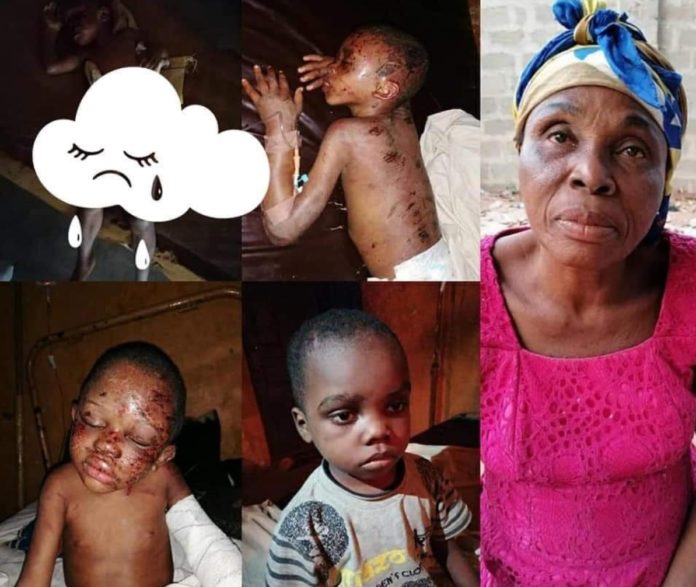
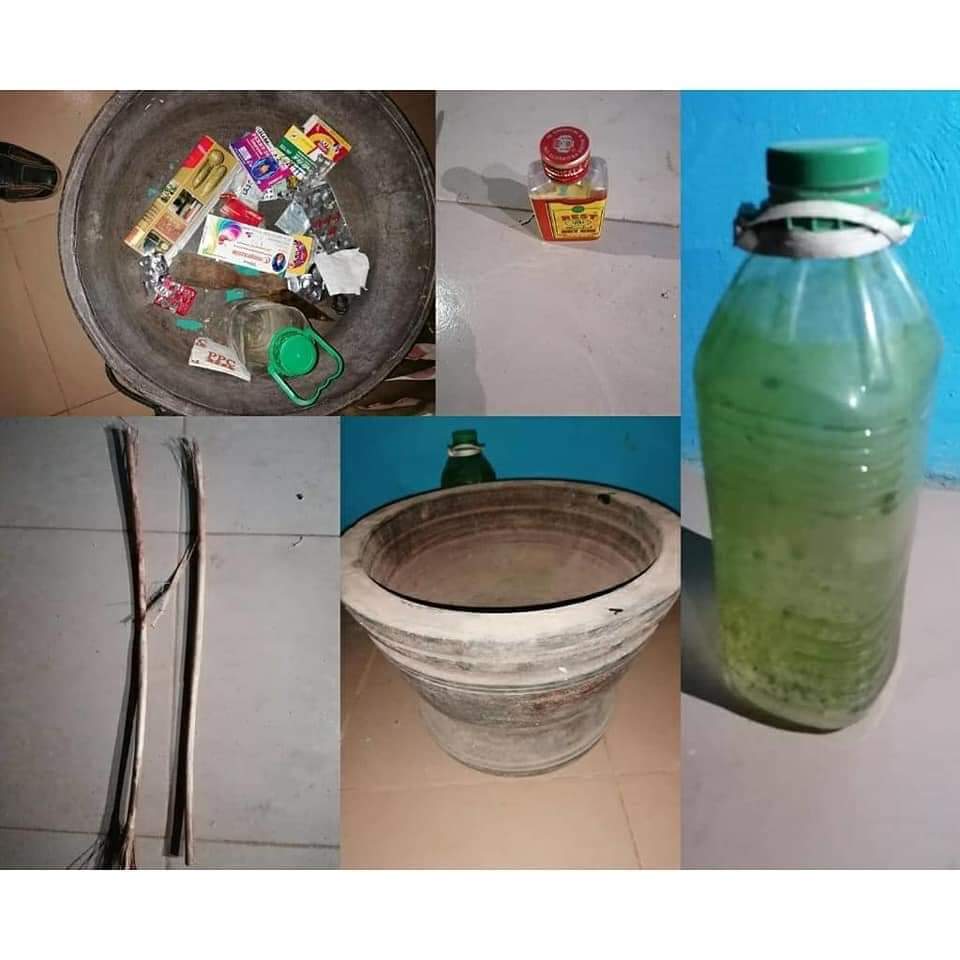
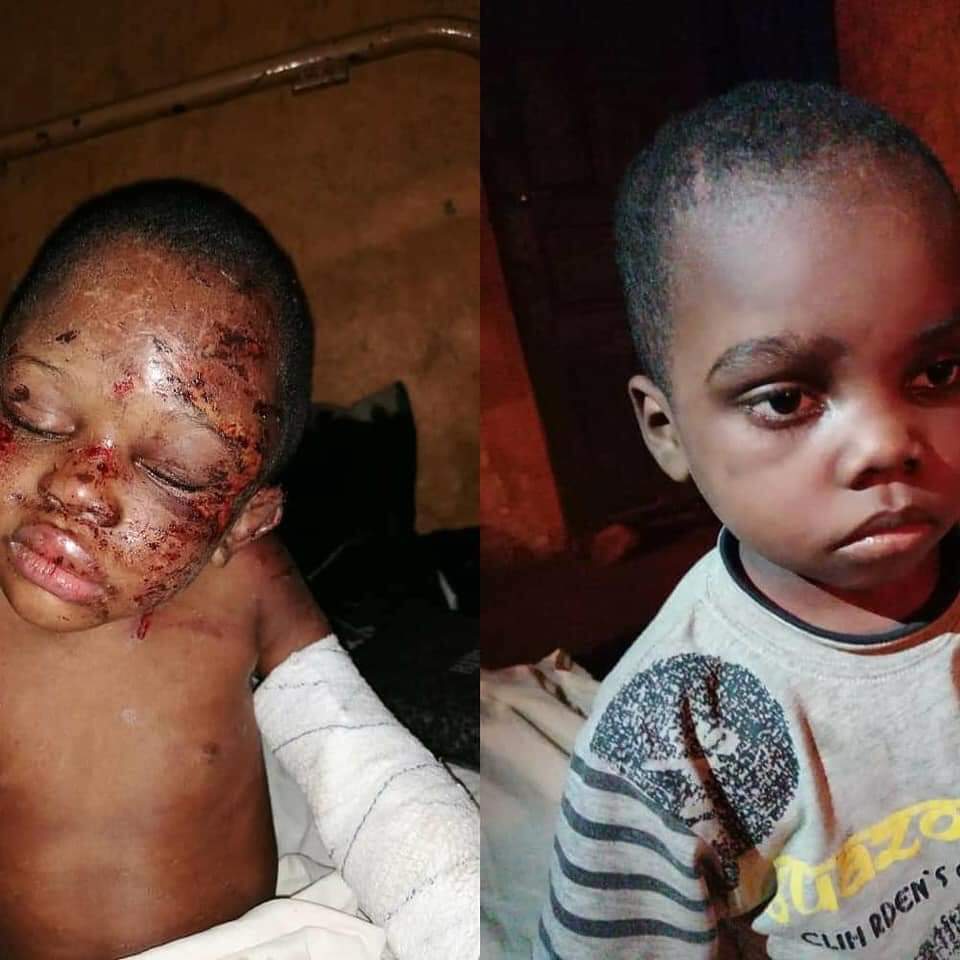
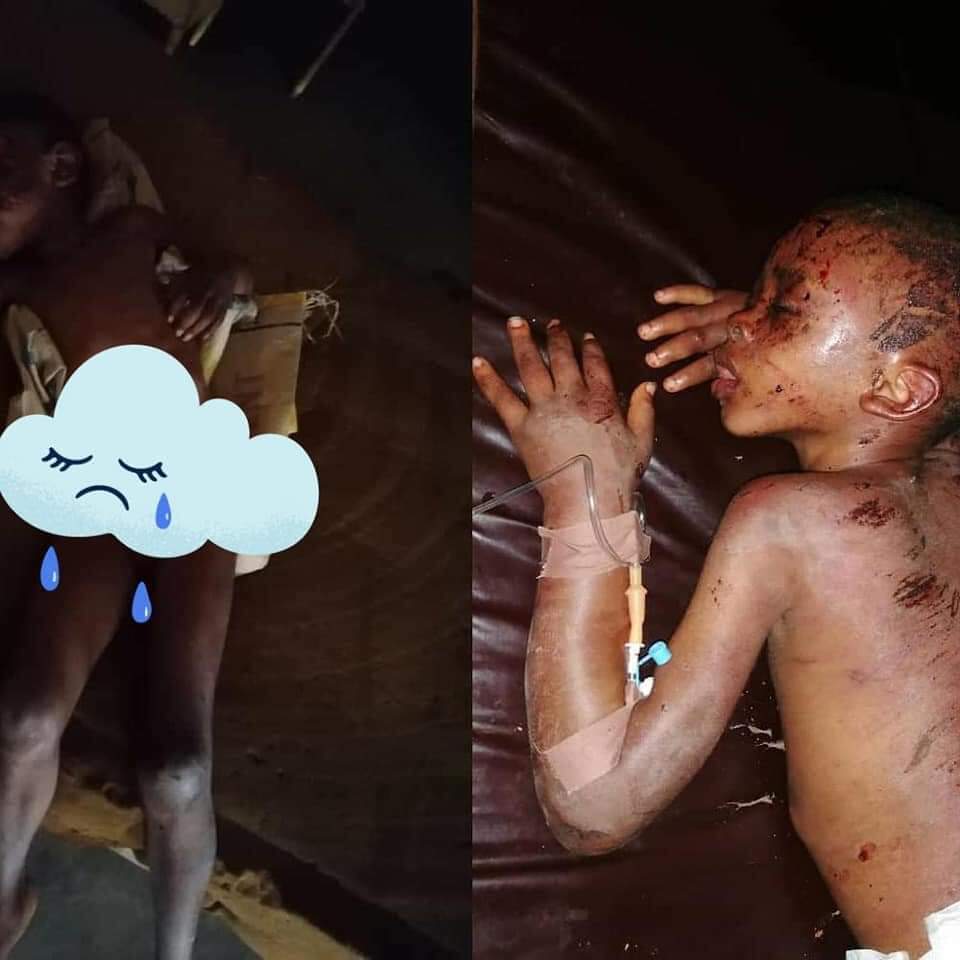
GRAPHICS: Battered children rescued from house filled with fetish items where they were locked up and abused by suspected female ritualists who own a ministry | NKANUTVMEDIA

Three children battered beyond recognition were rescued from a room filled with fetishism items and the two women who held them hostage have been arrested in Anambra state.

According to the Anambra state police, the women identified as Rejoice Raymond, 39, and Chidi Felicia Nwafor, 80, were arrested by police operatives attached to 3-3 Police Station Nkwelle.

Following intelligence report, on Friday, Feb 19, police stormed their address at NO.13 Akunwanta Mbamalu Street, Federal Housing Estates 3-3 Nkwelle Ezunaka, Anambra state, where they found three children locked up in a room.

The children – 2 boys and a girl – were badly bruised and were looking malnourished. They had broken bones and were left lying in their blood.

The entire room had blood stains alongside fetish items, including a mortar and multiples pestles, blood stained canes, concoction and more.

In the room, was also found a bucket where the children were made to poop as they were not allowed out of the room.

The children, whose parents are not known, were too battered to speak. They were barely conscious and appeared to be in shock.

According to the Anambra state police, the women had “subjected them into physical and emotional torture without feeding and inflicted several wounds on their body leaving them unconscious.”

Some sources allege the women own a ministry but also engage in fetishism, including pounding children in mortar.

The children were rushed to the hospital where they are now receiving treatment.

Consequently, the Commissioner of Police CP Monday Bala Kuryas,fsi has ordered a discreet investigation into the circumstances surrounding the case after which suspects would be brought to justice.

Carry Your Gun To School, Taraba NUT Charges Teachers

By John Mkom, Jalingo. 

Chairman Nigerian Union of Teachers, (NUT) Taraba state, Comrade Peter Jurius Vow, has urged all the teachers in the state to be carrying their guns while going to their respective schools to protect themselves and their pupils.

Jurius stated this in an exclusive interview with LEADERSHIP in Jalingo, the Taraba State capital over the abduction and kidnapping of students in some states of Nigeria.

He also  credited his view on the recent statement made by the Nigerian minister for defense, Bashir Magashi, that Nigerians should be ready to defend themselves against bandits.He added that the future of Nigeria is at stake, going by the level of kidnapping and abduction of students.“These children being held by bandits are doctors, journalists, professors, governors or world leaders of tomorrow.“

With what is going on, our future is threatened, government should intensify more security efforts, we should also be watchful in our environment, let’s report unusual faces to security and monitor our areas to forestall insecurity challenges.

Credit:leadership

FG hurriedly promotes Bawa to qualify him for EFCC top job as lawyer, anti-corruption group challenge nomination

EFCC Chairman-nominee, Abdulrasheed Bawa

The Economic and Financial Crimes Commission (EFCC) has promoted its Chairman-nominee, Abdulrasheed Ahmed Bawa, and 88 others.

They were promoted from Grade Level 13 Principal Detective Superintendent (PDS) to grade level 14 Deputy Chief Detective Superintendent (DCDS) Grade Level 14, effective from January 1, 2021, PRNigeria has gathered.

By this promotion, Bawa is now qualified for appointment as the Commission’s chairman.

The ‘swift’ promotion offered the anti-graft agency’s nominated boss, and other EFCC operatives is coming less than two weeks after President Muhammadu Buhari nominated Bawa to replace Ibrahim Magu, the former acting Chairman.

An internal memo sighted by PRNigeria and signed by one Femi Peter Gbarufu, which was issued on Friday, and titled, “Release of Promotion List”, disclosed that promotion letters would be issued to the affected staff, as soon as possible by the Human Resources Unit.

A source in the EFCC told PRNigeria that with the promotion, Bawa’s new Rank is equivalent to the position of Assistant Commissioner of Police (ACP), a qualification for the position of Chairman in the agency.

“Bawa was recruited into EFCC in 2005 as one of the pioneer cadets and has spent 16 years as an operative. By virtue of his new rank, he is now equivalent to Assistant Commissioner of Police and qualified to be a Chairman of EFCC.
“The EFCC Establishment Act, especially Section 2a (ii) stated that a candidate for appointment as the Chairman of the agency should be a serving or retired member of any security or law enforcement agency not below the rank of Assistant Commissioner of Police or equivalent.”

“The DCDS in EFCC is equivalent ACP in Police. For instance, the operative cadre entry-level in the police is Assistant Superintendent of Police (ASP) equivalent to Assistant Detective of Superintendent (ADS); Deputy Superintendent of Police (DSP) is equivalent to Deputy Detective Superintendent (DDS); Superintendent of Police (SP) is equivalent to Senior Detective Superintendent (SDS); Chief Superintendent of Police (CSP) is equivalent to Principal Detective Superintendent (PDS) while Assistant Commissioner of Police (ACP) is equivalent to Deputy Chief Detective Superintendent (DCDS).

“There are other senior officers in EFCC who are not detective operatives but with routine civil service ranks for administrative purposes. The Detective operatives currently in the service of EFCC are either course mates or junior to the Bawa who has just been promoted to qualifying level for the position of the Chairman,” the officer concluded.

Meanwhile, it was learnt that a lawyer, Osuagwu Ugochukwu, has filed a suit before the Federal High Court in Abuja seeking to stop the Senate confirmation of the chairman-designate.

The court document marked FHC/ABJ/CS/196/2021 was received at the Office of the Senate President on Thursday, according to an acknowledgement copy obtained by our correspondent on Friday.

It was learnt that the leadership of the Senate, the Presidency and the Office of the Attorney General of the Federation were holding talks as to how to address the issue in order to avoid a repeat of the last screening exercise where the then nominee, Ibrahim Magu, was rejected twice by the Senate.

Bawa is also believed to be a kinsman of the AGF, Abubakar Malami (SAN). Malami played a major role in the removal of Magu and reportedly recommended Bawa’s appointment to the President Muhammadu Buhari.

In the originating summons filed by Ugochukwu, it was argued that Section 2 of the EFCC Act states that the EFCC shall have a chairman who shall be the chief executive and accounting officer of the commission; be a serving or retired member of any government security or law enforcement agency “not below the rank of Assistant Commissioner of Police or equivalent; and possess not less than 15 years cognate experience.”

Ugochukwu asked the court to determine whether a Level 13 officer is the equivalent of an ACP.

The plaintiff subsequently sought two reliefs, including “a declaration that the 2nd defendant (Bawa), who is a Grade Level 13 public service officer and not an Assistant Commissioner of Police or its equivalent is not qualified to be the chairman of the EFCC” and “an order of perpetual injunction restraining the first defendant (Senate) from confirming the appointment of the second defendant (Bawa) as chairman of the EFCC.”

Meanwhile, the Centre for Anti-Corruption and Open Leadership has written a letter to the Senate asking the upper legislative chamber not to confirm Bawa as the EFCC chairman.

This is according to a letter titled ‘Don’t Confirm Abdulrasheed Bawa’s Appointment as EFCC Chair until He Clears His Name of Corruption Allegation; Appeal to the Nigerian Senate,’ which was signed by the Executive Director of CACOL, Debo Adeniran.

CACOL said Bawa was alleged to have diverted 224 forfeited trucks while he was the Port Harcourt zonal head of the commission and is also rumoured to be a cousin of the AGF.

The group further argued that Bawa is not up to the level of an ACP and is thus not qualified to be chairman of the EFCC.

“The EFCC law is an Act of the National Assembly, hence the Senate must not overrule itself by breaching a critical provision in the appointment of EFCC Chairman.

“It is against this background that CACOL is appealing to the Senate to please take the pains to dig deep into Mr Abdulrasheed Bawa’s record of overall performance, as well as that of corruption allegations levelled against him.

“Howbeit, if the rumour making waves in some quarters, which has also been confirmed by some sections of the media, is anything to go by, we would say Nigerians’ hope for a corruption-free society has been dashed with the nomination of Mr. Abdulrasheed Bawa as the chairman of the EFCC,” the letter read.

Bawa, who was accused of diverting recovered assets, was, however, absolved of any wrongdoing by the EFCC in a statement signed by its spokesman, Mr Wilson Uwujaren, on Tuesday.

Credit: sundiatapost

Defamation : Court Orders Blogger To Pay N500m To MFM Founder As Damages

An Ogun State High Court sitting in Abeokuta has slammed N500 million damages against UK-based blogger Maureen Badejo over libelous publications through her channel GIO TV against the general overseer of Mountain of Fire and Miracles Ministries (MFM) Daniel Olukoya and the church.

The claimants are the incorporated trustees of MFM and Olukoya.

Badejo, who is the anchor person for GIO TV on Facebook, had before the judgement made 52 separate allegations against Olukoya.

In one of her allegations, she claimed £4 million was stolen in MFM and that Olukoya was aware. She also claimed he was fully involved in all the alleged frauds being perpetrated by MFM church.

Ruling in a N10 billion libel suit against Badejo, Justice Abiodun Akinyemi awarded N250million to each of the claimants bringing the total to N500million as aggravated and exemplary damages for libel.

Justice Akinyemi, in the ruling, frowned at Badejo’s campaign against the claimants and described it as the worst case of reckless defamation and evil use of the internet and social media.

The court also ordered the defendant to “immediately pull down and erase each of the offending online publications/posts concerning the claimants from the internet.

“Tender a written apology and retraction of the offending publications and posts in a form and content acceptable to the claimants and published prominently in her Facebook, YouTube and Instagram accounts and in at least three nationally circulating newspapers in Nigeria and two international magazines including Time International, FORTHWITH.”

The court also issued perpetual injunction restraining Badejo, her agents, servants, privies or other persons from further making, publishing and/or disseminating defamatory stories and statements about the claimants.

Reacting to the judgement, counsel to the claimants Ime Asanga said a certified true copy of the judgment and a certificate of the judgment with Form 35 endorsed thereon had been served on Badejo through courier and that the proof of service indicates that she personally signed on them at 09:20 am on Thursday, February, 18, 2021.

Credit: cknnigeria

Sheik Gumi and the Politics of Appeasement

John Ogunlela

All those behind Sheik Gumi or emotionally drawn to his peace plan should go and read the history of Appeasement and how it proved crucial in the final rise of Adolf Hitler in 1938.
The summary is this: Hitler had made a foray into a region of Czechoslovakia known as Sudenteland and insisted it was part of the German empire. Neville Chamberlain, the the PM of Britain went to see Hitler and a few European leaders where he agreed that the best deal was to allow Hitler to have Sudenteland as long as that will bring peace. Hitler was later to remark that it was with trepidation he faced up to European leaders on that matter because his army was subpar at the time and was not ready for combat. He said he would have ran tail between leg had Europe stood up to him.
Neville Chamberlain returned to London and addresses a crowd from Downing Street that he had procured “peace for our time”, a statement which was to become the albatross of the world. By September that year (or was it 1939) Hitler’s Blitzkrieg (Lightening War) had smashed through the defences of Poland and was sweeping through that country. All the doubts Europe had had evaporated.
We are witnessing a significant transfer of wealth to bandits and people who have declared war against the nation. They are strengthening their forces slowly but surely using the resources of Nigeria. They understand the psychology of many of these leaders that they are soft and inept people and have zero understanding of strategy – only El-Rufai has spoken and analysed that part of the issue the way a leader must.
If this Maghreb militia keeps receiving financial encouragement this way, they will be across River Niger within a year from now or less. Leaders everywhere ought to understand what is going on and act firmly and strategically.

Hushpuppi in fresh FBI trouble, linked with N. Korean bank robbers

Nigerian Ramon Olorunwa Abbas-  Hushpuppi, now incarcerated in California as he awaits trial for cyber fraud was linked Friday by the FBI to North Korean hackers, said to be the biggest bank robbers in the world.

The Justice Department in a detailed statement released Friday, said Abbas took part in a “North Korean-perpetrated cyber-enabled heist from a Maltese bank in February 2019.”

His role was as a collaborator with a North Korean money launderer, Ghaleb Alaumary, based in Mississauga, Ontario, Canada.

The 37 year-old Alaumary was one of the people charged today by the FBI for many criminal schemes. The others are three North Koreans.

“Alaumary agreed to plead guilty to the charge, which was filed in the U.S. District Court in Los Angeles on Nov. 17, 2020”, according to the statement.

“Alaumary was a prolific money launderer for hackers engaged in ATM cash-out schemes, cyber-enabled bank heists, business email compromise (BEC) schemes, and other online fraud schemes. Alaumary is also being prosecuted for his involvement in a separate BEC scheme by the U.S. Attorney’s Office for the Southern District of Georgia.

“With respect to the North Korean co-conspirators’ activities, Alaumary organized teams of co-conspirators in the United States and Canada to launder millions of dollars obtained through ATM cash-out operations, including from BankIslami and a bank in India in 2018.

“Alaumary also conspired with Ramon Olorunwa Abbas, aka “Ray Hushpuppi,” and others to launder funds from a North Korean-perpetrated cyber-enabled heist from a Maltese bank in February 2019.”

Abbas already has a case of his own.

Last year, the U.S. Attorney’s Office in Los Angeles charged him in a separate case alleging that he conspired to launder hundreds of millions of dollars from BEC frauds and other scams.

In a July statement, the Justice Department referred to the Maltese bank attack as “a $14.7 million cyber-heist from a foreign financial institution.”

“Both the date and amount match that of the attack on Malta’s Bank of Valletta in February 2019,” reported Forbes.

Abbas, 38, was arrested in Dubai last year.

He arrived in the U.S. on July 3 to face criminal charges over allegations that he made “hundreds of millions of dollars” from business email compromise frauds and other scams.

His trial was to have commenced late last year, but was delayed by the COVID-19 pandemic.

Read the full US Justice Department statement on the indictment of three North Korean military hackers involved in cyber heists running into over $1.3billion

A federal indictment unsealed today charges three North Korean computer programmers with participating in a wide-ranging criminal conspiracy to conduct a series of destructive cyberattacks, to steal and extort more than $1.3 billion of money and cryptocurrency from financial institutions and companies, to create and deploy multiple malicious cryptocurrency applications, and to develop and fraudulently market a blockchain platform.

A second case unsealed today revealed that a Canadian-American citizen has agreed to plead guilty in a money laundering scheme and admitted to being a high-level money launderer for multiple criminal schemes, including ATM “cash-out” operations and a cyber-enabled bank heist orchestrated by North Korean hackers.

“As laid out in today’s indictment, North Korea’s operatives, using keyboards rather than guns, stealing digital wallets of cryptocurrency instead of sacks of cash, are the world’s leading bank robbers,” said Assistant Attorney General John C. Demers of the Justice Department’s National Security Division.

“The Department will continue to confront malicious nation state cyber activity with our unique tools and work with our fellow agencies and the family of norms abiding nations to do the same.

“Today’s unsealed indictment expands upon the FBI’s 2018 charges for the unprecedented cyberattacks conducted by the North Korean regime,” said the FBI Deputy Director Paul Abbate.

“The ongoing targeting, compromise, and cyber-enabled theft by North Korea from global victims was met with the outstanding, persistent investigative efforts of the FBI in close collaboration with U.S. and foreign partners. By arresting facilitators, seizing funds, and charging those responsible for the hacking conspiracy, the FBI continues to impose consequences and hold North Korea accountable for its/their criminal cyber activity.

“The scope of the criminal conduct by the North Korean hackers was extensive and long-running, and the range of crimes they have committed is staggering,” said Acting U.S. Attorney Tracy L. Wilkison for the Central District of California.

“The conduct detailed in the indictment are the acts of a criminal nation-state that has stopped at nothing to extract revenge and obtain money to prop up its regime.

“This case is a particularly striking example of the growing alliance between officials within some national governments and highly sophisticated cyber-criminals,” said U.S. Secret Service Assistant Director Michael R. D’Ambrosio. “The individuals indicted today committed a truly unprecedented range of financial and cyber-crimes: from ransomware attacks and phishing campaigns, to digital bank heists and sophisticated money laundering operations. With victims strewn across the globe, this case shows yet again that the challenge of cybercrime is, and will continue to be, a struggle that can only be won through partnerships, perseverance, and a relentless focus on holding criminals accountable.”
(biesloaded.ng)

Criminal Cartels on the Loose The Verdict By Olusegun Adeniyi

Following a tip-off in July 2016, the Office of the National Security Adviser (ONSA) arrested an obscure fruit seller under a bridge in Zaria, Kaduna State. Investigations revealed the man to be a high-ranking Boko Haram operative who coordinated the finance cell of the group with others in Dubai, United Arab Emirates (UAE) to disburse funds to various terror camps in North East Nigeria as well as Diffa, Nigér Republic. From what I gather, the Zaria arrest proved to be a major breakthrough that eventually revealed a pattern of financial flows and transactions not only to Boko Haram field operatives but to other criminal cartels, particularly those engaged in kidnappings for ransom.

The ONSA investigations further revealed that between 2015 and 2016, the sum of $782,000 was transferred from Dubai to Nigeria through Bureau De Change (BDC) operators to aid Boko Haram. As reported in the media, this was what led to the conviction in April 2019 of six Nigerians, including a man identified as a government official. Later that same year (December 2019), an Abu Dhabi Federal Court of Appeal affirmed the judgment of the lower court and upheld the imprisonment sentence imposed on the six Nigerian citizens. Aside laundering money for the terror group, these men were also found guilty of running a Boko Haram cell in the UAE to raise funds and material assistance for the insurgents in Nigeria. Although the convicts claim innocence, follow-up investigations have helped the security agencies to better understand the movement of money by criminal cartels in Nigeria. The investigations also led to the arrest of accomplices in Kaduna, Kano and Zamfara States.

Meanwhile, the Dubai security breakthrough helped to expose how some of the criminal networks operating in Nigeria had perfected a seamless method of laundering money through BDC operators. Once the money has been given to a BDC operator in Dubai, he contacts an associate in Nigeria who gives the same amount in cash to the coordinator. On the instruction of the Boko Haram leadership, the coordinator goes ahead to distribute the funds to members who incidentally have no direct contact with one another, in an elaborate scheme to cover their tracks. The same pattern was discovered for disbursement of ransom monies from kidnappings, especially those traced to illegal mining in Zamfara State.

What the foregoing suggests quite clearly is that we are dealing with a serious national security threat that is not only well organized but well-funded. For instance, the thriving Nigerian gold market in the UAE has been traced to activities of illegal miners in Zamfara with Aminu Kano International Airport as a gateway. “It is the most notorious airport in the country”, a security source told me last week. But the real challenge is in Zamfara where the proliferation of arms and hundreds of muscle men working as miners, (licensed as well as illegal) engage in kidnappings. A combination of porous borders, weak signal and technical intelligence, lack of proper data of licensed miners and the influx of illicit drugs such as Tramadol have combined to make banditry the most lucrative enterprise in the state.

According to security sources, there is a nexus between kidnappings for ransom and terrorism as well as between gold prospecting in Zamfara State and the general wave of criminality by herdsmen that has spread to the southern part of the country with dire implications for national peace and security. For instance, a clear pattern has emerged between ISWAP and kidnappings with many of the herders implicated as foot soldiers. “Most of the herdsmen you see all over the place, whether in the north or south, kidnapping, raping and maiming people are employees of a larger terror network. They kidnap but the ransom does not go to them”, a senior security officer told me.

Most of the people identified with illegal mining in Zamfara State are herders who realize that more money can be made from kidnappings. They are not only ‘diversifying’ their business, many of them are also moving southward. “A lot of these Fulani marauders are from Mali, Niger and Burkina Faso” said a security source. Sadly, rather than tackle the problem, the presidency indulges in making excuses that lead to accusations of complicity and most often in a manner that threatens the unity of the country as an inclusive polity founded on diversity. And with that, kidnappings for ransom has become the most lucrative enterprise in the country.

In October 2019, a former Inspector General of Police (IGP), Mohammed Abubakar disclosed that over N3 billion was collected by bandits as ransom from relatives of victims in Zamfara alone within a period of eight years. Abubakar who chaired a committee set up by the current governor, Bello Matawalle to find solutions to banditry in the state, said the report covered the period from June 2011 to May, 2019. The money, according to Abubakar, was collected from 3,672 victims whose relatives paid to secure their freedom. Abubakar said that a total of 4,983 women were widowed, 25,050 children orphaned and 190,340 persons displaced by banditry over the period in the state.

While that level of threat should worry the authorities, there is also an international dimension to the criminality that is just as intriguing to security agencies. I understand that there are more than a thousand Chinese and Indians in the mining business in Zamfara State. “Yet, not a single one of their nationals has been kidnapped.” Meanwhile, some of the people who serve as security personnel to these miners have been discovered to be engaged in kidnappings for ransom, raising questions about who they work for.

The threat coming from this criminal enterprise is now political given what the senate yesterday described as “issuance and counter issuance of eviction notice by some ethnic entrepreneurs and groups posing as ethnic nationalists and champions”, while kidnappers continue to operate mostly on the roads, outskirts of towns and farms where they ambush innocent rural people. That these kidnappers kill, maim and rape is bad enough. That they are identified as belonging to a certain ethnic colouration is the problem. They particularly enjoy brutalizing their victims which perhaps explains why in most instances, they force their captives to walk long distances on thorns and sharp stones in the bush.

Quoting the global risk consultancy, ‘Control Risks’, the Financial Times of London, recently reported that Nigeria has the highest rate of kidnaps for ransom of both locals and foreigners in all of Africa. “For most businesses, the greatest risk to their employees is while they are travelling,” Tom Griffin, senior partner for Africa and the Middle East at Control Risks was quoted to have said. “Almost half of all kidnaps in Nigeria recorded by Control Risks occur during road travel, with kidnappers often selecting targets based on perceived wealth during roadside ambushes, roadblocks or attacks in traffic congestion.”

We must admit that we have a crisis on our hands that is not restricted to any section of the country. It is national. In the clip of the interview he granted a television station that has gone viral, Alhaji Bashir Kurfi, National Chairman, Network for Justice narrated an incident that happened in Kurfi, Katsina State where he hails from. “One lady came to share her story. She went to see her daughter who gave birth and then the bandits came—they asked her to hold the baby and they raped the daughter. And then after, they asked the daughter to hold the baby and they raped the mother. This is what is going on everyday…it is the reality on the ground and it is a shame on us.”

It should worry President Muhammadu Buhari that whether on land or in water, the Nigeria territorial space is now one of the least safe spaces in the world. The latest report by the International Chamber of Commerce’s International Maritime Bureau (IMB) reveals that over 95 per cent of the 135 shipping crew members kidnapped last year were recorded in the Gulf of Guinea and mostly on Nigerian waters. “Incidents in the Gulf of Guinea are particularly dangerous, as over 80 per cent of attackers were armed with guns,” according to the IMB.

That there is no coherent strategy to deal with the challenge can be glimpsed from the interview granted the BBC Hausa Service by the Kaduna State Governor, Mallam Nasir elRufai. While he advocates that you do not appease criminals, his Zamfara State counterpart believes in offering ‘amnesty’ and money to bandits and kidnappers to make them change their ways. El-Rufai has therefore cited lack of unity and cooperation among the governors of the North West as one of the reasons the security challenges persist. The governors, according to El-Rufai, have different approaches to ending banditry and kidnapping.

This is where the moral authority of the president can help. He should be able to impress upon the governor of Zamfara State that you do not make deals with criminals. Bandits and kidnappers being offered government largesse will never keep to deals as we see with the experience of Katsina State. And while there is a place for the personal efforts such as the one being undertaken by Sheikh Gumi, the state must muster the capacity to restore law and order without bowing to criminals.

At a time we are facing apprehension over impending national crisis, it is the responsibility of leadership to identify solutions to difficult problems, ensure stability of the polity, and guide the society to prosperity. The fear of a national crisis, this time, is fueled by criminal activities traced to herdsmen who now roam the country with impunity. The rising profile and complexities of conflict disorders in the country therefore requires a hands-on approach from the president. Sadly, that is precisely where the problem lies.
That sundry criminal cartels have overpowered the capacity of the state to restore law and order is no longer in doubt. But more worrisome is the fact that our national security challenge is being framed around identity politics which can only exacerbate the situation. The tone of debate yesterday in the Senate reflected this unfortunate national divide. According to a senator from Adamawa State, Binos Yaroe, whenever kidnappers are arrested anywhere within the country, the majority of them always turn out to be Fulani. That is the kind of rhetoric you also get from the street. “Right now, we are an endangered species. People are going into homes to abduct, to rape, herdsmen are everywhere. We have spoken several times and nothing has been done. Posterity beckons”, said Senator Biodun Olujimi from Ekiti State in a note of resignation.

The connecting thread for the variants of violence that we witness across the country today, as I have argued several times on this page, is that the Nigerian state has lost what Max Weber described as the monopoly of “the legitimate use of physical force” to criminal cartels. Until we muster the capacity to effectively confront them, we will continue to be at their mercy. But whichever way one looks at the current challenge of insecurity across Nigeria, it all leads to the doorstep of President Buhari. It is therefore my hope that he will address that challenge most decisively. Before the amber light turns red!

• You can follow me on my Twitter handle, @Olusegunverdict and on www.olusegunadeniyi.com

Govt May Swap Abducted Kagara School Pupils for Arrested Bandits

There are indications that the government might consider releasing some arrested bandits as a part of the bargains to secure the release of 27 pupils and 15 workers of Government Science College, Kagara, in the Rafi Local Government Area of Niger State, kidnapped on Wednesday.

There are indications that the government might consider releasing some arrested bandits as a part of the bargains to secure the release of 27 pupils and 15 workers of Government Science College, Kagara, in the Rafi Local Government Area of Niger State, kidnapped on Wednesday.

It was learnt on Friday that the group of bandits responsible for the abduction wanted their gang members in custody of security agencies released as a swap deal to free the abductees.

Bandits in military uniform had reportedly stormed the school around 2am on Wednesday, and seized their victims, killing a Senior Secondary School 3 pupil who raised the alarm in the process.

They consequently led their victims – tied in pairs – to a nearby spot around Attahiru Secondary School where they had reportedly parked their motorcycles and whisked them into a forest.

In a bid to secure their release, a reliable source told The PUNCH that officials of Niger and Zamfara state governments met some bandits at Dutsin Magaji of Kotonkoro Forest in Rafi on Thursday evening.

The forest reportedly connects the four states of Kebbi, Zamfara, Niger and Kaduna.

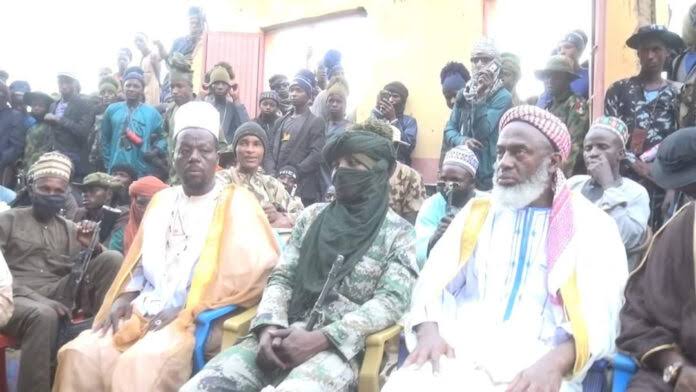
It was also said that a popular Kaduna-based cleric, Ahmad Gumi, met some bandits in Niger State as part of efforts to rescue the victims

The Inspector-General of Police, Mohammed Adamu, had also deployed 252 additional operatives and a helicopter to reinforce the ongoing rescue operation for the abducted pupils and staff members of the school.

Gunmi on Friday told one of our correspondents that he had met with an influential leader of a bandit group to broker a negotiation with the bandits responsible for the kidnapping.

The cleric emphasised that banditry was turning into an insurgency which must be urgently addressed, noting that the abductors were demanding the release of their members arrested by security agents as well.

He said, “I met with people who know the people responsible (for the abduction), which is one step ahead. Before now, when there was a kidnapping, we wouldn’t know those responsible, but now, we have met a leader who knows (these people) because he is commanding a large area and knows the person who did it and he is going to speak to him and plead with him (to release the abducted pupils and other victims. Since there is a peace process going on, they should release them. They (the bandits) too have people arrested by security agents. So, I am telling people, this is turning into an insurgency.”

Asked if the bandits were demanding the release of their arrested members as a condition to release the victims, Gumi said, “They did not really give it as a condition. We are just saying, ‘Please release them,’ and they said, ‘Okay, we will release them (the pupils and staff members of the school) but we also want you people to consider our people (bandits) that were arrested.’”

On how soon the victims would be released, the cleric said, “We hope they (students) will be released soon because he (the influential leader) said he knows the man and he is going to talk to him.”

He maintained that the latest kidnapping by the bandits had reinforced his call for amnesty, adding that he was happy that people had started seeing reason with him.

Gumi said, “It is not magic, I am telling you. I am not a criminal and I am not cajoling any government but I want peace in this country.

“People now understand me more and more. These people are harmed; just tell them: ‘Drop your arms, I will not pursue you legally; repent, I will rehabilitate you and I will build schools for you.’ You can’t go by force or with confrontation.”

Also, a top security official in Niger State who is privy to efforts being made to free the hostages confided in one of our correspondents that a meeting had been held but it appeared the kidnappers wanted to see readiness on the part of the government before taking the next line of action.

The source said, “The bandits are saying they want to see readiness on the part of the government before they can release the kidnapped victims. The bandits want some of their gang members that have been arrested by security agencies to be released.”

Lay down your arms, Niger government begs bandits

Meanwhile, the Niger State Government has appealed to bandits across the state to lay down their arms and embrace dialogue for peace to reign.

In a statement issued by Tanko Lawal, Information Officer to the Secretary to the Government of Niger State, Alhaji Ahmed Matane, on Friday, the state government told the bandits to surrender their arms.

Matane, who was part of the Sheikh Abubakar Gumi delegation, made the plea in Dutsen Magaji, Mariga Local Government Area of the state while addressing bandits and their commanders terrorising the state.

Matane, who was in company with the renowned Kaduna-based Islamic scholar, Gumi, called on other criminal elements, including kidnappers and cattle rustlers, to join in the peace dialogue in order to put an end to the security challenges bedevilling the state.

He enjoined the gang leaders to support the government in securing the release of the abducted pupils and workers of Government Science College, Kagara, as well as about 20 passengers of Niger State Transport Authority kidnapped on Sunday.

“The unfortunate incidents in recent days called for a sober reflection,” the SSG added.

Some of the bandit commanders in their separate remarks applauded the state government for the peace process, stressing that it would go a long way in restoring peace across the state.

They appealed to the government to assist with the release of their members arrested by security agencies and detained across the state for the peace process to thrive.

The highlight of the occasion was the distribution of Islamic books to the bandits by Gumi to teach them the doctrine of Islam.

Meanwhile, Governor Abubakar Bello of Niger State said that the government was interfacing with security agencies, community leaders and relevant people to ensure the safe release of the kidnapped students, staff and family members of the school as well as the NSTA bus passengers.

The governor stated this on Friday when he gave an update on the abduction at the Government House, Minna.

Bello appealed to the parents of the pupils and the people of the state to remain calm, assuring them that the government was making frantic efforts to ensure the release of the students and other people.

He said, “I want to assure you that we are doing everything we can. We are interfacing with the local communities, federal authorities and our own state authorities to ensure that we recover the victims safely.

“Our utmost priority right now is to make sure we bring them back home safely, and that is exactly what we are going to do.”

Punch

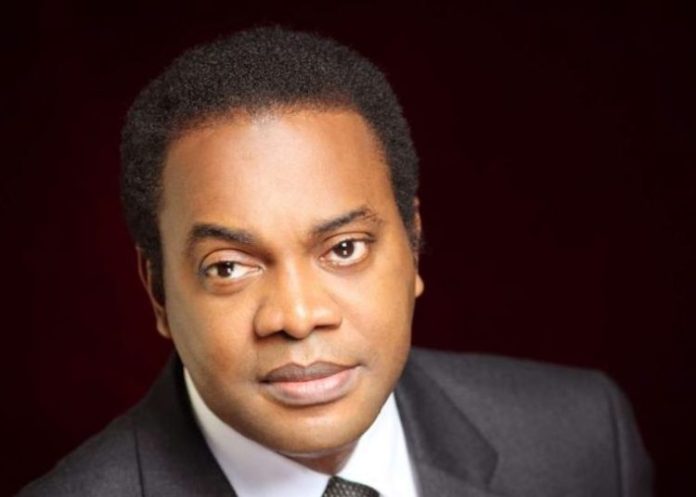
America and a Lost Africa, By Donald Duke

America lost Africa for four years under Donald Trump. The Joe Biden Administration can regain it.

Essentially, the United States should resist the temptation to compartmentalise the world into neatly convenient areas of descending strategic interest to it. The Trump Administration was a past master at that game. Its ideological war with China privileged the Indo-Pacific region over all others. Incidentally, the region was known as the Asia-Pacific before the Americans decided to rename it, in order to bring in India as a counterweight to China. (Hence the “Indo”).

A new strategic geography was created almost overnight. The rest of the world had no choice but to live with this imagined creation and readjust its own priorities. Japan, South Korea, Australia and the ten countries of the Association of Southeast Asian Nations suddenly found themselves to be a part of the Indo-Pacific. True, the geographical concept of the Indo-Pacific precedes the Trump ascendancy, but his political construct of a Free and Open Indo-Pacific was a thinly-veiled attempt to contain China.

After the Indo-Pacific came the European Union. The North Atlantic Treaty Organisation bound Europe existentially to America, except that Russia was in no mood to give up its historical dominance of eastern Europe. The Russian annexation of Crimea in 2014 marked the limits of trans-Atlantic power in Europe, the American invocation which had sought to write Russia out of contemporary European history simply because the Soviet Empire had dissolved.

Thanks to the successful American invasions of Afghanistan and Iraq, and regime change in Libya, the Middle East receded from American priorities, except for Syria, where Russian and Iranian intervention upheld the Bashar al-Assad regime against the sustained Western assault on it.h

The North, Latin and South Americas formed the next tier of interest to the United States. Physical proximity does not guarantee foreign policy visibility. Neither Canada nor Mexico threatened America militarily. The only challenge was the demographic one: the steady arrival in the United States of illegal immigrants from impoverished neighbors. The Trump dispensation went to work on securing borders.

Then came Africa. It did not have a China to question the primacy of the United States. It did not have a Britain or a Germany that had produced the historical template for the United States of America. Unlike the Middle East, it did not have a religious community extensive enough to pose the challenge of a clash of civilizations with a largely Christian but ultimately secular United States. And Africa lay nowhere close to America.

Hence its place at the bottom of the American strategic barrel. In the American imagination, Africa was compartmentalized out of its geographical identity as a world civilization. By that term, I mean a continent where human history began, where humans held on to their agency as historical actors in spite of the colonial Scramble for Africa, and where thinkers and activists participate in the unfolding of global history to this day.

It is that Africa which America should re-engage after the hiatus of the Trump years. The key to that re-engagement lies in China.

This point is made trenchantly by Rand Corporation senior political scientist Michael Shurkin in a recent article. “Seeing Africans as Africans and not pawns in some great game paradoxically could go a long way toward strengthening the United States’ position in its competition with other powers,” he argues, “especially if it translates into engagement with, and investment in, African economies and institutions in ways that are not limited to and transparently about countering Chinese moves.”

Shurkin lays out the demographic stakes on the table. Africa’s share of the global population stands at 17 per cent, he points out, and it is projected to grow to about 25 per cent by 2050 and 40 per cent by 2100. Four sub-Saharan African countries are projected to be among the ten most populous nations in 2100, among them Nigeria, Ethiopia, the Democratic Republic of Congo, and Tanzania. America, by contrast, is projected to be inhabited by 424 million people.

Even assuming that China continues on its growth strategy till then, would it not make sense for 424 million Americans to recognize Africa’s demographic strength, economic potential and political weight in international affairs at that time in the future? If so, the effort to build bridges with Africa should begin now.

The Biden Administration needs to shift Africa out of America’s China strategy. Africans are not interested in the global balance of power between the United States and the

People’s Republic of China because they do not wish to have to choose between friends. China’s economic links with Africa are welcome, particularly in the realm of infrastructure and connectivity. Equally so, however, are American investment, technical know-how, and strategic heft.

Everywhere in this world, Chinese are a fact of economic, political and strategic life. That fact cannot be wished away. Equally, however, Americans are a cultural fixture of African life. I cannot think of a single African nation where the majority of citizens hate and reject the American way of life. The heady mix of personal, economic and political freedom that the United States promises — although it does not produce that combination always for all its citizens — is a lodestar of the African sky.

Africans admire China for its economic progress and its sparkling ability to preserve law and order. America seems messy by contrast, but its political freedoms show a way out of the mess. Africans, who love prosperity and freedom in equal measure, are neither pro-Chinese and anti-American nor the other way around. Africans are pro-African. So should the United States be. China does not ask Africa to choose between it and America. Nor should America.

Africa was known once, in the most racist of ways, as the Dark Continent. It became the Lost Continent under Trump. Under Biden, it could become a part of the world regained for America.

Africans welcome the new dawn. Let the sun shine now.

•Duke is a former Governor of Cross River State

TIPS