Home Blog Page 1022

222 killed, 103 kidnapped in 7 days in Nigeria ― Security Tracker

Report by Nigeria Security Tracker has revealed that at least 222 people died as a result of terrorism activities in Nigeria in one week.

In a report released on Tuesday, Nigeria Security Tracker also stated that 133 Nigerians were kidnapped between February 13 and 19, 2021.

Details of the report reveal that 82 civilians and 21 Security men were killed in violent attacks, while the Nigerian Military forces killed 119 bandits and terrorists in the North.

“This update also represents violence related to Boko Haram in Cameroon, Chad, and Niger. These incidents are included in the Nigeria Security Tracker”, the report read.

Below is a breakdown of the killings

February 13: Bandits killed two in Igabi, Kaduna.
February 13: Two Nigerian Air Force personnel and “dozens” (estimated at twenty-four) of bandits were killed during a clash in Birnin-Gwari, Kaduna.
February 13: Suspected herdsmen killed three in Egbado North, Ogun.
February 13: Herdsmen killed three in Owo, Ondo.
February 13: Bandits killed three in Chikun, Kaduna.

February 13: Two police officers, two robbers, and one civilian were killed during a clash in Oshimili North, Delta.
February 14: Gunmen killed one police officer at a church in Ughelli North, Delta.
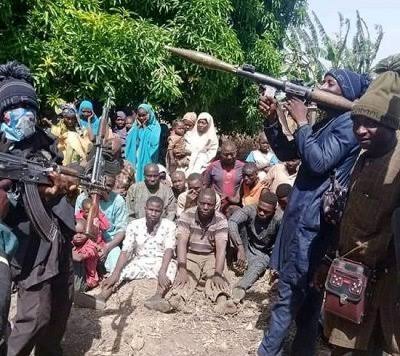
February 14: Kidnappers killed three and abducted thirty in Rafi, Niger State.
February 14: Herdsmen killed four in Bassa, Plateau.
February 14: Nigerian troops killed eighty-one Boko Haram militants and lost one soldier to a landmine in Gwoza, Borno.
February 14: Herdsmen killed four in Egbado North, Ogun.
February 15: Seven children were killed by a leftover explosive device in Maradun, Zamfara.

February 15: Boko Haram killed 10 Nigerian soldiers in Marte, Borno.
February 16: Bandits killed 11 in Rafi, Niger State.
February 16: Boko Haram killed five police officers and two civilians in Bursari, Yobe.
February 16: Suspected Indigenous People of Biafra (IPOB) members killed six children in Idemili North, Anambra. (IPOB has, however, denied any link with killing of the six children. See https://sundiatapost.com/ipob-desociates-itself-from-killing-of-children-in-anambra-warns-uzodinma-on-orlu-military-operation/)
February 16: Nigerian troops killed two Boko Haram militants in Bursari, Yobe.
February 17: Gunmen killed one and kidnapped 42 at a school in Rafi, Niger State.
February 17: Nigerian troops killed “several” (estimated at 10) bandits who kidnapped four in Birnin-Gwari, Kaduna.

February 17: Suspected herdsmen killed seven in Ovia North-East, Edo.
February 17: Gunmen killed one and kidnapped thirty in Shiroro, Niger State.
February 18: Kidnappers abducted seventeen in Faskari, Katsina.
February 19: Boko Haram killed “many” (estimated at twenty) civilians in Dikwa, Borno.
February 19: Gunmen killed one and kidnapped “several” (estimated at ten) in Rafi, Niger State.
February 19: Three killed during protests in Billiri, Gombe. (Nigerian
Tribune)

Senate Confesses! We Ignored Petitions and Confirmed Olonisakin, Buratai, Others as Ambassadors

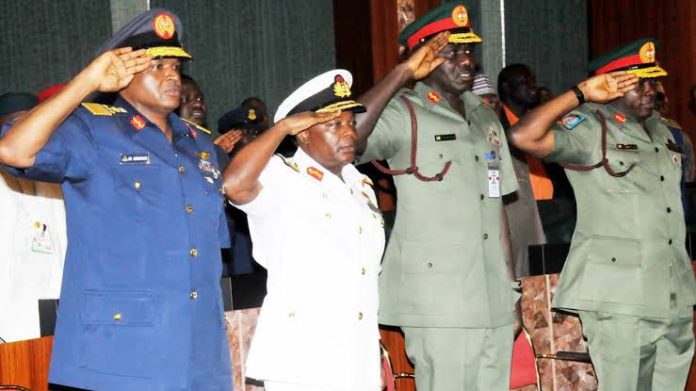
*Nigeria's immediate-past service chiefs, confirmed as non-career ambassadors.

By Ndubuisi Michaels

Chairman of Senate Committee of Foreign Affairs, Adamu Muhammad Bulkachuwa, on Tuesday confessed that in spite of the petitions received from Nigerians against the nominations of former service chiefs, his committee decided to go ahead to confirm them as ambassadors-designate. He said the committee took the decision because of the experiences of the nominees.

The former Service Chiefs confirmed are: General Abayomi G. Olonisakin, (Ekiti; Lt. General Tukur Y. Buratai (rtd), Borno; Vice Admiral Ibok-Ete E. Ibas (rtd), Cross River; and Air Marshal Sadique Baba Abubakar (rtd), Bauchi.

Relying on the report of the committee, the Senate on Tuesday confirmed the nominations of the former Service Chiefs as Ambassadors-designate.

Also confirmed was Air Vice Marshal Muhammad S. Usman (rtd), Kano.

Chairman of the Committee on Foreign Affairs, Adamu Muhammad Bulkachuwa, in his presentation said their appointments were made in line with section 171(40) of the 1999 Constitution as amended.

According to him, “their experiences as Service Chiefs and in the military where they rose to the highest ranks in their careers have made them eminently qualified; and that the nominees were very knowledgeable and articulate in their response to questions directed at them by the Committee.”

Bulkachuwa, however, disclosed in the report that “the Committee received petitions against their nominations as Non-Career Ambassadors of the Federal Republic of Nigeria but the petitions were dismissed.”

The Senate Minority Leader, Enyinnaya Abaribe, while coming under a point of order, demanded explanation as to the rationale behind the dismissal of the petition against the nominees by the Committee, particularly against the backdrop of the Senate resolutions in the past calling for their removal as Service Chiefs.

Responding, the Senate President pointed out that the Senate resolution demanding their removal was in no way related to President Muhammadu Buhari’s request for the Senate to confirm them as Ambassadors-Designate, adding that, “these are two separate roles.”

“Without prejudice to what the executive will do, where we need to fight the Boko Haram insurgency and banditry, because of their experience in the field, they should be able to interact very closely and sufficiently to advice and create the atmosphere for working together, for partnership and cooperation between Nigeria and those countries.

“So, I think on that scope, the nomination cannot be nullified because we said they should be changed”, Lawan said

The nominees were, thereafter, confirmed after a motion moved by the Senate Leader, Yahaya Abdullahi, to that effect and seconded by the Minority Leader, Enyinnaya Abaribe.

The Senate President in his remarks after the nominees were confirmed advised the Executive arm of government to deploy them to countries where their experiences as former military officers would be required.

Lawan said, “the nominees that we have just confirmed are nominees that have served this great country to the best of their ability as Service Chiefs and today, they have been confirmed as Non-Career Ambassadors.

“Our appeal to the Executive is to make sure that we utilize their experiences as Military men to the best, because we should be able to post them to countries where they can be much more useful in their engagements as Ambassadors.”

Credit: metrowatchonline

Chinese court orders man to pay ex-wife $7,700 for her housework during marriage

A divorce court in China has ordered a man to pay his ex-wife $7,700 in compensation for unpaid domestic work and child care during the couple’s five years of marriage.

The first-of-its-kind ruling has sparked debate in China about the value of labor in the home — which worldwide disproportionately falls on women, a dynamic that studies show has been worsened by the economic and social upheaval of the coronavirus pandemic.

In the ruling issued Monday, Beijing’s Fangshan District Court ordered the man, identified by his last name, Chen, to pay his ex-wife, identified as Wang, a monthly alimony of 2,000 yuan ($300) in addition to a one-time payment of 50,000 yuan ($7,700) for having borne the brunt of housework and child rearing during their marriage, the BBC reported.

The settlement relied on a new civil code that China introduced last year that permits a divorcing spouse to seek back pay if they had been the primary one responsible for child raising or other domestic labor, such as assisting in their partner’s work or taking care of elderly relatives. Before this legal change, an ex-spouse could file for compensation only if this agreement was laid out in a prenuptial contract, which rarely occurred, according to the BBC.AD

In setting the amount for the one-time payment, the judge told reporters Monday, he considered that although typically a divorcing couple must split their shared tangible property, “housework constitutes intangible property value,” the BBC reported.

The Organization for Economic Cooperation and Development (OECD) estimates that women in China spend an average of 2.5 more hours a day on unpaid work compared with men, which is higher than the OCED average of twice the time.

The landmark decision has garnered praise but also criticism in China, the latter in part from people who say that the judge perpetuated the devaluing of domestic labor in his calculation: the equivalent of $1,540 a year.

As of Monday, topics related to the ruling have been viewed more than 400 million times on Weibo, China’s equivalent to Twitter, according to the South China Morning Post.

“It’s only right that the money should be given, but 50,000 yuan is too little. If you go out and work for half a year you’d earn more than that,” one Weibo user wrote, SCMP reported.

Still, others said the compensation for unpaid domestic work was unnecessary. The woman “also enjoyed the fruits of her housework,” another user wrote, according to SCMP.

It remains unclear how widespread these kinds of cases may become. But divorce filings have spiked in some Chinese communities over the past year, which experts attribute to the coronavirus and the pressure on relationships brought on by prolonged shutdowns and economic disruption.

Read the full story here

Nigeria Should Use Article 4 Of ECOWAS Laws To Combat Killer Herdsmen — Falana-led Coalition

— Says Art 4 of Protocol Allows the Member States To Restrict Entry of Transborder Criminals
— Says ‘Ostensive Lack of Enforcement of Extant Laws’ And ‘Dereliction of Duty To Enforce Such Law’ Is The Bane of Nigeria’s Problem

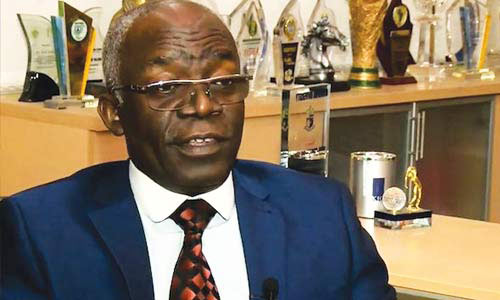
The Alliance on Surviving COVID-19 and Beyond (ASCAB) has urged the Nigerian government to leverage Article 4 of the ECOWAS Free Movement Laws to combat the influx of killer herdsmen into the country.

The development comes after the Minister of Information and Culture, Lai Mohammed, blamed the insecurity situation in Nigeria on ECOWAS laws.

The minister had in a recent statement claimed that the protocol allows for the influx of AK-47-bearing herders and bandits from neighbouring countries into Nigeria.

He had said: “ECOWAS Protocol allows trans-human movement between all the ECOWAS countries. That is why we are thinking of seriously reviewing the ECOWAS Protocols in that respect. What we find out today is that a lot of criminalities have been introduced through the herdsmen and trans-human.”

But reacting on Wednesday, ASCAB, in a statement signed by Femi Falana, its interim chairman, said the ECOWAS Protocol A/P.1/5/79 relating to Free Movement of Persons, Residence and Establishment (Free Movement Protocol) does not permit any form of trans-border banditry and illegal possession of arms and ammunition.

According to the group, rather than seeking a review or an amendment of the Protocol, the Nigerian government should take advantage of Article 4 of the legislation which stated that “Notwithstanding the provisions of article 3 above, member states shall reserve the right to refuse admission into their territory any community citizen who comes within the category of inadmissible immigrant under its laws.”

ASCAB stated that the article quoted above gives Nigeria permission to apply domestic laws to deal with the menace of trans-border criminality traced to armed herders and bandits.

“One of such domestic laws is the Animal Diseases (Control) Act (Cap. A17) Laws of the Federation of Nigeria 2004 that provides for the importation and exportation of animals, surveillance of importation, seizure or destruction of animals, control of trade animals etc., among other things,” it said.

“Specifically, the Act states that the importation of any animal, animal products or biologics into Nigeria from any other country by land, sea or air is prohibited except under a permit granted by the Director who in each case shall state the conditions under which the animal, hatching eggs or poultry may be imported.

“It also provided that imported animals may be subjected to such examination, disinfection, inoculation and quarantine at the risk and expense of the owner thereof as the Director may deem necessary and any animal, animal products, the biologic or infectious agent which is not imported in accordance with the provisions of this Act shall be seized or caused to be destroyed immediately on arrival by the Director, or by an authorized officer.

“Another relevant legislation is the Firearms Act (Cap. R11) Laws of the Federation of Nigeria 2004 which provides that no person shall have in his possession or under his control any firearm except in accordance with a licence granted by the President acting in his discretion or except in accordance with a licence granted in respect thereof by the Inspector-General of Police.

“Any person who contravenes any of the provisions of the Firearms Act is guilty of an offence and liable on conviction to a minimum sentence of ten years or five years imprisonment depending on the provision(s) breached.”

ASCAB, however, said security forces have contravened the law and rather allowed herders to bear arms and deploy same to commit all manners of criminal offences including criminal trespass, culpable homicide, abduction and rape.

The group emphasised that the ECOWAS Free Movement Protocol does not permit the uncontrolled influx of armed herders and bandits into Nigeria.

“Contrary to the Federal Government’s claim, the bane of Nigeria’s problem is the ostensive lack of enforcement of extant laws. It is the height of dereliction of duty to allow ‘foreign criminal herdsmen and bandits’ to invade farmlands, destroy livelihoods, kidnap, maim and kill citizens unchecked while also crippling the country’s fragile economy.

“Instead of blaming the ECOWAS Free Movement Protocol, the Federal Government should prohibit the movement of cattle and herders into the country pursuant to section 20 of the Act of the Animal Disease Act.”

The group also urged the Nigerian government to direct immigration officials to prevent armed herders from entering the country while the police should be allowed to arrest and prosecute herders caught with arms without licences.

ASCAB also said state governments should invoke the provisions of the relevant laws to curb the menace of attacks by local and foreign bandits and armed herders.

It added: “Since the Federal Government and the state governments have embraced ranching, the Commissioners of agriculture or the appropriate authorities in each of the States of the Federation should issue regulations, ban open grazing and movement of cattle in line with the provisions of Animal Laws, Animal Disease Laws, Forestry Laws etc.”

Credit:thenigerialawyer

LEAH SHARIBU: WON’T THEY REMEMBER HER NOW?

Inside Stuff With MARTINS OLOJA

I had planned to write a tribute on one of the most remarkable icons of journalism and good governance, a unique reference point in execution – that discipline of getting things done, whose eighth-day Fidau prayer was marked in Lagos on Friday 19 February with closure of all markets and shops, Alhaji Lateef Kayode Jakande (LKJ). I had wanted to conclude the piece on the iconic LKJ with a suggestion of a fitting tribute our president Muhammadu Buhari could pay to the former Lagos State Governor of Significance whose good thinking on a Metroline project would have solved the most ticklish challenge of today’s Lagos: gridlock. I had thought of how our president could have removed the reproach of the way he angrily stopped Air Commodore Gbolahan Mudasiru, the then Military Governor of Lagos State (1984-1986) from executing the LKJ transportation project in 1984. The indelible report of the stoppage has continued to crop up in public discourse on Lagos intractable gridlock as a blight on the credentials of our president. I had thought that a suggestion to the president to write a letter of commitment to support Lagos State Government to resuscitate the LKJ’s Metroline Project at this time should have been enough to remove that reproach from Buhari’s profile. Yes his portrait, which has been somewhat tainted with a recent report that the same Buhari who stopped the LKJ’s Metroline Project in 1984 was in Lagos in March 2018 to commission a meretricious Bus Terminal.

I had also planned to write on the parlous state of the Kagara school in Niger state where those children were abducted. Reason: I believe that the Niger state government should be enrolled in a ‘Hall of Shame’ for the sorry state of the 52-year-old school that the world has seen on television. I also wanted to deconstruct my professional colleague, Ms Kadaria Ahmed’s tirade on the media the other day. Her commentary has raised a lot of questions about journalism practice in the country. However, she too left a lot of lacunae in her curious article. But my spirit in the end led me to step aside from all the aforementioned issues so that I can raise more questions about our ‘goddess of resistance’, Leah Sharibu who will mark her fourth birthday in captivity on May 14, 2021. The oracle says I should not wait until the next birthday when again we will read copiously from the book of lamentation on Leah Sharibu and then forget as usual the morning after.

This is a time to ask more questions even if the answers will once again ‘blow in the wind’ as Bob Dylon and Tom Petty would claim. As it is increasingly becoming ‘curiouser and curiouser’ as Alice cried in ‘Adventures in Wonderland’ every day that kidnap of school children is now a thriving enterprise to the masterminds who are artfully attributing the deals from Chibok through Dapchi to Kankara and now Kagara to unknown bandits, let us remind the authorities that there are still 112 Chibok girls since 2014 and there is still a Leah Sharibu since February 19, 2018. While we leave the dealers who call themselves leaders to their conscience on the blood money they raise from kidnap of our children from schools, let’s us remind the authorities from the military, intelligence and security communities to the presidency that unless they also work hard too to negotiate the release of Leah Sharibu, they will not be able to talk about peaceful resolution of conflicts that have afflicted this administration. How many articles will the print and digital media publish before the authorities in Nigeria will know that celebration of the release of the 344 boys from Kankara school in Katsina in December 2020 is tainted without the release of Citizen Leah Sharibu? How many dangerous prayer points will Christian groups in Nigeria raise before the authorities in Nigeria will realise that their hypocrisy, inertia and complacency about the plight of the families of Citizen Leah and the remaining 112 Chibok girls will continue to remind Christians in the country that the Nigerian state is indeed discriminating against them? How many birthdays does Leah need to mark in captivity before our commander-in-chief would realise that each day the Christian school girl spends in the terrorists’ den diminishes his stature as the one elected to chiefly command the security and defence forces for welfare and security of the citizens? How many contextual questions do opinion columnists need to ask about our leader’s integrity over Citizen Leah before he can recall the grave implications of a pledge in his inaugural speech on May 29, 2015 that: ‘I belong to nobody…’?

How many times do we need to tell the powerful people in Abuja that failure to negotiate and secure freedom for Leah is an albatross on the neck of our leader and what he stands for? When will the president’s men and women realise that any call for promotion of national interest above sectional interest appears most irrelevant at this time?

Let’s stop interrogating why opinion writers in the media ask questions to put people in power on their toes. We do this so that our leaders can act in public interest. There are too many distractions these days from people who are busy serving the gods of their bellies. This piece is to remind the authorities in Abuja today that the nation is still waiting for freedom for Citizen Leah Sharibu, the only Dapchi schoolgirl and Christian who is still being held in captivity because of her faith. Some aid and development workers had raised concern about her safety several times but the federal government said all was well with her and they were continuing with negotiation to set her free. Some decent sources have conformed that she is alive and has in fact given birth in her sorrowful state. It is expedient to remind the president that people’s anxiety is beginning to turn to fear of the unknown as Alan Paton states in his classic ‘Cry, the beloved country’. And the implication is that when hope is deferred, as the ancient word notes, it makes the heart sick, but a longing fulfilled is a tree of life.
Look at this contrast that can define rampaging hypocrisy: While Zainab Aliyu, a Muslim girl who was arrested and detained in Saudi Arabia for alleged drug trafficking and whose release was secured through the intervention of the federal government, arrived in the country the other time, families and well-wishers were marking the 16th birthday of Leah Sharibu (as a captive) with several activities in Abuja, Jos and Lagos. As this has been noted several times too, this is not a good contrasting story in nation building at this time.

That is why we should continue to appeal to our leader to please use the doggedness with which he handled the case of Zainab Aliyu’s release for Leah Sharibu. This is one of the ways, Nigeria’s leader can show Nigerian citizens that he is a father to all, yes a good father who values human lives and can go to any length to save them.
It is in the main, not a good story that till date, Leah Sharibu, The Guardian’s 2018 ‘‘Person of the Year,’’ is still in the hands of her abductors who made the renunciation of her faith a precondition, which she declined for her release.
The origin: While 104 of her colleagues were released on March 21, 2018, five of the hapless girls died in captivity. Although, the Minister of Information and Culture, Alhaji Lai Mohammed announced then that the 104 girls’ release was unconditional, the refusal of the terrorists group to release Leah at the same time because she refused to convert to Islam, questions this view and buttresses some perception that the federal government’s negotiations through a back-channel led to the release of the other girls. So, it is indeed inexcusable that the federal government has not been able to negotiate Leah’s release since February 2018.

Can we also forget that this Christian girl, Leah during the third quarter of 2018, in a clear audio message begged President Buhari to come to her rescue. However, the government said the clip would be verified to be sure that it was Leah’s voice. There has been no update on the authenticity of the voice since. It will be recalled too that on October 3, 2018, President Buhari consoled Leah’s biological family and assured her parents that the federal government would do its utmost for the safety and security of Leah. The president was quoted as telling Mrs Rebecca Sharibu: “I convey my emotion, the strong commitment of my administration and the solidarity of all Nigerians to you and your family as we will do our best to bring your daughter home in peace and safety.” Despite the president’s assurance to the mother of Leah, there has been no update on the plight of the unlucky girl. This ugly reality should therefore be seen for what it is: a monumental embarrassment that has deeply affected people’s definition of their citizenship in this complex federation. As it has been noted several times, Nigeria’s leader should note again that the story of Leah Sharibu’s capture and her continued detention by Boko Haram insurgents as a result of her refusal to renounce her faith is legendary. That defiance echoes a bright message of love, selflessness, courage and hope to our nation. The Leah ‘The Guardian’ calls, ‘‘a goddess of resistance’’ to terror, is now the number one soldier on the frontline in defence of Nigeria’s now fragile unity, peace and progress. She is a true heroine. Finally, the word of the president on Leah and the remaining Chibok girls should be his bond! The remaining 112 Chibok girls and Leah Sharibu are still in Boko Haram’s captivity. They remain our missing daughters. To the parents, friends and relatives of Leah, who have been in agony and waiting for the return of their child, we appeal that they should continue to pray and keep hope alive. So, as Nigeria’s leader is working hard for the release of Kagara school children, he should be reminded that Citizen Leah is still missing and her parents and indeed Christians in the country are still agonising about her fate in the camps of the wicked ones. Nigeria can hit the world headlines for a significant reason if citizen Leah is released before May 14 this year when she will mark her fourth birthday in the camp of wicked scoundrels.

#

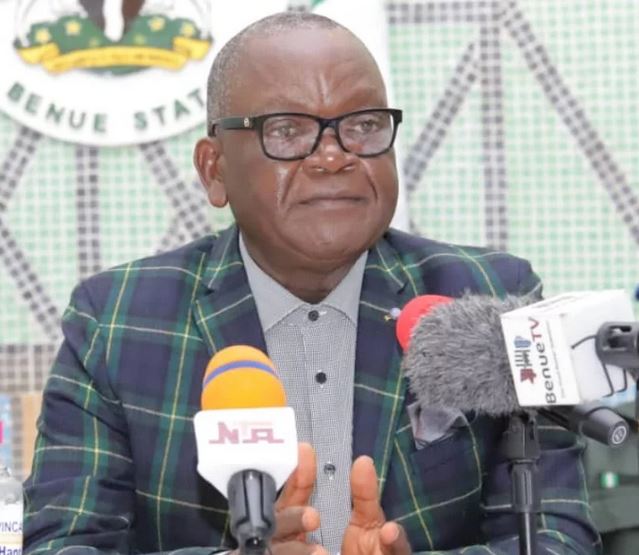
Herdsmen crisis: Bauchi Gov part of conspiracy to wipe some people away from Nigeria – Ortom

Governor Samuel Ortom of Benue State has accused his Bauchi State counterpart, Bala Mohammed, of joining force with killer herdsmen to eliminate people living in some part of the country, including his state.

The governor made the accusation on Monday in Makurdi, the state capital while addressing newsmen on the state of insecurity in the state.

Governor Ortom, who said he was not ready to join issues with the Bauchi Governor over his comment on Fulani recently, stated that he had been compelled to break his silence.

He advised his counterpart to revisit his oath of office, adding that the governor had failed in keeping his oath of protecting lives and properties of his electorate.

“I’m beginning to think that my counterpart in Bauchi is part of the terrorist Fulani Organisation terrorising the country.

“The governor should go back and reread his oath of office whether allowing foreign Fulani Herdsmen to come into Nigeria is part of the oath.

“I think he is part of the conspiracy to wipe away some people including Benue State”, Ortom Stated.

Earlier, Ortom said the people of the state were not against any tribe residing in the state but that they were rather against terrorists, killer herdsmen, and bandits.

“Every tribe has the right to reside in Benue State, so long they respect the rule of law, but as long as they refuse to abide by the law, we will make sure that the law catches up with you.

“We will make sure the security agency arrest and prosecute you and if you are found guilty, you will be jailed.

“We are against bandits and terrorists, you can see how we disarmed them here in Benue, when Gana was disturbing the peace of the state, we placed N50 million for anyone with useful information about his activities.

“No kidnapper in Benue will be spared. Whoever you are, we will go after you and make sure you are apprehended.

“The issue of Fulani terrorists, we will not permit them and there is no room for them here in Benue State.

“If you want to do cattle business, whether Fulani or anybody, you must embrace ranching. As long as this government is concerned, no room for open grazing,” Governor Ortom added.

Credit:Barristerng

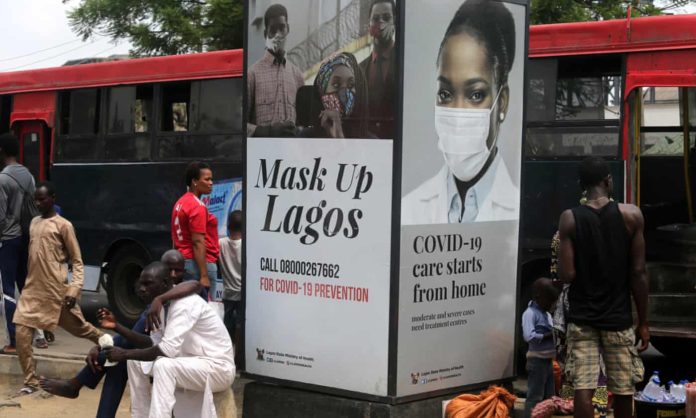
Nigeria survey suggests 23% of Lagos residents had Covid last year

People walk past a billboard that reads: ‘Mask up Lagos’ Photograph: Akintunde Akinleye/EPA

Study suggests infection rates have been much higher across the country than previously thought

More than one in five people in the state of Lagos in Nigeria had Covid-19 antibodies at the end of October, according to a study that suggests infection rates were much higher across the country than previously thought.

Nigeria’s Centre for Disease Control (NDCD) and the Institute for Medical Research collected blood samples from more than 10,000 individuals living in a representative sample of households in four states in September and October.

According to findings released on Monday, the prevalence of antibodies was 23% in the states of Lagos – which is home to more than 16 million people – and Enugu, 19% in Nasarawa state, and 9% in Gombe state. Confirmed infections stood in the tens of thousands at the time.

The findings offer the first detailed look into infections in Africa’s most populous country, where a lack of testing supplies has hampered the ability of authorities to fully ascertain the spread of the virus. Such seroprevalence studies are seen as the only way of revealing the actual burden of Covid-19 in Africa.

New variants were emerging quickly in Nigeria, the NCDC said, and would continue to do so until transmission rates fell.

Up to now the country has recorded just 1,800 deaths from Covid, but the head of the NCDC, Chikwe Ihekweazu, said the study findings meant it was “even more important” that Nigeria secured vaccines. Nigeria, like other countries in Africa, has struggled to secure vaccine doses amid fierce global competition.

Nigerian health officials recently approved the Oxford/AstraZeneca vaccine for use in the country and on Monday requested 10m vaccine doses from the African Union (AU) and the World Health Organization Covax programme – a platform working to secure vaccines for African countries. But authorities have not made clear when the vaccines will arrive.

The AU has said it has secured a provisional 270m vaccine doses from manufacturers for member states. The World Health Organization’s Africa director, Matshidiso Moeti, said last week African countries could begin to receive the first doses by the end of March, with larger deliveries by June.

On Monday, the World Health Organization sharply criticised wealthy countries for not only hogging Covid vaccines but in doing so, hindering the pathway for poorer nations to get them too.

The WHO’s director general, Tedros Adhanom Ghebreyesus, said some rich countries’ direct deals with manufacturers had meant that previously-agreed vaccine allocations for poorer countries, via the Covax programme, were being reduced.

The UN health agency chief said money was available to procure doses for some of the poorest countries, following fresh contributions from the US, the European Union and Germany – but it was worthless if there was nothing to buy.

Tedros urged wealthy nations to check whether their own deals with pharmaceutical companies were undermining Covax. “Even if you have the money, if you cannot use the money to buy vaccines, having the money doesn’t mean anything,” he told a virtual press conference with the German president, Frank-Walter Steinmeier.

Reuters contributed to this report

Shell Staff, Two Others Lured to Death by Fake Lover Met on Dating Site

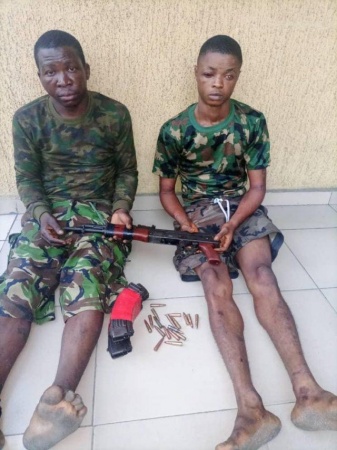
Two of the suspects

A worker with Shell Oil Services Company has been killed after hooking up with a supposed “lady” on a dating site, Tinder.

The victim, Progress Benin Disi, was lured to an isolated area and killed.

Unfortunately, Disi didn’t know the “lady” he had been chatting with on the dating site was actually a man and member of a five-man gang, which specialised in using dating sites to lure people to lonely spots and thereafter collect their valuables.

The suspects do not only pretend to be women, but rich women.

So most of their victims believe they would be going on a date with a rich woman, working in an oil company.

The incident occurred at Rivers State.

Members of the gang, presently in police net, are Michael Eneji, 30; Nwachukwu Emeka, 22; and Success Okeke, 27.

The gang was smashed by operatives of the Intelligence Response Team led by a Deputy Commissioner of Police, Abba Kyari.

Eneji and his gang members had also been accused of kidnapping and killing two other men, Michael Victor and Shola Olaseinde, using the same methodology.

According to police, on January 12, 2021, the family of Victor lodged a complaint that he had been missing since January 6, compelling the police to launch an investigation and also began tracking of his phone.

Through intelligence gathering and with support from the Technical Intelligence Unit, Force Headquarters, Abuja, Eneji was arrested with two of his members.

Police recovered one AK-47 rifle and three magazines tied together, loaded with 18 rounds of live ammunition.

The suspects were said to have confessed to have killed Victor on the very day they kidnapped him.

They led operatives to Old Onne Road, where they had left Victor’s corpse.

It was, however, discovered that the Divisional Police Officer in-charge of the jurisdiction, a Superintendent of Police, Chukwuma Emeka, had already recovered the corpse and deposited it at Okirika General Hospital.

Eneji, who got his BSC in Business Administration, confessed that aside from posing as a female on dating sites, he also used to carry out some operations, pretending to be a Naval Officer.

He added: “I tell people I’m a Naval personnel and I also wear a Naval uniform.

“In 2011, I was arrested by the Department of State Services and charged to court.

“The case was about receiving a stolen phone, but I was later granted bail by the court.

“In 2014, I was arrested by Anti-Kidnapping Unit of the Rivers State Police Command.

“We usually pose as women on these dating sites.

“As soon as we get our victims, we arrange a meeting.

“If the targets are stubborn, we bring in our lady, who speaks with them via video calls.

“We also use a small Tecno phone, which enables us to change our voices from that of a man to a woman’s.

“Once I have been able to establish a contact, I go to the next stage, which is to convince the victim that I will satisfy his sexual urges.

“Pretending to be a girl, I’ll tell them to meet me at Con-Oil Filling Station or Nyelek Filling Station, before Trailer Park, Eleme Road, while one of my boys, Success, will go there and meet them, pretending to be my domestic servant.

“He’ll direct them to ‘my house’ and to convince them to come, I tell them I live in a mansion and don’t like being disturbed.

“Once they start coming, Success will redirect them, leading them to an isolated place, where we then ambush them.

“Dressed in Army uniform, we overpower them, tie their hands and legs, and then take their valuables such as ATM cards and other items.

“The role of Abubakar and Otuma is to tie up the victims.

“Emeka usually handles the AK-47, just in case of any attack.

“My work is to go to the bank to empty accounts of our victims.”

Eneji, who is married and has two children, introduced himself as a farmer, who breeds dogs.

He explained that after secondary school, he got admission into Cross River State University of Technology, where he studied Business Administration.

He worked with Crone Consulting Company for about a year, before he voluntarily resigned and decided to seek an alternative source of income.

He said: “Sometime in 2014, I met some friends who introduced me to Online dating fraud.

“We download pictures of beautiful women and use the pictures as cover to woo men.

“We have a girl on standby who used to pose and respond to questions just in case the men want to have a video chat with any of us.

“We used to lure victims to locations, where they would be robbed and forced to withdraw all the money in their accounts.”

Eneji said he and his gang members had been doing such crimes for years until one of their victims, Victor, died.

It was at that point he decided that he was going to quit the game.

Recalling how he got involved in the business, Eneji said he had just returned from prison when his friend, Abubakar, came calling.

His words: “I tried my best to stay away from crime, but last October, I met Abubakar Sadiq.

“I used to know him as a fraudster and he was also the person that brought up the same business idea, which landed me in prison.

“I was broke and needed money, so I decided to help him.

“My job was to use the ATM and withdraw money from the account of his victims.

“I normally come to Con-Oil Filling Station along Onne Road where we converge to collect the ATM card.”

He said the lady working with the gang is known as Joy.

She would invite the victims to her house, located along Airport Road in Igwuruta-ali and as soon as the victim got close, he would be abducted and dragged into the bush, where he would be held until every money in his account had been taken.

Eneji said: “The latest victim that landed us in trouble was picked by my friend Success.

“I was one of those wearing naval camouflage.

“We stopped and dragged him into the bush.

“I had stepped out with his ATM when security men on patrol passed by.

“I ran and was waiting for the password when Abubakar called and told me that the man was dead.

“We all went home, and two days later, police arrested me.

“I am an ex-cadet.

“I went to Global Maritime Academy, but I did not graduate because the fees were too much.

“I used my pass to buy a cadet uniform.

“I only use the impersonation to make life easier for me.

“I also used to assist people to get bailed from the police station.

“I have an identity card, which police do not bother to confirm.

“I know it’s wrong, but in Nigeria, everyone fears the military.”

Eneji’s partner in crime, Success Chudi Okeke, a Micro-Biologist from Covenant Polytechnic, said he met Eneji some years back and since then they had been friends.

Recently, he paid him a visit and in the course of their discussion, he begged Eneji to show the secrets of making money.

He said: “He told me that online dating was the way out.

“Initially I didn’t want to join, but things were difficult for me after graduation.

“I’m the first son and I wanted my parents and other siblings to see me as someone who is doing well.

“My plan was to make some money and relocate to Lagos.

“He told me that my job was to pick our victims and move them to an agreed venue.

“They didn’t tell me that our latest victim died until police arrested me.

“It was at the police station that I identified him through the clothes he wore on the day we kidnapped him.”

Okeke explained that on the agreed date, the deceased gave him a phone number and asked him to pick him.

He said: “I called and told him that my madam, who works in an oil company requested that I should bring him to the house.

“I picked him at a bus stop near ConOil, along Refinery Road.

“On our way, we passed through the agreed spot and our gang members, dressed in military wear, stopped us.

“It was around 8pm; they asked why we were passing through there, pretending to search us.

“They overpowered the man and dragged him into the bush.

“I was waiting for them to collect his ATM and password when I saw flash lights from security guards, who were on patrol.

“I ran away and later called Eneji, who told me to go home and wait till further notice.

“I was still waiting when policemen came to arrest me.”

•Adapted from The Eagle Online.

Living in a Failed State, By Ebun-Olu Adegboruwa

Last week, the Senate asked the President to declare a state of emergency on security in Nigeria. From one Senator to the other, the men and women of the Upper Chamber of the National Assembly were unanimous that something has to be done urgently, to stem the slide into anarchy, unbridled violence and bloodshed across the land. What is the security situation presently? We have a police force lacking in legitimate leadership, the armed forces is so politicized that the leadership is loyal only to the party in power and a commander-in-chief that seems to have been totally overwhelmed with the crisis. It is by now clear to all and sundry, at least from the comments and contributions of lawmakers across party lines, that Nigeria is approaching a failed state. This was indeed the conclusion reached at a stakeholders’ summit held last week, where Professor Pat Utomi and others x-rayed the dangerous dimension that security has taken in Nigeria. The Sultan of Sokoto said somewhere else that Boko Haram has now transformed into bandits and kidnappers. It is the latest business in town.

Nigeria became a State formally in 1960, with sovereign powers transferred from the British colonialists to the representatives of the people. By law however, section 2 (1) of the 1999 Constitution states that “Nigeria is one indivisible and indissoluble sovereign state to be known by the name of the Federal Republic of Nigeria”, and by section 2 (2) thereof, “Nigeria shall be a Federation consisting of states and a Federal Capital Territory”. So, in the real sense of the word, Nigeria is a sovereign state consisting of federating units. Fair enough, the same Constitution that created the Nigerian Federation also specified the kind of powers that it should exercise and the functions it should perform, for its citizens. In this regard, Chapter 2 of the self-same Constitution, comes to bear. I will limit myself for this discourse however, to section 14 of the Constitution.

Under and by virtue of section 14 (2) (a), “sovereignty belongs to the people of Nigeria from whom government through this Constitution, derives ALL its powers and authority” (emphasis supplied). In very simple terms therefore, the sovereignty attached to the entity known as the Federal Republic of Nigeria, resides in the people of Nigeria. In essence, all our leaders hold power in trust for the people of Nigeria and they cannot go on acting as if it is the other way round. To break it down more, there is no President who should claim to be in power, there is no Governor who should assert any authority and there should be no legislative house or even a court of law that should rule over and above the people to lord their policies and decisions over them. Power belongs to the people, pure and simple. The fact that the people of Africa and especially Nigeria, have been living in the opposite of civility and modernisation, whereby those elected into office by the people turn around to arrogate power to themselves, cannot be an excuse to obfuscate this simple truth. One cannot of course claim not to be aware of the rare exception of the Nigerian situation where power belongs to and resides in the leaders. It is an anomaly.

Now to section 14 (2) (b) of the Constitution, wherein it is stated expressly and without equivocation, that “the security and welfare of the people shall be the primary purpose of government.” A community interpretation of section 14 (2) (a) and (b) respectively will show clearly that the Nigerian State was created for the people of Nigeria, that the focus of the entity called Nigeria is the people and that the target of power and existence of that Federation, is the people. It is good therefore, to sound it loud and clear, that the very existence of government, the totality of the exercise of power, by all and sundry, is for the security and welfare of the people and anything outside this, anything done that cannot achieve this, means a failure of governance. Pure and simple.

According to the learned authors of Merriam-Webster Dictionary, SECURITY means: “(a) freedom from danger (safety); (b) freedom from fear or anxiety; … something that secures, protection or measures taken to guard against espionage or sabotage, crime, attack, or escape.” The priority of security in governance is better illustrated by section 4 of the Police Act, wherein it is stated that the police shall be “… employed for the prevention and detection of crime, the apprehension of offenders, the preservation of law and order, the protection of life and property and the due enforcement of all laws and regulations with which they are directly charged, and shall perform such military duties within or outside Nigeria as may be required of them by, or under the authority of this or any other Act.” What stands out in this section is the phrase “protection of lives and property”. Now, let us match this with certain data recently released by the leadership of the Nigeria Police Force.

At the quarterly Northern Traditional Rulers’ Council meeting held in Kaduna as back as 2019, the former Inspector-General of Police stated that in the first quarter of 2019 alone, 1,071 persons lost their lives in crime-related cases across the country. He stated further that between January and April 2019 alone, 685 persons were kidnapped. Amnesty International has a higher figure of deaths and casualties. In 2018, it was estimated that about 6, 562 persons died from crime-related cases whilst generally, an estimate of about 13,000 persons are said to have died from the insurgency going on in the land, whilst about 1.1m people have been displaced thereby. Just in one year! The Global Terrorism Index suggests that Nigeria recorded about 8,314 deaths from crime-related cases in 2020. This is surely frightening, to the extent that no one can claim to sleep with the two eyes closed, any longer. It may well be that the government is taking all necessary steps to contain the rising spate of insecurity across Nigeria, but this remains to be seen by all and sundry, in terms of security and safety, in the real sense of the word. The summary now would seem to be that the government has not been able to rise up to the challenges posed by insecurity.

Now to welfare, since the two main points of governance are security and welfare. Merriam-Webster Dictionary defines WELFARE as “the state of doing well, especially in respect to good fortune, happiness, well-being, or prosperity.” Are we doing well as a people, presently? Are we enjoying some form of good fortune economically? Is the well-being of the people of this nation improving in any form at all? Are we happy, with the state of things in Nigeria? Is there prosperity in the land? Are we safe as a people? Can we travel safely on our roads presently? Without any doubt whatsoever, suicide cases have increased, the economic power of the people has dwindled considerably and virtually everyone now depends on handouts from the government, as private businesses are all struggling to survive, in the absence of basic infrastructure, especially power supply. I have no doubt in my mind that the true testimony across the land is that the majority of the people are suffering indeed. I see it in the text messages that I receive every now and then, for financial assistance, I read it in the news daily, of how many states in the Federation are owing their workers’ salaries, for several months and how the ordinary people are just living from hand to mouth, barely eking out a living, just surviving and tagging along.

The present circumstance of Nigeria is that many people have become beggars of some sort. Even as businessmen and women, professionals and even as manufacturers, the bulk of the little profit margin is spent on infrastructure, whereby you are forced to generate your own electricity, provide your own water, build your own road, employ your own security, train your children in private schools or send them abroad, if they must excel, provide yourself health care if you must live, and may be buy your own car, if you must move around. It is that bad, that the government seemed to have shifted all its responsibilities to the citizens. And how exactly is anyone expected to survive in such hostile environment, where you spend most of your valuable time in traffic, you get home to sleep in intense heat and darkness and then you eventually manage to make it to the office the following day, only to be confronted with power outage, all day long, draining all human capacity, productivity and usefulness. Can we then say that we have a nation or that any form of governance is in place?

From all the above frightening scenarios, how do you describe the entity created as Nigeria, if it is agreed that the two critical responsibilities of government are the security and welfare of the people? This piece became necessary as it would seem that those in authority do not well appreciate the enormity of the situation that we presently face in Nigeria or that state propaganda has so prospered and become the art of governance, that some of them are totally ensconced from the reality of present day Nigeria. Whereas I know that some well-meaning persons exist in authority presently, I verily believe that the time has now come, for some frank introspection that will translate into some genuine appreciation, of the debilitating welfare and security conditions of our people, if we are to say that there is governance at all. In the absence of that, the reasonable conclusion is that we are gradually moving to a failed state, as echoed by many statesmen lately, who, very unfortunately, are themselves part and parcel of the failure of the state. The main person we look up to for answers is the President, who must rise up and walk the talk.

•Ebun-Olu Adegboruwa (SAN) writes from Lekki Lagos.

The politics of amnesty: Like Niger Delta militants, like bandits; By Fredrick Nwabufo

Did the activities of militants in the Niger Delta qualify as crime? Hell Yes! Militancy and kidnapping were a profitable pursuit in that oil-rich region in the early 2000s. Kidnapping as an organised venture entered our national lexicon at the time. Immigrants from Europe and America working with oil companies were kidnapped and huge ransoms extracted from them. Soldiers and police officers were killed, and public infrastructure destroyed. This is a fact of history.

Really, there was a method to the madness of the Niger Delta militants. They were fighting for a just cause — a region so endowed; yet so impoverished. But the genuineness of their cause does not obviate the criminality of their exertions. Militancy is a crime against the state. Lives were lost; some families traumatised and scarred for life.

As the tension in the Niger Delta thawed owing to the political engineering of the Umar Musa Yar’Adua administration, copycat crimes inspired by militants sputtered in the south-east. The kidnapping establishment now had new shareholders. The south-east was in the thrall of kidnappers who killed their victims even after ransom was paid. Igbo-on-Igbo crime. Kidnapping became so pervasive in the south-east that some governors of the region resorted to demolishing property acquired by the hostage takers to deter other human hunters. Quasi-security groups were set up to deal with the challenge – which even persists to this day.

The criminal commerce was later trafficked to Lagos where a certain Evans Onuamadike and his gang reigned in the kidnapping industry like a potentate. Some of his victims were allegedly killed, and from his own confession, he extracted millions of naira from his victims and bought a mansion for himself at Magodo in Lagos.

ENTER BANDITS…

Nigeria is in the clutches of a more vicious stakeholder in the kidnapping enterprise. ‘’Bandits’’ as they have been tagged, do not only kidnap citizens, but also kill and maim some of them. They are more brutal in their execution – and without any regard for life. They have killed many Nigerians and sacked towns and villages. It is indubitable that ‘’bandits’’ are Nigeria’s most deadly adversary — after insurgents.

There is no method to the madness of bandits. There is no cause to justify the orgy of murders, rape and destruction.

However, Sheikh Ahmad Gumi in his proselytising for bandits has raised some prickly posers. He said bandits are waging an ethnic war against the state and that only by granting them amnesty can the titanic iceberg thaw. He said bandits believe their existence in Nigeria is threatened; so they fight. He said these people have endured the pillaging of their cattle and homes – with no protection from security agencies. I will not join the multitude to censure the Sheikh; I would rather plead we ponder on some of his revelations.

The Sheikh said: “People don’t know the Fulani at all. They are not after money. Even when they are burning houses in Oyo, don’t you see where they live? They stay in huts. They are not into buying flashy cars. They just like their cattle. The money they are collecting from kidnappings, they are buying weapons with them. The more you fight them, the more they fight back. They don’t surrender. They are saying if the air force continues to pester them, they will have to get anti-aircraft. Not all of them are criminals; the hard-line (position) taken against them turned them into the militants that they are.’’

Gumi made a salient point here if we care enough to shackle our emotions and interrogate the fact. Really, where does the money from kidnapping go to? These bandits do not buy cars or houses, instead they are acquiring ‘’armadas’’ – for what purpose? This validates the opinion that these bandits are waging an ethnic war. There is a backstory to every crisis. What we are witnessing could be beyond kidnapping and banditry. Kidnapping and banditry could just be the cash trove to finance this war.

It then makes sense that seeking an accord to end this crisis should not be banished out of the potpourri of remedies.

As a matter of fact, the nomadic Fulani has existed in the shadows – far removed from the presence of government. No protection or aid by the civil administration; so he becomes his own security. The present parlous state of affairs is as a result of successive years of failed leadership. The leadership has failed the Fulani; the leadership has failed the Igbo; the leadership has failed the Hausa; the leadership has failed the Yoruba; the leadership has failed all Nigerians.

We are all victims of the situation. The failure of leadership is the reason Nigerians take up arms against one another. The nomadic Fulani is a victim of failed leadership just like every one of us. We have to fix leadership.

THE POLITICS OF AMNESTY

Should it be unto bandits as it was unto Niger Delta militants? The ethnic cleavages have been revealed again in this crisis. The debate is now on ‘’my criminal is nicer than yours’’. While some Nigerians will not countenance any justification for banditry; yet they make strong arguments for Niger Delta militants who also kidnapped people, killed soldiers and extracted ransoms. ‘’My criminal is nicer than yours’’. We forget that at the end of the day, crime is crime whether by done by Ejiro, Kachalla or Chukwudi.

We cannot also rule out the possibility of some vultures seeking to use ‘’amnesty for bandits’’ as means to perpetuate their looting of the public till. So, if there must be amnesty for bandits, it should be at no financial cost to the government. However, the government should revisit the national livestock plan and work in consonance with state governors to see to its implementation. Already, the Nigeria Governors Forum has endorsed the plan. The government should not be seduced into doing a reprise of the ‘’amnesty package’’ of Niger Delta militants for bandits. Bandits should surrender their weapons unconditionally. In seeking peace, we must not create for ourselves future problems by rewarding crime.

I wish Nigeria peace.

Fredrick Nwabufo is a writer and journalist.

Twitter @FredrickNwabufo

TIPS