Home Blog Page 1021

Depressing Times!

By Olusegun Adeniyi

I know people who don’t bother with news. They don’t read newspapers. They are not on social media platforms. And when they turn on their television, be sure they are either going to watch Netflix or sports. I envy such people. Sometimes I wish I could just switch off from the reality of our existence and pretend things are normal. It’s worse when you are expected to proffer weekly opinions on the madness around you. But there are times when you decide to just let things pass, as I intend to do this week.

Let’s begin in Ebonyi. Governor David Umahi on Monday met with stakeholders from two warring communities (Uffiom and Ezza) in Ohaukwu local government of the state following a battle for supremacy between two factions of the National Union of Road Transport Workers (NURTW) which degenerated into a communal clash. At the meeting, Umahi made a shocking disclosure, even though as I am now finding out, the situation is actually worse. “Officially, we have recorded about 25 deaths, 26 arms recovered from the hoodlums, about 125 houses burnt, fuel and gas stations burnt” said Umahi who blamed the Ohaukwu council chairman, Clement Odah and the member representing Ohaukwu North constituency in the House of Assembly, Chinedu Awo for the violence.

According to the governor, the crisis could have been averted if Odah and Awo had listened to him. “When the problem started, I called them (Odah and Awo) severally one-on-one, three of us. We sat and I pleaded with them. In fact, at a time, one of them walked out on me. It took my begging to the Speaker for the House not to sack the person on this same issue. I just took it that there is nothing a father will not see; there is nothing leadership will not see. Two of them are in supremacy battle for 2023 that they do not know whether they will see,” Umahi told his audience.

That 25 people would be killed within a period of one month over a dispute by two politicians shows just how cheap life has become in Nigeria. The gory photographs being circulated also reveal a level of carnage that is mind boggling, with reports that more than 60 fatalities have actually been recorded. Hundreds of houses have also been razed in Agugwu, Ibenda, Akparata, Azuogbee, Ugoeze, Agugba, Ebeta and Ameka communities where rampaging young people reportedly move from house to house to kill.

With the dress rehearsal in Obalende, Lagos between supporters of MC Oluomo and Kunle Poly who recently brandished dangerous weapons in broad daylight, it is obvious that the NURTW (whose members are known as ‘agbero’) will play a critical role in the politics of 2023. We have evidently moved from democracy to banditrocracy but let us come back to Ebonyi. After alleging that money was contributed for the purchase of arms by the two warring parties, Umahi waxed Ecclesiastic: “The moment you contribute to spilling of blood, it means that you and your generation to the 5th generation will be cursed…If you are here or you know anybody contributing money to buy arms to spill innocent blood, you have to go home and begin prayers because come rain come sunshine, the word of God must come to pass, whether you like it or not.”

Offering curses and prayers in the settlement of disputes is not a bad idea. But it would be better if politicians making cold (and violent) calculations about elections that are still two years away were held accountable and justice availed the victims. You wonder where the Police are amid all this bloodletting. Well, they apparently have more pressing assignments to deal with in Ondo State where the people of Ifon in Ose local government area are still mourning their traditional ruler, Oba Israel Adeusi who was murdered on Ifon-Owo highway on 26th November 2020. According to reports, community leaders were summoned to Abuja by the police to account for the loss of a cow. The Aremo of Ifon, Adegoke Adeusi, asked, “Who is to be arrested? Is it the killers of our Oba or those alleged to have killed a cow? It is shameful. It is disgraceful. I was shocked when I heard that four of our leaders have been invited to come and answer for the killing of a cow. An Oba was killed and they are now talking about a cow.”

The Ifon chiefs need some lessons in civics. In the Nigeria of today, the fear of cow is the beginning of wisdom. But talking about misplaced priorities, Interior Minister, Rauf Aregbesola, whose responsibility it is to secure the homeland, said his party is now recruiting killers in the name of revalidation of membership. Addressing his supporters in Ilesha, Osun State last weekend, Aregbesola lamented: “We have registered killers and murderers in our party. Our party’s law cannot reject a killer when the court has not pronounced such a person as a killer. But we know killer, thief and rascal in our midst.”

Given Aregbesola’s declaration, must we begin to run from APC members since there is no way of knowing who might wield dangerous weapons (including AK-47) when you deal with them? And talking about violence, two deaths were reportedly recorded in Owerri, Imo State, on Sunday following attempts by former Governor (now Senator) Rochas Okorocha to forcefully reclaim his property that the state government had seized. Hope Uzodinma, whose route to power was paved by a curious supreme court judgement, “is now pursuing shadows” and “may not end well as governor,” according to Okorocha who was arrested and briefly detained. Although the apostle of ‘Iberiberism’ claims that his release was at the instance of the presidency, Imo State Commissioner for Information and Strategy, Declan Emelumba has countered that Okorocha was released by the police on medical grounds because he was “purging and stooling consistently.”

While we hope Okorocha’s bowel movement will soon stabilise so that the police can do their job, today marks the ninth day that bandits entered the premises of Government Science College, Kagara in Niger State where they killed a student before taking away 27 others as well as three staff and 12 family members. We can only pray for the safe return of the 42 persons still being held by the bandits. Sadly, images from the Kagara school have shown clearly that the Niger State government does not place a priority on education. All the facilities, including hostels and classrooms are so dilapidated that you wonder whether the school was actually built to produce bandits. In a related development, one of the 53 passengers of a Niger State Mass Transit bus kidnapped on 14th February but released at the weekend said the bandits brandished sophisticated weapons that she had only seen in movies. “Their weapons, I have never seen the type before in real life. They have rockets, guns, AK 47, and other weapons. The bandits were more than 1,000 in that bush,” she said while recounting their ordeal.

Nobody should be surprised by the kinds of weapons available to criminal cartels in the country or about their numbers. Banditry is now a most lucrative enterprise and it is also becoming risk-free since emissaries are being sent to beg them with a sinister claim by Sheik Ahmad Gumi that it’s only ‘Christian soldiers’ that have been killing them. I also have it on WhatsApp authority that discussions are ongoing in many states and Abuja regarding the necessity of creating an entire ministry, with hefty budget subheads for kidnappings and other ‘departments’. Meanwhile, Benue State Governor, Sam Ortom and his Bauchi State counterpart, Bala Mohammed, have been trading abusive words and damaging allegations. In the latest of the vitriol, Ortom accused Mohammed of harbouring terrorist inclinations.

It is interesting that both governors are members of the opposition Peoples Democratic Party (PDP) but in these days when ‘blood is thicker than water’ with alliances and counter-alliances being forged, those little details don’t matter. After speaking for the herdsmen to whom he alleged the Nigerian State “has not been fair”, former Bauchi Governor Isa Yuguda wondered why the clamour by incumbent Governor Mohammed that herdsmen be allowed to carry AK-47 is different from that of a ‘senior citizen’. Yuguda also has a word for the media: “Let us stop being sentimental for goodness sake, otherwise this country will crumble. It’s crumbling in your hands and I’m afraid that you as the press are creating this problem.”

Since Nigeria is ‘crumbling’ in the hands of the press (and not the politicians running the show), we should join Yuguda in appealing to journalists to drop their pens and computers and embrace the ‘non-lethal’ AK-47 that we are told should be readily available for every roving herdsman in the country. On the ‘senior citizen’ calling on Nigerians to defend themselves, Yuguda refused to mention the name but I can help him. It is the Defence Minister, Bashir Magashi, who said Nigerians should stop being ‘cowards’ at the sight of criminals. “At times, the bandits will only come with about three rounds of ammunition, when they fire shots everybody runs. In our younger days, we stand to fight any aggression coming for us. I don’t know why people are running from minor things like that. They should stand and let these people know that even the villagers have the competency and capabilities to defend themselves,” Magashi declared last week.

To be fair, Magashi is not alone in this thinking. Following the armed robbery attack on my house last December, I went to the police station to file the routine report. What transpired is an interesting story on its own but not for today. When I was finally brought before the DPO, she looked at me from head to toe and asked, “How many were they?” to which I replied, “I don’t know how many were outside but only one operated inside with a gun”. She retorted sharply: “And you could not wrestle him to the ground?” She asked the question with so much contempt that I couldn’t tell my wife when I got back home lest she deemed me to be one of those Magashi ‘cowards’ who could not take three bullets. I simply comforted myself with the thesis of Chinua Achebe in ‘Things Fall Apart’ that “It is sometimes good to be brave and courageous, but sometimes it is better to be a coward. We often stand in the compound of the fool and point at the ruins where a brave man used to live.”

I am now pondering several questions. How did Magashi know the number of rounds of ammunition bandits carry during their operations? Is it no longer the responsibility of the state to protect citizens? Is it really cowardly not to duel with a man wielding a gun? I honestly do not know what to make of Magashi’s declaration. But I take comfort in a contribution from the Senate floor on Tuesday and the riposte from Abia State that most of the pubic officials who superintend our affairs in Nigeria are either ‘drunkards’ or ‘village idiots’.

By the special grace of God, I will write this column next week!

• You can follow me on my Twitter handle, @Olusegunverdict and on www.olusegunadeniyi.com

Death In Custody: Autopsy Report Faults Police Claims

▪︎Victim Did Not Die Of Substance Abuse

The Chief Consultant Pathologist of University of Abuja Teaching Hospital, Gwagwalada (UATH), Dr. Abimiku, on Wednesday appeared before the Independent Investigative Panel on human rights violations by the disbanded Special Anti-Robbery Squad (SARS) and other police units and contradicted the Police On the cause of death of one late Ifeoma Abugu

His appearance follows summons by the panel to clear the air on the cause of death of late Ifeoma Abugu whom the police alleged died in custody due to substance abuse.

Dr Abimiku in his analysis of the autopsy result he conducted on the late Ifeoma Abugu before the Justice Suleiman Galadima (retd) led panel, stated that from his preliminary autopsy examination he noticed that her fingernails, lips and tongue were bluish, indicating that she had respiratory problem before she died.

Explaining further, the pathologist said there were bruises on her knees.

According to him, a cursory look at her organs revealed that there was accumulation of fluid in her lungs causing pulmonary congestion.

His examination of her kidney also revealed noncancerous cyst, multiple fibroid in her uterus and virginal swab shows dead sperms deposited in her body.

Continuing, he said in his thorough investigation of the cause of death as alleged by the police, he did a toxicology test to ascertain the allegation that she died from drug ingestion.

He said he did this by way of testing her body fluids for all the eleven drugs commonly abused, like rohypnol diazeperm barbiturate, marijuana, narcotic, cannabis, tranquilizers, amphetamines etc and all results came back negative.

To rule out all doubts, Dr Abimiku informed the panel that he further tested the late Ifeoma specifically for cocaine and still the result came out negative.

At this point Dr Abimiku disclosed to the 11-man investigative panel that the cause of death of Ifeoma Abugu was Anoxia, a medical condition caused by a decreased or lack of oxygen supply to the lungs.

“And this can come about as a result of strangulation, choking or suffocation “he added.

Under cross examination, the counsel to the respondents James Idachaba tried to discredit the report by alleging that the autopsy result was in contention because his respondents sought for second opinion on the result therefore he alleged the autopsy lacked integrity.

The doctor responded by saying “Autopsy result does not favour anybody, it is meant to establish the cause of death”.

Although the autopsy was done at the instance of the police, the panel members asked if the period of death and the time autopsy was conducted could change anything, the pathologist answered in the negative saying longer period can only make dissection difficult.

But he was quick to add that the virginal swap result if done early could have made a DNA of the sperm found in her possible; however that cannot be possible because sperm can only live for 72 hours in a woman’s body.

On the circumstances that led to the autopsy which was conducted by Dr Abimiku, he informed the panel that, the IPO alleged that Ifeoma Abugu’s fiancé was a suspected drug dealer and when they went to arrest him on the 10th September, 2020 they met Ifeoma at home, who he also claims was into sale and consumption of drugs.

She was then arrested and she later died in police custody on the 11th of September, 2020 of alleged drug overdose.

In a bid to establish her cause of death she was taken to the hospital on the 25th of September 2020 for autopsy.

In his response the chairman of the panel ordered the immediate release of the corpse to the family for proper burial rites, and the case was adjourned to 24th March 2021 for the police to open their defence.

It will be recalled that the case was partly heard in February 2021when Afam Ugwunwa, the fiancé, testified before the panel that she died in custody of the police.

Afam also said that the police alleged Ifeoma died of drug abuse, while the autopsy states that she died of anoxia.

It was as a result of the discrepancies between the police and the complainant that informed the decision of the panel to summon the Chief Consultant Pathologist who have now given a medical account of the circumstances of her death.

By Optimum Times

Custody of Children of Traditional Marriages and the “Chichidodo”.

Custody of Children of Traditional Marriages and the “Chichidodo”. Daily Law Tips (Tip 739) by Onyekachi Umah, Esq., LL.M, ACIArb(UK)

Introduction: 

There are several forms of marriages in Nigeria. Some are lawful and some are unlawul (like, same sex marriages). Among the lawful marriages in Nigeria are English marriage, Customary marriage and Islamic marriage. Since English marriage can be celebrated in a court premises (Marriage Registry), it is often referred to as “Court Marriage”. Customary marriage is also known as traditional marriage, native marriage and local marriage, among other nicknames.

Participants (couples) under a customary marriage have nothing to do with Courts, Marriage Registries, lawyers and any formal documentation for their customary marriages to be valid and lawful. It takes only consent and payment of dowry (bride price) for a customary marriage to be valid.  However, issues of children in Nigeria are regulated by federal and state laws, and not customary laws and customs.

So, it is always a surprise for couples married under customary marriage to be forced to manage the custody of their children under federal/state laws and not under customary law. It is more surprising since customary marriages are terminated only under customary law but the custody of children of customary marriages are handled under federal/state laws. This work showcases the lawful options for the custody of children born in a customary marriage.

The “Chichidodo” in Custody of Children of Customary Marriage: 

The Ghanaian author, Ayi Kwei Armah in his work (The Beautyful Ones Are Not Yet Born) introduced the bird (Chichidodo) that hates human excrement but feeds on maggots that grow on human excrements. This contrast is a reflection of the facial expressions of my clients, when informed that custody of their children will be managed under Federal/State laws and not under the customs and customary laws that govern their customary marriages. It is always a shock.

Children like any other human being have fundamental human rights. Fundamental human rights are contained in the Constitution of Nigeria. The constitution of Nigeria mandates all governments in Nigeria (Federal, State and Local Government) to ensure that children “ … are protected, against any exploitation whatsoever, and against moral and material neglect”. The affairs of children in Nigeria are also regulated by federal law (Child Rights Act) and similar state laws (Child Rights Laws). The primary essence of the federal and state laws on child rights is to protect the best interest and welfare of every child in Nigeria. To this end, every customary law, custom, religious teachings and codes in Nigeria bow to the federal and state laws in Nigeria on issues of child rights.

The marriage that brought about the birth of a child notwithstanding, the custody of a child in Nigeria is managed under the Child Rights Act or the respective Child Rights Laws of states in Nigeria. Also, whether a child is born under any form of marriage or not, the custody of the child is regulated by the above-mentioned laws. Every custody matter must be resolved by a court of law (Magistrate or High Court) having in mind the best interest and welfare of the child. So, any institution, person, office, group or court that is to decide the custody of a child “the best interest of the child shall be primary consideration.” Even a Customary Court that can terminate a customary marriage according to customs and customary law, cannot decide custody of a child without having in mind the best interest and welfare of the child as stipulated in the Child Rights Act or the Child Rights Laws.

Hence, a couple married under traditional marriage can determine the custody of their child/children by approaching a Customary Court, Magistrate Court or High Court with an application for custody. This may lead to sole custody (only one parent has the full custody of the child) or joint custody (both parents have the shared custody of their child). The argument that under customs and customary laws, that fathers must take custody of their children (especially, their male children) is rubbish and does not apply in any part of Nigeria. It is the parent that will protect and provide for the best interest and welfare of a child that will be granted the custody of a child. And, both parents of a child have equal rights over their child. Custody of a child is not a customary issue, even where the child is born under a customary marriage, rather it is a Child Rights issue and only the courts have the final say on such.

Conclusion: 

Traditional (customary) marriages are lawful and valid in Nigeria. No federal or state law regulates customary marriage. Although, there are few states that have made laws to regulate dowries (bride price) to avoid exploitation of bride grooms. Above all, every custom, customary marriage and customary law must not violate the constitution of Nigeria. Customary marriages can be terminated (divorced) by customary processes (often by a simple return of dowry/bride price). Also, customary marriages can be divorced by applications to the Customary Courts (this is the best option for people that want written proof of their divorce). There is no need to approach any Magistrate Court or High Court for termination/divorce of a customary marriage, since such courts lack powers over customary marriages.

However, where there is need for custody of a child (or children) born under customary marriage, it cannot be handled by custom, customary laws and customary processes rather it must be handled according to the Child Rights Act or its equivalents in states across Nigeria. This entails approaching a Customary Court or Magistrate Court or High Court for a custody order. The Customary Court Laws of various states in Nigeria emphasize on the place of the “best interest of a child” in making of orders for custody of a child. Above all, the courts must make an order for custody only in the best interest and welfare of a child as mandated by the Child Rights Act or the various Child Rights Laws of states in Nigeria. Like the bird, Chichidodo, federal and state laws control the custody of children of customary marriage although, the federal and state laws have no interest in customary marriages in Nigeria. However, this Chichidodo attitude is necessary for the uniformity in prioritization of the welfare and best interest of children in Nigeria, instead of allowing the often abusive and masculine customs and customary laws across Nigeria.

My authorities, are:

  1. Section 1, 2, 3, 4, 5, 6, 17(3)(f), 33, 34, 37, 39, 40, 41, 318 and 319 of the Constitution of the Federal Republic of Nigeria, 1999.
  2. Sections 1 and 2 of the Child’s Right Act and its equivalent in states across Nigeria.
  3. Section 22 (11) of the Customary Courts Law Cap 41, 2006
  4. Section 28 of the Customary Law of Lagos State 2011
  5. Section 16 (11)) of the Customary Court Law of Enugu State and and other similar provisions in Customary Court Laws of states in Nigeria
  6. The judgment of the Supreme Court of Nigeria (on types of marriages in Nigeria) in the case of CHINWEZE & ANOR v. MASI & ANOR (1989) LPELR-851(SC).
  7. The judgment of the Supreme Court of Nigeria (on application of customary law) in the case of ANLA v. AYANBOLA & ORS (1977) LPELR-24887(SC)
  8. The judgment of the Supreme Court of Nigeria (on meaning of customary law) in the case of USMAN v. UMARU (1992) LPELR-3432(SC)
  9. The judgment of the Supreme Court of Nigeria (on whether a father has absolute right to custody of child under customary law) in the case of OKWUEZE v. OKWUEZE (1989) LPELR-2539(SC)
  10. The judgment of the Court of Appel (on meaning of “Custom” and “Customary Law”) in the case of ”ANUNOBI v. NWANKWO (2017) LPELR-43774(CA)
  11. The judgment of the Court of Appeal (on whether a father has absolute right to custody of child under customary law) in the case of OKAFOR v. OKAFOR (2016) LPELR-40264(CA)
  12. The judgment of the Supreme Court of Nigeria (on the meaning of customary law) in the case of ZAIDEN Vs MOHSSEN (11973)) ALL NLR Page 740
  13. The judgment of the Supreme Court of Nigeria (on the definition of “child” and the maximum age for a custody order) in the case of FEBISOLA OKWUEZE Vs PAUL OKWUEZE (11989) 3 NWLR Part 109 page 321.
  14. The judgment of the Supreme Court of Nigeria (on how to prove Benin customary marriage) in the case of OSAMWONYI V. OSAMWONYI (1972) LPELR-2789(SC).
  15. Court of Appeal’s judgement (on how to prove customary marriage in Nigeria) in the case of MOTOH v. MOTOH (2010) LPELR-8643(CA).
  16. Court of Appeal’s judgment (on types of marriages in Nigeria and how to prove customary law marriage) in the case of OBIOZOR v. NNAMUA (2014) LPELR-23041(CA).
  17. Justice Folashade Aguda – Taiwo, “Guardianship And Custody Of Children;aCustomary Perspective” (National Judicial Institute, 11 March 2019) <https://nji.gov.ng/wp-content/uploads/2019/03/PAPER-PRESENTATION-ON-GUARDINSHIP-AND-CUSTODY-OF-CHILDREN-UNDER-CUSTOMARY-LAW.pdf> accessed 17 February 2021.
  18. Onyekachi Umah, “Custody of a Child In Customary Marriage: How and To Whom?” (LearnNigerianLaws.com, 29 September 2021) <https://learnnigerianlaws.com/custody-of-a-child-in-customary-marriage-how-and-to-whom/> accessed 17 February 2021
  19. Onyekachi Umah, “Factors That Court Consider Before Granting Custody Of Child To Any Person.” (LearnNigerianLaws.com, 3 March 2020) <https://learnnigerianlaws.com/factors-that-court-consider-before-granting-custody-of-child-to-any-person-daily-law-tips-tip-517-by-onyekachi-umah-esq-llm-aciarbuk/> accessed 17 February 2021
  20. Onyekachi Umah, “Forget Hollywood & Nollywood: In Nigeria, Marriages Cannot End By Signing Of Divorce Papers.” (LearnNigerianLaws.com, 23 July 2020) <https://learnnigerianlaws.com/forget-hollywood-nollywood-in-nigeria-marriages-cannot-end-by-signing-of-divorce-papers-daily-law-tips-tip-616-by-onyekachi-umah-esq-ll-m-aciarbuk/> accessed 17 February 2021.
  21. Onyekachi Umah, “How To Prove Traditional Marriage In Nigeria” (LearnNigerianLaws.com, 20 May 2020) <https://learnnigerianlaws.com/how-to-prove-traditional-marriage-in-nigeria-daily-law-tips-tip-573-by-onyekachi-umah-esq-llm-aciarbuk/> accessed 17 February 2021
  22. Onyekachi Umah, “Customary Marriages In Nigeria Are To Be Registered In Court.” (LearnNigerianLaws.com, 13 September 2018)  <https://learnnigerianlaws.com/daily-law-tips-by-onyekachi-umah-esq-tip-183-customary-marriages-in-nigeria-are-to-be-registered-in-court/> accessed 17 February 2021.

Sabi Law Projects:

#SabiLaw

#DailyLawTips

#SabiBusinessLaw

#SabiElectionLaws

#SabiHumanRignts

#SabiLawOnBeatFm

#SabiLawLectureSeries

#CriminalJusticeMonday

#SabiLawVideoChallenge

Speak with the writer, ask questions or make inquiries on this topic or any other via [email protected], [email protected] or +2348037665878 (whatsapp).

To receive free Daily Law Tips, join our free Telegram group, via this link: https://t.me/LearnNigerianLaws

To keep up to date on all our free legal awareness projects of Sabi Law Foundation, follow us via

Facebook Page:@LearnNigerianLaws, Instagram: @LearnNigerianLaws, Twitter: @LearnNigeriaLaw and YouTube: Learn Nigerian Laws

Please share this publication for free till it gets to those that need it most. Save a Nigerian today! NOTE: Sharing, modifying or publishing this publication without giving credit to the author or Sabi Law Foundation is a criminal breach of copyright and will be prosecuted. This publication is the writer’s view not a legal advice and does not create any form of relationship. You may reach the writer for more information.

This publication is powered by www.LearnNigerianLaws.com {A Free Law Awareness Program of Sabi Law Foundation, supported by the law firm of Bezaleel Chambers International (BCI).} Sabi Law Foundation is a Not-For-Profit and Non-Governmental Legal Awareness Organization based in Nigeria.

How to Obtain Letters of Administration.

How to Obtain Letters of Administration. Daily Law Tips (Tip 740) by Onyekachi Umah, Esq., LL.M, ACIArb(UK)

Introduction:

One of the features of human beings is the ability to die. Death is the end of the physical existence of a human being and this brings some legal challenges. It creates questions like, what happens to the property of a dead person (deceased), what happens where there is no WILL and who takes over ownership and management of the property of a dead person? To save the living some stress, it is advisable to make a valid WILL before death. This work focuses on how to obtain powers and control (letters of administration) over the property of a dead person that died without a WILL. The case study here is Abuja, the Federal Capital Territory, however, the same/similar processes and procedures are obtainable in all the states across Nigeria.

Forms and Procedures for Letters of Administration: 

Although everyone is encouraged to make a WILL at all times, since death comes like a thief in the night, not everyone will die with a WILL. Also, there may be new property acquired after a WILL or omitted from a WILL. So, there is a chance for the management and control of the property of a person that died without a WILL. The bad news is that, where there is no WILL, the persons to takeover and benefit from the property of a dead person, may not be the persons that the dead person would have appointed as beneficiaries, if the dead person had made a WILL. So, it is better to always have a valid WILL.

Where a person dies without a WILL, the surviving family members of the dead person can approach the Probate Registry to obtain power and control over the property of the dead person. My earlier work (can be read via <https://learnnigerianlaws.com/daily-law-tips-by-onyekachi-umah-esq-tip-144-who-can-inherit-property-of-a-dead-person-in-nigeria/> has listed out the family members that can seek for such power and control, and their order of priority. It is always advisable to engage the services of a legal practitioner ahead of a visit to a Probate Department, so that the lawyer offers a detailed guidance all through the entire process. The Probate Departments in Nigeria are located in the state High Courts at the thirty-six (36) states in Nigeria. Probate Departments are established to handle matters of WILL, letters of execution (this power is given where there is a WILL) and letters of administration (this power is given where there is no WILL).

The surviving family members of a dead person are to visit the Probate Department of the High Court in charge of the area where the dead person resided. In this work, we will assume that the dead person resided within the coverage of the High Court of the Federal Capital Territory. The Probate Department of the High Court of the Federal Capital Territory (FCT) is located at the Headquarters of the High Court of FCT, at Plot 426 Tigris Crescent, Aguiyi Ironsi Street, Maitama, Abuja. It stands opposite the Headquarters of the National Youth Service Corp (NYSC) and the Corporate Affairs Commission (CAC).

The following information and documents are needed by a Probate Department for it to give power and control over property of a dead person to family members of the dead person. The family members seeking such power and control must provide;

  1. Death Certificate (Original and Photocopy) from Hospital or National Population Commission. The original copy is for physical sighting.
  2. A letter of introduction of Next of Kin from the deceased office. (The Next of Kin must be the closest living relatives/family members of the deceased)
  3. A minimum of 2 next of kin (wife to come with marriage certificate, passports photographs and with any of her children that is above 18 years). The child must come in person with one passport photograph each and photocopy of his/her means of identification (International Passport, Work I.D. National I.D card, Voters Card, etc.)
  4. Two sureties that are resident in Abuja (who must come in person) are persons that are above the age of 18 years with traceable home addresses and places of work. Every Surety must come with one passport photograph and a photocopy of his/her means of identification (International Passport, Work I.D. National I.D card, Voters Card, etc.)
  5. The name of the pensioner’s managers of the deceased and PEN number must be provided (if there is a pension).
  6. Name(s) of the bank account of the deceased and account number and bank branch, must be provided. Since there is Bank Verification Numbers (BVN) in Nigeria now, it may be helpful to have such number to ensure that no bank account of a deceased person is left out.
  7. Document of landed property (if the deceased had any).
  8. Share certificates (if the deceased had shares in companies and businesses). Also note that a fee (estate fees on shares) will be charged on the total shares upon assessment.
  9. Certificates and proofs of any other property whatsoever (including credits owed the deceased, royalties, franchise, star registrations, trademarks, patents, golds and jewelries).Sabi Law On BeatFm
  10. The following complex documents are also needed; The Probate Application Form; Declaration of Next of Kin Form; Oath of Administration; Administration Bond; Statutory Affidavit of Next of Kin, Justification of Sureties; and Inventory. (This is another good reason to engage the services of a legal practitioner).
  11. The following information are also needed; Names of Widow or Widower and date of marriage; Name of Parents of the deceased and their addresses; Name of Brothers and Sisters of the deceased and their addresses; Names of the others of the children and their addresses of persons they live with.
  12. Application fee of N5,500 Naira Only is needed.
  13. Publication fee of N4,000 for a private edition that gets published within 24 hours or N10,500 Naira only for public edition which takes longer time to be done. Note that the publication will last for 21 days. Publication is made to give public notice to the world about the powers sought over the property of a deceased by his/her next of kin, so that any person with a conflicting interest may put in a protest, just like a marriage notice.
  14. Estate fee on landed property N50,000.00 each property (where among the deceased’s property is a land or landed property, the next of kin must pay an estate fee for each land/landed property).
  15. Letter of instruction to a lawyer. Note that a next of kin can empower his/her lawyer by a letter of authority to complete the processes, after the next of kin must have come to court to complete all required forms.
  16. All original copies of the above stated documents must be produced for sighting.
  17. Opening of files starts from 8:00am and stops at 1:00pm, no applications will be honored after this time.

Requirements for Completing a “Next of Kin Form”:

  1. Name of next of kin and his/her relationship with the deceased.
  2. Address
  3. Form and date of Marriage (copy of Marriage Certificate must be attached. This applies where a next-of-kin is a spouse of the deceased).
  4. Names and ages of children of the deceased seeking to be next of kin, their ages and names of their mothers.
  5. Names of the minor children; name and addresses of persons they live with.
  6. Name and address of the deceased.
  7. Names and addresses of the brothers and sisters of the deceased.
  8. The persons who will inherit the minor’s property if he/she dies.

Conclusion: 

Death of a person is not the death of the person’s property. The closest family members of a dead person have right to seek and obtain authority of the property of the dead person. The authority is “Letters of Administration”, so far as there is no WILL. The processes for obtaining such authority may be complex, slow and frustrating, so the services of lawyers are needed. However,  it is not compulsory to engage a lawyer.

My authorities, are:

  1. Section 1, 2, 3, 4, 5, 6, 17(3)(f), 33, 34, 37, 39, 40, 41, 318 and 319 of the Constitution of the Federal Republic of Nigeria, 1999.
  2. Section 49(1) of Administration of Estates Law, Lagos State and similar laws in other states of the Federation
  3. Judgment of the court in the case of Williams V. Ogundipe (2006) ALL FWLR (part 327)p.540.
  4. Onyekachi Umah, “Who Can Inherit Property Of A Dead Person In Nigeria.” (LearnNigerianLaws.com, 18 July 2018) <https://learnnigerianlaws.com/daily-law-tips-by-onyekachi-umah-esq-tip-144-who-can-inherit-property-of-a-dead-person-in-nigeria/> accessed 19 February 2021.
  5. Onyekachi Umah, “How To Recover Property Of The Dead In Nigeria. [A Legal Guide On Probate Matters In Nigeria]” (LearnNigerianLaws.com, 10 March 2016) <https://learnnigerianlaws.com/how-to-recover-property-of-the-dead/> accessed 19
  6. Onyekachi Umah, “A “WILL” Without Good Financial Provision For Family Can Be Cancelled” (LearnNigerianLaws.com, 7 December 2020) <https://learnnigerianlaws.com/a-will-without-good-financial-provision-for-family-can-be-cancelled/ > accessed 8 December 2020
  7. Onyekachi Umah, “Can a “Will” be Rewritten After Death of its Owner ?” (LearnNigerianLaws.com, 1 November 2018) <https://learnnigerianlaws.com/daily-law-tips-by-onyekachi-umah-esq-tip-218-can-a-will-be-rewritten-after-death-of-its-owner/> accessed 19 February 2021
  8. Onyekachi Umah, “Requirements Of A Valid/Genuine Will” (LearnNigerianLaws.com, 13 July 2020) <https://learnnigerianlaws.com/requirements-of-a-valid-genuine-will-daily-law-tips-tip-608-by-onyekachi-umah-esq-ll-m-aciarbuk/ > accessed 5 December 2020.
  9. Onyekachi Umah, “Can An Inheritance Under A “Will” Be Rejected?” (LearnNigerianLaws.com, 6 May 2020)<https://learnnigerianlaws.com/can-an-inheritance-under-a-will-be-rejected-daily-law-tips-tip-563-by-onyekachi-umah-esq-llm-aciarbuk/ > accessed 5 December 2020
  10. Onyekachi Umah, “He 4 Facts Courts Must Consider In Evaluating Expert Opinions On Handwriting And Signatures On Wills” (LearnNigerianLaws.com, 2 November 2019) <https://learnnigerianlaws.com/the-4-facts-courts-must-consider-in-evaluating-expert-opinions-on-handwriting-and-signatures-on-wills-daily-law-tips-tip-449-by-onyekachi-umah-esq-llm-aciarb-uk/ > accessed 5 December 2020
  11. Onyekachi Umah, “Acceptable Age For Making Of Wills In Nigeria” (LearnNigerianLaws.com, 25 April 2019) <https://learnnigerianlaws.com/acceptable-age-for-making-of-wills-in-nigeria-daily-law-tips-tip-318-by-onyekachi-umah-esq-llm-aciarb-uk/ > accessed 5 December 2020
  12. Onyekachi Umah, “A “WILL” Cannot Over Power Customs In Yoruba & Benin States In Nigeria” (LearnNigerianLaws.com, 9 December 2020) <https://learnnigerianlaws.com/a-will-cannot-over-power-customs-in-yoruba-benin-states-in-nigeria/> accessed 19 February 2021

Sabi Law Projects:

#SabiLaw

#DailyLawTips

#SabiBusinessLaw

#SabiElectionLaws

#SabiHumanRignts

#SabiLawOnBeatFm

#SabiLawLectureSeries

#CriminalJusticeMonday

#SabiLawVideoChallenge

Speak with the writer, ask questions or make inquiries on this topic or any other via [email protected], [email protected] or +2348037665878 (whatsapp).

To receive free Daily Law Tips, join our free Telegram group, via this link: https://t.me/LearnNigerianLaws

To keep up to date on all our free legal awareness projects of Sabi Law Foundation, follow us via

Facebook Page:@LearnNigerianLaws, Instagram: @LearnNigerianLaws, Twitter: @LearnNigeriaLaw and YouTube: Learn Nigerian Laws

Please share this publication for free till it gets to those that need it most. Save a Nigerian today! NOTE: Sharing, modifying or publishing this publication without giving credit to the author or Sabi Law Foundation is a criminal breach of copyright and will be prosecuted. This publication is the writer’s view not a legal advice and does not create any form of relationship. You may reach the writer for more information.

This publication is powered by www.LearnNigerianLaws.com {A Free Law Awareness Program of Sabi Law Foundation, supported by the law firm of Bezaleel Chambers International (BCI).} Sabi Law Foundation is a Not-For-Profit and Non-Governmental Legal Awareness Organization based in Nigeria.

I will Support Amnesty for Bandits, Says Lai Mohammed

By Ejiofor Alike

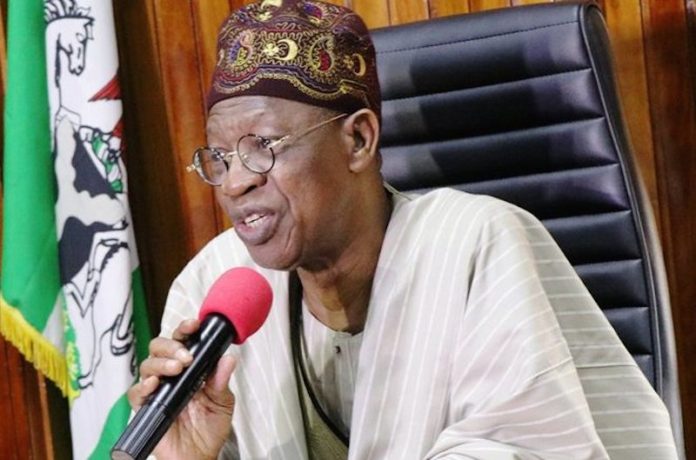
The Minister of Information and Culture, Alhaji Lai Mohammed has thrown his weight behind the states that offered amnesty to bandits, saying that “if granting amnesty to a warlord will lead to the surrendering of many others I will take that decision”.

The minister has also insisted that the country is safer today than it was prior to the coming of the All Progressives Congress (APC) government in 2015.

He also gave reason the federal government proscribed the Indigenous Peoples of Biafra (IPOB), saying that the group is not the same as bandits or killer herdsmen, stressing that the latter cannot be called terrorists.

Speaking yesterday on a live TV programme, Mohammed said that before 2015, the entire Northern Nigeria was no- go-area, adding that even the Federal Capital Territory (FCT) was not safe for residents.

“Before APC government came on board in 2015, bombs were going off everywhere including in the heart of FCT. During that time as a minister, before you go to the mosque in Abuja, we’re frisked before you enter for Jumat. It was that serious then but our government has stopped all that now”, he explained.

The minister argued that the government has worked very hard to degrade and subdue the insurgents just as he said the neutralisation of the bandits and insurgents by security agencies are underreported.

“The insurgents have been dealt a serious blow and

when these bandits who are not settled at a place are neutralized nobody hears about it. Our security agencies have been dealing with the insecurity and they have been succeeding”.

Reacting to the issue of some governors granting amnesty to notorious armed gangs, he said: “When dealing with a situation like an insurgency and banditry you do certain things in the interest of peace. If granting amnesty to a warlord will lead to the surrendering of many others I will take that decision”.

The minister also commented on Sheikh Abubakar Gumi’s amnesty proposal for bandits, saying that anyone can go on that mission if it will bring peace.

He, however, declared that the federal government did not authorise the meeting in the first place.

When asked why the federal government hurriedly proscribed the IPOB even when they were not as vicious as the bandits but failed to also proscribe bandits and killer-herdsmen who are carrying sophisticated weapons against innocent Nigerians, the minister argued that the two groups are different.

“Don’t compare IPOB with bandits and herdsmen. IPOB doesn’t believe in Nigeria hence they were declared a terrorist organisation. Bandits and herdsmen are only criminals”, Mohammed said.

“You proscribe known groups with names. You can’t just proscribe an unknown group legally,” he said.

“Secondly, it’s not whether they are proscribed or not, it is the way they are treated. Does the government actually treat them with kid gloves? The answer is no.”

He said, “When a group is championing a course for the disintegration of Nigeria… A group like IPOB (that) does not even recognise Nigeria as a state, sets up its own army and think it is a sovereign state is different from bandits and criminals. Please, don’t compare apples and oranges.”

He further argued that: “Security challenges are one thing. Challenging the sovereignty of Nigeria is a completely different thing. Don’t let us dwell on semantics.

“Don’t armed robbers threaten the security of lives and property? They do. Is there anywhere in the world that armed robbers have been proscribed?”

Credit:thisdaylive

#EndSARS: Lawyer Who Filed Complaint Against Sam Adeyemi, Adeyanju, Falz, 47 Others Alleged To Be Fake

A lawyer, Kenechukwu Okeke, who filed a criminal complaint before an Abuja Magistrates’ Court over the actions of 50 artists, celebrities and pastor during the October 2020 EndSARS struggles has been alleged to be fake, going by his conduct in court.

Our correspondent learnt that the Director-General of the Nigerian Law School and the Nigerian Bar Association had been contacted to authenticate Okeke’s legal status.

Activist, Deji Adeyanju, on behalf of the 50 persons in Okeke’s suit, had filed a case at the High Court and when the case was called for hearing today, it was stalled as the court held that Okeke should be ascertained with evidence if he was a lawyer.

At the hearing of the matter on Thursday, the case was called up and there were introductions by the applicant lead counsel, Samuel Ihenseksien and Okeke, who appeared as the first defendant, and as a counsel to himself.

The NBA Bwari Chairman, Bwari branch, Chukwuemeka Clement, also appeared in this case as amicus curea (a friend of the court).

Our correspondent learnt that the NBA chairman and applicant’s counsel then applied for the court to inquire about the status of Okeke as a lawyer, after which all hell allegedly broke loose.

“He was visibly shaken as he was caught unawares. His right leg was moving uncontrollably as the judge ordered for further findings and for the NBA to formally join the matter and submit their enquiry to court,” a source said.

The case was adjourned to March 8, 2021, at which point Kenechukwu took off and wouldn’t grant an interview as he had promised.

The lawyer representing Deji Adeyanju and the 49 others, Samuel Ihenseksein, explained how Okeke was believed to be fake and why a verification letter was written to the law school and the NBA to confirm his status as a lawyer.

The defence counsel said, “The matter was adjourned to today for continuation of hearing and I was present in court and the NBA Chairman also put in an appearance because something of note came up. In a nutshell, we have had reasons before now to actually suspect that Okeke in different sessions and at different sessions held himself to be a lawyer.

“He has actually challenged so many celebrities and of note, he challenged Peter Okoye and so, we have had reasons to look at this critically. We know that there is a particular behaviour and his recent character which made us to verify if he was truly a lawyer.

“The court actually took it in good faith and ordered an inquiry. He was actually shaking and moving about and we now have a strong suspicion that he was not a lawyer. To confirm our fears, we have actually written to the Chief Registrar of the court. The one I have is the letter to the DG, Law School, to verify his status.”

Culled from saharareporters

I Didn’t Know How $242m Got Into My Account, Brazilian Bank Scammer Nwude Tells Court

Emmanuel Nwude, a businessman, who was convicted of defrauding a Brazilian bank of $242 million, has denied knowing the source of the funds while testifying on Thursday before an Ikeja Special Offences Court.

Mr. Nwude was convicted by an Ikeja High Court in 2005 for impersonating Paul Ogwuma, a governor of the Central Bank of Nigeria (CBN), who had served from October 1, 1993 to May 29, 1999 in order to defraud a Brazilian bank.

The bank, Banco Noroeste, was defrauded of 242 million dollars between 1995 and 1998.

As at the time of the incident, it was the third largest bank fraud in history, resulting in the collapse of Banco Noroeste in 2001.

According to the EFCC, Mr. Nwude had convinced a director of the bank, Nelson Sakaguchi, to buy a yet-to-be-built airport in Abuja for $242 million.

The anti-graft agency said Mr. Sakaguchi, who fell for the scam, had between 1995 and 1998 paid $191 million in cash and the remainder in the form of outstanding interest for the nonexistent airport.

Mr. Nwude was sentenced to 25 years imprisonment for the fraud in 2005 by Justice Joseph Oyewole.

His conviction was the first major conviction for the then newly established Economic and Financial Crimes Commission (EFCC).

Mr. Nwude, after serving part of his jail term, is, however, back in court alongside two lawyers – Emmanuel Ilechukwu and Roland Kalu.

They face a 15-count charge of forging the documents of the property Justice Oyewole had ordered Mr. Nwude to forfeit to his victims.

The property is located at Plot Y, Mobolaji Johnson street, Oregun Alausa, Ikeja.

Speaking in his defence during Thursday’s proceedings, Mr. Nwude who was led in evidence by defence counsel, Chuks Nwachukwu, denied knowledge of the source of the funds from the 242 million dollars airport scam.

According to him, when he was standing trial for the $242 million scam, he was approached by a member of his legal team, Chris Uche (SAN) in prison who suggested that he make a plea bargain agreement with the EFCC.

He said Mr. Uche had advised that he would make the plea bargain agreement like what was done for Amaka Anajemba (one of his co-defendants in the fake airport scam) so that he would not be solely made to repay the funds to the victims.

He said he refused Mr. Uche’s offer because the funds found in his account by the anti-graft agency were not proceeds of fraud.

“I told him that I’m not responsible for the $242 million. That I’m not responsible for this money, I don’t know anything about it.

“The EFCC should check all the remittances that came through my accounts, though, I have my friend late Christian Anajemba’s (husband of Amaka, his co-defendant) various bank accounts.

“As money came to my accounts, I gave it to one of my Indian friends, Naresh Asnani, who has contact with a Swiss bank, who in turn does the exchange for me.

“When the money comes in, he (Asnani) takes his commission and I’ll take my commission and I give the large sum to Christian Anajemba,” Mr. Nwude said.

Mr. Nwude also accused a Senior Advocate of Nigeria, Olisa Agbakoba, of abandoning him two weeks after he collected N27 million out of the N30 million fee he charged him for legal representation during his trial for the $242 million scam.

“After G.O. K. Ajayi (SAN), I brought in Olisa Agbakoba (SAN) to stand for me.

“I have never been in court before, I never had experience of court. When I brought Agbakoba, he charged me N30 million and I paid him N27 million.

“Two weeks later Agbakoba asked me to bring more money and I said no because I just paid him N27 million. He said he wanted the money to pursue an appeal.

“He said if I did not pay the balance he would not appear in my matter again. I told him to go to hell.

“On the next adjournment, he refused to come and I was stranded in court, then EFCC introduced Rickey Tarfa (SAN) to me,” Mr. Nwude said.

Justice Mojisola Dada adjourned the case until May 24 for continuation of trial. (NAN)

Nigeria Won’t Make Progress Without More Borrowing — Finance Minister

*Says FG may compel MDAs to buy locally made vehicles

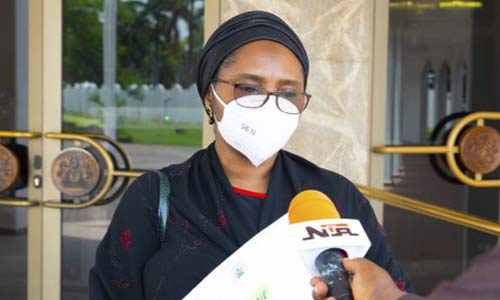
With $86.39 billion (N32.9 trillion) total debt stock, Nigeria will not make progress unless it borrows more to fund critical infrastructure, Minister of Finance, Budget and National Planning, Mrs Zainab Ahmed, has said.

She spoke at the maiden special media briefing by the MDAs organised by the Presidential Communications Team at the presidential villa, Abuja, on Thursday.

According to her, even though the country has expanded its borrowing, it is still below 25 per cent debt to GDP ratio and within the borrowing limit.

She said borrowing is necessary to roll out infrastructure now and not later.

Responding to question on excessive Chinese loans taken by the country and consequences on debt servicing, she explained: “On the issue of Chinese loans, if I may be permitted to speak to the question by the business. I think it’s useful to look at the budget for each year; look at the revenues, look at the expenditure, if you take out the new borrowing, really, what will the size of the budget be? How much can the government spend?

“So, there will be a lot of capital projects that are affected. So, we need to look at it that borrowing is, even as you see it in the budget every year, used to support infrastructural development. Otherwise, there will be a challenge.

“Secondly, let me add. I think we’re going through a process where we need to borrow now. Let’s just say in the short to medium term, to get the economy going, while we also expect revenues to improve.

“So, in terms of the pressure of debt service, by the time the revenue comes up, that should be lower, but there are some things you need to do now, to ensure that revenue comes up. So, we need to keep that in mind that if the economy grows and revenues improve, then debt service to revenue, in future, should be lower.”

While acknowledging that the government’s borrowing has become a touchy issue, Ahmed maintained that it is not misplaced.

She further said: “There is a lot of sensitivity in Nigeria about the level of borrowing by the government and it is not misplaced. And I said earlier that the level of borrowing is not unreasonable, it is not high.

“The problem we have is that of revenue. So, what we need to do is to increase revenue to be able to enhance our debt to GDP obligation capacity. If we say we will not borrow and therefore not build rials and major infrastructure until our revenue rises enough, then, we will regress as a country.

“We will be left behind, we won’t be able to improve our business environment and our economy will not grow. So, it is a decision that every government has to take.

“Our assessment is that we need to borrow to build our major infrastructure. We just need to make sure that when we borrow, we are applying the borrowing to specific major infrastructure that will enhance the business environment in this country.

“Again, we all have to work not just the Federal Government but state governments to increase our revenue to enhance our debt service obligations.

“We also have to make sure that when we are choosing the projects, we are choosing carefully the ones that will enhance the business environment so that more revenue yields come into the treasuries of the country.”

Still, on the borrowing threshold, the minister stated: “The total borrowing of the country as of 31 of December is 21.6% of the GDP. So, if we were not looking at adding the other category of loans that I mentioned, we don’t even need to increase that at this time. As of 2019, the debt to GDP ratio was 19.2%. So, only 2 per cent was added.”

She affirmed that all that is needed is for government to increase its local revenue, saying: “The more revenue we realise out of the budget, the less we borrow. As we see the oil price rising and provides us with more revenue, it provides us with some reliefs. We will be able to reduce our borrowing. So, it is a positive thing for us.”

The minister revealed that the Federal Executive Council (FEC) will soon to approve a policy mandating Ministries, Department and Agencies (MDAs) to buy locally manufactured vehicles.

She said as part of measures by the government to control inflation in the country, it has already reduced duties on imported vehicles from 35 to 5 per cent with a view to lessening the high cost of transportation, which in turn, impacts on inflation.

According to her, patronising locally made vehicles will mitigate against dumping due to reduced duties.

The minister maintained that the federal government is committed to purchasing locally made goods and vehicles and would engage with state governments to ensure that they do the same so as to encourage local production.

On the new import duty policy, she said that the Nigeria Customs Service has already directed all its outposts to commence its implementation.

She added: “Nigerian Customs has reviewed these guidelines and has notified all its operational posts to start implementing the new rates. So, it has taken effect.

“The Federal Government is committed to buying made in Nigeria products and buying made in Nigeria vehicles in particular. So, we will be hoping to have a Federal Executive Council approval to compel federal government agencies to buy made in Nigeria vehicles as much as is practicable.

“So, when the security agencies need a security vehicle that is a special design, and you don’t have it in Nigeria, we will still need to buy the ones that are outside.

“We’re hoping to also engage the states and encourage the states to take similar measures. It is important for us because we want to make sure the automotive industry survives and grows.

“The Federal Ministry of Industry, Trade and Investment has just finished a review of automated policy, which has been running now for seven years. I must say that the policy has not been reviewed before. So, this is the first review that is being done and the essence of the review is to see whether it has achieved the designed targets.

“Once the ministry gets its approvals, then the review will be announced and perhaps there will be a refreshing of the measures that are contained in that policy.”

Credit:thenigerialawyer

Nigeria Is A Failed State, Nothing Works Anymore — Clark

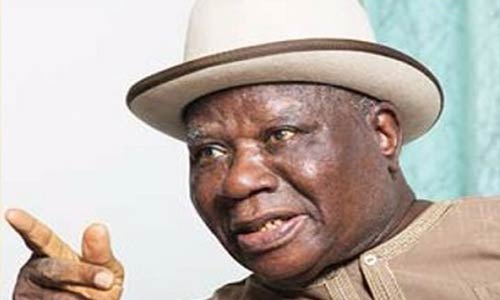
Ijaw leader Edwin Clark has said that Nigerian is a failed state because things no longer work properly in the nation.

The erstwhile federal commissioner for information made this disclosure on Wednesday at the National Restructuring Summit in Abuja.

He maintained that the Nigeria 1999 constitution is operating under a scam.

“Nigeria is a failed state, failed state in the sense that nothing works anymore. Bring the best expert to come and manage Nigeria under the 1999 constitution it will not yield any result because the 1999 constitution is a scam,” Vanguard Newspaper quoted the elder statesman to have said.

“The last constitution we had in this country was the 1963 constitution, the 1999 constitution was dictated by the military and handed down to Nigeria and that is why nothing works.”

“Some people who run Nigeria were beneficiaries of the 1963 constitution, beneficiaries of true federalism,” Mr. Clark asserted.

The Niger-Delta leader explained that the citizens of the oil-rich region have suffered try most injustice in Nigeria which could only be corrected via restructuring through federalism and resources control.

“A situation where we can control our resources and pay tax to the center, other regions have enjoyed this before. So we have suffered the most in Nigeria, we are not saying we should have everything that belongs to us, but we the people of Niger-Delta believe in restructuring through federalism,” Mr. Edwin said.

Credit:thenigerialawyer

Funmi Quadri (SAN) & Co Offers Free Mobile And Desktop Version Of Law Companion To Legal Aid Council

*Says Same Is Part Of Its Corporate Social Responsibility

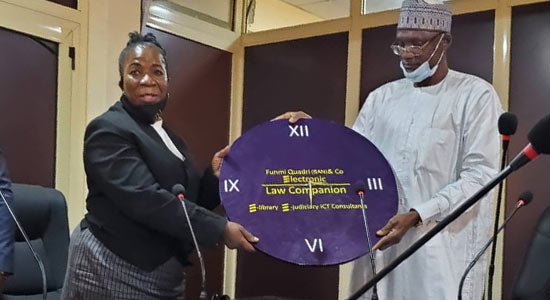
Funmi Quadri (SAN) & CO has supported the Legal Aid Council Of Nigeria with licenses for the mobile version of the law companion electronic library as well as desktop licenses to be distributed amongst the Council’s state offices.

This is contained in a statement made available to TheNigeriaLawyer titled: “FUNMI QUADRI (SAN) & CO PERFORM THEIR CORPORATE SOCIAL RESPONSIBILITY TO THE LEGAL AID COUNCIL OF NIGERIA ON THE 16TH OF FEBRUARY 2021”

The presentation was said to have held in the conference room at the Legal Aid Council Abuja office.

At the event were the Director-General; Aliyu B. Abubakar FCILRM and some senior staff of the council.

The firm says the license will enable lawyers of the Council to access several resources such as all judgments of the Supreme Court from inception-date; Judgments of the Court of Appeal; Prompt Updates on the case laws; Rules of Court and Acts.

The Principal Partner of the law firm, Mrs. Funmi Quadri (SAN), was said to have “acknowledged and commended the Legal Aid Council of Nigeria for their relentless work and selfless effort in defending poor Nigerians who do not have the resources to engage a legal representative most especially inmates in correctional facilities awaiting trial.”

The Director-General in turn presented a souvenir from the Legal Aid Council while he commended FUNMI QUADRI (SAN) & CO for their generous gesture.

The Legal Aid Council Of Nigeria is a body established by an Act of the National with the mandate of providing free legal assistance, representation, legal advice, and Alternative Dispute Resolution (ADR) to indigent Nigerians.

With offices spread across the 36 states of the Federation and several lawyers, it remains one of the largest law firms in Nigeria.

Funmi Quadri & Co is the publisher of Supreme Court Judgments, electronic law companion, and other publications.

Credit:thenigerialawyer

TIPS