By Elvis Pratton
In one of London’s most exclusive neighbourhoods sits a property so extravagant that calling it a house feels almost inadequate.
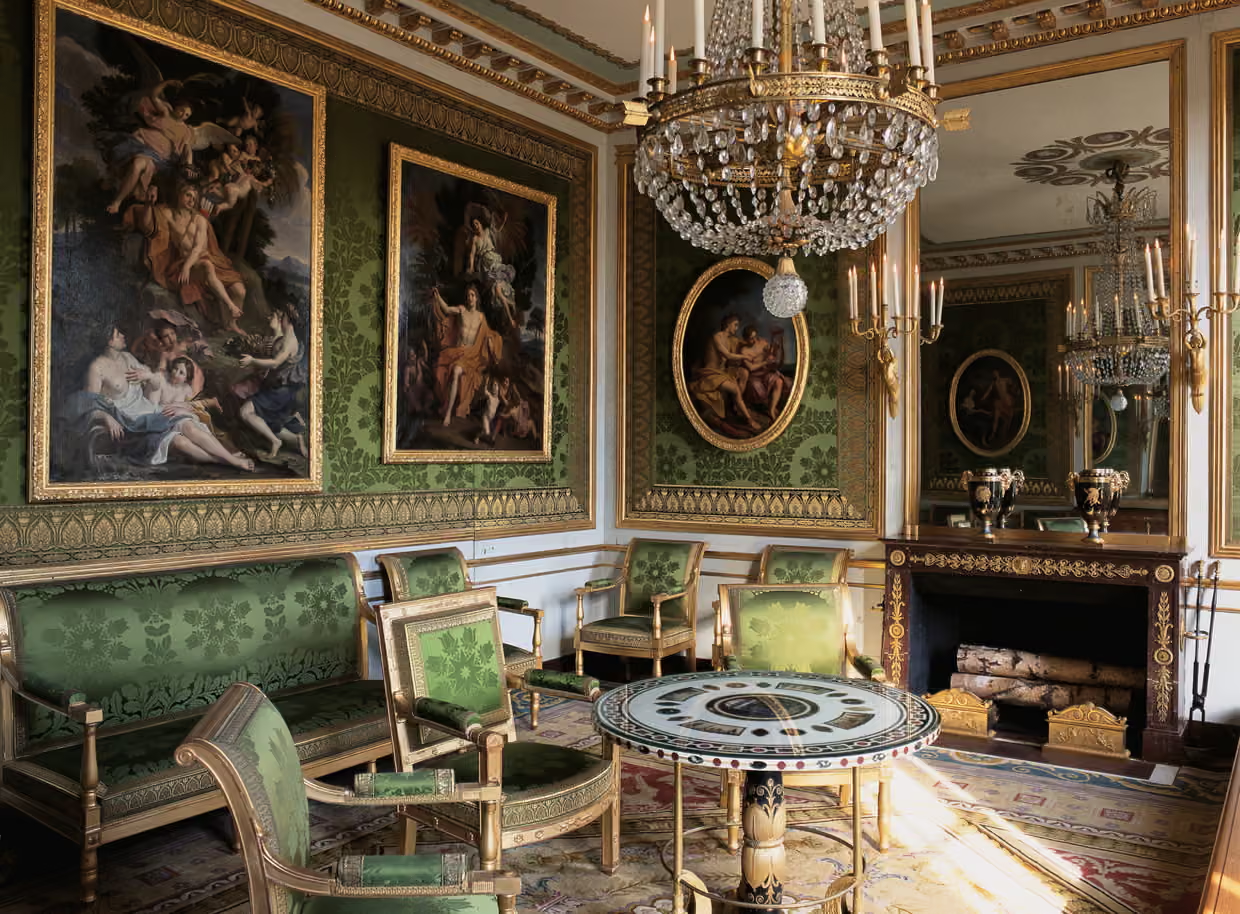
Number 2-8A Rutland Gate, overlooking Hyde Park in Knightsbridge, boasts 45 rooms, 24 marble bathrooms, four lifts, an indoor swimming pool and enough luxury to rival many royal residences. When it changed hands in 2020 for £210 million, it became Britain’s most expensive home.
Yet today, nobody lives there.
The mansion stands silent behind its imposing façade, its vast rooms empty, its chandeliers unlit, its famous views of Hyde Park enjoyed by no one.
The irony becomes impossible to ignore when one discovers that the only person who appears to call the property home is a homeless man sleeping on its doorstep.
For three years, Swedish-born Anders Fernstedt has lived beneath a makeshift shelter on the mansion’s porch. A few metres separate him from a property worth more than entire districts in some countries. Inside are dozens of unused rooms. Outside is a man who survives day-to-day with little more than a mattress, a duvet, a few bicycles and the kindness of strangers.
The contrast is striking, but perhaps not for the reasons many might think.
This is not simply a story about homelessness. Neither is it merely a story about wealth. It is, in many ways, a story about the curious things human beings devote their lives to acquiring.
The mansion’s history reads like a catalogue of extraordinary fortunes. It belonged to Lebanese billionaire and former Prime Minister Rafik Hariri before his assassination in 2005. It later passed through Saudi royalty and eventually became entangled in the collapse of China’s Evergrande empire, one of the biggest corporate failures in modern history.
Its owners commanded immense wealth, influence and power. Some built empires. Some advised kings. Some moved markets.
Yet today, none of them lives there.
The building remains. The people moved on.
There is something sobering about that reality.
Across the world, countless people spend their lives chasing larger houses, bigger bank accounts and greater status. There is nothing inherently wrong with success. Ambition has built cities, created jobs and transformed societies. But there comes a point where accumulation ceases to serve any practical purpose and becomes an end in itself.
A mansion with 45 rooms can only be occupied one room at a time.
A wardrobe filled with hundreds of suits still allows only one to be worn.
A fleet of luxury cars can only carry a person in one vehicle at any given moment.
Beyond a certain point, wealth stops being about use and begins to exist largely as a symbol.
That may be why some of history’s most admired figures are remembered not for what they owned but for what they gave away. Long after fortunes disappear, people remember schools that were built, scholarships that were funded, hospitals that were established and lives that were changed.
Property can outlive its owners. Investments can pass to strangers. Estates can become the subject of litigation. Entire fortunes can vanish within a generation.
But acts of generosity have a way of surviving their creators.
The story of Rutland Gate illustrates that truth in an almost theatrical way. One owner was assassinated. Another died. Another lost control of his vast business empire and now faces criminal consequences. The mansion itself has become trapped in a web of ownership disputes and legal complications.
Meanwhile, the man sleeping outside remains one of the few people with any meaningful relationship to the property. He waters flowers. He knows the neighbours. Children stop to talk to him. He notices the changing seasons. In a strange way, he appears to derive more daily value from the building than many of those who have owned it.
Perhaps that is the real lesson.
The measure of a life is not necessarily what we accumulate, but what purpose our accumulation serves. In the end, the houses remain behind. The titles pass on. The money changes hands.
What endures are the lives touched, the opportunities created and the good done while we were here.
By Elvis Pratton
In one of London’s most exclusive neighbourhoods sits a property so extravagant that calling it a house feels almost inadequate.
Number 2-8A Rutland Gate, overlooking Hyde Park in Knightsbridge, boasts 45 rooms, 24 marble bathrooms, four lifts, an indoor swimming pool and enough luxury to rival many royal residences. When it changed hands in 2020 for £210 million, it became Britain’s most expensive home.
Yet today, nobody lives there.
The mansion stands silent behind its imposing façade, its vast rooms empty, its chandeliers unlit, its famous views of Hyde Park enjoyed by no one.
The irony becomes impossible to ignore when one discovers that the only person who appears to call the property home is a homeless man sleeping on its doorstep.
For three years, Swedish-born Anders Fernstedt has lived beneath a makeshift shelter on the mansion’s porch. A few metres separate him from a property worth more than entire districts in some countries. Inside are dozens of unused rooms. Outside is a man who survives day-to-day with little more than a mattress, a duvet, a few bicycles and the kindness of strangers.
The contrast is striking, but perhaps not for the reasons many might think.
This is not simply a story about homelessness. Neither is it merely a story about wealth. It is, in many ways, a story about the curious things human beings devote their lives to acquiring.
The mansion’s history reads like a catalogue of extraordinary fortunes. It belonged to Lebanese billionaire and former Prime Minister Rafik Hariri before his assassination in 2005. It later passed through Saudi royalty and eventually became entangled in the collapse of China’s Evergrande empire, one of the biggest corporate failures in modern history.
Its owners commanded immense wealth, influence and power. Some built empires. Some advised kings. Some moved markets.
Yet today, none of them lives there.
The building remains. The people moved on.
There is something sobering about that reality.
Across the world, countless people spend their lives chasing larger houses, bigger bank accounts and greater status. There is nothing inherently wrong with success. Ambition has built cities, created jobs and transformed societies. But there comes a point where accumulation ceases to serve any practical purpose and becomes an end in itself.
A mansion with 45 rooms can only be occupied one room at a time.
A wardrobe filled with hundreds of suits still allows only one to be worn.
A fleet of luxury cars can only carry a person in one vehicle at any given moment.
Beyond a certain point, wealth stops being about use and begins to exist largely as a symbol.
That may be why some of history’s most admired figures are remembered not for what they owned but for what they gave away. Long after fortunes disappear, people remember schools that were built, scholarships that were funded, hospitals that were established and lives that were changed.
Property can outlive its owners. Investments can pass to strangers. Estates can become the subject of litigation. Entire fortunes can vanish within a generation.
But acts of generosity have a way of surviving their creators.
The story of Rutland Gate illustrates that truth in an almost theatrical way. One owner was assassinated. Another died. Another lost control of his vast business empire and now faces criminal consequences. The mansion itself has become trapped in a web of ownership disputes and legal complications.
Meanwhile, the man sleeping outside remains one of the few people with any meaningful relationship to the property. He waters flowers. He knows the neighbours. Children stop to talk to him. He notices the changing seasons. In a strange way, he appears to derive more daily value from the building than many of those who have owned it.
Perhaps that is the real lesson.
The measure of a life is not necessarily what we accumulate, but what purpose our accumulation serves. In the end, the houses remain behind. The titles pass on. The money changes hands.
What endures are the lives touched, the opportunities created and the good done while we were here.