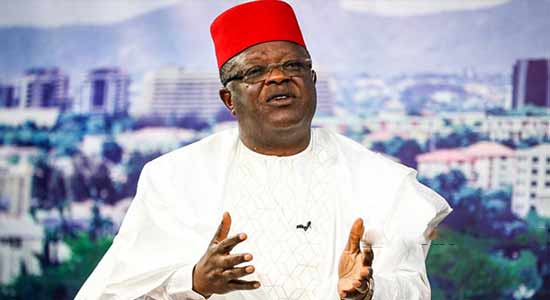
The Federal Ministry of Works, under the leadership of Minister Dave Umahi, has earmarked over ₦500 million in its 2026 budget for a series of empowerment and social intervention programmes, including training for hairdressers and make-up artists, the distribution of grinding machines, motorcycles and mini-vans, as well as anti–drug abuse awareness campaigns across selected states.
Details of the proposed expenditures are contained in the 2026 Appropriation Bill published on the Budget Office of the Federation’s website, which was reviewed on Thursday.
A breakdown of the budget shows that the projects are spread across multiple geopolitical zones, largely structured as constituency-level interventions.
Under budget item code ERGP 12234747, the ministry plans to spend ₦35 million on the provision of an unspecified number of grinding machines for women in Ndokwa/Ukwani Federal Constituency in the South-South.
Another ₦35 million has been allocated for the training and empowerment of women in hairdressing, make-up artistry and soap production in Mikang/Shandam/Qua’an Pan Federal Constituency of Plateau State, in the North-Central zone.
The budget further proposes ₦70 million for skills acquisition and the provision of trade equipment to youths, women and seven retirees in the Inyamaltu/Deba area of Gombe State, located in the North-East.
In the South-East, the ministry intends to spend ₦70 million on the supply of mini pick-up vans, mini shuttle buses and motorcycles to beneficiaries in Abakaliki Federal Constituency, Ebonyi State.
Another allocation covers training, sensitisation, advocacy and youth empowerment programmes against drug abuse in Zamfara State, in the North-West, alongside several other constituency-specific projects listed in the budget.
The inclusion of these empowerment initiatives in the Federal Ministry of Works’ 2026 budget has triggered debate and raised fresh questions about alignment with the ministry’s core mandate, which traditionally centres on road construction, rehabilitation and infrastructure delivery.
Critics argue that while empowerment and social interventions are important, such programmes are more typically associated with ministries and agencies specifically designed for social development, youth empowerment and poverty alleviation, prompting renewed scrutiny over budget prioritisation, institutional roles and fiscal discipline.