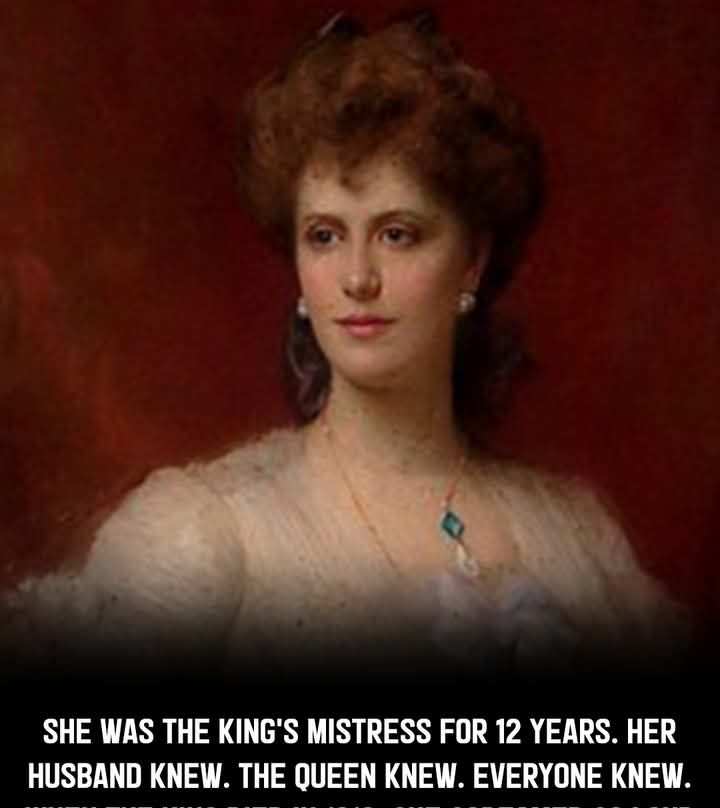
She was a politician whisperer, financial genius, and the King’s undisputed second wife in all but name. Her exit from court was chaotic, but her bloodline grabbed the crown.
Alice Keppel made being a royal mistress an art form. And 100 years later, her great-granddaughter would do it all over again.
Born Alice Edmonstone in 1868, she grew up in Duntreath Castle in Scotland, the youngest of eleven children. Her family descended from Scottish royalty. She was beautiful—chestnut hair, blue eyes, a tiny waist—but more importantly, she was charming, witty, and devastatingly discreet.
At 23, she married Lieutenant Colonel George Keppel, a handsome army officer from a noble family. There was just one problem: George had no money. As a younger son, he’d inherited a prestigious name and absolutely nothing else.
Alice needed to maintain their lifestyle in London’s high society. So she did what many ambitious women of that era did: she took wealthy lovers.
Her husband didn’t object. In fact, George once said: “I do not mind what she does as long as she comes back to me in the end.”
And she always did. Their marriage, according to their daughters, was filled with “companionship, love and laughter.” George had his own affairs. They had an arrangement that somehow… worked.
But in February 1898, Alice met someone who would change everything.
At a society party in London, the 29-year-old Alice was introduced to Albert Edward, Prince of Wales—the 56-year-old heir to the British throne. The prince, known as “Bertie,” was notorious for his appetites. Food. Drink. Women. He’d had at least 55 mistresses throughout his life, earning the nickname “Dirty Bertie.”
He was also desperately bored, married to Princess Alexandra of Denmark, who preferred quiet family life to his constant need for parties, travel, and stimulation.
Within weeks of meeting, Alice became his official mistress.
And here’s where Alice’s genius showed: she made everyone happy.
The Prince got a mistress who could calm his legendary temper, keep him entertained, and never cause a scandal. George got financial security—the King arranged a high-paying job for him with Sir Thomas Lipton of the tea empire. Queen Alexandra got peace—because Alice was discreet, unlike previous mistresses who’d flaunted their positions.
Even the government ministers were relieved. They would approach Alice before presenting controversial policies to the Prince, asking her to put him in a good mood first.
The Prince visited Alice regularly at her home in Portman Square. George would conveniently leave. It was all very civilized.
Instead of giving her money directly, the King gave Alice shares in a rubber company. They gained her £50,000—equivalent to £7.5 million today. His financial advisers managed her investments. She became wealthy in her own right.
In 1901, Queen Victoria died. Bertie ascended the throne as King Edward VII. Alice’s position didn’t diminish—it strengthened. She traveled with him to Biarritz every year. She hosted the most sought-after dinner parties in London. Politicians, diplomats, and royalty competed for invitations.
She was, in every way except legally, a second queen.
For twelve years, the arrangement continued. The King loved her. The Queen tolerated her. Society accepted her. Alice Keppel had achieved what no other royal mistress had: respectability.
But in 1909, the King’s health began failing. Years of excessive eating, drinking, and smoking had caught up with him. He collapsed during a state visit. In March 1910, he collapsed again in France and spent weeks convalescing.
When he returned to England in May 1910, he suffered multiple heart attacks.
Lying in bed at Buckingham Palace, King Edward VII asked for Alice. Queen Alexandra reluctantly allowed her into his bedroom while he was still conscious.
Then, on May 6, 1910, the King lost consciousness. Queen Alexandra turned to the doctor and hissed: “Get that woman away.”
But Alice couldn’t be moved. The normally composed, perfectly discreet Alice Keppel completely broke down. She screamed. She wailed. She had to be physically dragged from the room by members of the Royal Household.
At 11:30 PM that night, King Edward VII died at age 68.
Alice was so mortified by her outburst that she spent years downplaying it, pretending it hadn’t been that dramatic. But eventually, she admitted the truth: she had loved him, and she’d been unable to control herself.
Ten days later, at the King’s funeral, Queen Alexandra made a final gesture. She allowed Alice to attend.
But Alice’s time was over. The new King, George V, didn’t approve of his father’s lifestyle. He excluded Alice from court entirely. In November 1910, just months after the King’s death, the Keppels left England.
They traveled for two years—Ceylon, China, across Asia—before returning to London in 1912. But the Edwardian era was finished. Alice continued hosting parties, but she was a relic of a bygone age.
In 1925, Alice and George moved permanently to Italy, buying Villa dell’Ombrellino near Florence—a palazzo once owned by Galileo. They entertained exiled royalty and Winston Churchill at lavish gatherings.
Then in 1936, everything came full circle.
King Edward VIII—grandson of Alice’s former lover—abdicated the throne to marry Wallis Simpson, an American divorcée. The scandal rocked Britain.
Alice, dining at the Ritz Hotel when the news broke, was heard to declare: “Things were done much better in my day.”
She was right. In her era, royal mistresses knew their place. They were discreet. They didn’t break up the monarchy. They certainly didn’t make the King give up his throne.
During World War II, the Keppels returned to England. Alice famously said she preferred “bombs to boredom” and moved into the Ritz rather than stay in the countryside.
In 1946, they returned to their Italian villa. Alice was ill by then. On September 11, 1947, at age 79, she died of cirrhosis of the liver.
George Keppel was devastated. After 56 years of marriage—through affairs, scandals, and a King—he’d never stopped loving her.
Two and a half months later, on November 22, 1947, George died at the Ritz Hotel in London.
They said he couldn’t live without her.
They’re buried together in Florence.
And here’s where history gets deliciously ironic:
Through Alice’s younger daughter Sonia, she became the great-grandmother of Camilla Parker Bowles—now Queen Camilla.
And Camilla, like her great-grandmother before her, became the mistress of a Prince of Wales. Charles, the great-great-grandson of Alice’s King Edward VII, loved Camilla for decades while married to someone else.
History didn’t just rhyme. It repeated exactly.
Two women, related by blood but born a century apart, both fell in love with married heirs to the British throne. Both endured scandal. Both eventually triumphed.
The difference? Alice never became queen. She died a mistress.
Camilla did what Alice never could. She married her prince and wore the crown.
The British Royal Mail issued a 1995 “Greetings in Art” stamp featuring a photograph titled “Alice Keppel with her Daughter” taken by Alice Hughes in 1899. The mother was Alice Keppel and her eldest daughter, Violet. Queen Elizabeth II approved it personally. Because by then, everyone understood: Alice Keppel hadn’t been scandalous. She’d been ahead of her time. She’d found a way to make an impossible situation work for everyone involved.
She was the King’s mistress. Her husband knew. The Queen knew. Society knew.
And for twelve glorious years, nobody minded at all.
Read More here. https://www.townandcountrymag.com/leisure/arts-and-culture/a34659540/alice-keppel-camilla-ancestor-mistress/