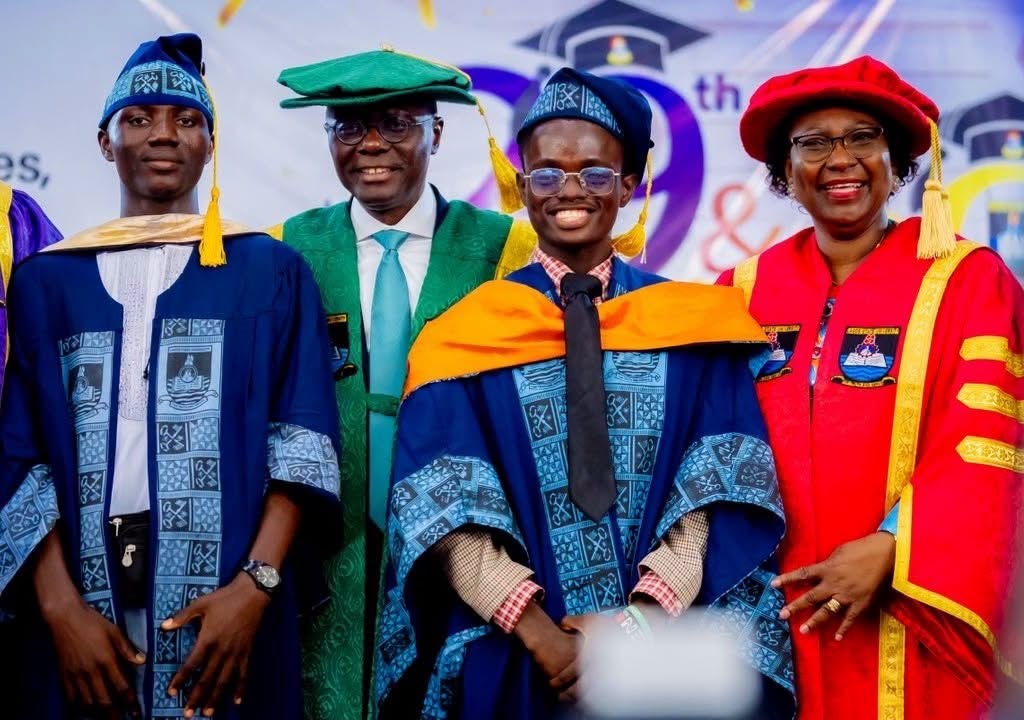
LAGOS — In a country where academic brilliance has too often been rewarded with little more than applause, certificates, plaques—and, in some notorious cases, a handshake—Lagos State Governor and Visitor to Lagos State University (LASU), Babajide Sanwo-Olu, has sent a powerful signal in a different direction.
At the university’s 29th and 30th combined convocation ceremonies on Wednesday, August 19, the governor awarded N20 million each to the overall best graduating students for the 2024/2025 and 2025/2026 academic sessions, bringing the total personal cash reward to N40 million.
The beneficiaries are Ayilara Olawale, who graduated from the Department of Project Management with a remarkable 4.96 CGPA, and Adebanjo Samuel Oluolamide, an Aerospace Engineering graduate who recorded an even higher 4.97 CGPA.
The gesture deserves to be viewed as more than an act of generosity. It is a statement about what society chooses to value.
For decades, Nigeria has struggled with a deeply distorted reward culture in which exceptional academic performance has frequently attracted derisory prizes, while entertainment, reality television and celebrity culture command enormous financial rewards and publicity.
That contrast has not gone unnoticed by young Nigerians.
From handshake to N20 million
The irony has, at various times, been almost embarrassing.
Investigations and commentaries over the years have documented extraordinary disparities in the way Nigeria rewards intellectual achievement. One widely reported account found cases in which best graduating students received sums ranging from N200 to a few thousand naira, with some academic prizes consisting of items as modest as a tuber of yam or a fowl.
In another reported case, a student who won seven academic awards after years of outstanding study received just N540,000 in total. Meanwhile, reality-show winners were receiving tens of millions of naira, cars and other valuable prizes.
The disparity became particularly conspicuous with the rise of Big Brother Naija and similar reality shows. At various points, winners have walked away with enormous cash prizes and substantial material rewards, while students who spent four, five, six or more years pursuing academic excellence were sometimes rewarded with amounts that barely acknowledged the effort involved.
This is not an argument against rewarding entertainment.
Entertainment has economic value. Popular culture creates jobs, attracts investment, generates advertising revenue and provides leisure. Reality television contestants are entitled to compete for whatever prizes sponsors are prepared to offer.
The problem is the message created when entertainment is consistently valued in millions while intellectual achievement is treated as though it were a hobby.
A society teaches its young people what it truly values not only through speeches, but through its reward systems.
The dangerous message of “Olodo uprising”
It is against this background that Nigeria’s increasingly visible “school na scam” mentality—and what may loosely be described as an “Olodo uprising”—should be understood.
The phrase is deliberately provocative, but the underlying phenomenon is serious.
When young people repeatedly see academic distinction produce little economic or social dividend, while visibility, controversy, entertainment and celebrity can produce instant wealth, it becomes increasingly difficult to persuade them that years of disciplined study, intellectual curiosity and academic excellence matter.
Why spend years reading, researching and competing for First Class honours if the ultimate reward is a handshake, a certificate and uncertainty about employment?
Why endure the rigours of professional education when someone can become a multimillionaire from a television show?
Those questions may be simplistic, but they are not entirely irrational responses to the incentives young Nigerians have observed around them.
A 2025 Guardian analysis captured the problem starkly, reporting that some of Nigeria’s best graduating students and young innovators were still receiving prizes ranging from N200 to N2,500, certificates or even a handshake, while sports and entertainment stars could attract awards worth hundreds of thousands of dollars. The paper argued that such disparities risk reinforcing the perception that education is a poor investment.
That is why the LASU gesture is significant.
Rewarding excellence is also nation-building
Sanwo-Olu’s decision effectively says to students: Your intellectual labour has value.
It tells the student who spends nights studying, researching and solving difficult problems that excellence will not necessarily go unnoticed.
It tells parents that academic achievement can still be celebrated in material terms.
It tells universities that their best students deserve more than ceremonial recognition.
And, perhaps most importantly, it tells society that brains are worth investing in.
The timing is particularly significant.
LASU says the 2024/2025 and 2025/2026 graduating cohorts comprise 20,604 graduates, including 494 First Class graduates and 3,383 postgraduate students, among them 238 PhD graduates.
Those numbers represent thousands of young people entering a difficult economy at a moment when Nigeria desperately needs competence—in science, engineering, medicine, law, technology, public administration, business, education and the humanities.
Among them is Oluolamide, the Aerospace Engineering graduate with a 4.97 CGPA. That is not merely a transcript. It represents years of discipline, intellectual stamina and sustained performance.
Putting N20 million behind such achievement gives that accomplishment a visibility that a certificate alone cannot provide.
A model that deserves to spread
There is another encouraging dimension to the story.
The N20 million award did not emerge in isolation. Oluolamide had already been recognised under the Sunbeth Excellence Partnership Programme, which presented him with a N10 million award before the governor’s additional N20 million personal gift.
This is precisely the kind of ecosystem Nigeria should be building.
Government, universities, foundations, corporations and philanthropists can all participate in creating a culture where excellence attracts meaningful recognition.
Imagine if every state governor adopted a similar programme.
Imagine if major Nigerian corporations competed—not merely for celebrity endorsements—but for the opportunity to sponsor the best graduating student in engineering, medicine, law, computer science, agriculture, economics or the sciences.
Imagine if universities had properly endowed prizes capable of changing the lives of their highest-performing students.
Imagine if academic competitions received the same publicity and sponsorship machinery routinely deployed for entertainment.
The effect would go beyond the individual winners. It would alter aspiration.
From “school na scam” to “school pays”
For too long, Nigeria has allowed its reward system to undermine its educational message.
We tell young people to study hard, acquire skills and become useful citizens. Then society sometimes rewards entirely different attributes more handsomely.
That contradiction cannot continue indefinitely without consequences.
The answer is not to diminish entertainment or begrudge reality-show winners their prizes. The answer is to raise the value placed on education, research, innovation and intellectual achievement.
The ₦20 million LASU awards therefore deserve to be celebrated not simply because two graduates have become richer.
They deserve attention because they represent a potentially important change in the national conversation about merit. Sanwo-Olu has put a substantial price tag on academic excellence.
Perhaps more governors, universities, businesses and wealthy Nigerians will now ask themselves a simple question:
What would happen if we made being brilliant, disciplined and academically exceptional worth celebrating—and worth something substantial?
In a country where the “Olodo uprising” sometimes appears louder than the culture of scholarship, N20 million for excellence is more than money. It is a signpost. And it points in the right direction. Nigeria should follow it.