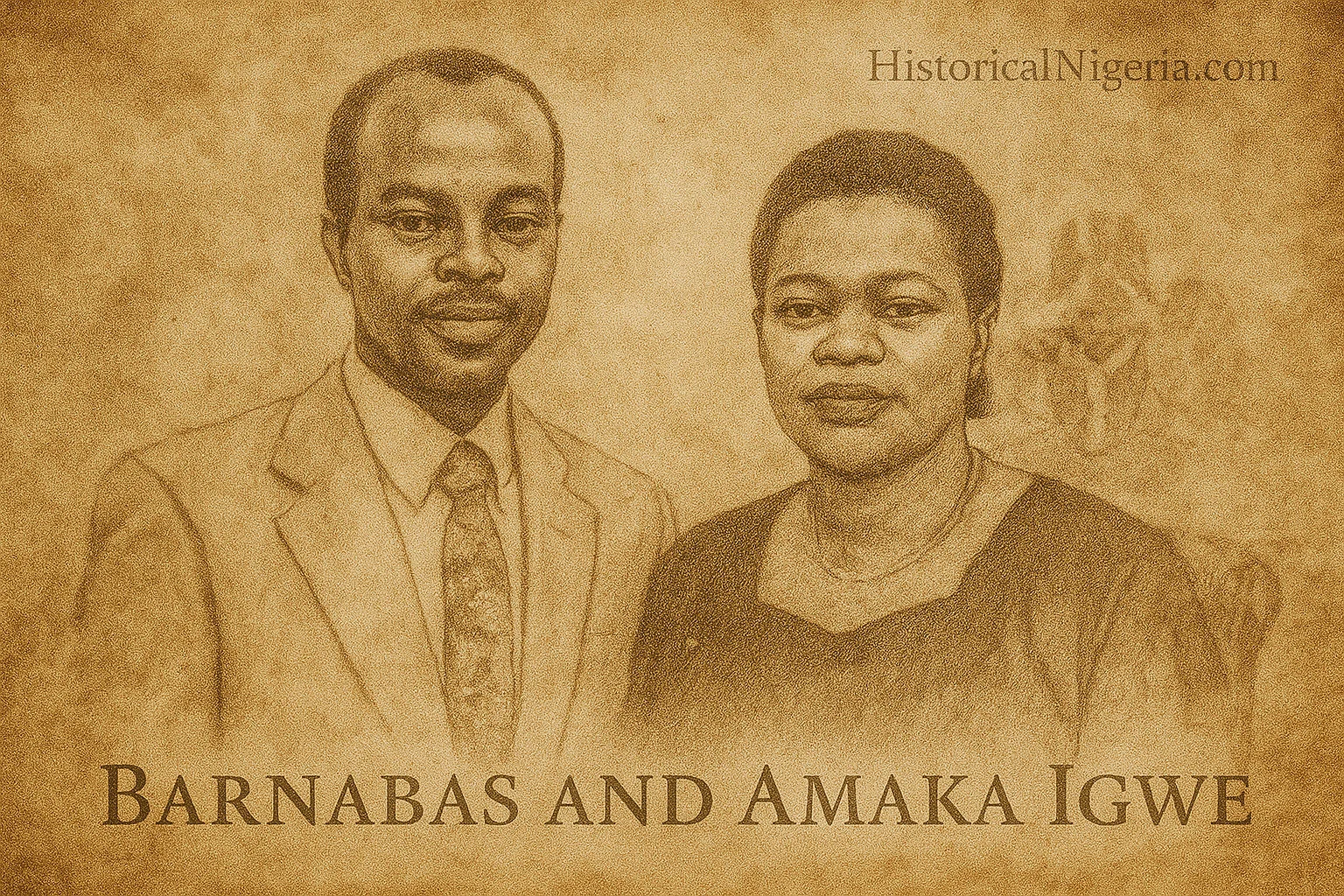
Twenty-four years after Barnabas and Abigail (Amaka) Igwe were murdered, Lillian Okenwa revisits one of the darkest chapters in the history of the Nigerian Bar—and the questions that have refused to disappear.
By Lillian Okenwa
Before they became one of Nigeria’s oldest unresolved justice files, Barnabas and Abigail (Amaka) Igwe were simply two lawyers building a future.
They were partners in every sense. They shared a marriage, a legal practice, clients, courtrooms and the quiet ambitions of young professionals determined to build something that would outlive them. Barnabas chaired the Nigerian Bar Association (NBA), Onitsha Branch, one of the country’s most influential Bar branches. Abigail practised law alongside him, building her own reputation while helping to grow the chambers they called their own.
Away from the courtroom, life revolved around three young children whose world was measured not by court sittings or legal briefs but by school uniforms, bedtime stories and the certainty that their parents would always come home.
The family was preparing to welcome another child. Abigail was pregnant.
In the closing days of August 2002, the Igwes travelled to Ibadan for the Nigerian Bar Association’s Annual General Conference. Like thousands of lawyers who make the annual journey every year, they spent the week debating legal reforms, renewing friendships and discussing the future of the profession.
When the conference ended, delegates dispersed to every corner of the country. Some returned to Lagos. Others travelled to Kano, Port Harcourt, Enugu, Maiduguri, Abuja and elsewhere.
Barnabas and Abigail began the familiar journey back to Onitsha.
They expected to return to ordinary life. Their children expected their parents home. Clients expected them back in chambers. Colleagues expected to see them in court.
The week ahead promised nothing extraordinary.
It never arrived.
On September 1, 2002, barely a day after returning from Ibadan, Barnabas and Abigail were ambushed on Oraifite Street in Onitsha. According to contemporaneous accounts, a group of assailants pulled them out of their vehicle, attacked them with machetes, shot them repeatedly and ran over them with their own vehicle before fleeing. Police found nothing to suggest robbery. Human Rights Watch, which examined the circumstances shortly afterwards, said there was “strong, credible evidence” that the killings were politically motivated, pointing to Barnabas’ outspoken criticism of the Anambra State Government and threats reportedly made against him and colleagues before the attack.
Abigail died from her injuries.
The unborn child she carried died with her.
Barnabas was rushed to hospital. Doctors fought to save him. They could not.
By the end of that Sunday, three young children had lost both parents.
A law firm built through years of sacrifice had fallen silent.
The legal profession had lost two of its own.
For much of the past twenty-four years, the tragedy has largely been remembered as the assassination of Barnabas Igwe, the outspoken NBA branch chairman whose criticism of government made him one of Anambra’s best-known lawyers.
The record tells a fuller story.
Abigail attended the same conference. She travelled the same road home. She practised in the same chambers. She stood before the same courts. She belonged to the same profession. She died in the same attack.
The Igwe file has always been the story of two lawyers.
It is also the story of three children whose lives were divided into two chapters: Before that Sunday afternoon and everything that followed.
News of the murders spread through legal circles with astonishing speed. Lawyers who had shared conversations with the Igwes in Ibadan only hours earlier struggled to comprehend what had happened. NBA branches convened emergency meetings. Senior Advocates demanded answers. Human rights organisations called for an independent investigation. Across the country, there was a widespread belief that a crime of such brutality, committed against two members of the legal profession, would be pursued relentlessly until those responsible were identified and brought before the courts.
The certainty of those first days would not survive.
What began as the investigation into the murder of two lawyers gradually evolved into something much larger—a test of institutions, memory and the rule of law. That journey begins in Anambra, where the events leading to September 2002 had been unfolding long before Barnabas and Abigail Igwe set out for Ibadan.
A state on edge
When the couple returned from the NBA AGC in Ibadan, they were coming home to a state in turmoil.
Anambra in 2002 was a place where public confidence in government had frayed, state institutions were struggling to function and the administration of justice had become a subject of daily public debate rather than quiet constitutional routine.
The courts, the traditional refuge for citizens seeking justice, had themselves become casualties of the crisis.
For months, judicial activities had been disrupted by industrial action over unpaid salaries and poor conditions of service. Litigants watched cases stall indefinitely. Lawyers found themselves unable to prosecute matters or secure hearings for clients. Justice, delayed by circumstances beyond the courtroom, was beginning to look increasingly inaccessible.
For members of the Bar, silence carried its own risks. Barnabas Igwe chose another path.
As Chairman of the Nigerian Bar Association, Onitsha Branch, he emerged as one of the profession’s most outspoken voices. He criticised the prolonged paralysis of the courts, condemned the hardship imposed on judicial officers and insisted that no democratic society could afford to treat the justice system as an afterthought.
His interventions were neither private nor occasional. They were public, persistent and increasingly difficult to ignore.
But the judiciary was not the only institution under pressure.
Communities across Anambra were grappling with violent crime, while the rise of the Bakassi Boys had introduced another layer of uncertainty. Celebrated in some quarters for confronting armed robbery, the vigilante organisation was criticised by human rights groups over allegations of extra-judicial killings, enforced disappearances and operations outside the safeguards of the law. Questions about security and accountability increasingly dominated public discourse.
Barnabas spoke into that atmosphere with unusual candour.
Colleagues remember him as a lawyer who regarded the Constitution as more than a document to be cited in court. To him, it represented a promise that public authority remained answerable to the law. When institutions appeared to drift from that promise, he believed the Bar had a duty to respond.
His speeches earned admiration from many within the profession. They also drew criticism beyond it.
Reports published after the murders indicate that Barnabas had spoken about threats directed at him because of his public criticism of government policies and the deteriorating state of the justice system. Human Rights Watch similarly documented concerns that other lawyers in Anambra had received threats during the same period, raising broader fears about the environment in which members of the profession were operating.
Whether those warnings were connected to what happened on September 1 would become one of the defining questions of the investigation.
The attack on Barnabas and Abigail did not occur in isolation.
It unfolded against a backdrop of political tension, institutional fragility and growing anxiety about the capacity of the state to protect those who challenged it.
Those circumstances shaped the reaction that followed.
Within hours of the murders, many lawyers rejected suggestions that the attack was an ordinary criminal act. The brutality of the killings, the absence of any obvious robbery motive and Barnabas’ public profile immediately fuelled demands for a thorough and independent investigation.
The response was swift.
Police launched an investigation.
The Nigerian Bar Association mobilised nationally.
Human rights organisations called for accountability.
Public officials promised that those responsible would be identified and prosecuted.
For a brief period, confidence outweighed doubt. The investigation appeared to move quickly.
Names began to surface.
Suspects were identified.
Arrests followed.
Across the legal community, there was cautious optimism that justice would not be delayed.
Few imagined that the case would soon enter a labyrinth of investigations, prosecutions, procedural setbacks, prison escapes, official inquiries and competing narratives that would stretch across more than two decades.
The murders of Barnabas and Abigail Igwe had already shaken the legal profession.
The investigation that followed would test the criminal justice system itself.
Next Sunday: Part II – The Investigation: How early arrests raised hopes of swift justice; the suspects, the prosecution, dramatic courtroom developments, alleged prison escapes, and the long chain of events that transformed a murder investigation into one of the most contested criminal justice cases in the history of the Nigerian Bar.