A controversial conference invitation has opened a much bigger argument about the Nigerian Bar itself—and how willing it is to hear the public it claims to serve.
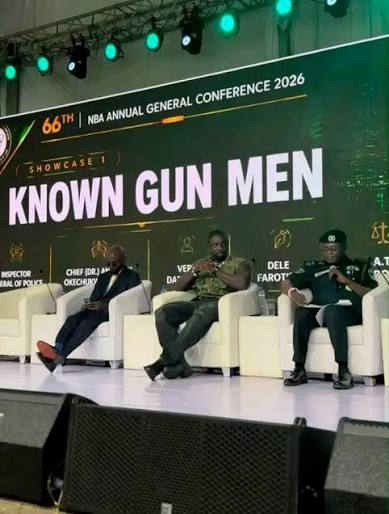
PORT HARCOURT — The controversy surrounding VeryDarkMan’s appearance at the Nigerian Bar Association’s Annual General Conference has outgrown the social-media activist at its centre.
What began as a question about why Martins Vincent Otse, better known as VeryDarkMan (VDM), was invited to address one of Nigeria’s largest gatherings of lawyers has developed into a more consequential argument about the Nigerian Bar itself: Who does the profession listen to, what kind of criticism should it tolerate, and where should it draw the line between public accountability and professional standards?
The disagreement became sharper after human-rights lawyer and legal scholar Prof. Chidi Odinkalu offered an emphatic defence of the NBA’s decision to give VDM a platform.
His description was deliberately provocative.
VeryDarkMan, Odinkalu argued, is “customer feedback.”
The phrase captured the larger argument he was making about the relationship between the legal profession and the people who depend on the justice system.
For Odinkalu, the courts, lawyers and judges do not exist for themselves. They exist to serve citizens. If the public is dissatisfied with the way justice is administered, then the profession cannot decide that criticism is legitimate only when it comes wrapped in legal language, delivered by a senior practitioner or expressed within the conventions of a courtroom.
VDM, in this reading, was not invited because he is a lawyer.
He was invited because he represents a constituency that lawyers rarely hear from at their own professional gatherings: the angry, impatient and often distrustful public that encounters the justice system from the other side of the courtroom.
Odinkalu went further, questioning what he regarded as the selective indignation of some members of the profession.
He pointed to the long-standing allegations of corruption within the justice system, arguing that lawyers who pay bribes to judges and judges who accept them have appeared before NBA audiences without provoking anything approaching the reaction generated by the presence of a controversial social-media activist.
It was a deliberately uncomfortable comparison.
The question behind it is harder still: Has the Bar become more offended by the manner in which citizens criticise the justice system than by the failures that give rise to the criticism in the first place?
That argument, however, has met resistance from within the profession.
Senior lawyer Douglas Ogbankwa, in an open letter addressed to VDM, challenged the legitimacy of according the activist such a platform. His objection was not simply about personality or popularity. It went to the responsibility of a professional association to maintain standards in the way public issues are debated.
For Ogbankwa and those who share his concerns, social-media reach is not a substitute for expertise, evidence or professional accountability. An activist may have an enormous audience and may raise genuine concerns, but that does not automatically make every allegation accurate or every conclusion sound.
There is a legitimate concern here.
The law operates within rules of evidence, procedure and due process for a reason. Accusations that might attract millions of views online still have to withstand scrutiny before they can become findings of fact. The danger of confusing popularity with proof is particularly acute when the subjects are judges, lawyers, police officers or other public officials whose reputations can be damaged by allegations that have not been tested.
Yet the argument does not end there.
Professional standards cannot become a shield against criticism.
The legal profession’s authority ultimately depends on public confidence, and public confidence cannot be commanded by professional title. A citizen who believes a case was mishandled, a police officer acted improperly, a judge behaved unfairly or a lawyer demanded an improper payment does not necessarily have the vocabulary—or the patience—to present the complaint in the measured language of a legal brief.
Sometimes the complaint arrives as anger. Sometimes it arrives as a viral video. Sometimes it arrives through a person like VeryDarkMan.
The profession can dislike the messenger and still have to confront the message.
That is where the dispute over his invitation becomes considerably more interesting than the personality who triggered it.
The NBA is not a debating society. It is a professional body with statutory responsibilities and a long institutional history. Its conferences are expected to promote legal education, professional development and serious discussion of issues affecting the administration of justice.
But the Bar also occupies a special place in Nigerian public life. Lawyers routinely appear before courts to challenge government decisions, defend individual rights, expose abuses of power and demand accountability from institutions.
It would be difficult, therefore, to insist that the public should remain silent when those same institutions come under criticism.
The more useful question is whether the Bar can listen without surrendering its standards.
That is the balance at stake.
There is nothing inherently undignified about hearing an outsider. Nor does giving someone a platform amount to endorsing everything that person has said or done. Indeed, an audience of lawyers should be particularly capable of listening critically, testing assertions and separating evidence from rhetoric.
The invitation could therefore be viewed not as a lowering of standards but as a test of confidence in them.
If the Bar believes its institutions can withstand scrutiny, why should an outspoken critic be considered too dangerous to hear?
But the opposite argument deserves equal consideration. If a professional conference becomes a stage where unverified allegations are amplified without challenge, the NBA risks weakening the very standards it exists to protect.
The answer cannot be to silence either side. It should be to interrogate the claims.
That is what makes the Odinkalu-Ogbankwa disagreement worth watching. They are not merely arguing about VeryDarkMan. They are advancing competing ideas about the relationship between the Bar and the society around it.
One sees the outsider’s voice as evidence of what the profession needs to hear.
The other sees the uncontrolled outsider’s voice as a threat to the discipline that gives the profession its authority.
Both arguments contain a warning.
A Bar that refuses to listen to public anger can become detached from the society it serves. A Bar that abandons professional standards in the pursuit of popularity can lose the authority it needs to speak credibly about justice.
VeryDarkMan has therefore become something more than a controversial guest at the NBA’s 2026 conference in Port Harcourt.
He has become a mirror.
What members of the Bar see in that mirror may depend on where they stand.
For some, it is a reminder that citizens are tired of being spoken about without being heard.
For others, it is a warning that professional institutions cannot allow social-media influence to replace evidence and expertise.
And for the NBA itself, the controversy presents a question that will survive the conference long after the microphones have been switched off:
Can the Nigerian Bar open its doors to the anger of the public without losing the discipline of the profession?
That is a much bigger question than whether VeryDarkMan deserved an invitation.