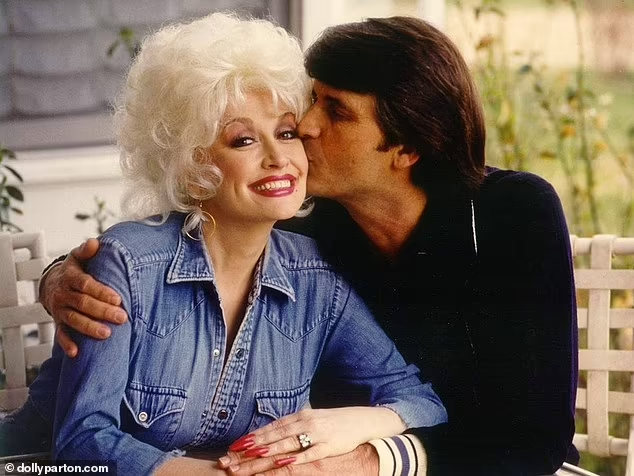
Dolly Parton (1946–2026): The Country Girl Who Conquered the World Without Ever Leaving Home
By Lillian Okenwa
The measure of Dolly Parton’s life was never the glitter, the rhinestones or even the extraordinary success. It was the improbable journey from a crowded cabin in the Smoky Mountains to the front rank of world music, achieved without losing the humility, generosity and storytelling gift that first carried her beyond the hills of Tennessee. Over six remarkable decades, she did more than make records. She changed the sound of country music, wrote one of the greatest songs of the twentieth century and left behind a body of work that will long outlive the applause.
There are artists whose careers are measured by awards, record sales or chart positions.
Dolly Parton’s legacy resists that kind of accounting.
It lives in songs that have outlasted generations, in millions of children who learned to love books because she quietly mailed them one every month, and in a remarkable life that carried her from a one-room cabin in the mountains of Tennessee to the summit of global popular culture without ever asking her to abandon the values that shaped her.
Parton, who has died at the age of 80, spent more than six decades recording music, releasing over 50 studio albums and writing more than 3,000 songs, a catalogue that placed her among the most accomplished songwriters of the modern era. She sold well over 100 million records, won multiple Grammy Awards and built an entertainment empire that stretched from Nashville to Hollywood, Broadway and beyond.
Yet statistics explain very little about Dolly Parton.
She became a global icon because she understood something many gifted musicians never do: Great songs are not performances; they are conversations.
She sang to people, not at them.
Long before country music became fashionable outside the United States—before Nashville emerged as an international destination and before streaming carried Appalachian ballads into homes across Africa, Europe and Asia—Dolly Parton had already proved that stories rooted in one corner of America could speak to the rest of the world.
She made country music travel.
More importantly, she made people who had never listened to country music believe it belonged to them.
That achievement becomes even more remarkable when viewed against where her story began.
Born Dolly Rebecca Parton on January 19, 1946, she was the fourth of twelve children born to Robert Lee Parton and Avie Lee Owens. The family lived in severe poverty in a tiny cabin in the Great Smoky Mountains of Tennessee, often without many of the comforts that most Americans took for granted. Those early years never left her. They became the emotional landscape of songs such as Coat of Many Colors, one of the most moving reflections ever written about dignity in poverty.
Her success never persuaded her to rewrite that history.
Instead, she wore it proudly.
Throughout her career she spoke with affection about her parents, her eleven siblings and the crowded household that taught her resilience, humour and generosity long before fame arrived.
Music transformed her life, but family shaped it.
The public often remembered the rhinestones, towering blonde hair and effortless wit.
Professional musicians noticed something else.
Behind the glamour stood an exceptional songwriter.
She could compress heartbreak into three verses, tell a complete story in under four minutes and write melodies so deceptively simple that they felt as though they had always existed.
Few songs illustrate that gift better than I Will Always Love You.
Popular memory associates the song with Whitney Houston’s breathtaking performance in The Bodyguard, one of the defining recordings of the twentieth century. The version became a worldwide phenomenon, selling millions of copies, dominating international charts and helping transform Houston into one of the most celebrated voices in music history.
But the song began somewhere far more intimate.
Parton wrote it in 1973, not as a romantic ballad but as a farewell to Porter Wagoner, the mentor with whom she had worked before deciding to pursue her own career. It was a song about gratitude, independence and the pain that sometimes accompanies necessary endings.
Nearly twenty years later, Whitney Houston gave it another life.
Parton never treated Houston’s astonishing success as something taken from her. Instead, she celebrated it, often saying that Whitney’s interpretation had introduced the song—and its writer—to audiences around the world who might otherwise never have heard either.
Only a songwriter secure in her own greatness could rejoice so completely in another artist’s triumph.
That generosity extended far beyond music.
Although she and her husband, Carl Dean, never had children of their own, Parton devoted much of her fortune to helping other people’s children. Through her Imagination Library, she placed millions of free books into the hands of young readers across several countries, believing that literacy offered opportunities that poverty could not erase. She often remarked that while she had no biological children, she felt she had been given millions of children to love.
Her marriage to Dean became one of the quiet miracles of modern celebrity.
They met outside a Nashville laundromat in 1964, married two years later and remained together for almost six decades. Dean shunned publicity with extraordinary consistency, choosing a private life while his wife became one of the most recognisable entertainers on earth. Their relationship survived not because it demanded attention but because it seemed content without it.
When Carl Dean died in March 2025, those close to Parton sensed a change.
She continued working, continued smiling and continued making plans.
But she also acknowledged that life had become quieter.
She honoured him in the language she trusted most, recording If You Hadn’t Been There, a deeply personal tribute to the man she described as the love of her life.
Now, barely a year later, she has followed him.
Read Also: The truth behind Dolly Parton’s hit Jolene and how it was inspired by husband Carl Dean
Read Also: Inside Dolly Parton’s intensely private marriage to Carl Dean and why they never had kids
History will remember Dolly Parton as the Queen of Country.
That title, distinguished as it is, scarcely captures the scale of her achievement.
She helped move country music beyond its traditional audience without stripping it of its identity. She demonstrated that commercial success need not come at the expense of authenticity. She became one of the rare entertainers admired as much for her character as for her talent.
Many singers produce hit records.
Very few alter the direction of an entire genre.
Fewer still write songs that continue to find new voices long after they first leave the page.
Dolly Parton did all three.
And whenever I Will Always Love You is heard again—and it surely will be—many listeners will think first of Whitney Houston’s incomparable voice.
Then they will remember the woman who wrote the words.
In the end, that may be Dolly Parton’s greatest triumph.
The world never had to choose between the songwriter and the singer.
It was fortunate enough to have both.