



By Nick Agule
Sir, your assertion that by devaluing the Naira, the Tinubu government has hit a “perfect sweet spot” (because a weak Naira has made Nigerian goods to become cheaper on global markets, thus generating an export surge) only holds water if our exports consistently exceed imports.
But when imports dominate as they currently do, the supposed gains from exports vanish, and the forex reforms (devalued Naira) become yet another burden on ordinary Nigerians through high imported inflation!
Before a weaker Naira can translate into export gains, Nigeria must first confront and resolve its deep structural deficiencies. Without fixing the fundamentals – power, infrastructure, production capacity, and regulatory bottlenecks, all underpinned by the rule of law – currency devaluation only amplifies hardship, not competitiveness.
With just 5kMW for 240 million people, industrialisation is stillborn! No country in history has industrialised on the back of generators or fragmented power solutions. Only robust grid solutions can ignite real industrial growth.
The power crisis can be tackled with 3 decisive moves:
- Unbundle transmission
- Fix the DISCOs
- Put the private sector in the driving seat and let capital efficiency lead (note: the President Jonathan’s so-called privatisation of the power sector was a sham that needs to be fixed).
Yet the most seemingly out-of-depth minister in this government is the one in charge of power. Every time he speaks, it’s about tariffs. But Nigeria’s power problem isn’t pricing or tariffs – it’s output.
When MTN & co entered Nigeria’s telecom sector, tariffs weren’t their concern. The real opportunity they saw was in scale. While NITEL was stuck offering 500k lines, MTN & co envisioned 100 million lines and got to work deploying capex to build the infrastructure. Today, they deliver over 200 million lines at a fraction of NITEL’s old tariffs and still remain highly profitable.
The same principle applies to power. If competent, well-capitalised private operators are allowed to lead, they won’t fixate on tariffs either. The real opportunity lies in expanding supply from the current 5kMW to say 100kMW Nigeria actually needs.
Unfortunately, this is the vision the power minister has failed to grasp. His obsession with tariffs has blinded him to the scale of opportunities possible in output growth.
Because something as basic as power is in deficit, while officials spin export figures, we’re importing nearly everything from any product with iron or steel content (because our steel plants are dead), including vehicles, aircraft, arms, building materials, etc. pharmaceuticals and even gas are on our import list while we are flaring our own gas!
As for the touted food exports, one cargo of wheat imported from Ukraine alone wipes out the entire narrative.
Another huge import not attracting mention is – seats on flights. Right now, as I type, Nigerians are idling away in Addis Ababa, Nairobi, Casablanca, Cairo, Maroc, Istanbul, Doha etc – doing nothing but waiting for connecting flights to Europe, America or Asia. The cost of importing airline seats alone dwarfs whatever exports we’re boasting about.
Until we confront the structural deficits in our economy – power, production, infrastructure, security, law and policy, etc. – export optimism remains daydreams!
Tariffs won’t build factories. Speeches won’t revive steel. And forex tweaks won’t industrialise a nation running on fumes. Nigeria doesn’t need cosmetic reforms. We need courage, competence, and a complete reset and perhaps some prayers!
Nick Agule is a Nigerian citizen passionate about good governance and the deepening of our democracy.
See the DG’s article in the comments of this post: https://www.facebook.com/share/p/1BCcTR2myn/
Nick Agule
Email: [email protected]
X: @NickAgule
Facebook: Nick Agule, FCA
05.09.2025
The views expressed by contributors are strictly personal and not of Law & Society Magazine.



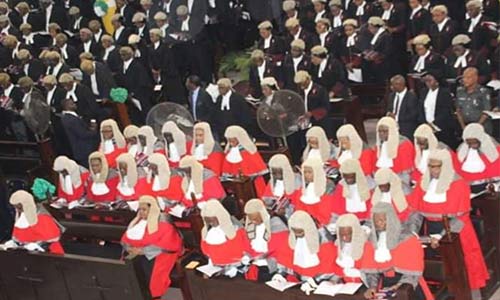


A weak Naira only helps if exports exceed imports—otherwise, it worsens the burden on Nigerians.