Nigeria’s chronic underrepresentation of women in elective office came under renewed scrutiny on Thursday as leading lawyers, gender advocates, lawmakers and development experts insisted that the proposed Reserved Seats Bill offers the country an opportunity to correct one of the deepest democratic deficits in its political history.
Speaking during a webinar organised by the Parliamentary Committee of the FIDA Nigeria Abuja Branch, participants argued that the legislation is neither a privilege nor an act of charity for women but a temporary constitutional mechanism designed to dismantle structural barriers that have kept half of Nigeria’s population almost entirely absent from legislative decision-making.
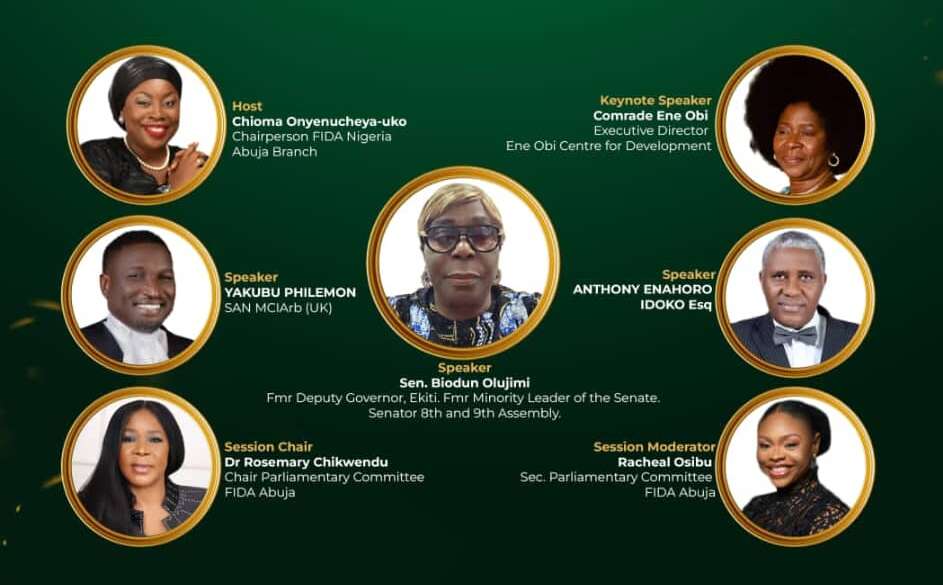
The virtual dialogue, themed “Exploring the Importance of the Reserved Seats for Women Bill,” brought together senior members of the legal profession, former legislators, civil society leaders and advocates for constitutional reform, all of whom urged sustained advocacy to ensure the passage of the proposed amendment.
Chairperson of the FIDA Abuja Parliamentary Committee, Dr. Rosemary Chikwendu, set the tone by confronting what she described as one of Nigeria’s greatest democratic contradictions.
While women constitute well over half of Nigeria’s population, she observed, they occupy barely 4.4 per cent of elective legislative seats across the federal and state legislatures—approximately 64 positions out of about 1,460 available seats. By comparison, she noted, more than 30 African countries have already crossed the 20 per cent threshold for female parliamentary representation, while countries such as Rwanda (63.8%), South Africa (44.7%), Cabo Verde (44.4%), Ethiopia and Senegal (about 41%) have demonstrated that deliberate constitutional and legislative reforms can substantially improve women’s political participation.
Dr. Chikwendu stressed that the Reserved Seats Bill is often misunderstood.
She explained that the proposal is not intended to permanently reserve political offices for women, nor would it suddenly produce gender parity. Rather, if passed, it would increase women’s representation to about 13 per cent, providing what she described as a realistic foundation upon which broader political inclusion could gradually be built.
“This will not solve every problem overnight,” she noted. “It is simply a starting point.”
Serving as moderator, Rachel Osibu walked participants through the contents of the proposed constitutional amendment, explaining that the bill seeks to create additional temporary legislative seats for women at the federal and state levels as an affirmative action measure until greater political balance is achieved through the normal electoral process.
Delivering the keynote address, renowned gender advocate and Executive Director of the Centre for Development, Comrade Ene Obi, challenged what she described as deeply entrenched cultural stereotypes that continue to frustrate qualified women seeking elective office.
Recalling a recent political experience, she narrated how a highly qualified female aspirant was pressured to withdraw her ambition in favour of a male candidate despite clearly possessing stronger credentials, arguing that such experiences remain commonplace across Nigeria’s political landscape.
She warned that Nigeria’s democratic record on women’s representation has steadily deteriorated rather than improved.
According to her, the country recorded its highest number of elected female federal lawmakers during the 2007 general elections, when 36 women entered the National Assembly—nine Senators and twenty-seven members of the House of Representatives—representing about 7.7 per cent of the legislature.
Nearly two decades later, however, the numbers have continued to decline. The Ninth National Assembly had only 19 women, while the current Tenth Assembly has fallen even lower, with only 18 female lawmakers, making Nigeria one of the poorest performers globally in women’s parliamentary representation.
Obi maintained that the Reserved Seats Bill should therefore be viewed as a temporary corrective mechanism rather than a permanent entitlement.
“The objective is not to replace men,” she argued. “It is to build a more representative democracy. Once an acceptable balance is achieved, such extraordinary measures naturally become unnecessary.”
Calling on the Nigerian Bar Association (NBA) to actively support the legislation, she described the proposal as fundamentally an issue of social justice, insisting that legal practitioners have a responsibility to champion reforms capable of strengthening constitutional democracy.
She also criticised what she described as the National Assembly’s inconsistent attention to issues affecting ordinary Nigerians, expressing concern over frequent legislative recesses and poor attendance during debates on critical national reforms.
“Our democracy requires sustained civic engagement,” she said. “Citizens cannot afford to become spectators.”
Quoting former United Nations Secretary-General Kofi Annan, she reminded participants that “there is no tool for development more effective than the empowerment of women” and that no national development strategy benefits society more than one that places women at its centre.
Former Deputy Governor of Ekiti State and former Senate Minority Leader, Senator Biodun Olujimi, drew from her own political journey to encourage women not to retreat from public life despite the obstacles confronting them, insisting that persistence, preparation and institutional reforms must work together to expand women’s participation in governance.
Senior Advocate of Nigeria Yakubu Philemon approached the issue from a constitutional perspective, arguing that Nigeria’s legal framework already prohibits discrimination based on gender and should therefore support stronger affirmative measures to achieve substantive equality.
He recalled the landmark judgment delivered by Justice Donatus Okorowo of the Federal High Court in April 2022 directing the Federal Government to implement the 35 per cent affirmative action policy in public appointments, describing the decision as an important judicial affirmation of inclusive governance.
Vice Chair of NBA Abuja, Unity Bar, Anthony Enahoro Idoko challenged assumptions that political leadership is naturally the preserve of men, insisting that competence, rather than gender, should determine who occupies public office.
Drawing inspiration from civil rights scholar Angela Davis, he argued that societies only progress when they refuse to accept injustice as normal, maintaining that excluding women from leadership impoverishes governance itself.
The webinar also attracted several distinguished members of FIDA, including the association’s immediate past Country Vice President, Amina Agbaje, alongside lawyers, academics and civil society advocates from across the country.
International President of FIDA, Ezinwa Okoroafor, described the campaign for the Reserved Seats Bill as part of a broader global struggle for equal representation, noting that meaningful democracy cannot exist when women remain systematically excluded from the institutions where laws are made. She commended the Abuja Branch for sustaining conversations capable of influencing national policy and urged members to transform advocacy into coordinated action until the constitutional reforms are achieved.
Bringing the event to a close, Chairperson of FIDA Abuja Branch, Chioma Onyenucheya-Uko, said the discussion underscored why legal practitioners must remain at the forefront of constitutional reforms that promote equality, justice and inclusive governance. She urged participants not to allow the momentum generated by the webinar to fade, emphasising that lasting change would require sustained engagement with lawmakers, political parties and citizens across the country.
Mrs. Adejoke Layi-Babatunde, the National Chair person of FIDA Nigeria’s parliamentary committee, expressed appreciation to the speakers and participants for enriching the conversation, describing the overwhelming response to the webinar as evidence of growing national support for reforms that seek to expand women’s participation in governance. She reaffirmed the committee’s commitment to continuing public education and advocacy until the Reserved Seats Bill receives the legislative support necessary to become part of Nigeria’s constitutional framework.
For many participants, the webinar ultimately reinforced a simple but compelling proposition: the Reserved Seats Bill is not about conferring special privileges on women. It is about strengthening representative democracy by ensuring that Nigeria’s legislative institutions more accurately reflect the society they were elected to serve.