By Philip Ayazi, Esq.
The above write up by one Sunny Igbonugo (The Tiny Voice) makes interesting reading. Not for felicity of language or the allure of logic, but for blatant inaccuracies being passed off as the truth.
The writer certainly did not get his facts right, which gives the disturbing impression that he did not even read the actual text of the judgments upon which the writeup is anchored.
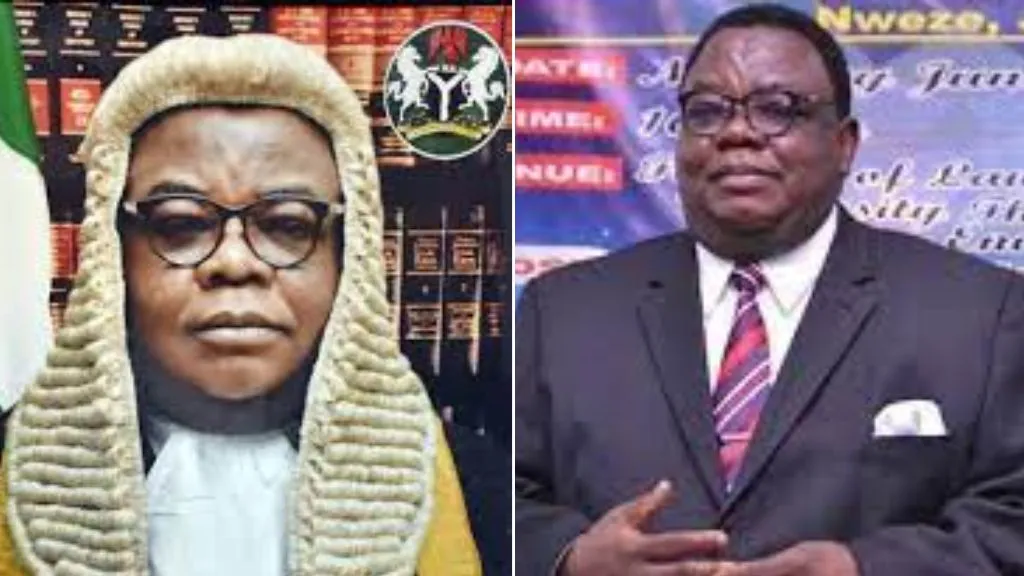
It is simply not correct that Hon Justice Chima Centus Nweze, JSC was on the seven-man panel of Justices that sacked Emeka Ihedioha, and pronounced Hope Ozodinma as Governor of Imo State.
It was only upon the retirement of a member of that panel (Sanusi, JSC) that C. C. Nweze JSC was drafted in as replacement to hear the review application, in which he wrote the dissenting opinion referred to.
Since C. C. Nweze JSC did not take part in the sacking of Emeka Ihedioha, his Lordship had no “earlier position” that was subsequently “disavowed” in the review application.
Everyone is entitled to his opinion, but certainly not to his own facts. Facts are sacred. Any writer who distorts facts loses legitimacy.
There is no gainsaying that his Lordship’s subsequent decision in the case involving Ahmed Lawan was very controversial. However, it is extreme exaggeration to characterise Lawan’s case as “no less impactful and damaging to Nigeria’s legal jurisprudence” as the Uzodinma case.
Uzodinma’s case was a unanimous decision of a seven-man panel (technically called a full court) in which a candidate who scored a distant 4th position was catapulted to the top. It was unprecedented, hence Nweze wrote in his scathing decent that the decision would “haunt our electoral jurisprudence for a long time to come”.
But Lawan’s case was a 3:2 split decision by a panel of five justices. The two cases are poles apart, akin to the comparison between apples and oranges. The only similarity is that both are political cases involving high profile litigants that generated a great deal of public interest.
The narrow issue in Lawan’s case (initiated by originating summons) was whether allegations bordering on criminality can be be resolved on the basis of affidavit evidence without calling oral evidence.
C. C. Nweze JSC and his two co-travelers in the majority answered in the negative, whilst the two other Justices in the minority thought otherwise.
The minority had their say and the majority had their way. That is simply how disagreements are resolved in a multi-member panel of Judges/Justices.
In the leading judgment Nweze JSC pointed out that the bedrock of the suit revealed allegations of fraudulent practices as the 1st respondent (Machina) accused the APC of fraudulently substituting his name with that of Ahmed Lawan. Consequently, his lordship held that in light of the allegation of fraud, the case ought not have been commenced (or determined) by an originating summons, insisting that there was need to call witnesses to prove the allegation of fraud.
A litany of decided cases lend credence to the stance taken by the majority.
The minority however harped on the fact that Lawan had contested the presidential primary election of the APC and was ineligible to participate in the senatorial primary election, which was not the issue before the Supreme Court!
The point to vigorously underscore is that no two judges or lawyers see things from the same perspective, and the fact alone that C.C. Nweze JSC pitched tent with the majority in holding that criminal allegations (fraud) are ill-suited for resolution by way of originating summons without calling oral evidence certainly did not make him the villain the writer craned to project.
After all, Nweze JSC was only one of three justices in the majority, but no scathing remark was directed at the other two justices. For reasons best known to the writer, Nweze JSC was singled out for undeserved vilification. Perceptive readers deserve to know why.
I will not hazard a guess on the motives of the writer (who, incidentally, is Nweze’s kinsman of Igbo extraction), but something does not ring right!
The Hon Justice C. C. Nweze JSC is (not was) arguably one of the most cerebral judicial personages Nigeria has produced. His Lordship’s legal publications and judicial pronouncements (whether as lead judgments or contributions) as a Justice of the Court of Appeal and the Supreme Court of Nigeria bear eloquent testimony to an extraordinary man whose searing intellect and strength of character can scarcely be diminished by the fact that he was part of the majority in Lawan’s case.
Notwithstanding unwarranted vitriolic attacks and aspersions in write-ups such as the present, Hon. Justice C. C. Nweze, JSC occupies (and will continue to occupy) pride of place in the judicial Hall of Fame alongside formidable jurists like Oputa, Kayode, Eso, Bello, Obaseki, Aniagolu, Niki Tobi, et al.
The assertion that C. C. Nweze, JSC died as a “broken man” is a monumental disservice to the memory of a man who became a legend in his own lifetime.
I will excuse the author’s understandable lack of awareness that his Lordship had battled debilitating illness for more than a decade and half before eventually succumbing to the cold hands of death,
peacefully, on 30/7/2023 after undergoing a not-so-successful major surgery!
The writer and other self-appointed public commentators of his ilk should refrain from disturbing the peaceful repose of a great soul, the lachets of whose sandals they may not be worthy to untie.
Philip Ayazi, Esq.
The views expressed by contributors are strictly personal and not of Law & Society Magazine.