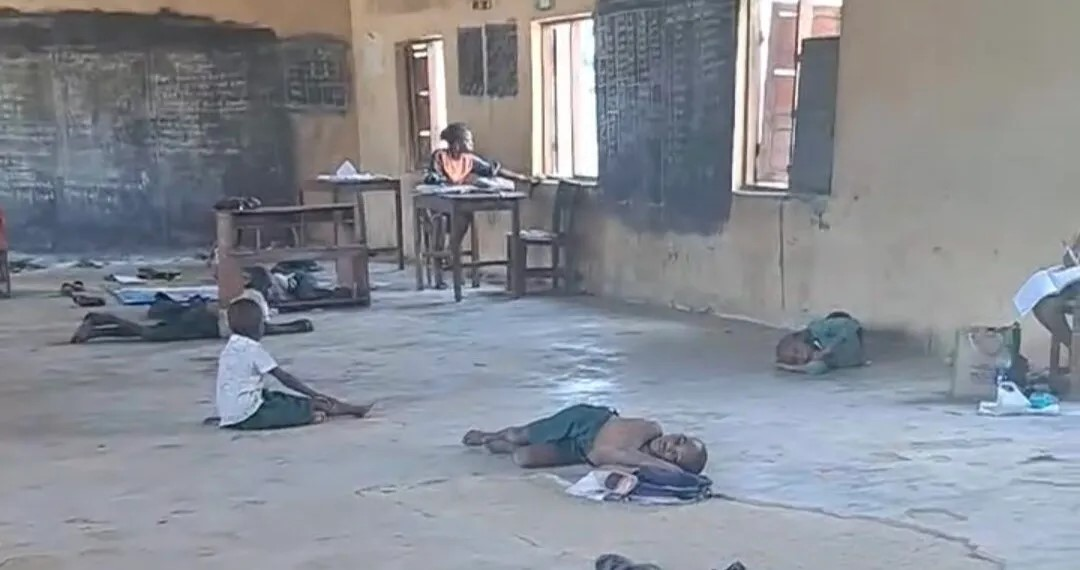
A troubling video from a public primary school in Ibiaku Itam, Itu Local Government Area of Akwa Ibom State, has ignited outrage across social media — and reopened uncomfortable questions about governance priorities in one of Nigeria’s highest-earning states.
The footage from Primary School, Ibiaku Itam in Ikot Mbonde Community, shows a classroom stripped to its barest form. Only four functional dual desks are visible. Four pupils squeeze into spaces meant for two. Others sit on cracked concrete floors, hunched over exercise books. Some lie on their stomachs to write. A few perch on broken planks. Their teacher, without a table, balances on a stool.
Windows hang loosely from their frames. The roof sags. The floor is fractured.
It is a scene one might expect in a remote, conflict-ravaged outpost. Instead, this school sits within the orbit of Uyo, the state capital — in oil-rich Akwa Ibom.
Model Schools vs. The Forgotten Majority
According to the 2022 approved budget, Akwa Ibom has 1,164 public primary schools. The administration of Governor Umo Eno has embarked on constructing 31 “model” primary schools — one in each local government area. Some have been completed and boast modern structures and seating.
But once those 31 schools are removed from the equation, 1,133 remain. Many are in various states of neglect.
Primary School, Ibiaku Itam, education stakeholders say, is not an isolated case. It is symptomatic.
Budget documents reviewed show repeated allocations for classroom furniture — but little evidence of execution.
In the 2023 revised budget, N16 million was approved for dual desks and plastic tables and chairs for pupils. The Budget Performance Report covering January to September 2023 recorded no expenditure on those items.
In 2024, N12 million was again budgeted for 1,000 dual desks and 50 plastic tables/chairs. Between January and September 2024, expenditure again stood at zero.
No publicly available records clarify whether spending occurred in the final quarters of 2023 or 2024. Requests for clarification to the Commissioner for Education, Ubong Umoh, and the Chairman of the State Universal Basic Education Board (SUBEB), Anietie Etuk, have yet to yield detailed responses.
For 2025, allocations were fragmented across multiple line items, including N1.6 million for 1,000 dual desks and several million more for plastic chairs and tables. Yet the state has not published its 2025 Budget Performance Report.
The question lingers: were the desks ever bought?
Record Revenue, Questioned Priorities
In 2025, Akwa Ibom recorded its highest-ever revenue — N1.134 trillion — while total spending reached N1.330 trillion.
Among the most prominent expenditures was the donation of 10 luxury SUVs to former deputy governors and political party leaders. Each vehicle, according to the 2025 approved budget, costs N100 million, totalling N1 billion.
At the state’s own procurement benchmark — roughly N40,000 per pupil table/chair — that N1 billion could procure at least 25,000 seats.
Twenty-five thousand seats would not merely furnish a classroom; they could transform learning conditions across dozens of schools.
Instead, in Ibiaku Itam, children sit on the floor.
Civil society advocates say the optics are troubling.
“When children sit on bare floors to learn, it sends a powerful psychological message,” said Akanimo Sampson of Rebuilders Foundation. “It tells the child their comfort and dignity are not important.”
She added that in a system where luxury vehicles are routinely provided for political elites, the absence of basic classroom seating cannot credibly be blamed on lack of resources.
“It reflects a deeper governance failure — a misunderstanding of what truly drives development.”
Billions to Councils, Silence on Accountability
Primary education is also a constitutional responsibility of local governments under Nigeria’s 1999 Constitution. Itu Local Government Area received N4.62 billion in FAAC allocations between January and November 2025, excluding internally generated revenue.
Yet no local government in the state publishes its budget online, despite requirements under the Akwa Ibom State Fiscal Responsibility Law mandating transparency.
Efforts to obtain clarification from Itu council chairperson Ubong Nkutt were unsuccessful.
The silence reinforces a broader concern: public funds flow, but accountability lags.
Experts Warn of Lasting Damage
Idongesit Archibong, a professor of Early Childhood Education at the University of Uyo, described the situation as “inhuman.”
“For effective learning, method, environment and content must align,” he said. “If a child is uncomfortable, concentration drops. The demonstration method becomes difficult. Participation suffers. It is very bad to allow kids to sit on the floor in primary school.”
He posed a pointed question: Would public officials allow their own children to learn this way?
Education experts warn that discomfort is not merely an inconvenience; it shapes self-worth, motivation and long-term outcomes.
Learning, they argue, is cognitive, physical and emotional.
A Pattern of Neglect
This is not the first alarm bell.
In 2018, investigative reports detailed how corruption and poor budget implementation contributed to the near collapse of public education in the state. Infrastructure decayed. Teachers went unpaid. Students endured squalid conditions.
Years later, despite record revenues, the fundamentals appear unresolved.
Historic Neglect Mirrors Classroom Crisis
The pattern of neglect extends beyond classrooms.
The historic Amalgamation House in Ikot Abasi — where Lord Frederick Lugard signed the 1914 documents uniting Nigeria’s Northern and Southern Protectorates — now stands in visible decay. Wooden structures rot. Artefacts deteriorate. Surrounding colonial landmarks crumble.
The site, potentially a tourism and heritage hub, languishes unattended.
Critics see symbolism: a state rich in oil revenue, yet struggling to maintain both its history and its classrooms.
A Second Chance in 2026?
The 2026 budget shows increased allocations for school furniture and, for the first time, explicitly names beneficiary schools. Hundreds of dual desks are approved for select institutions across several local government areas.
Specificity marks progress.
But history tempers optimism. This is not the first time funds have been earmarked.
For pupils in Ibiaku Itam and hundreds of other schools, the issue is not allocation on paper — it is execution on the ground.
In a state that can afford N100 million SUVs, the image of children lying on concrete floors to learn may become the defining question of governance:
The question now is, what truly matters?
Watch the video below.