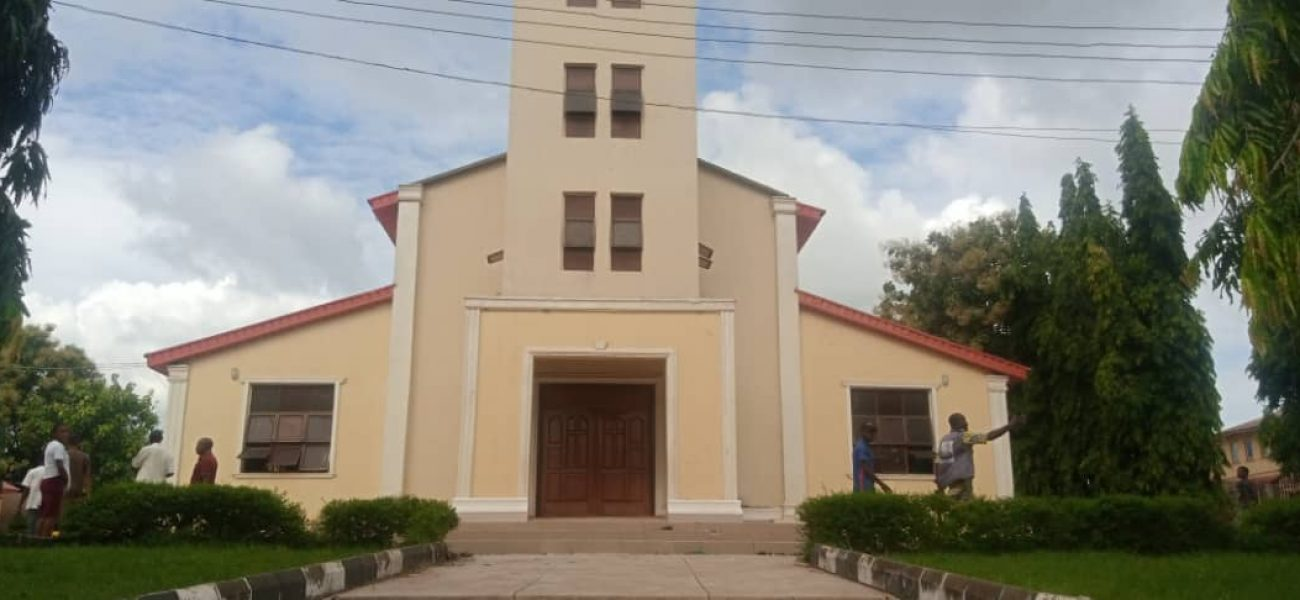
Nearly four years after gunmen stormed St. Francis Catholic Church and massacred worshippers in one of Nigeria’s deadliest church attacks, operatives of the Department of State Services (DSS) say they have arrested a sixth suspect linked to the atrocity.
But as authorities celebrate what they describe as a “significant milestone,” fresh violence has once again rattled Ondo State. Gunmen have abducted six worshippers from a Celestial Church in Uso, along the Owo–Akure Expressway.
For many residents, the haunting question lingers: What use is justice years later if insecurity still ravages the state and worshippers remain unprotected?
The Long Hunt for a Fugitive
The June 5, 2022 attack on St. Francis Catholic Church left more than 40 people dead and over 140 injured, sending shockwaves across Nigeria and beyond.
Five suspects—Idris Omeiza (25), Al Qasim Idris (20), Jamiu Abdulmalik (26), Abdulhaleem Idris (25), and Momoh Otuho Abubakar (47)—are already standing trial for terrorism-related offences.
For nearly four years, however, a sixth suspect allegedly evaded capture.
Security sources say DSS operatives finally tracked down Sani Yusuf in Iguosa community, along Powerline in Ovia North Local Government Area of Edo State. According to security analyst Zagazola Makama, Yusuf is believed to be a high-profile commander of the Islamic State West Africa Province (ISWAP).
Investigators allege he slipped into Kano after the Owo massacre before relocating quietly to Edo State.
Security sources claim Yusuf has confessed to participating in the planning and execution of the church attack. He is also alleged to have admitted involvement in the July 2022 Suleja military barracks attack, the Zuma Rock checkpoint assault that killed five soldiers, and multiple kidnapping operations in Kaduna State.
Officials describe the arrest as a breakthrough in dismantling ISWAP-linked networks operating in southern Nigeria.
Inside the Courtroom: How the Attack Was Planned
At the Federal High Court in Abuja, a senior DSS official testified in vivid detail about how the Owo attack was allegedly orchestrated.
The prosecution witness, identified as “SSI,” a Deputy Director in charge of Terrorism Investigation, told the court that the accused were members of an ISWAP-affiliated faction described as Al-Shabab.
According to the testimony, a planning meeting was allegedly held on May 30, 2022, at a secondary school in Ogaminana, Kogi State. The directive, the court heard, was explicit: attack the Catholic church in Owo on Sunday and kill the presiding priest.
Weapons, including five AK-47 rifles, magazines, ammunition, and explosive devices, were allegedly supplied ahead of the attack. On June 5, the assailants reportedly drove to Owo in a Volkswagen Golf, concealed their weapons in a sack, and opened fire inside and outside the sanctuary.
Justice Emeka Nwite admitted DSS investigation reports, autopsy findings, and photographic evidence into the court record.
For survivors and families of victims, the trial represents a slow march toward accountability.
But outside the courtroom, insecurity remains a lived reality.
Fresh Fear: Six Worshippers Abducted
In the early hours of February 25, 2026—around 12:50 a.m.—gunmen invaded a Celestial Church during a night service in Uso, Owo Local Government Area.
According to the Ondo State Police Command, six worshippers were abducted and taken to an unknown destination.
Police spokesperson DSP Abayomi Jimoh said security operatives, in collaboration with the Nigerian Army and local vigilante groups, launched a coordinated rescue effort. One victim has since been rescued, and a suspected informant has been arrested.
Operations to rescue the remaining abductees are ongoing.
Yet for many residents, the attack is chillingly symbolic: the same Owo axis that witnessed the 2022 massacre is once again in the headlines.
Milestone or Mirage?
Security analysts say the arrest of a high-ranking ISWAP operative is operationally significant. It demonstrates intelligence persistence and cross-state tracking capability.
But critics argue that security success cannot be measured solely by arrests years after tragedy.
Ondo, like many Nigerian states, continues to grapple with kidnappings, highway ambushes, and attacks on rural communities. Churches, once considered sanctuaries, are increasingly seen as vulnerable targets.
Residents question whether counterterrorism victories translate into everyday safety.
Justice for the dead, they say, must not eclipse protection for the living.
A State Still on Edge
The Owo massacre was meant to be a wake-up call, an inflexion point in Nigeria’s fight against terrorism spreading southward.
Four years later, a fugitive has been caught. A trial inches forward. Confessions are recorded.
But as gunmen continue to strike, Ondo residents are left confronting a sobering paradox:
If arrests come after bloodshed, who prevents the next attack?
Until that question is convincingly answered, every courtroom breakthrough risks feeling less like closure and more like a reminder of a crisis that refuses to end.