Returning to Port Harcourt after a year of political turmoil, the Nigerian Bar Association’s 2026 Annual General Conference opened with an ultimatum to the nation’s legal establishment: stop playing it safe. From state governors to continental leaders, the message was blunt—an obedient judiciary is a luxury a fragile democracy cannot afford.
PORT HARCOURT — The Nigerian Bar Association (NBA) formally opened its 2026 Annual General Conference in Port Harcourt on Sunday, launching a week of high-stakes deliberations with uncompromising calls from political leaders, jurists, and international figures to fortify state institutions and halt the erosion of judicial independence.
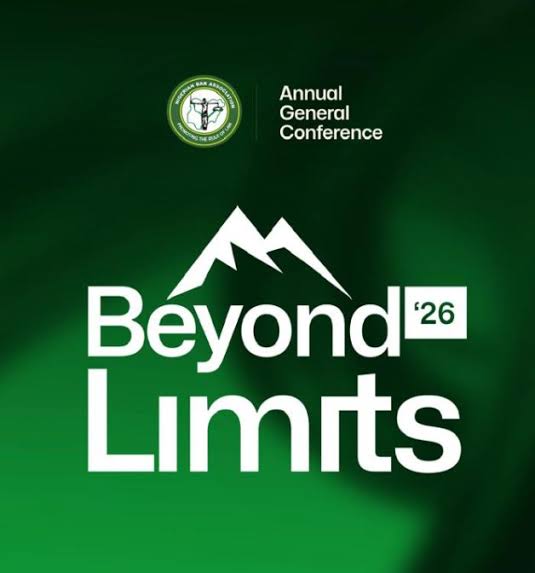
Convened under the theme “Beyond Limits,” the conference brings together top legal practitioners, military commanders, traditional rulers, and civil society leaders to address systemic weaknesses in Nigeria’s democracy, justice delivery, and governance framework.
Judiciary Must Shift from Dispute Settlement to Public Shield
Declaring the conference open, Rivers State Governor Siminalayi Fubara welcomed delegates back to the oil capital—a return made possible following the end of the state of emergency and the restoration of elected democratic governance in Rivers State.
Fubara urged the Bench to abandon comfortable conformity and recognize the far-reaching societal consequences of its decisions.
“Courts cannot function merely as venues for dispute resolution; they must remain the ultimate refuge for ordinary citizens seeking justice. Judges should not be mere conformists if they are to serve as true custodians of the rule of law. Public confidence is restored only when the Bench demonstrates the courage to hold governments and public officials accountable.”
— Siminalayi Fubara, Governor of Rivers State
NBA Defends Principles Over Convenience
Outgoing NBA President Mazi Afam Osigwe, SAN, outlined why the Bar temporarily pulled the Annual General Conference from Port Harcourt in 2025, emphasizing that the decision was rooted in constitutional principles rather than political maneuvering.
- Reaffirming Democratic Norms: The NBA refused to host its annual gathering under an unconstitutional sole administrator following the 2025 emergency declaration, pledging to return only when democratic governance was restored.
- Overcoming Structural Bottlenecks: Osigwe noted that 66 years post-independence, tribalism, sectionalism, and political complacency continue to stymie national growth.
- Shifting from Critique to Solutions: He urged the legal community to move past superficial commentary and offer actionable, structural reforms to the state.
Weah: “Democracy Cannot Survive on Strong Men”
In a fiery keynote address, former Liberian President George Weah warned that democratic collapse rarely happens overnight—it occurs through the steady, quiet decay of constitutional checks.
- Institutional Resilience over Individual Power: Weah stressed that democratic systems do not fail solely through military coups, but through the deliberate weakening of courts, budget manipulation, and judicial intimidation.
- Daily Resistance:“Democracy doesn’t end on election night; it is tested every single day,” Weah cautioned, asserting that a fearless, independent Bar is the primary defense against authoritarian creep.
- The African Reality: Addressing Africa’s developmental deficit, Weah remarked: “We Africans are not short of brilliance; we are short of the infrastructure that makes brilliance accessible.”
Tech, Ethics, and National Security Take Center Stage
Modernizing the Supreme Court
Chief Justice of Nigeria, Hon. Justice Kudirat Kekere-Ekun, represented by the Chief Judge of Rivers State Hon. .Justice Simeon Chibuzor Amadi., highlighted ongoing procedural reforms at the apex court designed to integrate artificial intelligence and digital case management into the Nigerian justice system, urging lower courts to rapidly adopt modern technology.
Security rooted in Human Rights
Maj. Gen. Everest Okoro, representing the Chief of Army Staff, noted that military operations alone cannot secure the nation. He emphasized that durable national security requires a foundational commitment to human rights, due process, and cross-institutional collaboration with the Bench and Bar.
Traditional and Continental Solidarities
- The Shehu of Borno called on lawyers to protect vulnerable citizens and treat legal practice as a public service rather than a commercial enterprise.
- Isaac Semakade, President of the Uganda Law Society, pressed for absolute adherence to human dignity and the constitutional right to defense for all accused persons, regardless of political pressure.
The conference continues throughout the week in Port Harcourt, with technical sessions focusing on judicial reform, legal tech adoption, civil liberties, and national economic stability.