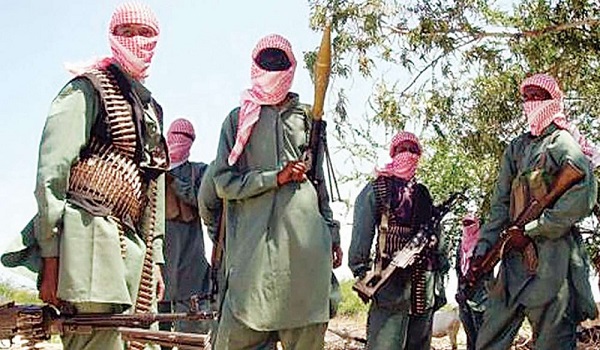
As kidnappings and terrorist attacks intensify across Nigeria, the federal government is facing growing criticism for what observers describe as a widening gap between rhetoric and decisive action.
Rather than announcing major arrests or operational breakthroughs, senior officials have issued a series of disclosures pointing to how armed groups continue to evade state surveillance—raising fresh questions about accountability despite years of heavy security spending.
Weeks after Nigeria’s Minister of Communications, Innovation and Digital Economy, Bosun Tijani, revealed that terrorists were using sophisticated communications technology to defeat government tracking systems, the National Counter Terrorism Centre (NCTC) has now alleged that point-of-sale (POS) operators are facilitating ransom payments to criminal and extremist networks.
Ransom Payments Routed Through POS Terminals
Speaking at an end-of-year media briefing in Abuja on Tuesday, NCTC National Coordinator Maj. Gen. Adamu Laka said investigations into kidnapping and terrorism cases showed that ransom payments are increasingly being routed through POS terminals.
“In many cases, ransom payments are transferred by victims directly to POS operators whose account details are provided by terrorists,” Laka said. “The money is then withdrawn by the criminals.”
His comments come amid a resurgence of kidnapping-for-ransom operations, particularly in northern Nigeria, where armed groups have stepped up attacks on soft targets including schoolchildren and worshippers.
In November alone, Nigeria recorded two separate mass school abductions in Kebbi and Niger states, though the victims were later released.
While the government officially discourages ransom payments, families often pay to secure the release of loved ones. Allegations that the state itself sometimes pays ransom have circulated for years—claims authorities consistently deny.
A Growing, Poorly Regulated POS Network
Nigeria’s POS ecosystem has expanded rapidly in recent years, driven by limited access to formal banking in rural communities and the Central Bank of Nigeria’s (CBN) push for financial inclusion.
Today, thousands of agents provide cash withdrawals, transfers and bill payments on behalf of banks and fintech firms, often operating informally and with minimal oversight.
Although the CBN has issued multiple regulations governing agent banking—including Know Your Customer (KYC) rules, transaction limits and mandatory reporting of suspicious activity to the Nigerian Financial Intelligence Unit (NFIU)—analysts say enforcement remains uneven, particularly in remote areas where criminal networks thrive.
Under existing rules, financial institutions are expected to flag unusual transactions and freeze accounts linked to crime. Critics argue that persistent gaps in supervision have turned POS networks into a weak link in Nigeria’s counterterrorism and anti-kidnapping efforts.
Media Warned as Government Urges “Operational Sensitivity”
Alongside the disclosures, the NCTC urged media organisations to exercise caution in reporting sensitive security information, warning that premature disclosures could compromise investigations and endanger lives.
Laka praised journalists for helping counter extremist propaganda but cautioned that in the age of instant digital virality, the line between public interest and operational security is increasingly blurred.
“Operational details, intelligence-led activities and ongoing investigations are highly sensitive,” he said, warning that criminal groups actively exploit open-source information.
He stressed that the call was not for silence but for responsible judgment, arguing that press freedom and national security are “complementary pillars” of a stable democracy.
Terrorists Using Advanced Tech to Stay Ahead
The NCTC’s comments followed revelations earlier this month by Communications Minister Bosun Tijani, who said armed groups are using advanced call-hopping technology to mask their locations.
“They weren’t using normal towers,” Tijani said during an appearance on Channels Television’s Politics Today on December 12. “They bounced calls off multiple towers and operated from areas with little or no coverage so their signals vanish once they relocate.”
According to Tijani, this tactic allows militants to coordinate attacks from unserved regions, staying several steps ahead of conventional tracking systems.
The government says it is attempting to close the gap by upgrading Nigeria’s communication satellites to serve as backups when ground-based infrastructure fails.
“If our towers are not working, our satellites will work,” Tijani said, noting that Nigeria is the only West African country with its own communications satellites.
Public Anger, Political Pressure—and a Shocking Video
The disclosures have intensified public anger over Nigeria’s massive defence and security spending. Over the past decade, billions of dollars have been allocated to military procurement and intelligence operations, yet armed groups continue to expand their reach, firepower and sophistication.
Political pressure on President Bola Ahmed Tinubu has mounted following his recent declaration of a security emergency. Labour leader Joe Ajaero has accused the administration of failing to deliver tangible results—an allegation the government rejects.
Public confidence was further shaken by a widely circulated but unverified video appearing to show a Katsina State lawmaker entering a forest to negotiate directly with armed bandits without any visible security escort.
In the footage, recorded in Hausa, the politician addresses the gunmen deferentially, referring to their leader as the “Grand Commander of Peace.” He thanks them for allegedly releasing abductees and announces what he describes as an agreement with the group.
The remarks—including calls to halt military operations against “peaceful bandits” and requests for government projects in bandit-controlled areas—have sparked nationwide outrage.
Security analysts warn that if authentic, the video points to a dangerous erosion of state authority and the emergence of armed groups as parallel power structures, exposing the desperation of local officials amid a faltering national security response.