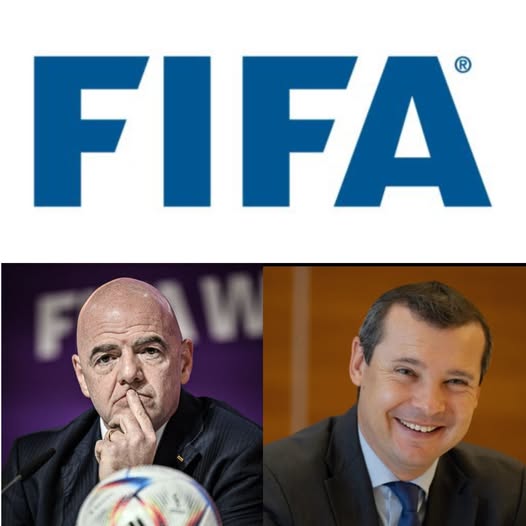
The departure of one of Gianni Infantino’s closest allies is the latest sign that dissent inside FIFA’s corridors of power may be becoming increasingly costly.
The sudden departure of FIFA Chief Operating Officer Kevin Lamour has sharpened concerns about governance, internal dissent and the concentration of power within football’s world governing body, coming just weeks after he publicly criticised President Gianni Infantino’s controversial attempt to transfer some of the organisation’s most valuable commercial assets into a private investment vehicle.
FIFA confirmed on Monday that Lamour’s employment ended on August 17, bringing to an abrupt close the tenure of one of the most influential figures inside its executive structure and a longtime confidant of Infantino.
“FIFA can confirm that the working relationship between FIFA and Kevin Lamour as FIFA’s Chief Operating Officer has ended on 17 August 2026,” a spokesperson for the governing body said.
“FIFA thanks Kevin for his two years of service and wishes him the best of luck for the future. No further comment will be made on the matter.”
The brevity of the statement contrasted sharply with Lamour’s standing within the organisation. He was not an outsider or an inherited executive. Before joining FIFA’s senior leadership team in November 2024, Lamour had been part of Infantino’s successful campaign for the FIFA presidency in 2016 and was widely regarded as one of the president’s trusted lieutenants.
His exit therefore carries significance beyond an ordinary management reshuffle. It follows an unusually public disagreement over the future direction of FIFA and, more fundamentally, over who controls one of the world’s richest sporting institutions.
At the centre of the dispute was Infantino’s proposal to create a new commercial subsidiary that would hold some of FIFA’s most lucrative assets, including commercial rights associated with the FIFA World Cup and other flagship competitions.
The governing body reportedly valued the proposed entity at about $20 billion and planned to sell as much as a 20 per cent stake to private equity investors, a transaction expected to generate approximately $4.2 billion.
Supporters argued that the structure would unlock fresh capital and accelerate investment in football development. Critics, however, questioned whether placing core commercial assets into a partially privately owned vehicle would fundamentally alter FIFA’s character, shifting it further from its role as the custodian of global football towards that of a commercially driven enterprise.
Lamour emerged as the most senior internal voice challenging the proposal.
In remarks that reverberated across the organisation, he accused FIFA employees of being misled and suggested that the initiative reflected the ambitions of a single individual rather than the collective interests of world football.
“Our mission … is to serve football, not to serve the personal interests of a person who, unfortunately, believes he embodies FIFA when he is supposed to be at its service,” Lamour said.
The criticism represented a rare public challenge to Infantino from within his own leadership circle, where internal disagreements have seldom reached the public domain.
His intervention came shortly after the resignation of Carlos Cordeiro, one of Infantino’s senior advisers, who also opposed the proposal, describing it as “a bad deal for football.”
Facing mounting resistance, Infantino ultimately withdrew the plan.
Lamour’s departure nevertheless raises fresh questions about the space for internal disagreement within FIFA at a time when the organisation continues to consolidate unprecedented commercial influence over the global game.
Since assuming office in 2016 on promises of transparency, institutional reform and a break from the governance scandals that engulfed FIFA under previous administrations, Infantino has overseen dramatic growth in the federation’s revenues and expanded its commercial footprint through new competitions and broadcasting agreements.
Those achievements, however, have increasingly been accompanied by criticism from governance experts and former officials who argue that decision-making within FIFA has become progressively more centralised around the office of the president.
Lamour’s exit is unlikely to end that debate. Instead, it is expected to fuel broader questions about institutional governance within international sport: whether senior executives remain free to challenge proposals they believe are contrary to an organisation’s mission, or whether loyalty to leadership has become the defining currency of advancement.
The episode also rekindles a wider conversation about the commercial future of football itself.
As sovereign wealth funds, private equity firms and multinational investors deepen their involvement in the sport, governing bodies face growing pressure to monetise assets that were once regarded as part of football’s collective heritage. For critics of Infantino’s abandoned proposal, the concern was never simply about attracting investment. It was about preserving FIFA’s independence and ensuring that the commercial value generated by the World Cup remains subordinate to the interests of the game rather than those of financial markets.
Whether Lamour’s departure was directly connected to his opposition has not been stated by FIFA. Yet the timing is likely to invite scrutiny far beyond Zurich.
For observers of global sport, the episode underscores a recurring tension that extends well beyond football: institutions often proclaim openness to debate, but the true measure of governance lies in what happens when influential insiders publicly disagree with those at the top.