Fresh claims about Prince Adeniyi Adeyemi’s royal identity emerge as investigators probe how a council the Presidency disowns appeared in Nigeria’s budget and operated from the Federal Secretariat
As criminal proceedings continue against the man accused of running one of Nigeria’s most controversial alleged “ghost agencies,” a resurfaced video has reignited questions that neither the Presidency nor investigators have fully answered.
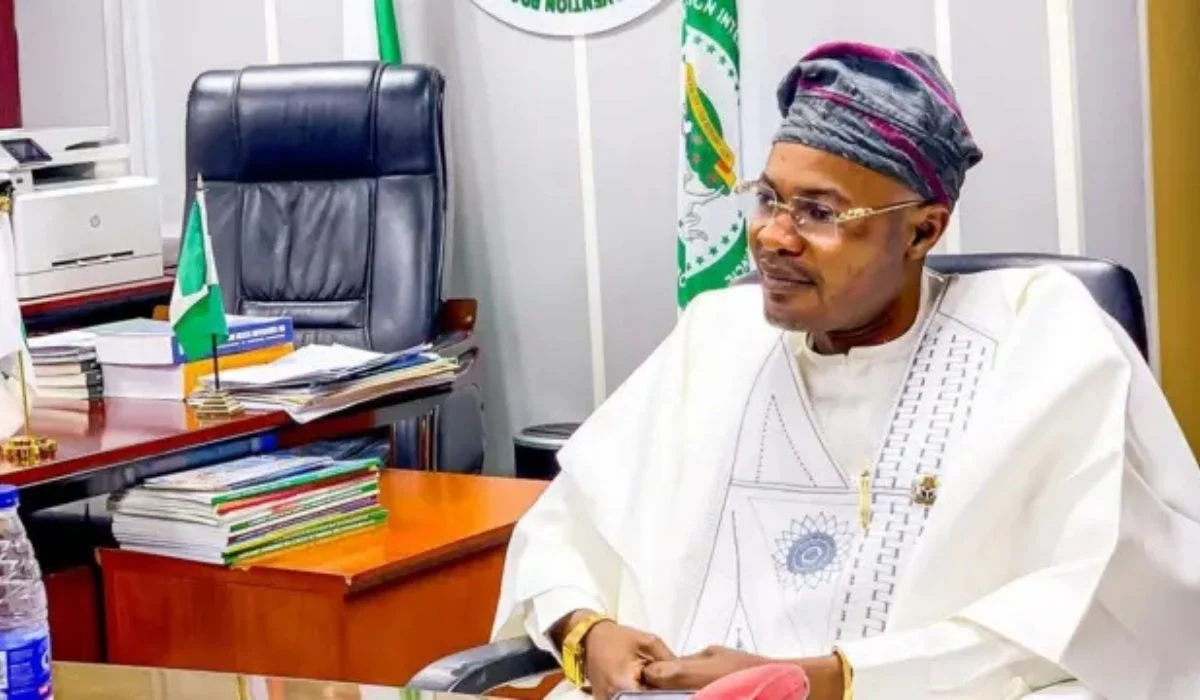
The footage, recorded during a press conference in Abuja in late June but now circulating widely across social media, shows Prince Adeniyi Matthew Adeyemi—the self-proclaimed Director-General of the Presidential Foreign Intervention Promotion Council (PFIPC)—mounting what may be his most detailed public defence yet against allegations that the council never legally existed.
Standing before journalists weeks before his arraignment, Adeyemi did not merely deny wrongdoing.
Instead, he turned his attention to the Federal Government itself, asking what has become the central question hanging over the scandal.
If the Presidential Foreign Intervention Promotion Council was fictitious, how did it find its way into Nigeria’s 2026 Appropriation Act with more than ₦1.3 billion in budgetary allocations?
That question has since become one of the defining mysteries surrounding a controversy that now stretches beyond allegations of forgery and impersonation into the integrity of Nigeria’s budgeting and public finance systems.
The Challenge to the Presidency
During the briefing, Adeyemi questioned the Presidency’s insistence that the council had no legal existence.
He argued that the inclusion of the PFIPC in official budget documents could not have occurred accidentally.
“The national budget does not emerge in isolation. It passes through multiple layers of technical drafting, executive coordination, ministerial inputs, Budget Office review and legislative scrutiny by both chambers of the National Assembly,” he said.
He continued:
“The question becomes unavoidable: At what point in this process did references to a non-existent agency enter the official record? And if they are indeed present in official documentation, what does that imply about the integrity of the process that produced and approved those documents?”
Adeyemi also maintained that the council operated official accounts with the Central Bank of Nigeria, including a Treasury Single Account (TSA), a domiciliary account and a sterling account.
“Is it even possible to open an account with fictitious documents in a commercial bank in Nigeria today, let alone the Central Bank?”
Perhaps his most explosive allegation was directed at the Chief of Staff to the President, Femi Gbajabiamila.
Adeyemi alleged that the Chief of Staff demanded 48 per cent of the council’s proposed ₦27.4 billion take-off grant—amounting to about ₦12.5 billion.
The Presidency has consistently rejected the allegation and maintains that the PFIPC has no legal foundation.
The Palace Connection
Even as the legal battle unfolds, fresh findings from security investigations have opened another chapter in the story—this time focusing on Adeyemi’s identity.
Investigations by federal security agencies reportedly traced him to Oyo town, where officers interviewed individuals familiar with his early life inside the palace of the late Lamidi Adeyemi III.
According to sources familiar with the investigation, palace officials told investigators that although Adeyemi spent much of his childhood within the royal household, he was not biologically related to the late monarch.
The officials reportedly identified “Adeniyi” as his family surname and “Matthew” as his middle name, while claiming that he gradually adopted the title of “Prince” over the years despite lacking royal lineage.
One senior palace aide was also said to have informed investigators that the late Alaafin eventually cautioned Adeyemi against publicly presenting himself as a prince because he was not a member of the royal family.
Those claims have not been independently verified, and Adeyemi has not publicly responded to the palace-related allegations.
A Criminal Trial—and a Constitutional Puzzle
The Presidency insists the matter is straightforward.
According to government officials, the Presidential Foreign Intervention Promotion Council was never created by law.
Authorities allege that Adeyemi forged appointment letters bearing the names and signatures of senior government officials, established offices inside Phase III of the Federal Secretariat in Abuja, and presented himself to diplomats, investors and members of the public as a serving Director-General.
He now faces an eight-count charge before the Federal High Court bordering on forgery, impersonation, false personation and operating a fictitious government agency.
Adeyemi has denied the allegations.
Questions That Refuse to Go Away
Yet investigators say the criminal case addresses only one side of the controversy.
The other concerns the institutions that processed the council through Nigeria’s budgeting system.
According to findings reviewed by this newspaper, the PFIPC was allegedly assigned its own agency code during preparation of the 2026 federal budget, complete with ten separate expenditure lines covering personnel, overheads and capital projects.
The entries reportedly emerged during the September-December 2025 budget preparation cycle—even though investigations into Adeyemi’s activities had already commenced and he had reportedly been arrested in October that year.
Sources familiar with the appropriations process further indicated that the council was administratively linked to the dormant Presidential Economic Advisory Council, allowing its estimates to move within the Presidency’s broader budget submission before being transmitted through the Federal Ministry of Finance to the National Assembly.
Perhaps more remarkably, officials familiar with the process said no identifiable representative appeared before lawmakers to specifically defend the council’s proposed ₦1.3 billion allocation during the 2026 budget defence sessions.
Ordinarily, ministries, departments and agencies are expected to justify their personnel costs, operational budgets and capital projects before legislative committees.
If no such defence took place, public finance experts say it would expose a significant oversight failure in Nigeria’s appropriation process.
The Bigger Story
The PFIPC affair has gradually evolved beyond questions surrounding one man’s conduct.
Public finance specialists say the controversy now raises broader institutional questions that extend across multiple arms of government.
Among them are who created the agency code, who approved its inclusion under the Presidency, whether officials within the Budget Office queried its legal status, whether any funds were eventually released through the Treasury Single Account, and why multiple layers of executive and legislative scrutiny failed to detect what the Presidency now describes as a non-existent agency.
Those questions remain unanswered.
Competing Narratives
For now, two sharply conflicting narratives continue to compete.
The Presidency maintains that Adeyemi orchestrated an elaborate scheme by forging official documents and falsely presenting himself as the head of a federal agency that never existed.
Adeyemi, on the other hand, insists that he headed a legitimate presidential council, argues that official budget records corroborate his position and maintains that the courts—not public opinion—will ultimately determine who is telling the truth.
The criminal proceedings before the Federal High Court may decide whether Adeyemi committed the offences alleged against him.
But they are unlikely, on their own, to answer the question that continues to trouble many observers.
If the PFIPC never legally existed, how did it acquire an agency code, appear in an Appropriation Act, operate from the Federal Secretariat, and become associated with more than ₦1.3 billion in federal budget allocations?
Until those questions are answered, the PFIPC saga will remain more than the story of one defendant. It will remain a test of the transparency, accountability and internal safeguards of Nigeria’s public finance system.
Watch the video here.