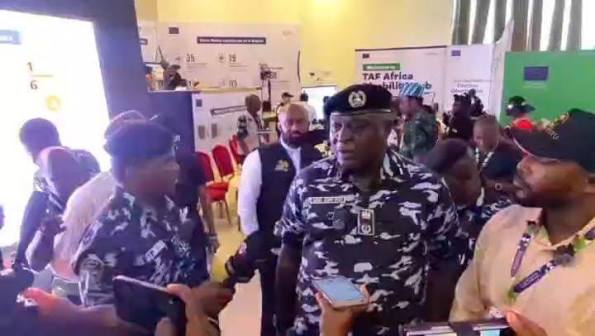
The Osun deployment has become significant for reasons that extend beyond the election itself, offering a rare window into how Nigeria assigns its most senior police officers at a time when almost every part of the country faces its own security pressures.
The Osun State governorship election was always expected to attract an unusually heavy security presence. Elections in Nigeria have too often been accompanied by ballot snatching, political violence and voter intimidation, making preventive deployment one of the principal responsibilities of the Nigeria Police Force.
What few anticipated, however, was the sheer concentration of senior police leadership that would accompany the exercise.
Officially, the Force confirmed the deployment of a Deputy Inspector-General of Police and about 30 Commissioners of Police to coordinate election security. Media reports also indicated that 36 Deputy Commissioners of Police and 51 Assistant Commissioners were assigned to the operation, alongside thousands of other personnel drawn from the Police and sister security agencies. For a governorship election in a state with approximately 1.9 million registered voters, the scale of the command structure was difficult to overlook.
It was that concentration—not merely the outcome of the election—that soon became the subject of public discussion.
For critics, the deployment illustrated what they regard as an increasingly familiar dilemma in Nigerian policing: the ability to assemble overwhelming security resources for politically significant events while communities across the federation continue to grapple with kidnapping, banditry, communal violence and organised crime, often complaining of inadequate police presence and slow emergency response.
Among the most pointed observations came from columnist Festus Adedayo, who argued that the mobilisation effectively left many states without their substantive Commissioners of Police during the election weekend. His comment was intended as a criticism of the scale of the operation rather than a description of the Police’s official command arrangements, and the Force has not acknowledged that any state command was left without operational leadership. In practice, police commands continue to function through established chains of command whenever Commissioners are assigned to national duties.
That distinction, however, does not entirely answer the broader concern.
The question is not whether state commands ceased to function during the Osun election. It is whether a policing system that frequently cites shortages of manpower, equipment and operational capacity should concentrate so much of its senior leadership around a single governorship poll while security emergencies continue to unfold elsewhere.
That question acquires additional weight when viewed against Nigeria’s wider security landscape. From insurgent attacks in the North-East and banditry in the North-West to kidnappings in the North-Central, oil theft in the Niger Delta and violent crime across several urban centres, virtually every region continues to demand sustained police attention. The Force itself has repeatedly acknowledged the pressures created by limited personnel and expanding security responsibilities.
Supporters of the deployment argue that elections are unlike ordinary policing operations. The consequences of electoral violence can be profound, undermining public confidence in democratic institutions and triggering wider instability. From that perspective, assigning an exceptional number of senior officers to Osun was not an extravagance but a precaution intended to ensure that the election passed without serious incident.
Critics see the matter differently. They contend that the operation reflected a pattern in which the state’s most visible security assets are marshalled for political events while communities facing persistent criminal violence rarely witness a comparable concentration of command attention. Whether that comparison is entirely fair remains open to debate, but it is one that the Osun deployment has once again brought into sharp focus.
Long after the campaign banners have been removed, the enduring image may not be of the votes that were cast, but of the remarkable assembly of senior police commanders in a single state. In a country where every Commissioner of Police oversees communities confronting their own security challenges, the deployment has left behind a question that extends well beyond Osun: How should a nation with finite policing resources decide where its most experienced officers are needed most?