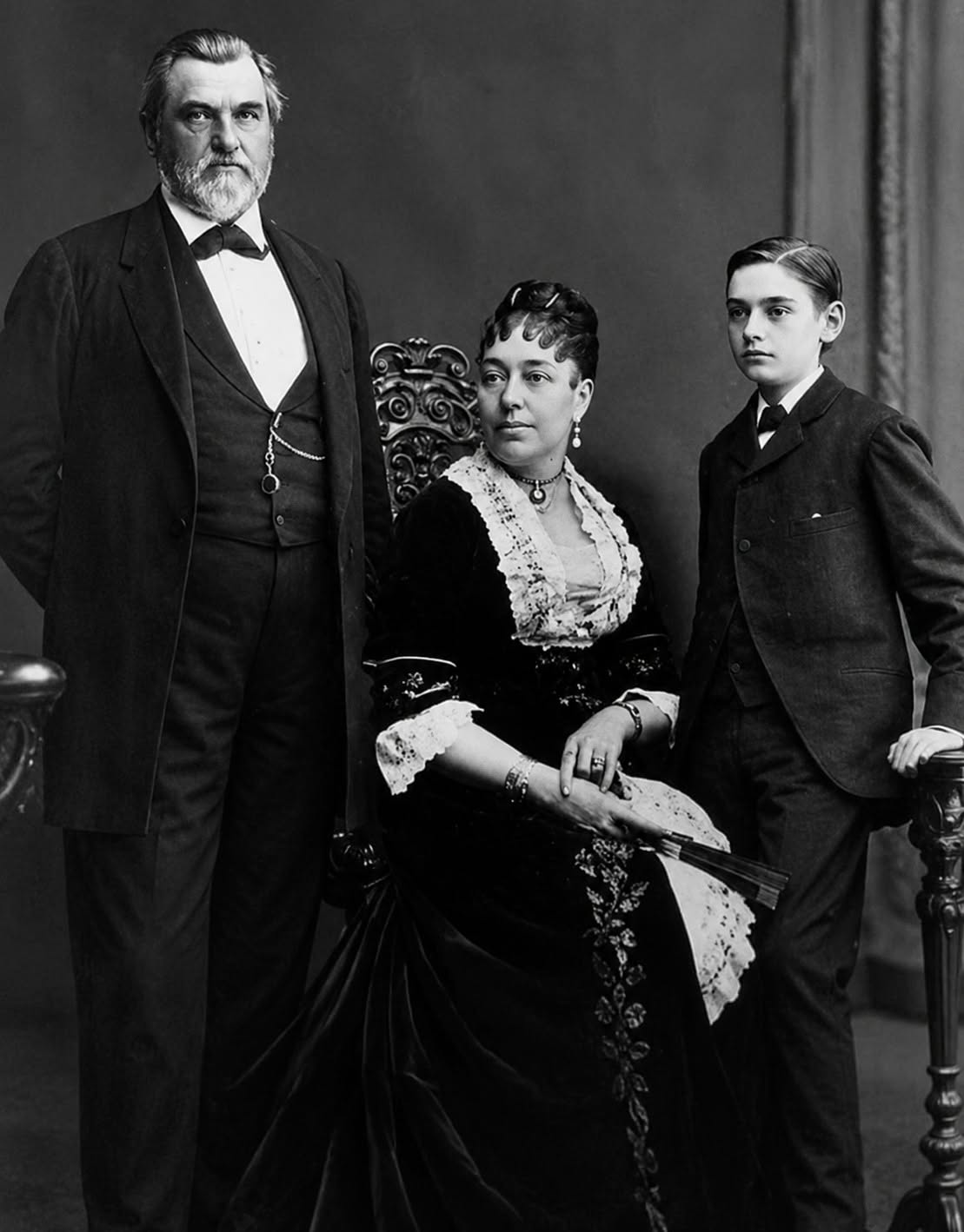
On a spring day in Florence in 1884, one of America’s richest families lost the only fortune that truly mattered.
Fifteen-year-old Leland Stanford Jr., the only child of railroad magnate, former California Governor and United States Senator Leland Stanford and his wife, Jane, died of typhoid fever while travelling through Europe with his parents. They had crossed the Atlantic to broaden their son’s education. Instead, they found themselves preparing for his funeral in a foreign country.
No amount of wealth could alter the outcome. The vast fortune that had built railroads across a continent and transformed the Stanfords into symbols of America’s Gilded Age proved powerless against disease.
For many families, such a tragedy might have ended in private grief and a monument of stone. The Stanfords chose something altogether different.
According to Stanford University’s own historical records, the grieving father turned to his wife after their son’s death and declared: “The children of California shall be our children.”
It was more than an expression of sorrow. It became the foundation of one of the world’s most influential universities.
Rather than preserve their son’s memory with statues or memorials, the couple decided to devote their immense fortune to educating generations of young people they would never meet. Their grief became a public trust.
The decision was extraordinary not only because of its scale but because it challenged many assumptions about higher education in nineteenth-century America.
When Leland Stanford Junior University opened on October 1, 1891, on the family’s 8,180-acre Palo Alto ranch, it was conceived as a co-educational, non-denominational institution committed to practical learning as much as classical scholarship. At a time when many prestigious universities remained socially and intellectually exclusive, Stanford sought to widen opportunity rather than preserve privilege.
The experiment was greeted with scepticism.
America’s oldest universities dominated higher education, and many doubted that a new institution established on what was then the western frontier could compete with centuries-old establishments in the East. Critics dismissed it as the expensive ambition of a railroad baron.
Events soon threatened to prove them right.
Barely two years after the university admitted its first students, Leland Stanford died. At almost the same time, the federal government pursued substantial financial claims arising from disputes connected with the Central Pacific Railroad, while the Panic of 1893 plunged the country into economic crisis. Much of the Stanford estate became tied up in litigation, leaving the infant university facing financial collapse.
Jane Stanford refused to abandon the institution that had become the living memorial to her son.
Historical accounts record that she sold personal jewellery, mortgaged property and used private resources to keep the university operating while contesting the legal claims against the estate. Faculty salaries were paid, students remained in classrooms and the institution survived one of the most precarious periods in its history largely because of one widow’s determination that her son’s legacy would not disappear with the family’s fortune.
The challenges did not end there. Stanford endured financial hardship, a typhoid outbreak in the early twentieth century and the devastating 1906 San Francisco earthquake, which destroyed several of its earliest buildings. Yet the institution continued to grow.
Few could have imagined where that journey would lead.
During much of its early history, Stanford was regarded as a respected regional university rather than a global academic power. The transformation gathered momentum in the decades after the Second World War, when partnerships between researchers, entrepreneurs and industry helped lay the foundations of what would become Silicon Valley.
The university’s graduates and faculty would later help establish or shape companies such as Hewlett-Packard, Intel, Sun Microsystems, Yahoo, Google, Netflix and Instagram, while Stanford scholars and alumni accumulated Nobel Prizes, pioneered medical advances, transformed engineering and reshaped the digital economy.
None of that could have been foreseen in Florence in 1884.
The Stanfords were not trying to build a technology powerhouse, launch a global innovation ecosystem or influence the future of artificial intelligence. They were responding to the oldest and most personal of human experiences: the loss of a child.
That is perhaps the most enduring lesson of Stanford’s founding.
History often celebrates institutions through their rankings, famous graduates or financial endowments. Yet the university’s origins remind us that some of humanity’s greatest achievements begin not with ambition but with compassion; not with the pursuit of prestige but with the determination that personal tragedy should become public good.
The story also corrects one of higher education’s most persistent myths. Contrary to the popular tale that the Stanfords founded their university after being rudely dismissed by Harvard, historians have found no evidence that such an encounter occurred. The real history is far more remarkable. Stanford University was not born from wounded pride or institutional rivalry. It emerged from two parents who decided that if they could no longer shape the future of their own son, they would help shape the futures of countless others.
More than a century later, that decision continues to echo across the world.
Thousands of students still arrive each year on the land where Leland Stanford Jr. once rode horses as a boy. They study, innovate, argue, discover and dream, often unaware that the university exists because one family refused to allow grief to become an ending.
Today, Stanford’s influence extends far beyond California. Its faculty and alumni have received dozens of Nobel Prizes, its research has transformed medicine, engineering and computer science, and its graduates have helped build companies that define the modern age. Yet none of those achievements was the original objective.
The university began with a simpler conviction: that education could become the most enduring memorial a parent could leave behind.
The Stanfords lost the future they had imagined for one child. In its place, they created opportunities for millions.
Few monuments have ever spoken so quietly—or lasted so long.