“Never give in. Never give in. Never, never, never…” Winston Churchill’s famous words could well have been written for Bob Dole.
On April 14, 1945, a 21-year-old American lieutenant lay motionless on an Italian hillside, convinced his life was over.
German machine-gun fire had ripped through his body. His right shoulder was shattered. His neck and spine were badly damaged. His arm hung limp. Blood soaked his uniform as the battle raged around him.
For hours, he drifted in and out of consciousness, waiting for medics who could not reach him because the fighting was too intense.
Some believed he would not survive. A fellow soldier injected him with morphine and reportedly marked an “M” on his forehead—in blood—to prevent anyone from administering a second, fatal dose.
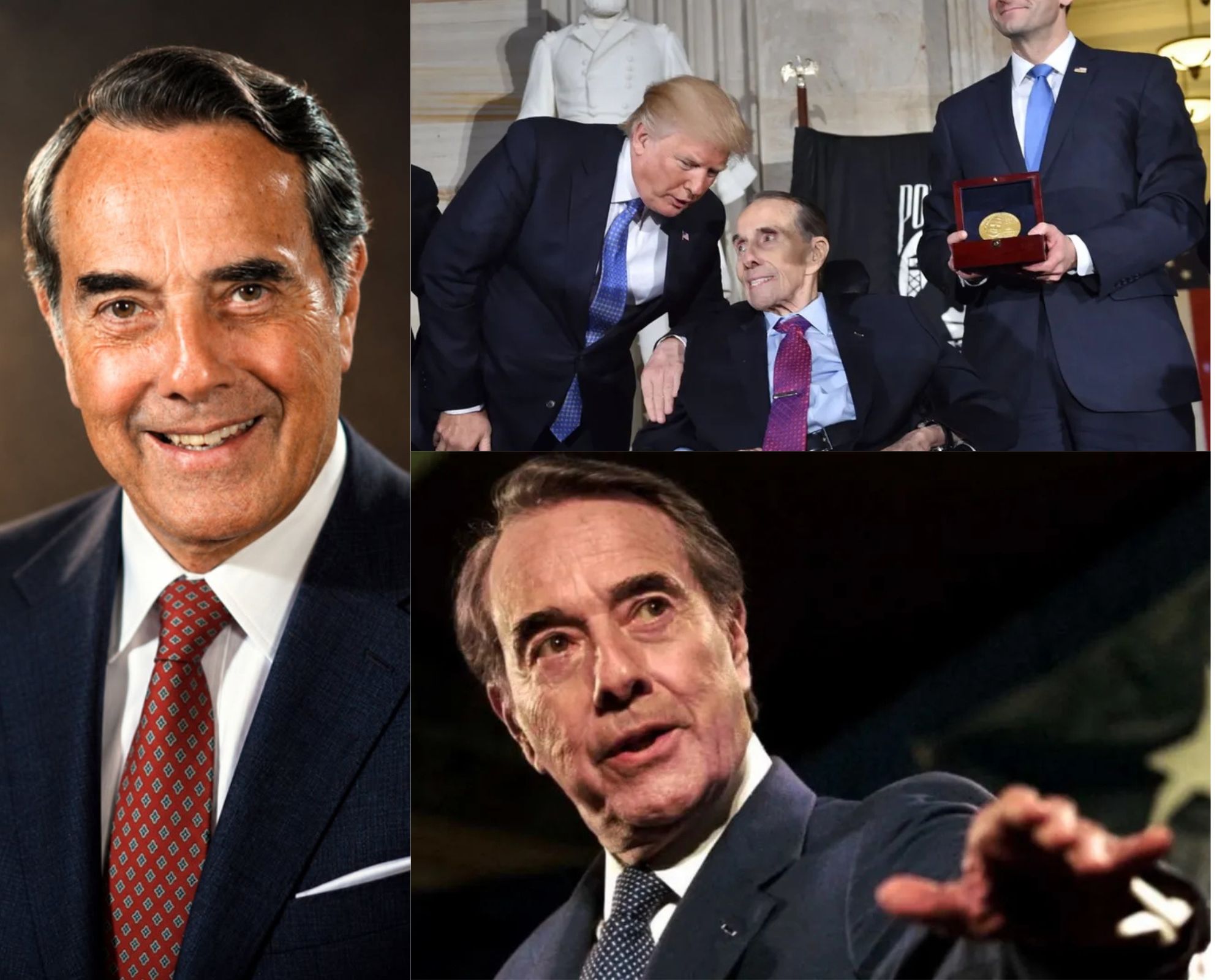
That young officer was Robert Joseph “Bob” Dole.
Few would have imagined that the broken soldier abandoned on a battlefield in northern Italy would one day become one of America’s most influential lawmakers and the Republican Party’s presidential nominee.
His survival was remarkable. His comeback bordered on extraordinary.
Doctors doubted he would ever regain anything resembling a normal life. He spent nearly three years in hospitals, enduring repeated surgeries, infections and painful rehabilitation. His right arm never fully recovered. Everyday tasks became daily reminders of what war had taken from him.
Yet Bob Dole refused to allow injury to define him.
Instead of surrendering to bitterness, he reinvented himself.
Back home in Kansas, the former athlete who had once preferred basketball courts to classrooms buried himself in books while recovering. Unable to hold them comfortably, he projected pages onto the ceiling above his bed and read for hours, consuming history, philosophy and the writings of Abraham Lincoln.
He studied law, painstakingly recording lectures because writing was difficult, then transcribing them left-handed through the night.
The obstacles never disappeared. He simply learned to outwork them.
Politics beckoned.
From the Kansas legislature to the House of Representatives and then the United States Senate, Dole steadily built a reputation for discipline, pragmatism and resilience. He would eventually spend decades in Congress, rise to become the Senate Republican leader and earn respect across party lines for his willingness to negotiate and forge bipartisan agreements.
His war injuries remained with him for life.
Many Americans noticed that he often carried a pen in his weakened right hand. It was not a stylistic flourish. The pen discouraged well-meaning strangers from extending painful handshakes that his damaged arm could not comfortably manage.
Behind that simple gesture lay a daily reminder of a battlefield that almost claimed his life.
In 1996, at the age of 73, Dole finally secured the Republican nomination for President of the United States.
He ultimately lost to the incumbent, Bill Clinton, but by then his candidacy symbolised something larger than electoral victory. A man once expected to spend the rest of his life disabled had climbed to the highest levels of American public life.
His greatest victory may never have been political.
It may have been the decision, made consciously or instinctively, not to surrender after April 1945.
Many who endure catastrophic setbacks spend the rest of their lives defined by tragedy. Dole chose a different path. He acknowledged his scars without allowing them to become excuses. He accepted his limitations without permitting them to limit his ambition.
His life became an enduring lesson that resilience is less about avoiding hardship than refusing to let hardship have the final word.
Even in retirement, Dole remained active in public affairs, offering counsel to younger leaders and lending his voice to causes close to his heart, including disability rights and veterans’ welfare. He accepted honours with characteristic humour, once joking after receiving a promotion from captain to colonel decades after the war that he had been perfectly happy as a captain because “it pays the same.”
When he died in December 2021 at the age of 98, after a lifetime that included military service, legislative leadership and a presidential campaign, tributes poured in from allies and opponents alike.
They celebrated the senator, the statesman and the candidate.
But perhaps the defining image of Bob Dole remains that young lieutenant lying wounded on a distant hillside in Italy, his future seemingly extinguished before it had properly begun.
Most would have seen only despair.
He saw another chance.
And for the next 76 years, he spent it proving that defeat is not determined by what knocks a person down, but by whether they choose to rise again.
In an age that celebrates instant success, Bob Dole’s story reminds us that greatness is often forged in pain, tempered by perseverance and revealed only to those who refuse to quit.
Churchill urged the world never to give in.
Bob Dole spent nearly a century showing what that looks like.