By Mojúbàolú Olufúnké Okome
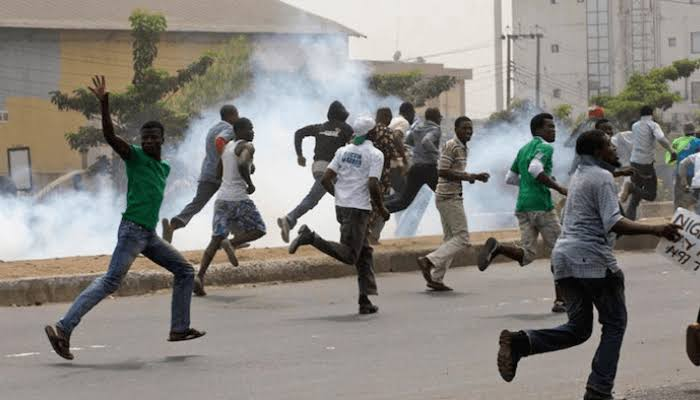
I tend to write long papers, and make long, complex explanations that may bore most. Here’s an attempt to be brief, distilled from a L-O-N-G paper. I first wrote about this matter in the early years of this century. However, many Nigerians at the time never saw any sense in paying attention. I wonder why we think that ignoring a matter would make it go away. We are now forced to contend with rampant insecurity, dreadful and growing poverty, causing escalating inequality. Maybe now we will get serious and realize that no one is coming to save us. The political class are also culpable because they are figuratively fiddling while our Rome burns.
Let me give you the full idea. I edited a book that was published by Palgrave in 2013. The paper, was written for a conference”: “‘(Un)civil Society’? State Failure and the Contradictions of Self-Organisation in Nigeria,” May 14–17, 2005, sponsored by the Heinrich Böll Foundation and organized by Axel Harneit-Sievers. The conference focused on the conceptual and practical meanings of “uncivil society,” and many of the papers presented considered the extent to which Nigeria was a failed state.
But this book presents the argument that while those conceptual explorations remain valid for scholars of Nigerian and African politics, it is also important to more deliberately interrogate and contextualize “uncivil society” and state failure, rather than accept them at face value. The “uncivil society” concept included key aspects like:
• Context of the Discussion: The concept is explored through the lens of state-society relations, particularly when the state fails to meet the needs of its people. It is used to analyze scenarios where civil society, or elements within it, act in ways that are destructive or against democratic principles.
• Key Publications/Work: I edited Contesting the Nigerian State: Civil Society and the Contradictions of Self-Organization. I also authored “A Cause for Alarm: The State, Human Security and National Security in Nigeria,” a paper first presented in January 2015 to the UI Masters students in Strategic Studies which discusses these themes.
• Focus on Nigeria: The work focuses on the contradictions in Nigeria, where, despite democratic transitions, the state often struggles to maintain security and uphold civil liberties, leading to “uncivil” actions by both state and non-state actors.
• Relevance: The work highlights discussions about state fragility, the role of militias, and political instability.
Here’s a powerpoint created with NotebookLM on the same subject.
Insurgency, State Fragility, and Human Security in Nigeria: A Comprehensive Analysis
Mojúbàolú Olufúnké Okome
Professor of Political Science, African & Women’s Studies
Brooklyn College, CUNY
Summary
This paper analyzes Nigeria’s interlocking crises of state fragility, insurgency (primarily Boko Haram and newer groups like Lakurawa), and human security failure. The author argues that Nigeria is not a “failed state” but a fragile one — a distinction that preserves the possibility of improvement. The paper traces the structural roots of insecurity, evaluates the weakness of state and civil society responses, and proposes both immediate and long-term policy interventions.
Key Takeaways
- Nigeria is a fragile state, not merely a failed one. Despite having Africa’s largest economy, it ranks very low on the Human Development Index and consistently fails to fulfill its constitutional obligation to protect citizens from want and fear.
- Boko Haram is a symptom, not the cause. The insurgency exploits structural problems rooted in British colonialism, extreme poverty, weak governance, and a North-South divide — not a sudden or isolated breakdown.
- The security crisis has worsened and diversified. Beyond Boko Haram, new threats like Lakurawa — a jihadist group affiliated with the Islamic State Sahel Province — have emerged, exploiting ungoverned border areas in Sokoto and Kebbi states. Banditry, kidnapping, and mass school closures have spread across multiple regions.
- The humanitarian toll is staggering. An estimated 300,000 killed since 2009, 3 million displaced, 18–20 million children out of school, and 133 million Nigerians living in multidimensional poverty — with the worst concentrated in the Northwest and Northeast.
- Military failure is rooted in corruption. Despite a £4 billion annual defense budget, the military was repeatedly outgunned by Boko Haram. Massive embezzlement of defense funds went unaddressed, and 54 soldiers were sentenced to death for mutinying rather than confront Boko Haram.
- Government response has been deeply inadequate. President Jonathan failed to visit Chibok after the girls’ abduction, spread misinformation calling activists unpatriotic, and prioritized electioneering over security. The paper is equally critical of President Tinubu leaving Nigeria days after U.S. airstrikes on Christmas Day 2025 without public explanation.
- Civil society response has been weak and fragmented. The #BringBackOurGirls movement kept the issue alive but was poorly resourced and politically marginalized. Religious institutions largely urged passivity (prayer over protest), and most Nigerians outside the Northeast treated the crisis as someone else’s problem.
- Economic inequality fuels extremism. Mass unemployment, grinding poverty (especially in the North), and the visible indifference of Nigeria’s wealthy elite create fertile ground for extremist recruitment.
- Foreign military intervention is not the answer. The paper argues against direct U.S. military involvement, calling instead for targeted economic sanctions, UN Special Rapporteur investigations, African Union engagement under Article 4(h), and international pressure to hold the Nigerian government accountable.
- The state must lead its own rescue. The central argument is that no foreign power can or should substitute for Nigerian state accountability. Civil society, scholars, and citizens must demand that the state fulfill its constitutional duty to protect ALL Nigerians — regardless of region, religion, or class.