Why Nigeria’s fight against terrorism now demands more than military victories—and why the legal profession can no longer remain at the margins
By Law & Society Magazine Investigations
For nearly two decades, Nigeria has responded to terrorism, insurgency and organised violence largely through military and security operations. Public debate has understandably revolved around troop deployments, intelligence gathering, aerial bombardments, arrests, rescue missions and casualty figures. Those remain indispensable elements of any serious counter-terrorism strategy. No nation confronted by armed groups can dispense with force where force is lawfully required.
Yet every prolonged security crisis reaches a point where military success alone no longer answers the questions citizens continue to ask.
Why do communities repeatedly return to the same cycle of displacement? Why do families spend years searching for relatives who disappeared without trace? Why do victims struggle to obtain recognition, participation in criminal proceedings or meaningful redress? Why do recurring institutional failures rarely produce equally visible accountability? Why do guarantees contained in the Constitution appear strongest in legal texts but weakest in places where violence has become part of everyday life?
Those are no longer operational questions. They belong squarely within the domain of law and public governance.
Throughout this series, Law & Society Magazine has examined insecurity from different perspectives. We have reported from communities emptied by violence, followed the ordeal of schoolchildren and teachers caught in abductions, explored the strategic consequences of prolonged insecurity, examined the controversy surrounding the reintegration of former insurgents, and documented the strain placed on public bodies expected to discharge their statutory duties under increasingly dangerous conditions.
Viewed together, those reports point in the same direction.
Organised violence does not merely destroy lives. It steadily tests the ability of public institutions to perform the functions for which they exist.
A Republic is measured not only by its capacity to confront armed groups but also by whether its legal and civic institutions continue to function while doing so.
Section 14(2)(b) of the Constitution provides that the security and welfare of the people shall be the primary purpose of government. The provision is quoted frequently in political debate, but its practical implications extend far beyond campaign speeches and official statements. Constitutional obligations do not diminish because they become difficult to fulfil. Periods of prolonged insecurity demand closer scrutiny of whether public authorities are meeting the standards imposed by the Constitution and by law.
Recent attacks involving judicial officers have brought that question much closer to the courts themselves.
Justice Faruku Hassan Bunza of the Kebbi State High Court was abducted from his residence, with his captors reportedly demanding a ₦200 million ransom. Days later, a Shari’ah Court judge in Katsina narrowly escaped abduction after armed men reportedly entered court premises. A year earlier, Bayelsa High Court Judge Justice Ebiyerin Omukoro regained his freedom after spending days in captivity following his abduction in Yenagoa. Each incident will ultimately be determined on its own facts. Together, however, they illustrate the pressures increasingly confronting those entrusted with administering justice.
The same pattern is visible elsewhere.
Teachers have died while protecting pupils. Engineers supervising public infrastructure projects have disappeared while carrying out official assignments. Military intelligence officers have been killed in circumstances that continue to raise difficult operational questions. Farming communities have been abandoned because residents no longer consider it safe to cultivate their land. Health workers, humanitarian personnel and traditional rulers have all confronted threats that would once have been regarded as exceptional.
No single incident defines the condition of the Republic.
Across different sectors and different parts of the country, however, insecurity is increasingly shaping the environment within which public officials perform their lawful duties. That should concern lawyers every bit as much as it concerns soldiers.
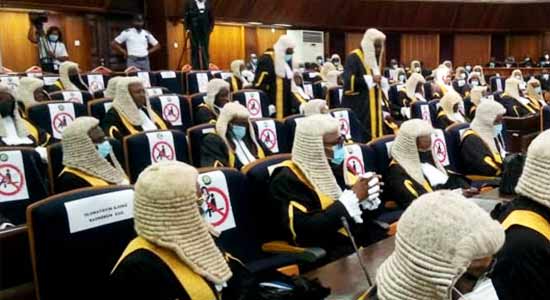
For decades, the Nigerian legal profession stood at the forefront of many of the country’s defining constitutional struggles. Lawyers challenged military decrees, defended judicial independence, expanded electoral accountability and protected fundamental rights when democratic institutions came under sustained pressure. Those achievements remain among the profession’s finest contributions because they demonstrated that the rule of law is strengthened not only through legislation and elections but also through principled legal action pursued in the public interest.
The legal profession now faces a different constitutional test.
Read Also: ENDGAME (Part III): Why terror still pays
Read Also: WHEN TERROR PAYS|The Endgame: How do you make terror stop paying?
This is not an argument for judges to supervise military campaigns or determine operational tactics. Democratic societies recognise institutional boundaries for good reason. Courts do not command troops, and security agencies do not decide constitutional disputes.
Between those responsibilities, however, lies significant legal ground that remains largely unexplored.
Across many constitutional democracies, public interest litigation has helped improve policing standards, strengthened the rights of victims, compelled compliance with statutory obligations, expanded institutional transparency and clarified the legal responsibilities of governments confronting persistent security challenges. None of those decisions replaced security agencies or dictated military strategy. They strengthened the legal framework within which public power was exercised.
Nigeria has only begun to explore those possibilities.
The organised Bar is uniquely placed to help shape that development.
Rather than limiting its engagement with insecurity to conferences, communiqués and policy discussions, the profession could pursue carefully selected public interest cases involving victims’ rights, statutory compliance, investigative standards, witness protection, compensation frameworks, institutional accountability and the enforcement of existing legal obligations. Universities, civil society organisations and specialised litigation centres can reinforce that effort through research, strategic advocacy and carefully documented evidence capable of assisting the courts.
Such work is unlikely to produce immediate results.
Neither did the constitutional litigation that gradually reshaped Nigeria’s democratic development.
Law seldom transforms public institutions overnight. Its influence is cumulative. It defines legal duties, establishes standards and gradually changes what citizens are entitled to expect from those who exercise public authority.
That is why independent courts and an independent legal profession remain indispensable to every constitutional democracy.
Throughout this series, readers have encountered parents searching for children who never returned, communities emptied by fear, schools transformed into places of mourning, villages where farming has become an act of courage, and families still seeking answers years after loved ones disappeared while carrying out lawful assignments. Those stories matter not only because they reveal human suffering, but because they expose the distance that can emerge between constitutional promise and everyday experience.
Reducing that distance cannot be left to government alone.
Nor is it a responsibility that belongs exclusively to the military.
Every institution established under the Constitution has a role to play.
The legal profession occupies a distinctive place among them because its principal instruments are neither political office nor armed force. Its influence lies in the disciplined use of the Constitution, the courts and the law to hold public institutions to the standards the Republic has set for itself.
Periods of prolonged insecurity place those standards under exceptional strain. They are also the moments when constitutional guarantees matter most.
Nigeria’s security challenges will continue to require capable security agencies, effective intelligence, political leadership and properly equipped armed forces.
They will also require something less visible but equally enduring: A legal culture prepared to insist that public power remains accountable, victims remain visible, institutions perform the duties assigned to them by law, and constitutional guarantees retain practical meaning beyond the pages of the Constitution itself.
The Constitution already provides more legal tools than Nigeria has consistently used.
Whether those tools remain largely theoretical, or become part of the country’s long-term response to organised violence, is no longer a question for government alone.
It is a challenge for the courts.
It is a challenge for universities.
It is a challenge for civil society.
Above all, it is a challenge for the organised Bar.
If this series has established anything, it is that lasting security will depend not only on reclaiming territory from armed groups, but also on strengthening the legal institutions that preserve public confidence long after the shooting stops.
That work belongs to the present generation of lawyers.
And history will record whether the profession recognised the moment when the Constitution needed its strongest defenders most.