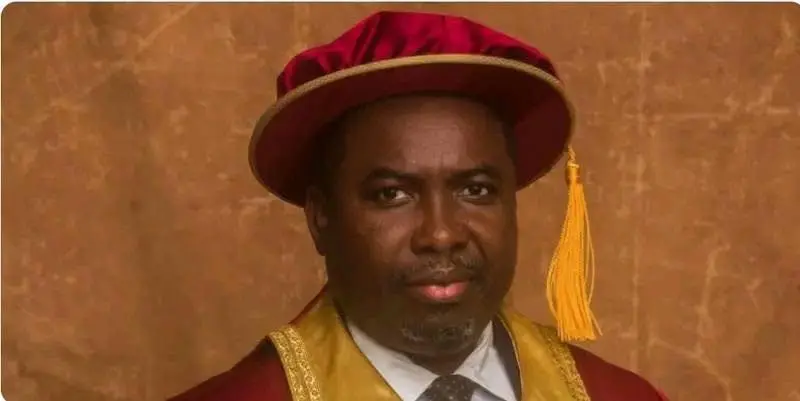
Nigeria’s electoral umpire is facing mounting scrutiny after a cybersecurity expert publicly challenged its forensic investigation clearing its chairman, Joash Amupitan, of links to a controversial social media account.
The Independent National Electoral Commission (INEC) had announced plans to track down and prosecute individuals behind what it described as a fake X (formerly Twitter) account impersonating Amupitan. The commission said a “multi-layered forensic investigation” found no evidence tying the chairman to the account, dismissing viral posts attributed to him as fabricated and “technically impossible.”
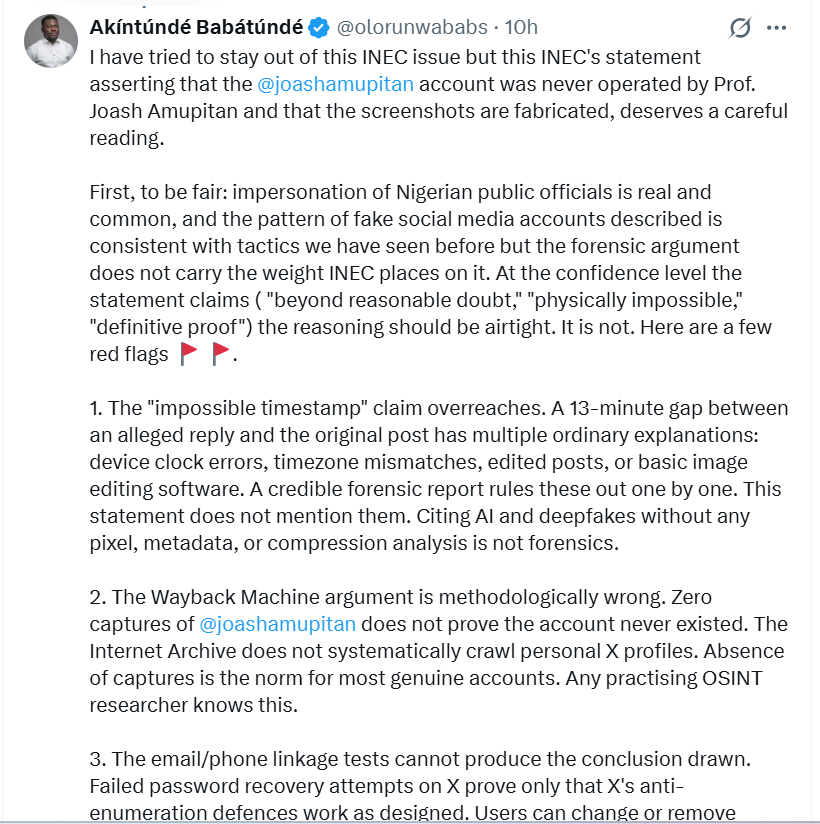
But in a detailed critique posted on X, cybersecurity analyst Akíntúndé Babátúndé argued that INEC’s conclusions “do not carry the weight” the commission claims, raising questions about the robustness—and credibility—of the findings.
“At the confidence level the statement claims—‘beyond reasonable doubt,’ ‘physically impossible,’ ‘definitive proof’—the reasoning should be airtight. It is not,” Babátúndé wrote.
Forensic Claims Under Pressure
At the center of INEC’s defense is a timestamp discrepancy: the commission said one alleged reply appeared 13 minutes before the original post it referenced—proof, it argued, that the content was fabricated using artificial intelligence.
Babátúndé pushed back, calling that conclusion premature.
He argued that such discrepancies could stem from routine technical issues, including timezone mismatches, device clock errors, post edits, or even basic image manipulation. “Citing AI and deepfakes without any pixel, metadata, or compression analysis is not forensics,” he said.
The analyst also challenged INEC’s reliance on the Wayback Machine, noting that the absence of archived records does not prove an account never existed. “The Internet Archive does not systematically crawl personal X profiles. Absence of captures is the norm,” he wrote.
Questions Over Digital Evidence
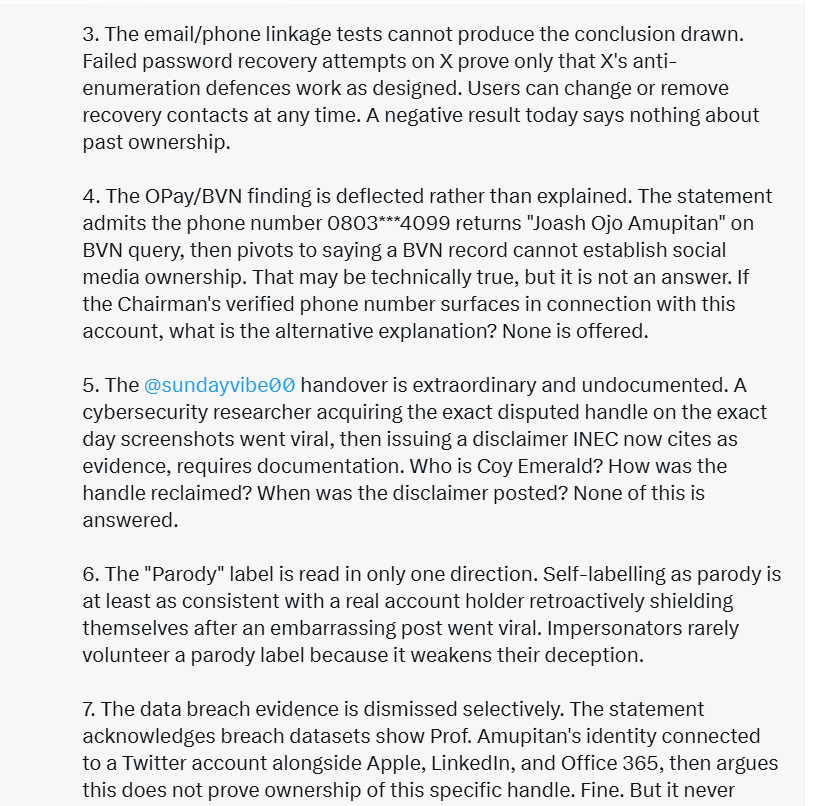
INEC further argued that password recovery tests showed no link between the disputed account and Amupitan’s known email or phone number. But Babátúndé said such tests are inconclusive, since users can change recovery details at any time.
He also highlighted a key inconsistency: a phone number associated with Amupitan reportedly appeared in bank verification (BVN) checks connected to the controversy.
“If the chairman’s verified phone number surfaces in connection with this account, what is the alternative explanation?” he asked. “None is offered.”
The commission’s explanation of the account’s sudden transformation—from @joashamupitan to @sundayvibe00—also drew scrutiny. INEC described the change as a “damage-control tactic” by an impersonator, noting the account was locked and relabeled as a parody.
Babátúndé, however, said the timeline raises fresh questions. “A researcher acquiring the exact handle on the exact day screenshots went viral requires documentation. Who is behind it? How was it obtained? That chain of custody is missing.”
“Liar’s Dividend” and the AI Defense
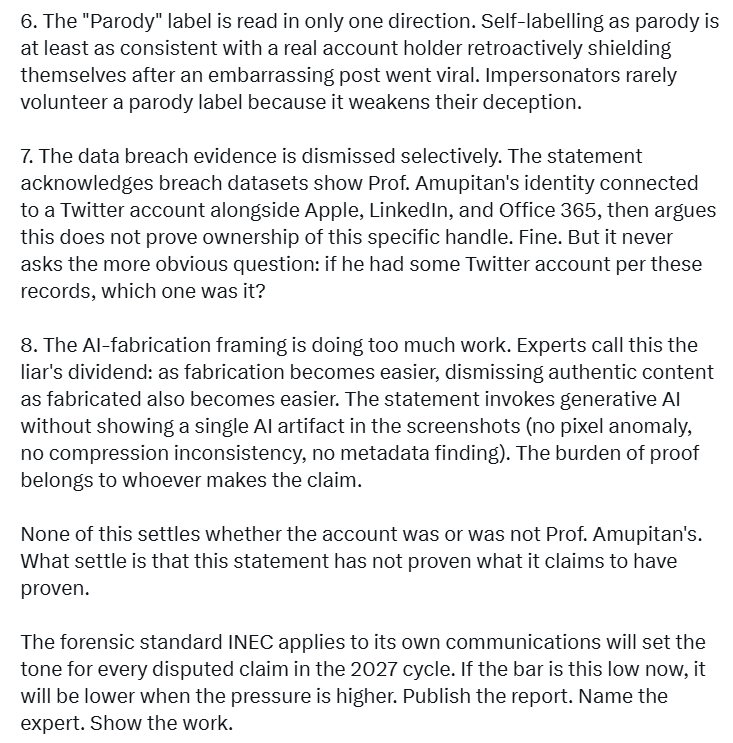
The analyst further warned against what he described as the overuse of artificial intelligence as a blanket explanation.
Invoking the concept of the “liar’s dividend”—where genuine content can be dismissed as fake in an era of deepfakes, he argued that INEC risks undermining trust by making sweeping claims without verifiable technical evidence.
“The statement invokes generative AI without showing a single artifact,” he said.
A Broader Political Storm
The controversy comes amid growing political pressure on Amupitan, whose appointment has already drawn criticism over perceived partisanship due to his past legal work for Nigeria’s ruling party.
Prominent figures, including Chidi Odinkalu, Pat Utomi, and Femi Falana, have called for his resignation, citing concerns about the independence of the electoral body ahead of future elections.
The dispute has been further fueled by reports suggesting the existence of earlier digital footprints tied to the disputed account, including findings from independent fact-checkers indicating that the handle may have existed prior to the controversy.
INEC Stands Firm
In its official response, INEC dismissed the criticisms, insisting its investigation was “comprehensive, multi-sourced, and unambiguous.” The commission described the incident as part of a coordinated impersonation and disinformation campaign targeting its leadership.
It also warned of the growing threat posed by AI-driven misinformation and urged the public to verify content before sharing.
Meanwhile, Babátúndé has called for full transparency.
“Publish the report. Name the expert. Show the work,” he wrote.
What’s at Stake
Beyond the immediate controversy, the dispute underscores a deeper issue: trust in Nigeria’s electoral system as preparations for future elections intensify.
As Babátúndé put it, the standards INEC applies now “will set the tone for every disputed claim” in the next election cycle.
Read the tweets below……………………………..